Feeds:
Posts
Comments

Archive for the ‘About’ Category

ClusterStock has an article by John Carney, How Ignorant Are Shareholders?, in which he argues that the financial crisis has “dealt a serious blow” to the “idea that corporate governance reforms that empower shareholders to direct the activities of corporations would make companies more financially responsible.” We think John’s got it wrong, but before we begin our rant, let us just say that there is much to respect about John Carney. According to his bio, he’s got a law degree from the University of Pennsylvania, and he practiced corporate law at Skadden, Arps, Slate, Meagher & Flom and Latham & Watkins, both of which are preeminent firms. We also almost wholly agree with his positions on plenty of contentious issues, as summarized here in his bio:

He has argued that failed banks should not be bailed out, Lehman’s collapse was not a disaster, AIG should be declared bankrupt, that naked short selling is not a problem, that backdating isn’t so bad, insider trading should be legal, many corporate CEOs are underpaid, global solutions are worse than local solutions, Warren Buffett is overrated, Michael Milken is a great American, the collapse of the hedge fund was not a scandal, hedge funds are over-regulated, education is overrated by the educated, bonuses at successful Wall Street’s firms are deserved and possibly undersized, management buyouts are boons to the economy, Enron’s management was victimized by an over-zealous prosecution, Sarbanes-Oxley should be repealed, corporate compliance culture is a disaster, shareholder democracy is overrated, hostile takeovers ought to be revived, the market is permanently moving away from public ownership of equity in corporations, private partnerships are on the rise, public ignorance is encouraged and manipulated by governments and corporations, experts overrate expertise, regulatory agencies are controlled by the businesses they supposedly regulate and Wall Street is much more fun than people give it credit for.

He’s trained in the dark arts of the law and he’s practiced with the best. In other words, he should know better.

John’s premise is that financial companies that score highest on most measures of corporate governance performed poorly during the crisis. He argues that shareholders are ignorant, and giving them more say in the management of a company is like tossing the car keys to a blind man and jumping in the back seat:

In political science, the roles of irrationality and public ignorance are well understood. Studies going back decades prove that the public is not only ignorant, it is stubbornly ignorant. It remains ignorant even in the face of widely available and easily obtainable information. Voters are so ignorant that they cannot rationally choose between different programs offered by politicians. And the ignorance persists so that they cannot assign blame or credit to the parties responsible for the programs that are ignorantly selected.

If economists were to take this seriously and apply it to shareholder behavior, they might discover that the case for shareholder democracy is seriously undermined. Instead, many continue to doubt that shareholder ignorance is a serious problem. And those who acknowledge it could be a problem, often assume it can be overcome by providing shareholders with more information. This simply ignores what we’ve learned in political science about shareholder ignorance.

Now, we don’t disagree that many shareholders are ignorant. It’s well known that many don’t read disclosure documents, and many can’t read financial statements. We’ve also argued previously that even those who do read financial statements often ignore important parts of those financial statements, like the balance sheet. Our own About Greenbackd page argues that there are opportunities for investors focused on the balance sheet, because many investors are mesmerized by earnings and totally ignore assets. Where earnings understate the asset value, this creates an opportunity for investors like us. No, we don’t disagree that many shareholders are ignorant. In fact, we rely on that ignorance to make our living.

The point at which we diverge from John is his contention that this ignorance precludes a shareholder from voting. We don’t allow shareholders to vote because that is the best way to manage a company. Shareholders vote because it is their right to do so. A share is nothing more than a bundle of rights: A right to a dividend, a right to a share of the assets on a winding up, a right to a say in the affairs of the company on certain issues, a right to determine who directs the affairs of the company. They are property rights, and standing is accorded to the holder to enforce those rights.  The board, and, indirectly, the officers of the corporation, serve at the pleasure of the shareholders. Often a board will seek to prevent a shareholder attempting to demonstrate this last point, for example, by implementing poison pills and other shareholder unfriendly devices, but that is nothing more than an implicit recognition by the board that it is true. Voting, then, is simply a shareholder exercising one of their property rights. If you advance your money, we think you should get all of the attendant property rights, whether you’re ignorant or not. In this society, for good or ill, the owner of property is the person who controls its destiny. We’d argue that this is generally a good thing, and almost all progress the world over stems from this simple principle. Any attempt to sever the relationship between private property and ownership strikes right at the heart of capitalism.

So why the seeming relationship between “good corporation governance” and poor returns? Who knows, really? Statistics can be massaged to say anything. If we had to guess, without reading the paper, we’d guess that it’s a problem of definition. The phrase “good corporate governance” is at best meaningless, and at worst a smoke screen to obfuscate what it really is: an attempt by management to operate on behalf of “stakeholders” (read “parties other than shareholders”), to adhere to the “triple bottom line,” “The Equator Principles,” and other similar ideas irrelevant to shareholders. It’s no wonder that the corporation performs poorly. The board’s worried about everyone other than the owners. We’d argue that those are not proper considerations for the board. What sensible suggestions fall within the remit of “good corporate governance” are necessary only because shareholders don’t have sufficient voice in the operation of the company. They are simply unnecessary, additional regulation to paper over holes left because shareheolders are disenfranchised.

What’s the alternative? Plato’s Republic shoehorned into the corporations law? Philosopher-king CEOs? Frankly, the thought makes us gag. No, the real alternative is shareholder enfranchisement. Force the stewards of capital – the boards and officers – to recognize the rights of shareholders – the rightful owners of that capital. Ensure that shareholders are properly able to deal with their property as they see fit, and to express their desires for that property to the board without restriction. Carl Icahn has prepared a good starting point in a series of essays, Capitalism Should Return to Its Roots, We’re Not the Boss of A.I.G. and It’s Up to the Shareholders, Not the Government, to Demand Change at a Company.

John concludes by calling on economists to “survey shareholders and objectively document ignorance.” There’s no need. They can be as dumb as a box of hammers, but they should still be allowed to cast their vote. If that right is taken away the key foundation of capitalism is lost, and we’re pulling our money out of the market and putting it into shot-gun shells and tinned food.

End rant.

Read Full Post »

In The growth illusion, an article appearing in the most recent Buttonwood’s notebook column of The Economist, Buttonwood argues that valuation, rather than economic growth, determines investment returns at the country level. In support of this thesis, Buttonwood highlights research undertaken by Elroy Dimson, Paul Marsh and Mike Staunton from the London Business School, which suggests that chasing growth economies is akin to chasing growth stocks, and generates similarly disappointing results. Buttonwood explains Dimson, Marsh and Staunton’s findings thus:

Over the 17 countries they studied, going back to 1900, there was actually a negative correlation between investment returns and growth in GDP per capita, the best measure of how rich people are getting. In a second test, they took the five-year growth rates of the economies and divided them into quintiles. The quintle of countries with the highest growth rate over the previous five years, produced average returns over the following year of 6%; those in the slowest-growing quintile produced returns of 12%. In a third test, they looked at the countries and found no statistical link between one year’s GDP growth rate and the next year’s investment returns.

Buttonwood posits several possible explanations for the phenomenon:

One likely explanation is that growth countries are like growth stocks; their potential is recognised and the price of their equities is bid up to stratospheric levels. The second is that a stockmarket does not precisely represent a country’s economy – it excludes unquoted companies and includes the foreign subsidiaries of domestic businesses. The third factor may be that growth is siphoned off by insiders – executives and the like – at the expense of shareholders.

William J. Bernstein discussed the phenomenon on his Efficient Frontier website in a 2006 article, Thick as a brick, in which he wrote:

In even simpler terms, just as growth stocks have lower returns than value stocks, so do growth nations have lower returns than value nations—and they similarly get overbought by the rubes.

Buttonwood discusses other research supporting Dimson, Marsh and Staunton’s findings:

Paul Marson, the chief investment officer of Lombard Odier, has extended this research to emerging markets. He found no correlation between GDP growth and stockmarket returns in developing countries over the period 1976-2005. A classic example is China; average nominal GDP growth since 1993 has been 15.6%, the compound stockmarket return over the same period has been minus 3.3%. In stodgy old Britain, nominal GDP growth has averaged just 4.9%, but investment returns have been 6.1% per annum, more than nine percentage points ahead of booming China.

Buttonwood concludes that higher valuations – determined on an earnings, rather than asset basis – lead to lower returns:

What does work? Over the long run (but not the short), it is valuation; the higher the starting price-earnings ratio when you buy a market, the lower the return over the next 10 years. That is why buying shares back in 1999 and 2000 has provided to be such a bad deal.

It raises an interesting question for us: Can relative price-to-asset values be used to determine which countries are likely to provide the best investment returns? If anyone is aware of such research, please leave a comment or contact us at greenbackd [at] gmail [dot] com.

Read Full Post »

We’ve received some great investment ideas on this blog from our readers, and it seems a shame that they remain hidden in the comments of other posts (See, for example, Shake&Bake’s take on LDIS or Sop81_1’s analysis of EDCI). To that end, we’re extending an open invitation to anyone who wishes to submit a post for publication. The only requirement is that it be within the remit of Greenbackd, which is say that it is an undervalued asset situation with a catalyst. Email your idea to greenbackd [at] gmail [dot] com.

We have our first guest post for Friday from Wes Gray. We hope it’s the first of many.

Read Full Post »

Updated.

Megan McArdle has written an article for The Atlantic, What Would Warren Do?, on Warren Buffett and the development of value investing, arguing that better information, more widely available, will erode the “modest advantage” value investors have over “a broader market strategy” and Warren Buffett’s demise will be the end of value investment. We respectfully disagree.

The article traces the evolution of value investing from Benjamin Graham’s “arithmetic” approach to Buffett’s “subjective” approach. McCardle writes that the rules of value investing have changed as Buffett – standard bearer for all value investors – has “refined and redefined” them for “a new era”:

When Benjamin Graham and David L. Dodd wrote the value-investing urtext, Security Analysis, in 1934, the rules were more hard-and-fast. Graham and Dodd looked for companies whose price was less than their intrinsic value, and offered various formulas for divining this value.

Buying stock in firms where the intrinsic value of the assets is higher than the market capitalization worked well in the depths of the Great Depression, when investors were wary of holding equity. Between 1929 and 1932, the Dow lost just about 90 percent of its value, bottoming out at 41.22. What economists call the “equity premium”—the extra return that investors demand to compensate for the risk of holding stocks—has never since been so high. That’s why Graham and Dodd could find companies whose liquidation value offered a substantial “margin of safety” for people who bought their equity.

Moreover, book value and other balance-sheet-based metrics have become less useful, as the market, and the economy, have changed. Persistent inflation means that the historical cost of the assets on the balance sheet in many cases bears only passing resemblance to their actual worth. Meanwhile, firms get more and more of their value from intangible assets, like intellectual property or strong brands, that don’t show up in the financial statements. Geico, one of Buffett’s crown jewels, gets much of its value not from physical equipment or even investment savvy, but from a sterling brand name built on relentless advertising.

McCardle says that the rules have changed so much that Graham’s approach no longer offers any competitive advantage:

Much of what Graham and Dodd did so well was simply hard coolie labor. In an era before spreadsheets or financial databases, they looked at company reports and painstakingly did the arithmetic to see where a company stood. That effort offers no competitive advantage in today’s information-saturated market. So while value investors still hew to the core notion of determining a company’s intrinsic value, waiting for the market to misprice the stock, and then buying on the cheap, nowadays that determination has much more of a subjective skill element.

As proof of this assertion, McCardle offers this:

Well, for starters, the market still hasn’t fallen to Graham-and-Dodd levels; most of the managers I talked to groused that they were finding few real bargains. The market was irrational enough to drag down their investment results, but too rational to offer stocks at deep discounts from intrinsic value. Meanwhile, many of their potential investors had just lost half their money.

Value investors love to deride academics and the efficient-market hypothesis, but they can’t deny that stock-screening tools and other analytics have taken away many of the best bargains. At least some managers have lost the will to wait patiently for superdeals and have taken on more risk to get more return. As we walked to dinner through the soft Omaha twilight, a fund manager I had encountered at a “meet and greet” suddenly said, “The only way to make money these days is leverage.”

And my dinner companion seemed to be saying that value managers couldn’t compete with other funds without taking at least some of those bets.

McCardle concludes with the following:

Right now, the academic literature suggests that value investing has a modest advantage over a broader market strategy. Better information, more widely available, may continue to erode that edge. But the principles of prudence, patience, and thrift will always, in the end, offer a better chance at outsize returns. The question is whether, once Saint Warren passes, his followers will find the courage to stick to them.

In response, we’d like to make the following observations:

Better information, more widely available, will not erode value’s edge

There are as many different styles of value investment as there are value investors, the uniting element being an adherence to the concept of “intrinsic value,” which is simply defined as a measure of value distinct from price. Many investors describing themselves as value investors have subtly different measures of intrinsic value, from liquidation value, to asset value, to earning power, to private market value and, if the fund manager McCardle met at the twlight “meet and greet” is an indication, some of the investors wearing the “value” badge do nothing of the sort. While investors of the same stripe often coalesce around the same opportunity, there are so many different perspectives that one type (say, the liquidation value investor) could easily sell to another (say, the earning power investor), and both could be right in their assessment of the intrinsic value of the stock, and have made money in the process. This means that diffusion of information won’t cause the value opportunities to disappear, because the interpretation of that information is the key step. As Shai points out in the comments with his Klarman quote, value investment is as much about attititude as it is about intellect or access to information. Being smart, having five screens and a Bloomberg terminal won’t get you close to Walter Schloss’ record, which he achieved with a borrowed copy of Value Line working 9.30am to 4.30pm.

Buffett has not rejected Graham, and has not redefined value

Graham’s contribution was to establish the value investment framework – the concept of intrinsic value – and to describe how one could operate successfully as an investor, most notably through the concept of margin of safety. Graham discussed a number of ideas about the manner in which intrinsic value could be assessed, and was so expansive in his teaching that he left very little ground uncovered for future value investors. It is a tribute to Buffett’s genius that he was able to find new ground within Graham’s framework, which he did by blending Phil Fisher’s philosophy with Graham’s. Buffett’s divergence from Graham’s methods was not, however, a rejection of Graham’s philosophy. Buffett has said on occassions too numerous to quote that he still works within Graham’s framework and has said that his change was a function of the increasingly large sums of capital he had to invest, and not a problem with Graham’s approach. In a June 23, 1999 Business Week article, Buffett said:

If I was running $1 million today, or $10 million for that matter, I’d be fully invested. Anyone who says that size does not hurt investment performance is selling. The highest rates of return I’ve ever achieved were in the 1950s. I killed the Dow. You ought to see the numbers. But I was investing peanuts then. It’s a huge structural advantage not to have a lot of money. I think I could make you 50% a year on $1 million. No, I know I could. I guarantee that.

When asked in 2005 what his approach would be if he had to invest less than $10M, Buffett still indicated that he preferred Graham style securities. That’s not a rejection of Graham’s investment philosophy, or his approach.

Don’t bother looking for Graham-style opportunities, they’ve disappeared

Leave them all for us. If there was ever an investment style that should suffer from too many practioners, Graham’s “net current asset value” proxy for liquidation value investing is it. NCAV investing is about as simple as investing gets, and a free screen is all that an investor requires to find NCAV opportunities. Yet our research demonstrates that even this strategy continues to outperform the market. We probably can’t run a multi-billion dollar portfolio on the basis of a simple NCAV screen, but we’ll cross that bridge when we get to it. For the average investor, investing in Graham-style NCAV opportunities is all we’ll ever need. You say those opportunities have disappeared? Have a look at the screens on our blogroll. There are plenty there. When those opportunities do disappear – and they will eventually – it won’t be because of all those supercomputers chasing them, it’ll be a function of valuation. Prices go up, and prices come down. When they’re up, it’s hard to find investable opportunities, and when they come down, it’s easier to do so. It has always been thus, and it will always be so. When there aren’t many opportunities around, that’s a signal from the market. It’s telling you to wait. As a friend of Greenbackd says, “Patience can be a bitter plant, but it has sweet fruit.”

There are other value practitioners who will carry the torch forward

Klarman, Tweedy Browne, Greenblatt, Tilson, Dreman, Gabelli, Miller, Price, Whitman, Pabrai, Biglari (please insert any names I’ve forgotten into the comments) and a host of others toiling away in obscurity will carry the torch forward. Value investment is in good hands.

Read Full Post »

Bespoke Investment Group (via The Reformed Broker) has a list of the biggest gainers for 2009. It should come as no surprise to regular readers of Greenbackd that a number of the stocks are former sub-liquidation value plays (most of which we missed):

Little ten baggersWe opened a position in VNDA and got a great return. We lost our nerve with BGP and missed out on a great return. We completely ignored ATSG, DTSG, SMRT, RFMD, PIR and CHUX although all appeared on our NCAV screen at some stage earlier this year. A little more evidence that diamonds can be found if you dig through enough trash.
Read Full Post »

In the following video, legendary value investor Marty Whitman discusses Benjamin Graham’s net-net formula and his adjustments to it. We’ve previously covered those adjustments here, but we’ve added the video because we think it’s quite amazing to see the great man explaining his rationale for making them. The highlight, from our perspective, is this gem:

We do net-nets based more on common sense. As, for example, you have an asset – a Class A office building – financed with recourse finance, fully tenanted by credit-worthy tenants; That, for accounting purposes, is classified as a fixed asset, but, given such a building, you pick up the telephone and sell it, and really it’s more current than K-Mart’s inventories, for example, which is classified as a current asset. 

 Enjoy the rest of his wit below:


Read Full Post »

Catalyst Investment Research, the collaboration between Damien J. Park of Hedge Fund Solutions and The Official Activist Investing Blog, and Jonathan Heller, CFA, of Cheap Stocks, has a new Special Report on the Steel Partners II Investment Portfolio (.pdf).

In the Special Report, Damien and Jonathan analyze the Steel Partners II portfolio companies to determine which have been “unfairly impacted by the recent selloff” following Steel Partners II’s announcement that it will restructure as a publicly-traded holding company.

Damien and Jonathan describe the opportunity as follows:

Following months of litigation with several investors seeking to block the restructuring, Steel was granted Court approval to move forward with the plan on June 19. As a result, on July 15, Steel Partners distributed approximately half of the economic value of their fund via cash and a pro rata in-kind distribution of securities to those investors seeking to exit the fund immediately. Following the distribution, a number of smaller, illiquid securities observed enormous selloffs – causing a massive imbalance in supply and demand, and resulting in a precipitous decline in the market value of certain companies. We believe the dramatic reduction in value at a few of these companies is a short-term phenomenon and not correlated with the fundamental value intrinsic to the company.

Read the rest of the Special Report by clicking here (.pdf).

Read Full Post »

In Blank Checks Firing Blanks (Breakingviews.com via NYTimes.com), Lauren Silva Laughlin and George Hay write about the recent performance of blank check companies, otherwise known as special-purpose acquisition corporations or SPACs. Blank checks are shell companies that raise money from the public in order to acquire a business the identity of which is not known at the time the capital is raised. The trick is that a deal must be consumated before a certain date or the funds must be returned to the investors.

Many of the blank checks raised in 2007 are running out of time to complete an aquisition. While some 2007 SPACs did manage to seal a deal, it seems most were unable to do so because of the turmoil in the markets and were forced to liquidate:

About 40 of 66 SPACs that started in 2007 have been liquidated or will probably end up being liquidated, according to SPAC Research Partners.

It turns out that those SPACs forced to liquidate have outperformed those that actually completed a transaction:

And SPACs that sat on cash and safe investments have actually outperformed those that did deals. Take the GSC Acquisition Company, established by GSC Group, a debt-focused investment firm. The SPAC’s bosses tried to acquire Complete Energy, a power producer. But the deal wasn’t completed in time, and GSC Acquisition was liquidated last month.

Investors received around $9.80 a share in cash, just shy of the $10 they paid in its initial public offering two years earlier.

Investors in SPACs that did deals haven’t been so lucky. Shares of Aldabra 2 Acquisition Corporation, for instance, have plunged more than 75 percent since that SPAC bought Boise Cascade’s paper, packaging and transportation business and changed its name to Boise Inc. in February 2008.

From a deep value investor’s point of view, SPACs present an interesting investment opportunity. The value analysis is simple enough: Most trade at a discount to net cash. The difficulty is in assessing which will actually return the cash and which will spray it away on an acquisition. In making such an assessment, it helps to have a large activist investor sitting on the register. Cue Daniel Loeb and Third Point LLC. Third Point’s most recent 13F filing shows a number of SPACs in Loeb’s portfolio, including the following (via Market Folly):

  1. Liberty Acquisition Holdings (LIA): 11.75% of Loeb’s portfolio
  2. Victory Acquisition Corp (VRY): 5% of Loeb’s portfolio
  3. Trian Acquisition (TUX): 4.95% of Loeb’s portfolio
  4. Triplecrown Acquisition (TCW): 4.35% of Loeb’s portfolio
  5. Global Brands Acquisition (GQN): 2.4% of Loeb’s portfolio
  6. Global Consumer Acquisition (GHC): 1.8% of Loeb’s portfolio

We haven’t looked at any of these in detail, but they might present a happy hunting ground for the liquidation value investor. We’ll return to these stocks if there’s further turmoil in the market.

[Full Disclosure: We do not have a holding in any of the securities listed above. This is neither a recommendation to buy or sell any securities. All information provided believed to be reliable and presented for information purposes only. Do your own research before investing in any security.]

Read Full Post »

Avigen Inc (NASDAQ:AVGN) is back in negotiations with MediciNova, Inc. regarding a proposed acquisition of AVGN by MediciNova. The consideration for the deal is AVGN’s “net cash liquidation value plus $3 million” and “a contingent payment right for a specific product program milestone payment associated with Avigen’s Assignment Agreement with Genzyme Corporation, potentially subject to certain adjustments.”

We started following AVGN in December last year (see archived posts here) because it was a net cash stock and specialist biotechnology investor Biotechnology Value Fund (BVF) was pushing it to liquidate and return its cash to shareholders. Despite BVF’s failure to remove the board, we continued to maintain our position in AVGN because BVF won a number of important concessions from the board that made AVGN a much more attractive stock than it was when we started following it. The stock price reflects this: AVGN closed yesterday at $1.32, up 103.8% from our $0.65 purchase price. We last estimated the net cash liquidation value at around $34M or $1.14 per share. Including the $3M from MediciNova would increase that value to around $37M or $1.24 per share. We believe that there is a reasonable chance that AVGN will yield more than its current $1.32 share price when the “contingent payment right” capturing the near term payments from Genzyme is taken into account. AVGN shareholders also have an option-like exposure to any value in AVGN’s AV411 assets and program, although we cannot estimate the value of this with any certainty.

The press release from AVGN regarding the business combination with MediciNova is set out below:

MediciNova and Avigen Confirm Understanding for Key Terms for a Business Combination

SAN DIEGO and ALAMEDA, Calif., June 25, 2009 (GLOBE NEWSWIRE) — MediciNova, Inc., a biopharmaceutical company that is publicly traded on the Nasdaq Global Market (Nasdaq:MNOV – News) and the Hercules Market of the Osaka Securities Exchange (Code Number:4875), and Avigen, Inc. (Nasdaq:AVGN – News), a biopharmaceutical company, today announced that they have confirmed their understanding of certain key terms for a proposed acquisition of Avigen by MediciNova that would combine the companies’ broad neurological clinical development programs based on ibudilast (Avigen’s AV-411 and MediciNova’s MN-166).

MediciNova and Avigen currently contemplate that the terms of the merger would provide that Avigen shareholders receive consideration approximating Avigen’s net cash liquidation value plus $3 million. Avigen shareholders would be able to elect to receive this consideration in cash at closing or to receive a convertible security by which that cash consideration may be converted into MediciNova stock at a conversion price equal to the greater of $4.00 or a mutually agreeable volume-weighted average price of MediciNova common stock. At the end of 18 months, any unexercised convertible securities would be paid out at their cash value. This would allow shareholders of both companies the opportunity to participate in the future value created by combining the companies’ product portfolios. In addition to the consideration above, all Avigen shareholders would receive a contingent payment right for a specific product program milestone payment associated with Avigen’s Assignment Agreement with Genzyme Corporation, potentially subject to certain adjustments.

Yuichi Iwaki, M.D., Ph.D., MediciNova’s President and Chief Executive Officer, said, “We are excited to announce this important step towards a potential acquisition of Avigen and believe that the proposed merger presents clear advantages for the shareholders of both companies, most notably, the ability to more fully take advantage of the opportunities that the ibudilast compound and analogs provide in a variety of indications and markets. We look forward to finalizing definitive documentation as expeditiously as possible and to presenting this transaction for shareholder approval in due course.”

“Avigen believes the proposed merger on the terms currently contemplated would be in the best interests of our shareholders and we intend to continue to negotiate with the goal of reaching agreement on all of the terms and presenting it to our shareholders for approval in the third quarter of 2009,” commented Andrew Sauter, Avigen’s Chief Executive Officer, President and Chief Financial Officer. “We believe that combining our ibudilast programs, AV411 and MN-166, would enhance the global development potential for the compound in a range of neurological indications, including Multiple Sclerosis, neuropathic pain and drug addiction.”

The understanding reached by the parties is nonbinding and subject to definitive documentation and due diligence. The closing of any proposed merger would also be subject to customary closing conditions, including required shareholder and regulatory approvals and the absence of material adverse changes. MediciNova and Avigen are not legally obligated to continue discussions regarding the proposed transaction on the terms described herein or on any other terms. No definitive agreements have been reached, and there can be no assurances that definitive agreements will be successfully negotiated, that the proposed terms will not be revised or that the proposed merger will be completed.

[Full Disclosure: We have a holding in AVGN. This is neither a recommendation to buy or sell any securities. All information provided believed to be reliable and presented for information purposes only. Do your own research before investing in any security.]

Read Full Post »

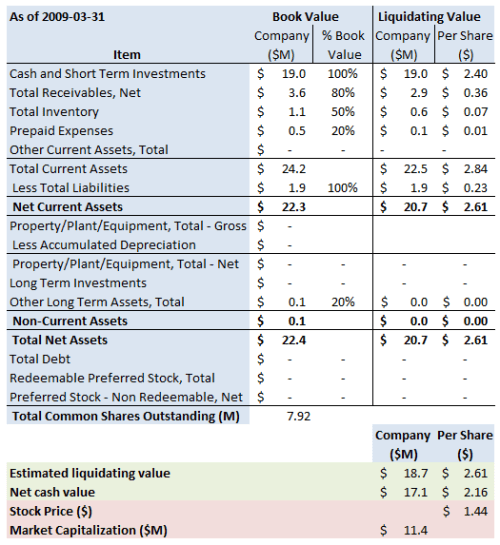
Forward Industries Inc (NASDAQ:FORD) is a new position for us. We haven’t deviated from our love of deep value (it’s trading at a discount to net cash and liquidation value), but there’s no obvious catalyst in the stock at this stage. Management appears to be considering a “strategic transaction” of some kind, although this might include an “acquisition or some other combination.” At its $1.44 close Friday, FORD has a market capitalization of $11.4M. We estimate the liquidation value to be around 60% higher at $18.7M, or $2.60 per share. Trinad Management did have an activist position in the stock, but has been selling recently and only one stockholder owns more than 5% of the stock. We’re attracted to it because it looks cheap, and we think the elements are in place for a catalyst to emerge, so we’re adding it to the Greenbackd Portfolio.

About FORD

FORD designs, markets, and distributes “custom-designed, soft-sided carrying cases and other carry solutions products made from leather, nylon, vinyl, and other synthetic fabrics.” The cases and other products protect “portable electronic devices such as medical devices and cellular phones.” It sells directly to original-equipment-manufacturers in Europe, the “APAC Region,” and the Americas and to retailers and distributors in the United States, Canada, and Europe. It has been in operation since 1961.

The value proposition

FORD has been confronted with blustery headwinds over the last four years. FORD management write in the most recent 10Q (for the year ended March 31, 2009) that “deteriorating economic conditions, rising unemployment, tight credit markets, and heightened uncertainty in financial markets” has “adversely impacted discretionary consumer spending, including spending on the types of electronic devices that are accessorized by [FORD’s] products. [FORD’s management] expect this challenging business environment to continue in the foreseeable future.” Revenues are down from $50M+ in 2005 to less than $20M this year. The drop in net income has been even more precipitous, from a profit of $12M in 2005 to a loss of $1.1M in the most recent quarter, bringing the loss for the last 12 months to around $1.9M. Despite this, FORD still had around $19M of cash and equivalents at the end of March (the “Book Value” column shows the assets as they are carried in the financial statements, and the “Liquidating Value” column shows our estimate of the value of the assets in a liquidation):

FORD SummarySummary balance sheet adjustments

We’ve made the following adjustments to the balance sheet estimates (included in the valuation above):

  • Cash burn: We’ve got no real idea about FORD’s prospects. Its cash burn over the last 6 months has been around $0.8M. That was made up of a net loss of $1.3M, reduced by $0.6M for non-cash items, and changes in working capital items of $0.1M. Accounts payable decreased $0.6M, which had the effect of contributing to the net cash used by operating activities. If we assume, as management has, that the company will face a similarly tough operating environment over the next 12 months, we estimate cash burn of around $2M.
  • Off-balance sheet arrangements: According to FORD’s most recent 10Q, it has no off-balance sheet arrangements.
  • Contractual obligations: FORD’s contractual obligations are minimal, totalling $0.6M.

After making the adjustments above, we estimate FORD’s liquidation value at around $18.7M or $2.60 per share.

Possible catalysts

FORD’s President and Acting Chairman, Mr. Doug Sabra, said in the letter to FORD shareholders accompanying the notice of annual shareholders’ meeting, that in 2008 “management began to implement operational and strategic initiatives in order to put [FORD]’s business on a stronger, more sustainable footing. …  This past August we retained an outside consultant to assist us in vetting possible partners for a strategic transaction.” It seems that the “strategic transaction” might include a “possible acquisition or other combination that makes sense in the context of [FORD’s] existing business, without jeopardizing the strong financial position that we have worked so hard to build.” FORD’s focus on a “strategic transaction” is a positive, in our view, although our vast preference is for a sale of the company, buyback, special dividend or return of capital over an acquisition.

Any transaction will require the consent of FORD’s board. While it has a free float of around 92%, the company’s so-called “Anti-takeover Provisions” authorize the board to issue up to 4M shares of “blank check” preferred stock. From the 10Q:

The Board of Directors has the authority and discretion, without shareholder approval, to issue preferred stock in one or more series for any consideration it deems appropriate, and to fix the relative rights and preferences thereof including their redemption, dividend and conversion rights.

Conclusion

At its $1.44 close Friday, FORD is trading at a substantial 60% discount to its $2.60 per share liquidation value and $2.16 per share net cash value. While there’s no obvious catalyst in the stock at this stage, management’s consideration of a “strategic transaction” is a positive. The risk to this position is management spending the cash on an acquisition. We think a far better use of the company’s cash is a buyback, special dividend or return of capital. Another concern is Trinad Management exiting its activist position in the stock. Those concerns aside, we’re attracted to FORD because it looks cheap at such a discount to net cash. We’re adding it to the Greenbackd Portfolio.

FORD closed Friday at $1.44.

The S&P500 Index closed Friday at 940.38.

Hat tip PP.

[Full Disclosure:  We do not have a holding in FORD. This is neither a recommendation to buy or sell any securities. All information provided believed to be reliable and presented for information purposes only. Do your own research before investing in any security.]

Read Full Post »

« Newer Posts - Older Posts »