Feeds:
Posts
Comments

Archive for the ‘Net Quick Value’ Category

Continuing the quantitative value investment theme I’ve been trying to develop over the last week or so, I present my definition of a simple quantitative value strategy: net nets. James Montier, author of the essay Painting By Numbers: An Ode To Quant, which I use as the justification for simple quantitative investing, authored an article in September 2008 specifically dealing with net nets as a global investment strategy: Graham’’s net-nets: outdated or outstanding? (Edit: It seems this link no longer works as SG obliterates any article ever written by Montier). Quelle surprise, Montier found that buying net-nets is a viable and profitable strategy:

Testing such a deep value approach reveals that it would have been a highly profitable strategy. Over the period 1985-2007, buying a global basket of net-nets would have generated a return of over 35% p.a. versus an equally weighted universe return of 17% p.a.

An annual return of 35% over 23 years would put you in elite company indeed, so Montier’s methodology is worthy of closer inspection. Unfortunately he doesn’t discuss his methodology in any detail, other than to say as follows:

I decided to test the performance of buying net-nets on a global basis. I used a sample of developed markets over the period 1985 onwards, all returns were in dollar terms.

It may have been a strategy similar to the annual rebalancing methodology discussed in Oppenheimer’s Ben Graham’s Net Current Asset Values: A Performance Update. That paper demonstrates a purely mechanical annual rebalancing of stocks meeting Graham’s net current asset value criterion generated a mean return between 1970 and 1983  of “29.4% per year versus 11.5% per year for the NYSE-AMEX Index.” It doesn’t really matter exactly how Montier generated his return. Whether he bought each net net as it became a net net or simply purchased a basket on a regular basis (monthly, quarterly, annually, whatever), it’s sufficient to know that he was testing the holding of a basket of net nets throughout the period 1985 to 2007.

Montier’s findings are as follows:

  • The net-nets portfolio contains a median universe of 65 stocks per year.
  • There is a small cap bias to the portfolio. The median market cap of a net-net is US$21m.
  • At the time of writing (September 2008), Montier found around 175 net-nets globally. Over half were in Japan.
  • If we define total business failure as stocks that drop more than 90% in a year, then the net-nets portfolio sees about 5% of its constituents witnessing such an event. In the broad market only around 2% of stocks suffer such an outcome.
  • The overall portfolio suffered only three down years in our sample, compared to six for the overall market.

Several of Montier’s findings are particularly interesting to me. At an individual company level, a net net is more likely to suffer a permanent loss of capital than the average stock:

If we define a permanent loss of capital as a decline of 90% or more in a single year, then we see 5% of the net-nets selections suffering such a fate, compared with 2% in the broader market.

Here’s the chart:
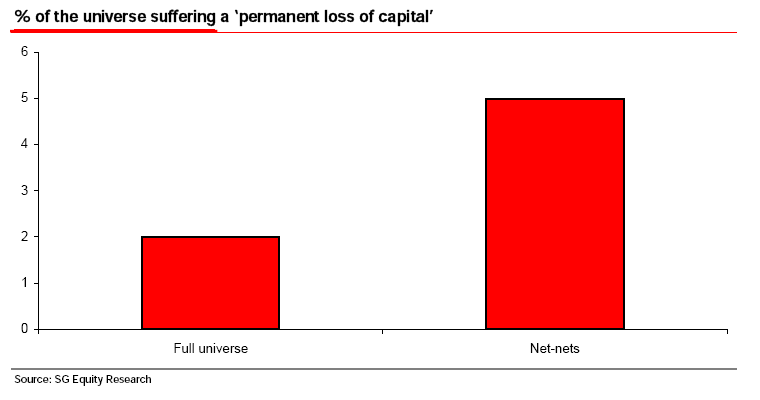
This is interesting given that NCAV is often used as a proxy for liquidation value.

Very few companies turn out to have an ultimate value less than the working capital alone, although scattered instances may be found.

Montier believes this may provide a clue as to why the net net strategy continues to work:

This relatively poor performance may hint at an explanation as to why investors shy away from net-nets. If investors look at the performance of the individual stocks in their portfolio rather than the portfolio itself (known as ‘narrow-framing’), then they will see big losses more often than if they follow a broad market strategy. We know that people are generally loss averse, so they tend to feel losses far more than gains. This asymmetric response coupled with narrow framing means that investors in the net-nets strategy need to overcome several behavioural biases.

Paradoxically, it seems that what is true at the individual company level is not true at an aggregate level. The net net strategy has fewer down years than the market:

If one were to frame more broadly and look at the portfolio performance overall, the picture is much brighter. The net-net strategy only generated losses in three years in the entire sample we backtested. In contrast, the overall market witnessed some six years of negative returns.

Here’s the chart:

And it seems that the net net strategy is a reasonable contrary indicator. When the market is up, fewer can be found, and when the market is down, they seem to be available in abundance:
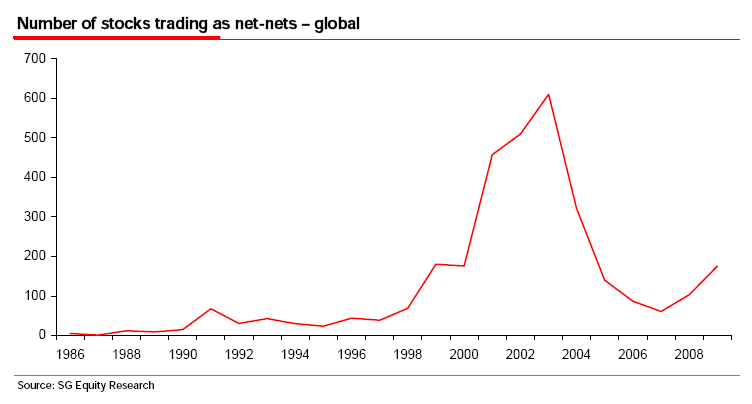
The main drawback to the net net strategy is its limited application. Stocks tend to be small and illiquid, which puts a limit on the amount of capital that can be safely run using it. That aside, it seems like a good way to get started in a small fund or with a individual account. Montier concludes:

…In various ways practically all these bargain issues turned out to be profitable and the average annual return proved much more remunerative than most other investments.

Good old Benjamin Graham. What a guy.

Buy my book The Acquirer’s Multiple: How the Billionaire Contrarians of Deep Value Beat the Market from on Kindlepaperback, and Audible.

Here’s your book for the fall if you’re on global Wall Street. Tobias Carlisle has hit a home run deep over left field. It’s an incredibly smart, dense, 213 pages on how to not lose money in the market. It’s your Autumn smart read. –Tom Keene, Bloomberg’s Editor-At-Large, Bloomberg Surveillance, September 9, 2014.

Click here if you’d like to read more on The Acquirer’s Multiple, or connect with me on Twitter, LinkedIn or Facebook. Check out the best deep value stocks in the largest 1000 names for free on the deep value stock screener at The Acquirer’s Multiple®.
Read Full Post »

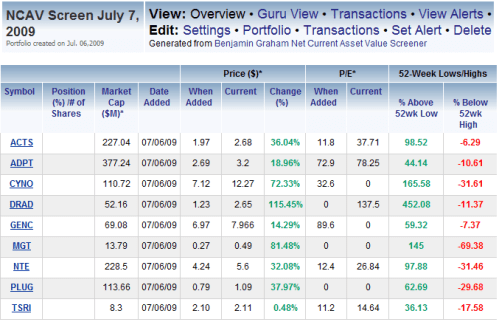
We’ve recently been using the GuruFocus Benjamin Graham Net Current Asset Value Screener (subscription required) to generate regular watchlists of net net stocks. The GuruFocus NCAV screen has some superb functionality that makes it possible to create the watchlist from the screen and then track the performance of those stocks. We created our first watchlist on July 7 of this year using the July 6 closing prices. The performance of the stocks in that first watchlist over the last quarter has been nothing short of spectacular. Here is a screen grab (with some columns removed to fit the space below):

GuruFocus NCAV Screen

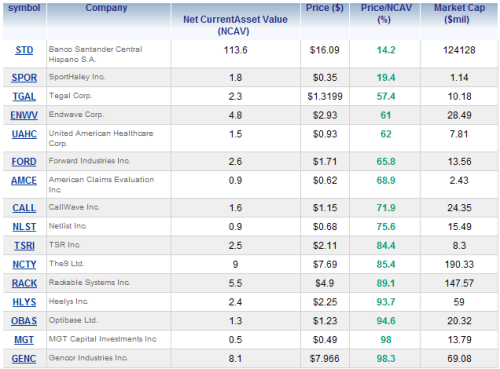
We know the market’s been somewhat frothy recently, but those returns are still notable. The average return to date across the nine stocks in the watchlist is 45.5% against the return on the S&P500 of 20.05% over the same period, an outperformance of more than 25% in ~three months. We’ve decided to run another screen today and we’ll track the return of that watchlist over the coming months. The stocks in the watchlist are set out below (again, with a column removed to fit the space below):

GuruFocus NCAV Screen 2009 10 13

We’ve done no research on these firms beyond running the screen. If you plan on buying anything in this screen, at the absolute minimum we recommend that you do some research to determine whether they are currently net net stocks and not just caught in the screen because of out-of-date filings. We’ll compare the performance of the stocks against the S&P500, which closed yesterday at 1,076.18.

[Full Disclosure:  We have a holding in FORD. This is neither a recommendation to buy or sell any securities. All information provided believed to be reliable and presented for information purposes only. Do your own research before investing in any security.]

Benjamin Graham Net Current Asset Value Screener

Read Full Post »

In the following video, legendary value investor Marty Whitman discusses Benjamin Graham’s net-net formula and his adjustments to it. We’ve previously covered those adjustments here, but we’ve added the video because we think it’s quite amazing to see the great man explaining his rationale for making them. The highlight, from our perspective, is this gem:

We do net-nets based more on common sense. As, for example, you have an asset – a Class A office building – financed with recourse finance, fully tenanted by credit-worthy tenants; That, for accounting purposes, is classified as a fixed asset, but, given such a building, you pick up the telephone and sell it, and really it’s more current than K-Mart’s inventories, for example, which is classified as a current asset. 

 Enjoy the rest of his wit below:


Read Full Post »

Long-term readers of Greenbackd might remember our initial struggle to apply the net net / liquidation formula described by Benjamin Graham in the 1934 Edition of Security Analysis in the context of modern accounting. Putting aside our attempt to include and tweak the discounts to PP&E (kind of like fixing the smile on the Mona Lisa), most embarassing was our failure to factor into the valuation off-balance sheet liabilities and contractual obligations. The best thing that we can say about the whole sorry episode is that we got there in the end and we’ve been applying a more robust formulation for the last quarter. With that in mind, we thought it was particularly interesting to see the Financial Post’s article, Veteran tweaks Graham’s rule to find bargains (via Graham and Doddsville), which details the refinements legendary value investor Marty Whitman makes to Graham’s net-net formulation.

According to the article, Whitman makes the following adjustments to Graham’s 90-year old formula:

  • Companies must be well-financed

First and foremost, companies must be well-financed in keeping with the core tenet of Third Avenue’s “safe and cheap” method of value investing.

The goal is to own companies that are going concerns, not ones destined for liquidation. This difference is a crucial point of distinction between the focus of equity investors, who are often wiped out in liquidation, and bond investors, who have rights to the assets of a company in liquidation.

  • Whitman includes long-term assets that are easily liquidated

The second adjustment is to the assets themselves. Graham and Dodd focused exclusively on current assets when calculating liquidation value whereas Whitman includes long-term assets that are easily liquidated.

For example, roughly one third of long-term assets of Toyota Industries Corp. are investment securities, including a 6% position in Toyota Motor Corp. (TM/TSX), says Ian Lapey, portfolio manager at Third Avenue and designated successor to Whitman on the Third Avenue Value Fund.

These securities are therefore included in Third Avenue’s calculations of net-net.

Closer to home, oil and gas producer Encana Corp. (ECA/ TSX) has proved reserves of oil and natural gas that are not included in current assets, says Lapey.

“They are liquid in that there is a real market, current commodity prices notwithstanding, for high-quality proved reserves of oil and gas.” Encana is a top holding in AIC Global Focused Fund, sub-advised by Third Avenue and managed by Lapey.

  • Adjust for off-balance sheet liabilities

The third adjustment is the inclusion of off-balance-sheet liabilities. Here, U. S. banks’ structured investment vehicles readily spring to mind.

  • Include some PP&E

The fourth and final adjustment to Graham and Dodd is the inclusion of “some property, plant and equipment” for their liquidated cash value and associated tax losses that often produce cash savings.

Hong Kong real estate companies, such as top holding Henderson Land Development Co. Ltd. (0012/HK),are required to mark property values to market prices, so liquidation values are easily ascertained.

“In most time periods, the market for fully leased office buildings is quite liquid,” says Lapey, justifying their inclusion in net-net calculations of these companies.

The article also discusses one of Whitman’s current positions, Sycamore Networks Inc (NASDAQ:SCMR):

Sycamore Networks Inc. (SCMR/NASDAQ) is the most compelling example of a net-net situation in the United States offered up by Lapey.

The telecom equipment company has more cash — US$935-million in all — than the total value assessed to it by the market, in light of its US$800-million market capitalization and US$38-million in total liabilities.

“We feel that there is value to their technology that is being recognized by some of the large telecom carriers,” says Lapey of Sycamore Networks, but he acknowledges its current weak earnings power. Lapey is also attracted to the one-third of outstanding share ownership by management because it presents an important alignment of their interests with those of Third Avenue, who are by and large passive investors.

These large valuation discounts in the market are reassuring words for investors from the one of the finest practitioners of Graham and Dodd.

“We are holding these companies trading at huge discounts,” says Lapey, “and if these companies were to sell assets or sell the whole companies we think the result would be a terrific return for our investment.”

As we discussed in our review of our first quarter, we started Greenbackd in an effort to extend our understanding of asset-based valuation described by Graham. Over the last few quarters we have refined our process a great deal, and it’s pleasing to us that we already include the adjustments identified by Whitman. We believe that our analyses are now qualitatively more robust than when we started out and seeing Whitman’s adjustments gives us some confidence that we’re on the right track.

Read Full Post »

Tweedy Browne, the deep value investment firm established in 1920, has updated its booklet, What Has Worked In Investing (.pdf). First published in 1992 and now updated for 2009, the booklet discusses over fifty academic studies of investment criteria that have produced high rates of investment return. Our interest in the booklet stems from its examination of a group of investment styles falling under the rubric, “Assets bought cheap,” in particular, Benjamin Graham’s “Net current asset value” method and the “Low price to book value” method.

Graham’s “Net current asset value” method

Says Tweedy Browne of Graham’s “Net current asset value” method:

The net current asset value approach is the oldest approach to investment in groups of securities with common selection characteristics of which we are aware. Benjamin Graham developed and tested this criterion between 1930 and 1932. The net current assets investment selection criterion calls for the purchase of stocks which are priced at 66% or less of a company’s underlying current assets (cash, receivables and inventory) net of all liabilities and claims senior to a company’s common stock (current liabilities, long-term debt, preferred stock, unfunded pension liabilities). For example, if a company’s current assets are $100 per share and the sum of current liabilities, long-term debt, preferred stock, and unfunded pension liabilities is $40 per share, then net current assets would be $60 per share, and Graham would pay no more than 66% of $60, or $40, for this stock. Graham used the net current asset investment selection technique extensively in the operations of his investment management business, Graham-Newman Corporation, through 1956. Graham reported that the average return, over a 30-year period, on diversified portfolios of net current asset stocks was about 20% per year

The booklet discusses a study conducted by Henry Oppenheimer, an Associate Professor of Finance at the State University of New York at Binghamton, in which he examined the returns of such stocks over a 13-year period from December 31, 1970 through December 31, 1983. Oppenheimer’s study assumed that all stocks meeting the investment criterion were purchased on December 31 of each year, held for one year, and replaced on December 31 of the subsequent year by stocks meeting the same criterion on that date. The total sample size was 645 net current asset selections. The smallest annual sample was 18 companies and the largest was 89 companies.

Oppenheimer’s conclusion about the returns from such stocks was nothing short of extraordinary:

The mean return from net current asset stocks for the 13-year period was 29.4% per year versus 11.5% per year for the NYSE-AMEX Index. One million dollars invested in the net current asset portfolio on December 31, 1970 would have increased to $25,497,300 by December 31, 1983. By comparison, $1,000,000 invested in the NYSE-AMEX Index would have increased to $3,729,600 on December 31, 1983. The net current asset portfolio’s exceptional performance over the entire 13 years was not consistent over smaller subsets of time within the 13-year period. For the three-year period, December 31, 1970 through December 31, 1973, which represents 23% of the 13-year study period, the mean annual return from the net current asset portfolio was .6% per year as compared to 4.6% per year for the NYSE-AMEX Index.

Perhaps most intriguing, though, was Oppenheimer’s conclusion about the relative outperformance of the loss-making stocks over the profitable ones:

The study also examined the investment results from the net current asset companies which operated at a loss (about one-third of the entire sample of companies) as compared to the investment results of the net current asset companies which operated profitably. The companies operating at a loss had slightly higher investment returns than the companies with positive earnings: 31.3% per year for the unprofitable companies versus 28.9% per year for the profitable companies.

We believe that Oppenheimer’s study presents a compelling argument for such an investment approach.

Low price in relation to book value

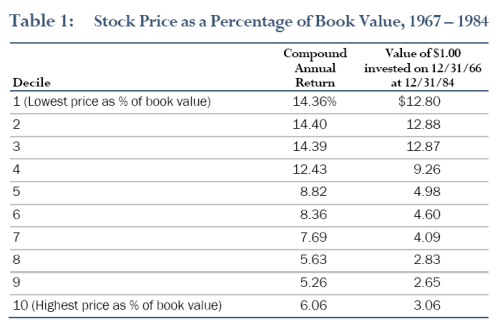
The second investment method falling under the rubric of “Assets bought cheap” is the “Low price in relation to book value” method. The booklet discusses a study conducted by Roger Ibbotson, Professor in the Practice of Finance at Yale School of Management and President of Ibbotson Associates, Inc., a consulting firm specializing in economics, investments and finance. In “Decile Portfolios of the New York Stock Exchange, 1967 – 1984,” Working Paper, Yale School of Management, 1986, Ibbotson studied the relationship between stock price as a proportion of book value and investment returns. To test this relationship, all stocks listed on the NYSE were ranked on December 31 of each year, according to stock price as a percentage of book value, and sorted into deciles. Ibbotson then measured the compound average annual returns for each decile for the 18-year period, December 31, 1966 through December 31, 1984.

Ibbotson found that stocks with a low price-to-book value ratio had significantly better investment returns over the 18-year period than stocks priced high as a proportion of book value. Tweedy Browne set out Ibbotson’s results in the following Table 1:

tweedy-table-1

A second study conducted by Werner F.M. DeBondt and Richard H. Thaler, Finance Professors at University of Wisconsin and Cornell University, respectively, examined stock price in relation to book value in “Further Evidence on Investor Overreaction and Stock Market Seasonality,” The Journal of Finance, July 1987. DeBondt and Thaler ranked all companies listed on the NYSE and AMEX, except companies that were part of the S&P 40 Financial Index, according to stock price in relation to book value and then sorted them into quintiles on December 31 in each of 1969, 1971, 1973, 1975, 1977 and 1979. DeBondt and Thaler then calculated the investment return against the equal weighted NYSE Index over the subsequent four years for all of the stocks in each selection period. The four-year returns against the market index were then averaged.

The stocks in the lowest quintile had an average market price to book value ratio of 0.36 and an average earnings yield (the inverse of the P/E ratio) of 0.10 (indicating a P/E of 10). DeBondt and Thaler found a cumulative average return in excess of the market index over the four years of 40.7%. Meanwhile, the stocks in the highest quintile, those with an average market price to book value ratio of 3.42 and an average earnings yield of 0.147 (a P/E of 6.8), returned 1.3% less than the market index over the four years after portfolio formation.

Perhaps the most striking finding by DeBondt and Thaler, and one that accords with our view about the difficulty of predicting earnings with any degree of accuracy, was the contrast between the earnings pattern of the companies in the lowest quintile (average price/book value of 0.36) and the highest quintile (average price/book value of 3.42). Tweedy Browne set out DeBondt and Thaler’s findings in Table 3 below, which describes the average earnings per share for companies in the lowest and highest quintile of price/book value in the three years prior to selection and the four years subsequent to selection:

tweedy-table-3

In the four years after the date of selection, the earnings of the companies in the lowest price/book value quintile increase 24.4%, more than the companies in the highest price/book value quintile, whose earnings increased only 8.2%. DeBondt and Thaler attribute the earnings outperformance of the companies in the lowest quintile to the phenomenon of “mean reversion,” which Tweedy Browne describes as the observation that “significant declines in earnings are followed by significant earnings increases, and that significant earnings increases are followed by slower rates of increase or declines.”

The booklet continues to discuss Tweedy Browne’s own findings confirming those of the studies described above, and a range of other studies that confirm the findings over different periods of time and in different countries. The findings form a compelling argument for an investment philosophy rooted in deep value and focused on assets, such as Greenbackd’s.

Buy my book The Acquirer’s Multiple: How the Billionaire Contrarians of Deep Value Beat the Market from on Kindlepaperback, and Audible.

Here’s your book for the fall if you’re on global Wall Street. Tobias Carlisle has hit a home run deep over left field. It’s an incredibly smart, dense, 213 pages on how to not lose money in the market. It’s your Autumn smart read. –Tom Keene, Bloomberg’s Editor-At-Large, Bloomberg Surveillance, September 9, 2014.

Click here if you’d like to read more on The Acquirer’s Multiple, or connect with me on Twitter, LinkedIn or Facebook. Check out the best deep value stocks in the largest 1000 names for free on the deep value stock screener at The Acquirer’s Multiple®.
Read Full Post »

Seth Klarman, the founder of The Baupost Group, an exceptionally well-performed, deep value-oriented private investment partnership, is known for seeking idiosyncratic investments. The Baupost Group’s returns bear out his unusual strategy: Over the past 25 years, The Baupost Group has generated an annual compound return of 20% and is ranked 49th in Alpha’s hedge fund rankings.

Klarman detailed his investment process in Margin of Safety: Risk-Averse Value Investing Strategies for the Thoughtful Investor, an iconic book on value investing that is required reading for all value investors. Published in 1991, the book is long out-of-print and famously difficult to obtain. According to a 2006 Business Week article, The $700 Used Book: Why all the buzz about Seth Klarman’s out-of-print investing classic?:

The 249-page book is especially hot among those seeking jobs with value-oriented investment firms. “You win serious points for talking Klarman,” says a newly minted MBA who got his hands on a copy prior to a late-round interview with a top mutual fund firm. “It’s pretty much assumed that you’ve read Graham and Dodd and Warren Buffett.” (Benjamin Graham and David Dodd’s 1934 work, Security Analysis, is a seminal book on value investing, while Buffett’s annual letters to shareholders are considered gospel.) “The book belongs in the category of Buffett and Graham,” says Oakmark Funds manager Bill Nygren, a collector of stock market tomes.

In the book, Klarman carefully explains the rationale for an investment strategy grounded in the value school. He also discusses at some length several sources for value investment opportunities. Why is the book germane to Greenbackd’s ongoing discussion of liquidation value investment? One source of investment opportunity identified by Klarman is stocks trading below liquidation value.

Klarman’s attitude to liquidation value investment closely accords with our own, and so we’ve reproduced below the relevant portion of Chapter 8 The Art of Business Valuation in Margin of Safety, in which he provides the basis for making such investments and outlines his approach to assessing liquidation value:

Liquidation Value

The liquidation value of a business is a conservative assessment of its worth in which only tangible assets are considered and intangibles, such as going-concern value, are not. Accordingly, when a stock is selling at a discount to liquidation value per share, a near rock-bottom appraisal, it is frequently an attractive investment.

A liquidation analysis is a theoretical exercise in valuation but not usually an actual approach to value realization. The assets of a company are typically worth more as part of an going concern than in liquidation, so liquidation value is generally a worst-case assessment. Even when an ongoing business is dismantled, many of its component parts are not actually liquidated but instead are sold intact as operating entities. Breakup value is one form of liquidation analysis, this involves determining the highest value of each component of a business, either as an ongoing enterprise or in liquidation. Most announced corporate liquidations are really breakups; ongoing business value is preserved whenever it exceeds liquidation value.

How should investors value assets in a liquidation analysis? An orderly liquidation over time is virtually certain to realize greater proceeds than a “fire sale,” but time is not always available to a company in liquidation. When a business is in financial distress, a quick liquidation (a fire sale) may maximize the estate value. In a fire sale the value of inventory, depending on its nature, must be discounted steeply below carrying value. Receivables should probably be significantly discounted as well; the nature of the business, the identity of the customer, the amount owed, and whether or not the business is in any way ongoing all influence the ultimate realization from each receivable.

When no crisis is at hand, liquidation proceeds are usually maximized through a more orderly winding up of a business. In an orderly liquidation the values realized from disposing of current assets will more closely approximate stated book value. Cash, as in any liquidation analysis, is worth one hundred cents on the dollar. Investment securities should be valued at market prices, less estimated transaction costs in selling them. Accounts receivable are appraised at close to their face amount. The realizable value of inventories – tens of thousands of programmed computer diskettes hundreds of thousands of purple slippers, or millions of sticks of chewing gum – is not so easily determinable and may well be less than book value. The discount depends on whether the inventories consist of finished goods, work in process, or raw materials, and whether or not there is the risk of technological or fashion obsolescence. The value of inventory in a supermarket does not fluctuate much, but the value of a warehouse full of computers certainly may. Obviously a liquidation sale would yield less for inventory than would an orderly sale to regular customers.

The liquidation value of a company’s fixed assets can be difficult to determine. The value of plant and equipment, for example, depends on its ability to generate cash flows, either in the current use or in alternative uses. Some machines and facilities are multipurpose and widely owned; others may have value only to the present owner. The value of restaurant equipment, for example, is more readily determinable than the value of an aging steel mill.

In approximating the liquidation value of a company, some value investors, emulating Benjamin Graham, calculate “net-net working capital” as a shortcut. Net working capital consists of current assets (cash, marketable securities, receivables, and inventories) less current liabilities (accounts, notes, and taxes payable within one year.) Net-net working capital is defined as net working capital minus all long-term liabilities. even when a company has little ongoing business value, investors who buy at a price below net-net working capital are protected by the approximate liquidation value of current assets alone. As long as working capital is not overstated and operations are not rapidly consuming cash, a company could liquidate its assets, extinguish all liabilities, and still distribute proceeds in excess of the market price to investors. Ongoing business losses can, however, quickly erode net-net working capital. Investors must therefore always consider the state of a company’s current operations before buying. Investors should also consider any off-balance sheet or contingent liabilities that might be incurred in the course of an actual liquidation, such as plant closing and environmental laws.

A corporate liquidation typically connotes business failure; but ironically, it may correspond with investment success. The reason is that the liquidation or breakup of a company is a catalyst for the realization of the underlying business value. Since value investors attempt to buy securities trading at a considerable discount from the value of a business’s underlying assets, a liquidation is one way for investors to realize profits.

A liquidation is, in a sense, one of the few interfaces where the essence of the stock market is revealed. Are stocks pieces of paper to be endlessly traded back and forth, or are they proportional interests in underlying businesses? A liquidation settles this debate, distributing to owners of pieces of paper the actual cash proceeds resulting from the sale of corporate assets to the highest bidder. A liquidation thereby acts as a tether to reality for the stock market, forcing either undervalued or overvalued share prices to move into line with actual underlying value.

We’ll continue our discussion on Seth Klarman and his approach to liquidation value investment later this week.

Buy my book The Acquirer’s Multiple: How the Billionaire Contrarians of Deep Value Beat the Market from on Kindlepaperback, and Audible.

Here’s your book for the fall if you’re on global Wall Street. Tobias Carlisle has hit a home run deep over left field. It’s an incredibly smart, dense, 213 pages on how to not lose money in the market. It’s your Autumn smart read. –Tom Keene, Bloomberg’s Editor-At-Large, Bloomberg Surveillance, September 9, 2014.

Click here if you’d like to read more on The Acquirer’s Multiple, or connect with me on Twitter, LinkedIn or Facebook. Check out the best deep value stocks in the largest 1000 names for free on the deep value stock screener at The Acquirer’s Multiple®.
Read Full Post »

CNBC has an interview with Ricardo Salinas, the Mexican billionaire who took a position in Circuit City Stores Inc (OTC:CCTYQ) after it fell into bankruptcy and lost $41 million. In the interview with Michelle Caruso-Cabrera, Salinas explains why he made his bet on CCTYQ and how it went wrong. Although Salinas’ CCTYQ investment wasn’t a Grahamian net net, his explanation does capture some of the pitfalls of investing based on asset values:

Mr. Salinas made the majority of his $41 million investment in Circuit City after the troubled chain filed for bankruptcy protection in November. He amassed a 28 percent stake in the company and then began trying to work out a deal with Circuit City’s suppliers in an effort to take the chain private.

But Mr. Salinas backed out of the deal just before the company decided to liquidate, according to a recent account in The Richmond Times-Dispatch.

“It was much more complicated than he expected it to be,” an unidentified source told the newspaper. Pricing on some inventory “was just too high” and the support from banks and vendors “just wasn’t there,” the Times-Dispatch quoted the source as saying.

In his CNBC interview, Mr. Salinas expressed regret about not capturing Circuit City at a bargain-basement price and losing his investment, but acknowledged that it was for the best.

“I don’t care how rich you are, it must hurt to lose $41 million,” Ms. Caruso-Cabrera said to Mr. Salinas on location in Mexico.

“You know – when you’re talking about investments and businesses- it doesn’t pay to be afraid,” Mr. Salinas said, according to a transcript of the interview, which will be broadcast Wednesday night on CNBC. “It doesn’t pay, because fear is not a good counselor. Fear makes you do stupid things. So, of course it hurts.”

Mr. Salinas said he is moving on from his experience but is still looking at buying American assets.

“Well, we’re looking at a couple of mining companies that have been really pounded by the declining commodities,” he said in the interview. “And we think that, you know, mining is a great business. So we might go into a new tack there.”

(Via The New York Times Dealbook)

Read Full Post »

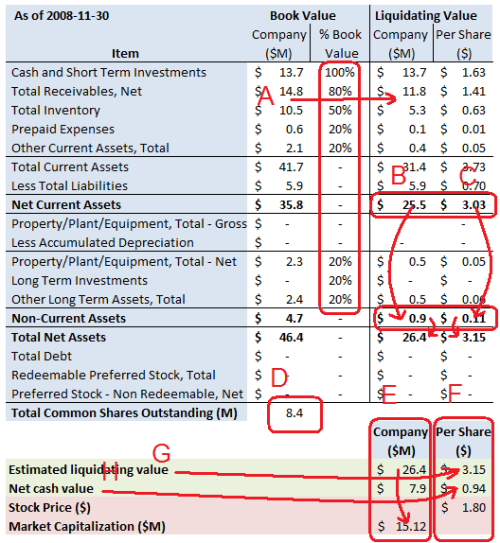
We are trialing a change to our summary presentation of company financial statements. The new summaries will look like this (this is our summary balance sheet for Aehr Test Systems (NASDAQ:AEHR) – it’s cheap but there’s no catalyst):

aehr-summary-changes

A brief explanation of the various changes:

  1. A. shows the carrying value of the receivables ($14.8M), our estimate for the percentage of carrying value the receivables will yield in liquidation (80%), the liquidating value ($11.8M) and the liquidating value per share ($1.41).
  2. B. shows the net current asset value ($25.5M), which, when added to the non-current asset value ($0.9M), gives the liquidating value for the company ($26.4M).
  3. C. is the same calculation as B. but on a per share basis: the net current asset value per share ($3.03), which, when added to the non-current asset value per share ($0.11), gives the liquidating value per share ($3.15).
  4. D. is the amount of stock the company has on issue.
  5. E. shows the liquidating value of the company ($26.4M), the net cash value of the company ($7.9M) and the market capitalization ($15.12M). In this instance, the company is trading at approximately 60% of our estimate of its liquidation value.
  6. F. shows the same amounts as E. on a per share basis against the stock price.
  7. G. and H. are the estimated liquidating value on a company and per share basis, and the net cash value on company and per share basis.

We’re keen to hear what you think of the changes. We think it presents the discount applied to the carrying values and the net current asset values more clearly than the previous summaries.

Read Full Post »

In our last post, we discussed our approach to long-term and fixed asset valuation. We concluded that, given our inability to actually value any given asset or class of assets, the best that we could do is fix a point at which we feel that we are more likely to be right than wrong about a stock’s value but would also have enough opportunities to invest. We argued that magic point for us in relation to property, plant and equipment is 50%, based on nothing more more than our limited experience. We acknowledge that this method will cause us to make many mistakes, so in this post we set out our method for protecting ourselves from those mistakes.

We try to protect ourselves from our mistakes in three ways:

  1. We try to buy at a substantial (i.e. more than 1/3) discount to our estimate of the written down value. Sometimes our valuation will be so wrong that the discount will be an illusion, and the real value will be well south of our estimate (maybe somewhere near Antarctica). In those instances, if the liquidation becomes a reality, we will lose money. In other instances, the real value will be higher than our estimate, and we will make money. Our hope is that the latter occurs more frequently than the former, but we are certain that the former will occur regularly.
  2. We try to buy a portfolio of these securities and we don’t concentrate too much of the portfolio in any one security. The more certain we are about a security, the larger the portion of the portfolio it will command. This means that net cash stocks that have ceased trading and are in liquidation or paying a special dividend take up a larger proportion of our portfolio than cash-burning industrials in liquidity crises with value wholly concentrated in property, plant and equipment (that said, at a big enough discount, they might take up a lot of the portfolio). This means that if any one stock, or even a handful of stocks, go to zero or thereabouts, they don’t destroy our entire stake and we can live to invest another day.
  3. We try to follow investors much smarter than we are. From our perspective, there’s no shame in riding on someone else’s coat-tails, especially when those coat-tails are on the back of someone smarter, better resourced and more experienced. This is one of the main reasons we only invest when we can see a Schedule 13D notice filed with the SEC (the other reason is that the 13D filing is the precursor to the catalytic event that removes the discount). Often, the 13D notice will set out the investor’s rationale for the investment, which may include their view on the stock’s valuation. While we always do our own research, we are comforted when we see other value-oriented investors in the stock, and we hope that experienced, professional, value investors are right more often than they are wrong (even though we know that they will also make mistakes).

The first method above attempts to limit the effect of an error in valuation on any given investment. We hope that if we’re wrong about the value, it’s only by a matter of degree, and we can salvage some value from the investment. The second limits the damage that a total, or near total, destruction of value in any one investment does to the portolio as a whole. The third is a check on our thought process. If we’re right about a situation, we’d expect to see investors smarter than we are already in the stock. If they’re not there, we’d have to look deep into the abyss before jumping in. We haven’t had to do that yet.

We hope that this better explains our approach to investment. Once again, we’re always keen to hear other points of view, or to have someone point out the obvious holes in the argument.

Read Full Post »

We’ve recently received several questions about our valuation methodology. Specifically, readers have asked why we include property, plant and equipment in our valuation, and why we only discount it by half, as opposed to a higher figure (two-thirds, four-fifths, one-hundred percent). They are concerned that by including property, plant and equipment in our assessment, or by failing to apply a sufficient discount to those assets, we are overstating the asset or liquidation value of the companies we cover and therefore overpaying for their stock. In this post, we better describe our approach to asset valuation. In the next post, we deal with our method for protecting ourselves from overpaying for stock.

Our valuation methodology is closely based on Benjamin Graham’s approach, which he set out in Security Analysis and The Interpretation of Financial Statements. Like Graham, we have a strong preference for current assets, and, in particular, cash. As we mention on the About Greenbackd page, our favorite stocks are those backed by greenbacks, hence our name: Greenbackd. We love to find what Graham described as gold-dollars-with-strings-attached that can be purchased for 50 cents. We believe that there is value in long-term and fixed assets, although not necessarily the value at which those assets are carried in the financial statements. The appropriate discount for long-term and fixed assets is something with which we (and we suspect other Grahamite / asset / liquidation investors) struggle. We think it’s useful to consider Graham’s approach, which we’ve set out below:

Graham’s approach to valuing long-term and fixed assets

Graham’s preference was clearly for current assets, as this quote from Chapter XXIV of The Interpretation of Financial Statements: The Classic 1937 Edition demonstrates:

It is particularly interesting when the current assets make up a relatively large part of the total assets, and the liabilities ahead of the common are relatively small. This is true because the current assets usually suffer a much smaller loss in liquidation than do the fixed assets. In some cases of liquidation it happens that the fixed assets realize only about enough to make up the shrinkage in the current assets.

Hence the “net current asset value” of an industrial security is likely to constitute a rough measure of its liquidating value. It is found by taking the net current assets (or “working capital”) alone and deducting therefrom the full claims of all senior securities. When a stock is selling at much less than its net current asset value, this fact is always of interest, although it is by no means conclusive proof that the issue is undervalued.

Despite Graham’s cautionary tone above, he did not necessarily exclude long-term and fixed assets from his assessment of value. He did, however, heavily discount those assets (from Chapter XLIII of Security Analysis: The Classic 1934 Edition “Significance of the Current Asset Value”):

The value to be ascribed to the assets however, will vary according to their character. The following schedule indicates fairly well the relative dependability of various types of assets in liquidation.

liquidation-value-schedule2

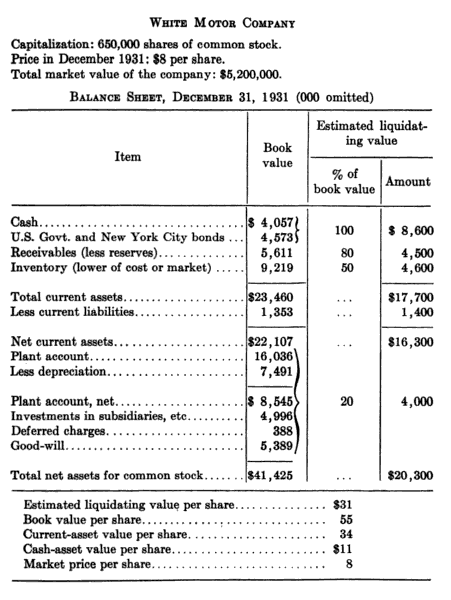
Graham then set out an example valuation for White Motor Company:

In studying this computation it must be borne in mind that our object is not to determine the exact liquidating value of White Motor, but merely to form a rough idea of this liquidating value in order ascertain whether or not the shares are selling for less than the stockholders could actually take of the business. The latter question is answered very definitively in the affirmative. With a full allowance for possible error, there was no doubt at all that White Motor would liquidate for a great deal more than $8 per share or $5,200,000 for the company. The striking fact that the cash assets alone considerably exceed this figure, after deducting all liabilities, completely clinched the argument on this score.

white-motor-example1

Current-asset Value a Rough Measure of Liquidating Value. – The estimate values in liquidation as given for White Motor are somewhat lower in respect of inventories and somewhat higher as regards the fixed and miscellaneous assets than one might be inclined to adopt in other examples. We are allowing for the fact that motor-truck inventories are likely to be less salable than the average. On the other hand some of the assets listed as noncurrent, in particular the investment in White Motor Securities Corporation, would be likely to yield a larger proportion of their book values than the ordinary property account. It will be seen that White Motor’s estimated liquidating value (about $31 per share) is not far from the current-asset value ($34 per share). In the typical case it may be said that the noncurrent assets are likely to realize enough to make up most of the shrinkage suffered in the liquidation of the quick assets. Hence our first thesis, viz., that the current-asset value affords a rough measure of the liquidating value.

Greenbackd’s approach to valuing long-term and fixed assets

The first thing to note is that we’ve got no particular insight into any of the companies that we write about or the actual value of the companies’ assets. The valuations are based on the same generalized, unsophisticated, purely mathematical application of Graham’s formula. Further, if the actual value of an asset is objectively known or determinable, then we don’t know it and, in most cases, can’t determine it. That puts us at a disadvantage to those who do know the assets’ real value or can make that determination. Secondly, we can’t make the fine judgements about value that Graham has made in the White Motor example above. Perhaps it’s blindingly obvious that “motor-truck inventories are likely to be less salable than the average,” but we don’t know anything about motor-truck inventories or the average. It’s specific knowledge that we don’t have, which means that we are forced to mechanically apply the same discount to all assets of the same type.

Given that we’ve disclaimed any ability to actually value an asset or class of assets, why not adopt the lower to middle end of Graham’s valuation range for those assets? (Editors note: What a good suggestion. From here on in, we’re taking Graham’s advice. It’s simply because, in our experience, as idiosyncratic as it has been, an 80% discount to property, plant and equipment is too much in most instances. We think that 50% is a conservative estimate. In our limited experience, commercial and industrial real estate rarely seems to sell at much less than 15% below book value, and that’s in the recent collapse.) At first blush, specialist plant and equipment might appear to be worthless because the resale market is too small, but it can also be sold at a premium to its carrying value. For example, in the recent resources boom, we heard from an acquaintance in the mining industry that mining truck tires were so scarce as to sell in many instances at a higher price second hand than new. Apparently entire junked mining trucks were purchased in one country and shipped to another simply for the tires. Without that specialist knowledge of the mining industry, one might have ascribed a minimal value to an irreparable mining truck or a pile of used mining truck tires and missed the opportunity. What these examples demonstrate, in our opinion, is that the sale price for an asset to be sold out of liquidation is extremely difficult to judge until the actual sale, by which time it’s way too late to make an investment decision.

The best that we can do is fix a point at which we feel that we a more likely to be right than wrong about the value but will also have enough opportunities to invest to make the exercise worthwhile. For us, that point is roughly 20% 50% for property, plant and equipment. That 20% 50% is not based on anything more than (Edit: Graham’s formula, which has stood the test of time and should be applied in most cases unless one has a very good reason not to do so our limited experience, which is insufficient to be statistically significant for any industry or sector, geographical location or time in the investment cycle.) We always set out for our readers our estimate so that you can amend our valuation if you think it’s not conservative enough or just plain wrong (if you do make that amendment, we’d love to hear about it, so that we can adjust our valuation in light of a better reasoned valuation).

We hope that this sheds some light on our process. We’d love to hear your thoughts on the problems with our reasoning.

Read Full Post »

« Newer Posts - Older Posts »