Since last week’s Japanese liquidation value: 1932 US redux post, I’ve been attempting to determine whether the historical performance of Japanese sub-liquidation value stocks matches the experience in the US, which has been outstanding since the strategy was first identified by Benjamin Graham in 1932. The risk to the Japanese net net experience is the perception (rightly or not) that the weakness of shareholder rights in Japan means that net current asset value stocks there are destined to continue to trade at a discount to net current asset value. As I mentioned yesterday, I’m a little chary of the “Japan has weak shareholder rights” narrative. I’d rather look at the data, but the data are a little wanting.
As we all know, the US net net experience has been very good. Research undertaken by Professor Henry Oppenheimer on Graham’s liquidation value strategy between 1970 and 1983, published in the paper Ben Graham’s Net Current Asset Values: A Performance Update, indicates that “[the] mean return from net current asset stocks for the 13-year period was 29.4% per year versus 11.5% per year for the NYSE-AMEX Index. One million dollars invested in the net current asset portfolio on December 31, 1970 would have increased to $25,497,300 by December 31, 1983.” That’s an outstanding return.
In The performance of Japanese common stocks in relation to their net current asset values, a 1993 paper by Bildersee, Cheh and Zutshi, the authors undertook research similar to Oppenheimer’s in Japan over the period 1975 and 1988. Their findings, described in another paper, indicate that the Japanese net net investor’s experience has not been as outstanding as the US investor’s:
In the first study outside of the USA, Bildersee, Cheh and Zutshi (1993)’s paper focuses on the Japanese market from 1975 to 1988. In order to maintain a sample large enough for cross-sectional analysis, Graham’s criterion was relaxed so that firms are required to merely have an NCAV/MV ratio greater than zero. They found the mean market-adjusted return of the aggregate portfolio is around 1 percent per month (13 percent per year).
As an astute reader noted last week “…the test period for [the Bildersee] study is not the best. It includes Japan’s best analog to America’s Roaring Twenties. The Nikkei peaked on 12/29/89, and never recovered:”
Many of the “assets” on public companies’ books at that time were real estate bubble-related. At the peak in 1989, the aggregate market price for all private real estate in the city of Tokyo was purportedly greater than that of the entire state of California. You can see how the sudden runup in real estate during the bubble could cause asset-heavy companies to outperform the market.
So a better crucible for Japanese NCAVs might be the deflationary period, say beginning 1/1/90, which is more analogous to the US in 1932.
To see how the strategy has performed more recently, I’ve taken the Japanese net net stocks identified in James Montier’s Graham’s net-nets: outdated or outstanding? article from September 2008 and tracked their performance from the data of the article to today. Before I plow into the results, I’d like to discuss my methodology and the various problems with it:
- It was not possible to track all of the stocks identified by Montier. Where I couldn’t find a closing price for a stock, I’ve excluded it from the results and marked the stock as “N/A”. I’ve had to exclude 18 of 84 stocks, which is a meaningful proportion. It’s possible that these stocks were either taken over or went bust, and so would have had an effect on the results not reflected in my results.
- The opening prices were not always available. In some instances I had to use the price on another date close to the opening date (i.e +/1 month).
Without further ado, here are the results of Montier’s Graham’s net-nets: outdated or outstanding? picks:
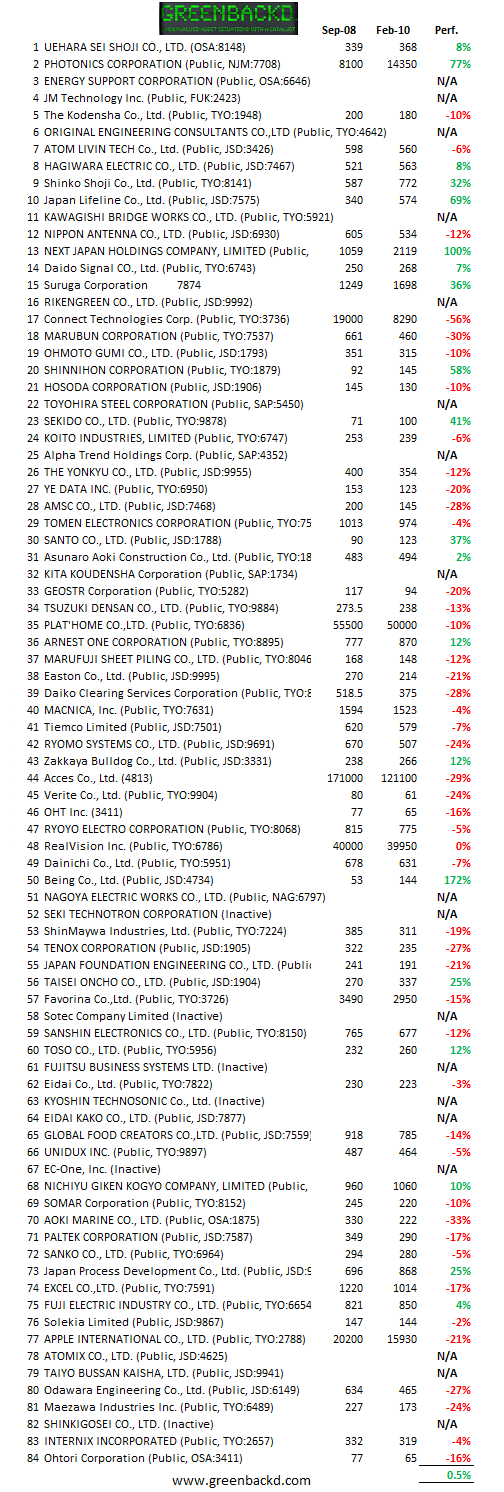
The 68 stocks tracked gained on average 0.5% between September 2008 and February 2010, which is a disappointing outcome. The results relative to the Japanese index are a little better. By way of comparison, the Nikkei 225 (roughly equivalent to the DJIA) fell from 12,834 to close yesterday at 10,057, a drop of 21.6%. Encouragingly, the net nets outperformed the N225 by a little over 21%.
The paucity of the data is a real problem for this study. I’ll update this post as I find more complete data or a more recent study.

 We opened a position in VNDA and got a great return. We lost our nerve with BGP and missed out on a great return. We completely ignored ATSG, DTSG, SMRT, RFMD, PIR and CHUX although all appeared on our NCAV screen at some stage earlier this year. A little more evidence that diamonds can be found if you dig through enough trash.
 As shown in table 2, City Investing Liquidating Trust was a hodgepodge of assets. Few investors had the inclination or stamina to evaluate these assets or the willingness to own them for the duration of a liquidation likely to take several years. Thus, while the units were ignored by most potential buyers, they sold in high volume at approximately $3, or substantially below underlying value.

 Greenbackd