Feeds:
Posts
Comments

Archive for the ‘Catalysts’ Category

Empirical Finance Research Blog has a review of a new paper, Repurchases, Reputation, and Returns, which finds that long-run stock returns are higher for companies announcing buybacks that had substantially completed a previous buyback. In other words, companies with a track record for following through on announced buybacks enjoy higher returns following a subsequent buyback announcement than companies that did not follow through on a previously announced buyback. While that might seem obvious, the paper makes two observations that we find particularly interesting in the context of our investment strategy:

  1. Past buyback completion rates are predictive of future buyback completion rates.
  2. Stocks with high completion rates but low stock returns following previous buybacks enjoy abnormally large returns following a subsequent buyback announcement.

It’s worth remembering that a buyback announcement does not bind a company to undertake a buyback, a situation we encountered recently: RACK suspends buyback and enters agreement to acquire Silicon Graphics; Greenbackd exits position. Companies frequently fail to follow through on announced repurchase plans. Empirical Finance Research cites a 1998 study by Stephens and Weisbach that found that firms on average repurchase only about 80% of the sum announced.

Empirical Finance Research summarizes the paper as follows:

This author measures the level of completion of previous buybacks, as measured by the shares bought as a fraction of the amount specified in the announcement, then uses this to explain how well various stocks do after subsequent buyback announcements. What she finds is that companies that had low completion rates on a previous share buyback experience much lower returns upon the announcement of another buyback. She interprets this as evidence of the company’s credibility, that investors don’t really believe a company about a share buyback when the company has failed to complete one in the past.

First the author confirms that past buyback completion rates are predictive of future buyback completion rates. Next she shows that the stock returns to a company making a buyback announcement are much higher for those with high past completion rates. Companies in the 90th percentile of past completion rate see returns 2.5% higher than those in the 10th percentile of past completion rate in the three days after a the new announcement.

Despite the size of these returns, this isn’t a very good trading strategy, because buyback announcements are clearly unexpected. However, in the next part of the paper the author finds that long-run returns are also reliably higher for repeat buyback companies with high past completion rates. Two year returns are 13.64% for those companies with above-median past completion rates versus 7.43% for those below the median. We should be leery of these results, however as they are not statistically significant.

Next the author splits her sample of repeat buyback companies into quintiles based on the return to the stock during the previous buyback. The two-year abnormal returns to companies in the lowest quintile (those with the lowest returns after their last buyback) are 17.33% after their subsequent buyback. This result is very statistically significant too.

But if we split this quintile in half based on past completion rates, and buy only those stocks with above-median past completion rate, the returns explode to 27.13% for the two year period.

Empirical Research Blog’s takeaway?

The value of this paper is not necessarily in a specific investment strategy but rather in the insight it provides in to a trading strategy we already knew about. I would be hesitant to implement this stand-alone for the practical difficulty in doing so. But any trading strategy that already uses share buybacks as a signaling factor might benefit from an augmentation that accounts for past buyback completion rate.

(Emphasis added)

Quite.
Read Full Post »

Rackable Systems Inc (NASDAQ:RACK) has filed its 10K for the year ended January 3, 2009.

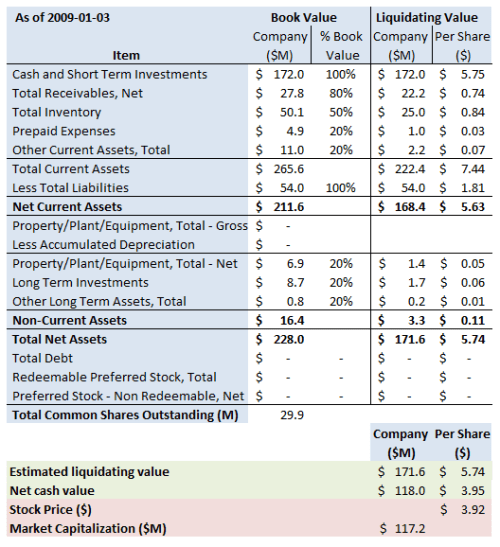
We’ve been following RACK (see our post archive here) because it is an undervalued asset play with a plan to repurchase almost 40% of its stock. The stock is up 10.1% from $3.56 when we added it to the Greenbackd Portfolio on March 11 this year to close yesterday at $3.92. The company now has a market capitalization of $117.2M. We initially estimated the company’s liquidation value to be 46% higher at $171.6M or $5.74 per share. We’ve now had an opportunity to review the 10K and see no reason to vary our initial estimate. If the buy back is completed at the current stock price, the company’s per share liquidation value will increase by 17% to $6.69, which presents considerable upside from the present price.

The value proposition updated

RACK has had a tough year, burning through $15.7M in the 12 months to January 3, 2009. The company’s value resides in the huge amounts of cash and equivalents on its balance sheet, much of which is from the $138.5 million follow-on public offering completed in March 2006. Set out below is our estimate of the company’s liquidation value (the “Book Value” column shows the assets as they are carried in the financial statements, and the “Liquidating Value” column shows our estimate of the value of the assets in a liquidation):

rack-summary-2009-1-3We estimate the company’s liquidation value to be around $171.6M or $5.74 per share, which is predominantly cash and equivalents in the amount of $172M or $5.75 per share. RACK’s net cash value is around $118M or $3.95 per share.
Off balance sheet arrangements and contractual obligations

According to the 10K, the company has no off-balance sheet arrangements. The contractual obligations as at January 3, 2009 were around $17.1M, around $9.5M of which falls due in the next 12 months. Those committments are $2.0M minimum lease payments under the company’s operating leases and $7.5 in purchase obligations. The company also had purchase committments in the amount of $7.6M in total.

Catalyst

According to the 10K, RACK plans to buy back almost $40M of its own stock:

In February 2009, our Board of Directors authorized a share repurchase program of up to $40 million of our common stock. The duration of the repurchase program is open ended. Under the program, we are able to purchase shares of common stock through open market transactions and privately negotiated purchases at prices deemed appropriate by management. The timing and amount of repurchase transactions under this program will depend on market conditions, corporate and regulatory considerations, alternative investment opportunities, and other relevant considerations. The program may be discontinued at any time by the Board of Directors. Shares we repurchase will be held in treasury for general corporate purposes, including issuances under employee equity incentive plans.

Conclusion

We like it when a company recognizes that its stock is deeply undervalued and takes radical action to capitalize on it. If the market is pricing a company’s stock below its liquidation value, the company’s priority should be investing in its own stock. With its stock at $3.92, RACK has a market capitalization of $117.2M, which means it’s trading at a discount to both its net cash value of $118M or $3.95 per share and its liquidation value of $171.6M or $5.74 per share. The cash burn is a risk, but we’re going to retain RACK in the portfolio.

[Full Disclosure:  We do not have a holding in RACK. This is neither a recommendation to buy or sell any securities. All information provided believed to be reliable and presented for information purposes only. Do your own research before investing in any security.]

Read Full Post »

Following on from our earlier post, Seth Klarman on Liquidation Value, we present the second post in our series on Klarman’s Margin of Safety: Risk-Averse Value Investing Strategies for the Thoughtful Investor.

As we discussed in our first post, Klarman is the founder of The Baupost Group, a deep value-oriented private investment partnership that has generated an annual compound return of 20% over the past 25 years. Klarman detailed his investment process in the iconic Margin of Safety. The book is required reading for all value investors, but is long out-of-print and notoriously difficult to obtain.

In today’s extract, drawn from Chapter 10 Areas of Opportunity for Value Investors: Catalysts, Ineficiences, and Institutional Constraints, Klarman discusses the importance of the catalyst in the investment process:

Once a security is purchased at a discount from underlying value, shareholders can benefit immediately if the stock price rises to better reflect underlying value or if an event occurs that causes that value to be realized by shareholders. Such an event eliminates investors’ dependence on market forces for investment profits. By precipitating the realization of underlying value, moreover, such an event considerably enhances investors’ margin of safety. I refer to such events as catalysts.

Some catalysts for the realization of underlying value exist at the discretion of a company’s management and board of directors. The decision to sell out or liquidate, for example, is made internally. Other catalysts are external and often relate to the voting control of a company’s stock. Control of the majority of a company’s stock typically allows the holder to elect the majority of the board of directors. Thus accumulation of stock leading to voting control, or simply management’s fear that this might happen, could lead to steps being taken by a company that cause its share price to more fully reflect underlying value.

Catalysts vary in their potency. The orderly sale or liquidation of a business leads to total value realization. Corporate spinoffs, share buybacks, recapitalizations, and major asset sales usually bring about only partial value realization.

Value investors are always on the lookout for catalysts. While buying assets at a discount from underlying value is the defining characteristic of value investing, the partial or total realization of underlying value through a catalyst is an important means of generating profits. Furthermore, the presence of a catalyst serves to reduce risk. If the gap between price and underlying value is likely to be closed quickly, the probability of losing money due to market fluctuations or adverse business developments is reduced. In the absence of a catalyst, however, underlying value could erode; conversely, the gap between price and value could widen with the vagaries of the market. Owning securities with catalysts for value realization is therefore an important way for investors to reduce the risk within their portfolios, augmenting the margin of safety achieved by investing at a discount from underlying value.

Catalysts that bring about total value realization are, of course, optimal. Nevertheless, catalysts for partial value realization serve two important purposes. First, they do help to realize underlying value, sometimes by placing it directly into the hands of shareholders such as through a recapitalization or spinoff and other times by reducing the discount between price and underlying value, such as through a share buyback. Second, a company that takes action resulting in the partial realization of underlying value for shareholders serves notice that management is shareholder oriented and may pursue additional value-realization strategies in the future. Over the years, for example, investors in Teledyne have repeatedly benefitted from timely share repurchases and spinoffs.

Tomorrow we present the final installment in the series, Seth Klarman on Investing in Corporate Liquidations.

Read Full Post »

In a paper published in February this year, Entrepreneurial Shareholder Activism: Hedge Funds and Other Private Investors, April Klein and Emanuel Zur examine recent “confrontational activism campaigns” by “entrepreneurial shareholder activists” and conclude that such strategies generate “significantly positive market reaction for the target firm around the initial Schedule 13D filing date” and “significantly positive returns over the subsequent year.”

The paper confirms our view that the filing of a 13D notice by an activist hedge fund is a catalytic event for a firm that heralds substantial positive returns in the stock.

Klien and Zur define an entrepreneurial shareholder activist as “an investor who buys a large stake in a publicly held corporation with the intention to bring about change and thereby realize a profit on the investment,” which seems quite broad. They define “confrontational activist campaign” very narrowly, including only campaigns beginning with the filing of a 13D notice in which the activist’s clear purpose is to redirect managements’ efforts without working with or communicating with management:

The redirections stated in the Schedule 13D purpose statement include (but are not limited to) seeking seats on the company’s board, opposing an existing merger or liquidation of the firm, pursuing strategic alternatives, or replacing the CEO. We exclude 13D filings that are filed because the investor is “unwilling to give up the option of affecting the firm” (Clifford (2008, p. 326)). We also exclude 13D filings if the investor states an interest in working with or communicating with management on a regular basis. These restrictions limit our analyses to activist campaigns that can be characterized as aggressive or confrontational. (Emphasis added)

Klien and Zur find that such strategies generate significant positive stock returns:

Specifically, hedge fund targets earn 10.2% average abnormal stock returns during the period surrounding the initial Schedule 13D. Other activist targets experience a significantly positive average abnormal return of 5.1% around the SEC filing window. These findings suggest that, on average, the market believes activism creates shareholder value. Our findings are consistent with those of Holderness and Sheehan (1985), who document significant price increases for firms targeted by “notorious” corporate raiders of the late 1970s and early 1980s, and also with those of Bethel, Liebeskind, and Opler (1998), who show similar results for firms targeted by individuals, rather than corporate or institutional large shareholders. The positive abnormal returns also are consistent with the work of Brav et al. (2008), who find positive market reactions for a sample of confrontational and nonconfrontational hedge fund Schedule 13D filings. Furthermore, our target abnormal returns do not dissipate in the 1-year period following the initial Schedule 13D. Instead, hedge fund targets earn an additional 11.4% abnormal return during the subsequent year, and other activist targets realize a 17.8% abnormal return over the year following the activists’ interventions.

One particularly interesting observation in the paper is the distinction between the strategies of hedge funds on one hand and other investors (individuals, private equity funds, venture capital firms, and asset management groups for wealthy investors) on the other. Klien and Zur believe that hedge funds address the “free cash flow problem:”

Under this theory, firms can reduce agency conflicts between managers and shareholders by reducing excess cash on hand, and by obligating managers to make continuous payouts in the form of increased dividends and interest payments to creditors. Consistent with this view, hedge fund targets initially have higher levels of cash on hand than do other entrepreneurial activist targets. In addition, hedge fund activists frequently demand that the target firm buy back its own shares, cut the CEO’s salary, or initiate dividends, whereas other activists do not make these demands. Consequently, over the fiscal year following the initial Schedule 13D, hedge fund targets, on average, double their dividends, significantly increase their debt-to assets ratio, and significantly decrease their cash and short-term investments.

In contrast to the hedge funds, the other investors seek to “redirect investment strategies:”

In their initial Schedule 13Ds, they most frequently demand changes in the targets’ operating strategies. Consistent with these requests, when comparing hedge fund and other entrepreneurial activist targets, we find significant differences in changes in R&D and capital expenditures in the year following the 13D filing, with the other entrepreneurial activist targets experiencing significant declines in both parameters.

We believe that Klien and Zur’s finding that confrontational activism campaigns by entrepreneurial shareholder activists generate significant positive returns in the 12 months following the filing of the 13D notice is further compelling evidence for Greenbackd’s investment strategy.

Read Full Post »

Ken Squire argues in a feature article in this week’s Barron’s magazine, A Golden Age for Activist Investing (subscription required), that the “political climate, shareholder sentiment and opportunities available to activists” means that “the sun, the moon and the stars have moved into alignment for activist investing.” Squire believes that the knowledge that investors “can’t rely on the markets to create value, so they will have to create it themselves” will turn many formerly passive investors into “reluctant activists.”

Squire makes some interesting points:

1. We are witnessing “the largest spreads ever between price and value”

While we don’t accept that we are yet witnessing “the largest spreads ever between price and value,” we believe that we are getting close. On long-term measures of value (for example, Graham’s 10-year trailing P/E ratio and corporate profits as a proportion of GDP) market prices are well below average and approaching all time lows (See Future Blind‘s post Market Valuation Charts prepared in October last year when the S&P500 was around 1160). More on this at a later date. (Note that this is not a declaration that we are nearing the bottom. We think there’s a good chance the markets will over-correct to the downside and stocks will be undervalued for an extended period).

2. The “economic and political climate will make it much easier for activist investors to succeed”

Squire argues that the “economic crisis has eroded confidence in boards and corporate leadership” and “[shareholders] have less patience for laggard management, indecisiveness and missteps, and are more likely to support an activist.” We don’t disagree with these points, but we dispute that this necessarily translates into success. Incumbent directors have a huge advantage over alternate slates. See, for example, Carl Icahn’s argument that boards and managements are entrenched by state laws and court decisions that “insulate them from shareholder accountability and allow them to maintain their salary-and-perk-laden sinecures.”

3. The “impaired credit markets will make it difficult to implement financial-engineering solutions”

Squire believes the environment will force activists to “focus on operations, strategy and governance, rather than stock repurchases and special dividends”:

There are many companies whose operations or strategy fell short, and activists will identify them and implement plans to improve operations, cut costs and redirect investment.

This is a particularly interesting point. It’s clearly more difficult for an activist investor to articulate to stockholders the benefits of improvements in operations or a redirection of investment than it is to simply promise a dividend or a buy-back, which should in turn reduce their chance of getting on the board. This might suggest that impaired credit markets actually reduce an activist investor’s chance of success.

4. We will see a “significant increase in corporate/strategic acquisitions”

Squire argues that “corporate acquirers have a low cost of capital” which will “compensate in part for the void in private-equity buyouts”:

Activists not only will be open to discussing potential transactions with strategic acquirers, but often will seek them out. The activist-investor board member will want to be involved in negotiating the transaction to assure that stockholders receive the best value.

5. Companies with net cash will attract activist investors

Squire writes that activists will target exactly the type of investments Greenbackd favors:

Given today’s backdrop, many activists are expected to emphasize net cash as an inducement to invest. Large amounts of cash give a company the financial flexibility to withstand economic stress, and make it a more attractive takeover target. Abundant cash also may be an indication that the stock is mispriced. In many cases, price/earnings ratios have been gravitating toward 10, without regard to cash balances.

Based on the foregoing, it’s hard to disagree with Squire’s conclusion that 2009 will be “a busy and exciting year for shareholder activism.” It’s certainly very good news investors like us. Lest we get a reputation for being blind cheerleaders for activist investment as an end in and of itself, we’d like to emphasize that Greenbackd’s focus is undervalued asset situations with a catalyst and we’re almost agnostic as to the source of the catalyst. Our ideal situation is a management prepared to recognize the discount of price to value and undertake some step to unlock that value or remove the discount. We remain ever optimistic that all directors – including those of smaller companies outside the glare of the analyst coverage and the mainstream media – fully embrace their fiduciary duties to stockholders. Our experience is that this doesn’t often happen in the absence of an agitating stockholder. This is the real reason that formerly passive investors become “reluctant activists.” Not because they “can’t rely on the markets to create value” but because they can’t rely on some boards and managements not to destroy value.

Read Full Post »

We’re often banging on about stock buy backs to anyone who’ll listen. We like them because they represent the lowest risk investment for any company with undervalued stock. The S&P500 peaked at 1,576.09 on October 11, 2007. It’s now off a lazy 47% to 827.50. It’s probably fair to say that the average stock is better value now than it was before the financial crisis began (Note: We are not saying that we think the average stock is good value, just that it’s better value than it was 15 months ago). One might think that this relatively better value would result in a surge in buy back activity. One would be wrong (click to enlarge):

buy-backs

(Source: Bloomberg via Market Folly).

Read Full Post »

The New York Times’ Dealbook has a copy of Ramius Capital’s recent white paper, The case for activist strategies. The paper seeks to explain how activist investment strategies create shareholder value and improve corporate governance by resolving conflicts of interest between shareholders, directors and management.

Perhaps most interesting for Greenbackd readers is the paper’s discussion of the results of two recent comprehensive studies about the effectiveness of activist strategies:

The first, “Hedge Fund Activism, Corporate Governance and Firm Performance,” conducted by four university professors, analyzed nearly 800 activist events in the US from 2001 to 2006. The authors found that success or partial success was attained in nearly 2/3rds of the cases. The study highlighted that the target firm typically outperforms the market by 7% to 8% over a four-week period before and after announced activist campaigns by hedge funds. If this boost in performance was temporary and activist funds did little to generate value, the stock price would have reverted back over the course of the investment but the study concluded that this was not the case. The study also found that the highest market performance response to activist activities were when the stated objective was strategic in nature whether intending to sell the company, divest non-core assets, or refocus the business strategy. It also found that the effects of activist activities improved long term operational performance at target firms, demonstrated by ROE and ROA increases, while evidence of positive financial and corporate governance effects were observed in the form of increased dividend payouts and lowered CEO compensation. Another interesting conclusion was that hostile activism, which was found in roughly 30% of the cases, typically received more favorable market responses than non-hostile activism. The second, “Hedge Fund Activism” by April Klein, an associate professor at NYU, examined a sample group of 155 activist campaigns. Her conclusion was that in many cases the perceived threat of a proxy fight was sufficient for the activist to achieve its goal. This study reaffirmed many of the same conclusions as the previously mentioned study, including the abnormal stock returns surrounding the initial announcement. This study also found that the abnormal return of activist targets during the subsequent year was even greater, roughly 11%, confirming that activists generate returns significantly beyond the initial market reaction.

The paper concludes that both of the studies confirm that activism creates value, and can augment returns for traditional passive value investors. We think it confirms the value proposition of our approach to investing alongside activist investors in deep value situations.

Read Full Post »

A stock buy-back is a great way for a deeply undervalued company to quickly increase its per share value. After identifying an undervalued asset situation, we look through the company’s filings to see if it has any existing plans authorizing it to buy-back its stock. On the rare occasions when we do locate such plans, we are often struck by (a) how few shares the company is authorized to buy back and (b) how few of the shares the company has actually bought back. InFocus Corporation (NASDAQ:INFS), which we posted about on Friday, is a classic example of this phenomenon.

INFS is trading at a big discount to its liquidation value, it has heaps of cash on hand and no debt, all of which makes it a prime candidate to undertake a big buy-back. Given the substantial discount to its current asset backing, any shares bought back at these levels have a huge positive effect on its per share value. It has just initiated a buy-back plan to repurchase over a three-year period up to 4M shares out of 40.7M on issue. As of September 30, the company had repurchased only 50,000 shares at an average price of $1.53 per share. 50,000 shares is simply too little to have any meaningful impact on the company’s value. We’d argue that even 4M (less than 10% of the outstanding common stock) isn’t enough. Why? Let’s look at what happens if the company repurchases many more shares, say 50% of its issued stock.

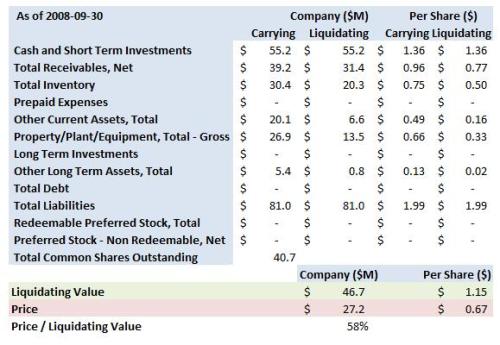
In our last blog post, we argued that INFS had a liquidation value of around $1.15 per share, 70% higher than its Friday close of $0.67. The company has cash and equivalents of around $55M and no debt as the summary financials demonstrate (the “Carrying” column shows the assets as they are carried in the financial statements, and the “Liquidating” column shows our estimate of the value of the assets in a liquidation):

Before

before-infs-summary

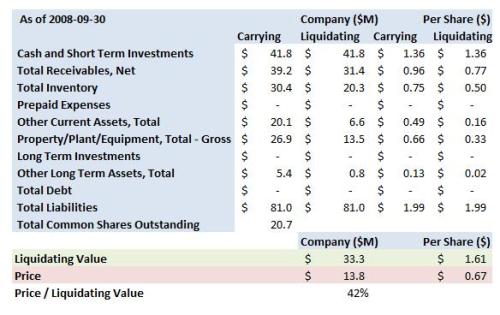
After

If INFS was to repurchase 50% of its stock (20M of its 40.7M shares currently on issue) at $0.67, it would cost INFS only $13.4M, leaving it with nearly $42M in cash on hand:

after-infs-summaryAfter the buy back, INFS’s per share liquidating value increases from $1.15 to $1.61 (a 40% increase).

There are very few investment opportunities that so quickly increase a company’s per share value. Given that management should know the company’s value better than the value of any other investment opportunity, it is also the most assured way of increasing a company’s per share value. There is simply no better way for an undervalued company to invest its excess cash than in its own stock.

Read Full Post »

« Newer Posts