Feeds:
Posts
Comments

Archive for the ‘Behavioral economics’ Category

Joel Greenblatt’s rationale for a value-weighted index can be paraphrased as follows:

  • Most investors, pro’s included, can’t beat the index. Therefore, buying an index fund is better than messing it up yourself or getting an active manager to mess it up for you.
  • If you’re going to buy an index, you might as well buy the best one. An index based on the market capitalization-weighted S&P500 will be handily beaten by an equal-weighted index, which will be handily beaten by a fundamentally weighted index, which is in turn handily beaten by a “value-weighted index,” which is what Greenblatt calls his “Magic Formula-weighted index.”

Yesterday we examined the first point. Today let’s examine the second.

Market Capitalization Weight < Equal Weight < Fundamental Weight < “Value Weight” (Greenblatt’s Magic Formula Weight)

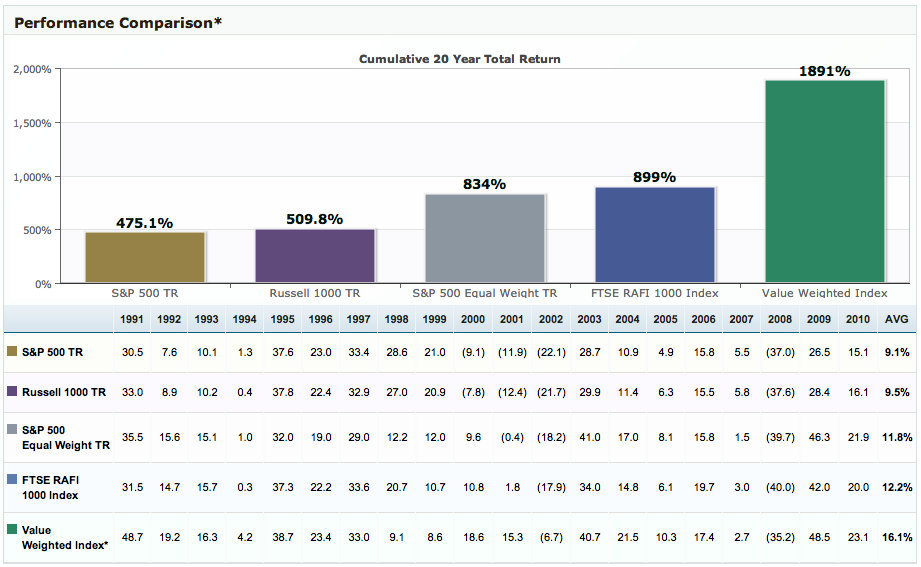
I think this chart is compelling:

It shows the CAGRs for a variety of indices over the 20 years to December 31, 2010. The first thing to note is that the equal weight index – represented by the &P500 Equal Weight TR – has a huge advantage over the market capitalization weighted S&P500 TR. Greenblatt says:

Over time, traditional market-cap weighted indexes such as the S&P 500 and the Russell 1000 have been shown to outperform most active managers. However, market cap weighted indexes suffer from a systematic flaw. The problem is that market-cap weighted indexes increase the amount they own of a particular company as that company’s stock price increases. As a company’s stock falls, its market capitalization falls and a market cap-weighted index will automatically own less of that company. However, over the short term, stock prices can often be affected by emotion. A market index that bases its investment weights solely on market capitalization (and therefore market price) will systematically invest too much in stocks when they are overpriced and too little in stocks when they are priced at bargain levels. (In the internet bubble, for example, as internet stocks went up in price, market cap-weighted indexes became too heavily concentrated in this overpriced sector and too underweighted in the stocks of established companies in less exciting industries.) This systematic flaw appears to cost market-cap weighted indexes approximately 2% per year in return over long periods.

The equal weight index corrects this systematic flaw to a degree (the small correction is still worth 2.7 percent per year in additional performance). Greenblatt describes it as randomizing the errors made by the market capitalization weighted index:

One way to avoid the problem of buying too much of overpriced stocks and too little of bargain stocks in a market-cap weighted index is to create an index that weights each stock in the index equally. An equally-weighted index will still own too much of overpriced stocks and too little of bargain-priced stocks, but in other cases, it will own more of bargain stocks and less of overpriced stocks. Since stocks in the index aren’t affected by price, errors will be random and average out over time. For this reason, equally weighted indexes should add back the approximately 2% per year lost to the inefficiencies of market-cap weighting.

While the errors are randomized in the equal weight index, they are still systematic – it still owns too much of the expensive stocks and too little of the cheap ones. Fundamental weighting corrects this error (again to a small degree). Fundamentally-weighted indexes weight companies based on their economic size using price ratios such as sales, book value, cash flow and dividends. The surprising thing is that this change is worth only 0.4 percent per year over equal weighting (still 3.1 percent per year over market capitalization weighting).

Similar to equally-weighted indexes, company weights are not affected by market price and therefore pricing errors are also random. By correcting for the systematic errors caused by weighting solely by market-cap, as tested over the last 40+ years, fundamentally-weighted indexes can also add back the approximately 2% lost each year due to the inefficiencies of market-cap weighting (with the last 20 years adding back even more!).

The Magic Formula / “value” weighted index has a huge advantage over fundamental weighting (+3.9 percent per year), and is a massive improvement over the market capitalization index (+7 percent per year). Greenblatt describes it as follows:

On the other hand, value-weighted indexes seek not only to avoid the losses due to the inefficiencies of market-cap weighting, but to add performance by buying more of stocks when they are available at bargain prices. Value-weighted indexes are continually rebalanced to weight most heavily those stocks that are priced at the largest discount to various measures of value. Over time, these indexes can significantly outperform active managers, market cap-weighted indexes, equally-weighted indexes, and fundamentally-weighted indexes.

I like Greenblatt’s approach. I’ve got two small criticisms:

1. I’m not sure that his Magic Formula weighting is genuine “value” weighting. Contrast Greenblatt’s approach with Dylan Grice’s “Intrinsic Value to Price” or “IVP” approach, which is a modified residual income approach, the details of which I’ll discuss in a later post. Grice’s IVP is a true intrinsic value calculation. He explains his approach in a way reminiscent of Buffett’s approach:

[How] is intrinsic value estimated? To answer, think first about how much you should pay for a going concern. The simplest such example would be that of a bank account containing $100, earning 5% per year interest. This asset is highly liquid. It also provides a stable income. And if I reinvest that income forever, it provides stable growth too. What’s it worth?

Let’s assume my desired return is 5%. The bank account is worth only its book value of $100 (the annual interest payment of $5 divided by my desired return of 5%). It may be liquid, stable and even growing, but since it’s not generating any value over and above my required return, it deserves no premium to book value.

This focus on an asset’s earnings power and, in particular, the ability of assets to earn returns in excess of desired returns is the essence of my intrinsic valuation, which is based on Steven Penman’s residual income model.1 The basic idea is that if a company is not earning a return in excess of our desired return, that company, like the bank account example above, deserves no premium to book value.

And it seems to work:
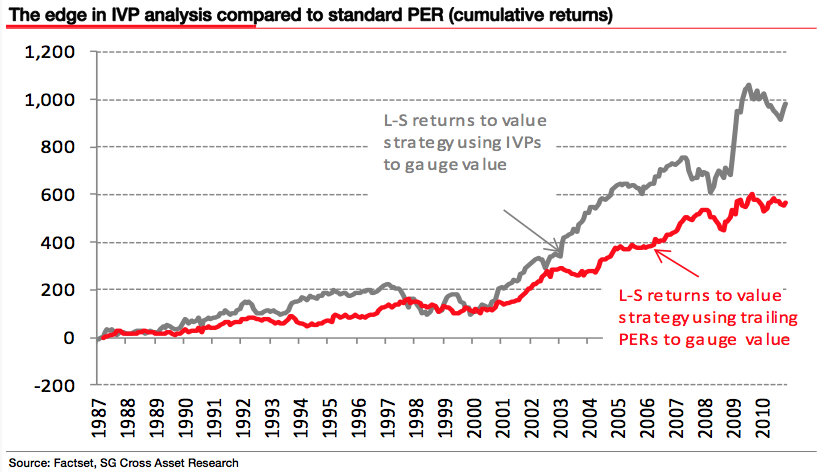
Grice actually calculates IVP while Greenblatt does not. Does that actually matter? Probably not. Even if it’s not what I think the average person understands real “value” weighting to be, Greenblatt’s approach seems to work. Why quibble over semantics?

2. As I’ve discussed before, Greenblatt’s Magic Formula return owes a great deal to his selection of EBIT/TEV as the price limb of his model. EBIT/TEV has been very well performed historically. If we were to substitute EBIT/TEV for the P/B, P/E, price-to-dividends, P/S, P/whatever, we’d have seen slightly better performance than the Magic Formula provided, but you might have been out of the game somewhere between 1997 to 2001.

Read Full Post »

Joel Greenblatt’s rationale for a value-weighted index can be paraphrased as follows:

  • Most investors, pro’s included, can’t beat the index. Therefore, buying an index fund is better than messing it up yourself or getting an active manager to mess it up for you.
  • If you’re going to buy an index, you might as well buy the best one. An index based on the market capitalization-weighted S&P500 will be handily beaten by an equal-weighted index, which will be handily beaten by a fundamentally weighted index, which is in turn handily beaten by a “value-weighted index,” which is what Greenblatt calls his “Magic Formula-weighted index.”

Let’s examine each of these points in some more depth.

Most investors, pro’s included, can’t beat the index.

The most famous argument against active management (at least by mutual funds) is by John Bogle, made before the Senate Subcommittee on Financial Management, the Budget, and International Security on November 3, 2003. Bogle’s testimony was on the then market-timing scandal, but he used the opportunity to speak more broadly on the investment industry.

Bogle argued that the average mutual fund should earn the market’s return less costs, but investors earn even less because they try to time the market:

What has been described as “a pathological mutation” in corporate America has transformed traditional owners capitalism into modern-day managers capitalism. In mutual fund America, the conflict of interest between fund managers and fund owners is an echo, if not an amplification, of that unfortunate, indeed “morally unacceptable”5 transformation. The blessing of our industry’s market-timing scandal—the good for our investors blown by that ill wind—is that it has focused the spotlight on that conflict, and on its even more scandalous manifestations: the level of fund costs, the building of assets of individual funds to levels at which they can no longer differentiate themselves, and the focus on selling funds that make money for managers while far too often losing money—and lots of it—for investors.

The net results of these conflicts of interest is readily measurable by comparing the long-term returns achieved by mutual funds, and by mutual fund shareholders, with the returns earned in the stock market itself. During the period 1984-2002, the U.S. stock market, as measured by the S&P 500 Index, provided an annual rate of return of 12.2%. The return on average mutual fund was 9.3%.6 The reason for that lag is not very complicated: As the trained, experienced investment professionals employed by the industry’s managers compete with one another to pick the best stocks, their results average out. Thus, the average mutual fund should earn the market’s return—before costs. Since all-in fund costs can be estimated at something like 3% per year, the annual lag of 2.9% in after-cost return seems simply to confirm that eminently reasonable hypothesis.

But during that same period, according to a study of mutual fund data provided by mutual fund data collector Dalbar, the average fund shareholder earned a return just 2.6% a year. How could that be? How solid is that number? Can that methodology be justified? I’d like to conclude by examining those issues, for the returns that fund managers actually deliver to fund shareholders serves as the definitive test of whether the fund investor is getting a fair shake.

This makes sense. Large mutual funds are the market, so on average earn returns that equate to the market average less costs. While it’s not directly on point, the huge penalty for timing and selection errors is worth exploring further.

Timing and selection penalties

Timing and selection penalties eat a huge proportion of the return. These costs are the result of investors investing in funds after good performance, and withdrawing from funds after poor performance:

It is reasonable to expect the average mutual fund investor to earn a return that falls well short of the return of the average fund. After all, we know that investors have paid a large timing penalty in their decisions, investing little in equity funds early in the period and huge amounts as the market bubble reached its maximum. During 1984-1988, when the S&P Index was below 300, investors purchased an average of just $11 billion per year of equity funds. They added another $105 billion per year when the Index was still below 1100. But after it topped the 1100 mark in 1998, they added to their holdings at an $218 billion(!) annual rate. Then, during the three quarters before the recent rally, with the Index below 900, equity fund investors actually withdrew $80 billion. Clearly, this perverse market sensitivity ill-served fund investors.

The Dalbar study calculates the returns on these cash flows as if they had been invested in the Standard & Poor’s 500 Index, and it is that simple calculation that produces the 2.6% annual investor return. Of course, it is not entirely fair to compare the return on those periodic investments over the years with initial lump-sum investments in the S&P 500 Stock Index and in the average fund. The gap between those returns and the returns earned by investors, then, is somewhat overstated. More appropriate would be a comparison of regular periodic investments in the market with the irregular (and counterproductive) periodic investments made by fund investors, which would reduce both the market return and the fund return with which the 2.6% return has been compared.

But if the gap is overstated, so is the 2.6% return figure itself. For investors did notselect the S&P 500 Index, as the Dalbar study implies. What they selected was an average fund that lagged the S&P Index by 2.9% per year. So they paid not only a timing penalty, but a selection penalty. Looked at superficially, then, the 2.6% return earned by investors should have been minus 0.3%.

Worse, what fund investors selected was not the average fund. Rather they invested most of their money, not only at the wrong time, but in the wrong funds. The selection penalty is reflected by the eagerness of investors as a group to jump into the “new economy” funds, and in the three years of the boom phase, place some $460 billion in those speculative funds, and pull $100 billion out of old-economy value funds—choices which clearly slashed investor returns.

I can imagine how difficult the investment decision is for mutual fund investors. How else does an investor in a mutual fund differentiate between similar funds other than by using historical return? I wouldn’t select a fund with a poor return. I’d put my money into the better one. Which is what everyone does, and why the average return sucks so bad. How bad? Bogle has calculated it below.

Dollar-weighted returns

The calculation of dollar-weighted returns speaks to the cost of timing and selection penalties:

Now let me give you some dollars-and-cents examples of how pouring money into the hot performers and hot sector funds of the era created a truly astonishing gap between (time-weighted) per-share fund returns and (dollar-weighted) returns that reflect what the funds actually earned for their owners. So let’s examine the astonishing gap between those two figures during the recent stock market boom and subsequent bust.

Consider first the “hot” funds of the day—the twenty funds which turned in the largest gains during the market upsurge. These funds had a compound return of 51% per year(!) in 1996-1999, only to suffer a compound annual loss of –32% during the subsequent three years. For the full period, they earned a net annualized return of 1.5%, and a cumulative gain of 9.2%. Not all that bad! Yet the investors in those funds, pouring tens of billions of dollars of their money in after the performance gains began, earned an annual return of minus 12.2%, losing fully 54% of their money during the period.

Now consider sector funds, specific arenas in which investors can (foolishly, as it turns out) make their bets. The computer, telecommunications, and technology sectors were the favorites of the day, but only until they collapsed. The average annual returns of 53% earned in the bull market by a group of the largest sector funds were followed by returns of minus 31% a year in the bear market, a net annual return of 3% and a cumulative gain of 19.2%. Again, not too bad. Yet sector fund investors, similar to the hot fund investors I described earlier, poured billions of dollars in the funds as they soared, and their annual return averaged –12.1%, a cumulative loss of 54% of their capital, too.

While the six-year annual returns for these funds were hardly horrible, both groups did lag the 4.3% annual return of the stock market, as measured by the largest S&P 500 Index Fund, which provided a 29% cumulative gain. But the investors in that index fund, taking no selection risk, minimized the stock market’s influence on their timing and earned a positive 2.4% return, building their capital by 15% during the challenging period. Index investor +15%; sector fund and hot fund investor –54%. Gap: 69 percentage points. It’s a stunning contrast.

Bogle’s conclusion says it all: Index investor +15%; sector fund and hot fund investor –54%. Gap: 69 percentage points. It’s a stunning contrast.

Tomorrow, why fundamental indexing beats the market.

Read Full Post »

Last week I looked at James Montier’s 2006 paper The Little Note That Beats The Market and his view that investors would struggle to implement the Magic Formula strategy for behavioral reasons, a view borne out by Greenblatt’s own research. This is not a criticism of the strategy, which is tractable and implementable, but an observation on how pernicious our cognitive biases are.

Greenblatt found that a compilation of all the “professionally managed” – read “systematic, automatic (hydromatic)” – accounts earned 84.1 percent over two years against the S&P 500 (up 62.7 percent). A compilation of “self-managed” accounts (the humans) over the same period showed a cumulative return of 59.4 percent, losing to the market by 20 percent, and to the machines by almost 25 percent. So the humans took this unmessupable system and messed it up. As predicted by Montier and Greenblatt.

Ugh.

Greenblatt, perhaps dismayed at the fact that he dragged the horses all the way to the water to find they still wouldn’t drink, has a new idea: value-weighted indexing (not to be confused with the academic term for market capitalization-weighting, which is, confusingly, also called value weighting).

I know from speaking to some of you that this is not a particularly popular idea, but I like it. Here’s Greenblatt’s rationale, paraphrased:

  • Most investors, pro’s included, can’t beat the index. Therefore, buying an index fund is better than messing it up yourself or getting an active manager to mess it up for you.
  • If you’re going to buy an index, you might as well buy the best one. An index based on the market capitalization-weighted S&P500 will be handily beaten by an equal-weighted index, which will be handily beaten by a fundamentally weighted index, which is in turn handily beaten by a “value-weighted index,” which is what Greenblatt calls his “Magic Formula-weighted index.”

I like the logic. I also think the data on the last point are persuasive. In chart form, the data on that last point look like this:

The value weighted index knocked out a CAGR of 16.1 percent per year over the last 20 years. Not bad.

Greenblatt explains his rationale in some depth in his latest book The Big Secret. The book has taken some heavy criticism on Amazon – average review is 3.2 out of 5 as of now – most of which I think is unwarranted (for example, “Like many others here, I do not exactly understand the reason for this book’s existence.”).

I’m going to take a close look at the value-weighted index this week.

Read Full Post »

In his 2006 paper, “The Little Note That Beats the Markets” James Montier backtested the Magic Formula and found that it supported the claim in the “Little Book That Beats The Market” that the Magic Formula does in fact beat the market:

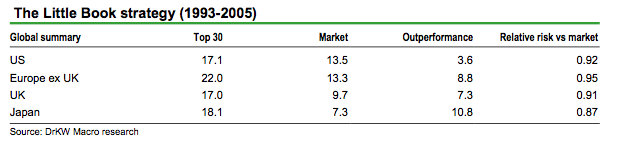
The results certainly support the notions put forward in the Little Book. In all the regions, the Little Book strategy substantially outperformed the market, and with lower risk! The range of outperformance went from just over 3.5% in the US to an astounding 10% in Japan.

The results of our backtest suggest that Greenblatt’s strategy isn’t unique to the US. We tested the Little Book strategy on US, European, UK and Japanese markets between 1993 and 2005. The results are impressive. The Little Book strategy beat the market (an equally weighted stock index) by 3.6%, 8.8%, 7.3% and 10.8% in the various regions respectively. And in all cases with lower volatility than the market! The outperformance was even better against the cap weighted indices.

Regardless, Montier felt that investors would struggle to implement the strategy for behavioral reasons:

Greenblatt suggests two reasons why investors will struggle to follow the Little Book strategy. Both ring true with us from our meeting with investors over the years. The first is “investing by using a magic formula may take away some of the fun”. Following a quant model or even a set of rules takes a lot of the excitement out of stock investing. What would you do all day if you didn’t have to meet companies or sit down with the sell side?

As Keynes noted “The game of professional investment is intolerably boring and over- exacting to anyone who is entirely exempt from the gambling instinct; whilst he who has it must pay to this propensity the appropriate toll”.

Secondly, the Little Book strategy, and all value strategies for that matter, requires patience. And patience is in very short supply amongst investors in today’s markets. I’ve even come across fund managers whose performance is monitored on a daily basis – congratulations are to be extended to their management for their complete mastery of measuring noise! Everyone seems to want the holy grail of profits without any pain. Dream on. It doesn’t exist.

Value strategies work over the long run, but not necessarily in the short term. There can be prolonged periods of underperformance. It is these periods of underperformance that ensure that not everyone becomes a value investor (coupled with a hubristic belief in their own abilities to pick stocks).

As Greenblatt notes “Imagine diligently watching those stocks each day as they do worse than the market averages over the course of many months or even years… The magic formula portfolio fared poorly relative to the market average in 5 out of every 12 months tested. For full-year periods… failed to beat the market averages once every four years”.

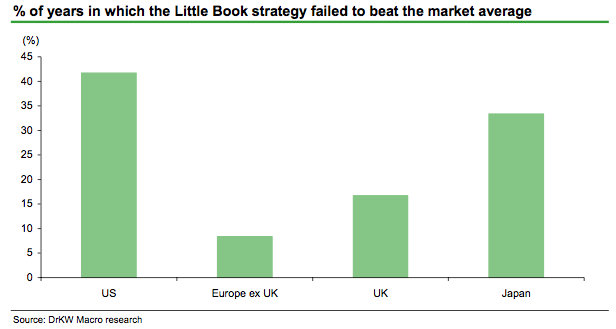
The chart below shows the proportion of years within Montier’s sample where the Magic Formula failed to beat the market  in each of the respective regions.

Europe and the UK show surprisingly few years of historic market underperformance. Montier says investors should “bear in mind the lessons from the US and Japan, where underperformance has been seen on a considerably more frequent basis:”

It is this periodic underperformance that really helps ensure the survival of such strategies. As long as investors continue to be overconfident in their abilities to consistently pick winners, and myopic enough that even a year of underperformance is enough to send them running, then strategies such as the Little Book are likely to continue to do well over the long run. Thankfully for those of us with faith in such models, the traits just described seem to be immutable characteristics of most people. As Warren Buffet said “Investing is simple but not easy”.

Montier has long promoted the theme that the reason value investors underperform value models is due to behavioral errors and cognitive biases. For example, in his excellent  2006 research report Painting By Numbers: An Ode To Quant Montier attributes most of the underperformance to overconfidence:

We all think that we know better than simple models. The key to the quant model’s performance is that it has a known error rate while our error rates are unknown.

The most common response to these findings is to argue that surely a fund manager should be able to use quant as an input, with the flexibility to override the model when required. However, as mentioned above, the evidence suggests that quant models tend to act as a ceiling rather than a floor for our behaviour. Additionally there is plenty of evidence to suggest that we tend to overweight our own opinions and experiences against statistical evidence.

Greenblatt has conducted a study on exactly this point. More tomorrow.

Read Full Post »

Since Joel Greenblatt’s introduction of the Magic Formula in the 2006 book “The Little Book That Beats The Market,” researchers have conducted a number of studies on the strategy and found it to be a market beater, both domestically and abroad.

Greenblatt claims returns in the order of 30.8 percent per year against a market average of 12.3 percent, and S&P500 return of 12.4 percent per year:

In Does Joel Greenblatt’s Magic Formula Investing Have Any Alpha? Meena Krishnamsetty finds that the Magic Formula generates annual alpha 4.5 percent:

It doesn’t beat the index funds by 18% per year and generate Warren Buffett like returns, but the excess return is still more than 5% per year. This is better than Eugene Fama’s DFA Small Cap Value Fund. It is also better than Lakonishok’s LSV Value Equity Fund.

Wes Gray’s Empirical Finance Blog struggles to repeat the study:

[We] can’t replicate the results under a variety of methods.

We’ve hacked and slashed the data, dealt with survivor bias, point-in-time bias, erroneous data, and all the other standard techniques used in academic empirical asset pricing analysis–still no dice.

In the preliminary results presented below, we analyze a stock universe consisting of large-caps (defined as being larger than 80 percentile on the NYSE in a given year). We test a portfolio that is annually rebalanced on June 30th, equal-weight invested across 30 stocks on July 1st, and held until June 30th of the following year.

Wes finds “serious outperformance” but “nowhere near the 31% CAGR outlined in the book.

Wes thinks that the outperformance of the Magic Formula is due to small cap stocks, which he tests in a second post “Magic Formula and Small Caps–The Missing Link?

Here are Wes’s results:

[While] the MF returns are definitely higher when you allow for smaller stocks, the results still do not earn anywhere near 31% CAGR.

Some closer observations of our results versus the results from the book:

For major “up” years, it seems that our backtest of the magic formula are very similar (especially from a statistical standpoint where the portfolios only have 30 names): 1991, 1995, 1997, 1999, 2001, and 2003.

The BIG difference is during down years: 1990, 1994, 2000, and 2002. For some reason, our backtest shows results which are roughly in line with the R2K (Russell 2000), but the MF results from the book present compelling upside returns during market downturns–so somehow the book results have negative beta during market blowouts? Weird to say the least…

James Montier, in a 2006 paper, “The Little Note That Beats the Markets” says that it works globally:

The results of our backtest suggest that Greenblatt’s strategy isn’t unique to the US. We tested the Little Book strategy on US, European, UK and Japanese markets between 1993 and 2005. The results are impressive. The Little Book strategy beat the market (an equally weighted stock index) by 3.6%, 8.8%, 7.3% and 10.8% in the various regions respectively. And in all cases with lower volatility than the market! The outperformance was even better against the cap weighted indices.

So the Magic Formula generates alpha, and beats the market globally, but not by as much as Greenblatt found originally, and much of the outperformance may be due to small cap stocks.

The Magic Formula and EBIT/TEV

Last week I took a look at the Loughran Wellman and Gray Vogel papers that found the enterprise multiple,  EBITDA/enterprise value, to be the best performing price ratio. A footnote in the Gray and Vogel paper says that they conducted the same research substituting EBIT for EBITDA and found “nearly identical results,” which is perhaps a little surprising but not inconceivable because they are so similar.

EBIT/TEV is one of two components in the Magic Formula (the other being ROC). I have long believed that the quality metric (ROC) adds little to the performance of the value metric (EBIT/EV), and that much of the success of the Magic Formula is due to its use of the enterprise multiple. James Montier seems to agree. In 2006, Montier backtested the strategy and its components in the US, Europe ex UK, UK and Japan:

The universe utilised was a combination of the FTSE and MSCI indices. This gave us the largest sample of data. We analysed the data from 1993 until the end of 2005. All returns and prices were measured in dollars. Utilities and Financials were both excluded from the test, for reasons that will become obvious very shortly. We only rebalance yearly.

Here are the results of Montier’s backtest of the Magic Formula:

And here’re the results for EBIT/TEV over the same period:

Huh? EBIT/TEV alone outperforms the Magic Formula everywhere but Japan?

Montier says that return on capital seems to bring little to the party in the UK and the USA:

In all the regions except Japan, the returns are higher from simply using a pure [EBIT/TEV] filter than they are from using the Little Book strategy. In the US and the UK, the gains from a pure [EBIT/TEV] strategy are very sizeable. In Europe, a pure [EBIT/TEV] strategy doesn’t alter the results from the Little Book strategy very much, but it is more volatile than the Little Book strategy. In Japan, the returns are lower than the Little Book strategy, but so is the relative volatility.

Montier suggests that one reason for favoring the Magic Formula over “pure” EBIT/TEV is career defence. The backtest covers an unusual period in the markets when expensive stocks outperformed for an extended period of time.

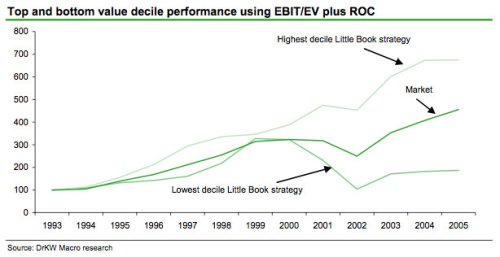
The charts below suggest a reason why one might want to have some form of quality input into the basic value screen. The first chart shows the top and bottom ranked deciles by EBIT/EV for the US (although other countries tell a similar story). It clearly shows the impact of the bubble. For a number of years, during the bubble, stocks that were simply cheap were shunned as we all know.


However, the chart below shows the top and bottom deciles using the combined Little Book strategy again for the US. The bubble is again visible, but the ROC component of the screen prevented the massive underperformance that was seen with the pure value strategy. Of course, the resulting returns are lower, but a fund manager following this strategy is unlikely to have lost his job.

In the second chart, note that it took eight years for the value decile to catch up to the glamour decile. They were tough times for value investors.

Conclusion

The Magic Formula beats the market, and generates real alpha. It might not beat the market by as much as Greenblatt found originally, and much of the outperformance is due to small cap stocks, but it’s a useful strategy. Better performance may be found in the use of pure EBIT/EV, but investors employing such a strategy could have very long periods of lean years.

Buy my book The Acquirer’s Multiple: How the Billionaire Contrarians of Deep Value Beat the Market from on Kindlepaperback, and Audible.

Here’s your book for the fall if you’re on global Wall Street. Tobias Carlisle has hit a home run deep over left field. It’s an incredibly smart, dense, 213 pages on how to not lose money in the market. It’s your Autumn smart read. –Tom Keene, Bloomberg’s Editor-At-Large, Bloomberg Surveillance, September 9, 2014.

Click here if you’d like to read more on The Acquirer’s Multiple, or connect with me on Twitter, LinkedIn or Facebook. Check out the best deep value stocks in the largest 1000 names for free on the deep value stock screener at The Acquirer’s Multiple®.


Read Full Post »

Another one for the annals of behavioral finance. From Handbook of the Economics of Finance, Chapter 18, A Survey Of Behavioral Finance by Nicholas BARBERIS, and Richard THALER, University of Chicago:

7.1 Insufficient diversification

A large body of evidence suggests that investors diversify their portfolio holdings much less than is recommended by normative models of portfolio choice. First, investors exhibit a pronounced “home bias” French and Poterba (1991) report that investors in the USA, Japan and the UK allocate 94%, 98%, and 82% of their overall equity investment, respectively, to domestic equities explain this fact on rational grounds [Lewis (1999)] Indeed, normative portfolio choice models that take human capital into account typically advise investors to short their national stock market, because of its high correlation with their human capital [Baxter and Jermann (1997)].

At the very least, it’s an argument for investing globally.

Read Full Post »

Michael Mauboussin appeared Friday on Consuelo Mack’s WealthTrack to discuss several of the ideas in his excellent book, Think Twice. Particularly compelling is his story about Triple Crown prospect Big Brown and the advantage of the “outside view” – the statistical one – over the “inside view” – the specific, anecdotal one (excerpted from the book):

June 7, 2008 was a steamy day in New York, but that didn’t stop fans from stuffing the seats at Belmont Park to see Big Brown’s bid for horseracing’s pinnacle, the Triple Crown. The undefeated colt had been impressive. He won the first leg of the Triple Crown, the Kentucky Derby, by 4 ¾ lengths and cruised to a 5 ¼-length win in the second leg, the Preakness.

Oozing with confidence, Big Brown’s trainer, Rick Dutrow, suggested that it was a “foregone conclusion” that his horse would take the prize. Dutrow was emboldened by the horse’s performance, demeanor, and even the good “karma” in the barn. Despite the fact that no horse had won the Triple Crown in over 30 years, the handicappers shared Dutrow’s enthusiasm, putting 3-to-10 odds—almost a 77 percent probability—on his winning.

The fans came out to see Big Brown make history. And make history he did—it just wasn’t what everyone expected. Big Brown was the first Triple Crown contender to finish dead last.

The story of Big Brown is a good example of a common mistake in decision making: psychologists call it using the “inside” instead of the “outside” view.

The inside view considers a problem by focusing on the specific task and by using information that is close at hand. It’s the natural way our minds work. The outside view, by contrast, asks if there are similar situations that can provide a statistical basis for making a decision. The outside view wants to know if others have faced comparable problems, and if so, what happened. It’s an unnatural way to think because it forces people to set aside the information they have gathered.

Dutrow and others were bullish on Big Brown given what they had seen. But the outside view demands to know what happened to horses that had been in Big Brown’s position previously. It turns out that 11 of the 29 had succeeded in their Triple Crown bid in the prior 130 years, about a 40 percent success rate. But scratching the surface of the data revealed an important dichotomy. Before 1950, 8 of the 9 horses that had tried to win the Triple Crown did so. But since 1950, only 3 of 20 succeeded, a measly 15 percent success rate. Further, when compared to the other six recent Triple Crown aspirants, Big Brown was by far the slowest. A careful review of the outside view suggested that Big Brown’s odds were a lot longer than what the tote board suggested. A favorite to win the race? Yes. A better than three-in-four chance? Bad bet.

Mauboussin on WealthTrack:

Hat Tip Abnormal Returns.


Read Full Post »

In a post in late November last year, Testing the performance of price-to-book value, I set up a hypothetical equally-weighted portfolio of the cheapest price-to-book stocks with a positive P/E ratio discovered using the Google Screener, which I called the “Greenbackd Contrarian Value Portfolio”.

The hypothetical portfolio is based on Josef Lakonishok, Andrei Shleifer, and Robert Vishny’s (“LSV”) Two-Dimensional Classification from their landmark Contrarian Investment, Extrapolation and Risk paper.

The portfolio has been operating for a little over 3 quarters, so I thought I’d check in and see how it’s going.

Here is the Tickerspy portfolio tracker for the Greenbackd Contrarian Value Portfolio showing how each individual stock is performing:

And the chart showing the performance of the portfolio against the S&P500:

The portfolio is up about 22.4% in total and 20.9% against the index. It’s volatile, but I’ll take volatility for a ~20% gain in an essentially flat market. The results are tracking approximately in line with the results one might expect from LSV’s research.

[Full Disclosure:  No positions. This is neither a recommendation to buy or sell any securities. All information provided believed to be reliable and presented for information purposes only. Do your own research before investing in any security.]

Read Full Post »

Zero Hedge has a great post on the quarterly Goldman Hedge Fund Trend Monitor. The most interesting aspect of the piece is the relative performance of stocks with the highest concentration of hedge fund holders against the performance of stocks with the lowest concentration of hedge fund holders:

We define “concentration” as the share of market capitalization owned in aggregate by hedge funds. The strategy of buying the 20 most concentrated stocks has a strong track record over more than eight years. Since 2001, the strategy has outperformed the market by an average of 312 bp per quarter (not annualized). The back test suggests that this strategy works in an upward trending market but tends to perform poorly during choppy or flat markets. The stocks in the basket tend to be mid-caps (at the lower end of the S&P 500 capitalization distribution), which have outperformed large-caps from 2004 to 2007, contributing to the attractive back-test results. The baskets are not sector neutral versus the S&P 500.

As you might have guessed, the “least concentrated” basket has outperformed the “most concentrated” portfolio since 2007:

The stocks with the “most concentrated” hedge fund ownership have outperformed the S&P 500 in 2010 ytd by 191 bp (+1.1% vs. -0.8%). The “most concentrated” stocks underperformed steadily for most of 2007 and 2008, but significantly outperformed in 2009. Our “most concentrated” basket outperformed the S&P 500 by 237 bp in 1Q 2010 (+7.7% vs. +5.4%) but lagged by 303 bp in 2Q 2010 (-14.5% vs. -11.4%).

Our “least concentrated” basket has outperformed the S&P 500 in 2010 ytd by 693 bp (+6.1% vs. -0.8%). The “least concentrated” basket outpaced the market by 50 bp in 1Q 2010 (+5.9% vs. +5.4%) and by 440 bp in 2Q (-7.0% vs. -11.4%).

So which stocks are currently in the “least” and “most” concentrated baskets:

Read the article.

Read Full Post »

Richard H. Thaler, Chicago School economist and co-author (along with Werner F.M. DeBondt) of Further Evidence on Investor Overreaction and Stock Market Seasonality, and the “Thaler” in Fuller & Thaler Asset Management, has written an opinion piece for the NYTimes.com “The Overconfidence Problem in Forecasting.”

Thaler says:

BUSINESSES in nearly every industry were caught off guard by the Great Recession. Few leaders in business — or government, for that matter — seem to have even considered the possibility that an economic downturn of this magnitude could happen.

What was wrong with their thinking? These decision-makers may have been betrayed by a flaw that has been documented in hundreds of studies: overconfidence.

Most of us think that we are “better than average” in most things. We are also “miscalibrated,” meaning that our sense of the probability of events doesn’t line up with reality. When we say we are sure about a certain fact, for example, we may well be right only half the time.

He then discusses a recent paper that shows that overconfidence permeates the top reaches of large companies:

In that paper, three financial economists — Itzhak Ben-David of Ohio State University and John R. Graham and Campbell R. Harvey of Duke — found that chief financial officers of major American corporations are not very good at forecasting the future. The authors’ investigation used a quarterly survey of C.F.O.’s that Duke has been running since 2001. Among other things, the C.F.O.’s were asked about their expectations for the return of the Standard & Poor’s 500-stock index for the next year — both their best guess and their 80 percent confidence limit. This means that in the example above, there would be a 10 percent chance that the return would be higher than the upper bound, and a 10 percent chance that it would be less than the lower one.

It turns out that C.F.O.’s, as a group, display terrible calibration. The actual market return over the next year fell between their 80 percent confidence limits only a third of the time, so these executives weren’t particularly good at forecasting the stock market. In fact, their predictions were negatively correlated with actual returns. For example, in the survey conducted on Feb. 26, 2009, the C.F.O.’s made their most pessimistic predictions, expecting a market return of just 2.0 percent, with a lower bound of minus 10.2 percent. In fact, the market soared 42.6 percent over the next year.

Thaler concludes:

Two lessons emerge from these papers. First, we shouldn’t expect that the competition to become a top manager will weed out overconfidence. In fact, the competition may tend to select overconfident people. One route to the corner office is to combine overconfidence with luck, which can be hard to distinguish from skill. C.E.O.’s who make it to the top this way will often stumble when their luck runs out.

The second lesson comes from Mark Twain: “It ain’t what you don’t know that gets you into trouble. It’s what you know for sure that just ain’t so.”

Read the article.

For more on Richard H. Thaler, see the post archive.

Read Full Post »

« Newer Posts - Older Posts »