Feeds:
Posts
Comments

Archive for January, 2010

One of the most fascinating examples of the phenomenon of mean reversion was identified by Werner F.M. DeBondt and Richard H. Thaler in Further Evidence on Investor Overreaction and Stock Market Seasonality. DeBondt and Thaler examined the relative performance of quintiles of stocks on the NYSE and AMEX ranked according to book value. As an adjunct to the main study, one of the variables they analyzed was the relative earnings performance of stocks in the lowest and highest price-to-book quintiles.

DeBondt and Thaler’s findings are as interesting as they are counter-intuitive. Stocks in the lowest price-to-book quintile (the cheapest stocks) grew their earnings faster than the stocks in the highest price-to-book quintile (the most expensive stocks). Tweedy Browne set out DeBondt and Thaler’s findings in Table 3 below, which describes the average earnings per share for companies in the lowest and highest quintile of price-to-book value in the three years prior to selection and the four years subsequent to selection:

tweedy-table-3

In the four years after the date of selection, the earnings of the companies in the lowest price-to-book value quintile (average price-to-book value of 0.36) increase 24.4%, more than the companies in the highest price-to-book value quintile (average price-to-book value of 3.42), whose earnings increased only 8.2%. DeBondt and Thaler attribute the earnings outperformance of the companies in the lowest quintile to mean reversion, which Tweedy Browne described as the observation that “significant declines in earnings are followed by significant earnings increases, and that significant earnings increases are followed by slower rates of increase or declines.”

The implication here is that not only does the price of stocks that are cheap relative to other stocks regress to the mean, but the underlying performance does too. That’s an amazing finding. There’s really no good reason why low price-to-book should be such a good predictor for short and mid-term earnings growth. I’ve spent some time thinking about why this might be so, and the only possible explanation I can come up with is magic. Nothing else fits.

Read Full Post »

The rationale for a quantitative approach to investing was first described by James Montier in his 2006 research report Painting By Numbers: An Ode To Quant:

  1. Simple statistical models outperform the judgements of the best experts
  2. Simple statistical models outperform the judgements of the best experts, even when those experts are given access to the simple statistical model.

In my experience, the immediate response to this statement in the investing context is always two-fold:

  1. What am I paying you for if I can build the model portfolio myself?
  2. Isn’t this what Long-Term Capital Management did?

Or, as Montier has it:

We find it ‘easy’ to understand the idea of analysts searching for value, and fund managers rooting out hidden opportunities. However, selling a quant model will be much harder. The term ‘black box’ will be bandied around in a highly pejorative way. Consultants may question why they are employing you at all, if ‘all’ you do is turn up and run the model and then walk away again.

It is for reasons like these that quant investing is likely to remain a fringe activity, no matter how successful it may be.

The response to these questions is as follows:

  1. It takes some discipline and faith in the model not to meddle with it. You’re paying the manager to keep his grubbly little paws off the portfolio. This is no small feat for a human being filled with powerful limbic system drives, testosterone (significant in ~50% of cases), dopamine and dopamine receptors and various other indicators interesting to someone possessing the DSM-IV-TR, all of which potentially lead to overconfidence and then to interference. You’re paying for the absence of interference, or the suppression of instinct. More on this in a moment.
  2. I’m talking about a simple model with a known error rate (momentarily leaving aside the Talebian argument about the limits of knowledge). My understanding is that LTCM’s problems were a combination of an excessively complicated, but insufficiently robust (in the Talebian sense) model, and, in any case, an inability to faithfully follow that model, which is failure of the first point above.

Suppressing intuition

We humans are clearly possessed of a powerful drive to allow our instincts to override our models. Andrew McAfee at Harvard Business Review has a recent post, The Future of Decision Making: Less Intuition, More Evidence, which essentially recapitulates Montier’s findings in relation to expertise, but McAfee frames it in the context of human intuition. McAfee discusses many examples demonstrating that intuition is flawed, and then asks how we can improve on intuition. His response? Statistical models, with a nod to the limits of the models.

Do we have an alternative to relying on human intuition, especially in complicated situations where there are a lot of factors at play? Sure. We have a large toolkit of statistical techniques designed to find patterns in masses of data (even big masses of messy data), and to deliver best guesses about cause-and-effect relationships. No responsible statistician would say that these techniques are perfect or guaranteed to work, but they’re pretty good.

And I love this story, which neatly captures the point at issue:

The arsenal of statistical techniques can be applied to almost any setting, including wine evaluation. Princeton economist Orley Ashenfleter predicts Bordeaux wine quality (and hence eventual price) using a model he developed that takes into account winter and harvest rainfall and growing season temperature. Massively influential wine critic Robert Parker has called Ashenfleter an “absolute total sham” and his approach “so absurd as to be laughable.” But as Ian Ayres recounts in his great book Supercrunchers, Ashenfelter was right and Parker wrong about the ’86 vintage, and the way-out-on-a-limb predictions Ashenfelter made about the sublime quality of the ’89 and ’90 wines turned out to be spot on.

Overall, we get inferior decisions and outcomes in crucial situations when we rely on human judgment and intuition instead of on hard, cold, boring data and math. This may be an uncomfortable conclusion, especially for today’s intuitive experts, but so what? I can’t think of a good reason for putting their interests over the interests of patients, customers, shareholders, and others affected by their judgments.

How do we proceed? McAfee has some thoughts:

So do we just dispense with the human experts altogether, or take away all their discretion and tell them to do whatever the computer says? In a few situations, this is exactly what’s been done. For most of us, our credit scores are an excellent predictor of whether we’ll pay back a loan, and banks have long relied on them to make automated yes/no decisions about offering credit. (The sub-prime mortgage meltdown stemmed in part from the fact that lenders started ignoring or downplaying credit scores in their desire to keep the money flowing. This wasn’t intuition as much as rank greed, but it shows another important aspect of relying on algorithms: They’re not greedy, either).

In most cases, though, it’s not feasible or smart to take people out of the decision-making loop entirely. When this is the case, a wise move is to follow the trail being blazed by practitioners of evidence-based medicine , and to place human decision makers in the middle of a computer-mediated process that presents an initial answer or decision generated from the best available data and knowledge. In many cases, this answer will be computer generated and statistically based. It gives the expert involved the opportunity to override the default decision. It monitors how often overrides occur, and why. it feeds back data on override frequency to both the experts and their bosses. It monitors outcomes/results of the decision (if possible) so that both algorithms and intuition can be improved.

Over time, we’ll get more data, more powerful computers, and better predictive algorithms. We’ll also do better at helping group-level (as opposed to individual) decision making, since many organizations require consensus for important decisions. This means that the ‘market share’ of computer automated or mediated decisions should go up, and intuition’s market share should go down. We can feel sorry for the human experts whose roles will be diminished as this happens. I’m more inclined, however, to feel sorry for the people on the receiving end of today’s intuitive decisions and judgments.

The quantitative value investor

To apply this quantitative approach to value investing, we would need to find simple quantitative value-based models that have outperformed the market. That is not a difficult process. We need go no further than the methodologies outlined in Oppenheimer’s Ben Graham’s Net Current Asset Values: A Performance Update or Lakonishok, Shleifer, and Vishny’s Contrarian Investment, Extrapolation and Risk. I believe that a quantitative application of either of those methodologies can lead to exceptional long-term investment returns in a fund. The challenge is making the sample mean (the portfolio return) match the population mean (the screen). As we will see, the real world application of the quantitative approach is not as straight-forward as we might initially expect because the act of buying (selling) interferes with the model.

Read Full Post »

Greenbackd is a proud sponsor of the 2010 5th Annual Value Investing Congress West and I’ve been able to secure a special discount for Greenbackd attendees.

Though the Congress is 5 months away, over 50% of the seats have already been reserved. Register by midnight next January 21, 2010 with discount code P10GB4 and you’ll save $1,600 off the regular price of admission.

Every year hundreds of people from around the world converge at this not-to-be-missed event to network with other savvy, sophisticated investors and learn from some of world’s most successful money managers. At the upcoming event, all-star investors will share their thoughts on today’s tumultuous markets and present their best, actionable investment ideas. Just one idea could earn you outstanding returns.

The confirmed speakers are an impressive bunch, including:

  • John BurbankPassport Capital
  • Patrick DegorceThélème Partners
  • Bruce BerkowitzFairholme Capital Management
  • Paul SonkinThe Hummingbird Value Funds
  • Mohnish PabraiPabrai Investment Funds
  • Thomas RussoGardner, Russo & Gardner
  • David NierenbergThe D3 Family Funds
  • Lloyd KhanerKhaner Capital
  • J. Carlo CannellCannell Capital
  • Whitney Tilson & Glenn TongueT2 Partners

See a slide show of the last Value Investing Congress in New York.

Register here. You must use discount code P10GB4 to receive the full discount. This discount expires at midnight next Thursaday, January 21st, 2010.

You’ve got exactly one week to get signed up with these savings.

The regular price of the two day event is $4,295. Greenbackd readers pay $2,695. That’s a 37% discount and savings of $1,600. If you’re from out of town, the Congress has also negotiated lower room rates at the Langham Huntington for attendees.

Make sure you get our exclusive discount for the Value Investing Congress here. Remember that you MUST use the discount code P10GB4 to receive the full discount.

Read Full Post »

One of the themes that I want to explore in some depth is “pure” contrarian investing, which is investing relying solely on the phenomenon of reversion to the mean. I’m calling it “pure” contrarian investing to distinguish it from the contrarian investing that is value investing disguised as contrarian investing. The reason for making this distinction is that I believe Lakonishok, Shleifer, and Vishny’s characterization of the returns to value as contrarian returns is a small flaw in Contrarian Investment, Extrapolation and Risk. I argue that it is a problem of LSV’s definition of “value.” I believe that LSV’s results contained the effects of both pure contrarianism (mean reversion) and value. While mean reversion and value were both observable in the results, I don’t believe that they are the same strategy, and I don’t believe that the returns to value are solely due to mean reversion. The returns to value stand alone and the returns to a mean reverting strategy also stand alone. In support of this contention I set out the returns to a simple pure contrarian strategy that does not rely on any calculation of value.

Contrarianism relies on mean reversion

The grundnorm of contrarianism is mean reversion, which is the idea that stocks that have performed poorly in the past will perform better in the future and stocks that have performed well in the past will not perform as well. Graham, quoting Horace’s Ars Poetica, described it thus:

Many shall be restored that now are fallen and many shall fall that are now in honor.

LSV argue that most investors don’t fully appreciate the phenomenon, which leads them to extrapolate past performance too far into the future. In practical terms it means the contrarian investor profits from other investors’ incorrect assessment that stocks that have performed well in the past will perform well in the future and stocks that have performed poorly in the past will continue to perform poorly.

LSV’s definition of value is a problem

LSV’s contrarian model argues that value strategies produce superior returns because of mean reversion. Value investors would argue that value strategies produce superior returns because they are exchanging of one store of value (say, 67c) for a greater store of value (say, a stock worth say $1). The problem is one of definition.

In Contrarian Investment, Extrapolation and Risk LSV categorized the stocks on simple one-variable classifications as either “glamour” or “value.” Two of those variables were price-to-earnings and price-to-book (there were three others). Here is the definitional problem: A low price-to-earnings multiple or a low price-to-book multiple does not necessarily connote value and the converse is also true, a high price-to-earnings multiple or a high price-to-book multiple does not necessarily indicate the absence of value.

John Burr Williams 1938 treatise The Theory of Investment Value is still the definitive word on value. Here is Buffett’s explication of Williams’s theory in his 1992 letter to shareholders, which I use because he puts his finger right on the problem with LSV’s methodology:

In The Theory of Investment Value, written over 50 years ago, John Burr Williams set forth the equation for value, which we condense here: The value of any stock, bond or business today is determined by the cash inflows and outflows – discounted at an appropriate interest rate – that can be expected to occur during the remaining life of the asset. Note that the formula is the same for stocks as for bonds. Even so, there is an important, and difficult to deal with, difference between the two: A bond has a coupon and maturity date that define future cash flows; but in the case of equities, the investment analyst must himself estimate the future “coupons.” Furthermore, the quality of management affects the bond coupon only rarely – chiefly when management is so inept or dishonest that payment of interest is suspended. In contrast, the ability of management can dramatically affect the equity “coupons.”

The investment shown by the discounted-flows-of-cash calculation to be the cheapest is the one that the investor should purchase – irrespective of whether the business grows or doesn’t, displays volatility or smoothness in its earnings, or carries a high price or low in relation to its current earnings and book value. Moreover, though the value equation has usually shown equities to be cheaper than bonds, that result is not inevitable: When bonds are calculated to be the more attractive investment, they should be bought.

What LSV observed in their paper may be attributable to contrarianism (mean reversion), but it is not necessarily attributable to value. While I think LSV’s selection of price-to-earnings and price-to-book as indicia of value in the aggregate probably means that value had some influence on the results, I don’t think they can definitively say that the cheapest stocks were in the “value” decile and the most expensive stocks were in the “glamour” decile. It’s easy to understand why they chose the indicia they did: It’s impractical to consider thousands of stocks and, in any case, impossible to reach a definitive value for each of those stocks (we would all assess the value of each stock in a different way). This leads me to conclude that the influence of value was somewhat weak, and what they were in fact observing was the influence of mean reversion. It doesn’t therefore seem valid to say that the superior returns to value are due to mean reversion when they haven’t tested for value. It does, however, raise an interesting question for investors. Can you invest solely relying on reversion to the mean? It seems you might be able to do so.

Pure contrarianism

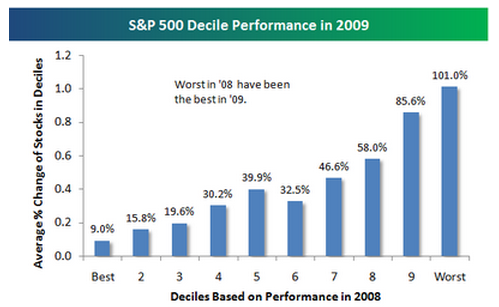
Pure contrarian investing is investing relying solely on the phenomenon of reversion to the mean without making an assessment of value. Is it possible to observe the effects of mean reversion by constructing a portfolio on a basis other than some indicia of value? It is, and the Bespoke Investment Group has done all the heavy lifting for us. Bespoke constructed from the S&P500 ten portfolios with 50 stocks in each on the basis of stock performance in 2008. They then tracked the performance of those stocks in 2009. The result?

Many of the stocks that got hit the hardest last year came roaring back this year, and the numbers below help quantify this.  As shown, the 50 stocks in the S&P 500 that did the worst in 2008 are up an average of 101% in 2009!  The 50 stocks that did the best in 2008 are up an average of just 9% in 2009.  2009 was definitely a year when buying the losers worked.

It’s a stunning outcome, and it seems that the portfolios (almost) performed in rank order. While there may be a value effect in these results, the deciles were constructed on price performance alone. This would seem to indicate that, at an aggregate level at least, mean reversion is a powerful phenomenon and a pure contrarian investment strategy relying on mean reversion should work.

Read Full Post »

As I foreshadowed yesterday, there are several related themes that I wish to explore on Greenbackd. These three ideas are as follows:

  1. Quantitative value investing
  2. Pure contrarian investing
  3. Problems with the received wisdom on value investment

Set out below is a brief overview of each.

A quantitative approach to value investment

I believe that James Montier’s 2006 research report Painting By Numbers: An Ode To Quant presents a compelling argument for a quantitative approach to value investing. Simple statistical or quantitative models have worked well in the context of value investing, and I think there is ample evidence that this is the case. (Note that simple is the operative word: I’m not advocating anything beyond basic arithmetic or the most elementary algebra.) Graham was said to know little about the businesses of the net current asset value stocks he bought. It seems that any further analysis beyond determining the net current asset value was unnecessary for him (although he does discuss in Security Analysis other considerations for the discerning security analyst). Perhaps that should be good enough for us.

As Oppenheimer’s Ben Graham’s Net Current Asset Values: A Performance Update paper demonstrates, a purely mechanical application of Graham’s net current asset value criterion generated a mean return between 1970 and 1983  of “29.4% per year versus 11.5% per year for the NYSE-AMEX Index.” Oppenheimer puts that return in context thus, “[one] million dollars invested in the net current asset portfolio on December 31, 1970 would have increased to $25,497,300 by December 31, 1983.” That’s a stunning return. It would have put you in elite company if you had been running a fund blindly following Oppenheimer’s methodology from the date of publication of the paper. Other papers examining the returns over different periods and in different markets written after Oppenheimer’s paper have found similar results (one of the papers is by Montier and I will be discussing it in some detail in the near future). The main criticism laid at the feet of the net net method is that it can only accommodate a small amount of capital. It is an individual investor or micro fund strategy. Simple strategies able to accommodate more capital are described in Lakonishok, Shleifer, and Vishny’s Contrarian Investment, Extrapolation and Risk. In that paper, the authors found substantial outperformance through the use of only one or two value-based variables, whether they be price-to-book, price-to earnings, price-to-cash flow or price-to-sales.

I believe these papers (and others I have discussed in the past) provide compelling evidence for quantitative value investing, but let me flip it around. Why not invest solely on the basis of some simple value-based variables? Because you think you can compound your portfolio faster by cherry-picking the better stocks on the screen? This despite what Montier says in Painting By Numbers about quant models representing “a ceiling in performance (from which we detract) rather than a floor (to which we can add)”? Bonne chance to you if that is the case, but you are one of the lucky few. The preponderance of data suggest that most investors will do better following a simple model.

Pure contrarian investing

By “pure” contrarian investing, I mean contrarian investing that is not value investing disguised as contrarian investing. LSV frame their Contrarian Investment, Extrapolation and Risk findings in the context of “contrarianism,” arguing that value strategies produce superior returns because most investors don’t fully appreciate the phenomenon of mean reversion, which leads them to extrapolate past performance too far into the future. LSV argues that investors can profit from the market’s (incorrect) assessment that stocks that have performed well in the past will perform well in the future and stocks that have performed poorly in the past will continue to perform poorly. If that is in fact the case, then contrarian strategies that don’t rely on value should also work. Can I simply buy some list of securities at a periodic low (52 weeks or whatever) and sell some list of securities at a periodic high (again, say 52 weeks) and expect to generate “good” (i.e. better than just hugging the index) returns? If not, it’s not contrarianism, but value that is the operative factor.

It is in this context that I want to explore Nassim Nicholas Taleb’s “naive empiricist.” If contrarianism appears to work as a stand alone strategy, how do I know that I’m not mining the data? I also want to consider whether the various papers written about value investment discussed on Greenbackd and the experiences of Buffett, Schloss, Klarman et al “prove” that value works. Taleb would say they don’t.  How, then, do I proceed if I don’t know whether the phenomenon we’re observing is real or a trick? We try to build a portfolio able to withstand stresses, or changes in circumstance. How do we do that? The answer is some combination of employing Graham’s margin of safety, diversifying, avoiding debt and holding an attitude like Montaigne’s “Que sais-je?”‘ (“What do I know?”). It’s hardly radical stuff, but, what I believe is interesting, is how well such a sceptical and un-confident approach marries with quantitative investing.

Problems with the received wisdom on value investment

Within the value investment community there are some topics that are verboten. It seems that some thoughts were proscribed some time ago, and we are now no longer even allowed to consider them. I don’t want delve into them now, other than to say that I believe they deserve some further consideration. Some principles are timeless, others are prisoners of the moment, and it is often impossible to distinguish between the two. How can we proceed if we don’t subject all received wisdom to further consideration to determine which rules are sound, and which we can safely ignore? I don’t believe we can. I’ll therefore be subjecting those topics to analysis in any attempt to find those worth following. If I’m going to make an embarrassing mistake, I’m betting it’s under this heading.

There are several other related topics that I wish to consider, but they are tangential to the foregoing three.

Read Full Post »

Welcome back to Greenbackd for 2010. I hope the holidays were as good to you as they were to me.

The break has afforded me the opportunity to gain some perspective on the direction of Greenbackd. Away from the regular posting schedule I found the time to write some Jerry McGuire The Things We Think and Do Not Say treatises, quickly consigning most of them to trash so that they couldn’t come back to haunt me at a later, more lucid and, perhaps, sober moment (I did say the holiday was good to me). Some (heavily edited) remnants of those rambling essays will filter through onto this site over the coming weeks. I’m charged up about several topics that I want to explore in some depth, which is a change from the net net ennui that was starting to creep in before the break.

The beauty of the Graham net net as a subject for investment is its simplicity. Conversely, that same characteristic makes it a poor subject for extended contemplation and writing. There is a limit to which the universe of Graham net nets, even those entwined in activist or special situations, can be subject to analysis before the returns to additional analysis diminish asymptotically to approaching zero. Note that in this context I don’t mean investment returns, but returns to the psyche, good feelings, the avoidance of boredom…in other words, the really important stuff. The investment returns in that area are good, but we all already know that to be the case. What am I contributing if I keep digging up undervalued net nets? Not much. Graham invented it. Oppenheimer proved it. Jon Heller writes about it better than anyone else. The rest of us are just regurgitating their work.

Really, this is old news. Greenbackd passed the point some time ago at which it was possible to hold off the tedium of net nets and evolved organically to embrace several related topics. I still love the activist dogfight for control or influence and I think a well-written 13D makes for excellent copy. I also still love finding blatantly misplaced securities, each one a little slash at the heart of the EMH. Greenbackd will continue to study individual securities and follow interesting activist situations, however, it will not be the sole focus of the site. For me, there are more interesting problems to tackle. My concern has been whether Greenbackd can contain the new topics or whether I’ll just annoy old Greenbackd readers with the new direction. My favorite blogger wrestled with same issue several years ago, and so I’m using her experience as a guide.

I think the smartest thinker and most lucid writer in the financial and political (in the broadest sense of the word) sphere is Marla Singer at Zero Hedge and occasionally Finem Respice (formerly Equity Private at Going Private). Marla, then writing as Equity Private, started out with a narrowly focussed blog about the “sardonic memoirs of a private equity professional,” but gradually expanded to cover only tangentially related topics like the role of government, economics, philosophy, literature, art, duelling, card sharping and cargo cults (the implications of which won’t be lost on most readers). For me, it was a thrilling departure, but Marla must have felt that Equity Private was too limited, and created Finem Respice before moving on to Zero Hedge. I was only too happy to follow, but I would have been equally happy for Equity Private to keep posting as Equity Private. (As an aside, I recommend following Marla at Zero Hedge. Her ability to tease out the hidden story from some granular detail in legislation or data is simply breathtaking and unmatched in the mainstream media.)

I’ll persist with Greenbackd because I like this boat, but it will be embarking for new shores. Pure net net investors are well served by other sites, so it’s probable that some readers will depart. This site will always be dedicated to deep value, but I want to find some uncharted territory. The voyage might not yield any new land, but I think it will be more fun than continuing to orienteer on Graham’s old maps. I have an inkling there is something interesting out there at the intersection of Montier, Montaigne, Taleb and Graham. Tomorrow, I’ll start to sketch out the new world. It also coincides with a personal change for me. Working in someone else’s fund has been enjoyable, but I feel it’s time to graduate to principal. I’m presently considering entering into an established partnership or starting my own fund. Whichever direction I go will likely have some influence on Greenbackd.

Read Full Post »

« Newer Posts