Feeds:
Posts
Comments

Archive for May, 2009

Digirad Corporation (NASDAQ:DRAD) has filed its 10Q for the quarter ended March 31, 2009.

We’ve been following DRAD (see our post archive here) because it is an undervalued asset play with a plan to sell assets and buy back its stock. The stock is up more than 43% since we started following it to close yesterday at $1.26, giving the company a market capitalization of $23.9M. We initially estimated the liquidation value to be around $29.3M or $1.55 per share. After reviewing the Q1 10Q, we’ve left the valuation essentially unchanged at $29.5M or $1.56 per share. The company’s net cash value is around $15.6M or $0.82 per share. DRAD has announced a plan to repurchase $2M of its stock, but it has not yet repurchased a material amount of stock.

The value proposition updated

Our updated estimate for the company’s liquidation value is set out below (the “Book Value” column shows the assets as they are carried in the financial statements, and the “Liquidating Value” column shows our estimate of the value of the assets in a liquidation):

drad-summary-2009-3-31

Balance sheet adjustments

We make the following adjustments to the balance sheet estimates above:

  • Cash burn: The company used $0.6M in cash in the first quarter. We have not included any cash burn in our estimate as DRAD’s first quarter’s cash burn was primarily due to a seasonal increase in DRAD’s inventory and a reduction in its accrued compensation and other liabilities and we do not expect this to be repeated in the second quarter.
  • Off-balance sheet arrangements and contractual obligations: The company hasn’t disclosed any off-balance sheet arrangements in its most recent 10K. The contractual obligations as at December 31 were around $3.0M, around $1.4M of which falls due in the next 12 months..

The catalyst

DRAD’s board has announced a stock buyback program:

The Company also announced that its board of directors has authorized a stock buyback program to repurchase up to an aggregate of $2 million of its issued and outstanding common shares. Digirad had approximately 19 million shares outstanding as of December 31, 2008. At current valuations, this repurchase plan would authorize the buyback of approximately 2.1 million shares, or approximately 11 percent of the company’s outstanding shares.

Chairman of the Digirad Board of Directors R. King Nelson said, “The board believes the Company’s direction and goals towards generating positive cash flow and earnings coupled with an undervalued stock price present a unique investment opportunity. We are confident this will provide a solid return to our shareholders.”

According to the most recent 10Q, the company has not bought back a material amount of stock:

On February 4, 2009, our board of directors authorized a stock buyback program to repurchase up to an aggregate of $2.0 million of our issued and outstanding common shares. The timing of stock repurchases and the number of shares of common stock to be repurchased are in compliance with Rule 10b-18 under the Securities Exchange Act of 1934. The timing and extent of the repurchase depends upon market conditions, applicable legal and contractual requirements, and other factors. During the three months ended March 31, 2009, we repurchased 11,000 shares of our common stock at a cost totaling $11,000.

Conclusion

At its $1.26 close yesterday, DRAD is trading at around 81% of its $29.5M or $1.56 per share in liquidation value. We see no reasons to cease holding DRAD in the Greenbackd Portfolio and so we’re going to maintain the position.

[Full Disclosure:  We do not have a holding in DRAD. This is neither a recommendation to buy or sell any securities. All information provided believed to be reliable and presented for information purposes only. Do your own research before investing in any security.]
Read Full Post »

Long-term readers of Greenbackd might remember our initial struggle to apply the net net / liquidation formula described by Benjamin Graham in the 1934 Edition of Security Analysis in the context of modern accounting. Putting aside our attempt to include and tweak the discounts to PP&E (kind of like fixing the smile on the Mona Lisa), most embarassing was our failure to factor into the valuation off-balance sheet liabilities and contractual obligations. The best thing that we can say about the whole sorry episode is that we got there in the end and we’ve been applying a more robust formulation for the last quarter. With that in mind, we thought it was particularly interesting to see the Financial Post’s article, Veteran tweaks Graham’s rule to find bargains (via Graham and Doddsville), which details the refinements legendary value investor Marty Whitman makes to Graham’s net-net formulation.

According to the article, Whitman makes the following adjustments to Graham’s 90-year old formula:

  • Companies must be well-financed

First and foremost, companies must be well-financed in keeping with the core tenet of Third Avenue’s “safe and cheap” method of value investing.

The goal is to own companies that are going concerns, not ones destined for liquidation. This difference is a crucial point of distinction between the focus of equity investors, who are often wiped out in liquidation, and bond investors, who have rights to the assets of a company in liquidation.

  • Whitman includes long-term assets that are easily liquidated

The second adjustment is to the assets themselves. Graham and Dodd focused exclusively on current assets when calculating liquidation value whereas Whitman includes long-term assets that are easily liquidated.

For example, roughly one third of long-term assets of Toyota Industries Corp. are investment securities, including a 6% position in Toyota Motor Corp. (TM/TSX), says Ian Lapey, portfolio manager at Third Avenue and designated successor to Whitman on the Third Avenue Value Fund.

These securities are therefore included in Third Avenue’s calculations of net-net.

Closer to home, oil and gas producer Encana Corp. (ECA/ TSX) has proved reserves of oil and natural gas that are not included in current assets, says Lapey.

“They are liquid in that there is a real market, current commodity prices notwithstanding, for high-quality proved reserves of oil and gas.” Encana is a top holding in AIC Global Focused Fund, sub-advised by Third Avenue and managed by Lapey.

  • Adjust for off-balance sheet liabilities

The third adjustment is the inclusion of off-balance-sheet liabilities. Here, U. S. banks’ structured investment vehicles readily spring to mind.

  • Include some PP&E

The fourth and final adjustment to Graham and Dodd is the inclusion of “some property, plant and equipment” for their liquidated cash value and associated tax losses that often produce cash savings.

Hong Kong real estate companies, such as top holding Henderson Land Development Co. Ltd. (0012/HK),are required to mark property values to market prices, so liquidation values are easily ascertained.

“In most time periods, the market for fully leased office buildings is quite liquid,” says Lapey, justifying their inclusion in net-net calculations of these companies.

The article also discusses one of Whitman’s current positions, Sycamore Networks Inc (NASDAQ:SCMR):

Sycamore Networks Inc. (SCMR/NASDAQ) is the most compelling example of a net-net situation in the United States offered up by Lapey.

The telecom equipment company has more cash — US$935-million in all — than the total value assessed to it by the market, in light of its US$800-million market capitalization and US$38-million in total liabilities.

“We feel that there is value to their technology that is being recognized by some of the large telecom carriers,” says Lapey of Sycamore Networks, but he acknowledges its current weak earnings power. Lapey is also attracted to the one-third of outstanding share ownership by management because it presents an important alignment of their interests with those of Third Avenue, who are by and large passive investors.

These large valuation discounts in the market are reassuring words for investors from the one of the finest practitioners of Graham and Dodd.

“We are holding these companies trading at huge discounts,” says Lapey, “and if these companies were to sell assets or sell the whole companies we think the result would be a terrific return for our investment.”

As we discussed in our review of our first quarter, we started Greenbackd in an effort to extend our understanding of asset-based valuation described by Graham. Over the last few quarters we have refined our process a great deal, and it’s pleasing to us that we already include the adjustments identified by Whitman. We believe that our analyses are now qualitatively more robust than when we started out and seeing Whitman’s adjustments gives us some confidence that we’re on the right track.

Read Full Post »

Soapstone Networks Inc (NASDAQ:SOAP) has filed its 10Q for the quarter ended March 31, 2009.

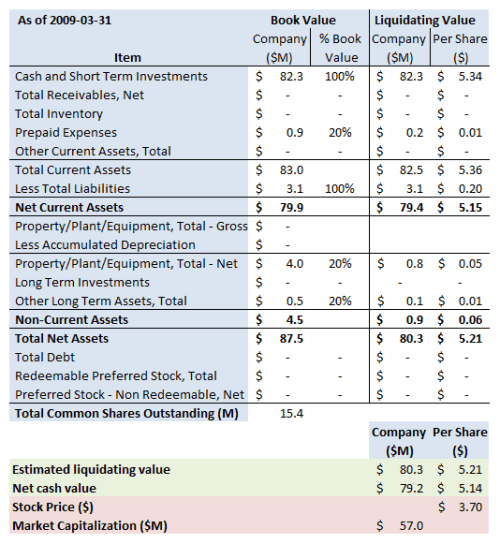
We been following SOAP (see our post archive here) because it is trading well below its net cash value with an activist investor, Mithras Capital, disclosing an 8.7% holding in October last year. The stock is up 48.0% from $2.50 when we initiated our position to close yesterday at $3.70, giving SOAP a market capitalization of $52.0M. We last estimated the company’s net cash value to be $86.1M or $5.59 per share. Following our review of the Q1 10Q, we’ve adjusted our valuation down 6% to $80.3M or $5.21 per share as a result of $6.7M of cash burned.

The value proposition updated

The company’s balance sheet value is almost wholly cash, which it continues to burn (the “Book Value” column shows the assets as they are carried in the financial statements, and the “Liquidating Value” column shows our estimate of the value of the assets in a liquidation):

soap-summary-2009-3-311

Balance sheet adjustments

We need to make the following adjustments to the balance sheet estimates above:

  • Cash burn: The company used $6.7M in cash in the first quarter. They expect cash burn to continue to be between $6M and $6.5M per quarter.
  • Off-balance sheet arrangements and contractual obligations: SOAP does not have any off-balance-sheet arrangements and its contractual obligations, which consist entirely of operating leases, are $3.9M. These operating lease payments are the minimum rent expense for SOAP’s facilities, including its head office.

Conclusion

We continue to believe that SOAP is a very good opportunity. The company’s ongoing business is small in comparison to its net cash position, so it shouldn’t dissipate its cash any time soon. It has no off-balance sheet arrangements, little in the way of ongoing contractual obligations and no material litigation, so the cash position seems reasonably certain. The company’s engagement of an investment bank to explore strategic alternatives is a promising step in the right direction. We continue to be concerned by the continued issuance of options at a huge discount to liquidation value. The sooner Mithras Capital gets control of this situation the better.

[Full Disclosure:  We have a holding in SOAP. This is neither a recommendation to buy or sell any securities. All information provided believed to be reliable and presented for information purposes only. Do your own research before investing in any security.]

Read Full Post »

« Newer Posts