Liquidation value investing is the purchase of securities at a discount to the value of the securities in a liquidation.
The rationale for such an investment is straight foward. In the 1934 edition of Security Analysis, Benjamin Graham argued that the phenomenon of a stock selling persistently below its liquidation value was “fundamentally illogical.” In Graham’s opinion, it meant:
- The stock was too cheap, and therefore offered an attractive opportunity for purchase and an attractive area for security analysis; and
- Management was pursuing a mistaken policy and should take corrective action, “if not voluntarily, then under pressure from the stockholders.”
Graham understood why these sort of stocks – also known as “net-net”, “net-quick” or “net current asset value” stocks – traded at a discount to liquidation value:
“Common stocks in this category almost always have an unsatisfactory trend of earnings.
…
The objection to buying these issues lies in the probability, or at least the possibility, that earnings will decline or losses continue, and that the resources will dissipated and the intrinsic value ultimately become less than the price paid.”
Graham responded to these objections that, while he could not deny that these outcomes occurred in individual cases:
“…there is a much wider range of potential developments which may result in establishing a higher market price. These include the following:
- The creation of an earning power commensurate with the company’s assets. This may result from: a. General improvement in the industry. b. Favorable change in the company’s operating policies, with or without a change in management. These changes include more efficient methods, new products, abandonment of unprofitable lines, etc.
- A sale or merger, because some other concern is able to utilize the resources to better advantage and hence can pay at least liquidating value for the assets.
- Complete or partial liquidation.“
Graham cautioned that, while there was scarcely any doubt that common stocks selling well below liquidating value represent on the whole a class of undervalued securities, the discerning securities analyst should exercise as much discrimination as possible:
“He will lean towards those for which he sees a fairly imminent prospect of some one of the favorable developments listed above. Or else he will be partial to such as reveal other attractive statistical features besides their liquid-asset position, e.g., satisfactory current earnings and dividends, or a high average earning power in the past. The analyst will avoid issues which have been losing their quick assets at a rapid rate and show no definite signs of ceasing to do so.”
Why securities trade below liquidation value
In 1932 Graham had authored a series of three articles for Forbes, titled, Inflated Treasuries and Deflated Stockholders, Should Rich Corporations Return Stockholders’ Cash?, and Should Rich but Losing Corporations Be Liquidated? in which he discussed the phenomenon of companies trading below liquidation value.
In the first article, Inflated Treasuries and Deflated Stockholders, Graham wrote:
“…a great number of American businesses are quoted in the market for much less than their liquidating value; that in the best judgment of Wall Street, these businesses are worth more dead than alive. For most industrial companies should bring, in orderly liquidation, at least as much as their quick assets alone.”
The reasons for the selling, Graham argued, was primarily “due to fear rather than necessity,” but also because investors didn’t pay any attention to what a company owns – not even its cash. He argued that value was associated exclusively with “earning power” and therefore “reported earnings – which might only be temporary or even deceptive – and in a complete eclipse of what had always been regarded as a vital factor in security values, namely the company’s working capital position.”
Graham proposed that investors should become not only “balance sheet conscious,” but “ownership conscious:”
“If they realized their rights as business owners, we would not have before us the insane spectacle of treasuries bloated with cash and their proprietors in a wild scramble to give away their interest on any terms they can get. Perhaps the corporation itself buys back the shares they throw on the market, and by a final touch of irony, we see the stockholders’ pitifully inadequate payment made to them with their own cash.“
In the final article, Should Rich but Losing Corporations Be Liquidated?, Graham explained the logic of an investment in a security trading at a discount to its liquidating value:
“If gold dollars without any strings attached could actually be purchased for 50 cents, plenty of publicity and plenty of buying power would quickly be marshaled to take advantage of the bargain. Corporate gold dollars are now available in quantity at 50 cents and less–but they do have strings attached. Although they belong to the stockholder, he doesn’t control them. He may have to sit back and watch them dwindle and disappear as operating losses take their toll. For that reason the public refuses to accept even the cash holdings of corporations at their face value.”
Graham then considered why investors should even contemplate liquidating values when companies were not going to liquidate, responding:
“The stockholders do not have it in their power to make a business profitable, but they do have it in their power to liquidate it. At bottom it is not a theoretical question at all; the issue is both very practical and very pressing.
…
In its simplest terms the question comes down to this: Are these managements wrong or is the market wrong? Are these low prices merely the product of unreasoning fear, or do they convey a stern warning to liquidate while there is yet time?”
How to determine a company’s liquidation value
In Security Analysis, Graham wrote that, in determining the liquidation value, the current-asset value generally provides a rough indication:
“A company’s balance sheet does not convey exact information as to its value in liquidation, but it does supply clues or hints which may prove useful. The first rule in calculating liquidating value is that the liabilities are real but the assets are of questionable value. This means that all true liabilities shown on the books must be deducted at their face amount. The value to be ascribed to the assets however, will vary according to their character.“
Graham then provided the following guide for determining the value of various types of assets in a liquidation:
- Cash assets (including securities at market) – 100%
- Receivables (less usual reserves) – between 75% to 90% with an average of 80%. Graham noted that retail installment accounts should be valued for liquidation at a lower rate, between 30% to 60% with an average of about 50%
- Inventories (at lower or cost or market) – between 50% to 75% with an average of 66.6%
- Fixed and miscellaneous assets (real estate, buildings, machinery, equipment, nonmarketable investments, intangibles etc) – between 1% to 50% with an approximate average of 15%.
Historical returns from investing at a discount to liquidation value
In 1992 Tweedy Browne, an undervalued asset investor established in 1920, produced a report What has worked in investing. The report described a number of academic studies of investment styles that have produced high rates of return, including an article in the November-December 1986 issue of Financial Analysts Journal called “Ben Graham’s Net Current Asset Values: A Performance Update”. The article described a study undertaken by Henry Oppenheimer, an Associate Professor of Finance at the State University of New York at Binghamton, in which he examined the investment results of stocks selling at or below 66% of net current asset value during the 13-year period from December 31, 1970 through December 31, 1983:
“The study assumed that all stocks meeting the investment criterion were purchased on December 31 of each year, held for one year, and replaced on December 31 of the subsequent year by stocks meeting the same criterion on that date. To create the annual net current asset portfolios, Oppenheimer screened the entire Standard & Poor’s Security Owners Guide. The entire 13-year study sample size was 645 net current asset selections from the New York Stock Exchange, the American Stock Exchange and the over-the-counter securities market. The minimum December 31 sample was 18 companies and the maximum December 31 sample was 89 companies.
The mean return from net current asset stocks for the 13-year period was 29.4% per year versus 11.5% per year for the NYSE-AMEX Index. One million dollars invested in the net current asset portfolio on December 31, 1970 would have increased to $25,497,300 by December 31, 1983. By comparison,$1,000,000 invested in the NYSE-AMEX Index would have increased to $3,729,600 on December 31,1983. The net current asset portfolio’s exceptional performance over the entire 13 years was not consistent over smaller subsets of time within the 13-year period. For the three-year period, December31, 1970 through December 31, 1973, which represents 23% of the 13-year study period, the mean annual return from the net current asset portfolio was .6% per year as compared to 4.6% per year for the NYSE-AMEX Index.
The study also examined the investment results from the net current asset companies which operated at a loss (about one-third of the entire sample of firms) as compared to the investment results of the net current asset companies which operated profitably. The firms operating at a loss had slightly higher investment returns than the firms with positive earnings: 31.3% per year for the unprofitable companies versus 28.9% per year for the profitable companies.
Further research by Tweedy, Browne has indicated that companies satisfying the net current asset criterion have not only enjoyed superior common stock performance over time but also often have been priced at significant discounts to “real world” estimates of the specific value that stockholders would probably receive in an actual sale or liquidation of the entire corporation. Net current asset value ascribes no value to a company’s real estate and equipment, nor is any going concern value ascribed to prospective earning power from a company’s sales base. When liquidation value appraisals are made, the estimated “haircut” on accounts receivable and inventory is often recouped or exceeded by the estimated value of a company’s real estate and equipment. It is not uncommon to see informed investors, such as a company’s own officers and directors or other corporations, accumulate the shares of a company priced in the stock market at less than 66% of net current asset value. The company itself is frequently a buyer of its own shares.
Common characteristics associated with stocks selling at less than 66% of net current asset value are low price/earnings ratios, low price/sales ratios and low prices in relation to “normal” earnings; i.e., what the company would earn if it earned the average return on equity for a given industry or the average neti ncome margin on sales for such industry. Current earnings are often depressed in relation to prior earnings. The stock price has often declined significantly from prior price levels, causing a shrinkage in a company’s market capitalization.”
Other studies
In Testing Ben Graham’s Net Current Asset Value Strategy in London (Word format), a paper from the business school of the University of Salford in the UK, the strategy was applied to stocks listed on the London Stock Exchange in the period 1980 to 2005. The paper found that stocks selected using the strategy:
“…substantially outperform the stock market over holding periods of up to five years. The average 60-month buy-and-hold raw return is 254 percent with equal weighting within the NCAV/MV portfolio and 216 percent with value weighting, which are much higher than market indices of only 137 percent and 108 percent. One million pounds invested in a series of NCAV/MV (equal weighted) portfolios starting on 1st July 1981 would have increased to £432 million by June 2005 based on the typical NCAV/MV returns over the study period. By comparison £1,000,000 invested in the entire UK main market would have increased to £34 million by end of June 2005.
For almost all post-formation lengths, and regardless of within portfolio weighting, the NCAV/MV portfolio outperforms either equal weighted or value weighted market indices with high statistical significance. Market-adjusted returns rise to 117 percent and 146 percent after five years if the stocks are equally weighted; and 78 percent and 108 percent after five years if the stocks are value weighted.”
The University of Salford paper is also useful because it discusses other studies and Benjamin Graham’s own results:
“Graham used the NCAV/MV criterion extensively in the operations of the Graham-Newman Corporation and report that shares selected on the basis of the NCAV/MV rule earn, on average, about 20 percent per year over the 30-year period to 1956 (Graham and Chatman (1996)). More recently, Oppenheimer (1986) tested returns of NCAV/MV portfolios with returns on both the NYSE-AMEX value-weighted index and the small-firm index from 1971 through 1983. He found that returns are rank-ordered: securities with the smallest purchase price as a percentage of NCAV show the largest returns. Over the 13-year period, the Graham criteria NCAV/MV portfolios on average outperformed the NYSE-AMEX index by 1.46 percent per month (19 percent per year) after adjusting for risk. When compared to the small-firm index, these portfolios earned an excess return of 0.67% per month (8 percent per year). In the first study outside of the USA, Bildersee, Cheh and Zutshi (1993)’s paper focuses on the Japanese market from 1975 to 1988. In order to maintain a sample large enough for cross-sectional analysis, Graham’s criterion was relaxed so that firms are required to merely have an NCAV/MV ratio greater than zero. They found the mean market-adjusted return of the aggregate portfolio is around 1 percent per month (13 percent per year).”
At Greenbackd, we believe that Graham’s rationale, along with the results of the studies, present a compelling argument for investing in these stocks. We spend our days trying to uncover as many of these stocks as we can. What we dig up, we review and post it to the website. Our latest review should be right here.
Buy my book The Acquirer’s Multiple: How the Billionaire Contrarians of Deep Value Beat the Market from on Kindle, paperback, and Audible.
Here’s your book for the fall if you’re on global Wall Street. Tobias Carlisle has hit a home run deep over left field. It’s an incredibly smart, dense, 213 pages on how to not lose money in the market. It’s your Autumn smart read. –Tom Keene, Bloomberg’s Editor-At-Large, Bloomberg Surveillance, September 9, 2014.
Click here if you’d like to read more on The Acquirer’s Multiple, or connect with me on Twitter, LinkedIn or Facebook. Check out the best deep value stocks in the largest 1000 names for free on the deep value stock screener at The Acquirer’s Multiple®.
Read Full Post »
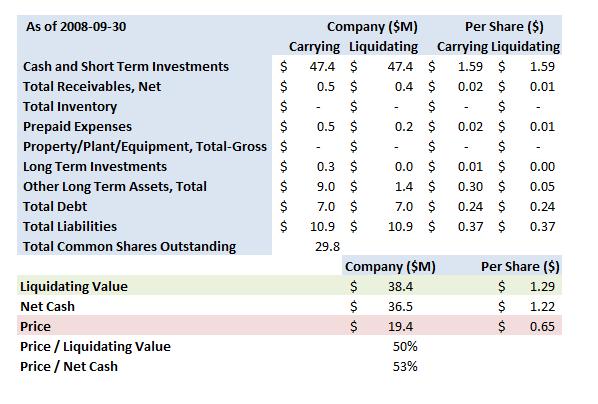 AVGN is a net cash stock, with $1.22 of net cash (cash after subtracting Total Liabilities). With its stock price at $0.65, AVGN is trading at a little over half its net cash value. We estimate AVGN’s value in a liquidation at around $38.4M ($1.29 per share). Given its net cash position of $36.5M or $1.22 per share, this means we have valued the rest of the company’s assets in liquidation at only $1.9M or $0.07 per share.


 Greenbackd