Feeds:
Posts
Comments

Posts Tagged ‘Net Cash Stock’

Cadus Corporation (OTC:KDUS) is an interesting play, but not without hairs on it. First, the good news: It’s trading at a discount to net cash with Carl Icahn disclosing an activist holding in 2002, and Moab Capital Partners disclosing an activist holding more recently. At its $1.51 close yesterday, the company has a market capitalization of $19.9M. The valuation is straight-forward. We estimate the net cash value to be around $20.6M or $1.57 per share and the liquidation value to be around $23.2M or $1.77 per share. The liquidation value excludes the potential value of federal and New York State and City net operating loss carry-forwards. It’s not a huge upside but it’s reasonably certain, and we think that’s a good thing in this market. The problem with the position is the catalyst. It’s a relatively tiny position for Icahn, so he’s got no real incentive to do anything with it. He’s been in the position since 2002, so he’s clearly in no hurry. That said, he’s not ignoring the position. He last updated his 13D filing in March this year, disclosing an increased 40% stake. He’s also got Moab Capital Partners to contend with. Moab holds 9.8% of the stock and says that it “has had good interaction with the CEO of Cadus, David Blitz, and feels comfortable that he will structure a transaction with an operating business that will generate significant long-term value for Cadus holders.” KDUS could end up being a classic value trap, but we think it’s worth a look at a discount to net cash, and two interested shareholders.

About KDUS

From the most recent 10Q:

The Company was incorporated in 1992 and until July 30, 1999, devoted substantially all of its resources to the development and application of novel yeast-based and other drug discovery technologies. On July 30, 1999, the Company sold its drug discovery assets and ceased its internal drug discovery operations and research efforts for collaborative partners.

At June 30, 2009, the Company had an accumulated deficit of approximately $34.9 million. The Company’s losses have resulted principally from costs incurred in connection with its research and development activities and from general and administrative costs associated with the Company’s operations. These costs have exceeded the Company’s revenues and interest income. As a result of the sale of its drug discovery assets and the cessation of its internal drug discovery operations and research efforts for collaborative partners, the Company ceased to have research funding revenues and substantially reduced its operating expenses. The Company expects to generate revenues in the future only if it is able to license its technologies.

The value proposition

KDUS is a relatively simple value proposition. It’s $21M of cash, and $3.1M in Bank of America Columbia Strategic Cash Portfolio (more on this below) against total liabilities of around $0.03M (that’s ~$27,000). We’ve set out the valuation below in the usual manner (the “Book Value” column shows the assets as they are carried in the financial statements, and the “Liquidating Value” column shows our estimate of the value of the assets in a liquidation):

KDUS Summary

Bank of America Columbia Strategic Cash Portfolio

We are not treating the Bank of America Columbia Strategic Cash Portfolio as cash. The asset has some issues, best described by this passage from the 10Q:

On December 10, 2007, the Fund notified the Company that conditions in the short-term credit markets had created a broad based perception of risk in non subprime asset-backed securities causing illiquidity across the market which led to extreme pricing pressure in those securities. The Fund also notified the Company that it is primarily invested in such securities, that it will begin an orderly liquidation of such securities, that unitholders would no longer be able to redeem their units in the Fund and that the Fund would redeem its units as it liquidated its investments. The Fund also began to value its securities based on market value rather than amortized value for purposes of determining net asset value per unit. The Fund has continued to pay interest monthly. The Company reclassified its investment in the Fund from cash equivalents to short-term investments. Through December 31, 2008, the Fund redeemed 19,445,459 units held by the Company for $18,787,142, which redemption was $658,317 in the aggregate less than the cost of such units. From January 1, 2009 to June 30, 2009, the Fund has redeemed an additional 2,314,849 units in the Fund for $1,934,798 which redemption was $380,051 in the aggregate less than the original $2,314,849 cost of such units. At June 30, 2009, the Company still owned 3,793,032 units in the Fund which was recorded on the balance sheet at $3,135,321. Such 3,793,032 units had a net asset value of $3,306,385 at June 30, 2009. The Fund has advised the Company that the balance or most of the balance, of the Company’s investment in the Fund will be redeemed by December 31, 2009. However, there can be no assurance as to when the redemption will take place or as to the net asset value at which the Company’s investment in the Fund will be redeemed.

We’ve applied a 20% discount to the Strategic Cash Portfolio, which is an additional discount to that applied by KDUS. This may be too conservative, but that is the only way that we feel comfortable.

The catalyst

Carl Icahn filed an amended 13D notice on March 12 this year, indicating an increased 40% holding in KDUS. Moab Capital Partners also holds around 9.8% of KDUS. Said Moab of its KDUS position in the August 16, 2007 13D:

The Reporting Persons have purchased the Shares in open market transactions because in their opinion, the market has not given full appreciation to Cadus’ cash balance, net operating loss carry-forwards and future prospects. Based on publically available information, as of 8/16/07, the company currently holds cash, equivalents and investments in marketable securities of $25.4 million and has significant federal and New York State and City net operating loss carry-forwards. The current market capitalization stands at $23.1 million, a 9% discount to the cash and investments on Cadus’ balance sheet. Moab feels the loss carry-forwards should also be ascribed market value. Cadus is cash flow positive and the share count has not increased in over five years. Moab has had good interaction with the CEO of Cadus, David Blitz, and feels comfortable that he will structure a transaction with an operating business that will generate significant long-term value for Cadus holders.

Moab’s purchase prices – between $1.86 and $1.76 – are higher than the current trading price of KDUS.

Despite these promising sentiments, a catalyst in KDUS is probably not imminent. We believe the position will require some patience for the following reasons: First, KDUS is controlled by Icahn and represents a very small part of his empire. He’s got no real immediate impetus to unlock the value. The play is probably Icahn selling his stake to another investor looking for a shell, or Icahn vending into KDUS some other business. You’d have to be brave / insane / a little of both to buy from Icahn usually, and doubly so in this instance given that he’s got no reason to sell. Second, it’s illiquid. Average volume is close to nada: 900 shares were traded on Friday and 6,500 were traded on Thursday. Even a small retail investor could make the entire market for a day or so. Finally, KDUS is a fairly well known position in the industry. It’s viewed as a stock that has been stagnant for years and unlikely to go anywhere because Icahn is too rich to care. We’ve heard that investing in KDUS is a “right of passage for would-be shell buyers.” Consider yourself warned.

Conclusion

Despite the foregoing misgivings, we’re reasonably comfortable with a position in KDUS for several reasons:

  1. The value. We’re primarily attracted to KDUS’s cash and liquidation values. While it’s not a huge upside from here, it’s downside is very limited. With slightly higher interest rates, KDUS will also likely return to cash flow positive territory.
  2. While Icahn is obviously not seeking an immediate resolution of the position, he controls an asset with a value not yet fully recognised by the market. If a worthwhile transaction materializes like Marley’s ghost before Scrooge’s eyes, we’re prepared to bet that Scrooge will buy us the biggest turkey in the poulterer’s shop. But it won’t happen this Christmas.

KDUS won’t ever be a 10 bagger, or even a double, but it’s got 20 – 30% in it. In an overheated market, that’s good enough for us. For these reasons, we’re adding it to the Greenbackd Portfolio.

KDUS closed Friday at $1.51.

The S&P500 closed Friday at 1,044.38.

[Full Disclosure:  We have a holding in KDUS. This is neither a recommendation to buy or sell any securities. All information provided believed to be reliable and presented for information purposes only. Do your own research before investing in any security.]
Read Full Post »

We’ve decided to exit our position in OrthoLogic Corporation (NASDAQ:CAPS) at its $0.90 close yesterday. We opened the position at $0.60, so we’re up 50% on an absolute basis. The S&P500 Index closed at 752.83 on February 27, the day we opened the position, and closed yesterday at 1,068.76, which means we’re up 8.0% on relative basis.

Post Mortem

We started following CAPS (see our post archive here) because it was trading below its net cash value and Biotechnology Value Fund (BVF) had a 13.42% holding. It was an unusual holding for us because BVF’s holding is passive. Further, CAPS is a development stage company spending its cash on the development and commercialization of two product platforms: AZX100 and Chrysalin® (TP508). Ordinarily, we wouldn’t have entered a position like this, but we did so because we’d had some success in the past with BVF, particularly with our AVGN position. As BVF’s holding in CAPS is passive, BVF seems to be betting on the return from the product platforms and doesn’t view it as a liquidation play. We have no insight into the value of those product platform assets, so our holding in CAPS is purely on its cash value. As the share price is now near the reduced net cash value, we’ve decided to exit. CAPS might still be a boomer for BVF, but we can’t assess the risks properly, so we’re out.

[Full Disclosure:  We do not have a holding in CAPS. This is neither a recommendation to buy or sell any securities. All information provided believed to be reliable and presented for information purposes only. Do your own research before investing in any security.]

Read Full Post »

The board of Ditech Networks Inc (NASDAQ:DITC) has agreed to nominate Lamassu Holdings’ representatives, Alan B. Howe and Frank J. Sansone, to be elected to the board at DITC’s next annual meeting. It seems that the board’s concern in nominating Howe and Sansone was that they not participate in any “withhold the vote” campaign or disparage the board. It’s a big win for Lamassu, and it appears their letter writing campaign was successful. The stock is now trading at a premium to our estimate of its liquidation value, which value is continuing to deteriorate, so we’re exiting the position. The stock is up from our initial $0.89 to close Friday at $1.75,which is an absolute return of 96.6%. The S&P500 closed at 788.42 when we opened the position, and closed Friday at 1,0472.73, which means our outperformance over the S$P500 was 64.4%.

Post Mortem

We started following DITC (see our archive here) because it was trading below its net cash value with an investor, Lamassu Holdings LLC, disclosing a 9.4% holding in November last year. Lamassu had previously offered to acquire DITC for $1.25 per share in cash. At that time, Lamassu said that it “[anticipated] its due diligence requirement [would] take no more than two weeks and there [was] no financing contingency.” Lamassu then nominated two candidates for election to the board “who [were] committed to enhancing shareholder value through a review of the Company’s business and strategic direction.” Lloyd I Miller III subsequently disclosed a 5.9% holding. Miller came out in support of the director candidates nominated by Lamassu as “candidates who [were] independent of management.” Miller said he sought “to encourage greater attention to corporate governance by all members of the Board of Directors.”

Lamassu then initiated a pointed letter campaign aimed at DITC’s board. In the first letter, Lamassu accused DITC management of “spending as though Ditech Networks has money to burn, adding to the amount of money you have already lost for shareholders during your tenure,” “aggressively [overstepping] the bounds of good corporate governance” and “clearly [violating] your fiduciary responsibility.” In the second, Lamassu claimed that the “decisions of this board [had] shown a pattern of director entrenchment characterized by prioritizing the interest of its members in the face of poor results at the expense of the shareholders” and called for shareholders to “receive ample representation on the board.” The campaign was succesful, and DITC agreeing to nominate Lamassu Holdings’ representatives for election to the board. The stock is up from our initial $0.89 to close Friday at $1.75, which gives the company a market capitalization of $46M. We last estimated the net cash value at around $32.2M or $1.23 per share and the liquidation value at around $43.4M or $1.65 per share. With the stock at a premium to the liquidation value, and that liquidation value deteriorating, we’ve decided to exit the position for a 96.6% gain.

The proxy statement for DITC’s 2009 annual meeting of stockholders more fully describes the agreement between Lamassu and DITC thus:

The Board of Directors currently has seven members. There are two directors in the class whose term of office expires in 2009. Both of the directors currently in serving in this term will not be standing for re-election. The Board of Directors has nominated two new persons to fill these positions. The two nominees, Mr. Alan B. Howe and Mr. Frank J. Sansone, are not currently directors of Ditech. The nomination of each of Mr. Howe and Mr. Sansone was recommended by a securityholder. If elected at the annual meeting, each of the nominees would serve until the 2012 annual meeting and until his successor is elected and has qualified, or until the director’s death, resignation or removal.

On September 2, 2009, Ditech and Lamassu Holdings L.L.C. and certain of its affiliates (collectively, “Lamassu”), entered into a letter agreement in which Ditech and Lamassu agreed that each of Mr. Howe and Mr. Sansone would be nominated to be elected to the Board of Directors at this annual meeting. In addition to the nomination of each of Mr. Howe and Mr. Sansone for election to the Board of Directors, the letter agreement also provides that:

• If Mr. Sansone is unable to serve as a director at a time when Lamassu owns at least 5% of the Ditech common stock, Ditech will appoint a replacement director designated by Lamassu and reasonably acceptable to Ditech Networks;

• Mr. Sansone and any replacement director will sign a conditional resignation from the Board of Directors, which may be accepted by the Board of Directors in the event that Lamassu’s beneficial ownership of Ditech common stock falls below 5% of the outstanding Ditech common stock;

• Lamassu will vote all of the shares it beneficially owns in support of the slate of directors nominated by the Board of Directors at this annual meeting of stockholders (and will not support or participate in any “withhold the vote” or similar campaign, or support any other nominees other than the slate of directors nominated by the Board of Directors);

• Lamassu withdrew its previously announced notice of its intent to nominate directors with respect to this annual meeting of stockholders;

• For a period ending 90 days from the date of this annual meeting of stockholders, Lamassu will not (i) make any public statement regarding Ditech, the Board of Directors or any of Ditech’s officers, directors or employees, except for the press release attached to the agreement or as may be required by law, or (ii) disparage Ditech, the Board of Directors, or any of Ditech’s officers, directors or employees, in any manner, including in any manner which could be harmful to Ditech or its business, the Board of Directors or its reputation, or the business reputation or personal reputation of any officer, director or employee of Ditech.

[Full Disclosure:  We do not have a holding in DITC. This is neither a recommendation to buy or sell any securities. All information provided believed to be reliable and presented for information purposes only. Do your own research before investing in any security.]

Read Full Post »

A group of investors in VaxGen Inc (OTC:VXGN) have formed the “VaxGen Full Value Committee” to conduct a proxy contest to replace the current board of VXGN at the next annual shareholders meeting. The group, comprising BA Value Investors’ Steven N. Bronson and ROI Capital Management’s Mark T. Boyer and Mitchell J. Soboleski, intends to replace the current board with directors who will focus on the following objectives:

1. Returning capital to [VXGN]’s shareholders, including an immediate distribution of $10,000,000 in cash;

2. Terminating [VXGN]’s lease with its landlord, Oyster Point Tech Center, LLC, and settling with the landlord the obligations of [VXGN] on the remaining lease payments;

3. Exploring ways to monetize [VXGN] as a “public shell,” including the utilization of [VXGN]’s Substantial Net Operating Losses; and

4. Protecting for the benefit of shareholders royalty payments receivable from the sale of [VXGN]’s intellectual property.

We’ve been following VXGN (see our post archive here) because it is trading at a substantial discount to its net cash position, has ended its cash-burning product development activities and is “seeking to maximize the value of its remaining assets through a strategic transaction or series of strategic transactions.” Management has said that, if the company is unable to identify and complete an alternate strategic transaction, it proposes to liquidate. One concern of ours has been a lawsuit against VXGN by its landlords, in which they sought $22.4M. That lawsuit was dismissed in May, so the path for VXGN to liquidate has now hopefully cleared. The board has, however, been dragging its feet on the liquidation. Given their relatively high compensation and almost non-existent shareholding, it’s not hard to see why.

BA Value Investors had previously disclosed an activist holding and, in a June 12 letter to the board, called on VXGN to “act promptly to reduce the size of the board to three directors; reduce director compensation; change to a smaller audit firm; terminate the lease of its facilities; otherwise cut costs; make an immediate $10 million distribution to shareholders; make a subsequent distribution of substantially all the remaining cash after settling the lease termination; distribute any royalty income to shareholders; and explore ways to monetize the public company value of the Issuer and use of its net operating losses.”

Another group led by Spencer Capital and styling itself “Value Investors for Change” has also filed preliminary proxy documents to remove the board. In the proxy documents, Value Investors for Change call out VXGN’s board on its “track record of failure and exorbitant cash compensation”:

VaxGen does not have any operations, other than preparing public reports. The Company has three employees, including the part-time principal executive officer and director, and four non-employee directors. Since the Company’s failed merger with Raven Biotechnologies, Inc. in March 2008, the Board has publicly disclosed that it would either pursue a strategic transaction or a series of strategic transactions or dissolve the Company. The Company has done neither. In the meantime, members of the Board have treated themselves to exorbitant cash compensation. Until July 2009, two non-employee members of the Board were paid over $300,000 per year in compensation. The principal executive officer will likely receive over $400,000 in cash compensation this year.

VXGN is up 31.3% since we initiated the position. At its $0.63 close yesterday, it has a market capitalization of $20.9M. We last estimated the company’s liquidation value to be around $25.4M or $0.77 per share. VXGN has other potentially valuable assets, including a “state-of-the-art biopharmaceutical manufacturing facility with a 1,000-liter bioreactor that can be used to make cell culture or microbial biologic products” and rights to specified percentages of future net sales relating to its anthrax vaccine product candidate and related technology. The authors of a letter sent to the board on July 14 of this year adjudge VXGN’s liquidation value to be significantly higher at $2.12 per share:

Excluding the lease obligations, the net financial assets alone of $37.2 million equate to $1.12 per share. The EBS royalties (assuming a 6% royalty rate and a $500 million contract as contemplated by NIH/HHS and EBS) of $30 million and milestones of $6 million total $36 million of potential additional future value (based clearly on assumptions, none of which are assured), or $1.09 per share. Adding $1.12 and $1.09 equals $2.21 per share.

The entry of the VaxGen Full Value Committee into the proxy contest will certainly make the next meeting an interesting spectacle, and, with any luck, we will see a liquidation of VXGN soon, either at the hands of the present board, by Value Investors for Change or the VaxGen Full Value Committee.

The Purpose of Transaction portion of the amended 13D filing is set out below:

The Reporting Persons acquired the shares of Common Stock to which this statement relates for investment purposes.

On June 12, 2009, Mr. Bronson, on behalf of BA Value Investors, LLC, sent a letter to the Board of Directors of the Issuer. In the letter, Mr. Bronson stated that the Company must act promptly to reduce the size of the board to three directors; reduce director compensation; change to a smaller audit firm; terminate the lease of its facilities; otherwise cut costs; make an immediate $10 million distribution to shareholders; make a subsequent distribution of substantially all the remaining cash after settling the lease termination; distribute any royalty income to shareholders; and explore ways to monetize the public company value of the Issuer and use of its net operating losses. A copy of the letter to the Issuer has been filed as Exhibit 1 to the Statement.

On August 21, 2009, the Reporting Persons formed a committee called the “VaxGen Full Value Committee.” The VaxGen Full Value Committee intends to conduct a proxy contest to replace the current Board of Directors at the next annual shareholders meeting with directors who will focus on the following objectives:

1. Returning capital to the Issuer’s shareholders, including an immediate distribution of $10,000,000 in cash;

2. Terminating the Issuer’s lease with its landlord, Oyster Point Tech Center, LLC, and settling with the landlord the obligations of the Issuer on the remaining lease payments;

3. Exploring ways to monetize the Issuer as a “public shell,” including the utilization of the Issuer’s Substantial Net Operating Losses; and

4. Protecting for the benefit of shareholders royalty payments receivable from the sale of the Issuer’s intellectual property.

[Full Disclosure:  We have a holding in VXGN. This is neither a recommendation to buy or sell any securities. All information provided believed to be reliable and presented for information purposes only. Do your own research before investing in any security.]

Read Full Post »

We were going to stay away until after Labor Day, but this is too good to miss. From reader MCN1 on Aspen Exploration Corporation (OTC:ASPN):

Company Name: Aspen Exploration Corporation

Ticker: ASPN

Market Cap: $6.53M (as of 9/2/09)

Stock Price: $0.90 (as of 9/2/09)

Company Overview: Aspen Exploration Corporation is engaged in the exploration and development of oil and gas properties in California and Montana.

Situation:

Being a micro cap stock the management acknowledged in a press release in Sept 2008 that it would begin exploring strategic alternatives for Aspen “including the possibility of selling Aspen’s assets or considering another appropriate merger or acquisition transaction (from press release dated 9/4/08).” The motive behind pursing “strategic alternatives” was three fold: (1) the cost of being a public company for a company their size, (2) the belief the market price did not reflect the true value of ASPN’s assets, and (3) the president’s health issues (had a stroke in Jan 2008).

In Feb 2009, ASPN announced it had entered into an agreement with Venoco, Inc (VQ) to sell its California assets for approximately $8.425M (approximately because it was subject to adjustments). It was a good strategic fit for Venoco who has operations close to Aspen’s. On June 30, 2009 the transaction closed with Aspen receiving $7.6M (net of fees). Additionally, during this time period, Feb 09 – Jun 09, Aspen also sold its interests in Montana for $1.2M. Thus, the total sale proceeds to the company were $8.8M between the two transactions.

The company is trying to decide what to do with its liquid assets, either liquidated and payout to stockholders or pursue new business opportunities. Now management has stated it has reviewed some business opportunities, and thankfully, and has passed on those opportunities. Especially when you take into account that management is willing to look at opportunities outside of oil & gas – which was the company’s core business.

In either late October or November of this year, the company is going to “propose a resolution to consider the possibility of dissolution of Aspen to our stockholders at a meeting of stockholders….If Aspen were to dissolve, it would not enter into another business opportunity but would wind up its operations and distribute its remaining assets to stockholders (from 8-K filing dated 6/30/09).” This is what I and others are betting will happen.

Financials & Valuations:

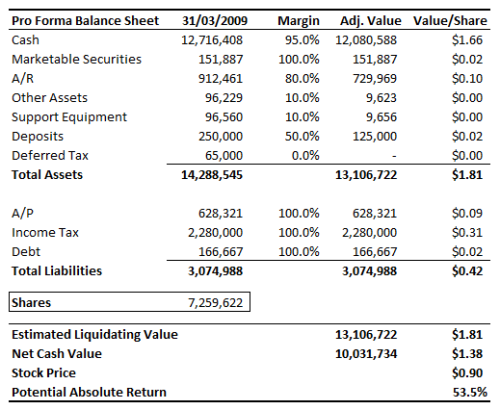
Here is a look at the post transaction balance sheet (pro forma) as of 3/30/09. The numbers below are taken from a SEC 8-K filing dated 7/2/09.

ASPN SummaryComments on Valuation:

Cash – I margined it at 95% to account for ongoing overhead the company still has to pay.

Deposits – not sure what that figure represents, could be overstating liquidation value here. 50% is arbitrary though amount is insignificant to the whole deal.

Valuation – Estimated net liquidation value of $1.38/share, the majority of which, represents cash and marketable securities at $1.26 compared to market price of $0.90.

Other:

The company also has joint venture, which they entered into in January 2007, with a company called Hemis Corporation where Hemis is the operator and is permitted to explore for commercial amounts of gold. Because Hemis is the operator, Aspen is not obligated to pay for any of the exploration and production costs, instead, Aspen retained a 5% gross royalty on production. As part of the agreement, Hemis paid Aspen $50k in Jan 07, $50k in Aug 07, was obligated to pay another $50k in Sept 08 (which hasn’t been received), and $50k on each anniversary date until production begins. Since the Sept 08 has not been received (and no updates have been provided), the agreement could have been terminated as non-payments was grounds for termination. I have assigned no value to this joint venture.

The stock is thinly traded, usually a couple thousand shares trade everyday. Since my purchases in July 09, the stock has ranged from $0.87 – $0.97.

Catalyst:

Catalyst one – the stockholder meeting in late October or November with stockholders voting to dissolve the company and proceeds are paid out.

Catalyst two (which helps ensure catalyst one occurs) – during May 09 – June 09 an individual (I’ll spare the name, you can refer to the SEC 13D filing, just look it up under Aspen’s filings on the SEC website) acquired $422.7K of stock in the company for an approximate 5% stake. In the 13D filing the individual states his intent which is “As Aspen currently has no active business operations and a significant amount of liquid assets, (individual name) believes that there is broad shareholder support for the implementation of a plan of liquidation and distribution of substantially all the proceeds from the Sale and Aspen’s additional liquid assets to Aspen’s shareholders. (individual name) is considering several stockholder resolutions…for inclusion in Aspen’s proxy statement for its next meeting of stockholders”

Disclosure: I am long ASPN. The information presented is obtained from public filing, please perform your own due diligence as this is neither a recommendation to buy or sell.

[Full Disclosure: We do not have a holding in ASPN. This is neither a recommendation to buy or sell any securities. All information provided believed to be reliable and presented for information purposes only. Do your own research before investing in any security.]

Read Full Post »

Although we closed our position in Avigen Inc (NASDAQ:AVGN) earlier this week, we’re keeping a watching brief on the stock. AVGN has now filed with the SEC the terms of the deal with MediciNova Inc (NASDAQ:MNOV), and they’re not as bad as the earlier report seemed to suggest. The deal has, however, attracted the ire of The Pennsylvania Funds, an AVGN shareholder, who has filed a class action lawsuit on behalf of all AVGN stockholders. The stock closed yesterday at $1.28, about $0.01 under our exit price. The terms of deal provide some downside protection and some upside optionality, and so are worth considering in some more detail, although probably not enough of either to persuade us to re-enter the stock. If the lawsuit gains traction and pushes the stock price down, however, AVGN might become attractive again.

About AVGN

We started following AVGN in December last year (see archived posts here) because it was a net cash stock and specialist biotechnology investor Biotechnology Value Fund (BVF) was pushing it to liquidate and return its cash to shareholders. Despite BVF’s failure to remove the board, we continued to maintain our position in AVGN because BVF won a number of important concessions from the board that made AVGN a much more attractive stock than it was when we started following it. We continuted to hold on when AVGN announced that it was back in negotiations with MediciNova, Inc, but closed the position for a 98.5% gain when the initial terms of the deal were announced.

The terms of the deal

The downside protection

Under the terms of the merger agreement AVGN shareholders will have the right to elect to receive an amount currently estimated by AVGN’s board at $1.24 per share in either cash or secured convertible notes to be issued by MNOV. Approximately $1.19 of the consideration will be paid at the closing, and approximately $0.05 will be paid at June 30, 2010. Both payments are subject to certain potential adjustments. The first payment is subject to adjustment based on activities related to the liquidation or sale of certain assets of AVGN in connection with the winding down of its operations prior to closing. The second payment is subject to upward adjustment based on savings in estimated expenses through closing and receipt of certain payments post-closing as well as downward adjustment in the event that closing liabilities exceed estimated liabilities through closing.

The upside optionality

The secured convertible notes will be convertible on the final business day of each month into shares of MNOV common stock at a conversion price of $6.80 per share, which conversion price is based on the volume-weighted average price of MNOV’s common stock as quoted on Nasdaq and the Osaka Securities Exchange over the 20 trading days prior to signing of the merger agreement. The convertible notes will mature on the 18-month anniversary of the closing of the merger, and the indenture governing the notes will include customary events of default and anti-dilution adjustments. Note that the last time MNOV traded above $6.80 was two years ago in August 2007.

The joint press release announcing the terms of the deal is set out below:

MediciNova and Avigen Enter Into Definitive Agreement for Business Combination

SAN DIEGO, Calif., and ALAMEDA, Calif., August 21, 2009 — MediciNova, Inc., a biopharmaceutical company that is publicly traded on the Nasdaq Global Market (Nasdaq:MNOV) and the Hercules Market of the Osaka Securities Exchange (Code Number:4875) and Avigen, Inc. (Nasdaq:AVGN), a biopharmaceutical company, today announced that they have entered into a definitive merger agreement pursuant to which MediciNova’s wholly-owned subsidiary will merge with and into Avigen. Completion of the transaction will permit the combination of the companies’ broad neurological clinical development programs based on ibudilast (Avigen’s AV-411 and MediciNova’s MN-166).

Under the terms of the merger agreement, which has been approved by both companies’ boards of directors, Avigen shareholders will have the right to elect to receive an amount currently estimated at approximately $1.24 per share in either cash or secured convertible notes to be issued by MediciNova. Approximately $1.19 of this consideration will be paid at the closing, and approximately $0.05 will be paid at June 30, 2010. As set forth in the merger agreement, both payments are subject to certain potential adjustments. The first payment is subject to adjustment based on activities related to the liquidation or sale of certain assets of Avigen in connection with the winding down of its operations prior to closing. The second payment is subject to upward adjustment based on savings in estimated expenses through closing and receipt of certain payments post-closing as well as downward adjustment in the event that closing liabilities exceed estimated liabilities through closing.

The secured convertible notes will be convertible on the final business day of each month into shares of MediciNova common stock at a conversion price of $6.80 per share, which conversion price is based on the volume-weighted average price of MediciNova’s common stock as quoted on Nasdaq and the Osaka Securities Exchange over the 20 trading days prior to signing of the merger agreement. The convertible notes will mature on the 18-month anniversary of the closing of the merger, and the indenture governing the notes will include customary events of default and anti-dilution adjustments.

In addition, Avigen’s stockholders will be entitled to one Contingent Payment Right (“CPR”) that will entitle holders under certain circumstances to a pro rata portion of one or more of the following: (1) in the event the first milestone payment of $6.0 million, or approximately $0.20 per share, under Avigen’s 2005 assignment agreement with Genzyme Corporation (“Genzyme Agreement”) is achieved in the 20 months following closing, a cash payment of the proceeds (to the extent such cash is received by MediciNova in the 20 months following closing); (2) in the event the Parkinson’s product reverts to MediciNova under the Genzyme Agreement and is subsequently sold, licensed or otherwise transferred, 50% of the proceeds received in cash in the 20 months following closing; and (3) the amount of money remaining in the plan trust established under Avigen’s management transition plan following termination of such trust. In each case, the payments will be net of any related out-of-pocket costs, damages, fines, penalties and expenses incurred by MediciNova. The CPRs will not be transferable except in limited circumstances.

Yuichi Iwaki, M.D., Ph.D., MediciNova’s President and Chief Executive Officer, said, “We are excited about combining Avigen with MediciNova and believe that it presents a unique opportunity for shareholders of both companies, most notably, the ability to more fully take advantage of the opportunities that the ibudilast compound and analogs provide in a variety of indications and markets.”

“We believe the transaction reduces many of the uncertainties involved with dissolution and is in the best interests of our shareholders,” commented Andrew Sauter, Avigen’s Chief Executive Officer, President and Chief Financial Officer. “In addition, we believe that combining the two companies’ ibudilast programs will enhance the global development potential for the compound that could benefit patients with a range of neurological indications.”

The transaction is expected to close in the fourth quarter of 2009 and is subject to approval of Avigen’s stockholders and approval of MediciNova’s stockholders as well as other customary closing conditions. In addition, the closing is conditioned on the receipt of certain releases from Avigen’s directors (other than John K.A. Prendergast), Kenneth Chahine, Kirk Johnson and Andrew A. Sauter.

RBC Capital Markets Corporation is acting as financial advisor to Avigen and Cooley Godward Kronish LLP is serving as its legal counsel. Ladenburg Thalmann & Co. Inc. (NYSE Amex: LTS) is acting as financial advisor to MediciNova, Euclidean Life Science Advisors is acting as its business advisor and Dechert LLP is serving as its legal counsel.

The AVGN press release disclosing the law suit is set out below:

On August 25, 2009, The Pennsylvania Funds filed a class action lawsuit in the Superior Court of the State of California, County of Alameda, purportedly on behalf of the stockholders of Avigen, Inc., against Avigen and its directors, alleging that Avigen’s directors breached their fiduciary duties to the stockholders of Avigen in connection with the proposed acquisition of Avigen by MediciNova, Inc. The complaint seeks to enjoin the defendants from completing the acquisition as currently contemplated.

Avigen and its directors intend to take all appropriate actions to defend the suit.

It is possible that additional similar complaints may be filed in the future. If this does occur, Avigen does not intend to announce the filing of any similar complaints unless they contain allegations that are substantially distinct from those made in the pending action.

Conclusion

With the terms of the deal announced by AVGN, we’re still happy to be out of the stock. The downside protection is subject to various adjustments, and the upside is wholly dependent on the performance of MNOV’s stock over $6.80, which is higher than the stock has traded since 2007. That said, it’s worth watching to the see the effect of the class action on the stock price, because there is a price at which the stock again becomes attractive.

Hat tip GR.

[Full Disclosure: We do not have a holding in AVGN. This is neither a recommendation to buy or sell any securities. All information provided believed to be reliable and presented for information purposes only. Do your own research before investing in any security.]

Read Full Post »

MediciNova Inc. (NASDAQ:MNOV) will acquire Avigen Inc (NASDAQ:AVGN) for $1.24 per share in cash or secured convertible notes. While the stock is trading at a slight premium to the bid, we’re taking the opportunity to exit. AVGN closed Friday at $1.29, which means we’re up 98.5% on an absolute basis. The S&P500 was at 816.21 when we opened the position, and closed Friday at 1,026.13, which means we’re up 72.7% on a relative basis.

Post mortem

We started following AVGN in December last year (see archived posts here) because it was a net cash stock and specialist biotechnology investor Biotechnology Value Fund (BVF) was pushing it to liquidate and return its cash to shareholders. Despite BVF’s failure to remove the board, we continued to maintain our position in AVGN because BVF won a number of important concessions from the board that made AVGN a much more attractive stock than it was when we started following it. We continuted to hold on when AVGN announced that it was back in negotiations with MediciNova, Inc. The consideration for the deal was announced as AVGN’s “net cash liquidation value plus $3 million” and “a contingent payment right for a specific product program milestone payment associated with Avigen’s Assignment Agreement with Genzyme Corporation, potentially subject to certain adjustments.” That seems tono longer be the case. The deal announced Friday calls for a payment of around $1.19 a share when the deal closes, with approximately $0.05 per share to be paid on June 30, 2010. This is a disappointing deal. AVGN has been sold for its net cash liquidation value plus $3M from MediciNova. We held on because we believed that there was a reasonable chance that AVGN could yield more than its then $1.34 share price when the “contingent payment right” capturing the near term payments from Genzyme was taken into account. MNOV has not provided AVGN shareholders with any value for AVGN’s AV411 assets and program.

Here is the press release announcing the sale (via MarketWatch):

MediciNova To Acquire Avigen For $1.24 a Share

William L. Watts

MarketWatch Pulse

LONDON — Biopharmaceutical firm MediciNova Inc. will acquire Avigen Inc. for $1.24 a share in cash or secured convertible notes, under an agreement announced Friday by the biopharmaceutical firms. Under the deal, around $1.19 a share will be paid when the deal closes, with approximately 5 cents a share to be paid on June 30, 2010. The transaction is expected to close in the fourth quarter, pending the approval of Avigen and MediciNova stockholders and other considerations. The companies said the merger will allow them to combine their neurological clinical development programs based on ibudilast, an anti-inflammatory drug.

[Full Disclosure: We have a holding in AVGN. This is neither a recommendation to buy or sell any securities. All information provided believed to be reliable and presented for information purposes only. Do your own research before investing in any security.]

Read Full Post »

Spencer Capital has filed preliminary proxy documents to remove the board of VaxGen Inc (OTC:VXGN). In the documents, Spencer Capital, which leads a group of investors calling themselves “Value Investors for Change,” call out VXGN’s board on its “track record of failure and exorbitant cash compensation”:

VaxGen does not have any operations, other than preparing public reports. The Company has three employees, including the part-time principal executive officer and director, and four non-employee directors. Since the Company’s failed merger with Raven Biotechnologies, Inc. in March 2008, the Board has publicly disclosed that it would either pursue a strategic transaction or a series of strategic transactions or dissolve the Company. The Company has done neither. In the meantime, members of the Board have treated themselves to exorbitant cash compensation. Until July 2009, two non-employee members of the Board were paid over $300,000 per year in compensation. The principal executive officer will likely receive over $400,000 in cash compensation this year.

We’ve been following VXGN (see our post archive here) because it is trading at a substantial discount to its net cash position, has ended its cash-burning product development activities and is “seeking to maximize the value of its remaining assets through a strategic transaction or series of strategic transactions.” Management has said that, if the company is unable to identify and complete an alternate strategic transaction, it proposes to liquidate. One concern of ours has been a lawsuit against VXGN by its landlords, in which they sought $22.4M. That lawsuit was dismissed in May, so the path for VXGN to liquidate has now hopefully cleared. The board has, however, been dragging its feet on the liquidation. Given their relatively high compensation and almost non-existent shareholding, it’s not hard to see why.

VXGN has now also attracted the attention of BA Value Investors, which has disclosed an activist holding and called on VXGN to “act promptly to reduce the size of the board to three directors; reduce director compensation; change to a smaller audit firm; terminate the lease of its facilities; otherwise cut costs; make an immediate $10 million distribution to shareholders; make a subsequent distribution of substantially all the remaining cash after settling the lease termination; distribute any royalty income to shareholders; and explore ways to monetize the public company value of the Issuer and use of its net operating losses.”

VXGN is up 25.0% since we initiated the position. At its $0.60 close yesterday, it has a market capitalization of $19.9M. We last estimated the company’s liquidation value to be around $25.4M or $0.77 per share. VXGN has other potentially valuable assets, including a “state-of-the-art biopharmaceutical manufacturing facility with a 1,000-liter bioreactor that can be used to make cell culture or microbial biologic products” and rights to specified percentages of future net sales relating to its anthrax vaccine product candidate and related technology. The authors of a letter sent to the board on July 14 of this year ajudge VXGN’s liquidation value to be significantly higher at $2.12 per share:

Excluding the lease obligations, the net financial assets alone of $37.2 million equate to $1.12 per share. The EBS royalties (assuming a 6% royalty rate and a $500 million contract as contemplated by NIH/HHS and EBS) of $30 million and milestones of $6 million total $36 million of potential additional future value (based clearly on assumptions, none of which are assured), or $1.09 per share. Adding $1.12 and $1.09 equals $2.21 per share.

Spencer Capital’s proxy solicitation is a welcome relief, and, with any luck, we will see a liquidation of VXGN soon, either at the hands of the present board, or by Value Investors for Change.

The preliminary proxy statement sets out the Value Investors for Change group’s “Reasons for the solicition” thus:

Even though VaxGen does not have substantial operations, Value Investors for Change believes that the Company has valuable assets, consisting of cash and net operating loss carryforwards (“NOLs”). We believe these assets should be unlocked for the benefit of shareholders, rather than consumed over time by the current Board.

We do not believe the members of the current Board are acting in the best interests of stockholders. Since the Company’s failed merger with Raven Biotechnologies, Inc. in March 2008, the Board has publicly disclosed that it would either pursue a strategic transaction or a series of strategic transactions or dissolve the Company. The Company has done neither. Instead, the Board has overseen the consumption of a large portion of the Company’s assets while paying itself exorbitant compensation. In addition, the Board’s interests are not aligned with the stockholders, as displayed by their miniscule equity stake in the Company.

Consumption of Assets

Since discontinuing its operations, the Company has consumed a significant amount of assets. According to its most recent quarterly report on Form 10-Q, since June 30, 2008, the Company’s assets have decreased by $31.7 million, or 45%. Since December 31, 2008, the Company’s assets have decreased by over $3.5 million, or 8.4%.

In addition, the Company recorded $3.6 million in general and administrative expenses during the six month period ended June 30, 2009. Much of this expense consisted of cash compensation to the Board.

Exorbitant Board Compensation

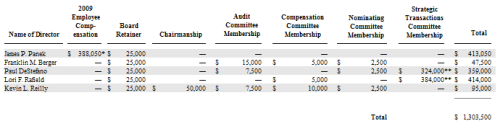
Despite the relatively simple task of overseeing a shell company and conducting an ordinary sale process, the Board has paid itself inordinately high compensation. The table below describes the principal executive officer’s 2009 cash compensation and the director cash compensation scheme for the VaxGen Board, as described in the Company’s 2008 annual report on Form 10-K:

VXGN Board Compensation 1

(This table has been modified from the original to fit this space)

* Consists of $195,000 annual base salary for 25 hours per week employment and a $193,050 lump sum payment. The lump sum payment was approved by the Board in consideration for Mr. Panek’s agreement not to resign for “good reason” under his employment agreement.

** VaxGen announced in its quarterly report for the period ended June 30, 2009 that, effective September 1, 2009, it had disbanded the Strategic Transactions Committee and that, following its disbandment, Board members would no longer receive additional compensation for service thereon.

While it is difficult to envision the rationale for the high cash compensation awarded to the Chairman Kevin Reilly and Franklin Berger, the most excessive portion of the director compensation consisted of the payments to the non-employee members of the Strategic Transactions Committee. Beginning in May 2008, Board members Lori F. Rafield and Paul DeStefano received $20,000 per month and $15,000 per month, respectively, for service on the Strategic Transactions Committee, which was formed to identify, review and evaluate potential strategic transactions and alternatives. Within a few months, these directors increased their compensation to $32,000 and $27,000 per month, respectively. This compensation is extraordinarily excessive.

Insignificant Board Equity Ownership

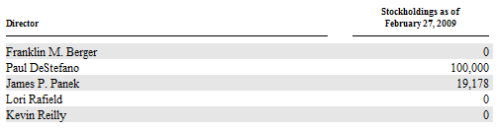
The members of the Board hold very few shares of the Company’s common stock. Most of the Board’s beneficial ownership holdings consist of underwater stock options. The following table describes the stockholdings of the Board, as set forth in the 2008 annual report, excluding options.

VXGN Board Compensation 2This Board has failed to take the steps we believe are necessary to preserve and enhance stockholder value. We believe the actions taken by the Board indicate that they are more interested in acting in their own self-interest rather than in the best interests of stockholders.


Value Investors for Change urges you to vote FOR the Fund’s proposal to elect the Nominees on the enclosed WHITE proxy card, thereby ending this disregard for stockholder interests. Vote to elect a new slate of directors who are willing to stand up for the interests of all stockholders and work to maximize stockholder value.

The members of the Board hold very few shares of the Company’s common stock. Most of the Board’s beneficial ownership holdings consist of underwater stock options. The following table describes the stockholdings of the Board, as set forth in the 2008 annual report, excluding options.

Hat tip bellamyj and matt.jensen08.

[Full Disclosure:  We have a holding in VXGN. This is neither a recommendation to buy or sell any securities. All information provided believed to be reliable and presented for information purposes only. Do your own research before investing in any security.]

Read Full Post »

Avigen Inc (NASDAQ:AVGN) has filed its 10Q for the period ended June 30, 2009.

One interesting aspect of the 10Q is the cost the company attributes to responding to the proxy fight and hostile tender offer:

Operating Activities. Net cash used in operating activities was $8.2 million during the six months ended June 30, 2009. Net cash used in operating activities during this period was primarily used to fund costs associated with our response to a proxy fight and hostile tender offer, and winding down clinical research and development activities, including non-clinical studies and clinical trials performed by third parties.

$8.2M? That’s $0.27 per share! Granted, some of it went to other activities, but presumably costs associated with “response to a proxy fight and hostile tender offer” was the larger portion of the $8.2M and that’s why it was listed first. It’s galling what directors are allowed to spend fighting off shareholders.

We started following AVGN in December last year (see archived posts here) because it was a net cash stock and specialist biotechnology investor Biotechnology Value Fund (BVF) was pushing it to liquidate and return its cash to shareholders. Despite BVF’s failure to remove the board, we continued to maintain our position in AVGN because BVF won a number of important concessions from the board that made AVGN a much more attractive stock than it was when we started following it. AVGN is now back in negotiations with MediciNova, Inc. regarding a proposed acquisition by MediciNova. The consideration for the deal is AVGN’s “net cash liquidation value plus $3 million” and “a contingent payment right for a specific product program milestone payment associated with Avigen’s Assignment Agreement with Genzyme Corporation, potentially subject to certain adjustments.” The stock price reflects this: AVGN closed yesterday at $1.34, up 106.2% from our $0.65 purchase price. We last estimated the net cash liquidation value at around $34M or $1.14 per share. We’ve now updated our estimate to $35M or $1.17 per share. Including the $3M from MediciNova would increase that value to around $38M or $1.27per share. We believe that there is a reasonable chance that AVGN will yield more than its current $1.34 share price when the “contingent payment right” capturing the near term payments from Genzyme is taken into account. AVGN shareholders also have an option-like exposure to any value in AVGN’s AV411 assets and program, although we cannot estimate the value of this with any certainty.

The value proposition updated

Set out below is our adjusted balance sheet for AVGN (the “Book Value” column shows the assets as they are carried in the financial statements, and the “Liquidating Value” column shows our estimate of the value of the assets in a liquidation):

AVGN Summary 2009 6 30

Conclusion

While BVF’s slate was unsuccessful at the special meeting, AVGN’s board has developed its own plan of liquidation, which should put a floor on AVGN’s stock at around its net cash value of $34M or $1.14 per share less wind down costs. There exists a good chance that AVGN will yield considerably more than its net cash value. The net cash estimate does not take into account AVGN’s AV411 assets and program or near term payments from Genzyme. With the downside protected, and a good chance at some upside from here, we think AVGN still represents good value, and we’re going to maintain our position accordingly.

[Full Disclosure: We have a holding in AVGN. This is neither a recommendation to buy or sell any securities. All information provided believed to be reliable and presented for information purposes only. Do your own research before investing in any security.]

Read Full Post »

Steel Partners has increased its holding in CoSine Communications Inc (OTC:COSN) from 44.9% to 47.5% at an average purchase price of $1.97 per share according to the fund’s most recent 13D notice.

We’ve been following COSN (see our COSN post archive) because it is a cash box controlled by activist investor Steel Partners. Steel Partners own 47.5% of the stock and sits on the board. The stock is up 16% since our initial post to close Friday at $2.03. We estimate the net cash value to be around $22.2M or $2.20 per share. The net cash value has remained stable through 2006, 2007, 2008 and 2009. COSN presents an opportunity to invest alongside Steel Partners at a discount to net cash in a company with substantial NOLs.

Hat tip FF.

[Full Disclosure:  We do not have a holding in COSN. This is neither a recommendation to buy or sell any securities. All information provided believed to be reliable and presented for information purposes only. Do your own research before investing in any security.]

Read Full Post »

« Newer Posts - Older Posts »