Feeds:
Posts
Comments

Posts Tagged ‘Liquidating Value’

Ikanos Communications Inc (NASDAQ:IKAN) has acquired the assets of the Broadband Access product line from Conexant Systems, Inc. (NASDAQ: CNXT) for $54M partially funded by a sale of $42M in common stock at $1.75 per share to Tallwood Venture Capital. Upon completion of the transaction, Tallwood Venture Capital will own approximately 45% of IKAN, which means that the possibility of any catalytic event occurring is now remote. While IKAN is still trading at a discount to our calculation of its liquidation and net cash values, without a catalyst our investment thesis is gone, so we’re exiting the position.

We opened the IKAN position at $1.14 and it closed Friday at $1.37, which means we’re up 20.2% on an absolute basis. The S&P500 Index was at 836.57 when we opened the position and closed yesterday at 866.23, which means we’re up 16.6% on a relative basis.

Post mortem

We started following IKAN (see our post archive here) because it was trading at a discount to its net cash and had retained a financial adviser to “assist it in exploring and evaluating strategic alternatives to maximize shareholder value.” IKAN disclosed in its September 10Q that it had retained investment bankers to advise the board about IKAN’s strategic options:

We recently decided to retain Barclays Capital (formerly Lehman Brothers) to provide financial advice regarding potential strategic options for the Company. Such options include, without limitation, financing transactions, acquisitions, strategic partnerships, corporate restructuring and other activities. There can be no assurance that the evaluation of our options will result in the identification, announcement or consummation of any transaction. If the Board of Directors does decide to authorize a transaction, that decision could cause significant volatility in the price of the Company’s outstanding common stock. Moreover, any transactions we do sign may not be acceptable to our stockholders. In addition, our investigation of strategic options may result in added costs, potential loss of customers and key employees as well as management’s distraction from ordinary-course business operations.

We said at the time that there seemed to be some appetite for acquisitions in this industry giving the example of IKAN’s competitor Centillium Communications Inc (NASDAQ: CTLM), which was acquired in October last year. We were hoping that IKAN was to be the vendor, but it seems the “strategic option” favored by IKAN and its investment bankers is to be the acquisition of Conexant’s Broadband Access product line. Here’s the press release:

Ikanos Communications Announces Plans to Acquire Conexant’s Broadband Access Product Line

Tallwood Venture Capital Invests $42 Million

Webcast and Conference Call Details Included for this Event and for

First Quarter 2009 Financial Results

FREMONT, Calif., April 22, 2009, Ikanos Communications, Inc. (NASDAQ: IKAN), a leading provider of broadband semiconductor and software products for the digital home, today announced the signing of a definitive agreement to purchase the Broadband Access product line from Conexant Systems, Inc. (NASDAQ: CNXT). The combined organization will have the expertise and resources required to satisfy the demand for powerful broadband network products around the world.

Under the terms of the agreement, which was unanimously approved by the boards of directors of both companies, Ikanos will purchase Conexant’s Broadband Access product line for $54 million in cash and the assumption of certain employee and facility related liabilities. In connection with this transaction, Tallwood Venture Capital, a leading investment firm focused on the semiconductor industry, has agreed to purchase 24 million shares of Ikanos common stock for $42 million, or $1.75 per share. Tallwood will also receive warrants to purchase an additional 7.8 million shares of common stock at $1.75 per share. The warrants will have a term of five years. Upon completion of the transactions, Tallwood Venture Capital will own approximately 45 percent of the outstanding shares of Ikanos (excluding the warrants). In addition, following the transaction, George Pavlov, general partner, and Dado Banatao, managing partner, will join Ikanos’ Board of Directors.

Ikanos’ purchase of Conexant’s Broadband Access product line is subject to customary closing conditions, including stockholder and regulatory approvals, and is expected to be completed in the third quarter of calendar year 2009.

Ikanos expects that the transaction will more than double the Company’s revenue, while providing significant leverage in its cost and spending structure. Ikanos also expects that the transaction will be accretive to its non-GAAP earnings per share within the first year after the close of the transaction.

“With the number of home networks doubling to more than 400 million by 2013 according to analysts, there’s a substantial opportunity for Ikanos to address the need for delivering bandwidth to and throughout the home,” said Michael Gulett, president and CEO of Ikanos. “We’ll use our strengthened leadership in broadband access as a platform on which to build new offerings that extend multi-play services seamlessly everywhere they are needed.”

Today, Ikanos and Conexant account for a cumulative 330 million broadband access ports shipped, bringing the power of the Internet to millions of people around the world. Conexant’s Broadband Access product line has traditionally been strong in North America and China while Ikanos has led in Japan, Korea and Europe. The combined company will be well positioned to address the global market for broadband semiconductors, and better serve customers in all geographies.

“Customers should not be concerned about product transitions. Once the acquisition is complete, the combined company will continue to make available and support the products acquired from Conexant along with the products of Ikanos,” added Gulett.

The combination of Ikanos and Conexant’s Broadband Access product line brings together the industry’s most comprehensive portfolio of broadband access products. Ikanos will build on its status as the VDSL market share leader, will add substantial ADSL market share, and will have a broad product portfolio that includes SHDSL, 802.11 b/g wireless networking, Ethernet switching, and passive optical networking (PON). In addition, the combined company will have both MIPS- and ARM-based processors that are powering broadband access networks around the world.

The combined company will also have the expertise to enable service providers and network equipment manufacturers to effectively build advanced networks, and deploy multi-play services including high-speed Internet, Internet protocol television (IPTV), voice-over Internet protocol (VoIP) and fixed-mobile convergence (FMC) offerings. The combined organization’s customers will include a vast array of industry leading network equipment manufacturers and service providers from around the world.

“The combined company brings together a talented team of employees that pioneered and set the standards for the broadband market,” said Craig Garen, senior vice president and general manager of Conexant’s Broadband Access business. “Going forward, we’ll continue to innovate and create new broadband access and home networking products that deliver enhanced value to the marketplace.”

Both Ikanos and Conexant have been strong, active proponents of industry standards, and are advancing the development of next-generation technologies like ITU-T G.hn for whole-home networking, retransmission and the dynamic spectrum management. The combined company will have a portfolio of intellectual property that will include well over 400 patents and applications.

“This transaction brings together a powerful combination of leading products, strong customer relationships, and deep technical expertise, all dedicated to the broadband market,” said George Pavlov, general partner at Tallwood Venture Capital. “The new company that emerges will be able to compete more effectively in existing and emerging markets, develop exciting new products, and provide greater value for its most important stakeholders – its customers, investors and employees.”

IKAN is still trading at a discount to both its net cash and liquidation valuations, so it’s difficult to exit when the possibility of additional upside is good. IKAN is still burning cash, so that value will deteriorate, and our investment thesis was based on some catalytic event occurring before the value was dissipated. Tallwood Venture Capital’s 45% holding (excluding the 7.8M warrants) means that Tallwood has control, which in turn means the chance of a catalytic event occurring that could realize that value is now low. For those reasons, we’re out.

Hat tip to JM.

[Full Disclosure:  We have a holding in IKAN. This is neither a recommendation to buy or sell any securities. All information provided believed to be reliable and presented for information purposes only. Do your own research before investing in any security.]
Read Full Post »

Autobytel Inc (NASDAQ:ABTL) has received a tender offer from Trilogy, Inc. at $0.35 per share. ABTL’s board is reviewing the offer and will advise its acceptence or rejection of the offer “on or before April 24, 2009.”

We started following ABTL (see our post archive here) because it was trading at a discount to its liquidation and net cash value and Trilogy, Inc. had been creeping up the register. Trilogy held 7.4% of ABTL’s outstanding stock prior to launching the tender offer. ABTL closed yesterday at $0.39, which is an 11% premium to Trilogy’s offer price, but still at a substantial discount to our estimate of ABTL’s liquidation value. We estimate that value to be around 38% higher still at $24.3M or $0.54 per share and ABTL’s net cash value to be around $15.4M or $0.34 per share.

Here’s Trilogy’s press release:

TRILOGY ENTERPRISES ANNOUNCES CASH TENDER OFFER FOR AUTOBYTEL AT $0.35 NET PER SHARE

AUSTIN, Texas, April 20, 2009 – Trilogy Enterprises, Inc. (“Trilogy”), a provider of technology powered business services to the automotive industry, today announced that its wholly-owned subsidiary, Infield Acquisition, Inc., has commenced a tender offer to acquire all of the outstanding shares of common stock of Autobytel Inc. (Nasdaq: ABTL) for $0.35 net per share in cash.

The offer represents a 32% premium over the trailing 30-day average closing price of Autobytel’s common stock.

“We are pleased to offer a significant premium to Autobytel’s shareholders, ” stated Sean Fallon, Senior Vice President of Trilogy. “The automotive industry is experiencing an unprecedented decline and we believe that Autobytel must take steps now to ensure its shareholders receive the highest value. Given the significant risks of this business and the Company’s history of operating losses, we believe the premium offered is very attractive.”

“As Autobytel’s second largest stockholder and the beneficial owner of approximately 7.4% of Autobytel’s outstanding common stock, we have studied this business carefully. We have concluded that Autobytel’s ability to execute a turnaround and realize significant value for its stockholders is subject to significant and unacceptable risk. We believe that a high-premium, all-cash tender offer is the most effective way to maximize value for all stockholders. As a result, we have determined it is necessary to take the offer directly to our fellow stockholders in order to deliver significant value to them as expeditiously as possible,” added Mr. Fallon.

“We are confident our fellow stockholders will find that this compelling offer reflects a superior value for their shares, both in light of Autobytel’s current and recent trading history, as well as any realistic near or long term assessment of Autobytel’s prospects. We are committed to completing this offer and remain willing to work cooperatively with Autobytel,” concluded Mr. Fallon.

The tender offer is scheduled to expire at 12:01 A.M., New York City time, on Tuesday, May 19, 2009, unless extended. The tender offer documents, including the Offer to Purchase and related Letter of Transmittal, will be filed today with the Securities and Exchange Commission (“SEC”). Autobytel’s stockholders may obtain copies of the tender offer documents when they become available at http://www.sec.gov. Free copies of such documents can also be obtained when they become available by calling Morrow & Co., LLC, toll-free at (800) 662-5200.

The tender offer was detailed in a letter dated April 20, 2009 from Trilogy to ABTL’s President and Chief Executive Officer, Jeffrey H. Coats, and ABTL’s Board of Directors. The full text of the letter is set forth below:

April 20, 2009
Autobytel Inc.
18872 MacArthur Boulevard, Suite 200
Irvine, California 92612-1400
Attention: Mr. Jeffrey H. Coats, President and Chief Executive Officer

Ladies and Gentlemen:

Trilogy Enterprises, Inc. (“Trilogy”), through its affiliates, owns approximately 7.4% of Autobytel Inc.’s (“Autobytel” or the “Company”) stock and is Autobytel’s second largest stockholder. We have successfully created and delivered innovative solutions to the automotive industry for more than a decade.

We believe Autobytel is facing a crucial period in its corporate existence. The automotive market is undergoing a crisis so severe that it is difficult to adequately describe. Strong companies may find a way forward. Weak companies will undoubtedly fail.

Unfortunately, Autobytel has historically struggled to create an independently viable business. For example:

• In 2006, Autobytel incurred operating losses of $40MM on $85MM in revenue;

• In 2007, Autobytel incurred operating losses of $35MM (not including litigation settlement costs) on $84MM in revenue; and

• In 2008, Autobytel incurred operating losses of $36MM (before impairment charges and litigation settlement costs) on $71MM in revenue, which declined by 15% from the prior year.

Autobytel has itself acknowledged that the market is “extremely challenging” and it expects the U.S. automotive industry to decline more than 20% in 2009. Given the market outlook, what should stockholders reasonably expect from a company that has not proven itself viable historically?

We recognize that Autobytel has taken steps to address this crisis. However, we do not believe the steps taken are adequate to address the severity of the situation. Autobytel facing another corporate reorganization during potentially the worst market in history seems highly unlikely to prevail. The current plan appears akin to “let’s give this one last shot”. Unfortunately, shareholder cash and value is at stake.

Given Autobytel’s business prospects and the significant historical and recent operating losses, the Board should take steps now to preserve as much shareholder value as possible. We believe the only means to accomplish this is the immediate sale of the business.

We are aware that Autobytel had engaged a financial advisor to evaluate the possible sale of the Company. Autobytel announced that its advisor conducted an extensive process which resulted in Autobytel concluding that shareholder value could not be maximized in the current environment. We assume this means no buyer desired to pay a price required by the Board.

Today, our wholly-owned subsidiary has commenced a tender offer that provides stockholders with an opportunity to sell shares at $0.35 per share in cash. We believe this price is likely lower than the share price the Board aspired to obtain during the recent sale process. However, we believe it is a full and fair value for the Company and offers both an attractive premium for stockholders, as well as immediate liquidity for a stock that is thinly traded.

We hereby request that the Board support the proposed tender offer, and in doing so, consider the following:

• The offer represents a 32% premium on the stock’s trailing 30 day closing price;

• The offer provides immediate liquidity for all stockholders;

• The trading volume reported for April is less than 65,000 shares per day, on over 45 million shares outstanding;

• The Company is a sub-scale public company and may not be able to continue to bear the costs and obligations of a public company;

• The Company cannot withstand another shift in strategy during what may be the worst market in history;

• The Company may not be able to continue to bear the costs of its management team, including the lucrative packages offered to its recent hires;

• The Company recently issued executive stock options at $0.35 per share, which the Company must believe is fair value;

• The Company had $32MM in cash in September and only $27MM in December;

• The Company continues to burn cash and is likely to do so for the foreseeable future. It is reasonable to believe that the Company may run out of cash by the end of 2010;

• Without at least breakeven results, stockholder value will only continue to deteriorate until no stockholder value remains;

• Any acquiror must take on the Company’s cash burn and fund the Company in a highly uncertain environment; and

• Any acquirer may have to invest significant additional funds into the Company to make it operationally efficient and competitive.

It is time to stop the erosion in stockholder value. Looking at where Autobytel’s stock price traded a year ago is not indicative of the true value of the Company, but it should serve as a reminder of the value that was destroyed. Autobytel’s management should realistically evaluate the prospects for its business. A candid assessment of that situation should lead management to conclude that an all cash offer at a significant premium to all Company stockholders is in the best interests of the stockholders.

We are pleased to make this proposal to our fellow stockholders. We believe they will find it to be attractive in light of both the Company’s trading history, and a realistic assessment of the Company’s prospects. We are committed to completing this offer and hopeful that we will be able to work cooperatively with the Company in doing so.
We look forward to your timely response.

Sincerely,
Trilogy Enterprises, Inc.

Trilogy’s offer is a little disappointing given that it is pitched at ABTL’s net cash value and at a large discount to its liquidation value. The discount is a direct result of the poison pill adopted by ABTL in 2004. From the most recent 10K:

Preferred Shares Purchase Rights Plan

In July 2004, the Board of Directors approved the adoption of a stockholder rights plan under which all stockholders of record as of August 10, 2004 received rights to purchase shares of Series A Junior Participating Preferred Stock. The rights were distributed as a non-taxable dividend and will expire July 30, 2014.

The rights will be exercisable only if a person or group acquires 15% or more of the common stock of the Company or announces a tender offer for 15% or more of the common stock. If a person or group acquires 15% or more of the common stock, all rightholders, except the acquirer, will be entitled to acquire at the then exercise price of a right that number of shares of the Company’s common stock which at the time will have a market value of two times the exercise price of the right. Under certain circumstances, all rightholders, other than the acquirer, will be entitled to receive at the then exercise price of a right that number of shares of common stock of the acquiring company which at the time will have a market value of two times the exercise price of the right. The initial exercise price of a right is $65.00.

The Board of Directors may terminate the rights plan at any time or redeem the rights prior to the time a person or group acquires more than 15% of the Company’s common stock.

In January 2009, the stockholder rights plan was amended to allow Coghill Capital Management LLC and certain of its affiliates (collectively “Coghill”) to hold up to 8,118,410 shares without becoming an acquiring person under the stockholders rights, subject to various conditions set forth in the amendment, including Coghill’s execution of and compliance with a standstill agreement.

We believe this is the opening salvo in Trilogy’s tender offer, and a higher price is possible if the board terminates the rights plan. We’ll watch the developments with interest.

[Full Disclosure:  We do not have a holding in ABTL. This is neither a recommendation to buy or sell any securities. All information provided believed to be reliable and presented for information purposes only. Do your own research before investing in any security.]

Read Full Post »

Chromcraft Revington (AMEX:CRC) has filed its 10K for the period ended December 31, 2008.

We initiated the position in CRC in December last year (see the post archive here) because it was trading at a substantial discount to its liquidation value and a substantial stockholder had called for its sale or orderly liquidation. Aldebaran Capital, LLC, a 7.7% stockholder, sent a letter to the company on October 29 last year arguing that if CRC is unable to “promptly stabilize its business and rationalize its cost structure” it should be sold or liquidated. Neither of those two events has occurred and the company now appears to be trading at a premium to its value in liquidation. We initially estimated the company’s liquidation value at around $15M. We’ve now reduced our valuation to $2.8M or $0.35 per share. The problem we identified when we opened the position persists: The company is in a liquidity crisis and risks entering bankruptcy. For these reasons, we’re exiting.

We opened the CRC position at $0.46 and it closed yesterday at $0.48, which means we’re up 4.8% on an absolute basis. The S&P500 Index was at 909.7 when we opened the position and closed yesterday at 832.39, which means we’re up 12.8% on a relative basis.

The value proposition updated

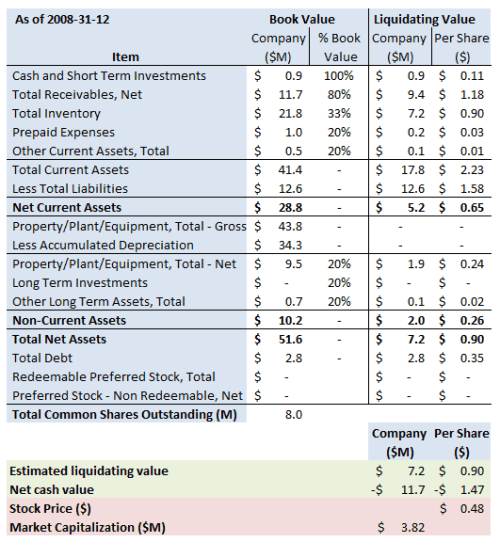
The company appears to have some value on its balance sheet, but much of that value is illusory for the reasons we’ll outline below (the “Book Value” column shows the assets as they are carried in the financial statements, and the “Liquidating Value” column shows our estimate of the value of the assets in a liquidation):

crc-summary-2008-12-31The $7.2M in liquidation value above doesn’t take into account CRC’s non-cancelable operating leases for office space, showroom facilities and transportation and other equipment. The future minimum lease payments under these leases for the years ending December 31, 2009, 2010, 2011, 2012 and 2013 are $1.9M, $1.1M, $0.8M, $0.6M, and $0, respectively, or $4.4M in total. Deducting the $4.4M from the $7.2M in balance sheet value leaves just $2.8M or $0.35 per share.
A slightly disappointing outcome, but we’re happy to take a small gain given the reduction in value.

[Full Disclosure:  We do not have a holding in CRC. This is neither a recommendation to buy or sell any securities. All information provided believed to be reliable and presented for information purposes only. Do your own research before investing in any security.]

Read Full Post »

Soapstone Networks Inc (NASDAQ:SOAP) has announced that it is reducing its headcount by approximately 40% “to reduce expenses and conserve cash in the current economic environment without diminishing the overall value of the Company.”

We been following SOAP (see our post archive here) because it is trading well below its net cash value with an activist investor, Mithras Capital, disclosing an 8.7% holding in October last year. The stock is up 40.0% from $2.50 when we initiated our position to close yesterday at $3.50, giving SOAP a market capitalization of $52.0M. We estimate the company’s net cash value to be $86.1M or $5.59 per share. We continue to believe that SOAP is a very good opportunity. The company’s ongoing business is small in comparison to its net cash position, so it shouldn’t dissipate its cash any time soon. It has no off-balance sheet arrangements, little in the way of ongoing contractual obligations and no material litigation, so the cash position seems reasonably certain. The company’s engagement of an investment bank to explore strategic alternatives is a promising step in the right direction. Of concern is the continued issuance of stock and options at a huge discount to liquidation value. The sooner Mithras Capital gets control of this situation the better.

The press release from SOAP is as follows:

Billerica, MA, April 14, 2009 – Soapstone Networks Inc. (NASDAQ: SOAP) today announced that it has undertaken an initiative to further reduce its total headcount by approximately 40%, in order to reduce expenses and conserve cash in the current economic environment without diminishing the overall value of the Company.

The Company expects to incur charges for severance and related costs of approximately $0.5 million in the second quarter of fiscal 2009 in connection with this action and anticipates overall incremental cost savings of approximately $3.0 million during 2009 as a result of these reductions, in addition to the $5.0 million in cost savings anticipated to result from the reduction in force previously announced February 12, 2009.

“We have taken these additional steps as we continue to aggressively explore strategic alternatives with the help of our financial advisor, Morgan Stanley & Co. Incorporated,” said Bill Leighton, Soapstone’s CEO. “We believe that this is a level at which we can continue with our PNC development and sales effort into the Carrier Ethernet market, while conserving a significant amount of cash.”

Hat tip to Double F.

[Full Disclosure:  We have a holding in SOAP. This is neither a recommendation to buy or sell any securities. All information provided believed to be reliable and presented for information purposes only. Do your own research before investing in any security.]

Read Full Post »

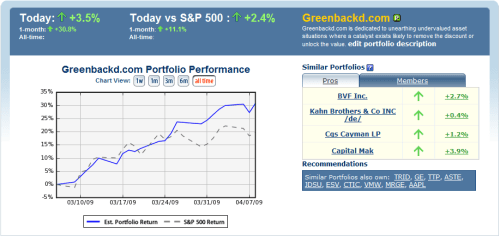
We’ve been tracking our performance using Tickerspy. You can see our up-to-date portfolio and performance here (You’ll need to set up an account with Tickerspy, which is free). We’re providing the link to the Tickerspy account so that you don’t need to wait for our quarterly report to see how the Greenbackd Portfolio is performing. For those who don’t want to set up a Tickerspy account, here’s a screen grab showing our performance since we opened our account on March 6, 2009 through April 8, 2009 (The usual caveat applies: one month is too short a period of time to determine whether Greenbackd’s strategy is working.):

tickerspy

We’re using Tickerspy because it tracks the performance of each stock in the portfolio and the portfolio performance against the S&P500 and automatically updates it all on a daily basis. It’s almost there, but Tickerspy is not entirely satisfactory. Ideally, we’d like a widget for the site that does all of this and doesn’t require our readers to open an account. We haven’t found anything like that yet. Does anyone have any suggestions for a service like this? If so, please drop us a line at greenbackd [at] gmail [dot] com or leave a comment below.

Read Full Post »

Tang Capital Partners has filed a preliminary proxy statement for the Vanda Pharmaceuticals Inc. (NASDAQ:VNDA) 2009 Annual Meeting of Stockholders urging stockholders to support Tang Capital Partners’ slate of two director nominees, Kevin C. Tang and Andrew D. Levin, M.D., Ph.D.

We’ve been following VNDA (see our post archive here) because it’s trading below its net cash value and Tang Capital Partners (TCP), has called for the company to “cease operations immediately, liquidate [VNDA]’s assets and distribute all remaining capital to the Stockholders.” The stock is up 16.7% since we initiated the position from $0.78 to close yesterday at $0.91, which gives the company a market capitalization of $24.3M. We estimate the net cash value to be around 75% higher at $42.6M or $1.60 per share. The company is hemorrhaging cash, so the investment turns on TCP’s ability to get control and staunch the bleeding. If TCP cannot get onto the board quickly or at all, the company will continue to burn cash and the investment will be a dud. VNDA has a staggered board, so this will make TCP’s task difficult.

The Background and reasons for the solicitation in the preliminary proxy statement is set out below:

Tang Capital has engaged in discussions with the Company and the Board with regards to the strategic direction of the Company. We believe that in order to maximize value for all stockholders, the Company must cease operations immediately, liquidate the Company’s assets and distribute all remaining capital to the Company’s stockholders.

Since the Company continues to operate as of the date of this Proxy Statement and has not publicly announced any plan of liquidation and dissolution, we believe the Board has rejected our proposal to immediately cease all operations, liquidate the Company’s assets and distribute all remaining capital to the Company’s stockholders. In light of the foregoing, and in order to preserve and maximize the diminishing value of the Company’s assets for the benefit of all stockholders, Tang Capital has nominated Kevin C. Tang and Andrew D. Levin, M.D., Ph.D. for election to the Board at the Annual Meeting and proposed a stockholder resolution to be voted on at the Annual Meeting whereby the stockholders will request that the Company cease operations immediately, liquidate the Company’s assets and distribute all remaining capital to the Company’s stockholders.

On February 13, 2009, Tang Capital delivered a letter (the “Letter”) to the Nominating and Governance Committee of the Company recommending Mr. Tang and Dr. Levin as nominees for election to the Board at the Annual Meeting. On the same date, Tang Capital also delivered a notice (the “Notice”) to the Company of its intention to, among other things, nominate Mr. Tang and Dr. Levin for election to the Board and propose the stockholder resolution described herein.

Since delivery of the Letter and Notice, the Board has failed to engage with Tang Capital in a dialogue on the merits of its recommendations. Tang Capital therefore decided to embark on this solicitation of proxies to elect the Nominees and approve the resolution described herein. See the information under the heading “Proposal 1 – Election of Directors” beginning on page • for additional information about the Nominees. Further, Tang Capital believes that the proposed resolution is the best way for the stockholders to let the Board know what the stockholders consider to be the best direction for the future of the Company in a manner that is quantitative, clear and indisputable.

[Full Disclosure:  We do not have a holding in VNDA. This is neither a recommendation to buy or sell any securities. All information provided believed to be reliable and presented for information purposes only. Do your own research before investing in any security.]

Read Full Post »

Tweedy Browne, the deep value investment firm established in 1920, has updated its booklet, What Has Worked In Investing (.pdf). First published in 1992 and now updated for 2009, the booklet discusses over fifty academic studies of investment criteria that have produced high rates of investment return. Our interest in the booklet stems from its examination of a group of investment styles falling under the rubric, “Assets bought cheap,” in particular, Benjamin Graham’s “Net current asset value” method and the “Low price to book value” method.

Graham’s “Net current asset value” method

Says Tweedy Browne of Graham’s “Net current asset value” method:

The net current asset value approach is the oldest approach to investment in groups of securities with common selection characteristics of which we are aware. Benjamin Graham developed and tested this criterion between 1930 and 1932. The net current assets investment selection criterion calls for the purchase of stocks which are priced at 66% or less of a company’s underlying current assets (cash, receivables and inventory) net of all liabilities and claims senior to a company’s common stock (current liabilities, long-term debt, preferred stock, unfunded pension liabilities). For example, if a company’s current assets are $100 per share and the sum of current liabilities, long-term debt, preferred stock, and unfunded pension liabilities is $40 per share, then net current assets would be $60 per share, and Graham would pay no more than 66% of $60, or $40, for this stock. Graham used the net current asset investment selection technique extensively in the operations of his investment management business, Graham-Newman Corporation, through 1956. Graham reported that the average return, over a 30-year period, on diversified portfolios of net current asset stocks was about 20% per year

The booklet discusses a study conducted by Henry Oppenheimer, an Associate Professor of Finance at the State University of New York at Binghamton, in which he examined the returns of such stocks over a 13-year period from December 31, 1970 through December 31, 1983. Oppenheimer’s study assumed that all stocks meeting the investment criterion were purchased on December 31 of each year, held for one year, and replaced on December 31 of the subsequent year by stocks meeting the same criterion on that date. The total sample size was 645 net current asset selections. The smallest annual sample was 18 companies and the largest was 89 companies.

Oppenheimer’s conclusion about the returns from such stocks was nothing short of extraordinary:

The mean return from net current asset stocks for the 13-year period was 29.4% per year versus 11.5% per year for the NYSE-AMEX Index. One million dollars invested in the net current asset portfolio on December 31, 1970 would have increased to $25,497,300 by December 31, 1983. By comparison, $1,000,000 invested in the NYSE-AMEX Index would have increased to $3,729,600 on December 31, 1983. The net current asset portfolio’s exceptional performance over the entire 13 years was not consistent over smaller subsets of time within the 13-year period. For the three-year period, December 31, 1970 through December 31, 1973, which represents 23% of the 13-year study period, the mean annual return from the net current asset portfolio was .6% per year as compared to 4.6% per year for the NYSE-AMEX Index.

Perhaps most intriguing, though, was Oppenheimer’s conclusion about the relative outperformance of the loss-making stocks over the profitable ones:

The study also examined the investment results from the net current asset companies which operated at a loss (about one-third of the entire sample of companies) as compared to the investment results of the net current asset companies which operated profitably. The companies operating at a loss had slightly higher investment returns than the companies with positive earnings: 31.3% per year for the unprofitable companies versus 28.9% per year for the profitable companies.

We believe that Oppenheimer’s study presents a compelling argument for such an investment approach.

Low price in relation to book value

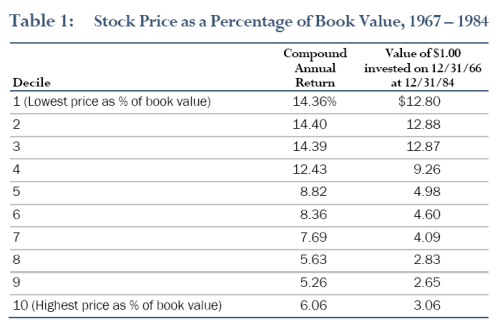
The second investment method falling under the rubric of “Assets bought cheap” is the “Low price in relation to book value” method. The booklet discusses a study conducted by Roger Ibbotson, Professor in the Practice of Finance at Yale School of Management and President of Ibbotson Associates, Inc., a consulting firm specializing in economics, investments and finance. In “Decile Portfolios of the New York Stock Exchange, 1967 – 1984,” Working Paper, Yale School of Management, 1986, Ibbotson studied the relationship between stock price as a proportion of book value and investment returns. To test this relationship, all stocks listed on the NYSE were ranked on December 31 of each year, according to stock price as a percentage of book value, and sorted into deciles. Ibbotson then measured the compound average annual returns for each decile for the 18-year period, December 31, 1966 through December 31, 1984.

Ibbotson found that stocks with a low price-to-book value ratio had significantly better investment returns over the 18-year period than stocks priced high as a proportion of book value. Tweedy Browne set out Ibbotson’s results in the following Table 1:

tweedy-table-1

A second study conducted by Werner F.M. DeBondt and Richard H. Thaler, Finance Professors at University of Wisconsin and Cornell University, respectively, examined stock price in relation to book value in “Further Evidence on Investor Overreaction and Stock Market Seasonality,” The Journal of Finance, July 1987. DeBondt and Thaler ranked all companies listed on the NYSE and AMEX, except companies that were part of the S&P 40 Financial Index, according to stock price in relation to book value and then sorted them into quintiles on December 31 in each of 1969, 1971, 1973, 1975, 1977 and 1979. DeBondt and Thaler then calculated the investment return against the equal weighted NYSE Index over the subsequent four years for all of the stocks in each selection period. The four-year returns against the market index were then averaged.

The stocks in the lowest quintile had an average market price to book value ratio of 0.36 and an average earnings yield (the inverse of the P/E ratio) of 0.10 (indicating a P/E of 10). DeBondt and Thaler found a cumulative average return in excess of the market index over the four years of 40.7%. Meanwhile, the stocks in the highest quintile, those with an average market price to book value ratio of 3.42 and an average earnings yield of 0.147 (a P/E of 6.8), returned 1.3% less than the market index over the four years after portfolio formation.

Perhaps the most striking finding by DeBondt and Thaler, and one that accords with our view about the difficulty of predicting earnings with any degree of accuracy, was the contrast between the earnings pattern of the companies in the lowest quintile (average price/book value of 0.36) and the highest quintile (average price/book value of 3.42). Tweedy Browne set out DeBondt and Thaler’s findings in Table 3 below, which describes the average earnings per share for companies in the lowest and highest quintile of price/book value in the three years prior to selection and the four years subsequent to selection:

tweedy-table-3

In the four years after the date of selection, the earnings of the companies in the lowest price/book value quintile increase 24.4%, more than the companies in the highest price/book value quintile, whose earnings increased only 8.2%. DeBondt and Thaler attribute the earnings outperformance of the companies in the lowest quintile to the phenomenon of “mean reversion,” which Tweedy Browne describes as the observation that “significant declines in earnings are followed by significant earnings increases, and that significant earnings increases are followed by slower rates of increase or declines.”

The booklet continues to discuss Tweedy Browne’s own findings confirming those of the studies described above, and a range of other studies that confirm the findings over different periods of time and in different countries. The findings form a compelling argument for an investment philosophy rooted in deep value and focused on assets, such as Greenbackd’s.

Buy my book The Acquirer’s Multiple: How the Billionaire Contrarians of Deep Value Beat the Market from on Kindlepaperback, and Audible.

Here’s your book for the fall if you’re on global Wall Street. Tobias Carlisle has hit a home run deep over left field. It’s an incredibly smart, dense, 213 pages on how to not lose money in the market. It’s your Autumn smart read. –Tom Keene, Bloomberg’s Editor-At-Large, Bloomberg Surveillance, September 9, 2014.

Click here if you’d like to read more on The Acquirer’s Multiple, or connect with me on Twitter, LinkedIn or Facebook. Check out the best deep value stocks in the largest 1000 names for free on the deep value stock screener at The Acquirer’s Multiple®.

Read Full Post »

ARC Wireless Solutions (NASDAQ:ARCW) has filed its 10K for the year ended December 31, 2008. In a disappointing development, ARCW has entered into a “financial advisory engagement” with a Brean Murray Carret and Mr. Hassan Nemazee for “financial advisory and business consulting services, including restructuring services,” pursuant to which ARCW pays fees for services. Over the life of the agreement to 2013, ARCW will pay no less than $1.5M. The agreement means that Brean Murray Carret will earn more than other shareholders by running the business and has no incentive to create a catalytic event in ARCW. That means our investment thesis is gone and we’re exiting on that basis. We opened the ARCW position at $2.86 and it closed yesterday at $2.75, which means we’re down 3.85% on an absolute basis. The S&P500 Index was at 845.71 when we opened the position and closed yesterday at 843.88, which means we’re down 3.63% on a relative basis.

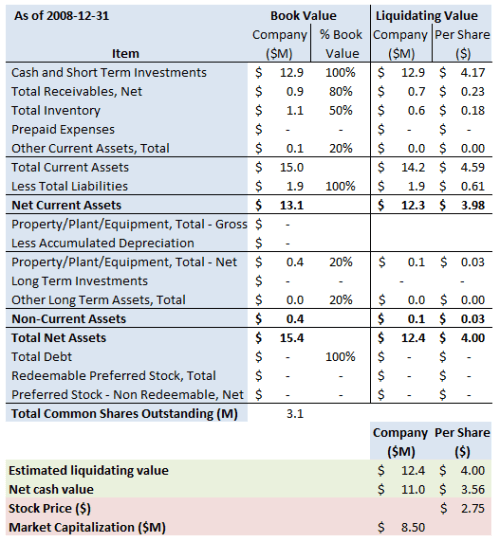
We started following ARCW on January 28, 2009 (see our post archive here) because it was a net cash stock with an activist investor, Brean Murray Carret, disclosing a 13.9% position on November 3 last year. ARCW closed yesterday at $2.75, giving it a market capitalization of just $8.5M. We initially estimated its liquidation value to be around $13.9M or $4.49 per share. After reviewing the 10K, we’ve now reduced our estimate of the liquidation value to $12.4M or $4.00 per share. The decrease is mostly attributable to cash used to fund operating losses in 2008. Brean Murray Carret’s original 13D filing disclosed its intention to tip out ARCW’s board and “nominate an alternative slate of directors for election to [ARCW’s]’s Board of Directors at the earliest possible opportunity.” Its subsequent 13D filing indicated that this occurred quickly, and Brean Murray Carret’s nominees were elected by the board of ARCW on November 12, 2008. Unfortunately for us, it seems Brean Murray Carret will run the business rather than realize the assets.

The value proposition updated

ARCW is a loss-making, generally cash-consuming company. The company’s balance sheet has, however, retained some value (the “Book Value” column shows the assets as they are carried in the financial statements, and the “Liquidating Value” column shows our estimate of the value of the assets in a liquidation):

arcw-summary-2008-12-31

Off-balance sheet arrangements and contractual obligations

According to the 10K, ARCW has no off-balance sheet arrangements and its contractual obligations are $0.9M in total.

The value remaining on ARCW’s balance sheet is as a result of its sale in 2006 of its wholly owned subsidiary Winncom for $17M. The company has since burned through some of that cash, but it does still have a net cash value of $11.0M or $3.56 per share.

The catalyst

We missed this in our initial analysis, but fortunately commenter Chad was awake. One disappointing development in ARCW since Brean Murray Carret got control of the board has been the company’s entry into a “financial advisory engagement” with Quadrant Management, Inc., which is under common control with Brean Murray Carret and Mr. Hassan Nemazee. Between them, they beneficially own 27.5% of ARCW. Pursuant to the “financial advisory engagement,” Quadrant provides to ARCW “financial advisory and business consulting services, including restructuring services.” ARCW pays the following: 1) an initial cash fee of $250,000; 2) an annual fee of the greater of (i) $250,000, or (ii) 20% of any increase in reported earnings before interest, taxes, depreciation and amortization after adjusting for one-time and non-recurring items for the current financial year over preceding year, or (iii) 20% of reported EBITDA for the current financial year, and; 3) all reasonable out-of-pocket expenses incurred by Quadrant in performing services under the engagement.

[Full Disclosure:  We do not have a holding in ARCW. This is neither a recommendation to buy or sell any securities. All information provided believed to be reliable and presented for information purposes only. Do your own research before investing in any security.]

Read Full Post »

Rackable Systems Inc (NASDAQ:RACK) has announced that it is suspending its buyback and acquiring substantially all the assets of Silicon Graphics Inc (NASDAQ:SGIC) for “approximately $25 million in cash, subject to adjustment in certain circumstances, plus the assumption of certain liabilities associated with the acquired assets.” Without the buyback, our investment thesis is gone, so we’re exiting our position in RACK. We opened it on March 11, 2009 when it was trading at $3.56, so we’re up 9.0% on an absolute basis. The S&P500 Index was trading at 719.60 when we opened the position in RACK, and closed yesterday at 811.08, which means we’re down 3.7% on a relative basis.

We started following RACK (see our post archive here) because it was an undervalued asset play, and had announced a plan to repurchase almost 40% of its stock. That buyback is now suspended. If the buyback had been completed at the current stock price, the company’s per share liquidation value would have increased by around 17% to $6.72. The acquisition of SGIC’s assets is also almost certain to reduce RACK’s liquidation value. The likely reduction in liquidation value combined with the suspension of the buyback is fatal to our investment thesis, and that’s why we’ve exited. On the whole, a disappointing outcome for us, but the stock is up to $3.95 in after hours trading, so the market clearly disagrees with our assessment.

The Asset Purchase Agreement makes for interesting reading, and the deal may well turn out to be a good one for RACK. It’s certainly buying at the right time and from a distressed seller, which are indicators, but not conclusive, that the deal is good for RACK. It also seems from the Asset Purchase Agreement that RACK is cherry picking the assets it wants and avoiding the liabilities it doesn’t. Whether the deal works for RACK, we have no idea. This sort of analysis is beyond us, so we focus on the liquidation value. Prior to the company entering into the agreement with SGIC, we estimated the liquidation value at around $171.6M or $5.74 per share. Although it is difficult to predict with any precision the effect of the acquisition on RACK’s liquidation value, we are almost certain that it will be reduced by the $25M cash payment plus whatever liabilities are assumed less a smaller increase for the assets acquired. It is likely that RACK’s liquidation value will still be somewhat above its present stock price, but, without the buyback catalyst, our reason for holding the stock is gone, and so we’re out. There’s a chance that the deal will fall over, so we’ll revisit RACK in that event.

The company’s press release is set out below:

Rackable Systems Announces Agreement to Acquire Silicon Graphics Inc.

FREMONT, CA and SUNNYVALE, CA., April 1, 2009 – Rackable Systems, Inc. (NASDAQ:RACK), a leading provider of servers and storage products for medium to large-scale data centers, today announced its agreement to acquire substantially all the assets of Silicon Graphics, Inc. (SGI) (NASDAQ: SGIC) for approximately $25 million in cash, subject to adjustment in certain circumstances, plus the assumption of certain liabilities associated with the acquired assets.

The combined businesses will provide customers with market leading hardware and software technology within large-scale x86 cluster computing, HPC, Internet, Cloud Computing, large-scale data storage environments and visualization platforms across many verticals and geographies. This combination is also expected to result in a stronger global services organization; reaching commercial, government and scientific sectors on a worldwide basis.

“The combined company will be positioned to solve the most demanding business and technology challenges our customers confront today,” said Mark J. Barrenechea, president and CEO of Rackable Systems. “In addition, this combination gives us the potential for significant operational synergies, a strong balance sheet, and positions the combined company for long-term growth and profitability.”

“We have been working very hard to strengthen our company, and today, we’ve taken another big step in that direction,” stated Robert “Bo” Ewald, CEO of Silicon Graphics. “This transaction represents a compelling opportunity for Silicon Graphics’ customers, partners and employees, who can all benefit from the emerging stronger company with better technologies, products and markets reach.”

Barrenechea added, “Together, we believe we will be a much stronger entity with great products and people offering a compelling proposition to compete more effectively in, and across, our collective markets.”

Rackable has signed an Asset Purchase Agreement to acquire substantially all the assets of SGI, and to assume certain liabilities relating to the assets, pursuant to Chapter 11 of the U.S. Bankruptcy Code, under which SGI filed its petition in New York on April 1, 2009. Completion of the transaction is subject to a number of closing conditions, including the approval of the Bankruptcy Court, and other uncertainties. Subject to such conditions and uncertainties, the transaction is expected to close within approximately 60 days. It is expected that SGI’s business operations will continue during the pre-closing period. SGI’s international operations would be part of the sale, but would not be part of the bankruptcy process.

Rackable also announced today that it had suspended its previously announced program including the repurchase of up to $40 million of the company’s stock.

Hat tip to shp.

[Full Disclosure:  We have a holding in RACK. This is neither a recommendation to buy or sell any securities. All information provided believed to be reliable and presented for information purposes only. Do your own research before investing in any security.]

Read Full Post »

MathStar Inc (OTC:MATH) has filed its 10K for the year ended December 31, 2008.

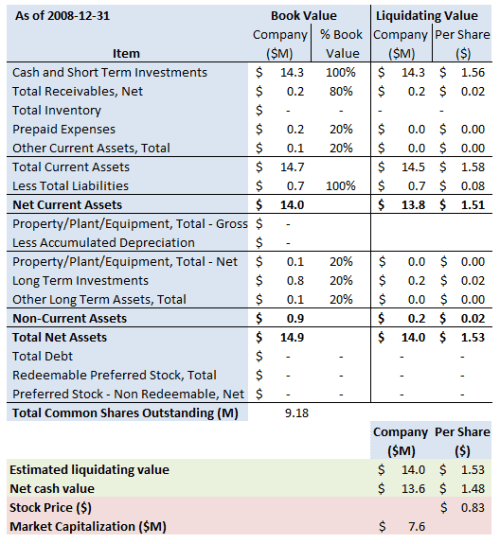
We’ve been following MATH since December last year (see our post archive here) when it was trading at $0.68. We initiated the position because MATH is a net cash stock with two substantial stockholders lobbying management to liquidate. The stock is up 21.3% to $0.825 yesterday, giving it a market capitalization of $7.6M. We initially estimated MATH’s liquidation value to be $14.4M or $1.57 per share. The balance sheet had around $14M or $1.52 per share in value at December 31. Adjusting for contractual obligations and another quarter of cash burn at say $0.6M per quarter, we now estimate MATH’s liquidation value to be around $12.0M or $1.31 per share. That value is predominantly cash and short term investments and doesn’t take into account any further value that the sale of the FPOA technology and intellectual property may yield. The two activist investors, Mr. Zachary McAdoo of The Zanett Group and Mr. Salvatore Muoio of S. Muoio & Co., have been urging MATH’s board to consider liquidation rather than a merger. MATH’s board seems to agree, twice rejecting unsolicited merger proposals, suspending the company’s operations and exploring “strategic alternatives, which could include merger, acquisition, increasing operations in another structure or liquidation.” From the 10K:

During the three months ended June 30, 2008, we announced a curtailment of operations as our Board evaluated strategic alternatives. Strategic alternatives that are being evaluated by our Board of Directors and management include, but are not limited to, restarting the company; merging with or acquiring another company, including or excluding our intellectual property (IP); increasing operations in another structure; or liquidation. The primary criteria for determining the strategic alternative is to maximize shareholder value, which may or may not include the use of the accumulated net operating losses (NOL). Although we have curtailed operations, we have met all financial obligations with vendors, key suppliers, and strategic partners. We have engaged a third party investment banking firm to explore the sale of intellectual property and patents and potential merger and acquisition alternatives.

The value proposition updated

MATH has rapidly burned cash throughout the year, mainly on research and development. The company has now put a stop to its R&D activities, which has reduced the cash burn significantly from $1.6M in the September quarter to $0.4M in the December quarter. The company’s value rests on its vestigial holding of cash and equivalents (the “Book Value” column shows the assets as they are carried in the financial statements, and the “Liquidating Value” column shows our estimate of the value of the assets in a liquidation):

math-summary-2008-12-31

Off-balance sheet arrangements and contractual obligations

According to MATH’s 10K, it has no off-balance sheet arrangements, but has around $1.4M in non-cancellable commitments for design licenses and operating leases.

Adjusting for the $1.4M in non-cancellable commitments for design licenses and operating leases and another quarter of cash burn at around $0.6M, we estimate the liquidation value to be around $12.0M or $1.31 per share.

Conclusion

At its $0.835 close yesterday, MATH has a market capitalization of just $7.6M. Our updated liquidation valuation is still some 60% higher at $12.0M or $1.31 per share, so we believe that MATH still represents good value. With other potentially valuable assets and Messrs. McAdoo and Muoio pushing the board to liquidate the company, we’re going to maintain our position in MATH.

[Full Disclosure:  We do not have a holding in MATH. This is neither a recommendation to buy or sell any securities. All information provided believed to be reliable and presented for information purposes only. Do your own research before investing in any security.]

Read Full Post »

« Newer Posts - Older Posts »