Feeds:
Posts
Comments

Posts Tagged ‘Activist investment’

Soapstone Networks Inc (NASDAQ:SOAP) has announced that it intends to liquidate and has filed its Plan of Liquidation.

We been following SOAP (see our post archive here) because it was trading well below its net cash value with an activist investor, Mithras Capital, disclosing an 8.7% holding in October last year. The stock is up 65% from $2.50 when we initiated our position to close today at $4.13, giving SOAP a market capitalization of $61.0M. We last estimated the company’s net cash value to be $80.3M or $5.21 per share. The company has now announced that it proposes to liquidate. It estimates that the total distribution, including an extraordinary cash dividend of $3.75 per share, will be between $4.00 and $4.50 per share

The press release from the company is set out below:

Soapstone Networks Announces Approval of Plan of Liquidation and Dissolution by Board of Directors and Wind Down of Operations

Billerica, MA, June 15, 2009 — Soapstone Networks Inc. (NASDAQ: SOAP), today announced that its Board of Directors (the “Board”) has unanimously approved a plan of dissolution and liquidation of the Company (the “Plan of Liquidation”) and that it will file a proxy statement seeking stockholder approval of such plan.

As part of this decision, the Company has ceased the development and marketing of the Soapstone Provider Network Controller (PNC) product and has reduced its workforce by 50 to a total of 14 employees. Moreover, if the Company’s stockholders approve the Plan of Liquidation, the Company intends to file a certificate of dissolution, delist its shares from NASDAQ, sell and monetize its non-cash assets, satisfy or settle its remaining liabilities and obligations, including any contingent liabilities and claims, terminate its remaining employees throughout the wind down period, and make one or more distributions to its stockholders of cash available for distribution.

The Company also announced that its Board has unanimously approved an extraordinary cash dividend of $3.75 per share, provided that the Board may adjust such amount at a later date to ensure there is remaining cash to satisfy potential liabilities. Such dividend will be payable after the stockholder meeting at which the Plan of Liquidation is approved by the Company’s stockholders and in connection with the filing of a Certificate of Dissolution with the Delaware Secretary of State.

The Company has analyzed its liquidation value and currently estimates that the amount of subsequent distributions to stockholders will range from $0.25 to $0.75 per share, for a total distribution, including the extraordinary cash dividend, of between $4.00 and $4.50 per share. The amount of these distributions, however, may vary substantially from these estimates based on the resolution of outstanding known and contingent liabilities and the possible assertion of claims that are currently unknown to the Company. If, prior to its dissolution, the Company receives an offer for a transaction that will, in the view of the Board, provide superior value to stockholders than the value of the estimated distributions under the Plan, taking into account all factors that could affect valuation, including timing and certainty of payment or closing, credit market risks, proposed terms and other factors, the Plan of Liquidation and the dissolution could be abandoned in favor of such a transaction.

The Board made this decision after completing an exhaustive evaluation of various strategic alternatives available to the Company for enhancing stockholder value, including but not limited to, continued execution of the Company’s business plan, the payment of a cash dividend to the Company’s stockholders, a repurchase by the Company of shares of its capital stock, the sale or spin off of Company assets, partnering or other collaboration agreements, a merger, sale or liquidation of, or acquisition by, the Company or other strategic transaction. The Company and its external advisors, including its financial advisor Morgan Stanley & Co. Incorporated, devoted substantial time and effort in identifying potential buyers or strategic partners and entered into negotiations with several potential partners; however, that process did not yield a potential transaction which the Board viewed as reasonably likely to provide greater realizable value to its stockholders than the complete dissolution and liquidation of the Company in accordance with the Plan of Liquidation.

[Full Disclosure:  We have a holding in SOAP. This is neither a recommendation to buy or sell any securities. All information provided believed to be reliable and presented for information purposes only. Do your own research before investing in any security.]
Read Full Post »

We are exiting our position in Amtech Systems Inc (NASDAQ:ASYS) at its $5.65 close yesterday because the stock is trading at a substantial premium to our valuation. We opened the position at $2.78, so we’re up 103.2% on an absolute basis. The S&P500 Index closed at 712.87 on the day we opened the position and close yesterday at 944.74, which means we’re up 70.9% on a relative basis.

Post mortem

We initiated the position in ASYS at its $2.78 closing price on March 5, 2009 (see our initial post here). At $2.78, the company had a market capitalization of $25.3M. We estimated the liquidation value to be almost 60% higher at $40M or $4.40 per share. ASYS was trading at a little under two-thirds of our estimate of its value in liquidation, but, unusually, had continued to generate positive operating cash flow and earnings in a difficult operating environment. Management seemed to have recognized that the stock was too cheap, and authorized a $4M stock buy-back. Our only criticism was that the buy-back could have been bigger. A private investor, Mr. Richard L. Scott, had disclosed a 7.0% holding in July last year. Mr Scott continued to purchase stock, and, as of February 17 this year, held 9.1% of ASYS’s outstanding stock. We don’t know anything about Mr. Scott, but we liked seeing a large stockholder increasing his stake when the stock price dropped. For those reasons, we thought ASYS represented very good value at a discount to its liquidation value and that’s why we added it to the Greenbackd Portfolio.

[Full Disclosure:  We have a holding in ASYS. This is neither a recommendation to buy or sell any securities. All information provided believed to be reliable and presented for information purposes only. Do your own research before investing in any security.]

Read Full Post »

Update June 16, 2009: SOAP has announced that it proposes to liquidate. See our post below.

Update June 3, 2009: We’ve pinned this post to the front page. Any new posts between now and July 4th will appear below this post.

June 1, 2009 marked the end of Greenbackd’s second quarter. It’s time again to report on the performance of the Greenbackd Portfolio and the positions in the portfolio, discuss the evolution of our valuation methodology and outline the future direction of Greenbackd.com.

Second quarter performance of the Greenbackd Portfolio

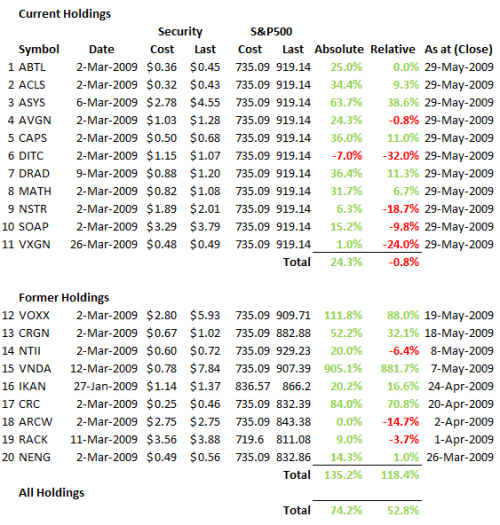
The second quarter was nothing short of a blockbuster for the Greenbackd Portfolio, up 74.2% on an absolute basis, which was 52.8% higher than the return on the S&P500 return over the same period. A large positive return for the period is heartening, but our celebration is tempered by the fact that it is difficult to avoid a good return in a market that rises 25.0% in a quarter. Our Q1 performance was -3.7% (see our first quarter performance here), which means that our total return since inception (assuming equal weighting in each quarter) is 67.8% against a return on the S&P500 of 11.6%, or an outperformance of 56.2% over the return in the S&P500.

It is still too early to determine how Greenbackd’s strategy of investing in undervalued asset situations with a catalyst is performing, but we believe we are heading in the right direction. Set out below is a list of all the stocks in the Greenbackd Portfolio and the absolute and relative performance of each from the close of the last trading day of the first quarter, Friday, February 28, 2009, to the close on the last trading day in the second quarter, May 29, 2009:

Greenbackd Portfolio Performance 2009 Q2You may have noticed something odd about our presentation of performance. The S&P500 index rose by 25.0% in our second quarter (from 735.09 to 919.14). Our +74.2% performance might suggest an outperformance over the S&P500 index of 49.2%, while we report outperformance of 52.8%. We calculate our performance on a slightly different basis, recording the level of the S&P500 index on the day each stock is added to the portfolio and then comparing the performance of each stock against the index for the same holding period. The Total Relative performance, therefore, is the average performance of each stock against the performance of the S&P500 index for the same periods. As we discussed above, the holding period for Greenbackd’s positions has been too short to provide any meaningful information about the likely performance of the strategy over the long term (2 to 5 years), but we believe that the strategy should outperform the market by a small margin.

Greenbackd’s valuation methodology

We started Greenbackd in an effort to extend our understanding of asset-based valuation described by Benjamin Graham in the 1934 Edition of Security Analysis. (You can see our summary of Graham’s approach here). Through some great discussion with our readers, many of whom work in the fund management industry as experienced analysts or even managing members of hedge funds, and by incorporating the observations of Marty Whitman (see Marty Whitman’s adjustments to Graham’s net net formula here) and Seth Klarman (our Seth Klarman series starts here), we have refined our process. We believe that what started out as a pretty unsophisticated application of Graham’s liquidation value methodology has evolved into a more realistic analysis of the balance sheet and the relationship of certain disclosures in the financial statements to asset value. Our analyses are now quantitatively more robust than when we started and that has manifest itself in better performance.

Tweedy Browne offers some compelling evidence for the asset based valuation approach here.

Update on the holdings in the Greenbackd Portfolio

There are eleven stocks remaining in the Greenbackd Portfolio:

  1. VXGN (added March 26, 2009 @ $0.48)
  2. DRAD (added March 9, 2009 @ $0.88)
  3. ASYS (added March 5, 2009 @ $2.78)
  4. CAPS (added February 27, 2009 @ $0.60)
  5. DITC (added February 19, 2009 @ $0.89)
  6. SOAP (added February 2, 2009 @ $2.50)
  7. NSTR (added January 16, 2009 @ $1.91)
  8. ACLS (added January 8, 2009 @ $0.60)
  9. MATH (added December 17, 2008 @ $0.68)
  10. ABTL (added December 11, 2008 @ $0.43)
  11. AVGN (added December 1, 2008 @ $0.65)

The future of Greenbackd.com

We are taking a brief vacation. We’ll be back full-time after July 4th, always reserving the right to post interesting ideas in the interum and update our open positions. If you’re looking for net nets in the meantime, there are two good screens:

  1. GuruFocus has a Graham net net screen ($249 per year)
  2. Graham Investor NCAV screen (Free)

Greenbackd is a labor of love. We try to create new content every week day, and to get the stock analyses up just after midnight Eastern Standard Time, so that they’re available before the markets open the following day. Most of the stocks that are currently trading at a premium to the price at which we originally identified them traded for a period at a discount to the price at which we identified them. This means that there are plenty of opportunities to trade on our ideas (not that we suggest you do that without reading our disclosures and doing your own research). If you find the ideas here compelling and you get some value from them, you can support our efforts by making a donation via PayPal.

We look forward to bringing you the best undervalued asset situations we can dig up in the next quarter.

Read Full Post »

The Official Activist Investing Blog has published its list of activist investments for April:

Ticker Company Investor
ABTL Autobytel Inc Trilogy Enterprises
AMLN Amylin Pharmaceuticals Carl Icahn
ASPM Aspect Medical Systems First Manhattan Co
ASUR Asure Software Inc Red Oak Partners
BASI Bioanalytical Systems Peter Kissinger
BBEP BreitBurn Energy Partners, L.P. Baupost Group
BCSB BCSB Bancorp Inc. Financial Edge Fund
CHE Chemed Corp [Download an In-Depth Analysis from Catalyst Investment Research]
MMI Investors
CHG CH Energy Group Inc GAMCO Investors
CHIC Charlotte Russe Holding Inc KarpReilly Capital Management
CLHI.PK CLST Holdings Red Oak Partners
COHM.PK Coachmen Industries Gamco Investors
CPY CPI Corp Ramius Capital
CWLZ Cowlitz Bancorporation Crescent Capital
DAVE Famous Daves of America Vicuna Advisors
DCS Dreman/Claymore Dividend & Income Fund Bulldog Investors
DFZ R.G. Barry Mill Road Capital
ENTU Entrust Inc. Empire Capital
ENZN Enzon Pharmaceuticals Inc. DellaCamera Capital Management
FACT Facet Biotech Corporation Baupost Group
FBSS Fauquier Bankshares, Inc. William Sudduth
FPU Florida Public Utilities Companyu Energy West
FSS Federal Signal Warren Kanders
GAIA Gaiam Inc Mill Road Capital
GEYH.OB Global Employment Holdings Victory Park Capital
GSIG GSI Group Stephen Bershad
GSLA GS Financial Corp Riggs Qualified Partners
HAR Harman International Industries Relational Investors
IPAS iPass Inc Foxhill Capital
IPAS iPass Inc Ramius Capital
KFS Kingsway Financial Services Inc Joseph Stilwell
KONA Kona Grill Mill Road Capital
MCGC MCG Capital Springbok Capital Management
MEG Media General GAMCO Investors
MLVF Malvern Federal Bancorp Joseph Stillwell
NDD Neuberger Berman Dividend Advantage Fund Bulldog Investor
NMTI NMT Medical Glenhill Advisors
NTN NTN Buzztime, Inc. Trinad Capital Master Fund
OFIX Orthofix International Ramius Capital
OICO OI Corp Mustang Capital Management
OPTV OpenTV Discovery Group
PIF Insured Municipal Income Fund Inc Bulldog Investors
PLCE The Childrens Place Retail Stores, Inc. Ezra Dabah
PWER Power One Bel Fuse
ROY International Royalty Corp Coordinates Capital Corp
RPT Ramco-Gershenson Properties Trust Equity One
SAH Sonic Automotive Paul Rusnak
SLRY Salary.com Kinderhook Partners
STRM Streamline Health Solutions Eric Lombardo
SUMT SumTotal Systems Vista Equity Partners
SUMT SumTotal Systems Discovery Capital
TDS Telephone & Data Systems GAMCO Investors
TDS Telephone & Data Systems Southeastern Asset Management
TLGD Tollgrade Communications Inc Ramius Capital Group
TMENE.OB Thermoenergy Corp Quercus Trust
TMI TM Entertainment & Media Inc Bulldog Investors
TTSP TransTech Services Partners Bulldog Investors
ULU Uluru Inc. Brencourt Advisors
VSNT Versant Corp Discovery Capital
WOC Wilshire Enterprises Bulldog Investors
WOLF Great Wolf Resorts Hovde Capital Advisors

Read Full Post »

Gretchen Morgenson of The NYTimes reports in Elect a Dissident, and You May Win a Prize that a new study of 120 “hybrid” boards (those formed when activist shareholders won one or more director seats) from 2005 through 2008 found that, on average, these companies’ shares outperformed their peers in both the short and long-term. The study was conducted by the Investor Responsibility Research Center Institute, a nonprofit organization, and Proxy Governance, a proxy advisory firm.

The results are compelling:

From the beginning of the contest period for a board seat through the first year of a hybrid board’s existence, companies’ total returns were 19.1 percent, or 16.6 percentage points better than peers’. And total share price performance through the three-year anniversary of the hybrid boards averaged 21.5 percent, almost 18 percentage points more than their peers.

According to Morgenson, much of the excess return occurs shortly after an activist announces his or her intention to seek board seats:

Investors, taking their cue that the company may be undervalued, typically bid up its shares in the three months leading up to the formation of a hybrid board. Keep in mind, too, that averages mask both exceptional and disastrous outcomes.

The size of the stake held by the dissident shareholder affects results: The bigger the shareholding, the bigger the gains:

At companies at which dissidents held 5 to 10 percent of shares, for instance, results over the following 15 months moderately exceeded those of their peer groups. But for companies in which the dissidents owned 10 percent to one-quarter of the stock, price appreciation significantly outshone peers, averaging almost 68 percentage points higher over the ensuing 15 months.

Performance at the companies where dissidents held less than 5 percent of shares was only in line with peers, on average.

Says Jon Lukomnik, director of the Investor Responsibility Research Center:

I think what it says is there is some value to owners being able to challenge existing management and that there are also some limits to that value.

The study is timely, coinciding with the Securities and Exchange Commission’s consideration of steps to make it easier for investors to nominate alternative directors to corporate boards.

Read Full Post »

Lamassu Holdings LLC has nominated two director candidates for election to the Ditech Networks Inc (NASDAQ:DITC) board of directors at the DITC annual meeting.

We’ve been following DITC (see our archive here) because it is trading below its net cash value with an investor, Lamassu Holdings LLC, disclosing a 9.4% holding in November last year. Lamassu has previously offered to acquire DITC for $1.25 per share in cash. Lamassu says that it “anticipates its due diligence requirement will take no more than two weeks and there is no financing contingency.” Lamassu has now nominated two candidates for election to the board “who are committed to enhancing shareholder value through a review of the Company’s business and strategic direction.” The stock is up 16.8% from $0.89 to close yesterday at $1.04, giving the company a market capitalization of $27.3M. We last estimated the net cash value to be $34.3M or $1.31 per share.

Here’s the announcement from Lamassu Holdings:

Lamassu Holdings L.L.C. Discloses Nomination of Two Highly Qualified Director Candidates for Election to the Ditech Networks Board of Directors at the 2009 Annual Meeting

NEWPORT BEACH, Calif.–(BUSINESS WIRE)–Lamassu Holdings L.L.C. (“Lamassu”) announced today that it has nominated two highly qualified director nominees for election to the Board of Directors (the “Board”) of Ditech Networks, Inc. (the “Company” or “DITC”) (Nasdaq:DITC) to replace two directors whose terms are up for election at the Company’s 2009 Annual Meeting of Stockholders (the “Annual Meeting”). Lamassu, which beneficially owns an aggregate of 2,399,845 shares, or approximately 9.1% of the outstanding shares of common stock of the Company, delivered written notice today of its nominations to the Corporate Secretary of the Company in accordance with the Company’s bylaws.

Tim Leehealey, managing member of Lamassu and one of Lamassu’s director nominees, stated, “After repeated attempts to engage in a constructive dialogue were ignored by the incumbent Board and AccessData’s interest in purchasing the Company at a significant premium was rejected without any discussions with the potential bidder, we have come to the conclusion that new leadership on the Board is needed to maximize stockholder value, which we believe has suffered significant deterioration at the hands of the current Board.”

Mr. Leehealey continued, “We believe the current regime has a strong track record of failure in allocating the Company’s capital. Whether embarking on organic product development or growth through acquisition, this Board has failed to diversify outside of its core echo cancellation product line. We believe all significant efforts to diversify, including its Titanium systems, the Packet Voice Processor platform and acquisition of Jasomi Networks, Inc., have cost the company well over $100 million in capital and, quite possibly, closer to $200 million, even as the Company generated significant cash from its core echo business. Now the Company is faced with reinventing its business and it appears the current Board, which has failed miserably in its prior attempts to do so, believes that stockholders want a course of action that includes internally pursing another high-risk product strategy as well as pursuing acquisition opportunities.”

Mr. Leehealey concluded, “We are fearful that stockholder equity will continue to erode at the Company unless substantial changes are made. To this end we are nominating two highly qualified directors who are committed to enhancing shareholder value through a review of the Company’s business and strategic direction. If elected, our nominees intend to work constructively with the remaining Board members, as well as with the Company’s management team, to determine the best course of action for stockholders. Our nominees intend to conduct a strategic review of all options for the Company, including a possible sale or liquidation, that will improve stockholder value without taking undo risk that could jeopardize the remaining value inherent in the Company’s balance sheet, something we believe this Board has failed to accomplish.”

Stockholders can refer to Lamassu’s previous SEC filings for additional information.

The Company currently has a total of seven directors. Lamassu is seeking to replace two incumbent directors whose terms of office expire at the Annual Meeting.

Lamassu’s two independent director nominees will bring substantial business leadership and corporate governance expertise to the Company’s Board. The nominees are:

* Tim Leehealey. Mr. Leehealey is the co-founder and managing member of Lamassu Holdings L.L.C., a holding company specializing in taking an active role in small technology and alternative energy investments. In addition to his position with Lamassu, Mr. Leehealey is CEO of AccessData, a Lamassu company and provider of investigative software focused in the areas of forensics, eDiscovery, and incident response. Mr. Leehealey joined AccessData in August of 2007 and under his leadership has more than doubled the size of the company and established it as one of the leading providers in its market. Prior to joining AccessData, Mr. Leehealey was with Guidance Software for four years, as the Vice President of Corporate Development, and played a key role in taking that company public in 2006. In addition to his work at Guidance Software and AccessData, Mr Leehealey spent approximately 10 years working as an equity analyst covering security and networking companies. Mr. Leehealey holds a degree in computer science and economics from Stanford University.

* Frank J. Sansone. Mr. Sansone has over 15 years of financial management and technology experience with a focus on managing all the financial elements of small fast growing public and private technology companies. Most recently Mr. Sansone served as CFO for LiveOffice, a rapidly growing SAAS email archiving software & services company with annual revenues of approximately $25 million with 96% annual bookings growth and 100+ employees. Prior to his involvement with LiveOffice Mr. Sansone served as the CFO of Guidance Software were he not only was instrumental in helping to deliver over 5 years of 40%+ growth but he also oversaw all the key financial aspects associated with taking the company public. Before joining Guidance Software Mr. Sansone accumulated approximately 10 years of financial experience including working for five years as a Audit Manager at PricewaterhouseCoopers. Mr. Sansone is a CPA in good standing with both the California Society of Certified Public Accountants as well as the American Institute of Certified Public Accountants.

[Full Disclosure:  We do not have a holding in DITC. This is neither a recommendation to buy or sell any securities. All information provided believed to be reliable and presented for information purposes only. Do your own research before investing in any security.]

Read Full Post »

The shareholders of Northstar Neuroscience Inc (NASDAQ:NSTR) have approved the complete liquidation of NSTR at a special meeting of shareholders.

We started following NSTR because it was a net cash stock that has announced that it plans to liquidate. NSTR closed Friday at $1.97, giving it a market capitalization of $48.4M. We originally estimated the final pay out figure in the liquidation to be around $59M or $2.26 per share, which presents an upside of around 25%. The company estimates a slightly lower pay out figure of between $1.90 and $2.10 “assuming we are unable to sell our non-cash assets” and expects to make an initial distribution within approximately 45 days after the Effective Date (which is to be announced) of approximately $1.80 per share.

The company’s announcement is as follows:

On May 14, 2009, Northstar Neuroscience, Inc. (the “Company”) held a special meeting of shareholders, at which the shareholders of the Company approved the voluntary dissolution and liquidation of the Company pursuant to a Plan of Complete Liquidation and Dissolution (the “Plan”). Pursuant to the Plan, the Company intends to file articles of dissolution (the “Articles”) with the Secretary of State of the State of Washington as soon as reasonably practicable after resolution of the audit of the Company’s State of Washington tax obligations and receipt of the required revenue clearance certificate from the Department of Revenue of the State of Washington. The Company will be dissolved upon the effective date of the Articles (the “Effective Date”), which may be the date on which the Articles are filed or a later date specified in the Articles. The Company intends to make a public announcement in advance of the anticipated Effective Date and to delist its Common Stock from the Nasdaq Global Market as of the Effective Date.

Pursuant to the Plan, the Company is also authorized to dispose of its remaining non-cash assets, on such terms and at such prices as the Company’s board of directors, without further shareholder approval, may determine to be in the best interests of the Company and its shareholders, to pay or make reasonable provision to pay all claims against and obligations of the Company, to make such provisions as will be reasonably likely to be sufficient to provide compensation for any claim against the Company which is the subject of a pending action, suit or proceeding to which the Company is a party, to distribute on a pro rata basis to the shareholders of the Company the remaining assets of the Company, and, subject to statutory limitations, to take all other actions necessary to wind up and liquidate the Company’s business and affairs.

[Full Disclosure:  We do not have a holding in NSTR. This is neither a recommendation to buy or sell any securities. All information provided believed to be reliable and presented for information purposes only. Do your own research before investing in any security.]

Read Full Post »

Avigen Inc (NASDAQ:AVGN) has been granted a United States Patent for the treatment of neuropathic pain with its AV411 (ibudilast) compound.

We started following AVGN in December last year (see archived posts here) because it was a net cash stock (i.e. it was trading at less than the value of its cash after deducting all liabilities), albeit a cash burning net cash stock, and specialist biotechnology investor Biotechnology Value Fund (BVF) was pushing it to liquidate and return its cash to shareholders. Despite BVF’s failure to remove the board, we continued to maintain our position in AVGN because BVF won a number of important concessions from the board that made AVGN a much more attractive stock than it was when we started following it. The stock price reflects this: AVGN is up 94% from $0.65 when we initiated the position to close yesterday at $1.26. We’ve reduced our estimate of the net cash slightly to $34M or $1.14 per share. We believe that the there is a good chance that AVGN will yield considerably more than its net cash value. The net cash estimate does not take into account AVGN’s AV411 assets and program or near term payments from Genzyme, which could be worth as much as $6M to $25M or between $0.18 or $0.75 per share more.

The announcement from the company is as follows:

Avigen Granted AV411 Patent for Neuropathic Pain

ALAMEDA, Calif., May 20, 2009 (GLOBE NEWSWIRE) — Avigen, Inc. (Nasdaq:AVGN) a biopharmaceutical company, announced today that it has been granted United States Patent No. 7,534,806, entitled “Method for Treating Neuropathic Pain and Associated Syndromes.” The patent covers the treatment of neuropathic pain with therapeutic doses of AV411 (ibudilast), including syndromes like diabetic neuropathy, post-herpetic neuralgia, and fibromyalgia, and neuropathic pain associated with stroke or accompanying cancer chemotherapy. Avigen anticipates additional patents will be issued covering indications that include addiction, delirium, and psychotic disorders, as well as composition of matter claims on AV411 analogs. AV411 is marketed in Japan but not approved for any indication in the United States.

“This patent is a critical first step to securing broad exclusivity for AV411 and analogs in the key markets of neuropathic pain and addiction,” commented Andrew Sauter, Avigen’s Chief Executive Officer, President and Chief Financial Officer. “We are currently seeking to monetize our AV411 drug development portfolio and believe the issuance of this patent, along with our active U.S. IND and Phase 2-staged data package, enhances the value proposition to potential buyers.”

“This is a significant accomplishment that reflects Avigen’s strategic efforts to identify novel mechanisms to treat neurologic disorders and to protect the know-how and intellectual property of our scientific discoveries,” stated Kirk Johnson, Ph.D., Vice President of Research and Development at Avigen. “Our intellectual property portfolio is advancing in parallel with our AV411 development efforts for pain states and certain drug addiction conditions, thus creating a cohesive program.”

Avigen discovered the utility of AV411 through its internal program to develop innovative and targeted approaches to reducing nervous system dysfunction caused by glial cell activation. Avigen was issued the new patent after demonstrating that AV411 effectively and safely treated neuropathic pain in well-recognized, standard preclinical animal models. The claims broadly cover the treatment of neuropathic pain, and make specific reference to using AV411 to treat many forms of neuropathic pain including diabetic neuropathy, postherpetic neuralgia, trigeminal neuralgia, HIV, stroke, fibromyalgia, reflex sympathetic dystrophy, complex regional pain syndrome, spinal cord injury, sciatica, phantom limb pain, and cancer chemotherapeutic-induced neuropathic pain.

AVGN’s board is developing a plan of liquidation, which should put a floor on AVGN’s stock at around its net cash value of $34M or $1.14 per share less wind down costs. There exists a good chance that AVGN will yield considerably more than its net cash value. The net cash estimate does not take into account AVGN’s AV411 technology or near term payments from Genzyme, which could be worth as much as $6M to $25M or between $0.18 or $0.75 per share more. With the downside protected, and a good chance at a substantial $0.75 per share upside from here, we think AVGN still represents good value, and we’re going to maintain our position accordingly.

[Full Disclosure: We have a holding in AVGN. This is neither a recommendation to buy or sell any securities. All information provided believed to be reliable and presented for information purposes only. Do your own research before investing in any security.]

Read Full Post »

MathStar Inc’s (OTC:MATH) board has rejected the $1.04 per share cash merger offer from PureChoice, Inc. because “the $1.04 per share price is less than the liquidation value of MathStar, including the value from any technology sale, and, in the Merger, MathStar’s shareholders would derive no value from MathStar’s net operating loss carryforwards.”

We’ve been following MATH since December last year (see our post archive here) when it was trading at $0.68. We initiated the position because MATH was trading below its net cash value and had two substantial stockholders lobbying management to liquidate. The stock is up 48.5% to $1.01 yesterday, giving it a market capitalization of $9.3M. We estimate MATH’s liquidation value to be around $12.0M or $1.31 per share. That value is predominantly cash and short term investments and doesn’t take into account any further value that the sale of the FPOA technology and intellectual property may yield. The two activist investors, Mr. Zachary McAdoo of The Zanett Group and Mr. Salvatore Muoio of S. Muoio & Co., have been urging MATH’s board to consider liquidation rather than a merger. MATH’s board seems to agree, twice rejecting PureChoice, Inc’s previous unsolicited merger proposals and now rejecting PureChoice, Inc for a third time, suspending the company’s operations and exploring “strategic alternatives, which could include merger, acquisition, increasing operations in another structure or liquidation.”

The press release from MATH is below:

On May 11, 2009, MathStar, Inc. received a letter containing an unsolicited proposal by PureChoice, Inc. (“PCI”) to enter into a merger transaction with MathStar (the “Merger”). As proposed by PCI, MathStar’s stockholders would receive cash consideration of $1.04 per share in the Merger for all of their MathStar shares.

MathStar’s Board considered and analyzed PCI’s Merger proposal. It concluded that PCI’s proposal was not acceptable because, among other reasons, the $1.04 per share price is less than the liquidation value of MathStar, including the value from any technology sale, and, in the Merger, MathStar’s shareholders would derive no value from MathStar’s net operating loss carryforwards. Thus, the Board rejected PCI’s Merger proposal as not being in the best interests of MathStar’s stockholders. The Board will continue to pursue strategic alternatives.

We said on the filing of the letter to MATH that we thought that, to be successful, any merger offer would, at the minimum, need to be pitched at MATH’s liquidation value (which we estimated at $12.0M or $1.31 per share). Hopefully PureChoice, Inc. will return with a genuine bid that reflects this value.

[Full Disclosure:  We do not have a holding in MATH. This is neither a recommendation to buy or sell any securities. All information provided believed to be reliable and presented for information purposes only. Do your own research before investing in any security.]

Read Full Post »

Trilogy, Inc’s $0.35 per share tender offer for Autobytel Inc (NASDAQ:ABTL) expired yesterday without Trilogy purchasing any shares. Trilogy has sent a letter to the board saying that it will “continue to evaluate [ABTL’s] business, its cash position, and its operating performance” and has called on the board to communicate to its shareholders the break-up value of Autobytel, such that shareholders can determine if that is the best course to maximize value.”

We started following ABTL (see our post archive here) because it was trading at a substantial discount to its liquidation and net cash values and Trilogy had filed a 13D notice disclosing a 7.4% holding. Trilogy had also launched a tender offer for ABTL at $0.35 per share, which was at our estimate of ABTL’s $15.4M or $0.34 per share net cash value, but at a substantial discount to our estimate of ABTL’s $24.3M or $0.54 per share liquidation value. When Trilogy launched its offer, we wrote that we believed that $0.35 per share was only the opening salvo and a higher price was possible if the board terminated the rights plan poison pill. The board rejected the offer out of hand and Trilogy did not make a further offer before the initial offer expired.  The stock closed yesterday at $0.46, which is at a substantial premium to Trilogy’s offer price and suggests the market may be anticipating a second offer. The stock is up 6.8% since we started following it in December.

Trilogy’s letter to the board of ABTL on the expiry of the offer is set out below:

May 19, 2009

Autobytel Inc.

18872 MacArthur Boulevard, Suite 200

Irvine, California 92612-1400

Attention: Mr. Jeffrey H. Coats, President and Chief Executive Officer

Ladies and Gentlemen:

We have reviewed Autobytel’s response to our recently expired tender offer. We are disappointed in Autobytel’s categorical refusal to engage us in discussions that may result in improving shareholder value. You have made it clear that you are not willing to negotiate. Given that, we elected not to increase our tender offer price and allowed the tender offer to expire unchanged.

In addition, we find Autobytel’s accusation that we have used confidential information in conjunction with our tender offer to be wholly irresponsible and baseless. It is difficult to comprehend Autobytel’s objective in making such an accusation.

We have noted that the Board believes the break-up value of Autobytel is “substantially in excess of the offers made…during the sale process”. We ask that the Board communicate to its shareholders the break-up value of Autobytel, such that shareholders can determine if that is the best course to maximize value.

We further note that Autobytel’s stock traded approximately 7 million shares during the tender offer. This is significantly in excess of normal trading volumes and provides evidence that shareholders do want liquidity.

We will continue to evaluate your business, its cash position, and its operating performance. We have noted your views regarding your cash position. We do agree that maintaining and growing cash from operations is important.

The automotive business continues to announce bad news daily. Dealerships are consolidating and the viability of key manufacturers is uncertain. We believe that now is the time for Autobytel to preserve as much shareholder value as possible. We cannot negotiate if the Board is unwilling. Accordingly, we elected not to extend our offer.

Regards,

Trilogy Enterprises, Inc.

Sean Fallon

Senior Vice President

[Full Disclosure:  We do not have a holding in ABTL. This is neither a recommendation to buy or sell any securities. All information provided believed to be reliable and presented for information purposes only. Do your own research before investing in any security.]

Read Full Post »

« Newer Posts - Older Posts »