Feeds:
Posts
Comments

Biotechnology Value Fund (BVF) yesterday filed an amended proxy statement in its effort to remove all of the existing directors of Avigen Inc (Nasdaq: AVGN).

We’ve been following AVGN (see archived posts here) because it’s a net cash stock (i.e. it’s trading at less than the value of its cash after deducting all liabilities) and specialist biotechnology activist fund BVF has been pushing it to liquidate and return its cash to shareholders. MediciNova Inc (NASDAQ:MNOV) has made an offer for AVGN that we think represents a clever way for AVGN’s stockholders to receive cash equivalent to that which they would receive in a liquidation (less $7M to be paid to MNOV) with the possibility for “an extraordinary, uncapped return” if MNOV is successful post-merger. We estimate AVGN’s cash at around $1.22 per share (BVF estimates $1.20 per share), which is around 20% higher than AVGN’s $1.02 close yesterday.

The Background to Solicitation portion of the amended proxy statement sets out a potted history of the situation to date:

The members of the BVF Group are currently the beneficial owners of an aggregate of 8,819,600 Shares, representing approximately 29.63% of the issued and outstanding common stock. As significant stockholders of Avigen, we have one goal: to maximize the value and minimize the risk on behalf of all stockholders. A brief synopsis of Avigen corporate history as well as our recent efforts to maximize stockholder value is summarized in the following chronology of events leading up to this proxy solicitation:

We first became a shareholder of Avigen in 2005, the year Avigen sold, for $12 million, its unsuccessful gene therapy business in which the Company had invested over $150 million. The Company, led by its current CEO, Ken Chahine, spent nearly two years running a “process” with the mandate to re-invent the Company by investing in whatever the current management team deemed compelling. In January 2006, this management team chose to acquire its lead development candidate, AV650, because, in their own words, “we believe it is a low risk.” In fact the Company’s entire strategy, then and now, is supposedly “designed to mitigate the risk of bringing innovative therapies to U.S. patients.” $100 million later, on October 21, 2008, Avigen announced the outright failure of its “low risk” bet on AV650, resulting in a collapse in the Company’s stock price. This same management team and Board, which has failed previously, now wishes to bet the substantial remaining stockholder capital on whatever it deems appropriate.

We recently acquired a significant number of Shares and became the largest stockholder of Avigen. We increased our investment in October 2008 based upon our belief that Avigen’s shares were significantly undervalued. In fact, Avigen reported $56 million, or $1.88 per Share, of financial assets as of September 30, 2008, consisting of cash, cash equivalents, available-for-sale securities and restricted investments, while trading at a price well below $1.00 during the two months prior to filing this proxy statement. We believe this depressed trading price, substantially below Avigen’s cash liquidation value, is based upon the market’s concern that management and the existing Board will pursue ill-advised or other value destroying ventures, at stockholders’ expense, while compensating themselves in the process.

Since this time, we have reached out to the Board numerous times, each time raising our concern that Avigen’s existing liquid assets not be wasted or otherwise committed to value destroying ventures.

We have specifically suggested that the Board “guaranty” the worst case outcome for all stockholders. This guaranty could be accomplished in several ways, including by dividending or distributing all excess cash to stockholders at the present time, or by offering to buy back any and all Shares from stockholders that wish to sell at a specific price at a specific future date. At no time have we asked for – nor would we accept – any consideration or benefit for ourselves that would not be offered to all stockholders.

The Board has ignored our attempts to work constructively for the benefit of all stockholders. Avigen responded to our offers by unilaterally increasing and broadening management’s “golden parachute” severance agreements and unilaterally adopting a “poison pill,” raising our concerns about this Board’s and management’s true intentions.

The Board’s “golden parachute” severance agreements with management, approved under the ridiculous justification that such payouts are necessary to “attract and retain key employees,” are particularly outrageous given Avigen’s current circumstances. Our analysis indicates that these payouts, which we believe would be triggered by most “change in control” scenarios, including a liquidation, total at least $2 million, a significant amount of the Company’s entire market value at the time of adoption. The recipients of these golden parachute arrangements include Avigen’s CEO, Ken Chahine, who resides in Park City, Utah, even though the Company is based in California. We question how the Company can justify such actions as necessary to “attract and retain key employees” when Avigen has no real business at this time. These hastily adopted severance arrangements need to be challenged and, if possible, revoked.

In addition, we believe the Board’s implementation of the stockholder rights plan, or “poison pill,” serves no purpose other than to entrench the Board and keep the BVF Group from purchasing additional stock in the Company. We are concerned that management and the Board are more concerned with retaining their jobs and compensation than with maximizing stockholder value. As evidence, Avigen’s stock price fell more than 20% after the adoption of the poison pill. The pill should be redeemed. The Board’s recent actions reveal its true self-interest and leave us concerned that the Board will indeed destroy and/or take all remaining value. Please see “Proposal No. 1 – Reasons for Removing Existing Directors – We believe the unilateral action by the Board to adopt a “poison pill” is an attempt by the Board and management to ensure the retention of their jobs and their compensation” for further discussion of Avigen’s recently adopted stockholder rights plan.

On December 22, 2008, MediciNova, Inc. (“MediciNova”), a company in which we have no economic interest, proposed to merge with Avigen with an innovative and, we believe, compelling downside-protected structure. We believe the proposed merger is uncontrovertibly in the best interest of all stockholders and we had grave concerns that the Board may not negotiate in good faith with MediciNova, if at all. Avigen’s statements apparently rejecting this proposal confirmed our worst fears. We are concerned that the Board’s and management’s self-interest will prevent them from acting in what we believe to clearly be the best interests of all stockholders.

Accordingly, after much consideration we felt compelled to call the Special Meeting to remove the existing directors and to elect new, truly independent directors who, if elected, plan to take actions to benefit all stockholders, including redeeming Avigen’s stockholder rights plan, working to consummate the proposed transaction with MediciNova and/or working to complete a distribution of Avigen’s assets to all stockholders.

Additionally, on January 23, 2009, we commenced a cash tender offer to purchase any and all of the outstanding Shares that we do not own at a price of $1.00 per Share (the “Offer”). The offer price represents a 35% premium over Avigen’s closing stock price of $0.74 on January 8, 2009, the date prior to the date of our announcement that we were seeking to remove all incumbent members of the Board. The Offer was extended on February 20, 2009 and on March 5, 2009 and is currently scheduled to expire at 6:00 p.m., New York City time, on Friday, April 3, 2009, unless it is further extended.

The Offer is conditioned upon, among other things, (i) the Nominees being elected to the Board at the Special Meeting or otherwise being appointed to, and constituting a majority of, the members of the Board, (ii) the Board redeeming the “poison pill,” or our being satisfied in our reasonable discretion that the “poison pill” is otherwise inapplicable to the Offer, the BVF Group or any affiliates or associates of the BVF Group, and (iii) Avigen not having authorized, recommended, proposed, announced its intent to enter into or entered into an agreement with respect to or effected any merger, consolidation, liquidation, dissolution, business combination, acquisition of assets, disposition of assets, alternative strategy or relinquishment of any material contract or other right of Avigen or any comparable event or capital depleting transaction not in the ordinary course of business. The Offer is not subject to any financing condition.

Assuming the conditions to this Offer are satisfied, stockholders would have the choice of (i) tendering their Shares and receiving a fixed cash payment upon the closing of the Offer at a premium to the market price on the day prior to both the announcement of the Offer and the announcement we were seeking to remove the incumbent members of the Board and to elect the Nominees, or (ii) maintaining their investment in the Company and participating in the proposed merger with MediciNova, if it occurs. Regardless of whether or not a stockholder intends to tender their Shares in the Offer, we strongly recommend that all stockholders vote to elect each of the Nominees and in favor of the other proposals set forth in this Proxy Statement.

We encourage you to review the remainder of this Proxy Statement, which describes in greater detail our concerns and the proposals contained herein.

[Full Disclosure: We have a holding in AVGN. This is neither a recommendation to buy or sell any securities. All information provided believed to be reliable and presented for information purposes only.]

Avigen Inc (Nasdaq: AVGN) yesterday mailed a letter to stockholders calling on them to reject the proposal to remove AVGN’s board being presented to stockholders by Biotechnology Value Fund (BVF).

We’ve been following AVGN (see archived posts here) because it’s a net cash stock (i.e. it’s trading at less than the value of its cash after deducting all liabilities) and specialist biotechnology activist fund BVF has been pushing it to liquidate and return its cash to shareholders. MediciNova Inc (NASDAQ:MNOV) has made an offer for AVGN that we think represents a clever way for AVGN’s stockholders to receive cash equivalent to that which they would receive in a liquidation (less $7M to be paid to MNOV) with the possibility for “an extraordinary, uncapped return” if MNOV is successful post-merger. We estimate AVGN’s cash at around $1.22 per share (BVF estimates $1.20 per share), which is around 20% higher than AVGN’s $1.02 close yesterday.

The text of AVGN’s letter to stockholders is set out below:

To our stockholders:

We urge you to support your Board of Directors at the upcoming Special Meeting of Avigen Stockholders on March 27, 2009 – by rejecting the proposal to remove your Board of Directors that is being presented to stockholders by Biotechnology Value Fund (BVF).

The Avigen Board is committed to enhancing the value of your investment and has acted consistently and responsibly to protect the company’s value and represent your best interest.

In contrast, BVF, an activist investor, seeks to take direct control of the company with nominees that have conflicts of interest (all but one is a BVF manager or partner), have no insight into the value of Avigen’s assets, have not been forthcoming with other stockholders about their dealings, and have a record of acting in ways that are NOT in the best interests of other stockholders.

Your Board of Directors unanimously recommends that you vote AGAINST the proposal to remove the current Board, using the enclosed WHITE proxy card. This will enable the Board to continue working to maximize Avigen’s value.

AVIGEN’S BOARD HAS WORKED HARD TO EARN YOUR TRUST

Avigen’s Board is executing a plan to maximize the value of your investment. Your vote will allow the Board to complete these efforts:

Our Pledge To Stockholders

Avigen’s Board is committed to protecting your rights and intends to:

1) Continue efforts to capture the financial value of our AV411 pain and addiction program;

2) Present the best merger transaction, if any, for a vote of stockholders;

3) Provide stockholders who have a preference for liquidity in a transaction, the ability to redeem part, if not all, of their shares for cash;

4) Continue to update stockholders on our progress; and

5) Conclude the process in a timely manner – no later than the end of 2009.

1) We’ve preserved cash and protected Avigen stockholders’ upside.

We expect to have cash of more than $40 million at the end of 2009, in part because of the conservative actions we took last year, including cutting headcount by 70% and selling an early-stage program for $7 million in cash. Even before the disappointing clinical trial results last October, we worked hard to maintain a strong and clean balance sheet and to hold the line on expenses. Importantly, in each of the last five years, your Board has met or exceeded its year-end cash projections and we intend to do the same in 2009.

2) We’re conducting a competitive process so stockholders get the most value out of Avigen’s current assets.

Your Board is leading an orderly process to maximize value for the assets of the company and is committed to taking steps to ensure we deliver the best opportunities for stockholders.

Your current Board and management have the necessary know-how to sell or partner our pain and addiction program for its highest value to stockholders. AV411 is a promising therapy that is in government-funded human testing. We are currently in negotiations with multiple interested parties.

3) The Board’s strategic review process is paying off: we have received seven written proposals to date.

Seven companies have made written offers to Avigen. Now, we are carefully negotiating with interested parties. Because this is a competitive process, each of the companies knows they must present their best offer. We are making steady progress in our negotiations and expect to complete the process in the coming months.

4) We intend to give stockholders with a need or preference for liquidity in a transaction an option to redeem at least part, if not all, of their shares for cash

We believe BVF’s need for liquidity greatly outweighs its interest in evaluating opportunities that could lead to increased value for other stockholders. With your best interest in mind, we intend to provide an opportunity for any stockholder to opt-out and redeem at least part, if not all, of their shares for cash in any transaction. We believe this will provide BVF an opportunity to sell part or all of its position and not impose its own agenda on other stockholders.

5) We’re prepared to cash out stockholders if we can’t find a better option.

We recognize that despite our best intentions and efforts, it may not be possible to identify a favorable merger transaction. Therefore, if at any point during this process, your Board of Directors determines that a favorable transaction is unlikely, the Board will continue to consider all other strategic options, including a partial or complete distribution of Avigen’s cash. In any event, we intend to complete the process, including monetizing our pain and addiction program, no later than the end of 2009.

BVF DOES NOT REPRESENT YOUR INTEREST

BVF is trying to seize complete control of your Board and has acted in ways that are not in the best interests of other stockholders.

1) BVF’s interests are different from other stockholders’ interests

Why does BVF oppose the Board’s competitive process – a process that aims to maximize value for all stockholders? We believe it’s because BVF’s interests are different from the interests of all other stockholders.

BVF cannot easily sell its almost 9 million shares of Avigen without causing the stock price to fall. It could avoid this risk, however, if it can force Avigen into any transaction that cashes BVF out of the stock – even if that means accepting a significant discount to our book value and a significantly lower price for you.

In fact, BVF has opposed all plans that don’t fit its self-serving agenda – even when this has meant destroying value for other Avigen stockholders.

2) BVF favors immediate acceptance of the initial acquisition proposal from MediciNova – despite the low initial proposed value per share – apparently without negotiations to improve the terms

BVF immediately supported the initial acquisition proposal by MediciNova without encouraging negotiation to improve the terms. That proposal is estimated to result in potential cash for Avigen stockholders of approximately $0.91 per share1 after being sequestered and unavailable to Avigen stockholders until at least June 2010. The other components of the transaction provide little value. Your Board believes it can deliver more value for your investment through negotiations with MediciNova or through other competitive proposals.

____________________
1 This estimate is based on our good faith assumptions of Avigen’s cash at the close of the transaction and estimated transaction costs.

3) BVF has not been forthcoming with stockholders

The CEO of MediciNova told Avigen’s management that MediciNova was working with BVF in making its acquisition proposal to Avigen. BVF has not disclosed this working relationship with MediciNova to stockholders.

4) BVF activities have hurt other Avigen stockholders

In the face of BVF’s public support for the MediciNova acquisition and its attacks on Avigen’s Board, several potential bidders who have not submitted a written proposal for Avigen’s assets have been reluctant to negotiate with Avigen until BVF’s threats are resolved. One important would-be buyer said they don’t want to spend the time and money in making a proposal that BVF is going to reject out of hand.

Finally, we learned from three separate parties that a BVF manager – and one of BVF’s nominees for the Avigen Board – tried to sabotage Avigen’s confidential discussions with a potential bidder. The BVF nominee contacted Board members of a potential bidder and warned them that BVF would withhold its support for their potential deal with Avigen. These actions undermine the best interest of other stockholders.

In short, BVF’s actions have consistently harmed the interests of other Avigen stockholders. The Board believes BVF would not be an appropriate steward for all stockholders, and urges stockholders to reject the BVF proposal by voting on the WHITE proxy card AGAINST the removal of your Board.

YOUR BOARD IS COMMITTED TO CREATING WEALTH FOR ALL STOCKHOLDERS – AND IS MAKING GOOD ON THIS COMMITMENT

Your Board of Directors is committed to pursuing the strategies that are in the best interest of the majority of our stockholders and to protecting the rights of all stockholders. It is committed to finding a way to work with BVF, our largest stockholder – and has made numerous attempts to reach out to BVF and to accommodate its interests.

We believe that removing, without cause, all six of your directors – and replacing them with BVF’s nominees who lack relevant experience2 and are not independent – is not in the best interests of all of Avigen’s stockholders.

____________________
2 Based on disclosure in BVF’s proxy statement.

Your vote in this proxy contest comes down to one thing: Who can you expect to deliver, to you and all other Avigen stockholders, the full value from Avigen’s assets? We urge you to reject the BVF proposal and support your current Board of Directors, which has over the years earned your trust.

Respectfully,

Signed for the Board of Directors
Zola Horovitz, Ph.D. as Chairman of the Board
Kenneth G. Chahine, Ph.D., J.D. as Chief Executive Officer

[Full Disclosure: We have a holding in AVGN. This is neither a recommendation to buy or sell any securities. All information provided believed to be reliable and presented for information purposes only.]

The New York Times has an article by Andrew Pollack, “Drug Investors Lose Patience,” about investors pushing biotechnology companies to liquidate and return capital to investors. Pollack notes that such clashes have become much more common in recent months as the stock market crash has pushed the market capitalization of many biotechnology companies to less than the cash on hand, which creates an opportunity for investors to realize an immediate return if the company dissolves. The article covers three situations that we have been following closely for several months, Avigen Inc (Nasdaq: AVGN), Neurobiological Technologies Inc (NASDAQ:NTII) and Northstar Neuroscience Inc (NASDAQ:NSTR).

The first is the clash between Avigen Inc (Nasdaq: AVGN) and Biotechnology Value Fund (BVF). We’ve been following AVGN (see archived posts here) for exactly the reason that Pollack identifies: it’s a net cash stock (i.e. it’s trading at less than the value of its cash after deducting all liabilities) and specialist biotechnology activist fund BVF has been pushing it to liquidate and return its cash to shareholders. MediciNova Inc (NASDAQ:MNOV) has made an offer for AVGN that we think represents a clever way for AVGN’s stockholders to receive cash equivalent to that which they would receive in a liquidation (less $7M to be paid to MNOV) with the possibility for “an extraordinary, uncapped return” if MNOV is successful post-merger. We estimate AVGN’s cash at around $1.22 per share (BVF estimates $1.20 per share), which is around 20% higher than AVGN’s $1.02 close yesterday.

Pollack provides a good background to the AVGN vs BVF stoush:

The Biotechnology Value Fund, often called BVF, was a longtime shareholder in Avigen. But it sold 640,000 shares, nearly all its holdings, for about $3.95 to $4.60 a share. The sale was near the stock’s highs for the year – in the two months before Avigen was scheduled to announce, in October, the clinical trial results of its drug to treat a symptom of multiple sclerosis. After the drug failed, BVF swooped in and bought more than eight million shares, nearly a 30 percent stake, at about 58 cents a share. That was well below Avigen’s cash total of about $1.90 a share at the time.

BVF has made a $1-a-share tender offer for Avigen and is trying to replace the directors. If it gains control, it could liquidate Avigen or sell it to MediciNova, which has said it wants to buy it. Mr. Chahine, the chief of Avigen, which is based in Alameda, Calif., said its assets might be parlayed into a deal that would be worth more than BVF or MediciNova would pay and more than the liquidation value. “All we’re saying is, give us an opportunity to canvass the field, see what’s out there and bring something to the shareholders,” he said.

But Mr. Nodelman said such a process might eat up the company’s remaining cash. “Someone’s got to police the space,” he said. “We’re making sure that the last $50 million in the company don’t go to the bankers and the consultants and the golden parachutes.”

BVF, which specializes in smaller biotech companies, has become the most outspoken investor pressing for its money back. The fund, based in San Francisco, gets about half of its capital from the Ziff family, which made its fortune in magazine publishing.

Mr. Nodelman makes no apologies for BVF’s having bought Avigen stock again after the collapse.

He also neatly captures the perspective of AVGN’s CEO, Ken Chahine, who, we think, speaks for on behalf of most CEOs in the same position:

“I hear that argument” about shareholder rights, said Kenneth G. Chahine, Avigen’s chief. “But it’s really ‘I want to raid the cash.’ We’re back to 1987 and ‘Barbarians at the Gate.’ “

The second situation mentioned in the article that we have been following is Neurobiological Technologies Inc (NASDAQ:NTII):

BVF is also one of four investors, which collectively own about two-thirds of the shares, demanding money back from Neurobiological Technologies of Emeryville, Calif.

The company’s stroke drug is derived from the venom of the Malayan pit viper. Three of the investors, including BVF, were shareholders when that drug failed in a clinical trial in December. The fourth bought in after the failure. The stock now trades at 58 cents, but its liquidation value would be as high as $1 a share.

Matthew Loar, the chief financial officer, said the company was sympathetic to the requests but had not yet decided what to do. In any case, he said, it could not act as fast as the investors want.

“You can’t just turn off the lights in a company in a day,” he said. Among other things, the company must figure out what to do with 1,000 poisonous snakes, he said. “We’re going to get rid of them in the most expeditious, reasonable way possible.”

We’ve been following NTII because it’s trading at a substantial discount to our estimate of its liquidating value. At its $0.59 close yesterday, NTII has a market capitalization of just $15.9M, which is around 10% higher than our $14.5M estimate for its net cash value but around two-thirds of our estimate of its $21.9M or $0.81 per share liquidation value. There exists the possibility that its liquidation value is significantly higher again if NTII receives a portion of the net proceeds paid to Celtic Pharmaceuticals upon a sale of XERECEPT. With stockholders representing 45% (note that Samuel L. Schwerin estimates 65%) of the outstanding stock of NTII calling for its liquidation, we feel the company will be under some pressure to accede and that should lead to a reasonably quick resolution.

The third situation we have been following is Northstar Neuroscience Inc (NASDAQ:NSTR), and it is particularly interesting because the company has agreed to liquidate:

Under pressure from the hedge fund RA Capital Management, for example, Northstar Neuroscience, a medical device company in Seattle whose stroke treatment failed, is proposing to liquidate, with shareholders receiving an estimated $1.90 to $2.10 a share in cash. The company’s stock, which had been as low as 90 cents in November, closed at $1.90 on Monday.

We started following NSTR because it is a net cash stock that has announced that it plans to liquidate. NSTR closed yesterday at $1.92, giving it a market capitalization of $50.2M. We originally estimated the final pay out figure in the liquidation to be around $59M or $2.26 per share, which presents an upside of around 17%. The company estimates a slightly lower pay out figure of between $1.90 and $2.10 “assuming we are unable to sell our non-cash assets” and expects to make an initial distribution within approximately 45 days after the Effective Date (which is to be announced) of approximately $1.80 per share.

The article notes that in some cases the investors asking for their money back are “not long-suffering shareholders” but “speculators who bought in only after the stock price collapsed, hoping to make a quick killing.” Aside from their characterization as “speculators,” we find ourselves in the latter camp. Our definition of investment hell is being caught in what Pollack calls a “zombie” – a company “lurching from product to product, surviving years or even decades without ever achieving success.” Finding a stock trading below a conservative estimate of the value of its assets with a good prospect that the value can be unlocked is our definition of investment heaven. Here’s to a few more quick killings, even if an investor requires the patience of Job to get them.

Hat tip to John Allen.

[Full Disclosure:  We have a holding in AVGN. We do not have a holding in NTII or NSTR. This is neither a recommendation to buy or sell any securities. All information provided believed to be reliable and presented for information purposes only. Do your own research before investing in any security.]

Biotechnology Value Fund (BVF) has extended its offer to purchase all of the outstanding shares of Avigen Inc (Nasdaq: AVGN) for $1.00 per share to April 3, 2009.

We’ve been following AVGN (see archived posts here) because it’s a net cash stock (i.e. it’s trading at less than the value of its cash after deducting all liabilities) and specialist biotechnology activist fund BVF has been pushing it to liquidate and return its cash to shareholders. MediciNova Inc (NASDAQ:MNOV) has made an offer for AVGN that we think represents a clever way for AVGN’s stockholders to receive cash equivalent to that which they would receive in a liquidation (less $7M to be paid to MNOV) with the possibility for “an extraordinary, uncapped return” if MNOV is successful post-merger. We estimate AVGN’s cash at around $1.22 per share (BVF estimates $1.20 per share), which is around 20% higher than AVGN’s $1.02 close today.

BVF’s press release follows:

BVF ACQUISITION LLC EXTENDS AVIGEN TENDER OFFER TO APRIL 3, 2009

NEW YORK, March 6, 2009 – BVF Acquisition LLC (the “Purchaser”), an affiliate of Biotechnology Value Fund L.P. (“BVF”), which has commenced a cash tender offer to purchase all of the outstanding shares of Avigen, Inc. (Nasdaq: AVGN) (“Avigen”) for $1.00 per share, announced today that it has extended the expiration date for the tender offer to 6:00 p.m., New York City time, on Friday, April 3, 2009. The tender offer was previously set to expire at 6:00 p.m., New York City time, on Friday, March 6, 2009. As of the close of business on March 6, 2009, a total of 2,854,626 shares, including shares tendered by guaranteed delivery, had been tendered in and not withdrawn from the offer, which together with the shares owned by BVF and affiliates, represents approximately 39.2% of the total shares outstanding of Avigen.

[Full Disclosure: We have a holding in AVGN. This is neither a recommendation to buy or sell any securities. All information provided believed to be reliable and presented for information purposes only.]

The Official Activist Investing Blog has published its list of activist investments for February (links are to the relevant post archive):

Ticker Company Investor
AANB Abigail Adams National Bancorp P.S. D’Iberville Limited Partnership
ABVA Alliance Bankshares Frank Williams
ADLS Advanced Life Sciences Holdings Groundworks of Palm Beach County
AHNA.PK ATC Healthcare Inc Roaring Fork Capital
AMLN Amylin Pharmaceuticals Carl Icahn
APAC APAC Customer Service Ronald Chez
APPA AP Pharma Tang Capital
ATML Atmel Corp. Microchip
ATSG Air Transport Services Group Red Mountain Capital
AVCA Advocat Inc. Bristol Investment Fund
BARI Bancorp Rhode Island Financial Edge Fund
BGP Borders Group Inc. Pershing Square Capital Management
BIIB Biogen Idec Inc. Carl Icahn
BVF Biovail Corp Eugene Melnyk
BWC.TO Bridgewater Systems Crescendo Partners
CAMD California Microdevices Dialectic Capital Management
CAV Cavalier Homes Inc Legacy Housing
CBNJ Cape Bancorp Inc Patriot Financial
CHE Chemed Corp MMI Investors
CHG CH Energy Group Gamco Investors
CLHI.PK CLST Holdings Red Oak Partners
CVG Convergys Corporation Jana Partners
DIN DineEquity, Inc MSD Capital
DITC Ditech Networks Lamassu Holdings
DPS Dr. Pepper Snapple Group Trian Fund
ENZN Enzon Pharmaceuticals inc. DellaCamera Capital Management
EPIC Epicor Software Corp Elliott Associaes
ESHB.PK Earl Schieb Lawndale Capital
GET Gaylord Entertainment Co Gamco Investors
GSLA GS Financial Corp. Riggs Qualified Partners
IPAS iPass Inc Foxhill Opportunity Master Fund
KFS Kingsway Financial Sevices Joseph Stilwell
LCAV LCA-Vision Eduardo Baviera Sabater
LGF Lions Gate Entertainment Corp Carl Icahn
MEDW Mediware Information Systems Cannell Capital
MIM MI Developments Greenlight Capital; Farallon Capital
MIPI Molecular Insight Pharmaceuticals David Barlow
MSPD Mindspeed Technologies AIGH Investment Partners
OFIX Orthofix International Venner Capital
OPTV OpenTV Corp Kudelski SA
ORCC Online Resources Group Tennenbaum Capital Partners
ORNG Orange 21 Costa Brava
PMRY Pomeroy IT Solutions David Pomeroy
PRSC Providence Sevice Corp 73114 Investments
RLH Red Lion Hotels Corp Columbia Pacific Opportunity Fund
SNG Canadian Superior Energy Palo Alto Investors
SNR Sunair Services Dru Schmitt
SSE Southern Connecticut Bancorp Lawrence Seidman
TDS Telephone & Data Systems Gamco Investors; Southeastern Asset Management
TEAM TechTeam Global Costa Brava; Emancipation Capital
TECUA Tecumseh Products Herrick Foundation
TLGD Tollgrade Communications of PA Ramius Capital
TLX Trans Lux Corp Gamco Investors
TUC Mac-Gray Corp Fairview Capital Investment
TUTR Plato Learning Stephen Becker
VNDA Vanda Pharmaceuticals Tang Capital
WEDC White Electronic Designs Corp Wynnefield Partners
WOC Wilshire Enterprises Bulldog Investors

Digirad Corporation (NASDAQ:DRAD) is a tiny undervalued asset play with a plan to sell assets and buy back its stock. At its $0.88 close on Friday, the company has a market capitalization of $16.7M. We estimate the liquidation value to be around 76% higher at $29.3M or $1.55 per share. The company’s net cash value is around $16M or $0.85 per share, which means the company is trading at a small premium to its net cash. DRAD plans to put the cash to good use, announcing a share buyback to repurchase $2M of its stock.

About DRAD

DRAD is a provider of cardiovascular imaging services and solid-state nuclear medicine imaging products to physician offices, hospitals and other medical services. The company operates through its wholly owned subsidiaries, Digirad Imaging Solutions, Inc. and Digirad Ultrascan Solutions, Inc. The company’s investor relations website is here.

The value proposition

DRAD’s earnings and cash flow are nothing to write home about. The company generated positive cash from operating activities for the last two years of $4.72M in 2007 and $2.37M in 2008, but capital expenditures have made the company a net consumer of cash. The summary of our estimate for the company’s liquidation value is set out below (the “Book Value” column shows the assets as they are carried in the financial statements, and the “Liquidating Value” column shows our estimate of the value of the assets in a liquidation):

drad-summaryWe estimate DRAD’s liquidation value at around $29.3M or $1.55 per share.
Off balance sheet arrangements and contractual obligations

The company hasn’t disclosed any off-balance sheet arrangements in its most recent 10K. The contractual obligations as at December 31 were around $3.0M, around $1.4M of which falls due in the next 12 months.

The catalyst

DRAD’s board has announced a stock buyback program:

The Company also announced that its board of directors has authorized a stock buyback program to repurchase up to an aggregate of $2 million of its issued and outstanding common shares. Digirad had approximately 19 million shares outstanding as of December 31, 2008. At current valuations, this repurchase plan would authorize the buyback of approximately 2.1 million shares, or approximately 11 percent of the company’s outstanding shares.

Chairman of the Digirad Board of Directors R. King Nelson said, “The board believes the Company’s direction and goals towards generating positive cash flow and earnings coupled with an undervalued stock price present a unique investment opportunity. We are confident this will provide a solid return to our shareholders.”

The impact of a $2M stock buyback at Friday’s closing price is to increase per share liquidation value by around 6% to $1.64 and leaves the company with $26.3M in cash and short term investments. We’d like to see a larger buyback (for example, $5M increases the per share value by around 20% and leaves $23.3M in cash), but this is a good start.

Conclusion

At its $0.88 close on Friday, DRAD is trading at around 57% of its $29.3M or $1.55 per share in liquidation value and at a small premium to its $16M or $0.85 per share in net cash. The share buyback to repurchase $2M of its stock will increase the per share liquidation value by around 6% to $1.64. We’re adding DRAD to the Greenbackd Portfolio.

DRAD closed Friday at $0.88.

The S&P500 Index closed Friday at 683.38.

Hat tip to JM.

[Full Disclosure:  We do not have a holding in DRAD. This is neither a recommendation to buy or sell any securities. All information provided believed to be reliable and presented for information purposes only. Do your own research before investing in any security.]

Avigen Inc (Nasdaq: AVGN) has filed amended proxy material in its opposition to the proxy solicitation of Biotechnology Value Fund (BVF).

We’ve been following AVGN (see archived posts here) because it’s a net cash stock (i.e. it’s trading at less than the value of its cash after deducting all liabilities) and specialist biotechnology activist fund BVF has been pushing it to liquidate and return its cash to shareholders. MediciNova Inc (NASDAQ:MNOV) has made an offer for AVGN that we think represents a clever way for AVGN’s stockholders to receive cash equivalent to that which they would receive in a liquidation (less $7M to be paid to MNOV) with the possibility for “an extraordinary, uncapped return” if MNOV is successful post-merger. We estimate AVGN’s cash at around $1.22 per share (BVF estimates $1.20 per share), which is around 26% higher than AVGN’s $0.97 close yesterday.

AVGN’s amended proxy material sets out an interesting background to the proxy solicitation. The background is quite lengthy, so we’ll pick it up from AVGN’s February 11 conference call:

On February 11, 2009, senior management of Avigen hosted a conference call relating to its fiscal year ended December 31, 2008. Senior management also updated stockholders on Avigen’s strategic process and responded to questions and answers.

On February 13, 2009, Dr. Horovitz spoke with Mr. Lampert and attempted to reassure him that Avigen was preserving its assets and that the competitive process to identify potential strategic opportunities was proceeding well. Mr. Horovitz indicated to Mr. Lampert that once the process was complete Avigen would communicate its findings to stockholders and that the Board did not believe that it would be prudent to make public commitments until that time.

On February 20, 2009, Mr. Lampert sent a letter to the Board, again demanding “downside protection” for all stockholders.

On February 21, 2009, Dr. Chahine was informed by multiple parties that Mr. Nodelman, a BVF Nominee, had learned of confidential early negotiations Avigen had with a company, and that during the previous week, Mr. Nodelman contacted one or more of the members of the board of that company to warn that BVF would withhold its support for any potential strategic transaction between Avigen and that company.

On February 23, 2009, the Board sent BVF a letter offering to discuss their differences with a view to arriving at a mutually beneficial outcome for all stockholders. Later that day, Drs. Horovitz and Chahine met with representatives of BVF to discuss whether there was a solution to avoid a proxy contest.

On February 24, 2009, MediciNova and Avigen reached a tentative agreement that they would sign a mutual confidentiality agreement with no standstill, with the understanding that only information that the companies were comfortable disclosing without a standstill would be exchanged.

On February 27, 2009, the Board reiterated to BVF its earlier offer to compromise and conveyed its desire to come to a mutually beneficial outcome for all stockholders and cease the proxy fight. Although no agreement was reached, the Board also reiterated its offer to continue to work collaboratively and professionally with BVF.

[Full Disclosure: We have a holding in AVGN. This is neither a recommendation to buy or sell any securities. All information provided believed to be reliable and presented for information purposes only.]

DellaCamera Capital Management has increased its stake in CuraGen Corporation (NASDAQ:CRGN) from 5.6% to 6.5% and nominated two candidates to the board.

We’ve been following CRGN since January 20, 2009 (see our post archive here) because it is a net cash stock with an investor, DellaCamera Capital Management, pushing the company to seek “alternative deployment of [its] capital.” The stock is up a little under 5% from $0.67 when we started following it to $0.70 yesterday, giving CRGN a market capitalization of around $40M. We’ve estimated CRGN’s net cash value to be around 50% higher at $62M or $1.07 per share. The company is not generating any operating cash flow as it is a “biopharmaceutical development company,” so the challenge for DellaCamera Capital Management is to persuade the company to pay a special dividend or liquidate before it dissipates its remaining cash.

The letter annexed to the amended 13D notice dated March 5, 2009 from DellaCamera Capital Management to CRGN is reproduced below:

CuraGen Corporation
322 East Main Street
Branford, Connecticut 06405
Attn: Corporate Secretary

Re: Solicitation Notice to Nominate Candidates for Election as Directors at the 2009 Annual Meeting of Stockholders of CuraGen Corporation (“CuraGen”)

Gentlemen:

DellaCamera Capital Master Fund, Ltd., a Cayman Islands exempted company (the “DellaCamera Fund“), is currently the record holder of 1,000 shares of common stock of CuraGen, par value $.01 (the “Common Stock“), and the beneficial owner of an additional 3,757,988 shares of Common Stock. The DellaCamera Fund, a private investment fund, has a name and address on the CuraGen stock transfer ledger of DELLACAMERA CAPITAL MASTER FUND LTD at 461 FIFTH AVE 10TH FLOOR NEW YORK NY 10017. Because the record date for the CuraGen 2009 Annual Meeting of Stockholders (the “2009 Annual Meeting“) has not been announced publicly, the number of shares of Common Stock which will be owned beneficially or of record by the DellaCamera Fund as of such record date is not known. The DellaCamera Fund currently does not hold any proxies relating to any CuraGen shares.

In accordance with Article I, Section 7(C) of the CuraGen By-laws, the DellaCamera Fund hereby delivers this Solicitation Notice to CuraGen for the purpose of nominating the two (2) individuals (the “Stockholder Nominees“) specified below for election as Class II Directors of CuraGen at the 2009 Annual Meeting (or a special meeting held in lieu thereof). The DellaCamera Fund shall hereafter be referred to as the “Nominating Stockholder.”

THE STOCKHOLDER NOMINEES:

1. Ralph DellaCamera, Jr.

Ralph DellaCamera, Jr., age 55, is a Managing Member and the Chief Investment Officer of DellaCamera Capital Management, LLC (“DCM“), the investment manager of the DellaCamera Fund. Prior to forming the DellaCamera Fund in 2005, Mr. DellaCamera was a Managing Director in the Leveraged Finance Groups of Guggenheim Capital Markets and Maxcor Financial, Inc. from 2002 to 2005. From 2000 to 2002, Mr. DellaCamera co-owned DellaCamera Giordano Securities, a broker/dealer based in Connecticut specializing in convertible and distressed securities. From 1986 until 1999, Mr. DellaCamera worked at Elliott Management Corporation (“Elliott“), a company that provides management services to Elliott Associates, L.P. and other affiliated private investment funds, as the head trader and senior risk manager. Mr. DellaCamera is a graduate of the University of New Haven.

As a Managing Member of DCM, Mr. DellaCamera may be deemed to have beneficial ownership of the securities of CuraGen owned directly by the DellaCamera Fund. As of the date of this notice, Mr. DellaCamera does not, directly or indirectly, beneficially or of record, own any CuraGen securities except as described in the preceding sentence.

The business address of Mr. DellaCamera is DellaCamera Capital Management, LLC, 461 Fifth Avenue, 10th Floor, New York, New York 10017.

2. Richard P. Mansouri

Richard P. Mansouri, age 39, is a Portfolio Manager and Head of Research at DCM. Mr. Mansouri has been with DCM since August 2007, where his primary responsibilities consist of providing research, analysis, and trading recommendations for a wide variety of debt and equity investments, which include select investments in the biopharmaceutical space. Prior to joining DCM, Mr. Mansouri was a Partner/Member of Para Advisors LLC (“Para“), an investment management firm, where he worked from January 2002 through July 2007. Prior to Para, Mr. Mansouri was a Senior Analyst at Elliott, where he worked from January 1995 through September 2001. Mr. Mansouri has been in the financial industry since 1991, including holding positions at Lazard Freres & Co. and Investcorp International Inc. Mr. Mansouri graduated magna cum laude from the University of Pennsylvania with a B.S.E. degree from The Moore School of Electrical Engineering and a B.S.Econ. degree from The Wharton School.

As of the date of this notice, Mr. Mansouri does not, directly or indirectly, beneficially or of record, own any CuraGen securities.

The business address of Mr. Mansouri is DellaCamera Capital Management, LLC, 461 Fifth Avenue, 10th Floor, New York, New York 10017.

The Nominating Stockholder believes that the background and qualifications of the Stockholder Nominees shows them to be well qualified to serve on the CuraGen Board of Directors, and that each of the Stockholder Nominees would add value and would strengthen the quality of the entire CuraGen Board of Directors. It is the Nominating Stockholder’s present intention to deliver a proxy statement and form of proxy to a sufficient number of holders of CuraGen’s voting shares to elect the Stockholder Nominees. The Nominating Stockholder has not at this time engaged representatives or persons to assist in any proxy solicitation with respect to the 2009 Annual Meeting.

Neither of the Stockholder Nominees has held a position or office with or been a director of CuraGen, and none of the employers listed above are a parent, subsidiary or affiliate of CuraGen.

With respect to all securities of CuraGen purchased or sold by each of the Stockholder Nominees and the Nominating Stockholder within the past two (2) years, the dates on which such securities were purchased or sold and the amounts of such purchases or sales by each are set forth onSchedule 1 attached hereto.

No part of the purchase price or market value of any of the shares purchased and owned beneficially, directly or indirectly by either of the Stockholder Nominees or the Stockholder Nominee within the past two (2) years was borrowed or otherwise obtained for the purpose of acquiring or holding such securities, except as described below. In the normal course of its business, the Nominating Stockholder purchases securities using funds from its general account and funds borrowed against securities it already owns. The Nominating Stockholder cannot determine whether any funds allocated to purchase CuraGen securities were from the Nominating Stockholder’s general account or from borrowings against securities it already owns.

Neither of the Stockholder Nominees is, or within the past year was, a party to any contract, arrangement or understanding with any person with respect to any securities of CuraGen, including, but not limited to, joint ventures, loan or option arrangements, puts or calls, guarantees against loss or guarantees of profit, division of losses or profits, or the giving or withholding of proxies.

Other than DCM, an associate of Mr. DellaCamera which may be deemed to have indirect beneficial ownership of the shares of Common Stock held directly by the DellaCamera Fund in DCM’s capacity as the investment manager of the DellaCamera Fund, no associate of the Stockholder Nominees owns any securities of CuraGen beneficially, directly or indirectly.

Neither of the Stockholder Nominees beneficially owns, directly or indirectly, any securities of any parent or subsidiary of CuraGen.

Except as previously noted regarding the capacity of each Stockholder Nominee in DCM (Mr. DellaCamera as a Managing Member of DCM and Mr. Mansouri as an employee of DCM), neither of the Stockholder Nominees has any arrangement or understanding between him and any other person, including the Nominating Stockholder, pursuant to which such Stockholder Nominee is to be selected as a director or nominee of CuraGen other than his consent to serve as a Director of CuraGen, if elected.

Neither of the Stockholder Nominees or any of their associates has any arrangement or understanding with any person with respect to any future employment by CuraGen or its affiliates or with respect to any future transaction to which CuraGen or any of its affiliates may be a party. The Nominating Stockholder and DCM have had and continue to have periodic discussions with CuraGen regarding methods of delivering additional value to the CuraGen stockholders, including the possible alternative deployment of CuraGen’s capital and possible utilization of CuraGen’s tax assets.

Neither of the Stockholder Nominees has a substantial interest, direct or indirect, by security holdings or otherwise, that will be acted upon at the 2009 Annual Meeting other than as to their election as directors.

In the past five (5) years, none of the Stockholder Nominees has been a party to or convicted in any legal or bankruptcy proceeding or subject to any judgment, order or decree of the type described in Item 401(f) of Securities and Exchange Commission (“SEC”) Regulation S-K.

Neither of the Stockholder Nominees nor any of their associates is a party adverse to or has a material interest adverse to CuraGen or any of its subsidiaries in any material pending legal proceeding.

Since the beginning of CuraGen’s last fiscal year, no Stockholder Nominee has been a party to or had or will have, a direct or indirect material interest in any transaction, series of transactions, or any currently proposed transaction or series of transactions, to which CuraGen or any of its subsidiaries was or is to be a party, in which the amount involved exceeds $120,000.

Neither of the Stockholder Nominees has any knowledge of any transaction described under Item 404(b) of Regulation S-K outside of what has been filed by CuraGen and third parties with the SEC and made publicly available.

Neither of the Stockholder Nominees was indebted to CuraGen or its subsidiaries at any time since the beginning of CuraGen’s last fiscal year in an amount in excess of $60,000.

Neither of the Stockholder Nominees has a family relationship with any director, executive officer, or other person nominated or chosen as of the date of this notice by CuraGen to become a director or executive officer.

With respect to the information of security ownership of certain beneficial owners and management of CuraGen, as required by Item 403 of Regulation S-K, neither of the Stockholder Nominees has any knowledge outside of what has been filed by CuraGen and third parties with the SEC and made publicly available.

Based solely on public filings to date, to the knowledge of the Stockholder Nominees, there has been no change in control of CuraGen since the beginning of CuraGen’s last fiscal year.

Each of the Stockholder Nominees would be deemed to be an “Independent Director” pursuant to the rules of NASDAQ.

Each of the Stockholder Nominees has consented to being named as a nominee in a proxy statement and on a proxy card and to serve as a director of CuraGen, if elected. Their signed consents are attached hereto.

If there is anything in this notice you do not understand or if you require any additional information please immediately contact Richard Mansouri at (212) 808-3565 or c/o DellaCamera Capital Management, LLC, 461 Fifth Avenue, 10th Floor, New York, New York 10017, or please contact Christopher P. Davis, Esq. at (212) 986-6000 or c/o Kleinberg, Kaplan, Wolff & Cohen, P.C., 551 Fifth Avenue, New York, New York 10176.

DELLACAMERA CAPITAL MASTER FUND, LTD.

By: /s/ Andrew Kurtz
Name: Andrew Kurtz, Director
Title: Director

[Full Disclosure:  We do not have a holding in CRGN. This is neither a recommendation to buy or sell any securities. All information provided believed to be reliable and presented for information purposes only. Do your own research before investing in any security.]

Regular readers of Greenbackd will note a few changes to the website. As we foreshadowed in our earlier post, Greenbackd Portfolio Q1 performance and update, we’ve amalgamated the old Contact us and Tips pages into a single Contact us / Tips page. We’ve also added a permanent Portfolio page, which contains our current holdings and which we will update whenever we add or remove a stock from the Greenbackd Portfolio.

Please let us know if you have any comments or suggestions for improving the site. If you don’t like this new layout, then let us know that too.

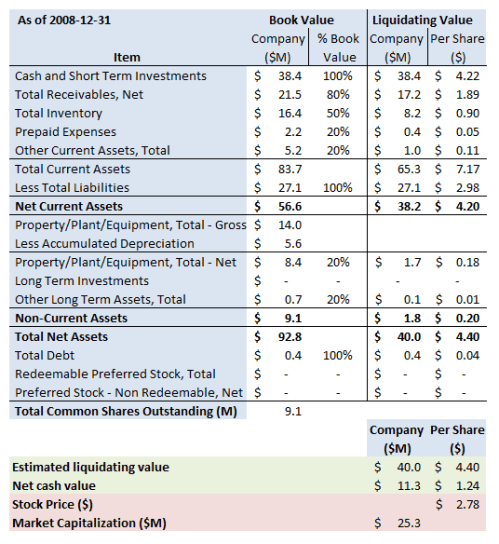
Amtech Systems Inc (NASDAQ:ASYS) is a new addition to the Greenbackd Portfolio. At its $2.78 closing price yesterday, the company has a market capitalization of $25.3M. We estimate the liquidation value to be almost 60% higher at $40M or $4.40 per share. A private investor, Mr. Richard L. Scott, disclosed a 7.0% holding in July last year. Mr Scott has continued to purchase stock, and, as of February 17 this year, holds 9.1% of ASYS’s outstanding stock. We’re not sure what Mr. Scott has planned for ASYS, but we think the stock is a relatively good bet as it has continued to generate positive operating cash flow and earnings.

About ASYS

ASYS is a supplier of horizontal diffusion furnace systems used for solar (photovoltaic) cell and semiconductor manufacturing. The company operates in two business segments: solar and semiconductor equipment, and polishing supplies, under the brand names Tempress Systems and Bruce Technologies. ASYS also supplies insert carriers to manufacturers of silicon wafers under the PR Hoffman brand, and provides lapping and polishing consumable products, as well as equipment used in various industries. The company’s investor relations website is here.

The value proposition

The summary of our estimate for the company’s liquidation value is set out below (the “Book Value” column shows the assets as they are carried in the financial statements, and the “Liquidating Value” column shows our estimate of the value of the assets in a liquidation):

asys-summaryWe estimate ASYS’s liquidation value to be around $40M or $4.40 per share.

Off-balance sheet arrangements and Contractual obligations

According to the company’s most recent 10Q, as of December 31, 2008, ASYS had no off-balance sheet arrangements. The only significant changes in contractual obligations since the end of fiscal 2008 have been purchase obligations in the amount of $6.1M. These purchase obligations consist of outstanding purchase orders for goods and services. While the amount represents purchase agreements, the actual amounts to be paid may be less in the event that any agreements are renegotiated, cancelled or terminated.

The catalyst

Mr. Scott disclosed his initial 7.0% holding in a 13D notice dated July 28, 2008, purchasing $5.4M of stock in ASYS at prices between $8.95 and $9.50. The initial 13D notice contains the standard disclosure for Purpose of Transaction, which we’ve reproduced below:

[Mr. Scott] purchased the Common Stock in open market transactions for general investment purposes. Consistent with such purposes, [Mr. Scott] may seek to engage in future discussions with management of [ASYS] and may make suggestions concerning [ASYS]’s operations, prospects, business and financial strategies, assets and liabilities, business and financing alternatives and such other matters as [Mr. Scott] may deem relevant to his investment in [ASYS]. In addition, [Mr. Scott] may from time to time, depending on prevailing market, economic and other conditions, acquire additional shares of the Common Stock of [ASYS] or engage in discussions with [ASYS] concerning further acquisitions of shares of the Common Stock of [ASYS] or further investments in [ASYS]. [Mr. Scott] intends to review his investment in [ASYS] on a continuing basis and, depending upon the price and availability of shares of the Common Stock, subsequent developments affecting [ASYS], [ASYS]’s business and prospects, other investment and business opportunities available to [Mr. Scott], general stock market and economic conditions, tax considerations and other factors considered relevant, may decide at any time to increase or to decrease the size of his investment in [ASYS].

Mr. Scott has continued to purchase stock in ASYS and has disclosed a 9.1% holding in an amended 13D notice dated February 20, 2009.

Stock repurchase program

According to the most recent 10Q, the company’s board approved a stock repurchase program in December authorizing the repurchase of up to $4M of ASYS’s common stock. If the buy-back is completed at the current stock price, we estimate that the company’s per share liquidation value would increase by around 7% to $4.70.

Conclusion

At its $2.78 close yesterday, ASYS is trading at a little under two-thirds of our estimate of its value in liquidation.  Given that it has continued to generate positive operating cash flow and earnings in a difficult operating environment, we think ASYS represents very good value at a discount to its liquidation value. Management seem to have recognized that the stock is too cheap, and have taken the right steps by authorizing a $4M stock buy-back. Our only criticism is that the buy-back could be bigger. For example, if the buy-back was increased to $10M and stock bought back at the current stock price, the company’s per share liquidation value would increase by 24% to $5.45, leaving ASYS with around $28M in cash and short-term investments. This is a very small criticism, and ASYS has the option to increase the buy-back in subsequent quarters if the stock price continues to trade at a discount to liquidation value. We don’t know anything about Mr. Scott, but we like to see large stockholders increasing their stakes when the stock price drops. We think ASYS is very good value, and that’s why we’re adding it to the Greenbackd Portfolio.

ASYS closed yesterday at $2.78.

The S&P500 Index closed yesterday at 712.87.

[Full Disclosure:  We do not have a holding in ASYS. This is neither a recommendation to buy or sell any securities. All information provided believed to be reliable and presented for information purposes only. Do your own research before investing in any security.]