Feeds:
Posts
Comments

Avigen Inc (NASDAQ:AVGN) has filed its 10K for the fiscal year ended December 31, 2008.

We’ve been following AVGN (see archived posts here) because it’s a net cash stock (i.e. it’s trading at less than the value of its cash after deducting all liabilities) and specialist biotechnology investor Biotechnology Value Fund (BVF) has been pushing it to liquidate and return its cash to shareholders. MediciNova Inc (NASDAQ:MNOV) has made an offer for AVGN that we think represents a clever way for AVGN’s stockholders to receive cash equivalent to that which they would receive in a liquidation (less $7M to be paid to MNOV) with the possibility for “an extraordinary, uncapped return” if MNOV is successful post-merger. The stock is up 60% from $0.65 to close at $1.04 yesterday. We initially estimated AVGN’s net cash value to be around $1.22 per share (BVF estimates $1.20 per share). We’ve now increased our estimate slightly to $37M or $1.24 per share. The net cash estimate does not take into account AVGN’s AV411 assets and program, which could be worth considerably more, perhaps as much as $10M to $25M or between $0.30 or $0.65 per share.

The value proposition updated

AVGN used net cash in operating activities of $21.1m in 2008. While the cash burn rate has been reduced, it still represents a significant risk for AVGN stockholders. AVGN has attempted to reduce cash burn but expects to incur future expenses in connection with efforts to monetize the AV411 assets and evaluate merger and acquisition proposals. AVGN does expect that expenses for 2009 will be significantly below the spending levels of recent years. Our updated estimate for the company’s net cash value is set out below (the “Book Value” column shows the assets as they are carried in the financial statements, and the “Liquidating Value” column shows our estimate of the value of the assets in a liquidation):

avgn-summary-2009-1-31Off-balance sheet arrangements and Contractual obligations

AVGN does not have any off-balance-sheet arrangements. Its total contractual obligations not included in the balance sheet include $3.2M in operating leases and $1.8M in research funding for third parties.

Conclusion

At its $1.04 closing price yesterday, AVGN is trading at a 20% discount to our estimate of its net cash value of $37M or $1.24 per share. The liquidation value could be considerably higher again, as we have not included in the estimate the potential value of the AV411 assets and program, which could be worth an additional $10M to $25M or between $0.30 or $0.65 per share. BVF has made considerable head way, and we believe they have a good chance of securing the AVGN board seats they seek. The stock is up considerably since we initiated the position, but has not yet reached our estimate of value, and so we are maintaining our position.

[Full Disclosure: We have a holding in AVGN. This is neither a recommendation to buy or sell any securities. All information provided believed to be reliable and presented for information purposes only.]

Autobytel Inc (NASDAQ:ABTL) has filed its 10K for the year ended December 31, 2008.

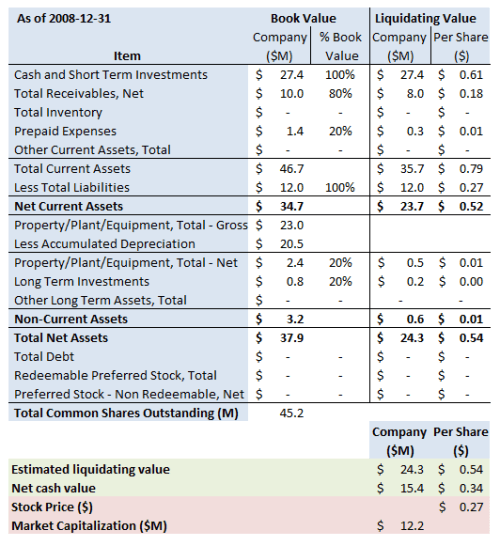
We’ve been following ABTL (see our post archive here) because it is trading at a discount to its liquidation value. We initially estimated the company’s liquidation value at $35.3M or $0.78 per share. We’ve now adjusted our valuation down significantly to $24.3M or $0.54 per share, partially because of the deterioration in ABTL’s balance sheet and partially because our initial analysis was overly optimistic (ABTL was one of our earliest posts). This is a disappointing outcome, but with the stock trading at less than half its liquidation value and 80% of its net cash value we plan to hold on for the moment.

The value proposition updated

ABTL has consumed a great deal of cash over the last 12 months, using $20M net cash in operating activities primarily from a net operating loss and an increase in its net working capital. Its principal sources of liquidity are from proceeds from dispositions of non-core businesses and the patent litigation settlement payments. ABTL has no debt and its cash and cash equivalents totaled $27.4 million as of December 31, 2008 compared to cash and cash equivalents of $27.6 million as of December 31, 2007. Our estimate for ABTL’s liquidation value is set out below (the “Book Value” column shows the assets as they are carried in the financial statements, and the “Liquidating Value” column shows our estimate of the value of the assets in a liquidation):

abtl-summary-2008-1-311We estimate ABTL’s net cash position at $15.4M or $0.34 per share and its liquidation value at $24.3M or $0.54 per share. Further cash payments are expected from the settlement with Dealix Corporation of $2.7M in March 2009 and 2010, which should bolster this position further.

Off-balance sheet arrangements and Contractual obligations

ABTL does not have any off-balance sheet arrangements. Its contractual obligations are around $3.4M in total through 2011, consisting of $1.8M in operating leases and $1.5M in purchase obligations.

A trancript of the company’s earnings conference call is available here.

Conclusion

Our position in ABTL has been a disappointing one, and has dragged down the performance of the portfolio. We propose to hold on for the time being, however, as the stock is trading at a price at which we would enter it, and so it makes no sense to exit.

[Full Disclosure:  We do not have a holding in ABTL. This is neither a recommendation to buy or sell any securities. All information provided believed to be reliable and presented for information purposes only. Do your own research before investing in any security.]

Soapstone Networks Inc (NASDAQ:SOAP) has filed its 10K for the year ended December 31, 2008.

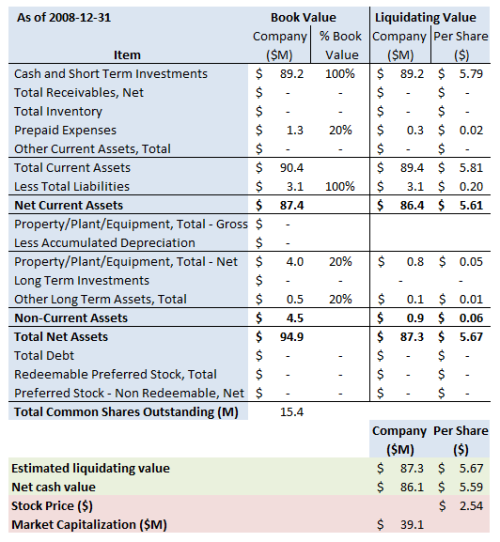
We started following SOAP on February 2 this year (see our post archive here) because it was trading well below its net cash value with an activist investor, Mithras Capital, disclosing an 8.7% holding in October last year. The stock is up 18.8% from $2.50 when we initiated our position to close Friday at $2.97, giving SOAP a market capitalization of $39.1M. We last estimated the company’s net cash value to be $86.1M or $5.78 per share. We are maintaining our estimate of the company’s net cash value but reducing the per share estimate to $5.59 because there is additional stock on issue.

The value proposition updated

The company’s balance sheet value is now almost wholly cash (the “Book Value” column shows the assets as they are carried in the financial statements, and the “Liquidating Value” column shows our estimate of the value of the assets in a liquidation):

soap-summary-2009-1-31

Off-balance sheet arrangements and Contractual obligations

SOAP does not have any off-balance-sheet arrangements and its contractual obligations, which consist entirely of operating leases, are $4.1M. These operating lease payments are the minimum lease payments under SOAP’s non-cancellable operating leases. SOAP treats payments made under its operating leases as rent expense for the facilities, including its head office.

Conclusion

As we’ve said on a number of occasions, we continue to believe that SOAP is one of the best opportunities available at the moment. The company’s ongoing business is small in comparison to its net cash position, so it shouldn’t dissipate its cash any time soon. It has no off-balance sheet arrangements, little in the way of ongoing contractual obligations and no material litigation, so the cash position seems reasonably certain. The company’s engagement of an investment bank to explore strategic alternatives is a promising step in the right direction. The only concern for us is the continued issuance of stock and options at a huge discount to liquidation value. The sooner Mithras Capital gets control of this situation the better.

[Full Disclosure:  We have a holding in SOAP. This is neither a recommendation to buy or sell any securities. All information provided believed to be reliable and presented for information purposes only. Do your own research before investing in any security.]

OrthoLogic Corporation (NASDAQ:CAPS) has filed its 10K for the year ended December 31, 2008.

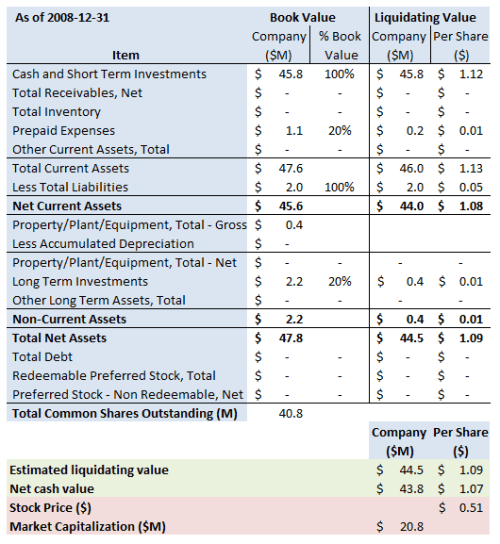
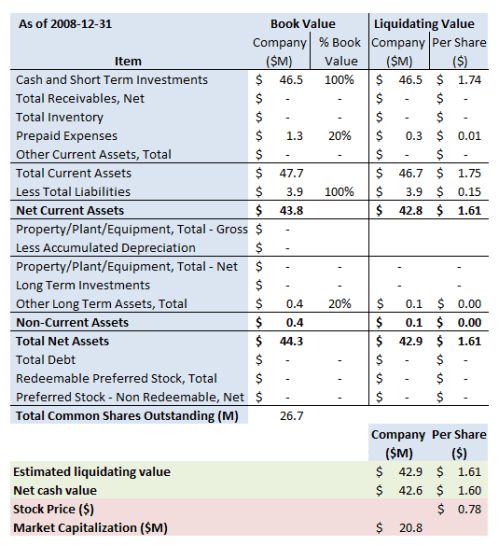
We’ve been following CAPS (see our post archive here) because it trades below its net cash value and Biotechnology Value Fund (BVF) has disclosed a 13.42% holding. It’s an unusual holding for us because BVF’s holding is passive. At CAPS’s $0.51 close Friday it has a market capitalization of $20.8M. Our initial estimate for CAPS’s net cash value was $44.1M or $1.08 per share. We’ve now adjusted that valuation to $43.8M or $1.07 per share. CAPS’s cash burn rate is quite high relative to its net cash position, so rapid steps need to be taken for this to be a profitable investment.

The value proposition updated

The summary of our estimate for the company’s liquidation value is set out below (the “Book Value” column shows the assets as they are carried in the financial statements, and the “Liquidating Value” column shows our estimate of the value of the assets in a liquidation):

caps-summary-2009-1-31

Off-balance sheet arrangements and Contractual obligations

There is no discussion in the 10K about CAPS’s off-balance sheet arrangements. CAPS’s only contractual obligation disclosed in 10K is for the company’s Tempe, Arizona facility and is $1.3M through 2012.

Conclusion

At its $0.51 close Friday, CAPS is trading at 47% of our estimate of its $1.07 per share net cash value. The risk for this investment continues to be that CAPS dissipates its cash before it or BVF can salvage any value. Management is taking steps to reduce its cash burn and repurchase undervalued stock, which is encouraging.

[Full Disclosure:  We do not have a holding in CAPS. This is neither a recommendation to buy or sell any securities. All information provided believed to be reliable and presented for information purposes only. Do your own research before investing in any security.]

Ditech Networks Inc (NASDAQ:DITC) has filed its 10Q for the period ended January 31, 2009.

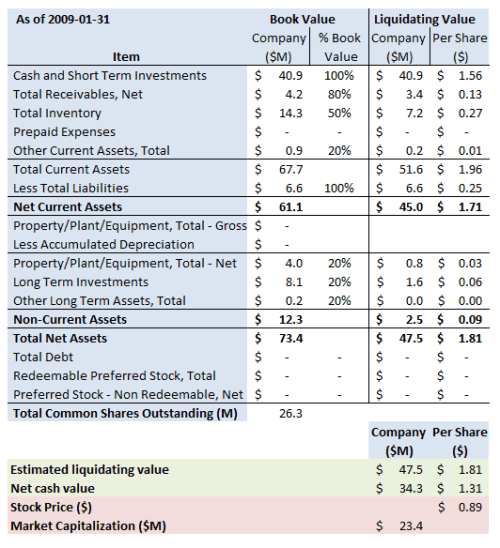
We’ve been following DITC (see our archive here) because it is trading well below its net cash value with an investor, Lamassu Holdings LLC, disclosing a 9.4% holding in November last year. Lamassu has offered to acquire DITC for $1.25 per share in cash. Lamassu says that it “anticipates its due diligence requirement will take no more than two weeks and there is no financing contingency.” The stock is up 19.1% from $0.89 to close Friday at $1.09, giving the company a market capitalization of $27.8M. We initially estimated the net cash value to be $37.9M or $1.44 per share. We’ve now adjusted our valuation down slightly to $34.3M or $1.31 per share.

The value proposition updated

DITC has continued to consume cash in its operations through the last quarter, bringing the cash burn in the last three quarters to $15.1M. As of January 31, 2009, DITC also had long-term investments of $8.2 million as compared to $15.1 million at April 30, 2008. These long-term investments are tied to auction rate securities that failed to settle at auction. Although these securities would normally be classified as short-term, as they typically settle every 7, 28 or 35 days, because they failed to settle at auction DITC has reclassified them to long-term pending them settling at auction. As of February 28, 2009, DITC continued to hold auction rate securities with a par value of $13.7M. Our updated valuation follows (the “Book Value” column shows the assets as they are carried in the financial statements, and the “Liquidating Value” column shows our estimate of the value of the assets in a liquidation):

ditc-summary-2009-1-31The company believes its “legacy business to be at or near cash flow break even” and this “will begin to be more evident in our financial results in the coming quarters:”

However, we do expect to continue to invest in our newer product offerings, which we believe will help diversify our customer base and hopefully add more predictability to our revenue streams. We expect that the investments in our new products will result in continued negative cash flows from operations until such time that we experience a resurgence of demand for our legacy products closer to their historical levels or our new products gain traction in the market and begin to generate meaningful revenue streams.

This is unfortunate. We think the best use of the company’s cash is its own undervalued stock.

Off-balance sheet arrangements and Contractual obligations

According to the 10Q, DITC has around $5.4M in contractual commitments (including $2.7M in operating leases and $2.7M in purchase commitments), around $2.9 of which falls due this year and the remainder falling due within the next 3 years. DITC has no other material commitments.

Conclusion

We propose to maintain our position in DITC and will continue to hold it in the Greenbackd Portfolio.

[Full Disclosure:  We do not have a holding in DITC. This is neither a recommendation to buy or sell any securities. All information provided believed to be reliable and presented for information purposes only. Do your own research before investing in any security.]

Biotechnology Value Fund (BVF) has filed the slides to its presentation to the stockholders of Avigen Inc (Nasdaq: AVGN) to remove the existing directors at the special meeting to be held March 27, 2009.

The slides can be viewed here.

We’ve been following AVGN (see archived posts here) because it’s a net cash stock (i.e. it’s trading at less than the value of its cash after deducting all liabilities) and specialist biotechnology activist fund BVF has been pushing it to liquidate and return its cash to shareholders. MediciNova Inc (NASDAQ:MNOV) has made an offer for AVGN that we think represents a clever way for AVGN’s stockholders to receive cash equivalent to that which they would receive in a liquidation (less $7M to be paid to MNOV) with the possibility for “an extraordinary, uncapped return” if MNOV is successful post-merger. The stock is up 68% from $0.65 to close at $1.09 on Friday. We are maintaining our position because we estimate AVGN’s liquidation value to be around 12% higher at $1.22 per share (BVF estimates $1.20 per share).

BVF has also issued the following press release:

BIOTECHNOLOGY VALUE FUND CONFIRMS NOMINEES’ PLANS IF ELECTED TO THE AVIGEN BOARD AT SPECIAL MEETING

Urges Stockholders to Vote to Remove Current Board and Elect its Slate of Four Stockholder-Oriented Independent Nominees

Biotechnology Value Fund, L.P. (“BVF”), today confirmed its plans for the future of Avigen, Inc. (Nasdaq: AVGN) if stockholders remove the current members of the Avigen Board and replace them with BVF’s four new, stockholder-oriented, independent director nominees at the Special Meeting of stockholders to be held on March 27, 2009. BVF, the beneficial owner of approximately 30% of the Company’s outstanding common stock, has called the Special Meeting to give stockholders the opportunity to protect what remains of Avigen’s assets, which it believes are in danger of being completely wasted by the Board. Upon the removal of the current Board and election of BVF’s nominees, subject to the nominees’ fiduciary duties, BVF pledges the following:

· First, all stockholders who desire liquidity will have the immediate ability to cash out of their investment in Avigen and receive a payment of $1.00 per share by tendering their shares into the BVF tender. Stockholders who do not wish to sell their shares will have the opportunity to participate with BVF in the future of Avigen;

· Next, the nominees will immediately announce that Avigen will only consider and proceed with strategic transactions that guarantee a quantified worst-case outcome of approximately Avigen’s liquidation value;

· Next, the nominees will then commence negotiations with MediciNova, with the goal of reaching an agreement on the best terms possible for all Avigen stockholders;

· Next, the nominees will consider any other transactions that satisfied the downside protection requirements described above; and

· Ultimately, the nominees will present any transaction that satisfies the downside protection requirements described above and that the nominees believe is in the best interests of stockholders to stockholders for their approval.

Should the nominees be unable to negotiate final terms with a third party that satisfies the requirements described above, or should such transaction not be approved by stockholders, the nominees intend to promptly return the Company’s remaining cash to stockholders.

Mark N. Lampert BVF Partner stated, “In addition to confirming our plan for the future of the Company, we also wanted to clarify a few remaining issues for stockholders. Specifically, neither BVF nor its nominees have any financial interest or other stake in MediciNova or its proposed transaction. Our only concern is for the fair valuation and prevention of lost value of Avigen. Our interest in Avigen is solely as stockholders – we have never sought, nor would we accept, any benefit solely for ourselves. In addition, in the event they are elected to the Board, our nominees will not receive any compensation for their services as directors of Avigen, other than Mr. Coppedge who stands to receive only nominal director fees. We encourage stockholders to act now to protect their investment by voting the GOLD proxy card today.”

[Full Disclosure: We have a holding in AVGN. This is neither a recommendation to buy or sell any securities. All information provided believed to be reliable and presented for information purposes only.]

CuraGen Corporation (NASDAQ:CRGN) has filed its 10K for the fiscal year ended December 31, 2008.

We’ve been following CRGN since January 20, 2009 (see our post archive here) because it is a net cash stock with an investor, DellaCamera Capital Management, pushing the company to seek “alternative deployment of [its] capital.” DellaCamera Capital Management has since increased its stake from 5.6% to 6.5% and nominated two candidates to the board. The stock is up 33% from $0.67 when we started following it to $0.89 yesterday, giving CRGN a market capitalization of around $50.8M. We initially estimated CRGN’s net cash value to be around $62M or $1.07 per share. After reviewing the filing, we’ve slightly decreased our valuation to $59.9M or $1.05 per share, which means CRGN is still trading at around 85% of its liquidation value.

The value proposition updated

The company is not generating any operating cash flow as it is a “biopharmaceutical development company,” so the challenge for DellaCamera Capital Management is to persuade the company to pay a special dividend or liquidate before it dissipates its remaining cash. CRGN’s value still lies in its $64.9M net cash position (the “Book Value” column shows the assets as they are carried in the financial statements, and the “Liquidating Value” column shows our estimate of the value of the assets in a liquidation):

crgn-summary-2008-10k1CRGN’s $87.6M in cash and cash equivalents consists of $19.1M in cash and equivalents, $30.3M in short-term investments and $38.2M in marketable securities.

Off-balance sheet arrangements and Contractual obligations

According to CRGN’s 10K, the company does not have any off-balance sheet arrangements. Its enforceable and legally binding obligations, along with future commitments related to all contracts that it is likely to continue, regardless of the fact that they are “cancelable as of December 31, 2008,” excluding those captured in the financial statements, are around $5.0M through 2011.

Deducting the $5.0M from the $64.9M in net assets leaves around $59.9M in liquidation value or $1.05 per share.

Conclusion

We are reasonably comfortable with the progress of CRGN and will continue to hold it in the Greenbackd Portfolio.

[Full Disclosure:  We do not have a holding in CRGN. This is neither a recommendation to buy or sell any securities. All information provided believed to be reliable and presented for information purposes only. Do your own research before investing in any security.]

Biotechnology Value Fund (BVF) yesterday filed additional material in the proxy solicitation to remove the existing directors of Avigen Inc (Nasdaq: AVGN) at the special meeting to be held March 27, 2009. BVF is urging stockholders to remove the current members of the AVGN and replace them with BVF’s four “new, stockholder-oriented, independent director nominees.” BVF has called the special meeting “to give stockholders the opportunity to protect what remains of [AVGN]’s assets, which it believes are in danger of being completely wasted by the Board.”

We’ve been following AVGN (see archived posts here) because it’s a net cash stock (i.e. it’s trading at less than the value of its cash after deducting all liabilities) and specialist biotechnology activist fund BVF has been pushing it to liquidate and return its cash to shareholders. MediciNova Inc (NASDAQ:MNOV) has made an offer for AVGN that we think represents a clever way for AVGN’s stockholders to receive cash equivalent to that which they would receive in a liquidation (less $7M to be paid to MNOV) with the possibility for “an extraordinary, uncapped return” if MNOV is successful post-merger. We estimate AVGN’s cash at around $1.22 per share (BVF estimates $1.20 per share), which is around 16% higher than AVGN’s $1.05 close yesterday.

BVF’s press release is set out below:

BIOTECHNOLOGY VALUE FUND, L.P.

March 12, 2009

VOTE THE ENCLOSED GOLD PROXY CARD TO HELP UNLOCK VALUE AT AVIGEN, INC.

ELECT DIRECTORS WHO ARE DEDICATED TO MAXIMIZING VALUE FOR ALL AVIGEN STOCKHOLDERS BY REDUCING CORPORATE WASTE AND PROTECTING STOCKHOLDERS’ DOWNSIDE RISK WHILE MAINTAINING SIGNIFICANT UPSIDE POTENTIAL

Dear Fellow Stockholders:

We, the Biotechnology Value Fund (“BVF”), are the owners of 8,819,600 shares, or approximately 30% of Avigen’s outstanding common stock. Since we took the lead in protecting value for all stockholders of Avigen in October of 2008, the stock price has increased by over 65%. We have successfully caused the Avigen management team and Board to reduce expenses and sell off programs that they do not have the necessary expertise to develop. We now need your participation to secure Avigen’s substantial remaining value by removing the members of the current self-serving Board and electing our independent nominees who are committed to protecting value for all stockholders.

Let me state from the outset that we neither seek, nor would we accept, any consideration or benefit solely for ourselves. Avigen has falsely accused us of this numerous times, even though we have been crystal clear on this fundamental issue all along. We are waging this effort because (a) we feel a sense of responsibility to do so on behalf of all stockholders given our unique position as the largest stockholder and (b) we believe it is the right thing to do, especially in the context of the current economic environment caused, in part, by similar self-serving managements and Boards.

Throughout this process we have sought only three simple things:

1. that Avigen stop recklessly wasting stockholder money;

2. that stockholders be empowered to decide the fate of Avigen’s remaining cash; and

3. that stockholders be guaranteed a quantified worst-case outcome of approximately Avigen’s liquidation value.

Thus far we have made progress with #1 and #2 above. Facing pressure from BVF, Avigen has abandoned, at least temporarily, its plan to spend money on its remaining products. In addition, the Company has now been forced to call a special meeting to finally permit stockholders the opportunity to weigh in. Prior to our intervention, Avigen’s stock traded at a mere 33% of the cash in the bank and at a steep discount to its current price. This is a remarkable reflection on how poorly Avigen was and is viewed by the investment community. Prior to our intervention, Avigen’s plan was to spend all stockholder money over two years on uncompelling products that it has subsequently conceded were not worthy of investment.

It is worth reflecting on some of Avigen’s historical “accomplishments”:

1. Avigen has consumed over $250 million of investor capital, with little value to show for it. Why should they be entrusted with the last $50 million?

2. Avigen selected a Chief Executive Officer who lives in Park City, Utah when the Company is based in California.

3. Avigen has committed to pay significant fees in the form of golden parachutes to its senior executives and multiple investment bankers, lawyers and consultants in an amount that, we believe, could exceed $5 million under certain circumstances.

4. Despite purporting to have reduced their use of cash and working to protect stockholders, we believe Avigen will spend nearly $20 million, or over $0.65 per share, between the time they announced the failure of AV650 and when they supposedly hope to complete a merger.

5. Avigen adopted a “poison pill,” which we believe is just another example of the Board acting first to protect their jobs rather than the stockholders they have a fiduciary duty to represent.

6. Avigen delayed calling the special meeting for approximately two months before setting a rushed meeting date that we believe was set to prevent stockholders from having adequate opportunity to receive and review proxy materials and vote at the special meeting.

We have grown increasingly dismayed that Avigen’s Board and management team, who collectively own little stock, have wasted money on golden parachutes, multiple investment bankers, consultants and lawyers. Had Avigen merely agreed to guarantee a worst case scenario for stockholders, this fight would not have transpired. Thus, we can only conclude that Avigen is likely to gamble stockholders’ remaining capital that, precedent warns, could result in a near total destruction of stockholder value.

We are frankly surprised that the Board has not previously addressed our concerns by affirmatively and unequivocally agreeing to proceed only with a transaction that provides for stockholders to receive no less than the Company’s approximate liquidation value. In fact, it appears to us that the Board is only now even mentioning an undefined intent to provide some merger liquidity in response to our demand for full downside protection for all stockholders. We believe that Avigen’s shares are undervalued by the market as a result of stockholders’ concern about the direction the current Board is taking the Company. New leadership is needed to prevent further erosion of each stockholder’s investment in Avigen, as well as to take advantage of opportunities that exist to maximize stockholder value.

WITHOUT ANY EVIDENT RATIONAL MOTIVE, AVIGEN HAS NOT AGGRESSIVELY PURSUED THE COMPELLING MERGER PROPOSAL BY MEDICINOVA THAT OFFERED BOTH DOWNSIDE PROTECTION AND SIGNIFICANT UPSIDE TO ALL AVIGEN STOCKHOLDERS

Unlike the current Board, we believe that a merger with MediciNova makes sense for all Avigen stockholders and we cannot understand why only lip service was paid to pursue a deal with MediciNova. Among the extraordinary potential benefits we see in a merger with MediciNova are:

Downside Protection: Based on our analysis, even if a merger with MediciNova is unsuccessful, Avigen stockholders would still receive the approximate current liquidation value of Avigen. This means that, even in the worst-case scenario, the merger would yield an approximate 65% premium to Avigen’s stock price before we submitted our request to the Company to call the special meeting.

Tremendous Upside Potential: Based on our analysis, if a merger with MediciNova is successful, Avigen stockholders could own a substantial percentage of MediciNova (approximately 45% of the combined company). We believe the Board has not had any substantive discussions with MediciNova. We do not understand why they have dismissed the offer as providing little value.

• Free Option: Under the terms of the proposed merger, stockholders would have at least one year after the merger is consummated to choose whether they want downside protection or upside potential, as described above. We believe this free option period offers stockholders tremendous upside potential with low risk.

Neither BVF nor its nominees have any financial interests in MediciNova. BVF is only interested in the superior transaction for ALL stockholders. We simply believe that in light of similar historical transactions, it is important that stockholders have downside protection. If BVF’s nominees are elected to the Board, stockholders can either tender their shares in the BVF tender, or not tender and participate with BVF in the future of Avigen, whether through a merger with MediciNova, subject to the nominees’ fiduciary obligations, or if the merger is not feasible, to consider liquidation or other similar type transactions. In any case all stockholders will get to choose and have the opportunity to get immediate cash back. The nominees intend to present any potential MediciNova transaction to stockholders for approval – ensuring that stockholders will get a true say in the future of Avigen.

We believe the Board’s failure to commit exclusively to a transaction that offers downside protection based on the Company’s liquidation value suggests that the Board is considering other options, which will put the value of Avigen at risk. As the Company’s largest stockholder, we share the interest of all stockholders in protecting and preserving our investment. Unlike the directors and management, BVF only profits if the stock price goes up and shares the interest of all stockholders to increase share value and limit share loss. We receive no other payments or compensation.

THE VAST MAJORITY OF FAILED BIOTECHNOLOGY COMPANIES THAT HAVE FOUND THEMSELVES IN AVIGEN’S CURRENT SITUATION HAVE MANAGED TO DESTROY BETWEEN 80%-99% OF STOCKHOLDER VALUE FROM THEIR THEN LIQUIDATION VALUE

We are concerned that Avigen will enter into a transaction without downside protection that would end up destroying value. We have good reason to fear this, because most recent mergers involving companies similarly situated to Avigen (e.g., Transcept Pharmaceuticals, Inc., Anesiva, Inc., ARCA biopharma, Inc., Evotec Aktiengesellschaft, Cardiovascular Systems, Inc. and others), managed to destroy stockholder value. In each of these transactions, the stock prices declined over 80% from their liquidation value following the Board’s decision to pursue a transaction, resulting in aggregate lost value in excess of $200 million. Of course the management, directors, and bankers took their millions of dollars of fees in cash rather than stock in the companies they supposedly supported. The directors and management of companies like Avigen deserve recognition: it is quite a feat to destroy 80% of the liquidation value of a company possessing little else but cash! The charts below illustrate these astonishing failures.
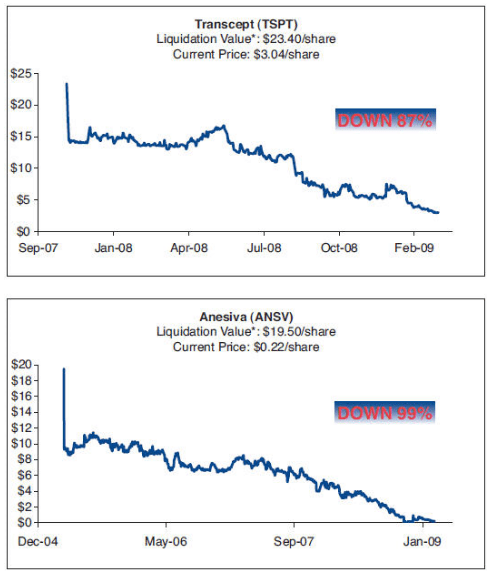
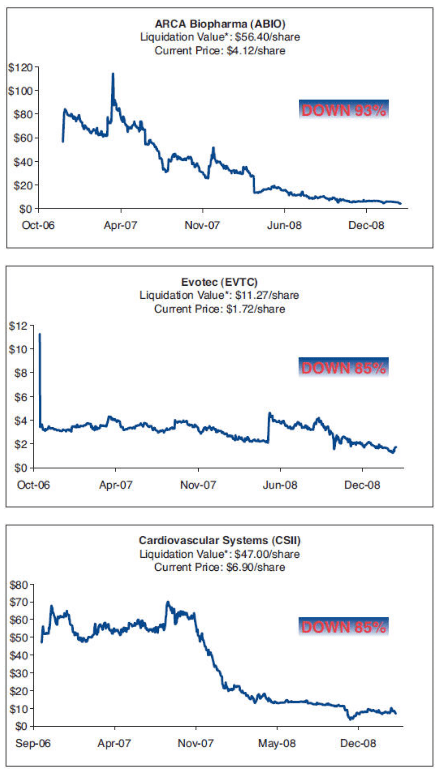
bvf-charts-1-and-21bvf-charts-3-4-and-5* Approximate net cash per share liquidation value at time of negative binary event.

This repeated lost value and waste is a key reason why we believe downside protection is so important for all stockholders. We want to prevent Avigen from joining this long and infamous list of failures. This is a key reason why we believe the MediciNova transaction is so attractive.

WE BELIEVE THE AVIGEN BOARD IS ENTRENCHING ITSELF AS IT PREPARES TO ENTER INTO AN EGREGIOUS TRANSACTION THAT COULD BURN THROUGH OUR COMPANY’S REMAINING CASH

In a shameless example of protecting their own self-interest, in October 2008 Avigen increased its golden parachute payments, allegedly to attract and retain executive talent. Our first question is: which executive employees does Avigen need to retain when, in our view, Avigen does not possess a viable business? We have estimated that the golden parachute payouts total at least $2 million. Payments to consultants, bankers and lawyers are quickly adding up as well. Given the current economic conditions, we find it irresponsible for Avigen to engage in such behavior that amounts to a slap in the face of all Avigen stockholders. The recent addition of a poison pill by the Board adds further insult to stockholders who have already been insulted by a Board that ignores their pleas.

We are afraid that if the current Board remains in place, they will burn through Avigen’s remaining cash by engaging in a transaction that will further destroy stockholder value. For example, any transaction proposed by Avigen is likely to have a substantial and non-refundable breakup fee that will not be returned to stockholders even if a transaction is not approved. Everyday that the current Board remains in place, the cash per share is dwindling.

AFTER DELAYING THE SPECIAL MEETING FOR MONTHS, THE BOARD FINALLY SET AN ACCELERATED MEETING DATE TO TRY AND PREVENT STOCKHOLDERS FROM HAVING AN OPPORTUNITY TO LET THEIR VOICE BE HEARD

The Board has now set March 27, 2009 as the date for the special meeting of stockholders. We delivered our notice to the board demanding that a special meeting be called approximately two months ago. Finally, after nearly two months of delay and significant and unnecessary corporate waste, the Company announced a March 27, 2009 meeting date, which will occur in just over two weeks, barely enough time to deliver our proxy materials to you. At this critical meeting, Avigen stockholders will be given the opportunity to remove the entire Board and elect independent directors who will strive to preserve and enhance value for all Avigen stockholders. We hope that you will support us by immediately voting the enclosed GOLD proxy card. If you Share our Concern for the Future of Our Company, Do Not Delay, Vote Your Gold Proxy Card Today.

TIME IS SHORT

Act Now to Protect Your Investment By Voting The Enclosed Gold Proxy Card Today

Unfortunately, we have come to the conclusion that the current Board is not fit to run our Company and that it will continue to destroy stockholder value if it is not replaced. Please join our campaign to maximize stockholder value by voting the enclosed GOLD proxy card today.

If you have any questions or need assistance in voting your GOLD proxy card, please contact our proxy solicitors, MacKenzie Partners, Inc., Toll-Free at 1-800-322-2885 or 1-212-929-5500 (call collect) or by email at proxy@mackenziepartners.com. We look forward to speaking to many of you during the course of this campaign and hope that we can count on your support.

Sincerely,

/s/ Mark N. Lampert
Mark N. Lampert
Biotechnology Value Fund, L.P.

[Full Disclosure: We have a holding in AVGN. This is neither a recommendation to buy or sell any securities. All information provided believed to be reliable and presented for information purposes only.]

Vanda Pharmaceuticals Inc. (NASDAQ:VNDA) is trading below its net cash value and an investor, Tang Capital Partners (TCP), has called for the company to “cease operations immediately, liquidate [VNDA]’s assets and distribute all remaining capital to the Stockholders.” At the company’s $0.78 closing price yesterday, VNDA has a market capitalization of $20.8M. We estimate the net cash value to be more than 100% higher at $42.6M or $1.60 per share. The company is hemorrhaging cash, so the investment turns on TCP’s ability to get control and staunch the bleeding. We think they’re a fair bet, so we’ve added VNDA to the Greenbackd Portfolio.

About VNDA

VNDA is “is a biopharmaceutical company focused on the development and commercialization of small molecule therapeutics, with exclusive worldwide commercial rights to two product candidates in clinical development for various central nervous system disorders.” The company’s investor relations website is here.

The value proposition

VNDA is rapidly burning through its cash. It consumed $7.5M in the December quarter, which brings its cash burn for the twelve months to December 31, 2008 to $46M (that’s right, forty-six million dollars). Its cash burn predominantly consists of salaries and related costs for R&D personnel of $3.8M and $4.8M in G&A expenses. The company has a substantial holding of cash and equivalents (the “Book Value” column shows the assets as they are carried in the financial statements, and the “Liquidating Value” column shows our estimate of the value of the assets in a liquidation):

vnda-summaryWe estimate the net cash value to be $42.6M or $1.60 per share. If VNDA burns through the same amount of cash in this quarter as the last quarter, this number will be reduced by $7.5M to $35.4M or $1.33 per share.

Off-balance sheet arrangements and contractual obligations

According to the company’s most recent 10Q (for the September quarter), it has no off-balance sheet arrangements. The contractual obligations as at December 31, 2008 totaled $5.8M and represents operating lease payments for the company’s headquarters through to 2016.

The company also has the following amounts due:

Consulting fees

We have engaged a regulatory consultant to assist us in our efforts to obtain FDA approval of the iloperidone NDA. We have committed to initial consulting expenses in the aggregate amount of $2.0 million pursuant to this engagement, $122,000 of which was expensed in the third quarter of 2008, and the remainder of which will be expensed in the fourth quarter of 2008. In addition, we may retain the services of the consultant on a monthly basis from and after January 1, 2009 through December 31, 2010. In the event that the iloperidone NDA is approved by the FDA, we will be obligated to pay the consultant a success fee of $6.0 million, which amount will be offset by the aggregate amount of all monthly retainer fees previously paid to the consultant (Success Fee). In addition to these fees, we are obligated to reimburse the consultant for its ordinary and necessary business expenses incurred in connection with its engagement. We may terminate the engagement at any time; however, we will remain obligated to pay any remaining Success Fee if the iloperidone NDA is approved by the FDA following such termination.

Clinical research organization contracts and other contracts

We have entered into agreements with clinical research organizations responsible for conducting and monitoring our clinical trials for iloperidone and tasimelteon, and have also entered into agreements with clinical supply manufacturing organizations and other outside contractors who will be responsible for additional services supporting our commercial activities and our ongoing clinical development processes. These contractual obligations are not reflected in the table above because we may terminate them on no more than 60 days notice without incurring additional charges (other than charges for work completed but not paid for through the effective date of termination and other costs incurred by our contractors in closing out work in progress as of the effective date of termination).

License agreements

In February 2004 and June 2004, we entered into separate licensing agreements with Bristol-Myers Squibb and Novartis, respectively, for the exclusive rights to develop and commercialize our two compounds in clinical development. We are obligated to make payments under the conditions in the agreements upon the achievement of specified clinical, regulatory and commercial milestones. If the products are successfully commercialized we will be required to pay certain royalties based on net sales for each of the licensed products. Please see the notes to the condensed consolidated financial statements included with this report for a more detailed description of these license agreements.

As a result of the successful commencement of the Phase III clinical study of tasimelteon in March 2006, we met the first milestone specified in our licensing agreement with Bristol-Myers Squibb and made an associated milestone payment of $1.0 million. During March 2007, we met our first milestone under the license agreement with Novartis for VSF-173 relating to the initiation of the Phase II clinical trial and made an associated milestone payment of $1.0 million. On November 3, 2008, we received written notice from Novartis that this license agreement had terminated in accordance with its terms as a result of our failure to satisfy a specific development milestone within the time period specified in the license agreement. Please see Item 5 “Other Information” of Part II of this quarterly report on Form 10-Q for a more detailed description of the termination of this license agreement. In November 2007, the Company met a milestone under the license agreement with Novartis for iloperidone relating to the acceptance of the NDA for iloperidone in schizophrenia and made a license payment of $5.0 million to Novartis. No other amounts were recorded as liabilities nor were any other contractual obligations relating to the license agreements included in the condensed consolidated financial statements as of September 30, 2008, since the amounts, timing and likelihood of these payments are unknown and will depend on the successful outcome of future clinical trials, regulatory filings, favorable FDA regulatory approvals, growth in product sales and other factors. For a more detailed description of the risks associated with the outcome of such clinical trials, regulatory filings, FDA approvals and product sales, please see the section “Risk Factors” of this quarterly report on Form 10-Q.

The catalyst

TCP disclosed its intial 21.1% holding in VNDA in a 13D notice dated October 6, 2008. The amended 13D notice dated November 17, 2008 disclosed a smaller 14.3% holding, which might suggest that TCP had reduced its holding. This was not the case. In fact, TCP was a purchaser throughout the relevant period. Unfortunately for TCP, some of its VNDA holdings were held in an account at Lehman Brothers International (Europe) (from the amended 13D notice):

On September 15, 2008 LBIE [Lehman Brothers International (Europe)] was placed into administration under United Kingdom law and four partners of PriceWaterhouseCoopers LLP were appointed as joint administrators (the “Joint Administrators”). The Joint Administrators have advised us that most of TCP’s shares were rehypothecated. The Joint Administrators and UK counsel have further advised that LBIE’s customers will not be able to recover rehypothecated shares, but instead will be entitled to a general unsecured claim with respect to such shares. Accordingly, TCP in this filing has reduced the number of shares of [VNDA] held by TCP to the extent such shares were held at LBIE. By making this filing, TCP does not waive any argument that it is entitled to recover such shares and expressly reserves such arguments.

Since the date of the last filing on Schedule 13D, on November 7, 2008, Tang Capital Partners, LP purchased 560,000 shares of Vanda Pharmaceuticals, Inc.’s common stock through the open market for $0.8291 per share.

(If you’re interested, you can read more about “rehypothecation” here.) In a further amended 13D notice dated February 18, 2009, TCP disclosed an increased 14.9% holding and discussed its nomination of two candidates to the board VNDA:

Since the date of the last filing on Schedule 13D, Kevin C. Tang has continued to have discussions with [VNDA] and its Board of Directors in regards to the strategic direction of [VNDA]. Mr. Tang has expressed his opinion and proposed to [VNDA] and its Board of Directors that in order to maximize value for all Stockholders, [VNDA] must cease operations immediately, liquidate [VNDA]’s assets and distribute all remaining capital to the Stockholders.

Since [VNDA] continues to operate as of the date of this filing and has not publicly announced any plan of liquidation and dissolution, the Reporting Persons believe [VNDA]’s Board of Directors has rejected their proposal to immediately cease all operations, liquidate [VNDA]’s assets and distribute all remaining capital to the stockholders. In light of the foregoing, and in order to preserve and maximize the diminishing value of [VNDA]’s assets for the benefit of all Stockholders, the Reporting Persons determined to nominate certain individuals to be elected to [VNDA]’s Board of Directors at the 2009 Annual Meeting of Stockholders, and propose certain resolutions to [VNDA]’s Stockholders, as discussed in more detail below.

On February 13, 2009, Tang Capital Partners, LP delivered a letter (the “Letter”) to the Nominating and Governance Committee of [VNDA] recommending the following individuals (the “Nominees”) as nominees for election to [VNDA]’s Board of Directors at the 2009 Annual Meeting of Stockholders:

Kevin C. Tang
Andrew D. Levin, M.D., Ph.D.

On the same date, Tang Capital Partners, LP also delivered a notice (the “Notice”) to [VNDA] of its intention to take the following actions at the 2009 Annual Meeting of Stockholders, or any other meetings of stockholders held in lieu thereof, and any adjournments, postponements, reschedulings or continuations thereof:

(1) nominate the Nominees as candidates for election to [VNDA]’s Board of Directors;

(2) propose resolutions of the stockholders of [VNDA] to amend the Bylaws to (i) provide that [VNDA]’s Annual Meetings of Stockholders for each year commencing in 2010 be held on April 30th or, if April 30th is not a business day, on the first business day following April 30th and (ii) provide that certain matters requiring the approval of [VNDA]’s Board of Directors require a unanimous vote for such approval; and

(3) propose resolutions of the stockholders of [VNDA] to request that the Board of Directors promptly take all necessary action to swiftly and orderly liquidate [VNDA]’s remaining assets and return all remaining capital to [VNDA]’s stockholders.

A copy of TCP’s letter nominating Messrs Tang and Levin to the board is set out below:

February 13, 2009

VIA HAND DELIVERY AND ELECTRONIC MAIL (ir@vandapharma.com, chip.clark@vandapharma.com)

William D. Clark
Corporate Secretary
Vanda Pharmaceuticals Inc.
9605 Medical Center Drive, Suite 300
Rockville, MD 20850

Re: Recommendations for Candidates for Election as Directors at the 2009 Annual Meeting of Stockholders of Vanda Pharmaceuticals Inc. (the “Company”)

Ladies and Gentlemen:

Tang Capital Partners, LP, a Delaware limited partnership (“TCP” or the “Investor”), and its affiliates collectively control 3,965,852 shares of Common Stock and have beneficially owned 5% or more of the Common Stock, based on the number of shares reported outstanding by the Company in its Quarterly Report on Form 10-Q for the quarter ended September 30, 2008, for at least four months. Please refer to Exhibit A, attached hereto, for information regarding the Investor’s holdings.

The Investor believes that it would serve the best interests of the Company and its stockholders for the Nominating/Corporate Governance Committee of the Company (the “Committee”) to nominate the following two candidates (each a “Candidate” and together the “Candidates”) to the Board of Directors of the Company (the “Board”) at the 2009 Annual Meeting of Stockholders of the Company (the “2009 Annual Meeting”):

1. Kevin C. Tang
2. Andrew D. Levin, M.D., Ph.D.

Biographical and background materials relating to each Candidate are set forth in Exhibits B and C attached hereto. In addition, the Candidates are prepared to complete any D&O questionnaire reasonably requested by the Company in connection with their nomination as directors.

Pursuant to the guidelines outlined in the Company’s public filings with the Securities and Exchange Commission, the Investors are hereby submitting these two candidates to the Committee for review and consideration. Both Candidates meet the criteria and attributes said to be considerations of the Company’s Nominating/Corporate Governance Committee as described in the Company’s proxy statement for its 2008 Annual Meeting of Stockholders, including:

· ability to read and understand basic financial statements;
· general understanding of the Company’s industry;
· relevant expertise upon which to be able to offer advice and guidance to management;
· ability and sufficient time to devote to the affairs of the Company;
· excellence in his field;
· ability to exercise sound business judgment;
· commitment to vigorously represent the long-term interests of the Company’s stockholders; and
· an absence of factors that would preclude the Board from making a determination that the candidates are independent directors as defined in Rule 4200(a)(15) of the rules of the NASDAQ Stock Market.

In addition, we believe that the backgrounds and qualifications of these Candidates, when considered as a group with the other directors of the Company, will provide a balance of knowledge, experience and capabilities that will allow the Board to fulfill its responsibilities. Moreover, the affiliation of each of the Candidates with a holder of significant shares of the Company will align their interests with those of stockholders generally.

In a separate letter to the Corporate Secretary of the Company, the Investor is simultaneously submitting a Stockholder’s Notice of Nomination of Persons for Election as Directors and Other Proposed Business at the 2009 Annual Meeting of Stockholders of Vanda Pharmaceuticals Inc., dated February 13, 2009 (the “Notice”). If the Board determines to nominate either of the proposed Candidates, recommends his election and includes his name in the proxy card for the 2009 Annual Meeting, the Investor will not directly nominate such Candidate at the 2009 Annual Meeting. If we do not hear from you by the close of business on February 28, 2009, we will pursue any and all courses of action that we determine to be appropriate for the election of our Nominees at the 2009 Annual Meeting.

Please address any correspondence or questions to Tang Capital Management, LLC, Attention: Kevin C. Tang, telephone (858) 200-3830, facsimile (858) 200-3837 (with a copy to Cooley Godward Kronish LLP, 4401 Eastgate Mall, San Diego, CA 92121, Attention: Ethan E. Christensen, Esq., telephone (858) 550-6076, facsimile (858) 550-6420).

Very truly yours,

Tang Capital Partners, LP
By: Tang Capital Management, LLC, its general partner
By: /s/ Kevin C. Tang
Kevin C. Tang
Managing Director

VNDA responded by issuing the following press release:

VANDA PHARMACEUTICALS RESPONDS TO ANNOUNCEMENT AND FILING BY A GROUP LED BY TANG CAPITAL PARTNERS, LP

ROCKVILLE, MD. – February 23, 2009 – Vanda Pharmaceuticals Inc. (NASDAQ: VNDA) (“Vanda” or the “Company”) today issued the following statement regarding two letters sent to Vanda by Tang Capital Partners, LP (“TCP”) and a SEC filing by TCP stating its intent to, among other things, nominate two directors to stand for election at Vanda’s 2009 Annual Meeting of Stockholders and submit proposals at the 2009 Annual Meeting to amend Vanda’s bylaws and request that the Board of Directors of Vanda take action to liquidate the Company.

In accordance with Delaware law and the Company’s bylaws, the Company’s Board of Directors is divided into three classes of approximately equal sizes. The members of each class are elected to serve a 3-year term with the term of office of each class ending in successive years. The two current directors of the Company whose terms expire at the 2009 Annual Meeting of Stockholders are its current Chief Executive Officer, Mihael H. Polymeropoulos, M.D. and its current Chairman of the Board, Argeris N. Karabelas, Ph.D. Dr. Polymeropoulos is a founder of Vanda and has served as President and Chief Executive Officer and a Director of Vanda since May of 2003. Dr. Karabelas has served as a Director and Chairman of the Board since 2003, when he co-founded Vanda with Dr. Polymeropoulos. The Company intends to nominate both of these individuals for reelection at the 2009 Annual Meeting of Stockholders. Vanda believes that its current Board of Directors has the independence, the knowledge and the commitment to successfully implement the Company’s business plan and to deliver value for the Company and its stockholders.

“The Board is disappointed that Tang Capital has opted to conduct an election contest, particularly when the Company is so close to receiving a response from the FDA regarding its lead compound, iloperidone. Instead of working with us to maximize stockholder value, Tang Capital has chosen to create unnecessary costs and distractions for the Company at this important time,” said Brian K. Halak, Ph.D., a member of the Company’s Board of Directors and Chairman of its Nominating/Corporate Governance Committee. Vanda believes the best interests of its stockholders will be better served by re-electing Drs. Polymeropoulos and Karabelas, and by continuing to move forward with its current business plan. Vanda therefore intends to oppose TCP’s nominees and to work actively to re-elect Drs. Polymeropoulos and Karabelas.

Vanda carefully reviewed TCP’s proposals to amend its bylaws and determined that such amendments would not be beneficial to the Company and its stockholders. Vanda believes that the proposed amendments requiring unanimous Board consent to approve certain transactions would, in the Company’s opinion, severely restrict the ability of the Company and its Board of Directors to conduct business. In addition, Vanda believes that the proposed amendment requiring the Company to hold its Annual Meeting on April 30 of each year would create unnecessary timing constraints and would not allow the Company enough time to prepare and file its annual proxy statement in a careful, thoughtful and thorough manner. Consequently, Vanda intends to oppose TCP’s proposal to amend the Company’s bylaws.

In addition, the Company does not believe that it is currently in the best interests of Vanda or its stockholders for the Company to “cease ongoing operations” and liquidate the Company, as has been suggested by TCP. Vanda’s Board of Directors and management regularly review all of the strategic options for managing the company to create the greatest value for its stockholders. Vanda’s Board of Directors and management team have been and remain intensely focused on acting in the best interest of the Company and creating value for all of its stockholders. In connection with this goal, Vanda’s management team has been working diligently over the past several months with the Food & Drug Administration (“FDA”) to reevaluate its response to Vanda’s New Drug Application (“NDA”) for iloperidone for the treatment of schizophrenia. In September of 2008, management met with the FDA to discuss the FDA’s not-approvable letter relating to the NDA and submitted a complete response on November 6, 2008, at the request of the FDA. The FDA accepted the complete response for review and has set a new target action date of May 6, 2009. The Company believes that, even in the absence of an approval by the FDA for iloperidone, there remains significant unrealized value in the Company’s other compounds. Therefore, the Company does not believe that liquidation is currently in the best interests of the Company or its stockholders and intends to oppose TCP’s proposal to liquidate the Company.

TCP has previously criticized Vanda’s spending in general and specifically its spending since the receipt of the not-approvable letter from the FDA. However, Vanda has substantially reduced spending and dramatically reduced its employee headcount in the wake of the FDA letter. The Company has been working on a reduced budget and has curtailed all non-essential expenditures. Vanda believes that this approach will allow it to continue to minimize any reduction in stockholder value based on the Company’s cash assets while it awaits the FDA’s reply to its complete response. Unfortunately, due to the course of action taken by TCP, the Company will now need to expend significant unanticipated amounts in connection with its 2009 Annual Meeting of Stockholders.
Moreover, under Delaware law, the Board of Directors is given the power to determine, in the first instance, whether the Company should be dissolved. The only exception to the clear statutory scheme involves unanimous approval of liquidation by all stockholders, which, given the Board’s perspective, is extremely unlikely. The Company’s Board of Directors has determined that it remains to be in the best interests of the Company to continue its operations.

Vanda has previously met with TCP to discuss its proposals and would be willing to meet with them again in the future.

Conclusion

VNDA is an interesting play. With its stock closing yesterday at $0.78, the company has a market capitalization of $20.8M. We estimate the net cash value to be around 100% higher at $42.6M or $1.60 per share. This value is of course deteriorating rapidly, and the challenge for investors is to determine which of two outcomes is more likely: If TCP can get on the board quickly, stop the cash burn and liquidate the company, we’re likely to see a reasonably good return. If TCP cannot get onto the board quickly or at all, the company will continue to burn cash and the investment will be a dud. VNDA has a staggered board, so this will make TCP’s task difficult. We’re inclined to take a position now and see how this plays out, although we’re going to keep a close eye on the proceedings.

VNDA closed yesterday at $0.78.

The S&P500 Index closed yesterday at 721.36.

Hat tip to manny.

[Full Disclosure:  We do not have a holding in VNDA. This is neither a recommendation to buy or sell any securities. All information provided believed to be reliable and presented for information purposes only. Do your own research before investing in any security.]

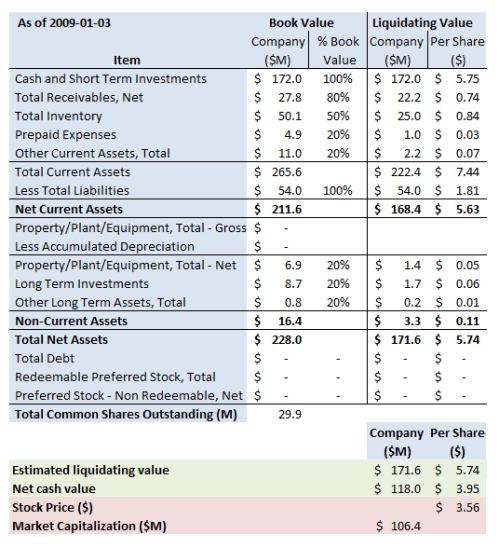
Rackable Systems Inc (NASDAQ:RACK) is a new undervalued asset play with a plan to repurchase almost 40% of its stock at current prices. At RACK’s $3.56 closing price yesterday, the company has a market capitalization of $106.4M. We estimate the company’s liquidation value to be 60% higher at $170.3M or $5.74 per share. If the buy back is completed at the current stock price, the company’s per share liquidation value will increase by almost 25% to $7.00. We’re adding RACK to the Greenbackd Portfolio.

About RACK

RACK is a provider of servers and storage products for data centers. The company was founded in 1999 and is based in Fremont, California. The company’s investor relations website is here.

The value proposition

RACK, as its CEO points out in its earnings release, has had a tough year, burning through $15.7M in the 12 months to January 3, 2009. The company does still have a huge amount of cash and equivalents on its balance sheet (the “Book Value” column shows the assets as they are carried in the financial statements, and the “Liquidating Value” column shows our estimate of the value of the assets in a liquidation):

rack-summary

We estimate the company’s liquidation value to be around $171.6M or $5.74 per share, which is predominantly cash and equivalents in the amount of $172M or $5.75 per share. RACK’s net cash value is around $118M or $3.95 per share.

Off balance sheet arrangements and contractual obligations

The company hasn’t disclosed any off-balance sheet arrangements in its most recent 10Q. The contractual obligations as at September 27, 2008 were around $10.2M, around $2.1M of which falls due in the next 12 months. Those committments are minimum lease payments under the company’s operating leases. The company also had purchase committments in the amount of $30.9M to the end of 2008. We’re not sure what these committments are for the next 12 months.

The catalyst

RACK has announced a radical buy back plan to repurchase $40M of its stock. From the press release:

“2008 was a tough year for our industry and for Rackable. Given our strong financial flexibility with $181 million in cash and investments, we plan on making key investments for 2009,” said Mark J. Barrenechea, president and CEO of Rackable Systems. “First, we plan to invest up to 10% of our cash to expand our product offerings and our sales and service capabilities. Second, the company announced a $40 million share repurchase program today. We believe this is an ideal time to invest in Rackable and that these investments will place the company in a stronger competitive position to gain market share as the economy recovers.”

We estimate that that such a buy back at the present prices will increase the company’s per share liquidation value by almost 25% to $7.00. This is a substantial upside to the current stock price.

Conclusion

It’s great to see company recognizing that its stock is deeply undervalued and taking radical action to capitalize on it. If the market is pricing your stock below its liquidation value, there are bargains to be had by investing in that stock, and we believe it should be your priority. With its stock at $3.56, RACK has a market capitalization of $106.4M, which means it’s trading at a discount to both its net cash value of $118M or $3.95 per share and its liquidation value of $171.6M or $5.74 per share. The cash burn is a risk, but we think RACK is a good bet at this level.

RACK closed yesterday at $3.56.

The S&P500 Index closed yesterday at 719.60 (!).

Hat tip to manny.

[Full Disclosure:  We do not have a holding in RACK. This is neither a recommendation to buy or sell any securities. All information provided believed to be reliable and presented for information purposes only. Do your own research before investing in any security.]