Feeds:
Posts
Comments

CoSine Communications Inc (OTC:COSN) has released its 10Q for the quarter ended September 30, 2009.

We’ve been following COSN (see Greenbackd’s COSN post archive) because it is a cash box controlled by activist investor Steel Partners. Steel Partners own 47.5% of the stock and sits on the board. The stock is up 11.4% since our initial post to close Friday at $1.95. I initially estimated the net cash value to be around $22.2M or $2.20 per share. After reviewing the 10Q I’ve slightly reduced it in line with the ~$0.3M cash burn for the last two quarters to $21.9M or $2.17 per share. The net cash value has remained relatively stable through 2006, 2007, 2008 and 2009. COSN presents an opportunity to invest alongside Steel Partners at a discount to net cash in a company with substantial NOLs.

The value proposition updated

Little has changed over the last two quarters. The valuation on COSN remains straight-forward: It has around $22.7m in cash and short-term investments, $0.2M in liabilities and 10.1M shares outstanding. I’ve set out the valuation below in the usual manner (the “Book Value” column shows the assets as they are carried in the financial statements, and the “Liquidating Value” column shows our estimate of the value of the assets in a liquidation):
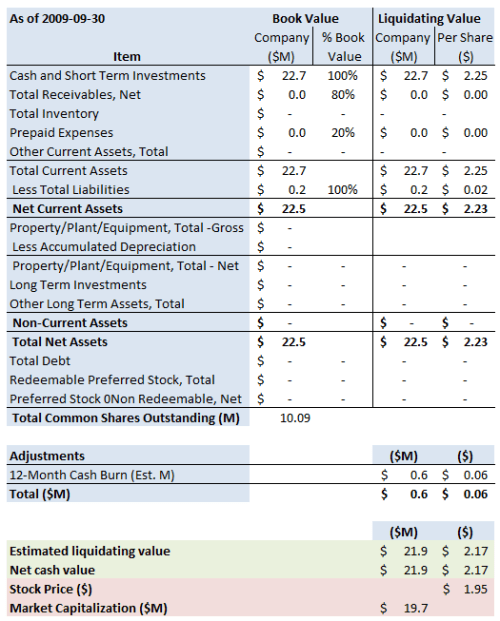
COSN Summary 2009 09 30

Balance sheet adjustments

I’ve made the following adjustments to the balance sheet estimates above:

  • Cash burn: The company used $0.58M in cash in the last three quarters, which we’ve annualized to $0.6M.
  • Off-balance sheet arrangements and contractual obligations: According to COSN’s 10Q, it has no off-balance sheet arrangements.

NOLS

A quick primer on net operating loss carry-forwards (“NOLs”) from the most 2009 10K:

NOLs may be carried forward to offset federal and state taxable income in future years and eliminate income taxes otherwise payable on such taxable income, subject to certain adjustments. Based on current federal corporate income tax rates, our NOLs and other carry-forwards could provide a benefit to us, if fully utilized, of significant future tax savings. However, our ability to use these tax benefits in future years will depend upon the amount of our otherwise taxable income. If we do not have sufficient taxable income in future years to use the tax benefits before they expire, we will lose the benefit of these NOLs permanently. Consequently, our ability to use the tax benefits associated with our substantial NOLs will depend significantly on our success in identifying suitable acquisition candidates, and once identified, successfully consummating an acquisition of these candidates.

Additionally, if we underwent an ownership change, the NOLs would be subject to an annual limit on the amount of the taxable income that may be offset by our NOLs generated prior to the ownership change. If an ownership change were to occur, we may be unable to use a significant portion of our NOLs to offset taxable income. In general, an ownership change occurs when, as of any testing date, the aggregate of the increase in percentage points is more than 50 percentage points of the total amount of a corporation’s stock owned by “5-percent stockholders,” within the meaning of the NOLs limitations, whose percentage ownership of the stock has increased as of such date over the lowest percentage of the stock owned by each such “5-percent stockholder” at any time during the three-year period preceding such date. In general, persons who own 5% or more of a corporation’s stock are “5-percent stockholders,” and all other persons who own less than 5% of a corporation’s stock are treated, together, as a single, public group “5-percent stockholder,” regardless of whether they own an aggregate of 5% of a corporation’s stock.

The amount of NOLs that we have claimed has not been audited or otherwise validated by the U.S. Internal Revenue Service (“IRS”). The IRS could challenge our calculation of the amount of our NOLs or our determinations as to when a prior change in ownership occurred and other provisions of the Internal Revenue Code may limit our ability to carry forward our NOLs to offset taxable income in future years. If the IRS was successful with respect to any such challenge, the potential tax benefit of the NOLs to us could be substantially reduced.

According to the 10K, as of December 31, 2008, COSN had federal NOLs of approximately $353M, which begin to expire in 2018 if not utilized and state NOLs of approximately $213M, which will begin to expire in 2009 if not utilized. The NOLs have a substantial value as a tax shield should COSN acquire a business with taxable earnings, but assessing that value is beyond us.

Catalyst

Steel Partners’ most recent 13D filing sets out its 47.5% holding. Steel Partners’ strategy is to use COSN’s cash to acquire a business with taxable earnings that can be offset by the NOLs. From the 10Q:

Redeployment Strategy and Liquidity

In July 2005, after a comprehensive review of strategic alternatives, our board of directors approved a strategy to redeploy our existing resources to identify and acquire one or more new business operations with existing or prospective taxable earnings that can be offset by use of our NOLs.

Ordinarly, I would prefer a return of cash to the acquisition of a business. This situation is different from the usual case because Steel Partners’ business is investment, and so I think the risk that they might make a bad investment is low. That said, there’s no assurance that they will find a suitable candidate, or if they do, that COSN will be able to use the NOLs.

Conclusion

COSN initially presented an opportunity to invest alongside Steel Partners at a 26% discount to net cash in a company with substantial NOLs. With the increase in the stock price the discount to its net cash position has narrowed to around 11%. I’m maintaining the position in the Greenbackd Portfolio.

[Full Disclosure:  We do not have a holding in COSN. This is neither a recommendation to buy or sell any securities. All information provided believed to be reliable and presented for information purposes only. Do your own research before investing in any security.]

A call for help

Please read the following request from Hunter of Distressed Debt Investing about Alan Cohen, who runs the credit and distressed debt book at York Capital Management:

I recently learned that Alan Cohen, the head of credit and distressed debt investing at York Capital Management, is suffering from leukemia. Many of us in the distressed community have worked with or know Alan and his team at York – simply incredible people.

Alan is in need of a blood stem cell match. If you are in New York City, there will be a match drive at York Capital Management on November 19th. Please contact Hunter for details. I really hope to see you there.

If you are outside of New York City, you can visit the National Marrow Donor Program for more details on where and how you can become a possible bone marrow donor (all that’s required is a saliva sample) and possibly make a life-saving transplant possible.

Please forward this to all those interested – the more people we get out, the better.

Thanks-

Hunter

I am absolutely thrilled that Greenbackd made The Reformed Broker’s superb Period Table of Finance Bloggers. I slept through most of my high school chemistry classes, but I think Greenbackd occupies the same esteemed place accorded to carbon on the periodic table of elements. Carbon’s got a bad rep at the moment, but that doesn’t bother me. Being a value investor, I know that “Many shall be restored that now are fallen and many shall fall that are now in honor.

Disclosure: Long Carbon (C).

Click to see a readable version (via The Reformed Broker):

Reformed Broker Periodic Table

Distressed Debt Investing has today launched the Distressed Debt Investors Club, a “community of investors dedicated to sharing ideas and helping each other navigate the sometimes mine-filled path of the distressed debt world.”

Members are admitted on the strength of their application and the thought process evident in the investment idea. Only 250 members will be admitted. Hunter is taking applications for next few weeks and will then admit those accepted to the site at the same time to “allow each member to see other admitted applicant’s ideas and thus begin the process of idea generation and sharing.”

If, like me, deep value, liquidations and activism are your thang, I would encourage you to join. The ability to analyze and trade in the debt side of the ledger will markedly expand your investment universe. Buy up all the bonds and get control like old “Net Quick” Evans or just agitate like Icahn.

Here is the Distressed Debt Investors Club FAQ.

Further questions should be directed to hunter[at]distressed-debt-investing[dot]com.

Aspen Exploration Corporation (OTC:ASPN) has announced that it will pay a cash dividend of $0.73 per share to stockholders of record on November 16, 2009 from the proceeds of the sale of its California oil and gas assets to Venoco, Inc. $0.73 per share represents $5.3M, which is just over the mid-point of the $5.0M to $5.5M range estimated by the company.

We’ve been following ASPN (see our ASPN post archive) because it’s trading at a discount to its $1.17 per share liquidation value and there are several potential catalysts in the stock, including a 13D filing from Tymothi O. Tombar, a plan to distribute substantially all of the net, after-tax proceeds from the completion of the Venoco sale to its stockholders ($5.3M), and the possibility that the company will dissolve. The stock is down 0.2% since we initiated the position to close yesterday at $0.983. This values the remaining stub of ASPN at $0.253 ($0.983 less $0.73) against a liquidating value I estimate at $0.44 ($1.17 less $0.73). I still think there’s obvious value here, and there might be another interesting play in the stub after the dividend. This is worth watching. It’s should also be noted, as reader bellamyj has pointed out, that, regardless of outcome of the upcoming shareholder vote, ASPN may not liquidate. This is not necessarily a bad thing if the controlling shareholder plans on monetizing the shell and its remaining cash. He owns 20% of the stock, so he’s got some incentive to do so, and he’s paying out a big cash dividend, which is a shareholder-friendly act. That said, it’s not clear whether that dividend was as a result of Timothy O. Tombar’s agitation or a spontaneous effort on behalf of the board. I’ve been wrong about managers before, but hope springs eternal.

Here’s the 8K filing:

On November 2, 2009 Aspen Exploration Corporation (“Aspen”) declared a cash dividend of $0.73 per share. The dividend will be paid to stockholders of record on November 16, 2009, with the dividend being paid on or about December 2, 2009. A copy of the news release describing the dividend is attached hereto as Exhibit 99.1. The distribution follows the final settlement of the sale of Aspen’s California oil and gas assets to Venoco, Inc., at which the parties made a number of immaterial adjustments to the purchase price paid at the June 30, 2009 closing, and made certain other payments that were not determined until after the closing. At the final settlement date Aspen received a net payment from Venoco, but was required to make various payments to third parties which ultimately resulted in a cash outflow from Aspen in an amount not considered to be material.

Aspen expects that after the payment of the dividend, and its anticipated operations through the end of the current calendar year, on December 31, 2009 it will have more than $3 million of working capital remaining. Aspen currently intends to utilize its remaining funds to maintain its corporate status as a reporting issuer under the Securities Exchange Act of 1934 and to explore other business opportunities. Pending developments with respect to any business opportunities Aspen identifies, Aspen may later reevaluate its status and plans and consider alternatives to wind up its affairs. Aspen’s projections and future plans described in this report are “forward-looking statements” (as such term is defined in Section 21E of the Securities Exchange Act of 1934, as amended) which are dependent upon a number of factors. There can be no assurance that Aspen’s projections will prove to be accurate or that Aspen will be able to successfully execute or implement its operations as described herein.

Hat tip Joe G.

[Full Disclosure:  I do not have a holding in ASPN. This is neither a recommendation to buy or sell any securities. All information provided believed to be reliable and presented for information purposes only. Do your own research before investing in any security.]

VaxGen Inc (OTC:VXGN) is all over. The latest 10Q has come out and, while not much has changed, it’s irrelevant in light of the pending deal with OXGN. The liquidation value remains around $23.6M or $0.71 per share. Whether that deal is consummated or not, VXGN shareholders will be worse off. The stock price is in no man’s land at the moment. It’s not cheap enough to buy more, and it’s still trading at a big discount to liquidation value. In this instance, it’s probably justified given the malice the board seems to have towards its shareholders. I’m closing Greenbackd’s position out at yesterday’s closing price of $0.53. Greenbackd is up 12.5% on VXGN on an absolute basis, which is off 13.0% relative to the S&P500. It’s a shame because I had plenty of chances to read the writing on the wall and get out at a decent profit. I didn’t, so more fool me. I hung around for too long, hoping that something would happen. Nothing did. The end.

Post mortem

We started following VXGN (see the VXGN post archive here) because it was trading at a substantial discount to its net cash position, had ended its cash-burning product development activities and was “seeking to maximize the value of its remaining assets through a strategic transaction or series of strategic transactions.” VXGN had other potentially valuable assets, including a “state-of-the-art biopharmaceutical manufacturing facility with a 1,000-liter bioreactor that can be used to make cell culture or microbial biologic products” and rights to specified percentages of future net sales relating to its anthrax vaccine product candidate and related technology. I initially estimated the liquidation value to be around $0.84 per share, although that reduced over the holding period to yesterdays $0.71 per share. The authors of a letter sent to the board on July 14 of this year adjudged VXGN’s liquidation value to be significantly higher at $2.12 per share:

Excluding the lease obligations, the net financial assets alone of $37.2 million equate to $1.12 per share. The EBS royalties (assuming a 6% royalty rate and a $500 million contract as contemplated by NIH/HHS and EBS) of $30 million and milestones of $6 million total $36 million of potential additional future value (based clearly on assumptions, none of which are assured), or $1.09 per share. Adding $1.12 and $1.09 equals $2.21 per share.

On the catalyst front, management had said that, if the company was unable to identify and complete an alternate strategic transaction, it proposed to liquidate. One concern of mine was the lawsuit against VXGN by its landlords, in which they sought $22.4M. That lawsuit was dismissed in May, at which point the path for VXGN to liquidate appeared to clear. Unfortunately the board dragged its feet on the liquidation, which, given their relatively high compensation and almost non-existent shareholding, was not difficult to understand.

This state of affairs drew two competing alternate proxy slates seeking nomination to the board of VXGN, Value Investors for Change and the VaxGen Full Value Committee. Value Investors for Change, led by Spencer Capital, filed preliminary proxy documents in August to remove the board. In the proxy documents, Value Investors for Change called out VXGN’s board on its “track record of failure and exorbitant cash compensation”:

VaxGen does not have any operations, other than preparing public reports. The Company has three employees, including the part-time principal executive officer and director, and four non-employee directors. Since the Company’s failed merger with Raven Biotechnologies, Inc. in March 2008, the Board has publicly disclosed that it would either pursue a strategic transaction or a series of strategic transactions or dissolve the Company. The Company has done neither. In the meantime, members of the Board have treated themselves to exorbitant cash compensation. Until July 2009, two non-employee members of the Board were paid over $300,000 per year in compensation. The principal executive officer will likely receive over $400,000 in cash compensation this year.

The VaxGen Full Value Committee, comprising BA Value Investors’ Steven N. Bronson and ROI Capital Management’s Mark T. Boyer and Mitchell J. Soboleski, intended to replace the current board with directors who would focus on the following objectives:

1. Returning capital to [VXGN]’s shareholders, including an immediate distribution of $10,000,000 in cash;

2. Terminating [VXGN]’s lease with its landlord, Oyster Point Tech Center, LLC, and settling with the landlord the obligations of [VXGN] on the remaining lease payments;

3. Exploring ways to monetize [VXGN] as a “public shell,” including the utilization of [VXGN]’s Substantial Net Operating Losses; and

4. Protecting for the benefit of shareholders royalty payments receivable from the sale of [VXGN]’s intellectual property.

BA Value Investors had previously disclosed an activist holding and, in a June 12 letter to the board, called on VXGN to “act promptly to reduce the size of the board to three directors; reduce director compensation; change to a smaller audit firm; terminate the lease of its facilities; otherwise cut costs; make an immediate $10 million distribution to shareholders; make a subsequent distribution of substantially all the remaining cash after settling the lease termination; distribute any royalty income to shareholders; and explore ways to monetize the public company value of the Issuer and use of its net operating losses.”

For a while it looked like a decent outcome was possible, but then VXGN threw a spanner in the works, striking an appalling deal with OXGN at a discount to VXGN’s $0.70 close the prior day. It is also priced at a discount to VXGN’s net cash and liquidation values, and payment is to be made in the watered scrip of OXGN, a speculative biotech play (see our more detailed take on the terms of the VXGN / OXGN deal). BA Value Investors and VaxGen Full Value Committee exited the stock shortly thereafter. Value Investors for Change has also been conspicuously silent, so I think we can assume they’ve thrown in the towel.

Disgruntled shareholders have now initiated several class actions against the board of VXGN over possible breaches of fiduciary duty in the sale to OXGN. The board certainly deserved the suit, but a successful outcome in any litigation will be a Pyrrhic victory for participating VXGN shareholders. As I understand it, VXGN’s board is indemnified out of VXGN’s assets and so as any damages award will return to VXGN plaintiffs VXGN’s assets less legal fees and the break fee.

It’s also possible that the merger will not survive the shareholder vote. As reader bellamyj noted, in November 2007 VXGN announced another disastrous merger with Raven Biotechnologies. Over the next few days VXGN stock fell almost 50% and the merger was terminated the day before the special meeting, apparently due to shareholder opposition. Perhaps that will happen again. If it does, OXGN will still tear out ~$2.5M from VXGN, but it may be a better outcome than the deal on the table. If that happens, we’ll revisit VXGN, but for now, we’re going to say, “Good riddance.” VXGN directors, hang your heads in shame.

Hat tip garp.

[Full Disclosure:  We don’t have a holding in VXGN. This is neither a recommendation to buy or sell any securities. All information provided believed to be reliable and presented for information purposes only. Do your own research before investing in any security.]

Nyer Medical Group Inc (NASDAQ:NYER) is to liquidate subject to the approval of its shareholders and the closing of two transactions. The board estimates that shareholders will receive a liquidating distribution of between $1.84 to $2.00 per share. At its $1.75 close yesterday, the low end of the range represents a 5% return and the high end represents a 15% return. This is the filing disclosing summaries of the two transaction agreements (the underlining is mine):

Asset Purchase Agreement

On October 22, 2009, D.A.W., Inc. (“DAW”), a wholly-owned subsidiary of Nyer Medical Group, Inc. (“Nyer”), and Nyer entered into an Asset Purchase Agreement (the “WAG Agreement”) with Walgreen Eastern Co., Inc., a New York corporation (“WAG”), for the sale of a substantial portion of DAW’s operating assets, including prescription files and inventory of a total of 12 neighborhood pharmacies which includes the assignment of eight leases (the “Acquired Assets”), for a purchase price, subject to certain adjustments, of $12.0 million plus up to $5.75 million of qualifying inventory and $1.1 million of operating equipment (the “WAG Transaction”).

DAW, Nyer and WAG made customary representations, warranties and covenants in the WAG Agreement. In addition, DAW and Nyer agreed that, for a period of three years, they would refrain (and cause their current controlled affiliates to refrain) from competing within a certain area of the pharmacies whose assets were included in the Acquired Assets, with certain exceptions set forth in the WAG Agreement.

The parties have agreed to indemnify each other against certain losses, including losses for breaches of representations, warranties and covenants. Each of DAW’s and Nyer’s indemnification obligations begin at an aggregate of $50,000 and are limited to a total of $1,200,000 or, with respect to the inaccuracy of certain fundamental representations, $4,000,000. Further, DAW’s and Nyer’s indemnification obligations terminate 90 days following the closing date, with certain exceptions, including an extension of the indemnification period for up to 12 months for claims related to certain representations and 3 years for claims related to noncompetition covenants. WAG agrees to indemnify DAW and Nyer for its breach of the WAG Agreement for a period of 12 months, except in certain circumstances set forth in the WAG Agreement, and its indemnification obligations are for an unlimited amount.

DAW, Nyer and WAG can terminate the WAG Agreement in certain specified instances, as provided in the WAG Agreement. If the closing does not occur and Nyer or DAW enters into an alternative transaction under certain conditions specified in the WAG Agreement, DAW would owe to WAG a breakup fee in the amount of $300,000 and reimbursement of actual out-of-pocket expenses in an amount up to $200,000.

The completion of the WAG Transaction is subject to certain closing conditions set forth in the WAG Agreement, including the approval of the WAG Transaction at a special meeting of Nyer’s shareholders which is expected to be held on or about December 15, 2009 (the “Special Meeting”).

Nyer’s Board of Directors engaged Newbury Piret Companies, Inc. (“Newbury Piret”) as financial advisor to evaluate the WAG Transaction. The Board of Directors of Nyer and DAW (the “Boards”) unanimously approved the WAG Transaction. In approving the WAG Transaction, the Boards considered the depressed market price of the stock, the historically low trading volume and volatility of bid prices; market pressures on margins and operating costs that would have an adverse effect on the operating results of the pharmacies, a fairness opinion from Newbury Piret and other considerations.

The foregoing description of the WAG Agreement is qualified in its entirety by reference to the full text of the WAG Agreement, a copy of which is attached hereto as Exhibit 2.1 to this Current Report on Form 8-K and incorporated herein.

Stock Purchase Agreement

On October 23, 2009, Nyer and DAW entered into a Transaction Agreement (the “DAW Stock Agreement”) with certain management investors named therein (the “Investors”) for the sale of the stock of DAW, under which Nyer will receive a benefit of $1,500,000 after giving effect to liabilities to be retained by DAW (the “DAW Stock Transaction”).

DAW and Nyer made customary representations, warranties and covenants in the DAW Stock Agreement. In addition, DAW and Nyer agreed, on the terms set forth in the DAW Stock Agreement, not to solicit or encourage any alternative sale transactions.

DAW, Nyer and the Investors can terminate the DAW Stock Agreement in certain specified instances, as provided in the DAW Stock Agreement. If the closing does not occur and Nyer and DAW enter into an alternative transaction under certain conditions specified in the DAW Stock Agreement, DAW and Nyer would owe to the Investors a breakup fee in the amount equal to the actual out-of-pocket expenses, including attorneys’ fees, incurred by the Investors in connection with the DAW Stock Transaction.

The completion of the DAW Stock Transaction is subject to certain closing conditions set forth in the DAW Stock Agreement, including the approval of the DAW Stock Transaction at the Special Meeting and the approval and closing of the WAG Transaction.

The DAW Stock Transaction was reviewed by a special committee of the Board of Directors of Nyer comprised of independent directors (the “Special Committee”). The Special Committee engaged Newbury Piret to evaluate the DAW Stock Transaction. The DAW Stock Transaction was unanimously approved by the Special Committee and recommended to the Boards by the Special Committee. The Boards also unanimously approved the DAW Stock Transaction. In approving the DAW Stock Transaction, the Special Committee and the Boards considered the fact that substantially all of the assets of DAW would be sold to WAG under the WAG Agreement, the lack of interest by WAG in the assets subject to the DAW Stock Agreement, a fairness opinion from Newbury Piret and other considerations.

The foregoing description of the DAW Stock Agreement is qualified in its entirety by reference to the full text of the DAW Stock Agreement, a copy of which is attached hereto as Exhibit 2.2 to this Current Report on Form 8-K and incorporated herein.

The WAG Agreement and DAW Stock Agreement (the “Agreements”) have been included to provide investors with information regarding their terms. It is not intended to provide any other factual information about Nyer or DAW. The representations, warranties and covenants contained in the Agreements were made only for purposes of such agreements and as of the specific dates therein, were solely for the benefit of the parties to such agreements, and may be subject to limitations agreed upon by the contracting parties, including being qualified by confidential disclosures exchanged between the parties in connection with the execution of the Agreements. The representations and warranties may have been made for the purposes of allocating contractual risk between the parties to the agreements instead of establishing those matters as facts, and may be subject to standards of materiality applicable to the contracting parties that differ from those applicable to investors. Investors are not third party beneficiaries under the Agreements and should not rely on the representations, warranties and covenants or any descriptions thereof as characterizations of the actual state of facts or condition of the Nyer, DAW or any other party to the Agreements. Moreover, information concerning the subject matter of the representations and warranties may change after the dates of the Agreements, which subsequent information may or may not be fully reflected in Nyer’s public disclosures.

Here is the announcement of the board approval of the liquidation:

As previously disclosed on October 23, 2009, in conjunction with the sale of a substantial portion of the assets of D.A.W., Inc. (“DAW”), a wholly owned subsidiary of Nyer Medical Group, Inc. (“Nyer”), to Walgreen Easter Co. (the “WAG Transaction) and the sale of the stock of DAW to certain management investors (the “DAW Stock Transaction”), the Board of Directors of Nyer approved the liquidation and dissolution of Nyer pursuant to a Plan of Dissolution (the “Plan of Dissolution”), subject to obtaining shareholder approval of the WAG Transaction, the DAW Stock Transaction, and the Plan of Dissolution (the “Transactions”). Upon shareholder approval and the closing of the WAG Transaction and the DAW Stock Transaction, Nyer intends to proceed with the orderly wind down and dissolution of Nyer pursuant to the Plan of Dissolution. Nyer currently expects that upon dissolution of Nyer, shareholders of Nyer will receive a liquidating distribution in the range of $1.84 to $2.00 a share, depending on the ultimate amount of assets and liabilities to be realized upon liquidation.

Management tend to underestimate liquidation distributions (for obvious reasons), so this is probably worth playing. With a market capitalization of just $7M, it’s a small company, but that’s nothing new around here. I’m adding it to the Greenbackd Portfolio at $1.75.

The S&P500 closed yesterday at $1042.88

Hat tip William Wang.

[Full Disclosure:  We have a holding in NYER. This is neither a recommendation to buy or sell any securities. All information provided believed to be reliable and presented for information purposes only. Do your own research before investing in any security.]

The WSJ has an article Profiting from the crash excerpting parts of the Gregory Zuckerman book The Greatest Trade Ever about John Paulson’s infamous bet against the housing market:

By early 2006 the 49-year-old Mr. Paulson had reached his twilight years in accelerated Wall Street-career time. He had been eclipsed by a group of investors who had amassed huge fortunes in a few years. It was the fourth year of a spectacular surge in housing prices, the likes of which the nation never had seen. Everyone seemed to be making money hand over fist. Everyone but John Paulson.

“This is crazy,” Mr. Paulson said to Paolo Pellegrini, one of his analysts.

Paulson’s response was to have Pellegrini look at the long term returns on house prices:

The answer was in front of him: Housing prices had climbed a puny 1.4% annually between 1975 and 2000, after inflation. But they had soared over 7% in the following five years, until 2005. The upshot: U.S. home prices would have to drop by almost 40% to return to their historic trend line. Not only had prices climbed like never before, but Mr. Pellegrini’s figures showed that each time housing had dropped in the past, it fell through the trend line, suggesting that an eventual drop likely would be brutal.

Paulson decided he wanted to bet that house prices would regress to the mean, but how to find the right instrument to allow him to do that:

By the spring, Mr. Paulson was convinced he had discovered the perfect trade. Insurance on risky home mortgages was trading at dirt-cheap prices. He would buy boatloads of credit-default swaps—or investments that served as insurance on risky mortgage debt. When housing hit the skids and homeowners defaulted on their mortgages, this insurance would rise in value—and Mr. Paulson would make a killing. If he could convince enough investors to back him, he could start a fund dedicated to this trade.

And then he stuck to his trade:

By the summer of 2006, Mr. Paulson had managed to raise $147 million, mostly from friends and family, to launch a fund. Soon, Josh Birnbaum, a top Goldman Sachs trader, began calling and asked to come by his office. Sitting across from Mr. Paulson, Mr. Pellegrini, and his top trader, Brad Rosenberg, Mr. Birnbaum got to the point.

Not only were Mr. Birnbaum’s clients eager to buy some of the mortgages that Paulson & Co. was betting against, but Mr. Birnbaum was, too. Mr. Birnbaum and his clients expected the mortgages, packaged as securities, to hold their value. “We’ve done the work and we don’t see them taking losses,” Mr. Birnbaum said.

After Mr. Birnbaum left, Mr. Rosenberg walked into Mr. Paulson’s office, a bit shaken. Mr. Paulson seemed unmoved. “Keep buying, Brad,” Mr. Paulson told Mr. Rosenberg.

What’s Paulson’s new big idea? Hint: It’s got distinctly Austrian tones:

By the middle of 2009, a record one in 10 Americans was delinquent or in foreclosure on their mortgages. U.S. housing prices had fallen more than 30% from their 2006 peak. In cities such as Miami, Phoenix, and Las Vegas, real-estate values dropped more than 40%. Several million people lost their homes. And more than 30% of U.S. home owners held mortgages that were underwater, or greater than the value of their houses, the highest level in 75 years.

As Mr. Paulson and others at his office discussed how much was being spent by the United States and other nations to rescue areas of the economy crippled by the financial collapse, he discovered his next targets, certain they were as doomed to collapse as subprime mortgages once had been: the U.S. dollar and other major currencies.

Mr. Paulson made a calculation: The supply of dollars had expanded by 120% over several months. That surely would lead to a drop in its value, and an eventual surge in inflation. “What’s the only asset that will hold value? It’s got to be gold,” Mr. Paulson argued.

Paulson & Co. had never dabbled in gold, and had no currency experts. He was also one of many warming to gold investments, worrying some investors. Some investors withdrew money from the fund, pushing his assets down to $28 billion or so.

Mr. Paulson acknowledged that his was a straightforward argument, but he paid the critics little heed.

“Three or four years from now, people will ask why they didn’t buy gold earlier,” Mr. Paulson said.

He purchased billions of dollars of gold investments. Betting against the dollar would be his new trade.

It is interesting to see a few well-respected investors on the same side of this trade. Einhorn made his views on gold known in his speech to the Value Investing Congress.

Forward Industries Inc (NASDAQ:FORD) has fired its investment and engaged another. It looks like FORD is intent on spending the cash on its balance sheet, which is a shame. Rather than make an acquisition, they should focus on the work on their desk and pay a big dividend. There’s a half chance that the bank could suggest a sale of the company, but that seems unlikely. I can’t believe there are no activists out there willing to take on this company. It’s 40% off its 52-week high. It’s net cash. There are no big holders. Management’s not doing a bad job, but an acquisition is a ridiculous idea. This is an instance of a management trying to plow a dollar back into the business and turn it into fifty cents. I could use that dollar more profitably. Then again, I’d probably just spend it on pennywhistles and moonpies.

We started following FORD (see our post archive here) because it was trading at a discount to its net cash and liquidation values, although there was no obvious catalyst. Management appeared to be considering a “strategic transaction” of some kind, which might have included an “acquisition or some other combination.” Trinad Management had an activist position in the stock, but had been selling at the time we opened the position and only one stockholder owned more than 5% of the stock. The stock is up 36.8% since we opened the position to close yesterday at $1.97, giving the company a market capitalization of $13.4M. Following our review of the most recent 10Q, we’ve estimate the liquidation value to $19.5M or $2.47 per share.

Here’s a link to the announcement (it’s just a marketing announcement by the bank so I’m not going to repost it).

FORD is trading at a substantial discount to its liquidation and net cash values. The risk to this position is management spraying the cash away on an acquisition. A far better use of the company’s cash is a buyback, special dividend or return of capital. Another concern is Trinad Management exiting its activist position in the stock. Those concerns aside, I’m going to maintain the position because it still looks cheap at a discount to net cash.

[Full Disclosure:  We have a holding in FORD. This is neither a recommendation to buy or sell any securities. All information provided believed to be reliable and presented for information purposes only. Do your own research before investing in any security.]

Following my Simoleon Sense interview with Miguel Barbosa, I’ve had a few requests for a post on Tom Evans. Here it is, hacked together like Frankenstein’s monster from all the public information I could track down:

Thomas Mellon Evans was a one of the first modern corporate raiders, taking Graham’s net current asset analysis and using it to wreak havoc on the gray flannel suits of the 40s and 50s. He’s not particularly well-known today, but he waged numerous takeover battles using tactics that are forerunners of those employed by many of the takeover artists of the 1980s and the activists of the 1990s and 2000s. Proxy battles? Check. Greenmail? Check. Liquidations? Check.

Born September 8, 1920 in Pittsburgh, and orphaned at the age of 11, Evans grew up poor. Despite his famous middle name (his grandmother’s first cousin was Andrew Mellon), he began his financial career at the bottom. After graduating from Yale University in 1931 in the teeth of the Great Depression, he landed a $100-a-month clerk’s job at Gulf Oil.

While his friends headed out in the evening, Evans would stay home reading balance sheets and looking for promising companies: those he could he could buy for less than the assets were worth in liquidation. Evans found such companies by calculating their “net quick assets,” the long forgotten name for “net current assets.” His friends teased him about his obsession and gave him a nickname: “Net Quick” Evans. From the 1944 Time Magazine article, Young Tom Evans:

With only some fatherly advice from Gulf’s Board Chairman, W. L. Mellon, Tom Evans made his way alone. For six years he saved money, like an Alger hero; and played the stockmarket, unlike an Alger hero. Thus he collected $10,000. He wanted to find and buy a family-owned business that had gone to pot. In the down-at-the-heels H. K. Porter Co., in Pittsburgh’s slummy Lawrenceville section, he found it. Once a No. 1 builder of industrial locomotives, Porter Co. was down to 40 workers.

Tom Evans bought up Porter bonds at 10 to 15 cents on the dollar, reorganized the company under 77B, and became president at 28.

From then on, Evan was the chief terror of the sleepy boardrooms of the era, much like Icahn would be 30 years later. As a connoisseur of deep value on the balance sheet, one has to admire his methods (From the New York Times obituary, Thomas Evans, 86, a Takeover Expert, Dies):

‘He was never really an operator; he was a financial guy — a balance sheet buyer,” one of his sons, Robert Sheldon Evans, told Forbes magazine in 1995. ”He would buy something for less than book value and figure the worst that could happen was he would liquidate it and come out O.K. What he didn’t want to do was lose money on the deal. If he knew his downside was covered, then he figured the upside would probably take care of itself.

”It was a very shrewd policy in the 50’s and 60’s, when there were highly inefficient markets: buying undervalued assets, running them for cash and selling off pieces. The 80’s leveraged buyout guys were just taking a lot of his deals to their logical extension.”

The book The White Sharks of Wall Street: Thomas Mellon Evans and the Original Corporate Raiders by Diana B. Henriques is an excellent biography on Evans. More than that, it describes many of the battles for corporate control in the 40s, 50s and 60s. In contradistinction to the takeover battles of the 80s, the dogfights in the 40s, 50s, and 60s were largely proxy fights, and in as much, should be familiar to today’s “activist investors.” James B. Stewart’s Let’s make a deal, his review of Henriques’ book, does it justice:

There are surely few phenomena more remarkable in American business than the periodic ability of cash-poor but swashbuckling newcomers, using little or none of their own money, to seize control of some of the country’s most valuable corporations. In its most recent, frenzied incarnation, dot-com entrepreneurs have exchanged stock in companies with few tangible assets and even fewer profits for control of established, profitable companies. Fifteen years ago, the currency was junk bonds rather than inflated stock. And before that, it was bank loans using a target’s assets as collateral.

Wall Street greets each wave of takeovers as the dawning of a new era. But the proposition that nothing has fundamentally changed is convincingly set forth in ”The White Sharks of Wall Street,” an engaging and thorough history of early corporate takeovers by Diana B. Henriques, a financial reporter for The New York Times. Her central character is Thomas Mellon Evans, who surfaces in what seems like nearly every trendsetting corporate battle from 1945 until his retirement in 1984, and whose tactics remain essential to practitioners of corporate warfare. Junk bonds? Greenmail? Scorched earth? Evans had been there long before investment bankers coined a catchy vocabulary to describe the maneuvers of people like T. Boone Pickens, Carl Icahn and Saul Steinberg.

Though Evans seems to have escaped the widespread public resentment and envy the others generated, and Henriques’s portrait is carefully nonjudgmental, it is difficult for a reader to work up much sympathy for him. He was ruthless, bad-tempered, usually indifferent to workers and communities. He repeatedly displayed what appears to be a criminal disregard for the antitrust laws (though he was never prosecuted). He divorced two wives (the second later committed suicide), and both times a replacement was conspicuously at hand long before any legal proceedings had begun. He betrayed two of his own sons in his quest for corporate dominance and wealth.

Yet as a deal maker Evans displayed a natural audacity and genius. In 1935, 24 years old and lacking any money to speak of, he decided he wanted to gain control of Pittsburgh’s struggling H. K. Porter Company, a manufacturer of steam locomotives. Inspired by a Fortune magazine account of Floyd Odlum, who became rich by using borrowed securities as collateral for loans to buy undervalued stock, Evans borrowed shares from a Mellon mentor, took out a loan and invested in Gulf Oil stock, then a Mellon enterprise. When Gulf’s stock rose handsomely as the nation emerged from the Depression, Evans used his profits to buy Porter bonds, then selling for a small fraction of their face value. When Porter finally had to declare bankruptcy and was reorganized, Evans, as the largest creditor, traded his bonds for equity and became the largest shareholder. Porter, essentially acquired for junk bonds, would be Evans’s vehicle for most of his life.

I highly recommend The White Sharks of Wall Street: Thomas Mellon Evans and the Original Corporate Raiders by Diana B. Henriques for fans of deep value and activist investment.