Feeds:
Posts
Comments

J. Carlo Cannell runs Cannell Capital, the long/short activist investment firm he founded in 1992 with just $600,000 under management. Cannell’s ideas are as unconventional as the man himself – he’s a Princeton liberal arts major, then freelance journalist in Fiji – and he describes himself as a “fox, not a hedge hog” (referring, I guess, to either the Isaiah Berlin essay or the Philip Tetlock book). Cannell has also taken the unconventional step of returning money to investors. In 2004, when funds under management had grown to $765 million, Cannell started returning funds to investors and stepped down to spend more time with family, saying:

The mortality rate of hedge funds with more than a billion dollars of assets under management is very high. I think about that every time we rise to that level through retained earnings. I would like to think that we practice prudence over greed.

He left only briefly, returning just six months later to manage the three Cannell Capital funds, the Cuttyhunk Fund, the Tonga Fund and the Anegada Fund, but funds under management were considerably reduced: By September 30, 2009, Cannell had trimmed his holding to approximately $168 million, investing in 85 companies. (See here for more on Cannell’s background, and investment approach)

Given his unconventionality, the awesome oddness of Cannell’s presentations at the Value Investors Congress should come as no surprise. For example, Cannell’s 2009 presentation was called Hydrodamalis Gigas, the Steller’s Sea Cow, which we hunted to extinction just 27 years after discovering it:

Steller’s Sea Cow: Delicious, and easy to catch.

How does the Sea Cow relate to investing? Cannell looks for companies that, like the Steller’s Sea Cow, have a difficult time adapting to a changing environment. He gave as an example a restaurant stock, which would have a more difficult time adapting to a slowdown in the economy than an oil and gas company. In the 2010 New York Value Investing Congress, Cannell expanded on his restaurant theme. He compared his search for short candidates in the restaurant industry to picking up roadkill on the side of the freeway, saying that he avoids them if they still have any life left, but if they’re dead, he grabs his shovel and sticks them in his portfolio. Another short anecdote: I was hanging out in the audience at the Pasadena Value Investing Congress in 2010 when Carlo sat down beside me. We had quick chat and he was lovely guy. Another hedge fund manager lamented to Cannell about the high cost of activist campaigns. Cannell’s response was words to the effect, “My activist campaigns are cheap. All I spend is the cost of the stamp to send a letter.” That’s really deep value investing.

Cannell is speaking again at this year’s Spring Value Investing Congress in Omaha, NE on May 6 and 7. (The Spring event was previously held in Pasadena, CA, but was moved because Charlie Munger no longer holds the Westco meeting in Pasadena). This year’s event is conveniently scheduled immediately after the Berkshire Hathaway Annual meeting at the CenturyLink Center (formerly the Qwest Center). Register here by December 19th and you’ll save $1,800 from the $4,595 others will pay later to attend. Remember to use Discount Code O12GB1.

I’ve attend the last four Value Investing Congresses, and can highly recommend them. There’s nothing better than seeing an investor you admire explaining live his or her process for finding stocks. There’s also a chance they’ll sit down beside you in the audience. For more information on Cannell or the other speakers, click here.

Disclosure: I get a commission if you buy through this link. You should know that every little bit helps keep me in the style to which I’ve become accustomed, by which I mean I buy the third cheapest bottle of vintage Champagne on the wine list, and all of my caviar is Sterlet. Above all, I am a deep value guy. Know that the commission is well spent.

Update: Icahn drops the hammer

From the press release:

ICAHN ENTERPRISES LP

FOR IMMEDIATE RELEASE

ICAHN ENTERPRISES HOLDINGS LP TO MAKE TENDER OFFER FOR ALL OF THE OUTSTANDING SHARES OF COMMERCIAL METALS COMPANY AT $15 PER SHARE

CONTACT: SUSAN GORDON (212) 702-4309

NEW YORK, NEW YORK, DECEMBER 6, 2011 – Carl C. Icahn today announced that Icahn Enterprises Holdings LP (a subsidiary of Icahn Enterprises LP (NYSE: IEP)), intends to initiate a tender offer for all of the outstanding shares of common stock of Commercial Metals Company (the “Company”) at $15 per share.

Closing of the tender offer will not be subject to any due diligence or financing conditions, but will be subject to the redemption by the Company’s Board of Directors of the recently adopted “poison pill” and waiver by the Board of Directors of Section 203 of the Delaware General Corporation Law, as well as other customary conditions. The tender offer will be subject to there being validly tendered and not withdrawn at least 40.1% of the issued and outstanding shares of the Company. That number of shares, when added to the shares already owned by the offeror and its affiliates, represents a majority of the issued and outstanding shares of the Company on a fully diluted basis. The tender offer will include withdrawal rights so that a tendering shareholder can freely withdraw any shares prior to the acceptance of such shares for payment under the tender offer.

Mr. Icahn stated that: “It is disappointing that this Board and management team rejected our all cash offer to buy Commercial Metals at $15 per share. I believe it was incumbent on the Board, and that the Board’s fiduciary duties required it, to allow shareholders to decide whether they wished to sell their Company.

Our tender offer will be directed to shareholders and will require shareholder action. After attempting to work with the Board, we are launching this tender offer so that shareholders can decide for themselves what they wish to do with their company.

We urge you to tender your shares. We have tried and failed to reason with the Board and management, and now it is incumbent upon you to voice your view and urge the Board to respond to shareholder demands. A strong tender offer response will send an unmistakable message to the Board that they need to redeem the poison pill and waive Section 203 so that the tender offer can close and shareholders can be paid immediately. All tendered shares will have withdrawal rights so that a tendering shareholder can freely withdraw any shares previously tendered prior to the acceptance of such shares for payment under the tender offer.

The tender offer price represents a premium of 31% over the stock’s closing price on November 25, 2011 (the trading day immediately prior to our previously announced offer to acquire the Company), which was $11.45, and a premium of 72.6% from its low this year on October 3, 2011, which was $8.60. If a majority of shareholders accept our tender offer (including shares already owned by the offeror and its affiliates), we do not believe that even this Board will stand in the way of allowing a majority of its shareholders from accepting this premium if they wish to do so. However, if the Board, even after hearing from a majority of shareholders, fails to lift the poison pill and waive Section 203, we will leave the tender offer open and seek a court order compelling the Board to redeem the poison pill and waive Section 203 so that the shareholders can receive their money.

We hope that even this Board will not decide to waste time and money fighting the will of shareholders in a courtroom battle. But, if they choose to do so, please know that we will fight this case all the way to the Delaware Supreme Court, and it is our belief, that we will prevail on the merits and that the court would order the Board to redeem the pill and waive Section 203 so that the shareholders can be paid. Obviously, the greater the amount tendered, the stronger our case will be.

Commercial Metals has consistently been at odds with good corporate governance standards. Examples of the lack of good corporate governance that are blatantly hostile to shareholders abound and include: (i) the retention of a staggered board, (ii) the adoption of a poison pill without shareholder approval and at the extremely low trigger of 10%, and (iii) the refusal by the Board to allow shareholders to vote on whether our offer was sufficient.

In addition, the 2011 ISS Proxy Advisory Services Report for Commercial Metals highlights numerous other areas of “High Concern”. ISS also noted that Commercial Metals sustained poor total shareholder return performance as determined by ISS’ standards. As a result of the Company’s poor performance, it is extremely important to send a clear message to the Board and management by tendering your shares.

Carl Icahn submitted a bid  for Commercial Metals Company (NYSE:CMC) last week that prompted an odd response from the company. Icahn sent a follow-up letter that was vintage Icahn. It seems management continued to ignore him, so late last week he sent a further letter to the company demanding action by yesterday at 9am. Icahn’s letter:

CARL C. ICAHN

December 2, 2011

Board of Directors
Commercial Metals Company
6565 North MacArthur Boulevard, Suite 800
Irving, Texas 75039

Ladies and Gentlemen:

On Monday, we informed you and publicly announced that Icahn Enterprises LP would purchase Commercial Metals Company at $15 per share, in cash, without any financing or due diligence conditions. Disappointingly, it is Friday afternoon, the week is over, and we have still not heard from you.

We are sure that you are keenly aware that since our announcement, over 22 million of the Company’s shares have traded. This represents over 19% of the Company’s outstanding shares, and is 200% higher than the average weekly trading volume over the past 52 weeks. To allow your shareholders to trade such heavy volumes without responding to our offer is completely irresponsible – but wholly consistent with the pattern of irresponsibility demonstrated by the Company over the years.

Icahn Enterprises (which currently has, on a consolidated basis, $22.4 billion of assets, including in excess of $13 billion in liquid assets, which are cash and marketable securities) made a legitimate offer to acquire your Company, and to be clear, we continue to be immediately ready to meet with you to document the transaction. We are not asking for any due diligence or financing conditions. All that we are asking is that you allow your shareholders to decide if they wish to sell their company.

We have received a number of inquiries from shareholders this week, as we are sure you have too. Shareholders deserve an answer; it is incumbent on this Board to respond to our offer. To that end, if you continue to disregard your duties and have not contacted us by 9:00 a.m., New York City time, on Monday, December 5, 2011, to schedule a meeting to discuss our offer, please be forewarned that we intend to take matters into our own hands.

Carl C. Icahn

No position.

Here’s a great story from investor Jay Schembs about Adams Golf Inc (NASDAQ:ADGF), which will be familiar to anyone who has spent some time sifting through net net screens for the last few years. Jay has had a position in ADGF since late 2008. After sitting through one too many conference calls listening to platitudes from CEO Chip Brewer about “shareholder value,” Jay decided to send a letter to ADGF’s largest shareholders pointing out the perfect inverse correlation between management’s equity grants and share price performance. Here’s Jay’s letter:

Dr. John Gregory
Mr. Joseph Gregory
SJ Strategic Investments
340 Martin Luther King Blvd., Suite 200
Bristol, Tennessee 37620

Mr. Roland Casati
Continental Offices, Ltd.
2700 River Road, Suite 211
Des Plaines, Illinois 60018

RE: Adams Golf

Dear Messrs. Gregory and Mr. Casati,

I am writing to voice serious concern regarding the alignment of management and shareholders of Adams Golf, Inc. (ADGF).

First and foremost, we as shareholders are suffering a slow death, quarter after quarter, as we endure a consistent erosion of ownership. From December 31, 2006 to September 30, 2011, due to equity grants given to management (primarily CEO Chip Brewer) fully diluted shares have increased 31%. During that time, the company’s share price has decreased 31% and shareholders have received zero cash distributions. How that performance should entitle management to ongoing equity compensation for a “job well done” is beyond me.

One of the primary concerns with regards to measuring management performance is the use of EBITDA. From ADGF’s 2010 proxy statement:

Our Annual Management Incentive Compensation Plan provides our named executive officers and key employees an opportunity to earn a semi-annual cash bonus for achieving specified performance-based goals established for the fiscal year. In 2009, 2010, and 2011 the Compensation Committee has established performance objectives for the named executive officers based on targeted levels of revenue growth and EBITDA (earnings before interest, taxes, depreciation and amortization). We believe that focusing on revenue growth is important because there are distinct advantages to revenue and profitability scale in the golf equipment business, such as the ability to advertise on network-televised golf events, to sponsor professional tour pros, and the ability to compete for strong research and development talent. We believe that focusing on EBITDA is important because it is the most widely accepted metric for the cash flow generated by a business. The performance objectives allow the named executive officers to earn a cash bonus up to a specified percentage of their base salary if Adams Golf achieves at least a specified threshold of the above metrics.

In the long term, shareholders only benefit to the extent the enterprise generates cash available for distribution. In stating “EBITDA is important because it is the most widely accepted metric for cash flow generated by a business,” you are ignoring taxes, capital structure, and investments required in fixed and working capital. ADGF does not require much investment in fixed assets, but does require substantial ongoing investments in working capital. As such, EBITDA fails to account for these cash outflows necessary to support growth.

A more sophisticated way to measure performance would be to look at the after-tax operating profit generated by the business in relation to the amount of capital investment required to generate those returns. From FY2006 through the last twelve months (“LTM”) ending September 30, 2011, ADGF has averaged a 4% return on invested capital.

As I mentioned earlier, during this same period, the share price has declined 31%. Certainly some of this share performance is attributable to broader economic and financial market woes. In my opinion, however, ADGF’s share underperformance is due primarily to the ongoing dilution described above as well as shareholder value destruction caused by generating returns below the company’s cost of capital.

My suggestion is to significantly overhaul the management compensation structure. Base management performance metrics on true creation of shareholder value (utilizing Economic Value Added or a similar metric), rather than simplistically focusing on revenue growth and EBITDA.

The significant equity grants to CEO Chip Brewer have enabled him to build a sizable ownership in ADGF. Mr. Brewer’s ownership on a fully diluted basis stood at 9.6% as of the 2010 proxy filing. Shareholders hopeful that Mr. Brewer’s ownership puts them on the same side of the table, however, are dismayed to find that since December 31, 2009, Mr. Brewer has purchased zero shares. During that same period, he has sold nearly 183,000 shares. This is hardly a ringing endorsement that we as shareholders have the CEO on our side.

In quarterly earnings calls, Mr. Brewer frequently talks about “creating shareholder value.” He encounters the question of this ongoing shareholder dilution more frequently on these calls, but always sidesteps a true response to shareholder concerns. One wonders how consistently diluting existing shareholders at the expense of management while failing to earn an acceptable rate of return on capital creates shareholder value.

I currently own slightly more than 1.5% of the fully diluted common equity outstanding. As such, while I certainly cannot influence any corporate decisions, I do take a keen interest in the affairs of the corporation. I am not representing a larger cabal or a hedge fund with greenmail or other ulterior motives. I would like to remain a long-term shareholder, but am reaching a level of frustration that will ultimately result in a sale of my shares if these concerns are not addressed.

What I ask is that you as the largest non-management shareholders seriously reconsider the current management compensation structure. Adams Golf has a great brand name, has overcome its legal issues, and in my opinion has a very bright future as a continued leading and innovative golf equipment company. If the board of directors cannot truly align the interests of management, the board and the broader shareholders, you will be left with consistent shareholder turnover and a stock price that continues to lag, as no long-term investors will be willing to commit their capital to a partner they cannot trust to truly represent their interests.

Regards,

Jay Schembs

Disclosure: I am long ADGF.

The good news is that the letter had immediate impact. Here’s Jay:

Earlier this week, I sent a letter to two of Adams Golf’s largest shareholders – the Gregory family and Roland Casati. I also published the letter on Seeking Alpha here. In the letter, I impored (sic) these shareholders to recognize the ongoing dilution and inadequate returns on capital generated by CEO Chip Brewer.

On Thursday, the Gregory family and Mr. Casati released an SEC form 13-D, wherein Mr. Casati has irrevocably pledged to vote his shares with the Gregorys. In total, they represent nearly 35% of the outstanding equity. More importantly, they will be voting against Mr. Brewer as a director on the board in next year’s proxy, and indicated they may submit “other possible related proposals to present to the stockholders.” While vague, taken in context with the vote against Mr. Brewer indicates to me they are hearing the shareholder frustration.

I can only hope my letter helped expedite what has been a long time coming.

I love to see a small shareholder getting results.

Greenbackd Disclosure: No position.

Dr. Travis Dirks has provided a guest post with important implications for activist and special situations investors. Travis is the Founder and CEO of Rotary Gallop, a company pioneering the application of Nobel-prize winning mathematics to the problem of acquiring, keeping and exercising corporate control. You can reach him at T@RotaryGallop.com

—-

To Fellow Greenbackd Readers:

Activists:

The advice you receive on proxy strategy is medieval. I mean that literally. It is a pocket of our world, which like baseball before Billy Bean and Moneyball, has not experienced the scientific revolution. That backwardness leads to serious strategic errors and the following post is a small example of how much better one can do.

Special Situations Investors:

We can calculate the exact odds that an activist will succeed in a proxy campaign. That makes certain activist campaigns a reliable uncorrelated class of special situations that can really boost you portfolio and help uncouple it from the market. Activist campaigns have all three legs of the special-situations stool: a clear deadline for the battle, a clear idea of the value of the company with/without their changes in place (if the activist has done his job), and the odds of success (now possible with Rotary Gallop’s tools). You can’t ask for a more textbook-perfect special situation than that!

—-

A current case beautifully highlights a fact we observe in engagement after engagement: going from qualitative fuzzy adjectives (traditional proxy strategy advice) to quantitative hard numbers can be a gamechanger! Even when the situation appears blatantly obvious, cold hard numbers give a new perspective like no other. Case in point: ModusLink Global Solutions, Inc (NasdaqGS: MLNK ) featuring Peerless Systems Corp. (PRLS) and Steel Partners.

For the second year in a row, ModusLink is having an eventful proxy season. For a great summary, check out the October 28th edition of the always useful Catalyst Equity Research Report . This year, management faces Peerless Systems’ seasoned activist Timothy Brog. He is backed by an amalgam of varied and vocal supporters, totaling roughly 11% ownership. This is significant activist power. Peerless is seeking to replace two directors up for election this year.

As far as we’ve been able to determine, Steel Partners, the 800-pound gorilla in the room and largest shareholder by far with nearly 12% ownership, has not publicly announced allegiance to either side. One might rightly assume the obvious: that Steel Partners is a huge prize in the contest and that they may have significant negotiating power with both management and Peerless Systems.

However, as a decision executive at one of the involved parties, how do I use this information? What do I do with an adjective like “significant” or “huge”? How do I weigh “significant” against the actual costs and changes that Steel Partners might like to see in order to support me? And what does “significant” really mean, coming from an advisor who may have a different gut-calibration than myself? Answer: It is a big fat ambiguous term that in turn results in a big fat clumsy strategy.

We can do better. Rotary Gallop’s Control Measurement  techniques crush fuzzy adjectives and presents tangible numbers. Numbers that you can touch and feel, weigh and measure, and then use to think. Numbers that exactly measure the power and influence of each shareholder. In the case of ModusLink, at Rotary Gallop we take “significant” and give you:

Steel partners has a voting power of 53%. In the upcoming proxy battle this January,  there is a 53% chance that Steel Partners will cast the deciding vote.

Take a moment to appreciate what just happened. We’ve gone from an adjective like “significant”, to knowing the odds that Steel Partners will be the deciding factor in the election. Now that is a giant leap forward! And the beauty of numbers is that we can make the connection between Steel Partners and the fate of the opposing campaigns even more direct.

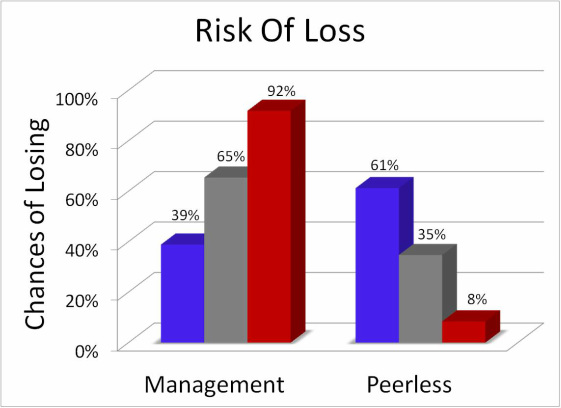
Presenting Exhibit 1: Management and Peerless’s Risk of loss

We have directly measured the “significance” of Steel Partners’ decision to Peerless and ModusLink. Look at the middle gray columns in the graph below. With Steel Partners remaining undecided, ModusLink has a 65% chance of losing, while Peerless has a 35% percent chance of losing. That is a fairly wide-open race, with management winning 7 out of 20 times.

Exhibit 1:  Measuring the Risk of Steel Partners’ decision to ModusLink and Peerless

If Steel Partners sides with ModusLink (blue columns) the tables turn but the race still remains quite wide open. Peerless has a 61% chance of loss while ModusLink now has only a 39% percent chance of loss. (ModusLink now wins 12 out of 20 times). If, on the other hand, Steel Partners sides with Peerless (red columns) we have a much more drastic change in the character of the race, with ModusLink’s risk of loss shooting all the way up to 92% percent and Peerless’s dropping to only 8%!

Using an adjective, like significant, to communicate the importance of Steel Partners completely misses the key observation that their value is asymmetric. In siding with ModusLink, Steel Partners does not change the character of the race – it still remains essentially open. However, in siding with Peerless, Steel Partners makes a proxy win nearly impossible for ModusLink’s and the game changes from a contest to one of negotiations. Thus, from Peerless’s point of view, Steel Partners represents a primarily offensive opportunity (a game winning strategy), while ModusLink should see them as primarily defensive (a stay-in-the-game strategy).

Now Peerless, ModusLink, and Steel Partners all know just how valuable Steel Partner’s decision is to each party and they will all be able to make much more intelligent decisions about what concessions are and aren’t worth Steel Partners’ support. Having at least this part of the competitive landscape in sharp focus will help the decision makers at Peerless and ModusLink as they head towards the election in January. And for other decision makers and advisers our there: You don’t have to put together your strategy while viewing the battle field through a dirty coke bottle. We have satellite images!

As I sign out, I’ll note that we can go another step further and put a monetary value on Steel Partners’ Vote for both Peerless and ModusLink, but that’s a post for another day. Let me know what you think!

-Travis

Greenbackd Disclosure: No position.

Greenbackd is 3!

Thanks for all the support.

Amit Chokshi of Kinnaras Capital, an independent registered investment advisor focused on deep-value, small capitalization and micro capitalization equity investing, has contributed a guest post on Imation Corp (NYSE:IMN).

About Kinnaras:

Kinnaras aims to deliver above average long-term results through application of a deep value investment strategy.  As a result, the Firm focuses on the “throwaways” of the equity market, or stocks that are generally viewed as broken from a fundamental standpoint.  The Firm utilizes a fundamental, bottom-up, research-intensive approach to security selection, focusing mainly on prospects trading below book and/or tangible book value or cheap price to free cash flow. Kinnaras is a strong advocate of mean reversion and has found that pessimistic valuations, and thus attractive investment opportunities, often manifest when the broader investment community disregards mean reversion and impounds overly pessimistic expectations into security prices.  When valuation incorporates these pessimistic assumptions, the risk/reward scenario favors the investor.

Imation Worth More Sold Than Alone

As a deep value investor, one is always confronted with companies that have potentially great assets but can be overshadowed by poor management.  As a deep value investor, often times a great stock is not necessarily a great company but the overall value available from an investment standpoint is too attractive to pass up.  Based on its current valuation, IMN appears to fall into this category.

IMN is a global developer and marketer of branded storage/recording products focused on optical media, magnetic tape media, flash and hard drive products and consumer electronic products.  The company has significant global scale and its brand portfolio includes the Imation, Memorex, and XtremeMac brands.  The company is also the exclusive licensee of the TDK Life on Record brand.

IMN has high brand recognition and is a leader in its key categories of optical and magnetic tape media.  While the company faces long term secular challenges with regards to how data is stored, the current valuation appears to be highly muted due to a number of strategic and capital allocation blunders over the company’s past 5+ years.  Management would be doing shareholders a greater service by simply putting the company up for sale given the time allotted for a number of strategic moves to play out unsuccessfully in recent years.  Moreover, IMN has been on an acquisition spree in 2011 and existing shareholders may see further value destruction given the track record of management.  The following highlights some key grievances shareholders should have with IMN’s current strategy

Horrific Capital Allocation by Management: IMN’s cash balance serves as somewhat of a fundamental backstop against permanent capital loss.  The problem, however, is that the company’s net cash balance has been used to fund a number of bad decisions, particularly M&A.  Management has acquired a number of businesses in recent years, none of which have benefited shareholders.  These acquisitions of businesses and intellectual property (“IP”) have led to clear value destruction as evidenced by IMN’s sales and operating income performance since those acquisitions along with on going write-offs of goodwill tied to a number of those purchases and constant restructuring charges eating into book equity.

One example of how poor management’s acquisition strategy was its purchase of BeCompliant Corporation (Encryptx) on February 28, 2011 which resulted in $1.6MM in goodwill.  In less than five weeks, IMN had determined the goodwill tied to this acquisition to be fully impaired!  While $1.6MM is a tiny amount, Table I highlights the total value of goodwill written off by IMN in recent years along with the ongoing restructuring charges in the context of the company’s historical acquisition capex.

TABLE I: IMN ACQUISITION CAPEX & IMPAIRMENT, RESTRUCTURING CHARGES ($MM) [Click to expand]

Since 2006, IMN management has deployed $442MM in cash to acquire a variety of businesses.  Since that time, investors have had to experience $152MM in goodwill write-offs and another $169MM in restructuring charges as IMN fumbles in regards to integrating newly acquired and existing business segments for a grand total of $320MM in charges since 2006.  IMN management is clearly a poor steward of capital.   What’s worse is that shareholders experienced value destruction at the expense of exercises which would have returned cash to shareholders.

For example, after 2007 IMN ceased paying a dividend.  The annual dividend returned over $20MM to investors annually.  Rather than provide investors with a certain return in the form of a dividend, IMN management has used that capital to obviously overpay for businesses such as Encryptx.  Another demonstration of poor capital allocation by management is its stock buyback history.  From 2005-2008, IMN spent nearly $190MM to buyback shares when its stock was valued at levels ranging from 0.4-1.1x P/S and 0.8-1.6x P/B or $14-$48 per share.  The average acquired share price of IMN’s treasury stock was $23.39.

Since 2008, IMN’s share price has ranged from its recent multi year low of $5.40 to about $14 (for a brief period in early 2009).  More importantly, IMN’s valuation has ranged from 0.15-0.25 P/S and 0.28-0.36 P/B.  So while IMN has had more than enough cash to purchase shares since that time, from 2009 on, IMN management decided to repurchase just under $10MM of stock.  This exemplifies management’s history of overpaying for assets – whether it’s businesses, IP, or the company’s own shares.

Management has no meaningful investment in IMN:  There has been considerable insider purchases since July 2011 across a number of companies.  IMN has had no major inside purchases despite the current low share price.  IMN CEO made an immaterial purchase in the open market very recently but overall, while  IMN stock has floundered, management has experienced none of the setbacks of shareholders for its inept strategy.  As mentioned above, management had the company execute on a number of buybacks from 2005-2008.  However, the overall effect of those buybacks were considerably offset by significant issuance of stock compensation.  As a result, IMN’s overall share count continued to grow despite these share buybacks.  In summary, management has demonstrated little appetite for the company’s shares, irrespective of valuation, while expecting shareholders to sit idly by while it awards itself dilutive stock compensation off the backs of investors.

There is no question that IMN has its share of challenges but is there value to be unlocked?  At current valuations, it appears that significant upside is potentially available if IMN investors can take an activist stance.  Management has had its chances for many years and it is clearly time to explore other options.  Despite the secular challenges IMN faces, the company is still worth more than current prices.  The following highlights the good aspects of IMN.

Valuation:  IMN is cheap based on a number of valuation metrics.  First, at $5.81 per share as of Monday’s (11/28/11) market close, IMN has a negative enterprise value.  IMN has $6.21 in net cash per share and the current share price means that the market is ascribing a negative value to IMN’s core operating business.  Given the number of patents and intellectual property along with a business that can generally crank out solid cash flow, IMN’s main businesses should not have a negative value despite the longer term secular challenges it faces.  On a capital return basis, IMN management should have the company repurchase shares at this level but that may be expecting far too much from management given its track record.

IMN is also trading at valuation levels below those reached even in 2008-09.  As Table II shows, IMN has not traded at levels this low at least since 2003.  Long-term challenges in its core business segments along with value destroying management are two reasons for these metrics grinding lower but at a certain point, valuation can become rather compelling.  I think current prices and valuation may reflect “highly compelling” from an investment standpoint.

TABLE II: IMN HISTORICAL VALUATION [Click to expand]

IMN’s current valuation could be ascribed to a company with major near-term problems, typical of those that burn considerable cash and have poor balance sheets characterized by high levels of debt and/or near-term refinancings.  IMN does not fit into this description.  As bad as IMN is performing, it is still on track for a positive free cash flow in 2011.  IMN has modest capital expenditure needs and IMN’s gross margins have been increasing in 2011, approaching gross margins realized in 2007.  Table III presents my estimate for FY 2011 excluding IMN’s non-cash restructuring charges and write-offs.  To be clear, a potential acquirer would also use pro forma statements in determining IMN’s value.

TABLE III: IMN 2011 SUMMARY OPERATING DATA

Using a highly conservative multiple of just 3.0x 2011 pro forma EBITDA of $49MM leads to a share price of $10.  What is clear from Table III is that if management could avoid squandering capital on acquisitions, IMN can still generate attractive free cash flow.  In addition, with a net cash balance of $233MM or $6.21/share, IMN should not generally be paying any net interest expense if that capital was better managed/allocated for cash management purposes.  A history of poor capital allocation and strategic blunders has led to IMN carrying a heavily discounted valuation.  At about $5.80, a case could be made that IMN is trading at or below liquidation value as presented in Table IV.

TABLE IV: IMN LIQUIDATION VALUE PER SHARE

Table IV shows that the major wildcard is really the value of IMN’s intangible assets.  While IMN is facing secular challenges, the IP it carries could very well have value to a potential acquirer, especially at an attractive valuation.  IMN maintains a long-term exclusive license with TDK which expires in 2032.  TDK, which owns nearly 20% of IMN, could bless a sale that allows those licenses to pass on to an acquiring company.  Aside from the TDK license, IMN holds over 275 patents.  IMN has recently entered into security focused technology for the purposes of flash and hard drive storage.  This technology uses various advanced password/encryption technology along with biometric authentication and could very well be worth much more to a larger technology company that could more broadly exploit this IP across its technology.  This is just one example of various IP IMN possesses.  In addition, IMN has leading market share and brand recognition/value in a number of areas such as optical media along with magnetic tape media.  A competitor like Sony Corp (“SNE”) or a client like IBM or Oracle (“ORCL”), both of which use IMN’s magnetic tape media in their own products for disaster storage/recovery and archiving, could find IMN’s IP of value.

TABLE V: IMN LIQUIDATION VALUE BASED ON INTANGIBLE ASSET DISCOUNT

If IMN’s IP and thus its intangible assets are absolutely worthless, IMN would be worth under $2 in a fire sale liquidation.  However, at even a 50% haircut of IP, IMN gets to where its stock is currently trading.  The less severe the discount, the more IMN is worth in a liquidation.  That’s hardly a groundbreaking statement but what if IMN’s IP is actually worth more than its carrying value?

TABLE VI: IMN LIQUIDATION VALUE BASED ON INTANGIBLE ASSET PREMIUM

What is clear is that IP has considerable value and in many cases eclipses the actual on-going business value of a number of companies.  The recent lawsuit between Micron Technology (“MU”) and Rambus Inc (“RMBS”) was for IP claims that could have yielded nearly $4B in royalties (before potentially tripling under California law) for RMBS. RMBS commanded a market valuation of roughly$2B before MU won the lawsuit.

Motorola Mobility Holdings (“MMI”) faced very challenging headwinds in the mobile device space against tough competitors such as Apple (“AAPL”), Samsung, HTC, and others.  This was reflected in the stock losing significant value once being spun off from Motorola (about 25% from its initial spin-off price).  Nonetheless, Google (“GOOG”) saw value in MMI’s IP, enough to offer a share price that was essentially 100% above its at-the-time lows.

Eastman Kodak (“EK”) has a number of operating challenges and a far less attractive balance sheet relative to RMBS, MMI, and IMN.  The company is wracking up losses and has a $1.2B pension shortfall.  Nonetheless, IP specialists MDB Capital believe that EK’s IP could be worth $3B in a sale.  EK currently has a market capitalization of just $295MM.

What is clear is that there is a wide range of valuation outcomes dependent on the value of the IP to a potential buyer.  IMN could be an easy and accretive acquisition to a number of large technology firms.  Firms like SNE, Maxell, and Verbatim could find IMN attractive for its leading position in optical media.  SNE could also find IMN’s magnetic storage division of value, as could IBM and ORCL.  IMN’s emerging storage division encompasses USB, hard disk drives, and flash drives (admittedly not really “emerging”) but has a particular focus on security focused applications in this storage format.  The IP related to biometric authentication and advanced encryption could be of value to a number of storage/storage tech companies such as Western Digital Corp (“WDC”), Seagate Technology (“STX”), SanDisk Corp. (“SNDK”), Micron Technology (“MU”). Even larger enterprise storage and software companies such EMC Corp (“EMC”), IBM, and ORCL could find this segment of value.  The small consumer electronics segment could be of interest to a company like Audiovox (“VOXX”).  However, in any case, all of IMN could be acquired at a very attractive price to nearly any large technology firm/buyer.

At a takeout price of just $10 per share, for example, an acquirer would be buying IMN’s core business for just $142MM with $6.21 of the $10 offer represented by IMN’s net cash.  This small deal size could very well lead to a quick payback period for a number of larger firms that could exploit IMN’s IP across multiple channels.  IMN could also be sold off in piecemeal fashion but given its small size and number of large technology companies that can utilize IMN’s IP, folding the entire company at an attractive price could be the easiest road.

Management and the board have had more than enough time in recent years to transform IMN or move it forward.  The operating results clearly show that this strategy is costing shareholders greatly and management appears to have little competence with regards to understanding how best to deploy capital.  Nearly $200MM was spent to repurchase far more expensive IMN shares prior to 2008 while a pittance of IMN capital has been deployed to buyback shares when the stock is trading for less than its net cash value.  In addition, upon ceasing its payment of annual dividend, IMN management has utilized that cash to pursue questionable acquisitions.  These acquisitions have led to destruction of shareholder equity given the subsequent writedowns and constant restructuring charges experienced by IMN.  The bottom line is IMN investors should pursue an activist stance and encourage management and the board to seek a sale for the sake of preserving what value is left in the company.

DISCLOSURE: AUTHOR MANAGES A HEDGE FUND AND MANAGED ACCOUNTS LONG IMN AND MU.

Greenbackd Disclosure: No Position.

Carl Icahn submitted a bid today for Commercial Metals Company (NYSE:CMC), a manufacturer and recycler of steel and metal products in the United States and internationally. Icahn submitted the bid by letter (set out below), which prompted an odd response from CMC management (also set out below). Icahn’s final response (set out last) to CMC’s press release is vintage Icahn.

Icahn’s bid letter:

CARL C. ICAHN

November 28, 2011

Board of Directors
Commercial Metals Company
6565 North MacArthur Boulevard, Suite 800
Irving, Texas 75039

Ladies and Gentlemen:

I am currently your largest shareholder and beneficially own 9.98% of the outstanding common shares of Commercial Metals Company (the “Company”) through several affiliated entities, including subsidiaries of Icahn Enterprises LP (NYSE: IEP). Based upon publicly available information, Icahn Enterprises (which currently has, on a consolidated basis, $22.4 billion of assets, including in excess of $13 billion in liquid assets, which are cash and marketable securities) hereby proposes to purchase the Company in a merger transaction at $15 per share without any financing or due diligence conditions. That price represents a premium of 31% over the stock’s closing price on November 25, 2011, which was $11.45, and a premium of 72.6% from its low this year on October 3, 2011, which was $8.60.

IEP is prepared to proceed to immediately negotiate and execute definitive documents. We firmly believe that the Board’s fiduciary duties require the Board to allow shareholders to decide for themselves if they wish to accept this offer. Accordingly, we are also prepared to structure the transaction with an immediate front end tender offer, with protections for minority shareholders pending completion of the merger.

This transaction will allow shareholders the opportunity to monetize their investment in the Company. Those who desire to stay invested in this industry could take their proceeds and invest in direct competitors in the steel industry which we believe are much better managed and better situated to take advantage of any possible economic recovery than Commercial Metals.

The reason IEP is paying a 31% premium over the November 25, 2011 closing price is because of IEP’s ownership of PSC Metals Inc. When the acquisition is completed IEP intends to combine Commercial Metals with IEP’s own metals recycling assets. IEP will sell Commercial Metals’ non-core assets and immediately appoint a new management team to run the steel business. In our opinion, these undertakings are imperative to realize future profits at Commercial Metals.

As a 10% shareholder of Commercial Metals we are extremely concerned about the capabilities and behavior of the current Board and management, and therefore, we intend to nominate three individuals as directors at the Company’s 2012 annual meeting of shareholders, as well as make several proposals for shareholder consideration. We do not believe the current Board is capable or willing to undertake the actions necessary to enable Commercial Metals to compete in the future. Such actions include, but are not limited to, the sale of non-core assets, the immediate replacement of management, and the refocusing of the business on core operations in North America. The track record established by the current Board and management team over the last several years is dismal.

Unfortunately, a below average operating performance fueled by a distracting and misguided international growth plan, combined with a disastrous investment record, has become the defining characteristic of Commercial Metals. We have no confidence in management’s ability to continue running the Company, nor do we have any confidence that the Board will ever hold management accountable for poor performance – as shown by the recent and inexplicable bonuses paid to management. But, hopefully,even this Board will finally take its fiduciary duty to shareholders seriously enough to allow shareholders to decide whether or not to sell the Company at a 31% premium over current market price.

Your management team has suggested a recovery in key end markets will not materialize in 2012. Further, in our opinion, because the Company has been so poorly managed, shareholders are exposed not only to cyclical industry risks, but also to permanent risks. Astoundingly, between 2006 and 2011, the Company squandered $2 billion of capital on ill-conceived acquisitions and “growth” projects, many of which generated negative EBITDA through the period.

Despite this dismal record, the Board recently granted bonuses to management, including a $750,000 bonus to the new CEO — for what exactly?! Not in recognition of the Company’s operating performance, but because management threw in the towel and admitted that the Company should walk away from many of the substantial investments that you approved only a few years earlier. The logic is absurd! The Company spends shareholder money on disastrous investments, and then several years later, awards management special bonuses – again shareholder money – for having the “courage” to run away from those very same investments!

Unfortunately, over the next several years even if the steel markets shift into a cyclical recovery, we fear, and believe, that Commercial Metals will simply shift back from the current strategy where management is supposedly focused on unwinding its disastrous investments, to the previous “strategy”, where management travels the world investing in losing “growth” projects from Croatia to Australia.

In light of the above, we again ask you to finally show that even this Board is serious enough about its fiduciary obligations to allow shareholders, and not themselves, to decide whether to sell the Company at a substantial premium over the current market price. We would like to move forward immediately and we are ready to meet. We are prepared to enter immediate negotiations and would like to see a tender offer launched as soon as possible.

Carl C. Icahn

CMC’s press release response:

Commercial Metals Company To Review Unsolicited Letter From Icahn Enterprises LP’s Chairman Carl Icahn

12:46pm EST

Commercial Metals Company confirmed that it has seen an open letter released to the press by Icahn Enterprises LP’s Carl Icahn proposing to acquire all outstanding common shares of Commercial Metals Company at a price of $15.00 per share. Commercial Metals Company’s Board of Directors, in consultation with its independent financial and legal advisers, will review the letter and determine a response that is in the best interests of the Company and its stockholders. The Company noted that Icahn’s letter did not constitute a formal offer and, as such, stockholders do not need to take any action. Goldman, Sachs & Co. is serving as financial adviser, and Sidley Austin LLP is legal adviser.

Icahn’s rejoinder:

CARL C. ICAHN

November 28, 2011

Board of Directors
Commercial Metals Company
6565 North MacArthur Boulevard, Suite 800
Irving, Texas 75039

Ladies and Gentlemen:

We have seen your press release “Commercial Metals Company to Review Unsolicited Letter From Carl Icahn” issued earlier today. You stated in your press release that: “The Company noted that Icahn’s letter did not constitute a formal offer and, as such, stockholders do not need to take any action.” This is absurd and in-keeping with the confused decisions and statements that this management team and Board have made over the past 3 to 4 years. We have no idea why the Board would want to misconstrue what was obviously a formal offer?

We do not want any confusion or misinformation, so let’s reiterate what should have already been clear. The offer we delivered to the Board earlier today is, in all respects and without any doubt, a formal all cash offer to acquire the Company. In fact, we will repeat our offer in order to eliminate the Board’s confusion. Here it is again:

Icahn Enterprises (which currently has, on a consolidated basis, $22.4 billion of assets, including in excess of $13 billion in liquid assets, which are cash and marketable securities) hereby proposes to purchase the Company in a merger transaction at $15 per share without any financing or due diligence conditions.

Given the obvious market interest in your securities, as evidenced by today’s heavy trading volumes, it is incumbent on the Board to respond to our offer as soon as possible.

Carl C. Icahn

Funny stuff.

[No position]

A small Canadian activist fund is leading a group of disgruntled shareholders in a campaign to break-up Research In Motion Limited (USA) (NASDAQ:RIMM). The activist, Jaguar Financial Corporation, says the group want a sale of the company as a whole or in parts, and the replacement of co-CEOs Mike Lazaridis and Jim Balsillie, RIMM’s two largest shareholders. They are also calling on the board to explore options to sell or spinoff RIMM’s patent portfolio.

The company previously been confronted by an unhappy investor about its governance structure. Northwest and Ethical Investments initially sought a proposal to split the chairman and chief executive roles but dropped it after RIMM said that it would form a committee to “study its leadership structure.”

Jaguar says that it speaks on behalf of shareholders representing 8 percent of the company’s shares. Vic Alboini, Jaguar’s CEO, says there are 13 shareholders in his camp, but he declined to identify them:

There is no collaboration on RIM other than, ‘we support the Jaguar initiative to cause corporate governance change, and to push the company to put itself up for sale or pursue strategic options’.

The distinction is important because a group of shareholders acting together and holding at least 10 percent of shares must disclose its membership.

The September 6 letter from Jaguar is set out below:

Jaguar, On Behalf of Supportive Shareholders, Requests Rim Directors to Commence a Value Maximization Process That May Include the Sale of Rim

TORONTO, Sept. 6, 2011 /CNW/ – Jaguar Financial Corporation (“Jaguar”) (TSX: JFC), a shareholder of Research In Motion Limited (“RIM” or the “Company”), on behalf of itself and other supportive shareholders, today called upon the Directors of RIM to establish and carry out a formal process for the maximization of shareholder value. This value maximization process would include the pursuit of all options including a potential sale of the Company or a monetization of the RIM patent portfolio by a spin-out to RIM shareholders.

Vic Alboini, Chairman and CEO of Jaguar, stated: “The status quo is not acceptable, the Company cannot sit still. It is time for transformational change. The Directors need to seize the reins to maximize shareholder value before more market value is lost.”

Jaguar strongly recommends that RIM’s Directors appoint a Special Committee of the Board consisting of four or five of the current seven independent directors to pursue a shareholder value maximization process.

Jaguar believes a transformational change to maximize shareholder value is necessary for the following reasons:

Poor Share Price Performance 

There has been a precipitous decline in the Company’s share price since 2008, from $149.90 in June 2008 to $29.59 on September 2, 2011, representing a decline of approximately 80.3%. In contrast, over the same timeframe, the TSX Composite Index has only fallen by approximately 14.8%. RIM’s chronic underperformance and repeated delays in executing its strategy have led Jaguar to the conclusion that fundamental change at RIM is required. Most importantly, RIM’s competitors have seen a significant increase in market share at RIM’s expense, both in the enterprise and consumer markets, and a corresponding increase in share price and overall valuation.

Lack of Innovation Resulting in a Loss of Market Share

While its rivals have demonstrated an ability to develop and market products with features that inspire consumer enthusiasm and drive higher adoption rates, RIM has clearly fallen short. Its failure to offer products with innovative features, combined with its limited selection of applications, has resulted in RIM losing market share to its competitors. While few would question the email and security capabilities of RIM’s BlackBerry platform, the reality is that RIM has failed to develop the multi-purpose device that meets the requirements of today’s dynamic consumer landscape.

The BlackBerry, once a market leader, has been relegated to number 3 in terms of market share behind Apple’s iPhone and Google’s Android phones. A recent comScore report estimated that RIM’s U.S. smartphone market share declined from 39% to 22% over the twelve month period ended July 31, 2011. This decline in the Company’s standing can largely be attributed to significant execution delays, inadequate mobile applications, and the lack of a competitive product that addresses the needs of the consumer marketplace.

With a reduced market share for RIM there is the serious risk that developers of mobile applications will prioritize developing applications for RIM’s competitors. There should be a concerted focus for RIM to encourage or finance the development of cutting edge mobile applications. This lack of an effective ecosystem is a key shortcoming that needs to be addressed.

Jaguar has noted the recent resignations of several key RIM employees. The disruption to the Company resulting from these departures could not have come at a more inopportune time. The ongoing exodus of RIM’s human capital raises questions about RIM’s ability to inspire and retain the talent that will be essential for RIM to regain its competitive standing.

Corporate Governance Concerns

Jaguar believes RIM’s current corporate structure, which includes Mr. James Balsillie and Mr. Mike Lazaridis as Co-Chief Executive Officers and Co-Chairmen of the Company, is ineffective and requires meaningful change. “Messrs. Balsillie and Lazaridis are first class entrepreneurs, but the current management arrangement with the Board impedes the Board’s effectiveness, in turn impacting RIM’s strategy, operations and performance”, stated Mr. Alboini.

At RIM’s most recent Annual General Meeting of shareholders, Northwest & Ethical Investments L.P. (“Northwest”), an institutional shareholder, proposed that the role of Chief Executive Officer and Chairman be divided and that RIM have an independent Chairman. However, Northwest withdrew its proposal after reaching a compromise with RIM that Jaguar believes is woefully inadequate.

RIM’s June 30, 2011 press release detailing the compromise outlined the formation of a Committee of independent directors to “study” the issues, “determine the business necessity” for Messrs. Balsillie and Lazaridis as Co-CEOs to have Board titles, “propose and provide a rationale for a recommended governance structure for RIM” and to report by January 31, 2012. Jaguar believes that this compromise clearly demonstrates the complacency that has led to the Company’s downfall, as well as the disconnect between the Board and its shareholder base.

“These issues can easily be determined in seven hours rather than seven months, and the solutions are obvious: one CEO and an independent Chairman” stated Mr. Alboini.

Recent Consolidation in the Mobile and Patent Spaces

Merger and acquisition activity has been prevalent in the technology industry recently, particularly regarding intellectual property, as highlighted by Google Inc.’s $12.5 billion proposed acquisition of Motorola Mobility Holdings, Inc.; Wi-LAN Inc.’s $480 million offer to acquire MOSAID Technologies Incorporated and the recent $4.5 billion acquisition of Nortel’s patents by a consortium of six companies including RIM.

On July 19, 2011 InterDigital, Inc. put itself up for sale, and the driving reason, as astutely articulated by the Chairman of InterDigital, was the recognition by major players in the mobile industry that the value of patent portfolios has increased substantially. The share price of InterDigital increased from $41.51 the day before the announcement of the value maximization strategy to the current price of $68.39.

In addition, Eastman Kodak Company announced on July 20, 2011 a value maximization strategy related to its digital imaging patent portfolios, a move it described as “reflecting the current heightened market demand for intellectual property.” Kodak stated “we believe the time is right to explore smart, opportunistic alternatives for our digital imaging patent portfolios.” Kodak shares increased from $2.31, the day before the announcement, to the current price level of $3.24.

Finally, the announcement on September 1, 2011 of MOSAID’s acquisition of 2,000 wireless patents and patent applications originally filed by Nokia further demonstrates the technology industry’s intensified interest in intellectual property.

With its own stock of coveted patents, RIM is positioned to benefit from the increased appetite for intellectual property, but the Board must change course and recognize the opportunity. RIM’s Directors must seize the reins, take note of recent merger and acquisition developments, and pursue a strategy that maximizes RIM’s value.

Without the commencement of a formal value maximization process, there is the potential for a serious loss of shareholder value. Jaguar believes now is the time to commence a formal value creation process.

[Long RIMM]

Eric Jackson of Ironfire Capital has a superb article at Forbes (How a “Cash-Rich Split” Could Take Yahoo! to $41/Share) setting out his “cash-rich split” analysis of Yahoo! Inc. (NASDAQ:YHOO). Here’s Jackson’s analysis:

A “cash-rich split” is the ideal way that Yahoo! should deal with its Asian assets. Furthermore, Yahoo!’s advisers – Goldman Sachs (GS) — must know this. They are smart guys and this is so obvious. If Yahoo!’s board is not yet convinced of this, they should be. Any leveraged recap plan or selling only a small piece of Yahoo! to private equity would be highway robbery of the shareholders by the board compared to a “cash-rich split.”

  • What is a Cash Rich Split? Here is a definition.
    • A cash-rich split-off is an M&A technique whereby the Seller exchanges stock of the Company for stock of a “cash-rich” subsidiary of the Company (“SplitCo”) on a tax-free basis
    • Benefits of cash-rich split-off for Company:
      • Opportunity to tax-efficiently dispose of a non-core asset
      • Opportunity to repurchase shares at attractive price
      • Company should seek to negotiate a share of Seller’s tax savings through a discount in the valuation of the shares repurchased
    • Benefits of cash-rich split-off for Seller:
      • Tax-free disposition of Company’s low tax basis stock by Seller, substantially for cash
      • Seller can negotiate with Company to contribute operating assets which Seller seeks to acquire
      • Alternative use: can also be used to unwind a stock-for-stock monetization structure on a permaently tax-free basis (e.g. Time Warner Cable/Comcast)
  • How would this work for Yahoo? The pre-tax value of Yahoo!’s 40% preferred stake in Alibaba Group is around $14 billion based on related transactions over the past two months (and Yahoo!’s last earnings call). The pre-tax value of Yahoo!’s 35% stake in Yahoo! Japan is $6.5 billion at Yahoo! Japan’s current market price of Y25,000. Let’s discount this to $5.5 billion as Yahoo! Japan might need an incentive to participate and liquidity. Only 66% of the compensation involved in a “cash-rich split” can be in the form of cash. So for their $14 billion of Alibaba Group stock, Yahoo! would receive $9.2 billion in cash and $4.8 billion of “other” assets. The $5.5 billion for Yahoo! Japan shares would be roughly $3.6 billion in cash and $1.9 billion in “other” assets.
  • Where do Alibaba Group and Yahoo! Japan get billions in cash for this transaction? Jack Ma could sell shares of Alibaba Group to Temasek (main contributor) and perhaps other interested parties (such as DST, Silver Lake) also participate. Yahoo! Japan already has around $2.5 billion in cash today. The rest can come from Softbank (who’s also involved in both Alibaba Group & Yahoo! Japan) or a secondary offering.
  • What are the “other” assets that Alibaba Group & Yahoo! Japan can contribute? This looks like a key issue with Alibaba Group’s tangible assets of only a $2 billion and Yahoo! Japan without a non-core asset of significance. The key is that only 5-10% of the total contribution has to be from an asset owned for more than 5 years. The remaining assets (23-28% of total spin value) can be acquired as part of the deal. Hulu might be an interesting asset for $3 billion (or whatever the market price is) and would be a great strategic fit. There are many other content, video, and social acquisitions that could be additive to Yahoo!’s core business.
  • What restrictions would Yahoo! have with the SplitCo proceeds? Yahoo! would have access to the cash the day the transaction closes.
  • What would Yahoo! look like post the 2 “cash-rich splits” of their Asian assets? You’re waiting for $41/share. We’re getting there. This is where it gets very interesting. Post split, Yahoo! would have close to $16B in cash ($3 billion of their existing cash + $9.2 billion from Alibaba Group + $3.6 billion from Yahoo! Japan). Yahoo! would also control almost $7 billion of “other” assets contributed as part of the splits. And Yahoo! would still have their core search and display biz worth $7.5 – 12 billion (based on a 5x – 8x multiple). It’s hard to see this portfolio of assets worth much less than $30 billion vs. the current market cap of $20 billion. That translates to fair value of $25/share.
  • What is the bull case if this plays out as described above? Yahoo! would be advised to use their cash to conduct a massive equity shrink, using a series of tender offers. And, of course, the lower the buyback price, the more shares they could buy back and the higher Yahoo!’s fair value rises. Let’s say Yahoo uses the $16 billion in cash to buy back as many shares as they can for $18/share. The number of the shares outstanding will go from 1.25 billion to 350 million. Yahoo! would still own the $7.5 billion core business + $7 billion of assets (not including any value for the patents which is ludicrous). $14.5 billion/350m shares = $41 stock. And the board — if they were really channeling John Malone — could conceivably lever up and buy back more shares. Simple sensitivity around the average buyback price and leverage is a very interesting exercise for one to play with. You can get to above $45 and $50/share very quickly.
  • What are the risks? 1) I’ve said it before and I stand by it — this is the worst corporate board in America. They could make a dumb decision. Fortunately their advisers understand the “cash-rich split” potential and Dan Loeb is standing at the ready to ensure the board makes no bozo moves. 2) They could name a new CEO first, before explaining the rest of the plan. This gets back to point 1 and a dumb board. 3) There are obviously many parties involved and all have to agree on price, timing, etc.

The YHOO situation is starting to get very interesting with Dan Loeb and Third Point holding a position and agitating for change. With a potential $41/~$15 payoff, it’s worthy of further consideration.

No position.

Another one for the annals of behavioral finance. From Handbook of the Economics of Finance, Chapter 18, A Survey Of Behavioral Finance by Nicholas BARBERIS, and Richard THALER, University of Chicago:

7.1 Insufficient diversification

A large body of evidence suggests that investors diversify their portfolio holdings much less than is recommended by normative models of portfolio choice. First, investors exhibit a pronounced “home bias” French and Poterba (1991) report that investors in the USA, Japan and the UK allocate 94%, 98%, and 82% of their overall equity investment, respectively, to domestic equities explain this fact on rational grounds [Lewis (1999)] Indeed, normative portfolio choice models that take human capital into account typically advise investors to short their national stock market, because of its high correlation with their human capital [Baxter and Jermann (1997)].

At the very least, it’s an argument for investing globally.