Feeds:
Posts
Comments

Greenbackd was honored to be one of the bloggers asked to participate in Abnormal Returns “Finance Blogger Wisdom” series. Tadas asked a range of questions and will publish them on Abnormal Returns over the course of the week. The first question is, “If you had a son or daughter just beginning to invest, what would you tell them to do to best prepare themselves for a lifetime of good investing?

I answered as follows:

Inspired by Michael Pollan’s edict for healthy eating (“Eat food. Not too much. Mostly plants.”), for good investing I’d propose “Buy value. Diversify globally. Stay invested.”

I feel that I should justify the answer a little in the context of the “What to do in sideways markets” post about Vitaliy Katsenelson‘s excellent book “The Little Book of Sideways Markets“. To recap, Vitaliy’s thesis is that equity markets are characterized by periods of valuation expansion (“bull market”) and contraction (“bear market” or “sideways market”). A sideways market is the result of earnings increasing while valuation drops. Historically, they are common:

We’ve clearly been in a sideways market for all of the 2000s, and yet the CAPE presently stands at 21.22. CAPE has in the past typically fallen to a single-digit low following a cyclical peak. The last time a sideways market traded on a CAPE of ~21 (1969) it took ~13 years to bottom (1982). The all-time peak US CAPE of 44.2 occurred in December 1999, all-time low US CAPE of 4.78 occurred in December 1920. The most recent CAPE low of 6.6 occurred in August 1982. I’m fully prepared for another 13 years of sideways market (although, to be fair, I don’t really care what the market does).

If you subscribe to Vitaliy’s thesis – as I do – that the sideways market will persist until we reach a single-digit CAPE, then it might seem odd to suggest staying fully invested. In my defence, I make the following two points:

First, I am assuming a relatively unsophisticated beginner investor.

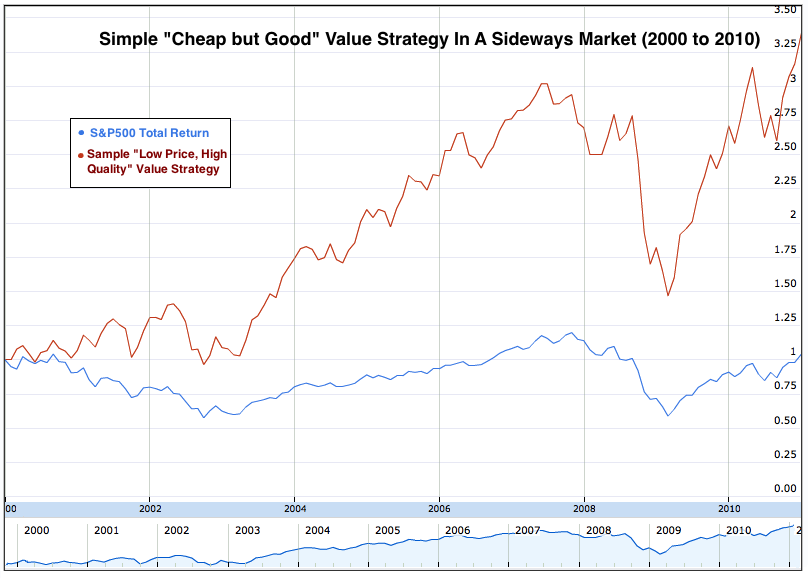
Second, this chart:

Source: Turnkey Analyst Backtester.

A simple, quantitative, “cheap but good” value strategy has delivered reasonable returns over the last decade in a flat market. I don’t think these returns are worth writing home about, but if my kids can dollar cost average into an ~11-12 percent per year in a flat market, they’ll do fine over the long run.

The other responses are outstanding. See them here.

From Michael Lewis’s Princeton University 2012 Baccalaureate Remarks:

The “Moneyball” story has practical implications. If you use better data, you can find better values; there are always market inefficiencies to exploit, and so on. But it has a broader and less practical message: don’t be deceived by life’s outcomes. Life’s outcomes, while not entirely random, have a huge amount of luck baked into them. Above all, recognize that if you have had success, you have also had luck — and with luck comes obligation. You owe a debt, and not just to your Gods. You owe a debt to the unlucky.

I have recently read Vitaliy Katsenelson‘s excellent The Little Book of Sideways Markets. Vitaliy’s thesis is that equity markets are characterised by periods of valuation expansion (“bull market”) and contraction (“bear market” or “sideways market”). I think it’s a compelling thesis, but I am well and truly in the choir. I’m open to counterarguments. Here’s the Cliff Notes version of Vitaliy’s thesis:

Sideways Markets

A sideways market is the result of earnings increasing while valuation drops. Historically, they are common (this is one of many charts Vitaliy provides in support of his thesis):

Equity markets are going sideways

Equity markets are presently experiencing an extended period of valuation contraction, manifesting as increasing earnings, falling cyclically adjusted price-to-earning ratios (“CAPE”) and a sideways market.

While the S&P500 TR is approximately flat for the period from December 1999 to the present, valuations have fallen 52 percent, from a CAPE of 44 in December 1999 to a CAPE of 20.56 presently (via Multpl).

Shiller PE Ratio Chart

20.56 is not cheap.

Despite over a decade of dropping valuations, a CAPE of 20.56 is presently still well-above long-term averages (the long-run mean is 16.43 and the long-run median is 15.84), indicating that the market is still 25 percent to 30 percent above those averages.

The market probably wont stop at the averages. CAPE has in the past typically fallen to a single-digit low following a cyclical peak

Sideways markets can continue for some time. The last time a sideways market traded on a CAPE of ~21 (1969) it took ~13 years to bottom (1982). The all-time peak US CAPE of 44.2 occurred in December 1999, all-time low US CAPE of 4.78 occurred in December 1920. The most recent CAPE low of 6.6 occurred in August 1982.

What Would Vitaliy Do? Buy and Sell

Vitaliy advocates a systematic approach, buying stocks that meet his “QVG” or “Quality, Value, Growth,” framework, and selling, rather than holding. He deals with this in some detail in the book.

The book is excellent. I highly recommend it. You can purchase a copy here.

Full Disclosure: I received from the publisher a copy of Vitaliy’s book gratis. I would have bought it if I had not.

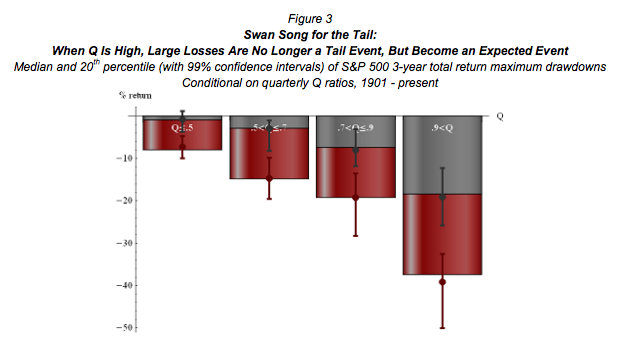
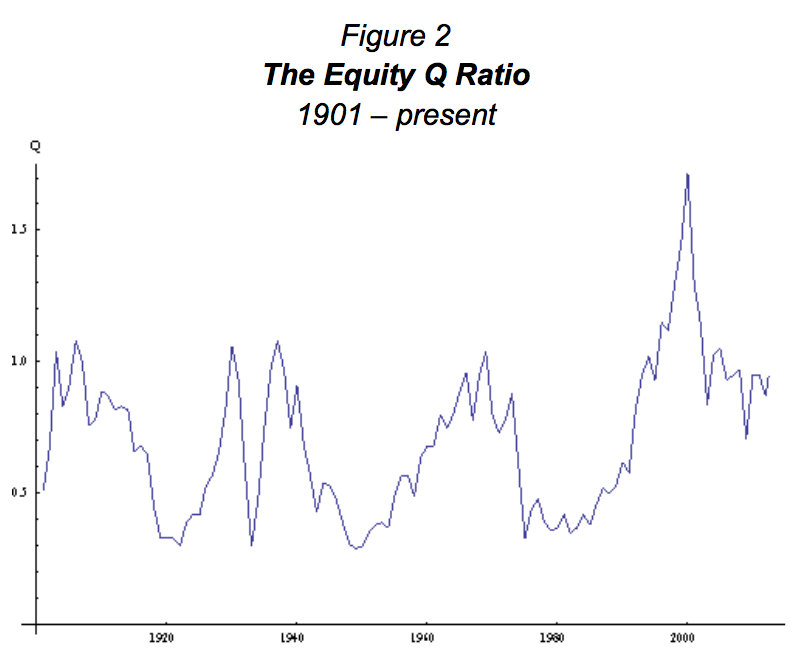
Mark Spitznagel, CIO of Universa, released in May a prescient white paper called “The Austrians and the Swan: Birds of a Different Feather” in which he discussed the theory behind the “Equity Q Ratio,” a variation of Tobin’s Q ratio, and the expected returns to the market from various levels of Equity Q Ratio.

Tobin’s Q ratio is the ratio between the market value of the stock market and against the aggregate net worth of the constituent stocks measured at replacement cost.

It can be defined to include or exclude debt. We exclude debt for ease of calculation, and refer to it in this form as “Equity Q”.

Spitznagel observes that the aggregate US stock market has suffered very few sizeable annual losses (which Spitznagel defines as “20% or more”). By definition, we can categorize such extreme stock market losses “tail events.”

However, when the Equity Q ratio is high, large losses are “no longer a tail event, but become an expected event.”

Equity Q ratios over 0.9 lead to some very ugly results. So where are we now?

Ugly.

H/T Zero Hedge.

Meb Faber’s World Beta has a great series of posts on  Graham / Shiller PEs globally as at May 24:

Meb says:

If you look at the history of country CAPEs, they tend to bottom out in single digits around 7. Bull markets can push this number up into the 40s, with the median around 18. These may be slightly skewed by most of these markets being in existence since 1970. (Note: All time lows register at 3 (Thailand and Korea) and top out near 100 (Japan).

Belgium, Netherlands, France, Spain, Russia, and Italy are all trading at CAPEs below 10. Generational buying opportunity or prelude to more pain?

The market has moved a little since Meb posted these. The S&0 500 stands this morning at 20.66, down from 21.76 on May 24. It’s still well above its long term mean of 15.48, and median of 14.45.

Yesterday I looked at John Hussman’s method for estimating the long-term returns on stocks. The long-term return on a security consists of two parts: income (from dividends or interest payments), and capital gains (from price changes). For any future stream of income, the higher the price you pay , the lower the annual rate of return you will earn. 

Hussman provides the following equation to mathematically estimate the total return on stocks over any future time horizon (annualized):

(1+g)(Original Yield/Terminal Yield)1/N – 1 + (Original + Terminal)/2

Where Original Yield is the original dividend yield (in decimal form), Terminal Yield is the dividend yield expected at the end of the holding period, N is the holding period in years, and g is the growth rate of dividends over the holding period.

Here’s my calculation. If I assume a dividend growth rate of 6 percent (about the long-run average*), the current S&P 500 dividend yield of 2.1 percent (from multpl.com), a terminal S&P 500 dividend yield of 4 percent (Hussman says that the dividend yield on stocks has historically averaged about 4 percent), the expected nominal return over ten years is 2.4 percent annually.

(1+0.06)(0.021/0.04)1/10 – 1 + (0.021 + 0.04)/2 = 0.02435

Ugly.

If I use multpl.com‘s mean and average long-term S&P 500 dividend yields of 4.46 and 4.39 percent respectively it gets uglier still, so I’m not going to bother.

Over 20 years the nominal return rises to 5.7 percent, and over 30 years 6.8 percent.

Still too ugly.

Hussman last calculated the 10-year S&P 500 total returns to be about 5.2 percent annually, and offers the following:

As a rule of thumb, a 1% market decline in a short period of time tends to increase the prospective 10-year return, not surprisingly, by about 0.1%. However, that approximation is less accurate over large movements or over extended periods of time, where growth in fundamentals and compounding effects become important.

The market is approximately flat since Hussman wrote his article on May 21, so the market decline should have had no impact. To get to Hussman’s 5.2 percent with my inputs, we have to assume a 9 percent growth rate (bullish!):

(1+0.09)(0.021/0.04)1/10 – 1 + (0.021 + 0.04)/2 = 0.05248

Or a terminal yield of 2.9 percent (still bullish):

(1+0.06)(0.021/0.0288)1/10 – 1 + (0.021 + 0.0288)/2 = 0.05194

I’ve got no idea why my calculation differs from Hussman’s. I’m all ears if anyone has any suggestions. Either way, even with outrageously bullish assumptions, 5.2 percent is not a great return. It’s about half the historical return of 10 percent. There are other methods of calculating expected returns that I’ll look at tomorrow.

* Hussman says:

Historically, earnings, dividends, revenues, book values and other stock market fundamentals have grown at a rate of 6% annually. Earnings are the most volatile of these, sometimes growing from trough-to-peak at rates approaching 20% annually, and sometimes plunging from peak-to- trough at rates approaching -20% annually. In fact, historically, earnings have been even more volatile than prices themselves. When measured from peak-to-peak or trough-to-trough however, earnings show exactly the same sturdy 6% annual growth rate that other stock market fundamentals exhibit. Over the past century, the highest growth rates over any 30-year period were 6.3% annually for dividends, and 7.8% for earnings (trough to peak).

There are a number of studies on the estimation of long-term returns to stocks. Ignoring the empirical research momentarily, the best explication of the estimation of long-term returns is by John Hussman in his article Valuations Matter. The logic is  straight forward.

According to Hussman, the long-term return on a security consists of two parts: income (from dividends or interest payments), and capital gains (from price changes). For any future stream of income, the higher the price you pay , the lower the annual rate of return you will earn:

Consider, for simplicity, a 30-year zero-coupon bond with a face value of $100. If the bond is priced at a yield-to-maturity of 10%, it will cost you $5.73 today. Over the coming 30 years, the price will advance to $100, and your annualized return will be 10%. Just what you bargained for.

But what happens in the meantime? Suppose that over the first 10 years of your holding period, interest rates decline, and the yield-to-maturity on your bond falls to 7%. With 20 years remaining to maturity, the price of the bond will be $25.84. Now here’s the crucial point. Even though the yield-to-maturity for the remaining life of the bond is just 7%, and the yield-to- maturity you bargained for when you bought the bond was only 10%, the return you have earned over the first 10 years is an impressive 16.26%!

By holding the security during a period when the yield-to-maturity is falling, you not only earn a return that is higher than the original yield to maturity, you earn a return that is dramatically higher than the future yield-to-maturity!

Now, the rest of the story. Over the remaining 20 years of the bond, you will not earn 16.26% annually, but 7% annually. If you do the math, you will find that over the entire 30 year holding period, you will have made — surprise — 10% annually. Just what you bargained for originally.

Here Hussman applies the same logic to the stock market:

For stocks, the “yield-to-maturity” comes from two components: income plus capital gain. The income component is simply the dividend yield. Assume initially that the dividend yield is held constant over time (we’ll relax this assumption in a moment). If the dividend yield (Dividend/Price) is constant, then by definition, prices must grow at exactly the same rate as dividends grow. By definition, when the dividend yield is unchanged between the date you buy stocks and the date you sell them, your total return equals the dividend yield (income) plus the growth rate of dividends (capital gain).

As a rule, a good estimate of the “yield-to-maturity” on stocks is the 6% long term growth rate plus the dividend yield. But remember, your actual return will only be equal to this value if the dividend yield stays constant over the period that you hold stocks. As we saw in our example, if the yield falls during the period you are holding stocks, your actual return will be even higher than the yield-to-maturity that you bargained for. On the other hand, if the yield on stocks rises over your holding period, your actual return will be even less than the yield-to-maturity you bargained for.

Historically, the dividend yield on stocks has averaged about 4%, and has fluctuated both above and below this 4% figure. As a result, the historical average return on stocks has typically been 6% + 4% = 10%. That’s precisely where that 10% “historical return” on stocks comes from.

Hussman provides the following equation to mathematically estimate the total return on stocks over any future time horizon (annualized):

(1+g)(Original Yield/Terminal Yield)1/N – 1 + (Original + Terminal)/2

Where Original Yield is the original dividend yield (in decimal form), Terminal Yield is the dividend yield expected at the end of the holding period, N is the holding period in years, and g is the growth rate of dividends over the holding period.

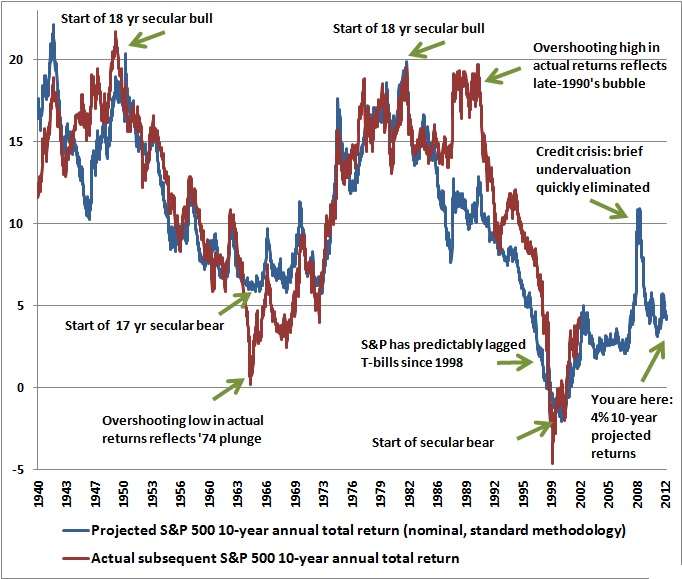
I find the logic appealing, but we should also consider how well the equation predicts the subsequent performance of the market. Here’s a chart from a recent Weekly Market Comment showing the projections for 10-year annual total returns on the S&P 500 versus actual subsequent 10-year total returns:
wmc120326a.jpg

Seems like a pretty good fit. The kicker: Hussman wrote his “Valuations Matter” article in June 1998, at which time he said of the market:

Currently, assuming dividend growth speeds up to a 6% rate and that the dividend yield is still just 1.4% in the future, the long term total return on stocks will be 7.4%. But here’s a more likely result: suppose the future dividend yield rises even a bit, even to just 2%. If that happens over the next 5 years, investors will earn a total return of zero over those 5 years. Over the next 10 years: just 4% annually. Over the next 20 years: 5.8% annually. Over the next 30 years: 6.4% annually. If the dividend yield rises to the historical average of 4% even 30 years from now, investors will have earned a total return of just 5% annually over that span. Consider that figure long and hard before trusting your retirement plans to a buy-and-hold approach in stocks.

It’s now 14 years since Hussman wrote the article. As difficult as it would been to believe it at the time, if anything, it seems at this point that Hussman was too optimistic.

Hussman’s rule of thumb seems like a sensible one:

You want to own stocks when the yield on stocks is high, or while favorable market action (interest rates, inflation, market breadth) are uniformly driving the yield downward. Beware when neither is true.

Tomorrow, I’ll show some estimates for the market as it stands now.

I’ve been closely following on Greenbackd the Kinnaras stoush with the board of Media General Inc (NYSE:MEG) over the last few months.

Kinnaras has been pushing the Board to “take advantage of the robust M&A market for both newspaper and broadcast television and to sell all operating units of MEG in order to retire existing corporate and pension debt and achieve a share price shareholders have rarely seen in recent years.”

It looks like Kinnaras has succeeded, with the board announcing recently that it had reached an agreement to sell its newspaper division, excluding the Tampa Tribune, to Warren Buffett’s BH Media Group for $142 million. In addition, Buffett would also provide MEG with a new Term Loan and revolver in exchange for roughly 20 percent of additional equity.

MEG is a provider of local news in small and mid-size communities throughout the Southeastern United States. It owns three metropolitan and 20 community newspapers and 18 network-affiliated broadcast television stations Virginia/Tennessee, Florida, Mid-South, North Carolina, and Ohio/Rhode Island.

Kinnaras’s Managing Member Amit Chokshi has a new post analyzing the sale and the valuation of the remaining rump of $MEG. Chokshi sees the valuation as follows (against a prevailing share price of $3.50):

A 6.8x multiple would imply a valuation of about $8.50/share when using my estimates for how MEG’s capitalization will look post the BH Media transaction and accounting for BH Media’s warrants. By year-end, it is possible that another $10-20MM in debt is reduced which would bring share value up close to $1. The reason the jump is so significant is because each dollar of cash flow erases some very expensive debt. In addition, pure-play broadcasters are valued from 6-9x EV/EBITDA and one could argue that MEG deserves a valuation closer towards the mid point or higher for its peers when factoring the disposal of newspapers and accounting for the high quality locations of its key stations.

Lastly, as I’ve repeated in each prior post, another potential value creation event would be selling off the entire company. BH Media will now occupy a Board seat and I don’t expect the blind subservience other Board members have. Management has demonstrated a clear lack of competence in every facet of managing MEG. The only thing they have done thus far is get lucky in terms of finding a buyer for their assets and providing them financing. As an owner of MEG, BH Media will get an up close look at the type of management this team brings and I suspect will compare the value management adds or detracts. To any sane observer, management is just pitiful and MEG’s value suffers for it.

Read the full post here.

No position.

Yesterday I covered a 2006 talk, “Journey Into the Whirlwind: Graham-and-Doddsville Revisited,” by Louis Lowenstein*, then a professor at the Columbia Law School, in which he compared the performance of a group of “true-blue, walk-the-walk value investors” and “a group of large cap growth funds”.

Lowenstein based the talk on an earlier paper he had written “Searching for Rational Investors In a Perfect Storm:”

In October, 1991, there occurred off the coast of Massachusetts a “perfect storm,” a tempest created by a rare coincidence of events. In the late ‘90s, there was another perfect storm, an also rare coincidence of forces which caused huge waves in our financial markets, as the NASDAQ index soared, collapsed, and bounced part way back.

What had happened to the so-called “rational” investors, the smart money, whom economists have for decades said would keep market prices in close touch with the underlying values? Despite the hundreds of papers on markets and their efficiency, it is a remarkable fact that no scholar, not one, has looked to see who are these rational, i.e., value, investors, how they operate, and with what results.

In the paper, Lowenstein decided to see how a group of ten value funds, selected by a knowledgeable manager, performed in the turbulent boom–crash–rebound years of 1999-2003. Did they suffer the permanent loss of capital of so many who invested in the telecom, media and tech stocks? How did their overall performance for the five years compare with the returns on the S&P 500?

To bring a group of rational/value investors out of the closet, I asked Bob Goldfarb, the highly regarded chief executive of the Sequoia Fund, to furnish the names of ten “true-blue” value funds, those which, as they say on the Street, don’t just talk the talk but walk the walk. (Had I prepared the list, I would have included Sequoia, but Goldfarb’s ten is Goldfarb’s ten.) They are all mutual funds, except for Source Capital, a closed-end fund which invests much like a mutual fund. The funds are as follows:

  • Clipper Fund
  • FPA Capital
  • First Eagle Global
  • Mutual Beacon
  • Oak Value
  • Oakmark Select
  • Longleaf Partners
  • Source Capital
  • Legg Mason Value
  • Tweedy Browne American Value

How did they perform?

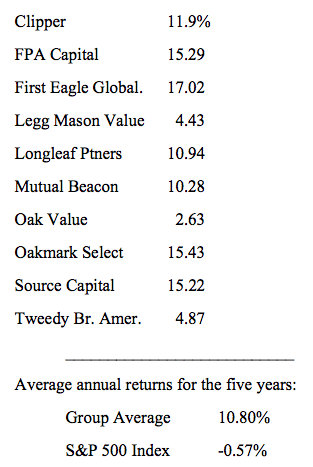
For most managers, mimicking the index, it was difficult not to own Enron, Oracle and the like, but the ten value funds had stayed far away. Instead, they owned highly selective portfolios, mostly 34 stocks or less, vs. the 160 in the average equity fund. Reflecting their consistent and disciplined approach, they turned their portfolios at one-sixth the rate of the average fund. Bottom line: every one of the ten outperformed the index over the five year period, and as a group they did so by an average of 11% per year, the financial equivalent of back-to-back no-hitters.

The five-year 1999-2003 average annual returns were as follows:

Here’s a link to the article.

The Superinvestors of Graham-and-Doddsville is a well-known article (see the original Hermes article here.pdf) by Warren Buffett defending value investing against the efficient market hypothesis. The article is an edited transcript of a talk Buffett gave at Columbia University in 1984 commemorating the fiftieth anniversary of Security Analysis, written by Benjamin Graham and David L. Dodd.

In a 2006 talk, “Journey Into the Whirlwind: Graham-and-Doddsville Revisited,” Louis Lowenstein*, then a professor at the Columbia Law School, compared the performance of a group of “true-blue, walk-the-walk value investors” (the “Goldfarb Ten”) and “a group of large cap growth funds” (the “Group of Fifteen”).

Here are Lowenstein’s findings:

For the five years ended this past August 31, the Group of Fifteen experienced on average negative returns of 8.89% per year, vs. a negative 2.71% for the S&P 500.4 The group of ten value funds I had studied in the “Searching for Rational Investors” article had been suggested by Bob Goldfarb of the Sequoia Fund.5 Over those same five years, the Goldfarb Ten enjoyed positive average annual returns of 9.83%. This audience is no doubt quick with numbers, but let me help. Those fifteen large growth funds underperformed the Goldfarb Ten during those five years by an average of over 18 percentage points per year. Hey, pretty soon you have real money. Only one of the fifteen had even modestly positive returns. Now if you go back ten years, a period that includes the bubble, the Group of Fifteen did better, averaging a positive 8.13% per year.Even for that ten year period, however, they underperformed the value group, on average, by more than 5% per year.6 With a good tailwind, those large cap funds were not great – underperforming the index by almost 2% per year – and in stormy weather their boats leaked badly.

Lowenstein takes a close look at one of the Group of Fifteen (a growth fund):

The first was the Massachusetts Investors Growth Stock Fund, chosen because of its long history. Founded in 1932, as the Massachusetts Investors Second Fund, it was, like its older sibling, Massachusetts Investors Trust, truly a mutual fund, in the sense that it was managed internally, supplemented by an advisory board of six prominent Boston businessmen.7 In 1969, when management was shifted to an external company, now known as MFS Investment Management, the total expense ratio was a modest 0.32%.

I am confident that the founders of the Massachusetts Investors Trust would no longer recognize their second fund, which has become a caricature of the “do something” culture. The expense ratio, though still below its peer group, has tripled. But it’s the turbulent pace of trading that would have puzzled and distressed them. At year-end 1999, having turned the portfolio over 174%, the manager said they had moved away from “stable growth companies” such as supermarket and financial companies, and into tech and leisure stocks, singling out in the year- end report Cisco and Sun Microsystems – each selling at the time at about 100 X earnings – for their “reasonable stock valuation.” The following year, while citing a bottom-up, “value sensitive approach,” the fund’s turnover soared to 261%. And in 2001, with the fund continuing to remark on its “fundamental . . .bottom-up investment process,” turnover reached the stratospheric level of 305%. It is difficult to conceive how, even in 2003, well after the market as a whole had stabilized, the managers of this $10 billion portfolio had sold $28 billion of stock and then reinvested that $28 billion in other stocks.

For the five years ended in 2003, turnover in the fund averaged 250%. All that senseless trading took a toll. For the five years ended this past August, average annual returns were a negative 9-1/2%. Over the past ten years, which included the glory days of the New Economy, the fund did better, almost matching the index, though still trailing our value funds by 4% a year. Net assets which had been a modest $1.9 billion at Don Phillips’ kickoff date in 1997, and had risen to $17 billion in 2000, are now about $8 billion.

If you’re feeling some sympathy for the passengers in this financial vehicle, hold on. Investors – and I’m using the term loosely – in the Mass. Inv. Growth Stock Fund were for several years running spinning their holdings in and out of the fund at rates approximating the total assets of the fund. In 2001, for example, investors cashed out of $17-1/2 billion in Class A shares, and bought $16 billion in new shares, leaving the fund at year end with net assets of about $14 billion. Having attracted, not investors, but speculators trying to catch the next new thing, management got the shareholders they deserved.

And the value investors?

Having updated my data through August of this year, I am happy to report that the Goldfarb Ten still look true blue – actually better than at year-end 2003. The portfolio turnover rates have dropped on average to 16% – translation, an average holding period of six years. Honey, what did you do today? Nothing, dear.The average cash holding is 14% of the portfolio, and five of the funds are closed to new investors.f Currently, however, two of the still open funds, Mutual Beacon and Clipper, are losing their managers. The company managing the Clipper Fund has been sold twice over and Jim Gipson and two colleagues recently announced they’re moving on. At Mutual Beacon, which is part of the Franklin Templeton family, David Winters has left to create a mutual fund, ah yes, the Wintergreen Fund. It will be interesting to see whether Mutual Beacon and Clipper will maintain their discipline.

Speaking of discipline, you may remember that after Buffett published “The Superinvestors,” someone calculated that while they were indeed superinvestors, on average they had trailed the market one year in three.20 Tom Russo, of the Semper Vic Partners fund, took a similar look at the Goldfarb Ten and found, for example, that four of them had each underperformed the S&P 500 for four consecutive years, 1996-1999, and in some cases by huge amounts. For the full ten years, of course, that underperformance was sharply reversed, and then some. Value investing thus requires not just patient managers but also patient investors, those with the temperament as well as intelligence to feel comfortable even when sorely out of step with the crowd. If you’re fretting that the CBOE Market Volatility Index may be signaling fear this week, value investing is not for you.

* Louis was father to Roger Lowenstein of Buffett: The Making of an American Capitalist.