Feeds:
Posts
Comments

Archive for the ‘Strategy’ Category

Embedded below is my Fall 2012 strategy paper, “Hunting Endangered Species: Investing in the Market for Corporate Control.

From the executive summary:

The market for corporate control acts to catalyze the stock prices of underperforming and undervalued corporations. An opportunity exists to front run participants in the market for corporate control—strategic acquirers, private equity firms, and activist hedge funds—and capture the control premium paid for acquired corporations. Eyquem Fund LP systematically targets stocks at the largest discount from their full change‐of‐control value with the highest probability of undergoing a near‐term catalytic change‐of‐control event. This document analyzes in detail the factors driving returns in the market for corporate control and the immense size of the opportunity.


Hunting Endangered Species: Investing in the Market for Corporate Control Fall 2012 Strategy Paper

This is the investment strategy I apply in the Eyquem Fund. It is obviously son-of-Greenbackd (deep value, contrarian and activist follow-on) and, although it deviates in several crucial aspects, it is influenced by the 1999 Piper Jaffray research report series, Wall Street’s Endangered Species.

For more of my research, see my white paper “Simple But Not Easy: The Case For Quantitative Value” and the accompanying presentation to the UC Davis MBA value investing class.

As always, I welcome any comments, criticisms, or questions.

Read Full Post »

Sponsored Content

More than 20 of the world’s most successful investors will come together on October 9-10* to share their insights and ideas online at the 2012 European Investing Summit 2012. Speakers include investors Charles de Vaulx (International Value Advisers), Jean-Marie Eveillard (First Eagle), Francisco Garcia Parames and Álvaro Guzmán de Lázaro Mateos (Bestinver), Howard Marks (Oaktree Capital Management), Tom Russo (Gardner, Russo & Gardner), Guy Spier (Aquamarine Capital), Amit Wadhwaney (Third Avenue Funds), and many more.

*You’ll enjoy two weeks of access to all online sessions, so if you’re busy on October 9-10, no problem.

REGISTER TODAY and SAVE 40%. Hurry, this discount today.

Read Full Post »

A new Journal of Finance paper examines whether improvements in a company’s internal corporate governance create value for shareholders. In The Vote is Cast: The Effect of Corporate Governance on Shareholder Value Vicente Cuñat, Mireia Gine, and Maria Guadalupe analyze the market reaction to governance proposals that pass or fail by a small margin of votes in annual meetings to identify the  impact of shareholder sponsored changes to governance rules on shareholder values and management behavior. Cuñat et al find that passing a proposal leads to significant positive abnormal returns:

Adopting one governance proposal increases shareholder value by 2.8%. The market reaction is larger in firms with more antitakeover provisions, higher institutional ownership, stronger investor activism, and for proposals sponsored by institutions. In addition, we find that acquisitions and capital expenditures decline and long-term performance improves.

The authors also conclude that, besides establishing how much shareholder value is generated by increasing shareholder rights and improving corporate governance inside firms, shareholder activism can create significant value:

Improving democracy inside firms, so that shareholder proposals that fall short of the majority threshold pass, would be value-increasing. We are able to precisely quantify that value.

We find that institutional activists’ proposals have higher effects, with an abnormal return of 2.1% on the day of the vote and a further 2.2% over the following six days. For individual proponents, the cumulative effect after one week is just 1.1%, and it is not statistically different from zero.

Read the full paper here: The Vote is Cast: The Effect of Corporate Governance on Shareholder Value (February 17, 2010 version on SSRN)

Read Full Post »

Amit Wadhwaney, Founding Manager of the Third Avenue International Value Fund, delivers a tour de force on global investing and discusses the following investment ideas, among others: AntarChile, Daiwa Securities, Handelsbanken, Mitsui Fudosan, Otsuka, Parmalat, Titan Cement, and Viterra:

Wadhwaney will speak at the upcoming European Investing Summit, the largest fully online value investing conference worldwide. For a very limited time, you can buy a ticket for 50% off here.

Read the 60-page transcript of the interview (.pdf).

Read Full Post »

Barron’s has a great 2010 article, Backstage Power, on activist Alexander Roepers’s investment approach:

By the time he was 25, the Dutch polyglot—French and German in addition to English and his native language—was already elbow deep in such deals as the head of corporate development in the U.S. for another company. In four years, “I did an incredible number of deals,” including the due diligence and valuation, as well as the structuring or restructuring of companies. That process led to his investment style at Atlantic, which considers industries “that you and I can understand and we can explain to our moms and dads.”

That typically means packaging, aerospace, pumps and valves, industrial materials, specialty chemicals, information-technology services and food companies.

Roepers looks for stocks between $1 billion and $20 billion in market cap, with investment-grade balance sheets and low interest expense. He also seeks profitable companies with 10%-plus free-cash-flow yields, high barriers to entry and low insider ownership. His purchases sport enterprise value (market cap plus net debt) multiples of roughly five to six times future earnings before interest, taxes, depreciation and amortization, or Ebitda. The firm is especially interested in stocks where there’s potential for an earnings turnaround or corporate restructuring.

Roeper_Profile

And his returns?

His flagship hedge vehicles, AJR fund and Cambrian U.S. fund, both still open to new investment and unleveraged, have easily beaten the Standard and Poor’s 500 index since inception. AJR has posted a 14% annualized total return from its start in 1993, compared with about 8% for the S&P 500. Long-only Cambrian U.S. has returned 21% a year since its 1992 beginning, versus the S&P 500’s 8.4% annualized gain in that time.

Reopers is speaking at this year’s New York Value Investing Congress on October 1st and 2nd, along with Bill Ackman, David Einhorn or Jeffrey W. Ubben of ValueAct (each of whom alone are worth the price of admission).

Discount: Register by September 7, 2012 and you’ll pay $3,295.That’s a total savings $1,400 from the $4,695 others will pay later to attend!  Click here to save $1,400 off the usual price of admission by clicking here and using discount code: N11GB2.

Here’s the list of managers presenting:

  • Bill AckmanPershing Square
  • David Einhorn, Greenlight Capital
  • Jeffrey W. Ubben, ValueAct Capital
  • Alexander Roepers, Atlantic Investment Management
  • Guy GottfriedRational Investment Group
  • Bob Robotti, Robotti & Company Advisors
  • Lloyd Khaner, Khaner Capital
  • Mick McGuire, Marcato Capital Management
  • John Mauldin, Millennium Wave Advisors
  • Barry Rosenstein, JANA Partners
  • Kian Ghazi, Hawkshaw Capital Management
  • Glenn TongueT2 Partners
  • Whitney TilsonT2 Partners

The discount for Greenbackd readers expires in seven days, so take advantage now. Click here to receive the discount.

Read Full Post »

On Monday I presented an expanded version of my white paper “Simple But Not Easy: The Case For Quantitative Value” to the UC Davis MBA value investing class.

Click the link to be taken to the UC Davis video:

Presentation to UC Davis Value Investing Class

A special thank you to the instructors Jacob Taylor, and Lonnie Rush, and UCD value investing class. Go Aggies!

Read Full Post »

There are two great new papers on the global “predictiveness” of the Graham / Shiller Cyclically Adjusted Price Earnings (CAPE) ratio. The first, Value Matters: Predictability of Stock Index Returns, by Natascia Angelini, Giacomo Bormetti, Stefano Marmi, and Franco Nardini examines the ability of the CAPE to predict long-run stock market performance over several different periods in developed markets like the U.S., Belgium, France, Germany, Japan, the Netherlands, Norway, Sweden and Switzerland. From the abstract:

The aim of this paper is twofold: to provide a theoretical framework and to give further empirical support to Shiller’s test of the appropriateness of prices in the stock market based on the Cyclically Adjusted Price Earnings (CAPE) ratio. We devote the first part of the paper to the empirical analysis and we show that the CAPE is a powerful predictor of future long run performances of the market not only for the U.S. but also for countries such us Belgium, France, Germany, Japan, the Netherlands, Norway, Sweden and Switzerland. We show four relevant empirical facts: i) the striking ability of the logarithmic averaged earning over price ratio to predict returns of the index, with an R squared which increases with the time horizon, ii) how this evidence increases switching from returns to gross returns, iii) moving over different time horizons, the regression coefficients are constant in a statistically robust way, and iv) the poorness of the prediction when the precursor is adjusted with long term interest rate. In the second part we provide a theoretical justification of the empirical observations. Indeed we propose a simple model of the price dynamics in which the return growth depends on three components: a) a momentum component, naturally justified in terms of agents’ belief that expected returns are higher in bullish markets than in bearish ones; b) a fundamental component proportional to the log earnings over price ratio at time zero. The initial value of the ratio determines the reference growth level, from which the actual stock price may deviate as an effect of random external disturbances, and c) a driving component ensuring the diffusive behaviour of stock prices. Under these assumptions, we are able to prove that, if we consider a sufficiently large number of periods, the expected rate of return and the expected gross return are linear in the initial time value of the log earnings over price ratio, and their variance goes to zero with rate of convergence equal to minus one. Ultimately this means that, in our model, the stock prices dynamics may generate bubbles and crashes in the short and medium run, whereas for future long-term returns the valuation ratio remains a good predictor.

Figure 1 from the paper (extracted below) shows 2 year to 16 year regressions for the period 1871-2010 (Points are organized in chronological order according to the color scale ranging from dark blue to red passing through light blue, green, yellow, and orange; labels in the top left panel refer to points corresponding to the first month of the specified year.):

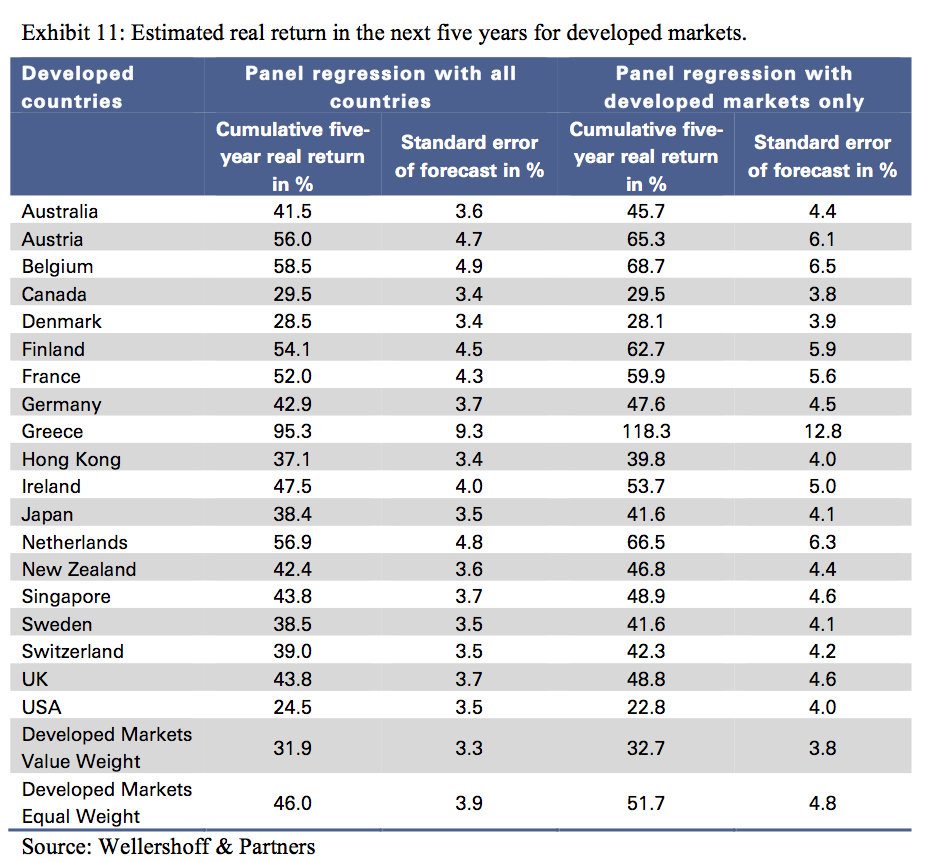
The second paper, Does the Shiller-PE Work in Emerging Markets? by Joachim Klement examines the reliability of CAPE as a forecasting and valuation tool for 35 countries including emerging markets. Klement finds that CAPE is a reliable long-term valuation indicator for developed and emerging markets. Klement uses the indicator to predict real returns on local equity markets over the next five to ten years (shown in Exhibits 11 and 12 extracted below):

Developed Markets
Emerging Markets

Klement makes some interesting observations about developed markets:

Looking at the forecasts for different markets the following observations stand out:

For all developed equity markets the expected real return in local currencies is positive and the probability of negative real returns after ten years is generally low.

The market with the lowest expected future return is the United States which together with Canada and Denmark promises real returns that are quite a bit lower than developed markets overall.

• Because of the low expected returns for US stock markets, an equal weighted portfolio of developed market equities is expected to perform significantly better than a typical value weighted portfolio. The current debate about optimal sector and country weights in a stock market index is still ongoing and there are many different rivaling approaches like equal weighting, fundamental weighting, GDP-weighting or equal risk contribution or minimum variance. The jury is still out which one of these approaches is the best for long-term investors, but our calculations indicate that an equal weighted portfolio should outperform a value weighted one.

• Looking at individual markets again, we see that the most attractive markets are generally the crisis-ridden European equity markets and in particular Greece which currently has such low valuations that real returns over the next five years could come close to 100%. But more stable markets like Finland, France or Germany also offer attractive long-term return possibilities.

And Klement on the emerging markets:

While the forecasts for emerging markets generally have a somewhat higher forecast error associated with them we can still observe some general trends:

Emerging market equities seem to be poised for significantly lower real returns than developed equities at the moment.

• Particularly smaller emerging countries like Peru, Colombia or Indonesia offer less attractive returns at the moment than more developed neighbors like Brazil or Thailand.

Some currently fashionable investment countries like China or India offer only average return prospects.

• From a regional perspective it seems that Eastern European countries together with Turkey and South Africa offer the highest future equity markets while Asia overall should be only average and in Latin America only Brazil seems a worthwhile investment at the moment.

H/T World Beta

Read Full Post »

The Value Investing Congress has announced the launch of a top idea contest called the Value Investing Challenge. The idea is to give “lesser-known (but equally-brilliant) investors” the opportunity to present at the next Value Investing Congress  taking place October 1 & 2, 2012 in NYC alongside world-renowned investors including David Einhorn, and Bill Ackman.

“The goal of the Value Investing Congress has always been to bring the best and brightest on stage in an environment where differentiated thinking can thrive,” said Whitney Tilson, Co-Founder and Chairman of the Value Investing Congress. “This new contest will help ensure that Congress attendees are getting the chance to capitalize on a truly unique perspective and hear from one investor whose idea rose to the top.”

To be eligible, contest participants must be current members of the SumZero community and employed at a hedge fund, mutual fund or private equity fund.

Here’s the press release:

July 11, 2012 12:30 ET

Value Investing Congress and SumZero Announce Partnership for the 1st Value Investing Challenge

Challenge Winner Will Have the Opportunity to Present His/Her Best Idea at the 8th Annual New York Value Investing Congress

NEW YORK, NY–(Marketwire – Jul 11, 2012) – The Value Investing Congress and SumZero, Inc. yesterday announced the launch of a top idea contest, the Value Investing Challenge. The ultimate Challenge goal is to encourage high-quality investment research, unearth top investing talent, and level the playing field so that lesser-known (but equally-brilliant) investors have the opportunity to present in front of the same high-profile Value Investing Congress audience as legendary investors such as David Einhorn and Bill Ackman.

Contestants are asked to contribute one investment write-up covering a company of at least $300 million in market capitalization. Submissions will be evaluated by a team of well-known value investors with several decades of professional experience between them.

The winner of the Value Investing Challenge will get the opportunity to present his/her idea at the next Value Investing Congress taking place October 1 & 2, 2012 in NYC alongside world-renowned investors including David Einhorn, Barry Rosenstein, and Alex Roepers, to name a few.

“The goal of the Value Investing Congress has always been to bring the best and brightest on stage in an environment where differentiated thinking can thrive,” said Whitney Tilson, Co-Founder and Chairman of the Value Investing Congress. “This new contest will help ensure that Congress attendees are getting the chance to capitalize on a truly unique perspective and hear from one investor whose idea rose to the top.”

“One of the reasons we created this contest is to identify a new breed of great investors who otherwise might never get the chance to present their thinking on such a grand platform,” said Divya Narendra, CEO/Co-Founder of SumZero, Inc. “There are a huge number of incredibly-talented investors who do not get heard on a large scale because they don’t manage a lot of assets or because they haven’t made a blockbuster trade. This contest is designed to rectify that. It’s about creating opportunities, identifying talent, and adding to the conversation.”

Eligible contest participants must be current members of the SumZero community and must be currently employed at a hedge fund, mutual fund or private equity fund with limited exception. More information on eligibility and how to enter the contest is available at the official site of the contest: www.valueinvestingchallenge.com.

The contest officially kicks off on July 10, 2012 and will conclude on August 17, 2012. The winner will be announced on Tuesday, September 18, 2012.

More information on eligibility and how to enter the contest is available at valueinvestingchallenge.com.

Read Full Post »

Greenbackd has been quiet over the last few days while I finished “Simple But Not Easy,” my latest white paper for Eyquem (embedded below). If you want to receive similar future missives, shoot me an email at greenbackd at gmail dot com. Thoughts, criticisms, and questions are all welcome too.

Read Full Post »

Greenbackd was honored to be one of the bloggers asked to participate in Abnormal Returns “Finance Blogger Wisdom” series. Tadas asked a range of questions and will publish them on Abnormal Returns over the course of the week. The first question is, “If you had a son or daughter just beginning to invest, what would you tell them to do to best prepare themselves for a lifetime of good investing?

I answered as follows:

Inspired by Michael Pollan’s edict for healthy eating (“Eat food. Not too much. Mostly plants.”), for good investing I’d propose “Buy value. Diversify globally. Stay invested.”

I feel that I should justify the answer a little in the context of the “What to do in sideways markets” post about Vitaliy Katsenelson‘s excellent book “The Little Book of Sideways Markets“. To recap, Vitaliy’s thesis is that equity markets are characterized by periods of valuation expansion (“bull market”) and contraction (“bear market” or “sideways market”). A sideways market is the result of earnings increasing while valuation drops. Historically, they are common:

We’ve clearly been in a sideways market for all of the 2000s, and yet the CAPE presently stands at 21.22. CAPE has in the past typically fallen to a single-digit low following a cyclical peak. The last time a sideways market traded on a CAPE of ~21 (1969) it took ~13 years to bottom (1982). The all-time peak US CAPE of 44.2 occurred in December 1999, all-time low US CAPE of 4.78 occurred in December 1920. The most recent CAPE low of 6.6 occurred in August 1982. I’m fully prepared for another 13 years of sideways market (although, to be fair, I don’t really care what the market does).

If you subscribe to Vitaliy’s thesis – as I do – that the sideways market will persist until we reach a single-digit CAPE, then it might seem odd to suggest staying fully invested. In my defence, I make the following two points:

First, I am assuming a relatively unsophisticated beginner investor.

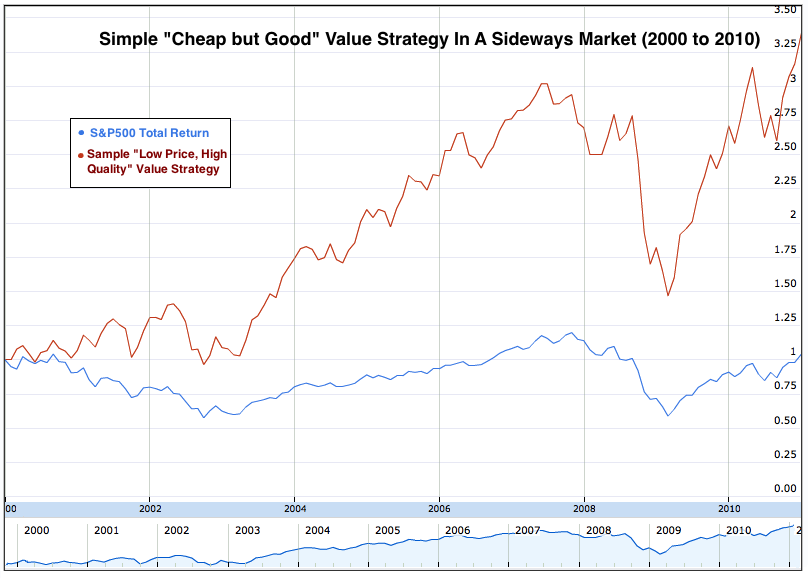
Second, this chart:

Source: Turnkey Analyst Backtester.

A simple, quantitative, “cheap but good” value strategy has delivered reasonable returns over the last decade in a flat market. I don’t think these returns are worth writing home about, but if my kids can dollar cost average into an ~11-12 percent per year in a flat market, they’ll do fine over the long run.

The other responses are outstanding. See them here.

Read Full Post »

« Newer Posts - Older Posts »