Feeds:
Posts
Comments

Archive for the ‘Strategy’ Category

Wes sent through this outstanding more-than-30-year-old speech, Trying Too Hard (.pdf), which foreshadows many of the ideas we discuss in Quantitative Value, so much so that I feel that I should point out that neither Wes nor I had read it before we wrote the book. The speaker, Dean Williams, named the speech for this story:

I had just completed what I thought was some fancy footwork involving buying and selling a long list of stocks. The oldest member of Morgan’s trust committee looked down the list and said, “Do you think you might be trying too hard?” A the time I thought, “Who ever heard of trying too hard?” Well, over the years I’ve changed my mind about that. Tonight I’m going to ask you to entertain some ideas shoe theme is this: We probably are trying too hard at what we do. More than that, no matter how hard we try, we may not be as important to the results as we’d like to think we are.

The speech covers the following themes, among others:

  • Prediction

…[M]ost of us spend a lot of out time doing something that human beings just don’t do very well. Predicting things.

  • Forecasting, information, and accuracy

Confidence in a forecast rises with the amount of information that goes into it. But the accuracy of the forecast stays the same. 

  • Expertise and forecasting

And when it comes to forecasting – as opposed to doing something – a lot of expertise is no better than a little expertise. And may be even worse.

  • The importance of mean reversion

If there is a reliable and helpful principle at works in our markets, my choice would be the ones the statisticians call “regression to the mean”. The tendency toward average profitability is a fundamental, if not the fundamental principle of competitive markets.

It can be a powerful investment tool. It can, almost by itself, select cheap portfolios and avoid expensive ones.

  • Simplicity

Simple approaches. Albert Einstein said that “… most of the fundamental ideas of science are essentially simple and may, as a rule, be expressed in a language comprehensible to everyone“.

  • Consistency

Look at the best performing funds for the past ten years or more. Templeton, Twentieth Century Growth, Oppenheimer Special, and others. What did they have in common?

It was that whatever their investment plans were, they had the discipline and good sense to carry them out consistently.

  • And finally, value

Spend your time measuring value instead of generating information. Don’t forecast. Buy what’s cheap today.

Read Trying Too Hard (.pdf). You won’t regret it.

h/t/ The Turnkey Analyst

Read Full Post »

In How to Beat The Little Book That Beats The Market: Redux I showed how in Quantitative Value we tested Joel Greenblatt’s Magic Formula outlined in The Little Book That (Still) Beats the Market). We found that Greenblatt’s Magic Formula has consistently outperformed the market, and with lower relative risk than the market, but wondered if we could improve on it.

We created a generic, academic alternative to the Magic Formula that we call “Quality and Price.” Quality and Price is the academic alternative to the Magic Formula because it draws its inspiration from academic research papers. We found the idea for the quality metric in an academic paper by Robert Novy-Marx called The Other Side of Value: Good Growth and the Gross Profitability Premium. The price ratio is drawn from the early research into value investment by Eugene Fama and Ken French. The Quality and Price strategy, like the Magic Formula, seeks to differentiate between stocks on the basis of … wait for it … quality and price. The difference, however, is that Quality and Price uses academically based measures for price and quality that seek to improve on the Magic Formula’s factors, which might provide better performance.

The Magic Formula uses Greenblatt’s version of return on invested capital (ROIC) as a proxy for a stock’s quality. The higher the ROIC, the higher the stock’s quality and the higher the ranking received by the stock. Quality and Price substitutes for ROIC a quality measure we’ll call gross profitability to total assets (GPA). GPA is defined as follows:

GPA = (Revenue − Cost of Goods Sold) / Total Assets

In Quality and Price, the higher a stock’s GPA, the higher the quality of the stock. The rationale for using gross profitability, rather than any other measure of profitability like earnings or EBIT, is simple. Gross profitability is the “cleanest” measure of true economic profitability. According to Novy-Marx:

The farther down the income statement one goes, the more polluted profi tability measures become, and the less related they are to true economic profi tability. For example, a firm that has both lower production costs and higher sales than its competitors is unambiguously more profitable. Even so, it can easily have lower earnings than its competitors. If the firm is quickly increasing its sales though aggressive advertising, or commissions to its sales force, these actions can, even if optimal, reduce its bottom line income below that of its less profitable competitors. Similarly, if the firm spends on research and development to further increase its production advantage, or invests in organizational capital that will help it maintain its competitive advantage, these actions result in lower current earnings. Moreover, capital expenditures that directly increase the scale of the firm’s operations further reduce its free cash flows relative to its competitors. These facts suggest constructing the empirical proxy for productivity using gross profits.

The Magic Formula uses EBIT/TEV as its price measure to rank stocks. For Quality and Price, we substitute the classic measure in finance literature – book value-to-market capitalization (BM):

BM = Book Value / Market Price

 We use BM rather than the more familiar price-to-book value or (P/B) notation because the academic convention is to describe it as BM, and it makes it more directly comparable with the Magic Formula’s EBIT/TEV. The rationale for BM capitalization is straightforward. Eugene Fama and Ken French consider BM capitalization a superior metric because it varies less from period to period than other measures based on income:

We always emphasize that different price ratios are just different ways to scale a stock’s price with a fundamental, to extract the information in the cross-section of stock prices about expected returns. One fundamental (book value, earnings, or cashflow) is pretty much as good as another for this job, and the average return spreads produced by different ratios are similar to and, in statistical terms, indistinguishable from one another. We like [book-to-market capitalization] because the book value in the numerator is more stable over time than earnings or cashflow, which is important for keeping turnover down in a value portfolio.

Next I’ll compare show the results of our examination of Quality and Price strategy to the Magic Formula. If you can’t wait, you can always pick up a copy of Quantitative Value.

Read Full Post »

Robert Novy-Marx, whose The Other Side of Value paper we quoted from extensively in Quantitative Value, has produced another ripping paper called The Quality Dimension of Value Investing (.pdf). Novy-Marx argues that  value investment strategies that seek high quality stocks are “nearly as profitable as traditional value strategies based on price signals alone.”

Accounting for both dimensions by trading on combined quality and price signals yields dramatic performance improvements over traditional value strategies. Accounting for quality also yields significant performance improvements for investors trading momentum as well as value.

Novy-Marx’s The Other Side of Value paper showed that a simple quality metric, gross profits-to-assets, has roughly as much power predicting the relative performance of different stocks as tried-and-true value measures like book-to-price.

Buying profitable firms and selling unprofitable firms, where profitability is measured by the difference between a firm’s total revenues and the costs of the goods or services it sells, yields a significant gross profitability premium.

Most intriguingly, Novy-Marx finds that “the signal in gross profits-to-assets is negatively correlated with that in valuation ratios.”

High quality firms tend to trade at premium prices, so value strategies that trade on quality signals (i.e., quality strategies) hold very different stocks than value strategies that trade on price signals. Quality strategies tilt towards what would traditionally be considered growth stocks. This makes quality strategies particularly attractive to traditional value investors, because quality strategies, in addition to delivering significant returns, provide a hedge to value exposures.

Novy-Marx argues that investors can “directly combine the quality and value signals and, in line with Graham’s basic vision, only buy high quality stocks at bargain prices. By trading on a single joint profitability and value signal, an investor can effectively capture the entirety of both premiums.

Performance of Quality, Value and Joint Strategies

(Click to enlarge).

Novy-Marx 2.1

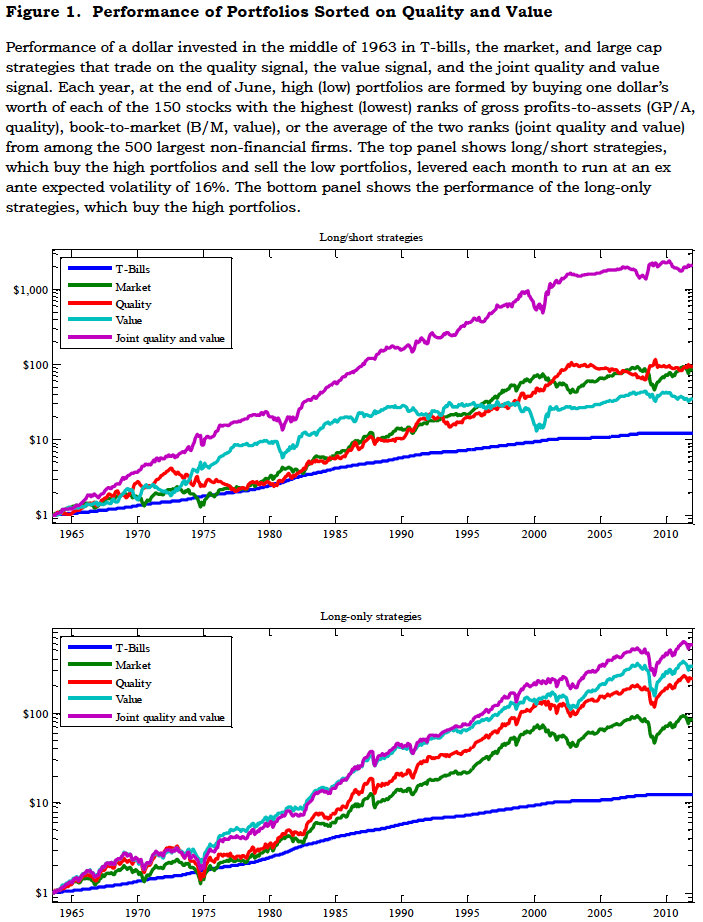
Figure 1 shows the performance of a dollar invested in mid-1963 in T-bills, the market, and strategies that trade on the quality signal, the value signal, and the joint quality and value signal. The top panel shows long/short strategies, which are levered each month to run at market volatility (i.e., an expected ex ante volatility of 16%, with leverage based on the observed volatility of the unlevered strategy over the preceding 60 months). By the end of 2011 a dollar invested in T-bills in 1963 would have grown to $12.31. A dollar invested in the market would have grown to $84.77. A dollar invested in the quality and value strategies would have grown to $94.04 and $35.12, respectively. A dollar invested in the strategy that traded on the joint quality and value signal would have grown to more than $2,131.

The bottom panel shows the performance of the long-only strategies. While a dollar invested in the market would have grown to more than $80, a dollar invested in profitable large cap stocks would have grown to $241, a dollar invested in cheap large cap stocks would have grown to $332, and a dollar invested in cheap, profitable large cap stocks would have grown to $572.

Drawdowns to Quality, Value, and Joint strategies

(Click to enlarge).

Novy Marx 2.2

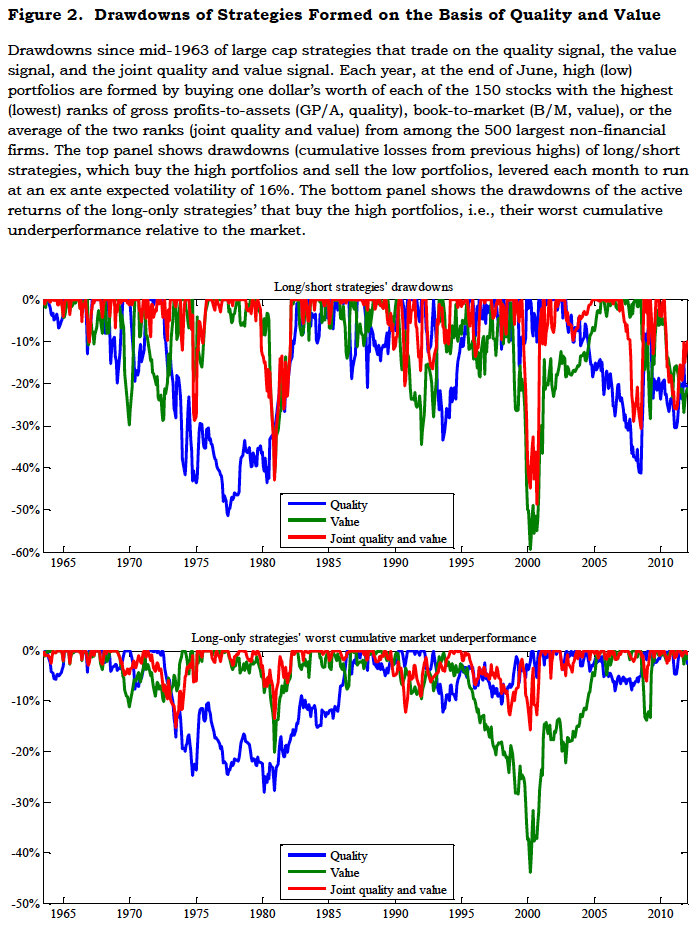
Figure 2 shows the drawdowns of the long/short strategies (top panel) and the worst cumulative under performance of the long-only strategies relative to the market, i.e., the drawdowns on the long-only strategies’ active returns (bottom panel). The top panel shows that the worst drawdowns experienced over the period by the long/short strategies run at market volatility were similar to market’s worst drawdown over the period. The joint quality and value strategy had, however, the smallest drawdowns of all the strategies considered. Its worst drawdown (48.7% in 2000) compares favorably to the worst drawdowns experienced by the market (51.6% in 2008-9, not shown), the traditional value strategy (down 59.5% by 2000), and the pure quality strategy (51.4% to 1977). Similar results hold for the worst five or ten drawdowns (average losses of 35.5% versus 41.1%, 38.9%, and 35.6% for the worst five drawdowns, and average losses of 25.8% versus 28.5%, 28.7%, and 26.5% for the worst ten drawdowns).

The bottom panel shows even more dramatic results for the long-only strategies active returns. Value stocks underperformed the market by 44% through the tech run-up over the second half of the ‘90s. Quality stocks lagged behind the market through much of the ‘70s, falling 28.1% behind by the end of the decade. Cheap, profitable stocks never lagged the market by more than 15.8%. Periods over which these stocks underperformed also tended to be followed quickly by periods of strong outperformance, yielding transient drawdowns that were sharply reversed.

Importantly, the signal in gross profitability is “extremely persistent,” and works well in the large cap universe.

Profitability strategies thus have low turnover, and can be implemented using liquid stocks with large capacities.

Novy-Marx’s basic message is that investors, in general but especially traditional value investors, leave money on the table when they ignore the quality dimension of value.

Read The Quality Dimension of Value Investing (.pdf).

Tomorrow, I show in an extract from Quantitative Value how we independently tested gross-profits-on-total-assets and found it to be highly predictive.

Read Full Post »
Sponsored Content

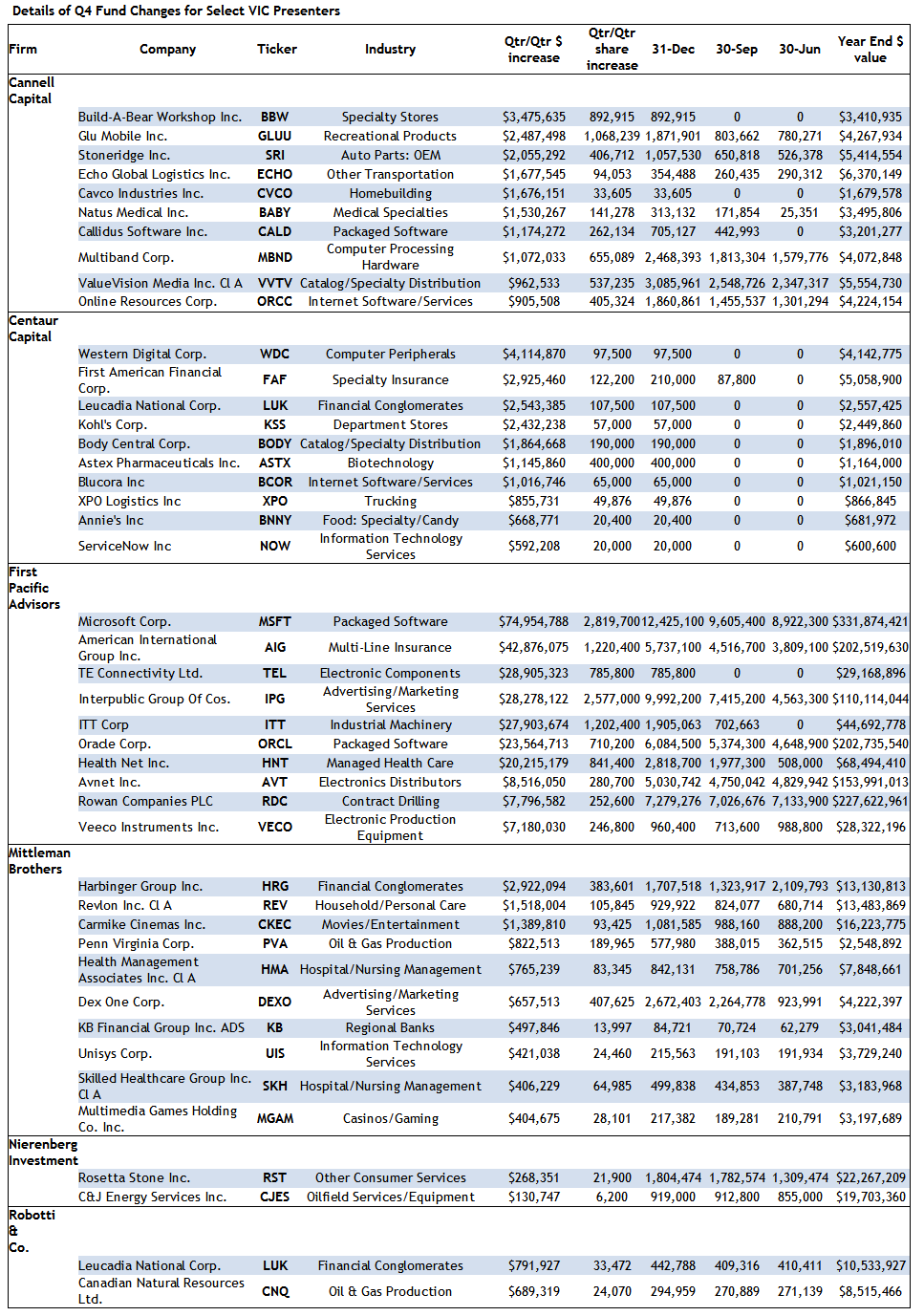
Briefing.com has provided a fantastic spreadsheet showing a few of the changes in the portfolios of several notable presenters at this spring’s Value Investing Congress. (Click to enlarge.)

Briefing.com VIC Portfolios

The organizers expect the Congress to sell out, so intending participants are encouraged to register early. Those who sign up by Monday, March 18th will save $1,400. Go to www.ValueInvestingCongress.com/Greenbackd and use discount code is S13GB7.

Read Full Post »

One of my favorite Benjamin Graham quotes:

Chairman: … One other question and I will desist. When you find a special situation and you decide, just for illustration, that you can buy for 10 and it is worth 30, and you take a position, and then you cannot realise it until a lot of other people  decide it is worth 30, how is that process brought about – by advertising, or what happens? (Rephrasing) What causes a cheap stock to find its value?

Graham: That is one of the mysteries of our business, and it is a mystery to me as well as to everybody else. [But] we know from experience that eventually the market catches up with value.

Benjamin Graham
Testimony to the Committee on Banking and Commerce
Sen. William Fulbright, Chairman
(11 March 1955)

Read Full Post »

Last May in How to beat The Little Book That Beats The Market: An analysis of the Magic Formula I took a look at Joel Greenblatt’s Magic Formula, which he introduced in the 2006 book The Little Book That Beats The Market (now updated to The Little Book That (Still) Beats the Market).

Wes and I put the Magic Formula under the microscope in our book Quantitative Value. We are huge fans of Greenblatt and the Magic Formula, writing in the book that Greenblatt is Benjamin Graham’s “heir in the application of systematic methods to value investment”.

The Magic Formula follows the same broad principles as the simple Graham model that I discussed a few weeks back in Examining Benjamin Graham’s Record: Skill Or Luck?. The Magic Formula diverges from Graham’s strategy by exchanging for Graham’s absolute price and quality measures (i.e. price-to-earnings ratio below 10, and debt-to-equity ratio below 50 percent) a ranking system that seeks those stocks with the best combination of price and quality more akin to Buffett’s value investing philosophy.

The Magic Formula was born of an experiment Greenblatt conducted in 2002. He wanted to know if Warren Buffett’s investment strategy could be quantified. Greenblatt read Buffett’s public pronouncements, most of which are contained in his investment vehicle Berkshire Hathaway, Inc.’s Chairman’s Letters. Buffett has written to the shareholders of Berkshire Hathaway every year since 1978, after he first took control of the company, laying out his investment strategy in some detail. Those letters describe the rationale for Buffett’s dictum, “It’s far better to buy a wonderful company at a fair price than a fair company at a wonderful price.” Greenblatt understood that Buffett’s “wonderful-company-at-a-fair-price” strategy required Buffett’s delicate qualitative judgment. Still, he wondered what would happen if he mechanically bought shares in good businesses available at bargain prices. Greenblatt discovered the answer after he tested the strategy: mechanical Buffett made a lot of money.

Wes and I tested the strategy and outlined the results in Quantitative Value. We found that Greenblatt’s Magic Formula has consistently outperformed the market, and with lower relative risk than the market. Naturally, having found something not broke, we set out to fix it, and wondered if we could improve on the Magic Formula’s outstanding performance. Are there other simple, logical strategies that can do better? Tune in soon for Part 2.

Read Full Post »

Robert Prechter’s prediction of a 100-year bear market reminds of this great story told in the introduction to my 2003 copy of Philip A. Fisher’s Common Stocks and Uncommon Profits and Other Writings. Phil’s son Kenneth L. Fisher recounts a story about his father that has stuck with me since I first read it. For me, it speaks to Phil Fisher’s eclectic genius, and quirky sense of humor:

But one night in the early 1970’s, we were together in Monterey at one of the first elaborate dog-and-pony shows for technology stocks – then known as “The Monterey Conference” – put on by the American Electronics Association. At the Monterey Conference, Father exhibited another quality I never forgot. The conference announced a dinner contest. There was a card at each place setting, and each person was to write down what he or she thought the Dow Jones Industrials would do the next day, which is, of course, a silly exercise. The cards were collected. The person who came closest to the Dow’s change for the day would win a mini-color TV (which were hot new items then). The winner would be announced at lunch the next day, right after the market closed at one o’clock (Pacific time). Most folks, it turned out, did what I did – wrote down some small number, like down or up 5.57 points. I did that assuming that the market was unlikely to do anything particularly spectacular because most days it doesn’t. Now in those days, the Dow was at about 900, so 5 points was neither huge nor tiny. That night, back at the hotel room, I asked Father what he put down; and he said, “Up 30 points,” which would be more than 3 percent. I asked why. He said he had no idea at all what the market would do; and if you knew him, you knew that he never had a view of what the market would do on a given day. But he said that if he put down a number like I did and won, people would think he was just lucky – that winning at 5.57 meant beating out the guy that put down 5.5 or the other guy at 6.0. It would all be transparently seen as sheer luck. But if he won saying, “up 30 points,” people would think he knew something and was not just lucky. If he lost, which he was probable and he expected to, no one would know what number he had written down, and it would cost him nothing. Sure enough, the next day, the Dow was up 26 points, and Father won by 10 points.

When it was announced at lunch that Phil Fisher had won and how high his number was, there were discernable “Ooh” and “Ahhhh” sounds all over the few-hundred-person crowd. There was, of course, the news of the day, which attempted to explain the move; and for the rest of the conference, Father readily explained to people a rationale for why he had figured out all that news in advance, which was pure fiction and nothing but false showmanship. But I listened pretty carefully, and everyone he told all that to swallowed it hook, line, and sinker. Although he was socially ill at ease always, and insecure, I learned that day that my father was a much better showman than I had ever fathomed. And, oh, he didn’t want the mini-TV because he had no use at all for change in his personal life. So he gave it to me and I took it home and gave it to mother, and she used it for a very long time.

Common Stocks and Uncommon Profits and Other Writings is, of course, required reading for all value investors.

Read Full Post »

In March 1976 a Mr. Hartman L. Butler, Jr., C.F.A. sat down for an hour long interview with Benjamin Graham in his home in La Jolla, California. Hartman recorded the discussion on his cassette tape recorder, and transcribed it into the following document. There are many great insights from Graham. Here are several of the best parts:

On the GEICO disaster unfolding at the time: 

It makes me shudder to think of the amounts of money they were able to lose in one year. Incredible! It is surprising how many of the large companies have managed to turn in losses of $50 million or $100 million in one year, in these last few years. Something unheard of in the old days. You have to be a genius to lose that much money.

On changes in his investment methodology, a subject we cover in detail in Quantitative Value:

I have lost most of the interest I had in the details of security analysis which I devoted myself to so strenuously for many years. I feel that they are relatively unimportant, which, in a sense, has put me opposed to developments in the whole profession. I think we can do it successfully with a few techniques and simple principles. The main point is to have the right general principles and the character to stick to them.

I have a considerable amount of doubt on the question of how successful analysts can be overall when applying these selectivity approaches. The thing that I have been emphasizing in my own work for the last few years has been the group approach. To try to buy groups of stocks that meet some simple criterion for being undervalued-regardless of the industry and with very little attention to the individual company. My recent article on three simple methods applied to common stocks was published in one of your Seminar Proceedings.

I am just finishing a 50-year study-the application of these simple methods to groups of stocks, actually, to all the stocks in the Moody’s Industrial Stock Group. I found the results were very good for 50 years. They certainly did twice as well as the Dow Jones. And so my enthusiasm has been transferred from the selective to the group approach. What I want is an earnings ratio twice as good as the bond interest ratio typically for most years. One can also apply a dividend criterion or an asset value criterion and get good results. My  research indicates the best results come from simple earnings criterions.

We looked at the performance of Graham’s simple strategy in Quantitative Value. For more see my overview piece, Examining Benjamin Graham’s Record: Skill Or Luck?

Hat tip to Tim Melvin @timmelvin

Buy my book The Acquirer’s Multiple: How the Billionaire Contrarians of Deep Value Beat the Market from on Kindlepaperback, and Audible.

Here’s your book for the fall if you’re on global Wall Street. Tobias Carlisle has hit a home run deep over left field. It’s an incredibly smart, dense, 213 pages on how to not lose money in the market. It’s your Autumn smart read. –Tom Keene, Bloomberg’s Editor-At-Large, Bloomberg Surveillance, September 9, 2014.

Click here if you’d like to read more on The Acquirer’s Multiple, or connect with me on Twitter, LinkedIn or Facebook. Check out the best deep value stocks in the largest 1000 names for free on the deep value stock screener at The Acquirer’s Multiple®.

Read Full Post »

Sponsored Content

When it comes to Canadian small caps, a lot of gems are outside the mines.

Acclaimed stock picker Guy Gottfried made that point in October 2011 at the New York Value Investing Congress. In his presentation, Gottfried asserted that investors in the Canadian market are “obsessed with resource stocks.” That means attractive equities outside the resource realm are often ignored.

Gottfried has followed his own advice – with exceptional results.

In 2011, Guy Gottfried threw The Brick at investors, and they thanked him when the retailer’s shares climbed 118% over the next year.

The Brick illustrates how Gottfried examines stocks. The furniture and appliance chain is a Canadian institution. However, it nearly went bankrupt before being recapitalized in 2009 by outside investors.

Yet even as its turnaround was clearly succeeding, Gottfried felt The Brick was “stigmatized by investors.” Gottfried was impressed by the company’s new management, capital allocation and balance sheet, not to mention its bargain valuation. From those criteria and more, Gottfried concluded The Brick was a “high-quality and extremely well-run business that trades at an undeservedly cheap price.”

He was right about that – and many other small cap stocks. The six stocks that Gottfried has recommended at his various VIC appearances have gained an average of 63%.

Guy Gottfried is the founder and head of the Toronto-based Rational Investment Group. He’ll share his latest high-conviction ideas at the 8th Annual Spring Value Investing Congress in Las Vegas, on May 6th and 7th.

The Congress is expected to sell out, and people are encouraged to register early. Those who sign up by Monday, February 18th will save $1,700. Go to www.ValueInvestingCongress.com/GuyGottfried. The discount code is S13GB5.

Read Full Post »

Abnormal Returns’ Tadas Viskanta has posted a great interview with my Quantitative Value co-author, the Turnkey Analyst Wes Gray:

AR: You write in the book that there are two arguments for value investing: “logical and empirical.” It seems like the value investing community heavily emphasizes the former as opposed to the latter. Why do you think that is?

WG: Human beings tend to favor good stories over evidence, but this can lead to problems. As Mark Twain says, “All you need is ignorance and confidence and the success is sure.”

This tendency to embrace stories might help explain why being “logical” is more heavily relied upon by investors, – good logic makes as good story. Relying on the evidence, or being “empirical,” is under appreciated because it is sometimes counterintuitive.  I’m actually a big fan of a logical story backed by empirical data. This is the essence of our book Quantitative Value. We present a compelling story on the value investment philosophy, but at each step along our journey we pepper our analysis with empirical analysis and academic rigor.

AR: You note in the book the importance of Ben Graham and how a continued application of his “simple value strategy” would still generate profits today. Have you seen the recent video about him? He seems to have been as interesting a guy as he was investor/teacher.

WG: As Toby and I conducted background research for the book, we became more and more convinced that Ben Graham was the original systematic value investor. In Quantitative Value we backtest a strategy Graham suggested in the 1976 Medical Economics Journal titled “The Simplest Way to Select Bargain Stocks.” We show that Graham’s strategy performed just as well over the past 40 years as it did in the 50 years prior to 1976. This is a remarkable “out-of-sample” test and highlights the robustness of a systematic value investment approach.

With respect to your question on the video: the recent video circulating the web reinforces our belief that Graham was an empiricist by nature and relied heavily on the scientific method to make his decisions. I also find it interesting that his discussions are so focused on the fallibility of human decision-making ability. Many of the ideas and concepts Graham mentioned regarding human behavior have been backed by behavioral finance studies written the past 20 years. He was well ahead of his time.

AR: The value community loves to continue to claim Warren Buffett as a disciple. However today he would be best described as a “quality and price” investor more than anything. What is the relevance of how Warren Buffett’s approach to investing has changed over time?

WG: The irony here is that, on average, Warren Buffett’s “new” approach to value investing is inferior to the approach originally described by Ben Graham. Buffett describes an approach that is broader in perspective and allows an investor to move along the cheapness axis to capture high quality firms. Graham, who studied the actual data, was much more focused on absolute cheapness. This concept is highlighted in many of his recommended investment approaches, where the foundation of the strategy prescribed is to simply purchase stocks under a specific price point (e.g., P/E <10).

After studying data from the post-Graham era, we have come to the same conclusion as Graham: cheapness is everything; quality is a nice-to-have. For example, the risk-adjusted returns on the higher-priced, but very high quality firms (i.e., Buffett firms) are much worse on a risk-adjusted basis than the returns on a basket of the cheapest firms that are of extreme low quality (i.e., Graham cigar butts). In the end, if you aren’t exclusively digging in the bargain bin, you’re missing out on potential outperformance.

Read the rest of the interview here. As Tadas says, the answers are illuminating.

For more on Quantitative Value, read my overview here.

Read Full Post »

« Newer Posts - Older Posts »