Feeds:
Posts
Comments

Archive for the ‘Stocks’ Category

Jay at Market Folly has introduced a quarterly newsletter “Hedge Fund Wisdom,” which Jay bills as a “complete guide to what hedge funds have been buying and selling.” The newsletter includes:

  • Complete portfolio updates on 20 prominent hedge funds
  • Commentary and analysis of each fund’s moves
  • Consensus buys & sells among the hedge funds profiled
  • In-depth analysis of 3 stocks hedge funds were buying. We take you inside the head of a hedge fund manager to examine the investment thesis, upside & downside, potential catalysts, market valuation, contrarian viewpoint, company background & more

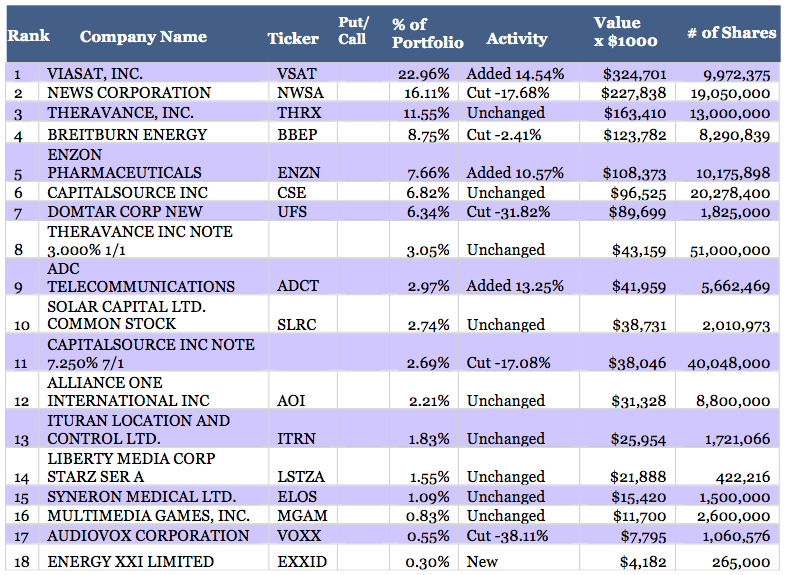
Here is an example of the holdings of Seth Klarman:

To celebrate the launch, Jay is providing two special introductory offers:

  • HFW Member – Annual (most popular choice! lock in additional cost savings before rates go up!) @ $199 / year
  • HFW Member – Quarterly (limited time offer, rates going up soon!)@ $60 / quarter

If you have any questions or issues, please send Jay an e-mail atinfo@hedgefundwisdom.com and he will get back to you.

Read Full Post »

While the WSJ is prepared to consign the PE ratio to the dustbin (see The Decline of the P/E Ratio and Is It Time to Scrap the Fusty Old P/E Ratio?) Barry Ritholtz is one of the few actually asking the question, “What does a falling P/E ratio mean?

Ritholz focuses on the expansion and contraction of the PE ratio as indicative of bull or bear markets:

We can define Bull and Bear markets over the past 100 years in terms of P/E expansion and contraction. I always show the chart below when I give speeches (from Crestmont Research, my annotations in blue) to emphasize the impact of crowd psychology on valautions.

Consider the message of this chart. It strongly suggests (at least to me) the following:

Bull markets are periods of P/E expansion. During Bulls, investors are willing to pay increasingly more for each dollar of earnings;

Bear markets are periods of P/E contraction. Investors demand more earnings for each dollar of share price they are willing to pay.

Hence, a falling P/E ratio is not indicia of its lack of utility. Nor is it proof of “Fustyness.” Rather, it suggests that crowd is still feeling burned by the recent collapse in prices and increase in volatility.

Here’s the chart:

I think Ritholz’s analysis is excellent as far as it goes, but I think it misses part of the story. The “E” in the PE ratio is also subject to expansion and contraction over the course of the business cycle. Earnings are still normalizing from a period of massive expansion. While the single-year market PE might be at 15.8, which is a little over the long-term average of 15, on a cyclically-adjusted basis, the PE ratio is over 20, which is historically expensive:

Click to View

Assuming that this time is not different, earnings will contract as they regress to the long-term mean, and the market PE ratio will contract along with earnings.

Read Full Post »

John Hussman’s excellent Weekly Market Comment for the week beginning September 6 has a superb chart showing the 10-year returns to the S&P500 implied by its present level. The news is sobering. John estimates returns for the coming decade of less than 6% per annum:

Though we use a variety of methods, the consensus estimate is at about 5.6% annually. I’ve detailed our estimation methodology in numerous weekly comments over the years. Below is a chart taking this analysis back to 1928. It would be nice, before quoting alternative valuation models, if Wall Street analysts would at least present similarly broad historical evidence that their methodology actually has a relationship with subsequent market returns. If a valuation opinion doesn’t come with extensive historical evidence, it’s noise.

Worse, the returns above are nominal returns. On an inflation-adjusted basis, John forecasts returns of just 1% per annum:

That said, one thing that does concern me about the foregoing model is that our “real” inflation-adjusted version projects a 10-year real total return for the S&P 500 of just over 1% annually. That suggests that about 4% of the nominal return projection represents implied inflation, which would be consistent with post-war U.S. history, but may or may not be accurate in this instance. My guess is that, in fact, we will observe significant CPI inflation in the latter half of this decade. Still, it is worth noting that our projection for real10-year returns is not compelling in any case. 10-year real returns for the S&P 500 have been predictably negative since 1998, but it is unfortunate that except for a few weeks in early 2009, we have not yet achieved a level of valuation from which we can expect a meaningfully different result.

John concludes:

To the extent that investors wish to compare our 5.6% estimate for 10-year S&P 500 total returns with the 2.7% yield on 10-year Treasuries, it is important to recognize that the higher 10-year expected return in the S&P 500 comes with a several-fold increase in risk, particularly over a shorter horizon. Moreover, the divergence between the two figures tends to expand, not contract, during economic downturns. Stocks are not cheap, and to the extent they may outperform bonds over the next 10 years, it will most likely be with extreme discomfort.

Read Full Post »

In Burry, Predictor of Mortgage Collapse, Bets on Farmland, Gold, Bloomberg has a great profile on Dr. Michael Burry and his recent investments. Says Bloomberg:

Michael Burry, the former hedge-fund manager who predicted the housing market’s plunge, said he is investing in farmable land, small technology companies and gold as he hunts original ideas and braces for a weaker dollar.

“I believe that agriculture land — productive agricultural land with water on site — will be very valuable in the future,” Burry, 39, said in a Bloomberg Television interview scheduled for broadcast this morning in New York. “I’ve put a good amount of money into that.”

Burry points to market correlation as “problematic”:

Burry, who now manages his own money after shuttering the fund in 2008, said finding original investments is difficult because many trades are crowded and asset classes often move together.

“I’m interested in finding investments that aren’t just simply going to float up and down with the market,” he said. “The incredible correlation that we’re experiencing — we’ve been experiencing for a number of years — is problematic.”

He likes Asian tech stocks:

Still, it’s possible to find opportunities among small companies because large investors and government officials focus on bigger ones, he said. He is particularly interested in small technology firms.

“Smaller companies in Asia, I think, are neglected,” he said. “There are some very cheap companies there.”

And gold:

Gold is also a favored investment as central banks issue debt and devalue their currencies, he said. Governments haven’t adequately addressed the causes of the financial crisis and may be sowing the seeds for future problems by borrowing, he said. In the U.S., lawmakers showed they didn’t understand how to prevent another crisis when they gave the Federal Reserve and Chairman Ben S. Bernanke additional authority, he said.

“The Federal Reserve, in my view, hadn’t seen this coming and in some ways, possibly contributed to the crisis,” he said. “Now, Bernanke is the most powerful Fed chairman in history. I’m not sure that’s the right response. The result tends to tell me they’re not getting it right.”

Read the post.

Burry continues to be a very popular topic on Greenbackd (for more, see my posts Michael Lewis’s The Big Short, the Vanity Fair article Betting on the Blind SideBurry’s techstocks.com “Value Investing” thread and Burry’s Scion Capital investor letters)

Read Full Post »

Cal Dive International Inc. (NYSE:DVR) is an interesting play on the offshore oil and gas service industry. It was trading through a cyclical and seasonal low before the Macondo well blowout. The blowout has had a significant impact on the offshore oil and natural gas industry, and saw DVR suffer one of its worst quarters in several years. As a result, DVR’s stock price has recently dropped to a new 52-week low. With Earl and several other hurricanes bearing down on the US, and the offshore oil and gas industry close to long-term lows, DVR looks like a bargain to me.

About DVR

DVR is a marine contractor providing manned diving, pipelay and pipe burial, platform installation and platform salvage services to a diverse customer base in the offshore oil and natural gas industry. It has operations in the Gulf of Mexico Outer Continental Shelf, the Northeastern U.S., Latin America, Southeast Asia, China, Australia, the Middle East, India and the Mediterranean. It owns and operates a diverse fleet of 29 vessels, including 19 surface and saturation diving support vessels, six pipelay/pipebury barges, one dedicated pipebury barge, one combination derrick/pipelay barge and two derrick barges.

Prior to December 2006, DVR was a wholly-owned by Helix Energy Solutions Group, Inc..  In December 2006, Helix transferred to DVR all of the assets and liabilities of its shallow water marine contracting business, including 23 surface and diving support vessels capable of operating in water depths of up to 1,000 feet and three shallow water pipelay vessels. DVR, through an initial public offering, became a separate company. Helix now owns less than 1% of DVR’s common stock.

Hurricanes, winter and energy prices

DVR is cyclical. It does well when oil and gas drillers drill. It’s also seasonal. The first quarter of the year is typically a slower period due to winter in the Gulf of Mexico. DVR’s 2010 “off-season” was particularly poor. Customer spending levels were significantly less during the first half of 2010 compared to the first half of 2009. The decline in demand for DVR’s services in the first half of 2010 was due to a reduction in hurricane repair work, the lag effect of decreased offshore drilling in 2009, and uncertainty regarding energy prices, specifically natural gas prices for Gulf of Mexico customers. Demand for DVR’s services generally lags behind successful drilling activity by a period of six to 18 months. Vessel utilization for its saturation diving vessels and construction barges – its two most profitable asset classes – declined significantly during 2010 as compared to the same period in 2009 (from the June 30 10Q):

The onset of the global recession in the fall of 2008 and the resulting decrease in worldwide demand for hydrocarbons caused many oil and natural gas companies to curtail capital spending for exploration and development. Despite this financial market and economic environment, we experienced steady demand for our services during the first three quarters of 2009. This demand was driven in part by the need for inspection, repair and salvage of damaged platforms and infrastructure following hurricanes Gustav and Ike, which passed through the Gulf of Mexico in the third quarter 2008, and increased domestic and international new construction activities, the capital budgets for many of which had already been committed prior to the end of 2008. However, demand for our services during the fourth quarter of 2009 and the first six months of 2010 was reduced for the following main reasons:

· reduced urgency by customers in completing the remaining hurricane repair and salvage work in the Gulf of Mexico;

· reduced new construction work due to significantly less drilling activity in 2009 and the first half of 2010; and

· fewer large integrated construction projects utilizing multiple vessels planned for 2010 as compared to the projects that were ongoing during the first six months of 2009.

Although there is some evidence that the worldwide economy is emerging from recession and we began to see signs of recovery in the market as we moved into the improved weather months, we still expect challenging market conditions for the remainder of 2010 compared to 2009. The Macondo well accident has significantly and adversely disrupted oil and gas exploration activities in the Gulf of Mexico and there is increased uncertainty in the market and regulatory environment for our industry which will likely have a negative effect on our customer’s spending levels for some time. The duration that this disruption will continue is currently unknown. Generally, we believe the long-term outlook for our business remains favorable in both domestic and international markets as capital spending will be required to replenish oil and natural gas production, which should drive long-term demand for our services.

Vessel utilization

Vessel utilization is a key metric. From the June 30 10Q:

We believe vessel utilization is one of the most important performance measurements for our business.  Utilization provides a good indication of demand for our vessels and, as a result, the contract rates we may charge for our services.  As a marine contractor, our vessel utilization is typically lower during the winter and early spring due to weather conditions in the Gulf of Mexico.  Accordingly, we attempt to schedule our drydock inspections and routine and preventive maintenance programs during this period.  The seasonal trend for vessel utilization can be disrupted by hurricanes, which have the ability to cause severe offshore damage and generate significant demand for our services from oil and natural gas companies to restore shut-in production.  This production restoration focus has led to increased demand for our services for prolonged periods following hurricanes, as was the case in the first half of 2009 following hurricanes Gustav and Ike in 2008.  Beginning in the fourth quarter of 2009, and reflected in our results for the first half of 2010, we once again returned to more customary seasonal conditions in the Gulf of Mexico.  The effect of this return to customary seasonal conditions on our utilization in these already historically slow periods was exacerbated by particularly weak demand for our services in the first half of 2010, resulting in a 27% decrease in vessel utilization across the entire fleet for the first half of 2010 as compared to the same period of 2009.

A small  increase in vessel utilization will see a huge increase in revenues, profitability and cash flow.

Valuation

DVR’s $4.63 close yesterday gives it a market capitalization of $436M and an enterprize value of around $574M (long-term debt net of cash is $138M). DVR’s most recent quarter was a difficult one. Free cash flow turned negative for the first quarter since the same quarter in 2008. Through very difficult business conditions, DVR has still managed to generate over $100M in FCF over the last twelve months, which means it trades on a EV/FCF ratio of 5.7, and a P/CF ratio of 2.8.

Conclusion

This post is intended only to be a quick look at DVR. The key points are thus:

  • DVR was trading through a cyclical and seasonal low before the Macondo well blowout turned what would have been a bad quarter into a disastrous quarter.
  • The stock has been unduly punished, and now trades at a EV/FCF ratio of 5.7, and a P/CF ratio of 2.8, which is cheap, especially so given the difficult trading conditions it is presently enduring.
  • A small improvement in vessel utilization will have an outsized impact on revenues, profitability and cash flow.

Hat tip Mariusz Skonieczny.

Long DVR.

Read Full Post »
When The Vapors recorded Turning Japanese in 1980, I wonder if they had any inkling that 30 years later the chorus would be co-opted by every macro pundit with a blog in the western world to explain the future of the US economy.

It’s everywhere, to wit:

The Guardian says, “We’re all turning Japanese.” PIMCO asks, “Is the U.S. turning Japanese?” Time asks, “Is America turning Japanese?” James Montier says, “the market is implying a 70% probability that the US turns Japanese.” The WSJ says, “US Isn’t Turning Japanese.” Paul Krugman, mangling the lyric, says, “Now we’re all Japanese.

The “turning Japanese” earworm has me considering gouging out my eyes and eardrums. Please, for the love of all that is good and holy in the world, find another cliché. Oh, and just in case you’ve forgotten how the song sounds, here it is in all its glory. Enjoy!:

Read Full Post »

The CXO Advisory Group blog has a great post about the indicators of persistence in hedge fund performance. CXO examines a July 2010 paper, “Hedge Fund Characteristics and Performance Persistence”, by Manuel Ammann, Otto Huber and Markus Schmid, in which the authors investigate hedge fund performance persistence over periods of six to 36 months based on portfolios of hedge funds formed via double sorts on past performance and another fund characteristic, which might include the following:

  • size;
  • age;
  • relative funds flow;
  • closure to new investments;
  • length of withdrawal notice period;
  • length of redemption period;
  • management and incentive fees;
  • leverage;
  • management personal investment; and,
  • a Strategy Distinctiveness Index (SDI) defined as a strategy-normalized form (ten different strategy types) of one minus the R-squared of monthly returns regressed against an equally-weighted strategy index over the prior two years.

CXO reports the authors’ findings thus:

Using characteristics and groomed performance data for a broad sample of hedge funds over the period 1994-2008, they find that:

  • Based on past performance alone:
    • Persistence of raw returns is economically meaningful up to two years (but statistically significant only for six months).
    • Persistence of multi-factor alpha is both economically and statistically highly significant up to three years. The difference in monthly future alpha between the top and bottom fifths (quintiles) of past alpha is 2.8%, 2.3%, 1.6% and 1.0% for rebalancing frequencies of six months, one year, two years and three years, respectively.
  • Based on double sorts that divide each past alpha quintile into a high and low half for some other fund characteristic, SDI is the only characteristic that systematically improves prediction of future performance.
    • The difference in monthly alpha between the tenth of funds with highest past alpha and higher SDI and the tenth of funds with the lowest past alpha and lower SDI is 3.0%, 2.6%, 1.8% and 1.0% for rebalancing frequencies of six months, one year, two years and three years, respectively.
    • These results translate to annualized alpha improvements of about 4.0% and 2.3% for annual and biennial rebalancing, respectively.
  • Results are robust to different factor models for calculating alpha, changing the order of double sorts, different demarcations for initial sorts (fifths, fourths, thirds, halves) and alternative definitions for SDI. However, the prediction enhancement of SDI disappears during the 2008 credit crisis, indicating that high-SDI funds have large idiosyncratic risks exposed by crises.

In summary, evidence indicates that hedge fund investors should focus on funds with the best past performances and the most distinctive (uncorrelated) strategies.

While past performance may be no guarantee of future results, it seems that past performance is a pretty good indicator of future performance.

Read Full Post »

Saturna Capital has an interesting take on the calculation of the Graham / Shiller PE10, otherwise known as the Cyclically Adjusted Price Earnings ratio (CAPE). Saturna argues that The Market May Be Cheaper Than It Looks because the Consumer Price Index (CPI) provided by the Bureau of Labor Statistics (BLS) understates the true rate of inflation, a key input to the CAPE calculation:

Potentially Understated Inflation

Given that inflation estimates play an influential role in the calculation of the P/E10, it is important to investigate the assumptions behind the calculation of inflation. Traditionally, inflation is measured using the Consumer Price Index (CPI) provided by the Bureau of Labor Statistics (BLS). The CPI estimates inflation by measuring fluctuations in the average price of a basket of consumer goods and services that is deemed to be typical of the average urban consumer. However, due to a variety of reasons, largely political, the methodology used to calculate CPI has undergone many changes in the past 10 to 20 years. One of the most controversial changes was to alter the composition of the basket to reflect changes in consumer behavior over time.

In doing so, the BLS hoped to remove biases that cause the CPI to overstate the true inflation rate. Former chairman of the Federal Reserve Alan Greenspan advocated this alternative methodology, arguing that if the price of steak went up, consumers would choose to eat more hamburger meat instead.² He therefore concluded that unless hamburger meat replaced steak in the basket, inflation would be overstated because consumers were not actually spending more money. Skeptics view these changes as government manipulation, the purpose of which is to understate the true inflation rate, as well as the wage and other rate increases indexed to it (think Social Security).

Saturna uses an alternative measure of inflation: the Shadow Government Statistics’ (SGS) Alternate CPI:

Over time this recalibration of the CPI has produced lower inflation estimates than the “old school” method. In fact, the discrepancy has become rather large… Unlike Mr. Greenspan, however, we prefer steak to hamburger meat. Accordingly, we tend to believe the truth lies somewhere in between the BLS’s CPI and the Shadow Government Statistics’ (SGS) Alternate CPI.

The implications for CAPE using Shadow Government CPI are as follows:

The wide gap between the government-sanctioned CPI and the Shadow Government CPI presents a competing set of assumptions about how to measure the effect of rising prices on the average consumer and the market as a whole. The relevance to investment analysts is that higher inflation figures can have a dramatic impact on the current P/E10 ratio. For example, if inflation is assumed to be 5% annually, $1 in nominal earnings from 10 years ago would be worth approximately $1.63 in today’s dollars. At 10% annually, $1 in nominal earnings from 10 years ago would be worth about $2.59 today. Using a higher inflation estimate therefore increases average real earnings over the 10-year period, and thus lowers the P/E10 ratio. If we assume the SGS figures are correct, then the current P/E10 based on the average closing price during the month of June is about 14x (see chart below). This ratio is much lower than the current P/E10 of near 20x using traditional CPI figures.

Click to View

Read the article.

Hat tip Ben Bortner.

Read Full Post »

One of my favorite strategies is the Endangered Species / Darwin’s Darlings strategy I discussed in some detail earlier this year (see Hunting endangered species and Endangered Species 2001). The strategy is based on a Spring 1999 Piper Jaffray research report called Wall Street’s Endangered Species by Daniel J. Donoghue, Michael R. Murphy and Mark Buckley, then at Piper Jaffray and now at Discovery Group, a firm founded by Donoghue and Murphy. The premise of the report was that undervalued small capitalization stocks (those with a market capitalization between $50M and $250M) lacked a competitive auction for their shares and required the emergence of a catalyst in the form of a merger or buy-out to close the value gap.

The NYTimes.com has an article, Accretive Uses “Take Private” Tactic In Equities, discussing hedge fund Accretive Capital Partners, which uses a strategy described thus:

Accretive Capital’s strategy is to buy long-only stakes in small- and micro-cap stocks that [founder Rick] Fearon believes would be attractive “take private” companies. The benefits of being public just don’t add up for such companies, he said.

Years ago when Fearon was a principal at private equity firm Allied Capital, he was struck by the wide gap in value the public and private equity markets assigned companies.

In private equity, companies were valued at six to seven times their cash flow, while public companies, especially the smallest businesses, were valued at almost half that, he said.

Fearon believes that market inefficiency, where prices often fail to reflect a company’s intrinsic value, and the $400 billion or so that pension funds and endowments currently have committed to private equity, will help spur returns.

Fearon is fishing in waters where, because the market capitalization of the smallest companies is less than $100 million, Wall Street research fails to adequately cover their operations. In addition to helping create an inefficient market, it has eroded the benefits of being a public company.

With an undervalued stock, stock options are never in the money, erasing the use of stock as a motivator for management and employees; cash becomes preferable to stock for acquisitions, and management holds on to undervalued shares.

“Management teams that have a strategy of A, B, C and D for creating shareholder value may in the back of their minds be thinking, ‘Well, maybe strategy E is the take private transaction, or we sell the company to a strategic buyer, because we’re not recognizing any of the benefits of being public,'” Fearon said.

In essence, the strategy is Endangered Species / Darwin’s Darlings. How has Accretive Capital performed?

Accretive Capital has been involved in 19 take-private transactions, or about one-third of the positions it has closed over the past decade.

Fearon has managed to take the $2 million in capital he started with from mostly high-net worth friends and family to about $20 million on his own. His fund plunged in 2008, but returned 132 percent last year and is up about 20 percent as of July.

Assuming no additional outside capital, turning $2M into $20M in ten years is a compound return of around 25%, which is impressive. [Update: As Charles points out in the comments, the article clearly says he’s returned 4x, not 10x, which is a compound return of around 15%, which is still impressive in a flat market, but not as amazing as 25%.]

Says Fearon of the investment landscape right now:

“We’re not lacking investment ideas or opportunities, our primary restraint is capital right now.”

Read Full Post »

This is your last chance to grab substantial savings for the Value Investing Congress. The event takes place on October 12th & 13th in New York City. Greenbackd readers can save $1,700 with discount code N10GB6. Register in the next six days before the price increases by $400. Get your ticket now.

The Value Investing Congress is the place for value investors from around the world to network with other value investors. I went to the May event earlier this year in Pasadena, and it was well worth it. The speakers seem to mingle freely and are generally available for a chat. Weather permitting, I’ll be in New York for this event.

Speakers include:

  • David Einhorn, Greenlight Capital Management
  • Lee Ainslie, Maverick Capital
  • John Burbank, Passport Capital
  • J Kyle Bass, Hayman Capital
  • Mohnish Pabrai, Pabrai Investment Funds
  • Amitabh Singhi, Surefin Investments
  • J. Carlo Cannell, Cannell Capital
  • Zeke Ashton, Centaur Capital Partners
  • Whitney Tilson & Glenn Tongue, T2 Partners

Take advantage of the substantial discount while it lasts. The price increases in six days, so get your ticket to the Value Investing Congress using discount code N10GB6.

Read Full Post »

« Newer Posts - Older Posts »