Feeds:
Posts
Comments

Archive for the ‘Stocks’ Category

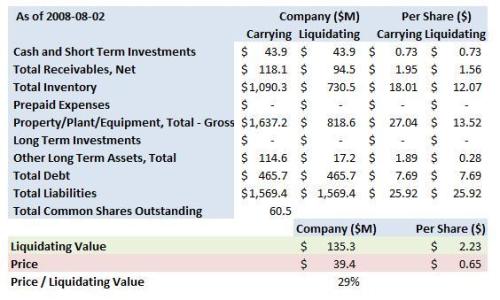
Dataram Corporation (NASDAQ: DRAM) is a classic net-net stock, with a $10.6M market cap at yesterday’s closing price of $1.20 and around $18.5M of value in liquidation, including $16M in cash.

About DRAM

According to the company’s website, DRAM is a developer, manufacturer and marketer of large-capacity memory products primarily used in high-performance network servers and workstations. The stock is down sharply because the company cut its dividend and its operating cash flow has turned negative in its most recent quarter, burning through $1.3M. We don’t know anything about “large-capacity memory products” so we don’t know if this is a short term blip on the road to more profits or the beginning of the end.

The value proposition

According to DRAM’s most recent quarterly report, the balance sheet looks reasonably healthy.  Set out below is our summary analysis (the “Carrying” column shows the assets as they are carried in the financial statements, and the “Liquidating” column shows our estimate of the value of the assets in a liquidation):
dram-summary

We estimate that DRAM has a liquidating value of around $18.5M, or $2.08 per share. In coming to that number, we’ve written down the Receivables by 20%, Inventory by 33% and Other Long Term Assets by 50%.

With its stock price at $1.20, DRAM is trading at 58% of its value in a liquidation and at a 24% discount to its net cash (cash less all liabilities) of $1.58 per share.

Catalysts

The risk with DRAM, as it is with any net net or net cash stock, is that the company might not make a profit any time soon and won’t liquidate before it dissipates its remaining cash. As we said above, we’ve got no insight into DRAM’s business and don’t know whether it can trade out of its present difficulties and back to at least a positive operating cash flow. According to the 10Q, the company is authorized to repurchase 172,196 shares under a stock repurchase plan but this is an immaterial amount in the context of the 8.9M shares on issue and the plan has been in existence since 2002. The best hope for the stockholders is that the company re-institutes its dividend, which, given its $16M in cash, it certainly seems able to do. No noted activists have disclosed a holding in the company, which means management have no incentive to do anything so stockholder friendly.

Conclusion

DRAM, at 58% of its liquidating value and 76% of its cash backing, is very cheap. We believe that it is worth watching but, with no obvious catalysts and a high cash burn rate, probably one to avoid unless you are willing to bet that its remaining cash might attract an activist or the business will turn around before it runs out of money.

[Disclosure: We do have a holding in DRAM. This is neither a recommendation to buy or sell any securities. All information provided believed to be reliable and presented for information purposes only.]

Read Full Post »
Greenbackd’s ideal investment opportunity is a deeply undervalued asset situation with a catalyst to quickly remove the discount. Unfortunately, those opportunities are few and far between.

We frequently find deeply undervalued asset situations with no obvious catalyst. We also often find activists in stocks that we woud not consider to be undervalued on an asset basis.

As a thought experiment, we thought that we would compare the performance of two stocks: one a net net and net cash stock lacking a catalyst, and the other a stock not obviously undervalued on an asset basis but nonetheless pursued by an activist investor.

We’ve selected Dataram Corporation (NASDAQ:DRAM) as representative of the net-nets. DRAM is a classic net-net stock, with a $10.5M market cap and around $19.4M of value in liquidation, including $16M in cash.

The second stock selects itself: Yahoo! Inc. (NASDAQ:YHOO), one of the original Internet stocks, has as one of its largest stockholders activist investing legend Carl Icahn and the NY Times speculates that it has a potential suitor. YHOO has a market cap of around $15.9B and tangible assets of around $5.5B, including around $3.2B in cash, which means it is not undervalued on an asset basis.

Today, we examine DRAM and on Monday we will examine YHOO.

Read Full Post »

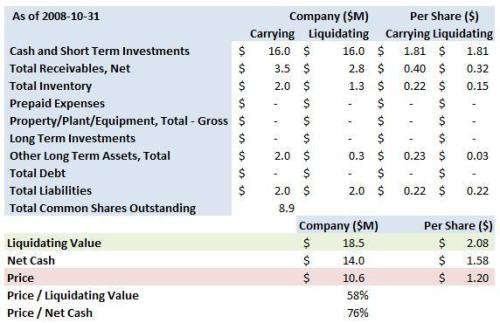
Zale Corporation (NYSE:ZLC) is an undervalued asset situation with a well-known activist investor, Richard Breeden of Breeden Capital Management LLC, holding two seats on the board. At yesterday’s closing price of $4.82, the company has a market capitalization of $154M. We estimate the liquidation value of the company at around $243M or $7.63 per share, which means that ZLC is trading at 63% of our estimated liquidation value.

About ZLC

ZLC is a specialty retailer of fine jewelry in North America. According to its website, at July 31, 2008, ZLC “operated 1,396 specialty retail jewelry stores and 739 kiosks located mainly in shopping malls throughout the United States, Canada and Puerto Rico. ZLC operates under three business segments: Fine Jewelry, Kiosk Jewelry and All Other. During the fiscal year ended July 31, 2008 (fiscal 2008), the Fine Jewelry segment generated approximately 88% of the Company’s net revenues, while the Kiosk revenues represented 12% of total revenues. On November 9, 2007, the Company completed the sale of its Bailey Banks & Biddle brand.”

The value proposition

ZLC is an undervalued asset situation with substantial Inventory and Property, Plant and Equipment (see most recent quarterly report here). Set out below is our summary analysis of the balance sheet (the “Carrying” column shows the assets as they are carried in the financial statements, and the “Liquidating” column shows our estimate of the value of the assets in a liquidation):

zlc-summary1

Perhaps unsurprisingly for a jewelry retailing business, ZLC’s asset value is predominantly in its Inventory and Property, Plant and Equipment. We don’t have any great insight into the jewelry retail business. We can see that consumers don’t have much discretionary cash available at the moment, so in a fire sale tomorrow the discount to the carrying value of Inventory could be substantial. On the other hand, there is no immediate need to sell the Inventory because jewelry is not a wasting asset and can even be a store of value. We lean towards the latter argument. ZLC has $984.6M in Inventory that we’ve written down by 15% to $837M or $26.24 per share. We’ve applied a 50% discount to the $728M worth of Property, Plant and Equipment (Gross) to arrive at $364M or $11.42 per share. We estimate the company’s liquidation value at around $243M or $7.63 per share, which means that, at yesterday’s closing price of $4.82, ZLC is trading at 63% of our estimated  value in a liquidation.

The catalyst

Activist investor Breeden Capital Management disclosed its holding in ZLC in its original 13D on September 17, 2007. Breeden has continued to buy shares of common stock in ZLC, disclosing in the most recent 13D filed November 28, 2008 that it controlled 28.46% of the company.

Breeden Capital Management’s Richard Breeden is a former chairman of the Securities and Exchange Commission. Breeden recently led a dissident shareholder group to win three seats on the board of tax preparation and accounting services company H&R Block Inc.

ZLC appointed Breeden Capital Management’s Richard Breeden and James Cotter (Cotter is a founding partner) to its board of directors on January 17, 2008

Conclusion

With ZLC trading at a substantial 33% discount to its value in liquidation and Breeden continuing to buy stock, ZLC seems like a good bet to us.

ZLC closed yesterday at $4.82.

The S&P 500 closed yesterday at 848.81.

[Disclosure: We do not presently have a holding in ZLC. This is neither a recommendation to buy or sell any securities. All information provided believed to be reliable and presented for information purposes only.]

Read Full Post »
Warning: We updated this post on December 18, 2008.

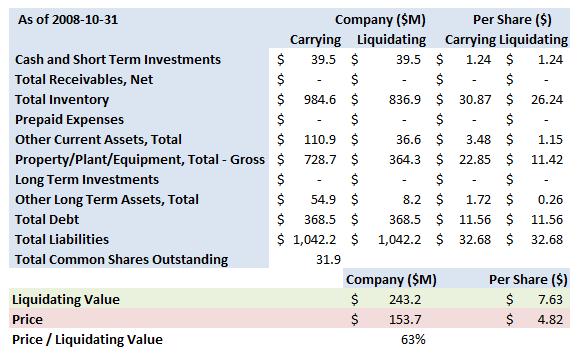
Borders Group, Inc. (NYSE:BGP) presents a rare opportunity to invest in a stock with a well-known brand alongside one of the best activist investors in the US, William A. Ackman of Pershing Square Capital Management, L.P. Want more? With a market capitalization of $39.4M at today’s close ($0.65) and a liquidation value we estimate at $135M, BGP is available right now at an astonishing 61% discount to that value.

About BGP

According to its website, BGP “operates over 509 Borders superstores in the U.S.; 32 Borders stores outside the U.S., in Australia, New Zealand, Singapore and Puerto Rico; and approximately 485 stores in the Waldenbooks Specialty Retail segment, including Waldenbooks, Borders Express, Borders airport stores, and Borders Outlet. Borders Group owns London-based Paperchase Products Limited, a retailer of stationery, cards and gifts with approximately 120 locations outside the U.S., including stand-alone stores and concessions. There are also more than 317 Paperchase shops located within U.S. Borders superstores and the company opened its first stand-alone Paperchase shop in the U.S. on Boston’s Newbury Street in 2007.”

The value proposition

While the company has been loss making for the last few years it maintained positive Cash Flow from Operating Activities of $94.1M last year, $46.9M in the 2007 year and, encouragingly, $76.6M in the most recent quarter to August 2008 (see the most recent 10Q here). There real value is in the balance sheet.  Set out below is our summary analysis (the “Carrying” column shows the assets as they are carried in the financial statements, and the “Liquidating” column shows our estimate of the value of the assets in a liquidation):

bgp-summary

BGP’s value is concentrated in its Inventory ($18.01 per share) and Property, Plant and Equipment ($27.04 per share). We have written down the Inventory by two-thirds to $12.07 per share and the Property, Plant and Equipment by half to $13.52 per share. The company has substantial liabilities of $25.92 per share, of which $7.69 is debt. We estimate the liquidating value of BGP to be around $2.23 per share. With the stock at $0.65, BGP is at an astonishing 29% of its liquidating value. Note that the liquidating value does not take into account BGP’s intangibles, like consumer brand recognition, which must have some residual value. At $0.65, we think BGP is a bargain.

The catalyst

William A. Ackman of Pershing Square Capital Management is perhaps one of the best – and best known – activist investors in the US. Pershing Square first disclosed its holding in BGP in a 13D notice filed October 9, 2007 and now controls around 33.6% of BGP’s stock (see the most recent 13D here).

Pershing Square has pushed the company to undertake certain strategies to enhance the value of its investment and BGP seems to be making progress in executing these measures.  According to the 10Q, on March 20, 2008, the company announced that it would “undergo a strategic alternative review process.”

“J.P. Morgan Securities Inc. and Merrill Lynch & Co. have been retained as the Company’s financial advisors to assist in this process. The review will include the investigation of a wide range of alternatives including the sale of the Company and/or certain divisions for the purpose of maximizing shareholder value.”

On April 9, 2008, the company completed a financing agreement with Pershing Square, which “will allow the Company to be fully funded during fiscal 2008, where absent these measures, liquidity issues may otherwise have arisen during the year.” According to the company’s most recent quarterly report, the financing agreement with Pershing Square consists of three main components:

“1. A $42.5 senior secured term loan maturing January 15, 2009 with an interest rate of 9.8% per annum. The term loan is secured by an indirect pledge of approximately 65% of the stock of Paperchase pursuant to a Deed of Charge Over Shares. In the event that Paperchase is sold, all proceeds from the sale are required to be used to prepay the term loan. The representations, covenants and events of default therein are otherwise substantially identical to the Company’s existing Multicurrency Revolving Credit Agreement (as amended, the “Credit Agreement”), other than some relating to Paperchase. Such exceptions are not expected to interfere with the operations of Paperchase or the Company in the ordinary course of business.

2. A backstop purchase offer that gave the Company the right but not the obligation, until January 15, 2009, to require Pershing Square to purchase its Paperchase, Australia, New Zealand and Singapore subsidiaries, as well as its interest in Bookshop Acquisitions, Inc. (Borders U.K.) after the Company has pursued a sale process to maximize the value of those assets. Pursuant to this sale process, the Company sold its Australia, New Zealand and Singapore subsidiaries during the second quarter of 2008 to companies affiliated with A&R Whitcoulls Group Holdings Pty Limited. Pershing Square’s remaining obligation to purchase the Company’s remaining U.K. subsidiaries remains in effect until January 15, 2009. Pershing Square’s purchase obligation for the U.K. subsidiaries is at a price of $65.0 (less any debt attributable to those assets) and on customary terms to be negotiated. Proceeds of any such purchase by Pershing Square are to be first applied to repay amounts outstanding under the $42.5 term loan. Although the Company believes that these businesses are worth substantially more than the backstop purchase offer price, the relative certainty of this arrangement provides the Company with valuable flexibility to pursue strategic alternatives. The Company has retained the right, in its sole discretion, to forego the sale of these assets or to require Pershing Square to consummate the transaction. Pershing Square has no right of first refusal or other preemptive right with respect to the sale of these businesses by the Company to other parties.

3. The issuance to Pershing Square of 9.55 million warrants to purchase the Company’s common stock at $7.00 per share. The Company is also required to issue an additional 5.15 million warrants to Pershing Square if any of the following three conditions occurs: the Company requires Pershing Square to purchase its international subsidiaries as described in (2) above, a definitive agreement relating to certain business combinations involving the Company is not signed by October 1, 2008, or the Company terminates the strategic alternatives process. The warrants will be cash-settled in certain circumstances and have a term of 6.5 years.

The warrants feature full anti-dilution protection, including preservation of the right to convert into the same percentage of the fully-diluted shares of the Company’s common stock that would be outstanding on a pro forma basis giving effect to the issuance of the shares underlying the warrants at all times, and “full-ratchet” adjustment to the exercise price for future issuances (in each case, subject to certain exceptions), and adjustments to compensate for all dividends and distributions.”

On October 1, 2008, Pershing Square exercised the right in paragraph 3 above to require the company to issue further warrants to purchase 5.15M shares at $7.00 per share, which means Pershing Square controls warrants covering an additional 14,700,000 shares.

Conclusion

It seems to us that this is one of the better opportunities out there at the moment. It’s not often that the stars align like this: a stock with a well-known brand selling at less than a third of its value in a liquidation with one of the best activist investors in the US controlling almost a third of its outstanding stock. BGP has already embarked on its value enhancing transformation. We believe that, given time, BGP will be worth more than its liquidation value, but, if we’re wrong, it’s still trading at a third of that value, which is a bargain.

BGP closed yesterday at $0.65.

The S&P 500 closed yesterday at 816.21.

[Disclosure: We do not presently have a holding in BGP. UPDATE: We have now acquired a holding in BGP. This is neither a recommendation to buy or sell any securities. All information provided believed to be reliable and presented for information purposes only.]

Read Full Post »
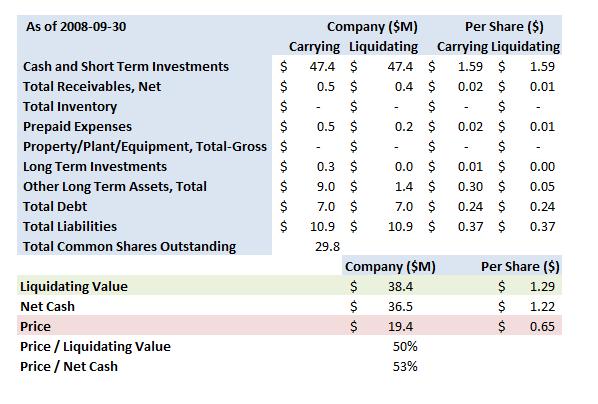
Avigen, Inc. (NASDAQ:AVGN) is an interesting opportunity: a rare net cash stock with an activist investor in pursuit. Based on its December 1, 2008 closing price of $0.65, the company has a market capitalization of $19.4M and net cash (i.e. cash less all liabilities) of $36.5M, which means that AVGN is trading at 53% of its net cash. Biotechnology Value Fund LP owns around 29% of the outstanding stock and has filed a 13D/A notice (most recent is here) requesting that AVGN “immediately reduce its expenses to as low a level as possible, partner or sell its remaining assets without further investment and take actions to distribute to [AVGN]’s stockholders as much of the resulting cash as possible.”

About AVGN

AVGN (website here) is a “biopharmaceutical company engaged in developing and commercializing small molecule therapeutics to treat neurological and neuromuscular disorders.”

The value proposition

According to AVGN’s most recent quarterly report, the company is bleeding cash, losing $9.4 in the September quarter. AVGN lost $25.2M last year and $24.3M in 2006. It has also had negative Cash Flow from Operating Activities for the September quarter in the amount of $8.4M. The company does, however, have a substantial amount of cash on its balance sheet. Set out below is our summary analysis (the “Carrying” column shows the assets as they are carried in the financial statements, and the “Liquidating” column shows our estimate of the value of the assets in a liquidation):

avgn-summaryAVGN is a net cash stock, with $1.22 of net cash (cash after subtracting Total Liabilities). With its stock price at $0.65, AVGN is trading at a little over half its net cash value. We estimate AVGN’s value in a liquidation at around $38.4M ($1.29 per share).  Given its net cash position of $36.5M or $1.22 per share, this means we have valued the rest of the company’s assets in liquidation at only $1.9M or $0.07 per share.

The catalyst

Biotechnology Value Fund originally filed a 13G notice in relation to AVGN, which indicates a passive investment. By updating to a 13D, Biotechnology Value Fund has indicated that it intends to take an active role in the company. An earlier 13D filing sets out Biotechnology Value Fund’s attitude towards the company:

“At the invitation of the Chairman of [AVGN], [Biotechnology Value Fund] articulated their views regarding the future of the Company in a conference call with the Board of Directors held on October 30, 2008. [Biotechnology Value Fund] stated their strong belief that [AVGN] should immediately reduce its expenses to as low a level as possible, partner or sell its remaining assets without further investment and take actions to distribute to [AVGN]’s stockholders as much of the resulting cash as possible. [AVGN] reported $56 million, or $1.88 per share, of financial assets as of September 30, 2008, consisting of cash, cash equivalents, available-for-sale securities and restricted investments.

[Biotechnology Value Fund] informed the Board of Directors that they think that the previously announced plan of spending [AVGN]’s remaining cash on the development of its early-stage pain drug, AV411 as well as [AVGN]’s corporate infrastructure is fundamentally flawed, especially in light of the current environment for raising additional capital. [Biotechnology Value Fund] believe that AV-411 is a high risk drug candidate that is best developed (if at all) by a larger company with greater financial resources and a lower cost of capital. By the time AV-411 could be commercialized, or even definitively proven safe and efficacious, [AVGN]’s existing cash resources would be depleted. [Biotechnology Value Fund] believe that the investment community clearly lacks confidence in such a plan, as evidenced by recent reports from stock analysts and by the $0.61 per share closing price of [AVGN]’s common stock on October 30, 2008, reflecting only 31% of [AVGN]’s financial assets as of September 30, 2008.

[Biotechnology Value Fund] intend to work with [AVGN]’s Board of Directors to effecuate a prompt return of cash to [AVGN]’s stockholders and intend to bring the matter directly to a vote of stockholders if their efforts with the Board of Directors are unsuccessful.”

Conclusion

It’s always exciting to find a net cash stock with an substantial stockholder demanding a return of cash. While it’s frightening to see AVGN hemorrhaging cash, Biotechnology Value Fund is awake to the opportunity to salvage what remains of the company’s value. If Biotechnology Value Fund is able to cause the company to quickly distribute the company’s remaining cash to stockholders, purchasers at these levels should see a good return on investment.

AVGN closed today at $0.65.

The S&P 500 Index closed at 816.21.

[Disclosure: We do not presently have a holding in AVGN. This is neither a recommendation to buy or sell any securities. All information provided believed to be reliable and presented for information purposes only.]

Read Full Post »
Barnwell Industries, Inc. (AMEX:BRN) is exactly the kind of opportunity Greenbackd likes to find: a company trading at a discount to its liquidating value with an activist investor agitating for change. We estimate the company has a value in liquidation of around $55M, so its market cap of $29M (based on its November 28, 2008 close of $3.51) puts the company at a 46% discount to that value. Dr. Eric Jackson’s Ironfire Capital LLC, an “equity long biased and event-driven activist investment firm”, has sniffed the value and launched a “‘friendly’ activist campaign targeting the company to unlock shareholder value”.

About BRN

BRN, according to its website, is “principally engaged in the following activities:

  • Oil and Natural Gas. Barnwell engages in oil and natural gas exploration, development, production and sales in Canada.
  • Land Investment. Barnwell invests in leasehold interests in real estate in Hawaii.
  • Real Estate Development. Established in January 2007, acquires house lots for investment and for the construction of turnkey single-family homes for sale”

Seems like an odd combination of businesses to us, which makes it a prime candidate for a bust up.

The value proposition

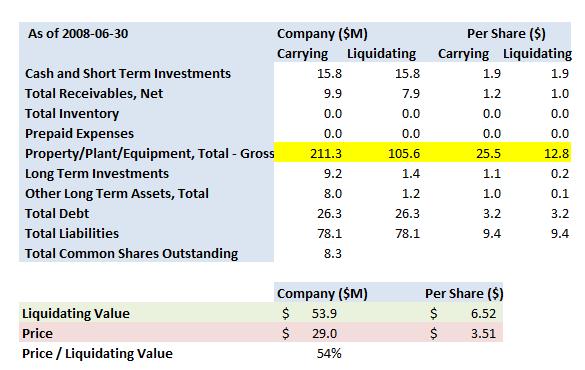
According to BRN’s most recent quarterly report, BRN has a reasonably healthy balance sheet and positive cash flow of operating activities of $8.7M for the three months ending June 30, 2008. Set out below is our summary analysis of the balance sheet (each “Carrying” column shows the assets as they are carried in the financial statements, and each “Liquidating” column shows our estimate of the value of the assets in a liquidation):

BRN Summary

Our liquidating value estimate for BRN is around $53.9M, or $6.52 per share. As the table above demonstrates, most of BRN’s value is in its Property, Plant, and Equipment, which is carried at $25.50 per share. In our valuation, we’ve written down BRN’s Property, Plant and Equipment per share by 50% to $12.75. Our written down value for the other assets is set out in the table. These estimates are often too conservative, but it is the only way we get to sleep at night. This is especially so given that the company is carrying $26M in total debt. With its stock price at $3.51 (at its November 28, 2008 closing price), BRN is trading at 54% of its value in a liquidation, which strikes us as a sufficient margin of safety.

The catalyst

Ironfire Capital has a position in BRN but it is presumably too small to require Ironfire to file a 13D notice.  Its founder, Dr. Eric Jackson, perhaps best known for his Yahoo! campaign, has published a number of “prescriptions” for BRN to enhance shareholder value on the web. Ironfire Capital is an interesting activist investor because it uses “Internet-based social networking tools” to “amplify the impact” of its campaigns. Dr. Jackson also writes a blog about his particular brand of web-based shareholder activism called Breakout Performance and has provided his analysis of BRN in a June post. He has also written about his prescriptions for BRN on his Sharehowner Activism Wiki, which include the following:

Simplify Corporate Structure

Barnwell’s three businesses (oil and gas, contract water drilling, and real estate/land investment) have no synergy. A simpler corporate structure would better allow the market to bid up the underlying value of the oil and gas business to reflect the doubling of the commodity pricing in the last year. Barnwell should sell its water drilling business, which is small and shrinking in revenues and earnings. If the company received 1x its revenues, its cash reserves would nearly double to $14MM, allowing a stock buyback and/or upping the dividend. Selling or spinning off the real estate business might also make sense to focus Barnwell as a small natural gas pure-play.

Reduce SG&A Costs

Over the last year, SG&A costs have gone up 50% to $3.2MM. Yet, revenues and gross profit only increased 28% and 27% respectively over that same period. Barnwell is growing its costs at twice the rate of its sales and profits. As they say in Business School, that’s not sustainable. It’s also not acceptable for a 65 person company. Selling off the water drilling business, which contributes little profit, is a step in the right direction to improving things here, but much more work is needed.

Do a Stock Buyback

The company did agree to pay out a 5 cent dividend recently. Hopefully, that will attract a new group of investors to the stock. However, a stock buyback is both prudent, given that the cash position has increased over the last year and the strength of gas and land development businesses, and would make the company more attractive by lowering further its price-earnings ratio.

Bring in Some New Blood to the Board

Barnwell’s board is large and long-tenured. RiskMetrics awarded Barnwell a Corporate Governance Quotient (CGQ) score that is lower than 70% of other energy companies. The board’s composition is part of the problem. Seven of the 11 directors are older than 64. Four of the directors have been on the board for more than a decade.

It makes sense to change the composition of the board. Some of the longstanding directors should step down now to make way for some new blood, but some of them shouldn’t be replaced. An 11-member board is too large for a $100MM company. Having fewer than 10 directors would lead to faster meetings with more participation and debate.

Better Align Executive Compensation with Performance

Executive compensation policy has also likely contributed to Barnwell’s lower CGQ score. Last year, the CEO was paid $1.2MM. He explained this by pointing to how the company’s profits increased by 200% that year, yet the stock price dropped in half over that same time. Stock price is due to external market conditions, not management. If a CEO doubles a company’s profit, that should be rewarded.”

Conclusion

At 54% of its written down value, BRN is very cheap. With Ironfire Capital agitating for change, we believe BRN presents an attractive opportunity for investment.

BRN closed on November 28, 2008 at $3.51. The S&P 500 Index closed on November 28, 2008 at 896.24.

[Disclosure: We do not presently have a holding in BRN. This is neither a recommendation to buy or sell any securities. All information provided believed to be reliable and presented for information purposes only.]

Read Full Post »
« Newer Posts