Feeds:
Posts
Comments

Archive for the ‘Stocks’ Category

In The value of Seth Klarman (free registration required), Absolute Return has a rare interview with the president and portfolio manager of the 28-year-old Baupost Group. In the interview, Klarman discusses several of Baupost’s positions over the last twelve months, including the fund’s stake in Facet Biotech, which I fumbled last year:

Around the same time the CIT deal was playing out, Klarman took a sizable stake in Facet Biotech—a small biotech company spun off in December 2008 from PDL BioPharma—for an average cost of $9 even though it had $17 per share in net cash at the time of the spinoff. “We liked the discount and pipeline of products,” Klarman recalls. “We knew that when small caps are spun off, they are frequently ignored and become cheap.”

Biogen Idec tried to acquire Facet in a hostile deal for $14.50 per share, raising the offer later to $17.50. When Facet allowed its largest shareholder, Biotech Value Fund, to buy up to 20% of the company, Baupost asked for identical terms, essentially becoming a poison pill. Baupost then told Facet it did not intend to tender its shares in the $17.50 per share offer. Eventually Biogen backed off, and Facet accepted a $27 per share offer from Abbott Laboratories.

Here Klarman discusses his strategy more broadly:

Value investors are typically thought of as stock investors, but Klarman says most of the time he prefers to buy bonds. Bonds are a senior security, offering more safety, and they have a catalyst built into them. Unlike equity, debt pays current principal and interest. If the issuer doesn’t make that timely payment, an investor can take action. “Catalysts can reduce your dependence on the level of the market or action of the market,” he explains. For example, defaults are specific incidents affecting the company regardless of what is going on in the overall market.

Over the past two years, Klarman’s preference for debt has been even more pronounced. After peaking at just $2 billion in June 2008, Baupost’s total equity assets shrank to around $1.2 billion from the fourth quarter of 2008 to the first half of 2009, before turning up slightly at year-end 2009 to nearly $1.6 billion. That puts equities at just a little more than 7% of total assets under management.

And his view on the market

The value pro is still looking at troubled companies, mortgage securities and select equities. But he is not buying much at the moment. Klarman says there are some opportunities in commercial real estate on the private side, but not as much as would be expected, given the depressed levels of the market. “That’s why we want to be patient,” he stresses.

Baupost is 30% in cash now, its long-time average. Klarman stresses that the cash position is residual—the result of a search for opportunity and not the result of a macro view. He says he can find great opportunities to buy at the same time he has a bearish view on the world. “We’re good at finding bargains, good at doing analysis,” he emphasizes. “We’re not good at calling short-term movements in the markets.”

And when the markets started to crumble in mid-May, he mostly stood pat, asserting that the 5% to 8% drop in prices did not unleash a torrent of bargains, mostly because of the market’s surge from its March 2009 bottom. “The market has gone up so much that, based on valuation, it is overvalued again to a meaningful degree where the expected returns logically from here can be as low as the low single digits or zero for the next several years,” he says.

Click here to see the remainder of the interview (free registration required).

Read Full Post »

In his 2003 Annual Meeting, Mohnish Pabrai discussed his thesis for his investment in Frontline Ltd (USA) (NYSE:FRO). I see a number of parallels between HAWK now and FRO then. Here is an extract from the transcript:

Frontline (FRO) is company I’d like to talk about because it is an interesting datapoint on how I look at businesses. Frontline is in the crude oil shipping business. About 2 and half years ago if you asked me if I had any competency or knowledge of the crude oil shipping business, I would say that I knew nothing about the business or industry. In 2001, I was just looking at a list of companies that had high dividend yields. One of the screens I look at is companies with high dividend yields, which sometimes means some sort of overhang which is dropping the price below where it should be.

If I looked at Value Line today, I would probably find three or four companies that have a dividend yield of 10%-12%. In 2001 I noticed there were two companies with a dividend yield over 15%. Both were in the crude oil shipping business. One was called Knightsbridge (VLCCF). I wanted to understand why they had such a high dividend yield. So I spent about a month studying the crude oil shipping business.

When Knightsbridge was formed a few years ago, they ordered a few oil tankers from a Korean ship yard. Each of these VLCCs (Very large Crude Carrier) and Suezmaxes costs about $50-70 million a piece and it takes 2-3 years to build one. The day the tankers were delivered they had a long term lease with Shell Oil. The deal was that Shell would pay them a base lease rate (say $10,000 a day per tanker) regardless of whether they used them or not. On top of that, they paid them a percentage of the delta between a base rate and the spot price for VLCC rentals.

For example, if the spot price went to $30,000/day, they might collect $20,000 a day. If the spot was $50,000/day, they’d collect say $35,000/day etc. The way Knightsbridge was set up, at $10,000 a day; they were able to cover their principal and interest payments and had a small positive cash flow. As the rates went above $10,000, there was a larger positive cash flow and the company was set up to just dividend all the excess cash out to shareholders – which is marvelous. I wish all public companies did that.

When tanker rates go up dramatically, this company’s dividends goes through the roof. This happened in 2001 when tanker rates which are normally $20,000-$30,000 a day went to $80,000 a day. They were making astronomical profits at the time and the dividend yield went through the roof – but of course it was not durable or sustainable.

That’s why the stock didn’t jump up significantly. Then next week it could drop. It is a very volatile business. But I studied the business because I was just curious. But in investing, all knowledge is cumulative and makes the analytics much faster the next time around. At the time I studied Knightsbridge I also took a look at half a dozen other publicly traded pure plays in oil shipping.

Last year, we had an interesting situation take place with one of these oil shipping companies called Frontline (FRO). Frontline is a company that is the exact opposite business model of Knightsbridge. They have the largest oil tankers fleet in the world, amongst all the public companies. The entire fleet is on the spot market. There are very few long term leases. They ride the spot market on these tankers.

Because they ride the spot market on these tankers, there is no such thing as earnings forecasts or guidance. The company’s CEO himself doesn’t know tomorrow what the income will be quarter to quarter. This is great because whenever Wall Street gets confused, it means we can make money. This is a company that has widely gyrating earnings.

Oil tanker rates have varied historically between $6,000 a day to $80,000 a day. The company needs about $18,000 a day to break even. Once rates go below $18,000 a day, they are bleeding red ink. Once they go above $18,000, about $30,000-$35,000, they are making huge profits. In the third quarter of last year, oil tanker rates collapsed. There was a recession in the US, and a few other factors causing a drop in crude oil shipping volume. Rates went down to $6,000 a day. At $6,000 a day, Frontline is bleeding red ink badly. The stock appropriately went from $11 a share to about $3, in about 3 months.

If you spent some time studying Frontline, you would find that they have 60 or 70 ships, and while the rates had collapsed for daily rentals, the price per ship hadn’t changed much, dropping about 10% or 15%. There was a small drop in price per ship, but nowhere near the price the stock had dropped; the stock had dropped over 70%.

Slide 27

Frontline has a liquidation book value of about $16.50 per share, which means if they simply shut down the business sell all their ships, shareholders would get about $16 a share. If you take the collapsed ship price, you would still get $11 per share. If one could buy the entire business for $3/share, one could turn around the next day and sell the ships and clean up. While the stock was at $3, the company insiders were furiously buying shares.

When you looked at the numbers, they had plenty of cash. They could handle $6000/day rates for several months without a liquidity crunch. Also, if they sell a ship, they raise $60-70 million. The total annual interest payments are $150 million. If the income went to $0, they could sell a few ships a year and keep the company going.

In addition there is a feedback loop in the tanker market. There are two kinds of tankers. There double hull and single hull tankers. After the Exxon Valdez spill, all sorts of maritime regulations were instituted requiring all new tankers to be double hull after 2006 because they are less likely to spill oil. The entire Frontline fleet is double hull tankers.

But there’s a huge number of these single hull rust buckets built in the 1970s. If the double hull tanker spot rate is at $30,000 a day, the single hull tanker is at $20,000 a day. Oil that gets shipped from the Middle East to China or India, for example, is on single hull tankers. But Shell or Mobil, etc., will avoid leasing a single hull tanker because it is an enormous liability if they have a spill. The third world is nonchalant about importing oil on single hull tankers, and all the double hull tankers come to Europe and the West. But when rates go to $6,000 a day, the delta between single and double hull disappears.

The single hull tankers stop being rented because there’s no significant delta in the daily rate. Everyone shifts to double hull tankers at that point. The single hull tanker fleet goes to zero revenue in a $6,000 a day rate environment. When it goes to zero revenue, all these guys who own the single hull tankers get jittery; they can sell these tankers to the ship breakers and get a few million dollars instantly. They know that by 2006 their ability to rent them will decline substantially. There is a dramatic increase in scrapping rate for single hulled tankers whenever rates go down.

It takes four years to build a new tanker, so when demand comes back up again, inventory is very tight. There is a definitive cycle. When rates go as low as $6,000 and stays there for a few weeks the rise to astronomically high levels – say $60,000/day is very fast. With Frontline, for about seven or eight weeks, the rates stayed at under $10,000 a day and then spiked to $80,000 a day in Q402.

Slide 28

I started buying around here ($5.90). Again, not smart enough to buy at the very bottom. I bought on average price at a price of $5.90 per share, which is about half of the $11/$12 per share you would get in a liquidation. Now Frontline’s price is about $20 a share because tanker rates are at $60,000 a day – people are in a euphoric/greedy state. But once we got past $9, approaching $10, I started to unload of the shares. The whole thing happened in a very short time period – resulting in a very high annualized rate of return.

Slide 29

We had a 55% return on the Frontline investment and an annualized rate of return of 273%. Frontline is a good example of why I am hesitant to share ideas because we will see this again. Oil tanker rates will go down and at the last meeting a bunch of investors told me, “We are watching now.” The more people that are tuned in, once it gets to $8 or $9, the more the buying – reducing our gains. But that is an example of a Special Situation investment in a company with negative cash flow.

Read Full Post »

Update: Links to Ben’s post have been fixed.

In September last year Ben Bortner provided a guest post on Seahawk Drilling (NASDAQ: HAWK). I said at the time that HAWK was not a typical Greenbackd stock, but it warranted consideration at a discount to Ben’s estimate of liquidation value. HAWK has been cut in half since Ben’s post for reasons unforeseeable at the time (see Ben’s excellent September post for the background) and it seems to be living in interesting times, which makes it a typical Greenbackd stock, to wit:

HAWK was cheapish before BP filled the Gulf of Mexico with oil and golf balls (to paraphrase Wyatt Cenac on The Daily Show, BP’s challenge now is to remove the impurities from the Gulf, namely the dead shrimp and the seawater). Prior to the spill, low natural gas prices and the credit crunch led to reduced fleet utilization and day rates that had hurt drillers in the Gulf of Mexico generally. Several problems specific to HAWK – a largish Mexican tax dispute and older jackup rigs in an environment where a slew of new rigs are in production – made it cheaper still. BP’s oil spill and the accompanying regulatory uncertainty have caused a perfect storm for HAWK, which may lead to a liquidity crisis. In short, that’s why I like it. The mere absence of bad luck should see this stock trade higher.

It looks very interesting at a big discount to liquidation value. At its $12 close yesterday HAWK has a market capitalization of $142M, which is 30% of its $443M or $36.6 per share in tangible book value as at March 31. It’s got $6.5M in debt and $73M in cash and short term investments. Cash burn is around $10M per quarter if demand for the rigs doesn’t pick up. The moratorium on drilling applies to deep-water drillers, and HAWK’s rigs are shallow water rigs, so permitting is not the reason for the cash burn – it’s insurance and overcapacity. That said, it seems that demand for HAWK’s rigs is improving.

On the other hand, here’s the bear case from August last year on HAWK’s prospects in less interesting times.

[Full Disclosure: I hold HAWK. This is neither a recommendation to buy or sell any securities. All information provided believed to be reliable and presented for information purposes only. Do your own research before investing in any security.]

Read Full Post »

Lawndale Capital Management, LLC filed an amended 13D on May 26 for its holding in P & F Industries Inc (NASDAQ:PFIN). Lawndale has been lobbying PFIN regarding “certain operational and corporate governance concerns that include, but are not limited to, what Lawndale believes to be excessive compensation paid to PFIN’s Chairman and CEO, Richard Horowitz, for poor performance. This further leads to serious concerns regarding the Board’s current composition and independence.”

Lawndale’s 13D exhibits its May 25 letter to PFIN board, which also annexes Proxy Governance’s Comparative Performance Analysis of PFIN. It is well worth reading.

Purpose of the Transaction

Extracted from the most recent 13D filing:

On May 25, 2010, Lawndale sent PFIN’s Board a letter (a copy of which is attached at Exhibit B hereto, and incorporated by reference to this filing) informing them of Lawndale’s intent to vote 272,812 shares, equal to 7.5% of eligible shares to “WITHOLD authority for ALL NOMINEES” on Proposal 1, Election of Directors, at PFIN’s annual meeting scheduled for June 3 2010 and noting independent proxy advisory services, Proxy Governance and RiskMetrics also recommended voting to “WITHHOLD ALL” and WITHHOLD Dubofsky”, respectively. (a copy of the Proxy Governance recommendation is attached as part of this exhibit)

As disclosed in greater detail in the letter, among the reasons for its vote, Lawndale cited the following:

· For P&F’s Small Size And Business Structure, Horowitz’ Compensation Is Wholly Inappropriate

· The Only Shareowner That Has Benefited From The Horowitz Era Has Been Horowitz

· P&F’s Board Requires Increased Independence Via New Directors From Outside “The Club”

At the invitation of the Nominating Committee Chairman, Marc Utay, in February 2010 Lawndale submitted the names and backgrounds of five highly qualified and independent individuals for possible addition to P&F’s Board. Although these nominations were made long before the deadline for setting PFIN’s slate and Proxy for the upcoming June 3 Annual Meeting, none of Lawndale’s suggested nominees appeared on PFIN’s final Proxy. Lawndale was recently informed that two of its nominees have been invited to meet with certain members of the Board in the week following PFIN’s Annual Meeting.

It is the view of Lawndale that a board comprised of qualified directors who are independent, and whose interests are better aligned with shareholders via meaningful purchased equity ownership, would more objectively and aggressively oversee the compensation and corporate acquisition decisions of PFIN.

Lawndale believes the public market value of PFIN is undervalued by not adequately reflecting the value of PFIN’s business segments and other assets, including certain long-held real estate.

While Lawndale acquired the Stock solely for investment purposes, Lawndale has been and may continue to be in contact with PFIN management, members of PFIN’s Board, other significant shareholders and others regarding alternatives that PFIN could employ to maximize shareholder value. Lawndale may from time to time take such actions, as it deems necessary or appropriate to maximize its investment in the Company’s shares. Such action(s) may include, but is not limited to, buying or selling the Company’s Stock at its discretion, communicating with the Company’s shareholders and/or others about actions which may be taken to improve the Company’s financial situation or governance policies or practices, as well as such other actions as Lawndale, in its sole discretion, may find appropriate.

About PFIN

PFIN operates in two primary lines of business, or segments: tools and other products (Tools) and hardware and accessories (Hardware). The Company conduct its Tools business through a wholly owned subsidiary, Continental Tool Group, Inc. (Continental), which in turn operates through its wholly owned subsidiaries, Florida Pneumatic Manufacturing Corporation (Florida Pneumatic) and Hy-Tech Machine, Inc. (Hy-Tech). The Company conducts its Hardware business through a wholly owned subsidiary, Countrywide Hardware Inc. (Countrywide), which in turn operates through its wholly owned subsidiaries, Nationwide Industries, Inc. (Nationwide), Woodmark International, L.P. (Woodmark) and Pacific Stair Products, Inc. (Pacific Stair).

[Full Disclosure:  I do no hold PFIN. This is neither a recommendation to buy or sell any securities. All information provided believed to be reliable and presented for information purposes only. Do your own research before investing in any security.]

Read Full Post »

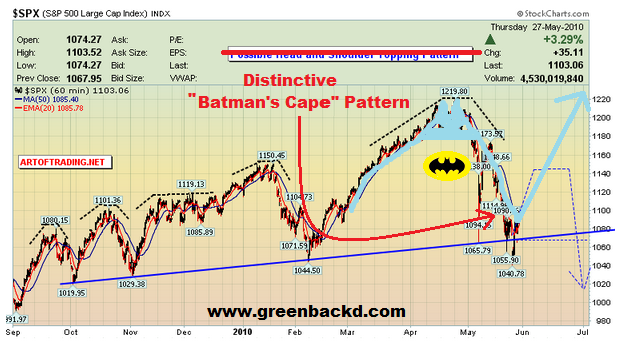
Josh at The Reformed Broker breaks out a chart showing “a blueprint for a potential head-and-shoulders topping formation with either the S&P or the DJIA currently sitting at the neckline.” Here’s the chart:

Josh says the ”right shoulder is coming’ meme will eventually go mainstream.” I’m no chartist, but when I stare at that chart, I have to admit that I don’t see the head-and-shoulders formation. I see something else. I see Batman’s cape:

I remember the old “Bat cape” trade of March ’09. When you see the Bat symbol, get on the right side of Batman.

Read Full Post »

Andrew Shapiro, President of Lawndale Capital Management, has provided today’s guest post on Reading International Inc (NASDAQ:RDI):

Exhibitor Reading Int’l – Cashing in on Aussie Land Boom – getting the movies for free.

Movie box office isn’t the only business that’s popping for theater exhibitor Reading International (NASDAQ: RDI) these days. In fact, a resurging property boom in Australia, particularly in Melbourne, is likely to have a greater effect on Reading’s near term market value than Avatar, Alice, Shrek or anything else on the silver screen.

That’s because Reading isn’t just a 466-screen exhibitor that has the 3rd, 4th, and 12th largest share in Australia, New Zealand, and the US, respectively.  Reading also owns valuable real estate parcels that have appreciated, in some instances, for over more than a decade, from surrounding population growth, substantial up-zoning, construction, lease-up and, of course, inflation.

It important to note that, at $4/share, the entire company’s market cap is $91MM.  Book value, at almost $5/share, is understated for all the appreciation on Reading’s real estate.  Extracting the value of Reading’s real estate from its enterprise value imputes a very low—possibly even negative—multiple on Reading’s cinema business.  In essence, you buy the land and get the movie business “for free”.

At its recent annual meeting, Reading made a slide presentation filed as an 8-K with the SEC. This presentation besides highlighted 2009’s record growth and an outstanding Q1 2010, illustrated, among other things, how Reading’s EV/EBITDA valuations were already equal to or somewhat less than comparable companies in both industry segments (see pages 7 and 9).

Per Reading’s 2009 10-K, its Real Estate segment is 49% or $197.MM of the company’s assets.  These assets include fee ownership of approximately 16.5mm sq. ft. of real estate comprised of 1.2 million sq ft. of cash flow generating commercial real estate, and approximately 15.3 million sq. ft. of land to be developed and built upon in the future. So almost 93% (15.3 sq. ft./16.5 sq ft) of Reading’s real estate assets presently do not yet contribute to Reading’s present $36MM adj EBITDA (LTM March 31, 2010).

The substantial amount of assets carried in Reading’s enterprise value that don’t contribute EBITDA is why the Reading’s recent decision to list for sale its large and unencumbered 51-acre Burwood Square development parcel in Melbourne is a major near-term catalyst that should shed light on Reading’s deep stock market undervaluation.

Purchased by Reading in 1996, the Burwood land has enjoyed almost 15 years’ worth of appreciation due to inflation, surrounding population growth, and substantial up-zoning.  Burwood is on Reading’s balance sheet for only $47MM, and represents the largest unrealized gain of any of Reading’s eight major undeveloped parcels, which together comprise 130 acres, have a gross book value of $70MM and don’t presently contribute to EBITDA.

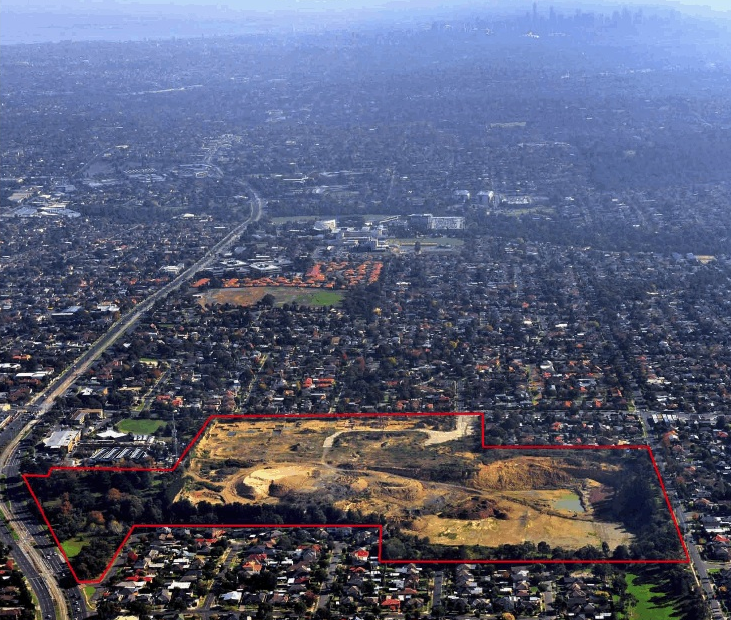
Acquired when it was nothing more than a rock quarry and zoned industrial, Burwood Square is now one of the last prime developable sites fairly close to Melbourne’s central business district. Indeed, the parcel was, until recently, part of a mixed-use development plan that was to include commercial, retail, and entertainment space, and 700-1000 residences.

However, there now appears to be good reason for the parcel to have an increased residential component – perhaps more than 2000 residences.  According to an article in a leading Melbourne paper, Burwood-area homeowners are seeing enormous growth from the steady rise in demand caused by housing requirements of nearby Deakin University and an influx of Chinese residents/students. It should be noted that student housing demand is less cyclical than most.

A detailed Information Memorandum (.pdf) (a sales “teaser”) on the Burwood parcel has recently been posted on Reading’s website. The teaser includes some amazing aerial photos clearly showing how Melbourne’s burgeoning population has migrated over the years to completely surround this crown jewel of Reading’s real estate holdings.  In addition, the memo sets forth that indications of interest, including buyer’s offer price, conditions and credentials and plans, are to be provided by end of day, June 28 and that Reading will short list its candidates by July 5th.

The sale of Burwood would convert a parcel, which comprises almost ¼ of Reading’s real estate asset book value, and unlock substantial embedded unrealized gain, into cash.  Investors ought to more easily reflect the intrinsic value of both of Reading’s business segments after monetizing Burwood and selling or developing other Reading non-EBITDA-generating parcels with a higher stock price.

Andrew also provided a link to the detailed Information Memorandum on the Burwood parcel (.pdf), which includes photos “making it clear how valuable this parcel is and what kind of embedded gain it represents.” Here is a sample photo:

[Full Disclosure:  I hold RDI. This is neither a recommendation to buy or sell any securities. All information provided believed to be reliable and presented for information purposes only. Do your own research before investing in any security.]

Read Full Post »

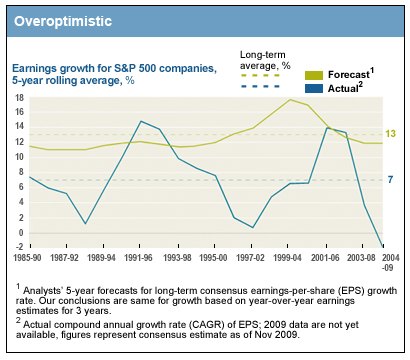
A lesson on the perils of projecting earnings from the Harvard Business Review’s The Daily Stat:

For the past quarter century, equity analysts’ earnings-growth estimates have been almost 100% too high. Their overoptimistic projections have generally ranged from 10% to 12% annually, compared with actual growth of 6% (excluding the spike in growth from 1998–2001), according to McKinsey research. Only in strong-growth years such as 2003 to 2006 did forecasts hit the mark.

As Robert Bruce says (via The Fallible Investor):

Perhaps the most surprising thing to me is the inability of even market professionals to adjust for profit margins. People will talk about how the P/E ratio is reasonable at 19 times without mentioning that it is 19 times the highest profit margins ever recorded. The least we can do, as professionals, is to normalise between economic boom and economic bust, between low profit margins such as those in 1982 when they were ½ normal and very high profit margins such as those of today. A lot of people think profit margins can be sustained. Profit margins are the most mean-reverting series in finance.

For more, see the McKinsey Quarterly’s Equity Analysts: Still too bullish.

Read Full Post »

BigBand Networks Inc (NasdaqGM:BBND) is interesting activist situation with ValueAct’s small cap fund holding 11% of its outstanding shares. I’d like to talk to someone who knows about BBND and its industry. You can reach me at greenbackd [at] gmail [dot] com.

About BBND

BBND develops, markets and sells network-based platforms that multiple system operators (MSOs) and telecommunications companies to offer video services across coaxial, fiber and copper networks. The Company’s customers are using its platforms to expand high-definition television (HDTV) services and ensure video advertising programming to subscribers. The Company’s Broadcast Video, TelcoTV and Switched Digital Video solutions comprises a combination of its modular software and programmable hardware platforms. The Company sells its products and services to customers in the United States and Canada through its direct sales force. The Company sells to customers internationally through a combination of direct sales and resellers. Its international resellers include Guangdong Tongke, Sugys and Ssangyong, who sell to end users such as Jiangsu Cable and LG Powercom.

Value proposition in summary

BBND’s tangible book value at 31 March was $142M or $2.10 per share (~80% of BBND’s assets are cash and short term investments and it has no debt). It closed yesterday at $2.81, giving it a market capitalization of $190M. The top line has fallen off a cliff, down from $185M in 2008 to $127M in the twelve months  Cash from operations has fallen even more precipitously, down from $48.8M in 2006 to $1.4M in the twelve months to 31 March. CapEx has run at $4.9M over the last twelve months and was $4.6M in 2009.

Activist catalyst

ValueAct is an exceptionally well-performed activist investor. As Davy Bui notes in this article:

ValueAct Capital [is] one of the elite activist funds, who as a group averaged gains of 144% in companies where they filed 13D forms.

According to the most recent 13D filed 18 May, as at 10 May ValueAct Capital held 11% of BBND’s outstanding capital in its SmallCap Master Fund. BBND released results on 7 May and the stock has fallen 20% since. ValueAct has continued to buy heavily, so clearly sees value at these prices.

Conclusion

There’s plenty of volume in this stock at these prices, so I’d love to talk to someone who understands BBND and the industry. Please get in touch at greenbackd [at] gmail [dot] com.

Read Full Post »

Following on from the Klarman sees another lost decade for stocks post, here are the full notes of Seth Klarman’s interview with Jason Zweig at the CFA Institutes Annual Conference (via ZeroHedge):

Read Full Post »

Saj Karsan has provided the following guest post on New Frontier Media, Inc. (NASDAQ:NOOF). Saj regularly posts Stock Ideas for Barel Karsan, and runs Karsan Value Funds, a private investment fund focused on value stocks. Here’s his take on NOOF:

Value investors are constantly on the look-out for businesses with “moats” that the competition cannot displace. Usually, this is the result of a competitive advantage that cannot be copied. But perhaps it can also be the result of being in a business that is shunned to the extent that no quality management wants to copy it.

Consider New Frontier Media (NOOF), producer and distributor of pornographic movies. The company has deals in place with the major cable providers which allows them to beam millions of dollars worth of adult pay-per-view content into homes throughout America and the world. Despite being a business that appears to be easily replicated, the company has enjoyed surprisingly good margins (approaching 20% on average) and returns (5-year ROE > 12%), beating up on its primary competitor, Playboy Enterprises (PLA).

Despite this, the company appears to trade at a substantial discount. New Frontier’s market cap is just $38 million, while the company has earned operating income far in excess of that in the last four years alone, even after including a $12 million goodwill write-down that caused the company’s 2009 net income to be negative. In addition, the company has $15 million of cash against just $3 million of debt.

The future is not without challenges, however. As consolidation in the cable industry throughout the United States has taken place, New Frontier’s customers have become more concentrated and powerful. As a result, New Frontier’s business would take a substantial hit if one of these operators switched to a different provider. More immediately, however, this has allowed the cable operators to push New Frontier on price, reducing domestic margins.

Furthermore, while the company’s founder Michael Weiner (which could also pass for a screen-name in this business) is still the chief executive, his annual salary and bonus dwarf his stock ownership in the company, which doesn’t say a lot for the company’s incentive structure. Nevertheless, the company has succeeded for years with Weiner at the helm, and shareholders appear to be offered a price at this level with a substantial margin of safety.

We first discussed this company a few months ago here.

Disclosure: Author has a long position in shares of NOOF

[Full Disclosure:  I do not have a holding in NOOF. This is neither a recommendation to buy or sell any securities. All information provided believed to be reliable and presented for information purposes only. Do your own research before investing in any security.]

Read Full Post »

« Newer Posts - Older Posts »