Feeds:
Posts
Comments

Archive for the ‘Activist Investors’ Category

Farukh Farooqi, long-time supporter of Greenbackd, founder of Marquis Research, a special situations research and advisory firm (for more on Farukh and his methodology see The Deal in the article “Scavenger Hunter”) and Greenbackd guest poster (see, for example, Silicon Storage Technology, Inc (NASDAQ:SSTI) and the SSTI archive here) has launched a blog, Oozing Alpha. Says Farukh:

Oozing Alpha is a place to share event driven and special situations with the institutional investment community.

We welcome and encourage you to submit your top ideas (farukh@marquisllc.com).

The only limitation we impose is that your recommendations should not be widely covered by the sell side and must not have an equity market capitalization greater than $1 billion.

The ideas will no doubt be up to Farukh’s usual high standards. The blog is off to a good start: the color scheme is very attractive.

Read Full Post »

In the Spring 1999 Piper Jaffray produced a research report called Wall Street’s Endangered Species by Daniel J. Donoghue, Michael R. Murphy and Mark Buckley, then at Piper Jaffray and now at Discovery Group, a firm founded by Donoghue and Murphy (see also Performance of Darwin’s Darlings). The premise of the report was that undervalued small capitalization stocks (those with a market capitalization between $50M and $250M) lacked a competitive auction for their shares and required the emergence of a catalyst in the form of a merger or buy-out to close the value gap.

In the first follow-up, Endangered species update: The extinct, the survivors, and the new watch list, from Summer 2000, Murphy and Buckley (Donoghue is not listed on the 2000 paper as an author) tested their original thesis and provided the “Darwin’s Darlings Class of 2000,” which was a list of what they viewed as “the most undervalued, yet profitable and growing small cap public companies” in 2000.

In the Fall of 2001, Donoghue, Murphy, Buckley and Danielle C. Kramer produced a further follow-up to the original report called Endangered Species 2001 (.pdf). Their thesis in the further follow up should be of particular interest to we value folk. Putting aside for one moment the purpose of the report (M&A research aimed at boards and management of Darwin’s darlings stocks to generate deal flow for the investment bank), it speaks to the very fertile environment for small capitalization value investing then in existence:

In the last few of years, many small public companies identified this [secular, small capitalization undervaluation] trend and agreed with the implications. Executives responded accordingly, and the number of strategic mergers and going-private transactions for small companies reached all-time highs. Shareholders of these companies were handsomely rewarded. The remaining companies, however, have watched their share prices stagnate.

Since the onset of the recent economic slowdown and the technology market correction, there has been much talk about a return to “value investing.” Many of our clients and industry contacts have even suggested that as investors search for more stable investments, they will uncover previously ignored small cap companies and these shareholders will finally be rewarded. We disagree and the data supports us:

Any recent increase in small-cap indices is misleading. Most of the smallest companies are still experiencing share price weakness and valuations continue to be well below their larger peers. We strongly believe that when the overall market rebounds, small-cap shareholders will experience significant underperformance unless their boards effect a change-of-control transaction.

In this report we review and refresh some of our original analyses from our previous publications. We also follow the actions and performance of companies that we identified over the past two years as some of the most attractive yet undervalued small-cap companies. Our findings confirm that companies that pursued a sale rewarded their shareholders with above-average returns, while the remaining companies continue to be largely ignored by the market. Finally, we conclude with our third annual list of the most attractive small-cap companies: Darwin’s Darlings Class of 2001.

Piper Jaffray’s data in support of their contention is as follows:

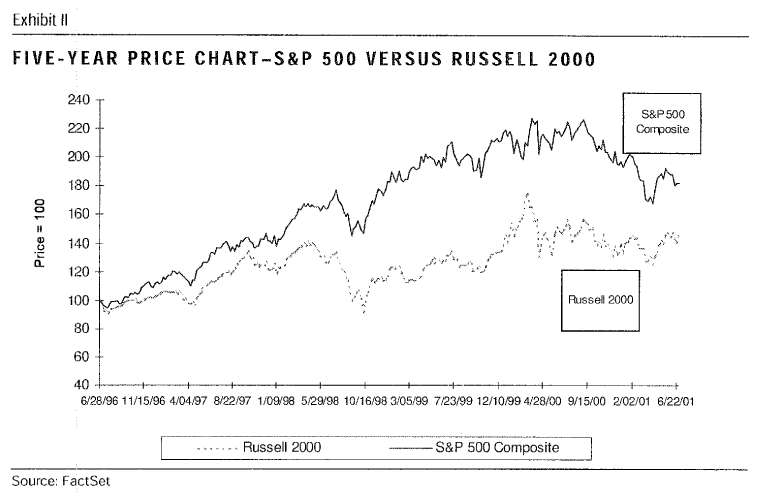
Looking back further than just the last 12 months, one finds that small-cap companies have severely lagged larger company indices for most periods. Exhibit II illustrates just how poorly the Russell 2000 compares to the S&P 500 during the longest bull market in history. In fact over the past five, seven and ten years, the Russell 2000 has underperformed the S&P 500. For the five, seven and 10 year periods, the S&P 500 rose 82.6 percent, 175.6 percent and 229.9 percent, respectively, while the Russell 2000 rose 47.9 percent, 113.4 percent, and 206.3 percent for the same periods.

The poor performance turned in by the Russell 2000 can be attributed to the share price performance of the smallest companies in the index. Our previous analysis has shown that the smallest companies in the index have generally underperformed the larger companies (see “Wall Streets Endangered Species,” Spring 1999). To understand the reasons for this differential, one must appreciate the breadth of the index. There is a tremendous gap in the market cap between the top 10 percent of the companies in the index, as ranked by market cap (“the first decile”) and the last 10 percent (“the bottom decile”). The median market capitalization of the first decile is $1.7 billion versus just $201.0 million for the bottom decile. There is almost an 8.0x difference between what can be considered a small cap company.

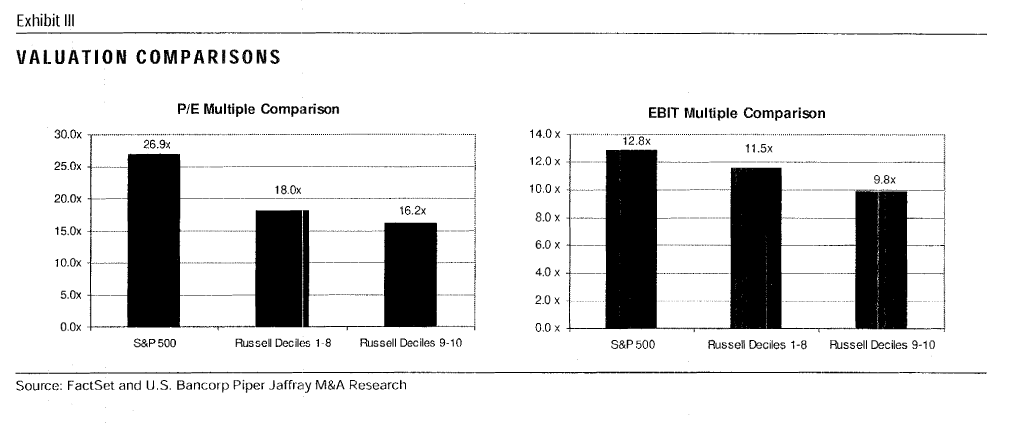
This distinction in size is important, because it is the smallest companies in the Russell 2000, and in the market as a whole, that have experienced the weakest share price performance and are the most undervalued. Exhibit III illustrates the valuation gap between the S&P 500 and the Russell 2000 indices. Even more noticeable is the discount experienced by the smallest companies. The bottom two deciles of the index are trading at nearly a 25 percent discount to the EBIT multiple of the S&P 500 and at nearly 40 percent below the PIE multiple on a trailing 12-month basis.

This valuation gap has been consistently present for the last several years, and we fully expect it to continue regardless of the direction of the overall market. This differential is being driven by a secular trend that is impacting the entire investing landscape. These changes are the result of:

• The increasing concentration of funds in the hands of institutional investors

• Institutional investors’ demand for companies with greater market capitalization and liquidity

• The shift by investment banks away from small cap-companies with respect to research coverage and trading

The authors concluded that the trends identified were “secular” and would continue, leading small capitalization stocks to face a future of chronic undervaluation:

Removing this discount and reviving shareholder value require a fundamental change in ownership structure. Equity must be transferred out of the hands of an unadoring and disinterested public and into those of either: 1) managers backed by private capital, or 2) larger companies that can capture strategic benefits. Either remedy breathes new life into these companies by providing cheaper sources of equity capital and shifting the focus away from quarterly EPS to long-term growth.

They recognized the implications for secular undervaluation which lead them to make an impressive early identification of the re-emergence of modern shareholder activism:

Unfortunately, many corporate executives continue to believe that if they stick to their business plan they will eventually be discovered by the financial community. Given the recent trends, this outcome is not likely. In fact, there is a growing trend toward shareholder activism to force these companies to seek strategic alternatives to unlock shareholder value. Corporate management is now facing a new peril – the dreaded proxy fight. Bouncing back from their lowest level in more than a decade, proxy fights have increased dramatically thus far in 2001 and are running at nearly twice the pace as they were last year, according to Institutional Shareholder Services. In fact, not since the late 1980s has there been such attention devoted to the shareholder activism movement.

As shown in our Darwin’s Darlings list in Exhibit XX, page 23, management ownership varies widely among the typical undervalued small cap. For those that were IPOs of family-held businesses, management stakes are generally high. In these instances in which a group effectively controls the company, there will be little noise from activist shareholders. However, companies with broad ownership (i.e., a spinoff from a larger parent) are more susceptible to unfriendly actions. In fact, widely held small caps frequently have blocks held by the growing number of small-cap investment funds focused on likely takeover targets.

Regardless of ownership structure, these companies typically have the customary defensive mechanisms in place. They are also protected because they are so thinly traded. In most cases it can take more than six months to accumulate a 5 percent position in the stock without impacting the share price. While we expect most of the successful acquisitions in this sector to be friendly, small-cap companies will have to increasingly worry about these unfriendly suitors.

There are several consistent factors that are driving the increased frustration among shareholders and, consequently, the increased pressure on Management and Boards. These factors include the aforementioned depressed share prices, lack of trading liquidity, and research coverage. But also included are bloated executive compensation packages that are not tied to share price performance and a feeling that corporate boards are staffed with management allies rather than independent-minded executives. Given the continuing malaise in the public markets, we believe this heightened proxy activity will continue into the foreseeable future. Companies with less than $250 million in market capitalization in low growth or cyclical markets are the most vulnerable to a potential proxy battle, particularly those companies whose shares are trading near their 52-week lows.

Here they describe what was a novelty at the time, but has since become the standard operating procedure for activist investors:

Given the growing acceptance of an aggressive strategy, we have noticed an increase in the number of groups willing to pursue a “non-friendly” investment strategy for small caps. Several funds have been formed to specifically identify a takeover target, invest significantly in the company, and force action by its own board. If an undervalued small cap chooses to ignore this possibility, it may soon find itself rushed into a defensive mode. Thwarting an unwanted takeover, answering to shareholders, and facing the distractions of the press may take precedence from the day-to-day actions of running the business.

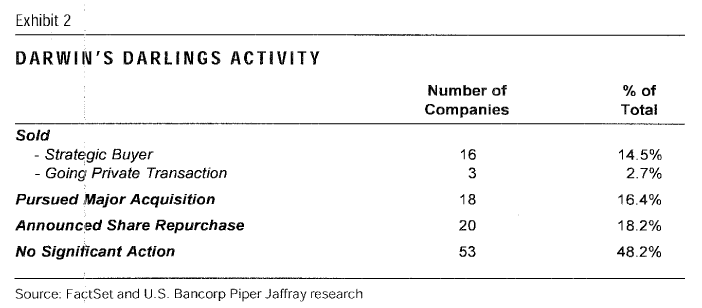
So how did the companies perform? Here’s the chart:

Almost 90 percent of the 1999 class and about half of the 2000 class pursued some significant strategic alternative during the year. The results for the class of 1999 represent a two-year period so it is not surprising that this list generated significantly more activity than the 2000 list. This would indicate that we should see additional action from the class of 2000 in the coming year.

A significant percentage (23 percent of the total) pursued a sale or going-private transaction to provide immediate value to their shareholders. Others are attempting to “grow out of” their predicament by pursuing acquisitions and many are repurchasing shares. However, many of Darwin’s Darlings have yet to take any significant action. Presumably, these companies are ignoring their current share price and assuming that patient shareholders will eventually be rewarded through a reversal in institutional investing trends, or perhaps, in a liquidity event at some later date.

The actual activity was, in fact, even greater than our data suggests as there were many transactions that were announced but failed to be consummated, particularly in light of the current difficult financing market. Chase Industries, Lodgian, Mesaba Holdings, and Chromcraft Revington all had announced transactions fall through. In addition, a large number of companies announced a decision to evaluate strategic alternatives, including Royal Appliance, Coastcast, and Play by Play ‘Toys.

The authors make an interesting observation about the utility of buy-backs:

For many of Darwin’s Darlings and other small-cap companies, the share repurchase may still have been an astute move. While share price support may not be permanent, the ownership of the company was consolidated as a result of buying in shares. The remaining shareholders were, in effect, “accreted up” in their percentage ownership. When a future event occurs to unlock value, these shareholders will reap the benefits of the repurchase program. Furthermore, the Company may have accommodated sellers desiring to exit their investment, thereby eliminating potentially troublesome, dissenting shareholders. There are circumstances when a repurchase makes good sense, but it should not be considered a mechanism to permanently boost share prices.

Piper Jaffray’s Darwin’s Darlings Class of 2001, the third annual list of the most attractive small-cap companies, makes for compelling reading. Net net investors will recognize several of the names (for example, DITC, DRAM,  PMRY and VOXX) from Greenbackd and general lists of net nets in 2008 and 2009. It’s worth considering that these stocks were, in 2001, the most attractive small-capitalization firms identified by Piper Jaffray.

See the full Endangered Species 2001 (.pdf) report.

Read Full Post »

In March I highlighted an investment strategy I first read about in a Spring 1999 research report called Wall Street’s Endangered Species by Daniel J. Donoghue, Michael R. Murphy and Mark Buckley, then at Piper Jaffray and now at Discovery Group, a firm founded by Donoghue and Murphy (see also Performance of Darwin’s Darlings). The premise, simply stated, is to identify undervalued small capitalization stocks lacking a competitive auction for their shares where a catalyst in the form of a merger or buy-out might emerge to close the value gap. I believe the strategy is a natural extension for Greenbackd, and so I’ve been exploring it over the last month.

Donoghue, Murphy and Buckley followed up their initial Wall Street’s Endangered Species research report with two updates, which I recalled were each called “Endangered Species Update” and discussed the returns from the strategy. While I initially believed that those follow-up reports were lost to the sands of time, I’ve been excavating my hard-copy files and found them, yellowed, and printed on papyrus with a dot matrix 9-pin stylus. I’ve now resurrected both, and I’ll be running them today and tomorrow.

In the first follow-up, Endangered species update: The extinct, the survivors, and the new watch list (.pdf), from Summer 2000, Murphy and Buckley (Donoghue is not listed on the 2000 paper as an author) tested their original thesis and provided the “Darwin’s Darlings Class of 2000,” which was a list of what they viewed as “the most undervalued, yet profitable and growing small cap public companies” in 2000.

As for the original class of 1999, the authors concluded:

About half of the Darwin’s Darlings pursued some significant strategic alternative during the year. A significant percentage (19 of the companies) pursued a sale or going-private transaction to provide immediate value to their shareholders. Others are attempting to “grow out of” their predicament by pursuing acquisitions, and many are repurchasing shares. However, about half of the Darlings have yet to take any significant action. Presumably, these companies are ignoring their current share price and assuming that patient shareholders will eventually be rewarded through a reversal in institutional investing trends or, more likely, a liquidity event at some later date. The path chosen clearly had a significant impact on shareholder value.

Here’s the summary table:

There are several fascinating aspects to their analysis. First, they looked at the outstanding performance of the sellers:

The 19 companies that pursued a sale easily outperformed the Russell 2000 and achieved an average premium of 51.4% to their 4-week prior share price. The vast majority of transactions were sales to strategic buyers who were able to pay a handsome premium to the selling shareholders. In general, the acquirers were large cap public companies. By simply valuing the profits of a Darwin’s Darling at their own market multiple, these buyers delivered a valuation to selling shareholders that far exceeded any share price the company might have independently achieved. Note in the summary statistics below that the average deal was at an EBIT multiple greater than 10x.

Here’s the table:

Second, they considered the low proportion of sellers who went private, rather than sold out to a strategic acquirer, and likely causes:

Only three of the Darwin’s Darlings announced a going-private transaction. At first glance, this is a surprisingly small number given the group’s low trading multiples and ample debt capacity. With private equity firms expressing a very high level of interest in these transactions, one might have expected more activity.

Why isn’t the percentage higher? In our opinion, it is a mix of economic reality and an ironic impact of corporate governance requirements. The financial sponsors typically involved in taking a company private are constrained with respect to the price they can pay for a company. With limits on prudent debt levels and minimum hurdle rates for equity investments, the typical financial engineer quickly reaches a limit on the price he can pay for a company. As a result, several factors come into play:

• A Board will typically assume that if a “financial” buyer is willing to pay a certain price, a “strategic” buyer must exist that can pay more.

• Corporate governance rules are usually interpreted to mean that a Board must pursue the highest price possible if a transaction is being evaluated.

• Management is reluctant to initiate a going-private opportunity for fear of putting the Company “in play.”

• Financial buyers and management worry that an unwanted, strategic “interloper” can steal a transaction away from them when the Board fulfills its fiduciary duty.

In light of the final two considerations, which benefit only management, it’s not difficult to understand why activists considered this sector of the market ripe for picking, but I digress.

Third, they analyzed the performance of companies repurchasing shares:

To many of the Darwin’s Darlings, their undervaluation was perceived as a buying opportunity. Twenty companies announced a share repurchase, either through the open market, or through more formalized programs such as Dutch Auction tender offers (see our M&A Insights: “What About a Dutch Auction?” April 2000).

As we expected, these repurchases had little to no impact on the companies’ share prices. The signaling impact of their announcement was minimal, since few analysts or investors were listening, and the buying support to the share price was typically insignificant. Furthermore, the decrease in shares outstanding served only to exacerbate trading liquidity challenges. From announcement date to present, these 20 companies as a group have underperformed the Russell 2000 by 17.5%.

For many of the Darlings and other small cap companies the share repurchase may still have been an astute move. While share prices may not have increased, the ownership of the company was consolidated as a result of buying-in shares. ‘The remaining shareholders were, in effect, “accreted up” in their percentage ownership. When a future event occurs to unlock value, these shareholders should reap the benefit of the repurchase program. Furthermore, the Company may have accommodated sellers desiring to exit their investment, thereby eliminating potentially troublesome, dissenting shareholders.

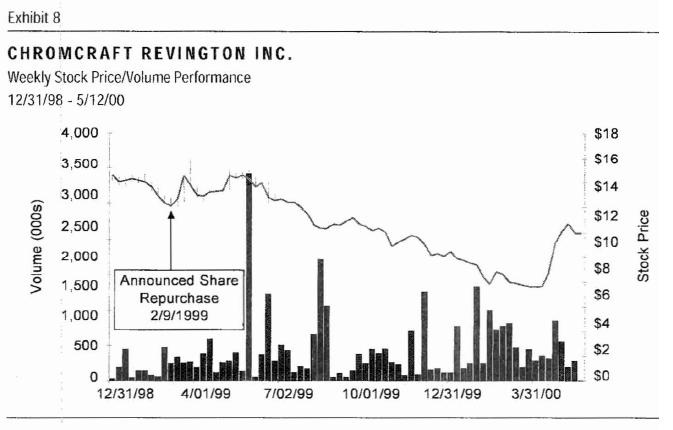
One such company repurchasing shares will be familiar to anyone who has followed Greenbackd for a while: Chromcraft Revington, Inc., (CRC:AMEX), which I entered as a sickly net net and exited right before it went up five-fold. (It’s worth noting that Jon Heller of Cheap Stocks got CRC right, buying just after I sold and making out like a bandit. I guess you can’t win ’em all.) Murphy and Buckley cite CRC as an abject lesson in why buy-backs don’t work for Darwin’s Darlings:

I’m not entirely sure that the broader conclusion is a fair one. Companies shouldn’t repurchase shares to goose share prices, but to enhance underlying intrinsic value in the hands of the remaining shareholders. That said, in CRC’s case, the fact that it went on to raise capital at a share price of ~$0.50 in 2009 probably means that their conclusion in CRC’s case was the correct one.

And what of the remainder:

About half of the Darwin’s Darlings stayed the course and did not announce any significant event over the past year. Another 18 sought and consummated an acquisition of some significant size. While surely these acquisitions had several strategic reasons, they were presumably pursued in part to help these companies grow out of their small cap valuation problems. Larger firms will, in theory, gain more recognition, additional liquidity, and higher valuations. However, for both the acquirers and the firms without any deal activity, the result was largely the same: little benefit for shareholders was provided.

Management teams and directors of many small cap companies have viewed the last few years as an aberration in the markets. “Interest in small caps will return” is a common refrain. We disagree, and our statistics prove us right thus far. Without a major change, we believe the shares of these companies will continue to meander. For the 53 Darwin’s Darlings that did not pursue any major activity in the last year, 80% are still below their 1998 high and 60% have underperformed the Russell 2000 over the last year. These are results, keep in mind, for some of the most attractive small cap firms.

This is the fabled “two-tier” market beloved by value investors. While everyone else was chasing dot coms and large caps, small cap companies with excellent fundamentals were lying around waiting to be snapped up. The authors concluded:

The public markets continue to ignore companies with a market capitalization below $250 million. Most institutional investors have large amounts of capital to invest and manage, and small caps have become problematic due to their lack of analyst coverage and minimal public float. As a result, these “orphans” of the public markets are valued at a significant discount to the remainder of the market. We do not see this trend reversing, and therefore recommend an active approach to the directors and management teams at most small cap companies. Without serious consideration of a sale to a strategic or financial buyer, we believe these companies, despite their sound operating performance, will not be able to deliver value to their shareholders.

Tomorrow, the 2001 Endangered species update.

Read Full Post »

The Wall Street Journal has an article, Activist Holders Eye Top Managers for Boards, discussing the trend for executives running public companies to switch to activist boardroom roles where they can oust executives who run other public companies:

To enhance their credibility in proxy fights, dissident investors increasingly put experienced corporate officials—including some former chief executives—on their board-seat slates, rather than simply propose relatively inexperienced managers from the activist firm. The tactic turns up the heat on the leaders of struggling businesses, and may increase dissidents’ board victories, sometimes resulting in the replacement of the CEO.

The “trend” is perhaps more in the telling than the numbers, but interesting nonetheless:

About 24% of 213 dissident nominees in 2009 contests had held top management roles at a public company, up from nearly 22% of 73 such candidates in 2004, reports data tracker FactSet SharkWatch.

The article focusses on John Mutch, the former CEO of Peregrine Systems Inc., who has “helped force out the heads of four small technology firms since 2006:”

“If I believe management is engaged in stupid, idiotic actions, I stand up and tell them so,” says Mr. Mutch. “In most cases, that means replacing the CEO.”

Most interesting for we net net folk was his involvement in the fight for Adaptec, Inc. (NASDAQ:ADPT), and the broader implications for activism in technology stocks:

Mr. Mutch says the experience convinced him that many high-tech companies “are undervalued, undermanaged and poorly governed.”

Mr. Mutch and Steel Partners launched a proxy battle for ADPT in 2007. Steel’s filings cited ADPT’s poor financial performance. Here’s the discussion in the reasons for the solicitation from the original proxy:

Given the Company’s poor track record, we believe that the Adaptec Board should not be trusted to assess acquisitions, growth investments, and product expansions while overseeing a restructuring plan.

Specifically, our concerns include the following:

· Adaptec’s operational performance has deteriorated under management and the Adaptec Board;

· Adaptec’s poor acquisition strategy and recent about-faces in strategic direction have resulted in further erosion to stockholder value;

· Adaptec’s stock performance has lagged indices and peers; and

· Adaptec has rewarded executive officers with excessive compensation packages and retention bonuses despite the Company’s poor performance.

ADPT agreed to put Mr. Mutch and Steel executives Jack Howard and John Quicke on its board ahead of the shareholder vote. The WSJ describes what happened next:

A contentious boardroom brawl occurred last August. Aristos Logic, which Adaptec acquired for $41 million in 2008, was generating less revenue growth than expected, Mr. Sundaresh informed analysts that month. Mr. Sundaresh proposed to fellow directors that they either sell the Aristos business or cut back investments severely to get costs under control, according to an attendee at the board meeting.

Mr. Mutch says he stood and attacked the CEO for switching strategy. “You sold us a bill of goods when you bought this company,” he recalls saying. “You’re not taking responsibility for this deal.” A shouting match erupted, with people “screaming at each other,” he adds.

Robert Loarie, another ally of Mr. Sundaresh, says Mr. Mutch unfairly accused the CEO of shirking his duties. Ex-director Joseph Kennedy says the dissidents also never grasped Adaptec’s strategy, and occasionally read newspapers during board discussions.

Mr. Mutch calls Mr. Kennedy’s and Mr. Loarie’s criticisms “incredulous.”

That same week, the split board replaced Mr. Howard as chairman. Steel won shareholders’ written approval to kick Messrs. Sundaresh and Loarie off the board last fall. The CEO soon resigned.

Mr. Mutch also joined activists to threaten proxy fights at Phoenix Technologies Ltd. (NASDAQ:PTEC), Aspyra, Inc (PINK:APYI) and Agilysys, Inc. (Public, NASDAQ:AGYS), and eventually got board seats at all three companies. Mr. Mutch says the CEOs in each case left during or soon after the possible contest. Perhaps a trend to watch.

Read Full Post »

I’ve exited the position in Forward Industries Inc (NASDAQ:FORD) at yesterday’s $3.23 close. I opened the position at $1.44 on July 20 last year. The stock is up 124.3% on an absolute basis and up 98% relative to the S&P500.

Post mortem

We started following FORD (see the post archive here) because it was trading at a discount to its net cash and liquidation values, although there was no obvious catalyst. Management appeared to be considering a “strategic transaction” of some kind, which might have included an “acquisition or some other combination.” At the time I said that I thought a better use of the cash on the balance sheet was a share buy-back or a dividend. Trinad Management had previously held an activist position in the stock, but had been selling at the time I opened the position and only one stockholder owned more than 5% of the stock. In late March LaGrange Capital Management filed a 13D notice for its position in Forward Industries Inc (NASDAQ:FORD) disclosing discussions with management regarding FORD’s “business and operations, financial performance, capital structure, governance, valuation, and future plans”. LaGrange is now the third largest shareholder with “just under 5% of all common shares.” At its $3.23 close yesterday, FORD has a market capitalization of $25.8M. My rough valuation pegs the Graham fire-sale liquidation value at around $20.0M or $2.50 per share. With the stock trading at a substantial 30% premium to that value and the business continuing to lose ground, I’m taking the money and running. More enterprising investors might want to hang around to see if LaGrange can squeeze some value out of a sale of the business.

The letter from LaGrange Capital Partners

LaGrange Capital Partners’ 13D notice with appended March 9 letter:

March 9, 2010

Mr. Douglas W. Sabra
Forward Industries Inc.
1801 Green Road, Suite E
Pompano Beach, FL 33064

Dear Doug,

Thank you and Jim for seeing me at the last minute. As we discussed, I am the General Partner at LaGrange Capital Partners Onshore, Offshore and Special Situations Yield Funds. LaGrange has been in business since 2000 and manages well over $100 million in assets. Our flagship fund has outperformed the S&P by approximately 7.6% per annum since inception.

LaGrange controls just under 5% of all common shares of Forward Industries, making us the third largest holder according to Bloomberg. To put it in perspective, we own approximately four times as many shares as the board (ex- Michael Schiffman), CEO and CFO combined. It is also worth noting that our shares were acquired for cash in the open market.

As a major investor, I am very concerned about the course of action presently being taken by this board and management team. To this end, I would like to discuss with you and the board of directors the company’s plans and LaGrange Capital’s desire for board representation as soon as possible.

Thank you for your time and consideration. I look forward to hearing from you, and can be reached at 212-993-7057.

Sincerely,

Grange Johnson

CC: John Chiste, Bruce Galloway, Fred Hamilton, Louis Lipschitz, Michael Schiffman

[Full Disclosure:  I do not have a holding in FORD. This is neither a recommendation to buy or sell any securities. All information provided believed to be reliable and presented for information purposes only. Do your own research before investing in any security.]

Read Full Post »

Zero Hedge has an interesting article, How To Capitalize On The Upcoming Irrationally Exuberant LBO Bubble, about “the imminent tidal wave of going private deals.” Privatisations are one of the means by which undervalued small capitalization stocks can “close their value gap.” Said Daniel J. Donoghue, Michael R. Murphy and Mark Buckley in Wall Street’s Endangered Species:

Management buy-outs can provide shareholders with the attractive control premiums currently experienced in the private M&A market. Alternatively, strategic mergers can immediately deliver large cap multiples to the small cap shareholder.

Bank of America’s Jeffrey Rosenberg sets the scene for what Zero Hedge calls “the LBO bubble v2:”

They’re back. The combination of the credit market resurgence and tight spreads, attractive equity valuations and ample private equity “dry powder” create the conditions for increasing the volumes of [leveraged buy-outs (LBOs)]. Whether deals will strike at the heart of the high grade market in the form of mega size transactions ($10b+) remains unclear, though the possibility clearly now exists. Unlike the most recent era, lower leverage and more prevalent change of control protections help to limit cram down losses. The IMS Health LBO illustrates the new LBO market dynamics – a $5.9B LBO funded with $3B in debt – where bank and mezzanine debt investors now augment the role of CLOs as key debt providers.

CLOs are “collateralized loan obligations,” which Wikipedia says “are a form of securitization where payments from multiple middle sized and large business loans are pooled together and passed on to different classes of owners in various tranches. A CLO is a type of collateralized debt obligation:”

Each class of owner may receive larger payments in exchange for being the first in line to lose money if the businesses fail to repay the loans. The actual loans used are generally multi-million dollar loans known as syndicated loans, usually originally lent by a bank with the intention of the loans being immediately paid off by the collateralized loan obligation owners. The loans are usually “leveraged loans”, that is, loans to businesses which owe an above average amount of money for their kind of business, usually because a new business owner has borrowed funds against the business to purchase it (known as a “leveraged buyout”) or because the business has borrowed funds to buy another business.

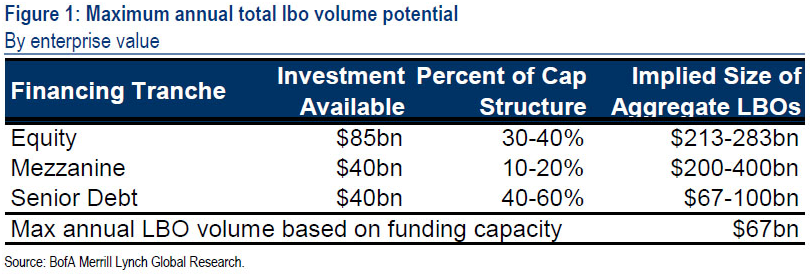
Rosenberg argues that the total pool of available LBO capital is ~$70B. Zero Hedge says, “Should CLOs indeed come back, look for this number to explode:”

Figure 1 below highlights our estimates of the maximum aggregate LBO volume supported by debt and equity fund raising capacity. These amounts represent only the limit on the size of LBO volumes, not our expectations of volumes in 2010. What is clear is that the return of the availability of senior debt financing is key to the ability to fund LBOs and this availability is supported by the new (relative to the earlier era) role of mezzanine debt in the “typical” LBO structure. According to these estimates of market capacity across senior, mezzanine and equity financing, expansion in senior debt financing capacity appears the constraint on the aggregate amount of LBO activity.

Note that this aggregate analysis does not describe the limits on mega size transactions – the $10B and above size transactions that garner greater attention and potential losses to cram down debt holders – as well as gains to public equity holders. That constraint remains the ability to absorb concentrated positions in a single fund. And as we describe more here, that constraint includes the new mezzanine debt financing capacity that contributes to today’s increasing amounts of debt funding capacity for LBOs.

Rosenberg has a noteworthy approach to identifying LBO candidates:

After having argued for the potential for increasing volumes for LBO risk, the starting point for managing that risk is to identify names that are more likely candidates. Since definitively identifying LBO candidates is impossible, we take the other approach: exclude names in which an LBO is infeasible. By limiting the universe down to feasible LBO candidates, we create a starting point for designing hedging strategies. Moving beyond this step is both an art and a science. In the sample trading strategies below, we employ both quantitative approaches as well as bottoms up input from our team of fundamental analysts to identify this small sample of feasible (though not necessarily probable) LBO candidates.

Click here to see Rosenberg’s LBO risk hedging strategies (via Zero Hedge).

Most useful for predominantly long equity investors like us, Zero Hedge also provides a copy of Goldman Sachs’ recently updated LBO screener (.xls), which looks like this (click to enlarge):

Says Zero Hedge:

The companies included represent the names most likely to be looked at actively by PE firms, and where a go private outcome would seem the highest. As such, buying the stock in a basket of the likeliest LBO candidates would be a relatively sure way to shotgun out a few quick LBO-type returns.

This is similar, in essence, to the approach of Donoghue, Murphy and Buckley as described in Wall Street’s Endangered Species, a strategy that performed well over the last 10 years.

Read Full Post »

The New York Times has a fantastic profile on Carl Icahn called Does Icahn Still Make Them Tremble?

He is one of Wall Street’s most colorful, controversial and complicated characters.

Wearing slightly rumpled khakis and waving his eyeglasses to punctuate key points, Mr. Icahn is constantly jumping from one topic to another in an endless stream of dialogue. In that respect, he more closely resembles an absent-minded professor than a master of the universe.

Corporate executives visiting his offices walk through hallways adorned with paintings of battle scenes and sculptures of cowboys on bucking broncos. One large painting in the conference room features a lion gazing at the bones of an animal in a desert.

Yet he bristles at being labeled a “raider,” despite the fact that he is widely viewed as a founding member of the clan that roamed Wall Street in the 1980s, occasionally pursuing hostile takeovers with ruthless abandon.

He prefers to paint his role in those years with the same “activist investor” brush he holds today, arguing that he has created tens of billions of dollars of value for shareholders in companies in which he invested. (In conversations, he declares that he has created $30 billion, $40 billion and even $50 billion worth of value for shareholders. What is a few billion among friends?)

This is Icahn’s thesis for his investments in the biotechnology sector:

“The biotechs have been his big winners recently,” particularly investments in ImClone Systems and MedImmune, said Mr. Young at Institutional Shareholder Services. “His thesis, which is no secret, is that biotech firms should be purchased by Big Pharma, which is always in need of new products. In his mind, that’s a match made in heaven.”

I love this story:

Mr. Icahn does not seem to let anything, including a very close friendship, get in the way of protecting his and his investors’ profits. Late in 2008, through his hedge fund, he sued Realogy, a real estate company controlled by Leon Black, the head of the private equity firm Apollo Management. Mr. Black was trying to reduce Realogy’s hefty debt load by offering to exchange some of the debt with bondholders.

Mr. Icahn, a bondholder who has known and been friends with Mr. Black for decades — the two have been longtime tennis partners — objected to some terms of the exchange and sued.

“Carl and I have been good friends for over 25 years,” Mr. Black said in an e-mail message. “Occasionally we skirmish as couples are wont to do, but I believe we both feel that when the chips are down that the friendship is paramount.”

How, exactly, does one sue and still be good friends with someone on Wall Street? Mr. Icahn smiles sagely over his cup of coffee: “The two of us have a saying that we always use whenever there is friction in our business dealings. We always say, ‘there’s only one Maltese Falcon.’ ”

At one point in that classic 1941 film, a character chasing a valuable figurine says to a close associate, “You’ve been like a son to me,” Mr. Icahn explains, paraphrasing from the movie.

Then, lowering his voice with mock intensity, Mr. Icahn adds that the character says that if you lose a son, it’s possible to get another — “but there’s only one Maltese Falcon.’ ”

Click here to see the rest of the article.

Read Full Post »

MMI Investments, the largest holder of DHT Holdings Inc (NYSE:DHT) stock, has announced that it sent a letter to Erik A. Lind, Chairman of DHT, formally nominating Robert N. Cowen for election to the DHT board.

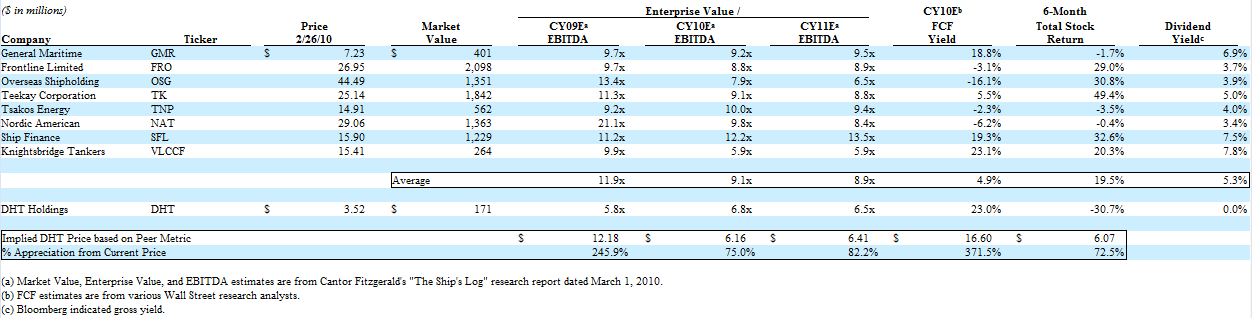
We started following DHT on Monday. MMI Investments is calling for DHT to reinstate the company’s dividend and appoint Robert N. Cowen, a “shipping industry veteran with over 30 years of experience including with DHT’s former parent company, Overseas Shipholding Group, Inc., to the DHT Board of Directors.” At its $4.03 close yesterday, DHT has a market capitalization of $196M and is trading at 5x 2010 expected free cash flow. MMI has set out its peer valuation and dividend analysis as an annexure to its latest 13D filing (set out in the original post). The board of DHT has responded by appointing a new independent director, Einar Michael Steimler. DHT’s Chief Executive Officer, Ole Jacob Diesen, has also stepped down. Says Clay Lifflander, President of MMI:

In the six months through February since DHT eliminated its dividend, a move that was never necessary in our view, the stock price dropped more than -30% at the same time as the average total return of its peers, all of whom currently pay dividends, was +19.5%. We believe DHT’s stockholders deserve better returns on their investment and improved performance from management and the Board. We therefore strongly urge the reinstatement of a dividend of $0.10 per share quarterly and the appointment of Bob Cowen to DHT’s Board of Directors.

Here’s the latest press release from MMI:

MMI INVESTMENTS, L.P. SUBMITS DIRECTOR NOMINATION FOR DHT HOLDINGS, INC. UPCOMING ANNUAL MEETING; WILL SOLICIT PROXIES FOR ELECTION OF ROBERT N. COWEN TO THE DHT BOARD

NEW YORK, NY, March 17, 2010 – – MMI Investments, L.P., the largest stockholder of DHT Holdings, Inc. (NYSE:DHT), announced today that it has sent a letter to Erik A. Lind, Chairman of the Board of DHT, formally nominating, in accordance with DHT’s bylaws, Robert N. Cowen, a shipping industry veteran with over 30 years of experience including with DHT’s former parent company, Overseas Shipholding Group, Inc., for election to the DHT Board of Directors at the upcoming annual meeting, tentatively scheduled for June 17, 2010. Mr. Lind has acknowledged receipt of the nomination.

Hat tip Ben Bortner.

[Full Disclosure: I do not hold DHT. This is neither a recommendation to buy or sell any securities. All information provided believed to be reliable and presented for information purposes only. Do your own research before investing in any security.]

Read Full Post »

DHT Holdings Inc (NYSE:DHT) is an interesting activist situation. MMI Investments, DHT’s largest shareholder, is calling for DHT to reinstate the company’s dividend and appoint Robert N. Cowen, a “shipping industry veteran with over 30 years of experience including with DHT’s former parent company, Overseas Shipholding Group, Inc., to the DHT Board of Directors.” At its $4.15 close on Friday, DHT has a market capitalization of $202M and is trading at a little over 5x 2010 expected free cash flow. MMI has set out its peer valuation and dividend analysis as an annexure to its latest 13D filing (set out below). The board of DHT has responded by appointing a new independent director, Einar Michael Steimler. DHT’s Chief Executive Officer, Ole Jacob Diesen, has also stepped down.

Says Clay Lifflander, President of MMI:

In the six months through February since DHT eliminated its dividend, a move that was never necessary in our view, the stock price dropped more than -30% at the same time as the average total return of its peers, all of whom currently pay dividends, was +19.5%. We believe DHT’s stockholders deserve better returns on their investment and improved performance from management and the Board. We therefore strongly urge the reinstatement of a dividend of $0.10 per share quarterly and the appointment of Bob Cowen to DHT’s Board of Directors.

The full text of MMI’s letter appended to the most recent 13D follows:

March 2, 2010

Erik A. Lind
Chairman of the Board
DHT Holdings, Inc.
26 New Street
St. Helier, Jersey JE23RA
Channel Islands

Dear Mr. Lind:

A s the largest stockholder of DHT Holdings, Inc. (“DHT” or the “Company”), MMI Investments, L.P. (“MMI”) is greatly frustrated with the poor performance of DHT stock, which is near its all-time low, and DHT’s valuation, which is at a severe discount to its peer group (see attachment: “DHT Peer Valuation”). We believe this underperformance is directly related to repeated poor decisions by management and the Board, such as the elimination of the Company’s dividend, and that stockholder value will continue to erode unless immediate action is taken. The board should act immediately to reinstate the dividend at a $0.10 per share quarterly rate and appoint as a member of the Board, Robert N. Cowen, a shipping industry veteran with over 30 years experience (including with DHT’s former corporate parent, Overseas Shipholding Group, Inc. (“OSG”)), as detailed below:

1) Reinstate the Dividend

DHT’s dividend strategy has been consistently erratic, shifting between paying out all available cash flow to paying a regular $0.25 quarterly dividend “to provide shareholders with a stable and visible distribution”1, to the dividend’s complete elimination in September – six months after the stock market bottomed and began its historic rise. This last decision was particularly toxic to stockholders, causing shares to plummet by more than 21% on the day of its announcement, due in part, we believe, to its inexplicability in the face of the nearly $40 million in free cash flow virtually guaranteed to the Company by its long-term charter agreements with OSG.

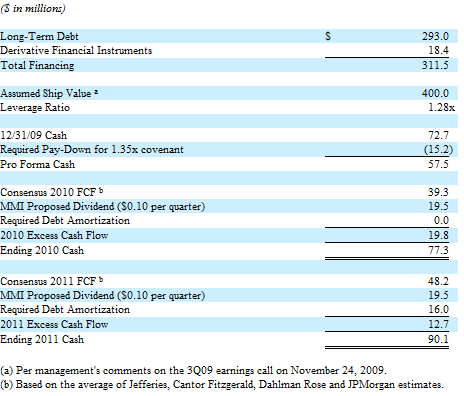
DHT’s zero dividend policy is not only inconsistent with its own intrinsic fundamentals, it is also dramatically out-of-step with its peers. DHT’s free cash flow yield2 at 23% is more than quadruple the mean of its comparable companies, who average a 5.3% dividend yield and who all currently pay dividends, including those who previously eliminated their dividend during the crisis. MMI recommends a quarterly dividend of $0.10 per share, which would leave significant free cash flow for debt repayment or other deployment in 2010 and 2011, even with the scheduled amortization of debt in 2011 (see attachment: “DHT Dividend Analysis”). A $0.10 per share quarterly dividend would also make DHT’s dividend yield a robust 11.4%, at a premium to its peers – a virtual necessity for stock price appreciation, which would drive the yield closer to parity.

2) Strengthen the Board

The Board’s non-dividend capital allocation decisions have also frequently seemed rash, and been dilutive to stockholder value. DHT’s only acquisitions since inception, the two Suezmax tanker purchases announced in 2007, were acquired at the top of the market for a total expenditure of $183 million. Today they are worth roughly half that amount in our opinion. In light of this poor acquisition track record, we believe the stated reason for eliminating the dividend, i.e. augmentation of the Company’s cash balance for potential acquisitions, only served to further unnerve stockholders.

We also believe this Board’s decision to complete an equity offering in March 2009 was similarly troubling and ill-timed. The offering came near the bottom of the stock market crisis, was priced less than a dollar above DHT’s all-time low stock price and at a dividend yield of 23% (which would subsequently become unsustainable because of the offering itself). Notably the unsustainable $0.25 per share quarterly dividend was eliminated only after it had been paid once to the new stockholders. As if to add insult to injury, at the time of the dividend elimination the offering proceeds were concurrently used to prepay debt in excess of the Company’s required covenant (ironically to the level at which DHT would be permitted to issue further dividends), and without receiving any concessions from its lender.

This past performance suggests that additional expertise and oversight at the Board level would benefit DHT and its stockholders. Therefore MMI strongly urges the immediate addition of Robert N. Cowen to the DHT board. Bob Cowen has over 30 years of experience in the oil tanker and dry bulk shipping business, having been Chief Operating Officer of DHT’s former parent company, OSG, and Chairman and Chief Executive Officer of OceanFreight Inc., a dry bulk shipping company for which he led its successful IPO and fleet start-up. The future opportunities afforded by the current industry weakness and the challenges presented by DHT’s escalating costs, both corporate and operating, require seasoned operational leadership which could augment the Board’s largely finance-related backgrounds. We believe Bob Cowen’s experience, intelligence and business acumen are well-suited to DHT’s challenges and opportunities, and that he would be a great asset to the Board.

We recommend expansion of the Board in part because of management’s comments on the February 16th, fourth quarter of 2009 earnings call, which suggest to us that they may not share stockholders’ frustration with the performance of DHT’s shares. Notably, Chief Executive Officer Ole Jacob Diesen’s remark that “…If we were to buy back shares, the share price has to be even lower” indicates an astounding belief that the stock is presently over-valued. We believe this is completely inconsistent with the facts. As we demonstrate in the attached “DHT Peer Valuation”, DHT’s stock price is presently at a 75% or greater discount to its value at its peers’ average multiples of 2010 and 2011 EBITDA, i.e. an implied stock price of approximately $6.16-$6.41 (versus $3.52 on 2/26/10) were it valued like its peers. On a net asset value basis (using management’s last estimate of DHT’s fleet value, $400 million) DHT is trading for less than its fleet value on an unchartered basis, despite the roughly $100 million at least in free cash flow to be collected by DHT through 2012 when the charters begin to roll off. This is in spite of the premium-worthy stability of DHT’s free cash flow generation from the long-term charters, and assumes virtually no additional hire in the next two years from improvement in rates. However, if market conditions continue to improve such that DHT does earn additional hire or fleet values rise, we believe the preceding valuation estimates will prove to be far too conservative.

In the six months since DHT eliminated its dividend its stock has dropped -30.7% whereas the average total return of its peers is +19.5%. We believe investors, many of whom chose DHT for its fundamental stability, have suffered more than enough capital loss and income disruption in service of a strategy so opaque and ill-communicated as to suggest there is no real strategy at all. We urge the immediate appointment of Mr. Cowen to the Board and reinstatement of the dividend to encourage strategic stability and focus and improved stock performance. Please inform us of your intentions regarding these two proposals by March 12, 2010. Mr. Cowen has indicated to me that he is available to discuss these issues with you, as are we. Please contact me at (212) 586-4333 with any questions.

Sincerely,

Clay Lifflander

_______________

1 Company press release, 1/4/08, “Double Hull Tankers, Inc. Sets Dividend Policy to a Fixed Annual Amount of $1.00 per share”

2 Calculated as DHT consensus 2010 free cash flow divided by market capitalization of $171 million on 2/26/10. All references herein to stock price, performance, valuations and yields refer to DHT’s closing price of $3.52 on 2/26/10.

MMI’s DHT Peer Valuation

(Click to enlarge)

MMI’s DHT Dividend Analysis

(Edited to fit space)
Here is the press release announcing the resignation of DHT’s Chief Executive Officer, Ole Jacob Diesen, on Thursday last week:

DHT Names Board Member Randee Day Acting Chief Executive Officer

ST. HELIER, CHANNEL ISLANDS, Mar 11, 2010 — DHT Holdings, Inc. (NYSE: DHT) announced today that Board member Randee Day has been named acting Chief Executive Officer of DHT Holdings, Inc. and DHT Maritime, Inc., effective April 1, 2010. Ms. Day will remain on the Board of Directors of both companies, but will not continue on the Audit, Nominating and Corporate Governance, and Compensation Committees.

Ms. Day succeeds Ole Jacob Diesen, who will step down as Chief Executive Officer on March 31, 2010. Mr. Diesen, who has been CEO since DHT’s initial public offering in 2005, was instrumental in developing DHT Maritime’s existing operating platform and the new corporate structure announced last week. This transition follows a comprehensive review of DHT’s strategy by the Board and management beginning in 2009. The Board and Mr. Diesen concluded it would be in DHT’s best interests to turn to new leadership as the Company pursues a more growth-oriented strategy going forward. Mr. Diesen will continue to work with DHT as a consultant for the next six months.

The DHT Board of Directors will conduct a search over the next few months for a permanent CEO and will evaluate both internal and external candidates. Ms. Day has indicated she would be a candidate for this position.

Erik A. Lind, Chairman of the Board of Directors, said, “We are indeed pleased that Randee Day has accepted our offer to become DHT’s acting CEO. Her distinguished career in the shipping industry spans nearly 35 years, and she is one of the industry’s most highly regarded financial executives. Throughout her career, she has demonstrated strong leadership qualities, both as a business originator and the initiator of innovative financial solutions. We are confident she will successfully advance the strategic objectives and growth plans endorsed by the Board. Her appointment follows the recent creation of a new holding company structure and the appointment of veteran shipping executive Einar Michael Steimler to the Board, both important steps in the company’s evolution.”

Randee Day said, “I am very pleased to serve DHT in this position at this important juncture in the Company’s evolution and am committed to executing on our strategy. With DHT’s stable cash flows, proven ability to access the capital markets, strengthened balance sheet and financial flexibility, I believe it is well positioned to capitalize on prudent growth opportunities that are available to those able to deploy capital in the current shipping market.”

Ms. Day has served as a board member and Chair of the Audit Committee of DHT Maritime since the company’s initial public offering in 2005. Since 2004, she has been Managing Director and Head of Maritime Investment Banking at the Seabury Group, a global advisory and investment banking firm for transportation companies. Before joining Seabury, Ms. Day was CEO of Day and Partners, a strategic advisory and restructuring firm that she founded with UK private investors in 1985. Prior to the formation of Day and Partners, she headed up JP Morgan’s Shipping Group in New York.

She has been a board member of TBS International Ltd, since 2001, and serves as the Chair of the Audit Committee and is a member of the Governance Committee. From 2008 to 2009, she served as a director of Ocean Rig ASA, Oslo, Norway. Ms. Day holds a Bachelor of Arts degree in International Relations from the University of Southern California.

Here is the press release announcing the appointment to the board of Einar Michael Steimler:

DHT ANNOUNCES THE APPOINTMENT OF A NEW DIRECTOR

ST. HELIER, JERSEY, CHANNEL ISLANDS, March 4, 2010 — DHT Holdings, Inc. (NYSE:DHT) announced today that it has appointed Einar Michael Steimler to its board of directors. The appointment of Mr. Steimler as a director, which expands the board from three to four independent directors, results from a rigorous process to identify prospective directors that will add valuable experience and insight to the board. Mr. Steimler is expected to join the company’s Audit, Compensation and Nominating and Corporate Governance Committees. This appointment will enable the board of directors to augment its commercial, operational and industry specific experience, particular within the tanker sector, where Mr. Steimler is a highly respected and well known industry executive.

Mr. Steimler, age 62, continues to serve as chairman of Tanker (UK) Agencies, the commercial agent to Tankers International, managers of the world’s largest VLCC pool. He was instrumental in the formation of Tanker (UK) Agencies in 2000 and served as its CEO until end 2007. Today, the Tankers International pool operates 41 ships including those of some of the world’s largest tanker companies.

Since 1998, Mr. Steimler has served as a Director of Euronav. From 1999 to 2003, he also served as a Director of EXMAR, a CMB Group company. During his long shipping career, he has been involved in both sale and purchase and chartering brokerage in the tanker, gas and chemical sectors and was a founder of Stemoco, a successful ship brokerage firm that was sold in 1994. He graduated from the Norwegian School of Business Management in 1973 with a degree in Economics.

The initial term of Mr. Steimler’s appointment to the DHT board of directors will expire at the company’s 2011 annual meeting.

Together with the company’s recent creation of a new holding company structure, the appointment of Mr. Steimler to the DHT board of directors represents a continuing step in the company’s ongoing initiatives to identify attractive growth opportunities.

The company also notes the receipt of communication from certain of its shareholders regarding the company’s strategy. As always, the company’s directors and management value the input of all of the company’s shareholders regarding the company’s direction and will continue to engage constructively with our shareholders regarding such input.

Hat tip Ben Bortner.

[Full Disclosure: I do not hold DHT. This is neither a recommendation to buy or sell any securities. All information provided believed to be reliable and presented for information purposes only. Do your own research before investing in any security.]

Read Full Post »
Yesterday I highlighted an investment strategy I first read about in a Spring 1999 research report called Wall Street’s Endangered Species by Daniel J. Donoghue, Michael R. Murphy and Mark Buckley, then at Piper Jaffray and now at Discovery Group, a firm founded by Donoghue and Murphy. The premise, simply stated, is to identify undervalued small capitalization stocks where a catalyst in the form of a merger or buy-out might emerge to close the value gap. I believe the strategy is a natural extension for Greenbackd, and so I’m going to explore it in some depth over the next few weeks.

The idea is reminiscent of “Super” Mario J. Gabelli’s Private Market Value with a Catalyst methodology, the premise of which is the value of a company “if it is acquired by an informed wealthy family, or by another private or public corporation, as opposed to the price it is trading at in the stock markets. Simply put, it is the intrinsic value of a company plus the control premium:”

To calculate PMV, Gabelli first takes into account the free cash flow (after allowing for depreciation), deducts debt and net options (stock options) and adds back the cash. To this, he then applies an ‘appropriate’ multiple to arrive at the PMV. It sounds simple enough, but where you can go completely wrong is the multiple. Gabelli says he either looks at recent valuations of similar acquisitions or applies an appropriate historical industry acquisition multiple to arrive at the PMV.

“Some of the factors that we look at while deciding multiples to apply are: what the business is going to be worth in five years from now, what kind of return on equity can we get over time, how much further debt can be put on the company, the tax rate and what the company would be worth if there was no growth or at some particular rate (4 or 8 per cent for instance),” he explains. Of course, the multiple – and the PMV – changes over time, as it is a function of interest rates, the capitalisation structure and taxes, all of which have an indirect impact on the value of the franchise.

Donoghue, Murphy and Buckley followed up their initial Wall Street’s Endangered Species research report with two updates, which I recall were each called “Endangered Species Update” and discussed the returns from the strategy. It seems that those follow-up reports are now lost to the sands of time. All that seems to remain is the press release of the final report:

For the last few years, Piper Jaffray has been reporting on the difficulties that small public companies face in today’s equity markets. Since the late 1990s many well run, profitable companies with a market capitalization of less than $250 million have watched their share prices underperform the rest of the stock market. With limited analyst coverage and low trading liquidity, many high-quality small companies are “lost in the shuffle” and trade at significantly lower valuation multiples than larger firms. Since our 1999 report “Wall Street’s Endangered Species,” we have held the position that:

This is a secular, not cyclical, trend and the undervaluation will continue. The best strategic move to increase shareholder value is to pursue a change-of-control transaction. Company management and the Board should either sell their company to a large strategic acquirer with the hope of gaining the buyer’s higher trading multiple, or take the company private.

In the last few of years, many small public companies identified this trend and agreed with the implications. Executives responded accordingly, and the number of strategic mergers and going-private transactions for small companies reached all-time highs. Shareholders of these companies were handsomely rewarded. The remaining companies, however, have watched their share prices stagnate.

Since the onset of the recent economic slowdown and the technology market correction, there has been much talk about a return to “value investing.” Many of our clients and industry contacts have even suggested that as investors search for more stable investments, they will uncover previously ignored small cap companies and these shareholders will finally be rewarded. We disagree and the data supports us:

Any recent increase in small-cap indices is misleading. Most of the smallest companies are still experiencing share price weakness and valuations continue to be well below their larger peers. We strongly believe that when the overall market rebounds, small-cap shareholders will experience significant underperformance unless their boards effect a change-of-control transaction.

In this report we review and refresh some of our original analyses from our previous publications. We also follow the actions and performance of companies that we identified over the past two years as some of the most attractive yet undervalued small-cap companies. Our findings confirm that companies that pursued a sale rewarded their shareholders with above-average returns, while the remaining companies continue to be largely ignored by the market. Finally, we conclude with our third annual list of the most attractive small-cap companies: Darwin’s Darlings Class of 2001.

Piper Jaffray did follow up the reports in a 2006 article called Is There a Renewed Prospect of Going-Private Transactions? Their conclusion:

Small-Cap Stocks Outperform

Small-cap stocks have experienced a dramatic resurgence over the past five years. With weak performances from large-cap stocks, small-caps have become more favorable investments with better returns and stronger trading multiples. Here is what we have seen:

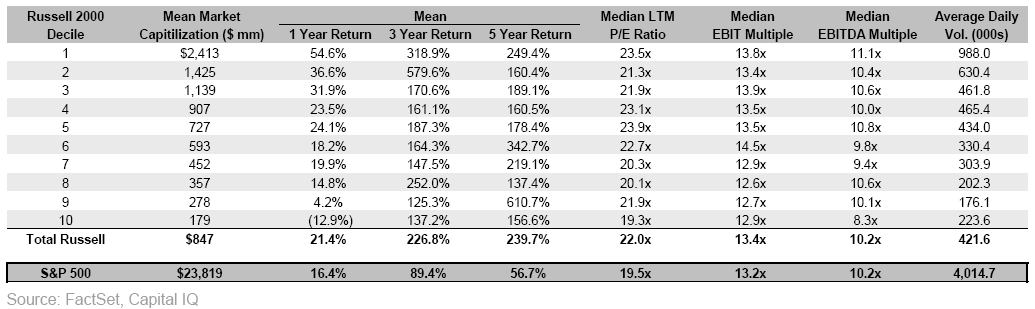
  • Over the last one-, three- and five-year periods, companies in the Russell 2000 have offered average returns of 21%, 227% and 240%, respectively, compared to S&P 500 companies with average returns of 16%, 89% and 57%, respectively.
  • The valuation gap that we saw five years ago between the bottom two deciles of companies in the Russell 2000 and the S&P 500 no longer exists, with the last two deciles in the Russell trading at only a 3% discount to the median EBIT multiple of S&P 500 companies and a 9% premium over the median P/E multiple.

(Click to embiggen)

Despite the rebound in valuations, small-cap stocks continue to face the same capital market challenges:

  • For companies with market caps between the $50 million and $250 million range, there are approximately 1.3 analysts covering each stock versus 7.7 analysts for companies with market caps of more than $250 million.
  • Trading volumes are slightly higher, with the last three deciles trading an average 202,276, 176,092 and 223,599 shares, respectively, per day, but still significantly below the volume of S&P 500 companies, which trade an average of 4.0 million shares per day.

More to come.

Read Full Post »

« Newer Posts - Older Posts »