Feeds:
Posts
Comments

Archive for the ‘Activist Investors’ Category

We cast our proxy votes on-line today in support of Biotechnology Value Fund’s (BVF) proposal to remove the board of Avigen Inc (NASDAQ:AVGN).

We’ve been following AVGN (see archived posts here) because it’s a net cash stock (i.e. it’s trading at less than the value of its cash after deducting all liabilities) and specialist biotechnology investor BVF has been pushing it to liquidate and return its cash to shareholders. MediciNova Inc (NASDAQ:MNOV) has made an offer for AVGN that we think represents a clever way for AVGN’s stockholders to receive cash equivalent to that which they would receive in a liquidation (less $7M to be paid to MNOV) with the possibility for “an extraordinary, uncapped return” if MNOV is successful post-merger. The stock is up 65% from $0.65 to close at $1.07 yesterday. We estimate AVGN’s net cash value to be $37M or $1.24 per share (BVF estimates $1.20 per share). The net cash estimate does not take into account AVGN’s AV411 assets and program, which could be worth considerably more, perhaps as much as $5M to $20M or between $0.15 or $0.60 per share.

BVF’s task is a difficult one. Why? Let’s turn to the proxy material, which states as follows:

To be approved, the Board Removal Proposal must receive “FOR” votes from the holders of at least two-thirds of all of Avigen’s outstanding shares entitled to vote either in person or by proxy at the Special Meeting. If you do not vote or “ABSTAIN” from voting, it will have the same effect as an “AGAINST” vote. Broker non-votes will have the same effect as “AGAINST” votes.

This is an incredibly high threshold. For BVF to unseat the board, it requires two-thirds of all of AVGN’s outstanding shares entitled to vote. This means that BVF’s enemy is likely not stockholders voting against BVF’s proposal, but stockholders not voting at all, because failing to vote has the same effect as voting against BVF. Let us say that again: failing to vote has the same effect as voting against BVF’s proposals. If 10% of AVGN’s voters fail to vote, BVF requires almost three-quarters of the votes from those actually voting.

If the purpose of voting at stockholder meetings is to give voice to the majority (or, in this case, the supermajority) of the stockholders, surely the process should be designed to reflect that will. At present, it is not. The deck is stacked heavily in favor of the incumbent board. At least two-thirds of all of AVGN’s outstanding shares must be voted for BVF. The real threshold is actually higher than two-thirds, because failure to vote equates to a vote against BVF. If even a small proportion of stockholders neglect to vote, BVF’s threshold is proportionately that much higher. Each obstacle reduces the chance that a stockholder votes along with BVF, and that’s a shame. The corporate voting process should function to reflect the will of each stockholder and it does not presently do that.

The special meeting is to be held next Friday, March 27, 2009. If you hold stock in AVGN, you must cast your vote before that date. If you wish to support BVF, you must vote GOLD card.

[Full Disclosure:  We have a holding in AVGN. This is neither a recommendation to buy or sell any securities. All information provided believed to be reliable and presented for information purposes only. Do your own research before investing in any security.]

Read Full Post »

Avigen Inc (NASDAQ:AVGN) has sent a letter sent to its stockholders saying that Glass Lewis, a “leading independent voting advisory service” has reviewed the Biotechnology Value Fund (BVF) proposal to remove AVGN’s board and has recommended that stockholders vote against the proposal. Glass Lewis make the recommendation on the basis that “…shareholders would be best served by allowing the current board to continue its competitive sale process and to negotiate the highest value agreement for this Company… . We also make this recommendation knowing that there are multiple parties interested in the Company and given the board’s commitment to return value to shareholders by year end 2009 in the event that no strategic agreement is negotiated.” Our two cents? While AVGN has taken steps to crystallize the value of AV411, engaging financial advisors and receiving “seven written proposals” for AVGN or AV411 (we’re not sure which), we believe that much of the credit for this should be properly laid at the feet of BVF. It’s difficult to imagine AVGN taking these steps without BVF’s presence on the share register, and we suspect that it would have been “business as usual” if BVF had not agitated so forcefully for change. We’re supporting BVF.

We’ve been following AVGN (see archived posts here) because it’s a net cash stock (i.e. it’s trading at less than the value of its cash after deducting all liabilities) and specialist biotechnology investor BVF has been pushing it to liquidate and return its cash to shareholders. MediciNova Inc (NASDAQ:MNOV) has made an offer for AVGN that we think represents a clever way for AVGN’s stockholders to receive cash equivalent to that which they would receive in a liquidation (less $7M to be paid to MNOV) with the possibility for “an extraordinary, uncapped return” if MNOV is successful post-merger. The stock is up 68% from $0.65 to close at $1.09 yesterday. We estimate AVGN’s net cash value to be $37M or $1.24 per share (BVF estimates $1.20 per share). The net cash estimate does not take into account AVGN’s AV411 assets and program, which could be worth considerably more, perhaps as much as $5M to $20M or between $0.15 or $0.60 per share.

The text of the letter is set out below:

Leading Independent Advisory Service Urges Avigen Stockholders to Reject BVF’s Proposal

Avigen’s Board Narrows Focus on Strongest Improved Bids Through Ongoing Competitive Process

Dear Shareholders,

We began building the current Board in early 2006 and have consistently followed core principals that reflect fiscal discipline and sound drug development strategies. These characteristics, along with the decisive actions taken last fall to safeguard the company’s resources, have put your Board in a position to serve the interests of all stockholders and maximize the value of your investment.

Since completing the sale of our hemophilia program for $7 million in mid-December, Avigen’s stock has appreciated 50% and we believe that the Board’s current strategy will continue to add value through an open and competitive process to evaluate potential merger transactions and a commitment to bring the strongest deal, if any, to stockholders for a vote.

Leading independent advisory service is recommending stockholders vote AGAINST BVF’s Board removal proposal

Glass Lewis is one of the nation’s leading independent voting advisory services and has reviewed the BVF Proposal to remove the current Avigen Board. As a firm that reviews many contests for control, Glass Lewis believes that an independent and knowledgeable Board is often in the best position to assess a company’s strategic alternatives for the benefit of all its stockholders. In Avigen’s situation, Glass Lewis recommends that “…shareholders would be best served by allowing the current board to continue its competitive sale process and to negotiate the highest value agreement for this Company… . We also make this recommendation knowing that there are multiple parties interested in the Company and given the board’s commitment to return value to shareholders by year end 2009 in the event that no strategic agreement is negotiated.”

The Board is listening to all stockholders and working to find a balance that reflects the range of preferences they have expressed. Avigen’s Board values all stockholders’ perspectives in defining an optimal deal structure and has encouraged BVF to consider accepting board seats or other observers rights that would allow it to participate directly in the process. This would allow the current competitive process to continue uninterrupted and without jeopardizing the most promising opportunities on the table.

Your Board now has several proposals that offer significant “downside protection” and is focusing on evaluating their upside potential

Since issuing our December 22, 2008 letter to stockholders, your Board has maintained its commitment to implement a straightforward strategy to get more value for stockholders than the company’s current cash assets. After initiating an orderly and competitive process to review strategic merger opportunities, your Board has received multiple written proposals that significantly value Avigen above its current stock price.

Your Board believes it is in the best interests of stockholders to pursue a flexible deal structure and bring the most attractive opportunity to a vote of stockholders as soon as possible. In the current environment, we believe investors are most attracted to companies with later-stage products and a lower risk profile. In the last two months we have identified several opportunities that meet these criteria. The strongest proposals received to date include most of the following:
(1) commercial or near commercial products;
(2) revenue or near-revenue generating opportunity;
(3) potential for sustainable operations without the need for equity financings;
(4) sales and marketing support from a strong commercialization partner;
(5) reduced remaining regulatory risk;
(6) attractive growth potential; and
(7) willingness to provide liquidity to Avigen stockholders who need or prefer cash.

Your Board has recently invited all bidders to provide an enhanced competitive “best” offer so that the Board and management can narrow their focus on the strongest proposals and accelerate the next stage of diligence. Several parties have improved their original offers, demonstrating unequivocally the soundness of this strategy and the likelihood that your Board’s efforts will result in greater value for stockholders.

We intend to bring to stockholders the strongest proposal. All proposals contain a significant liquidity option (i.e., “downside protection”) for stockholders that were attracted to that feature in the MediciNova proposal which was publically supported by BVF but, importantly, value Avigen above its current stock price. The Board’s focus is now on identifying which proposal best fits the criteria above and is most likely to provide the greatest upside potential for Avigen stockholders.

BVF’s public support for the MedicNova proposal overlooked the potential for improving the value through competitive negotiations

By unconditionally supporting the MediciNova proposal on December 29, 2008, and encouraging the Board to bring the proposal to “a shareholder vote as soon as practical,” BVF may have overlooked other elements of the proposal that did not fully value all of Avigen’s assets. By taking a measured approach, your Board recognized five factors that it would like to address in negotiations to enhance the value to Avigen’s stockholders:

* MediciNova is an early-stage development company that, in our opinion, is highly likely to need to raise significant additional capital in approximately the next year.

* MediciNova was trading at $1.60 per share on the day of the public statement, and yet proposed that Avigen stockholders to spend $7 million to buy MediciNova stock at $4.00 per share, taking an immediate LOSS of approximately $4.2 million.

* MediciNova proposed holding Avigen’s remaining cash for over a year, in the hopes that Avigen’s stockholders would buy more MediciNova stock at the same fixed price of $4.00 per share or 250% of its then trading price. In other words, the first $25 million in stock appreciation due from Avigen’s other assets (AV411 pain and addition program and the Genzyme milestone) would accrue to MediciNova without providing any upside benefit to Avigen’s stockholders.

* Most likely, these terms would lead to a cash payout to Avigen stockholders in June 2010 or later estimated at approximately $0.91 per share from their original Avigen holdings. During that year, Avigen’s cash would be at risk to MediciNova’s creditors if the company became insolvent, potentially leaving Avigen stockholders with much less.

* Finally, MediciNova is an extremely illiquid stock that most Avigen stockholders would find difficult to trade in the open market without significantly depressing the price, which warranted concessions. For example, during the fourth quarter of 2008, MediciNova traded less than 1,000 shares per day on 48% of the 64 trading days during the quarter and zero shares on 10 of those days.

In short, while recognizing the value of some elements of the MediciNova proposal, your Board was working first to establish an open and competitive review process in which to hold direct negotiations to evaluate and improve those terms. While respecting BVF’s enthusiasm for downside protection, we believe their aggressive early support undermined the ability of your Board to engage MediciNova in an orderly process and may have prevented MediciNova from offering its “best” proposal for all of Avigen’s assets.

Avigen’s Board urges stockholders to reject BVF’s proposal to remove the Board and avoid re-starting the competitive process or jeopardizing the strongest proposals currently under review

BVF made a shrewd investment when it recognized that Avigen’s assets were severely undervalued after the negative clinical trial results reported last October. This allowed BVF to acquire a 29% stake in Avigen at an estimated average price of approximately $0.58 per share which they understandably want to protect. Their best intentions, however, are handicapping the Board’s effort to maximize value for BVF and all stockholders and now risk losing several written proposals by recommending removal of the full Board.

Your Board has reduced expenses, preserved resources and monetized one of the company’s assets. Your Board is also increasing the upside for all stockholders through its efforts to partner or sell Avigen’s AV411 pain and addiction program and in running an open and competitive process designed to identify strategic merger opportunities that we believe ALL stockholders will find attractive.

In the end, your Board is committed to bringing the best transaction, if any, to stockholders for a vote and providing a liquidity option for stockholders that would prefer to redeem part, if not all, of their shares for cash. This process is not intended to extend beyond the fourth quarter and could progress much sooner.

Your Board would like to work with BVF to ensure that all stockholders get the very best outcome for their investment. We encourage stockholders to support this effort and vote AGAINST the BVF proposal on the WHITE proxy card today. Your Board is representing the interests of all stockholders and is in the best position to complete a value maximizing transaction.

Respectfully,

Signed for the Board of Directors
Zola Horovitz, Ph.D. as Chairman of the Board
Kenneth G. Chahine, Ph.D., J.D. as Chief Executive Officer

[Full Disclosure:  We have a holding in AVGN. This is neither a recommendation to buy or sell any securities. All information provided believed to be reliable and presented for information purposes only. Do your own research before investing in any security.]

Read Full Post »

Network Engines Inc (NASDAQ:NENG) has announced that it is reinstating its stock repurchase program.

We’ve been following NENG (see post archive here) since January 13 when it was trading at $0.38, which gave it a market capitalization of just $16.5M. The stock is up 10.5% since our initial post to $0.42, giving it a market capitalization of $18.1M. We estimate the company’s liquidation valuation to be around 40% higher at $23.8M or $0.55 per share. In November 2007, an activist investor, Trinad Management, pushed the company to “immediately [implement] a share buy-back program.” The company demurred and saw its stock sink to all-time lows. The company has now reinstated that stock repurchase program, which presents the possibility of increasing the company’s per share liquidation value above our $0.55 per share estimate and is good news for stockholders.

The company’s press release is set out below:

NEI RE-INSTITUTES STOCK REPURCHASE PROGRAM

CANTON, MA – March 16, 2009 – NEI (Nasdaq: NENG), a leading provider of application platforms, appliances and services for storage, security and communications software developers, today announced that its Board of Directors has authorized the re-institution of the Company’s stock repurchase program. This program, initially launched on June 12, 2008, authorizes the repurchase of up to $5 million of NEI’s common stock from time to time on the open market or in non-solicited privately negotiated transactions. During 2008, the Company had repurchased approximately $1.1 million, or 1,256,801 shares.

The timing and amount of shares repurchased will be determined at management’s discretion, depending upon its evaluation of market conditions and other factors. The Company plans to use existing working capital and future cash generation to finance the repurchases. On December 31, 2008, NEI reported a cash balance of $13.2 million and had approximately 43.2 million shares of common stock outstanding with a book value of about $1.25 per share.

“The Board’s decision to re-initiate the repurchase program strongly validates its confidence in and the prospects for the Company’s future,” said Greg Shortell, President and Chief Executive Officer of NEI. “We believe that the repurchase of our common stock at this time is an effective use of our capital based on current market conditions and the price of our stock relative to the Company’s balance sheet and enterprise value.”

[Full Disclosure: We do not have a holding in NENG. This is neither a recommendation to buy or sell any securities. All information provided believed to be reliable and presented for information purposes only. Do your own research before investing in any security.]

Read Full Post »

In a paper published in February this year, Entrepreneurial Shareholder Activism: Hedge Funds and Other Private Investors, April Klein and Emanuel Zur examine recent “confrontational activism campaigns” by “entrepreneurial shareholder activists” and conclude that such strategies generate “significantly positive market reaction for the target firm around the initial Schedule 13D filing date” and “significantly positive returns over the subsequent year.”

The paper confirms our view that the filing of a 13D notice by an activist hedge fund is a catalytic event for a firm that heralds substantial positive returns in the stock.

Klien and Zur define an entrepreneurial shareholder activist as “an investor who buys a large stake in a publicly held corporation with the intention to bring about change and thereby realize a profit on the investment,” which seems quite broad. They define “confrontational activist campaign” very narrowly, including only campaigns beginning with the filing of a 13D notice in which the activist’s clear purpose is to redirect managements’ efforts without working with or communicating with management:

The redirections stated in the Schedule 13D purpose statement include (but are not limited to) seeking seats on the company’s board, opposing an existing merger or liquidation of the firm, pursuing strategic alternatives, or replacing the CEO. We exclude 13D filings that are filed because the investor is “unwilling to give up the option of affecting the firm” (Clifford (2008, p. 326)). We also exclude 13D filings if the investor states an interest in working with or communicating with management on a regular basis. These restrictions limit our analyses to activist campaigns that can be characterized as aggressive or confrontational. (Emphasis added)

Klien and Zur find that such strategies generate significant positive stock returns:

Specifically, hedge fund targets earn 10.2% average abnormal stock returns during the period surrounding the initial Schedule 13D. Other activist targets experience a significantly positive average abnormal return of 5.1% around the SEC filing window. These findings suggest that, on average, the market believes activism creates shareholder value. Our findings are consistent with those of Holderness and Sheehan (1985), who document significant price increases for firms targeted by “notorious” corporate raiders of the late 1970s and early 1980s, and also with those of Bethel, Liebeskind, and Opler (1998), who show similar results for firms targeted by individuals, rather than corporate or institutional large shareholders. The positive abnormal returns also are consistent with the work of Brav et al. (2008), who find positive market reactions for a sample of confrontational and nonconfrontational hedge fund Schedule 13D filings. Furthermore, our target abnormal returns do not dissipate in the 1-year period following the initial Schedule 13D. Instead, hedge fund targets earn an additional 11.4% abnormal return during the subsequent year, and other activist targets realize a 17.8% abnormal return over the year following the activists’ interventions.

One particularly interesting observation in the paper is the distinction between the strategies of hedge funds on one hand and other investors (individuals, private equity funds, venture capital firms, and asset management groups for wealthy investors) on the other. Klien and Zur believe that hedge funds address the “free cash flow problem:”

Under this theory, firms can reduce agency conflicts between managers and shareholders by reducing excess cash on hand, and by obligating managers to make continuous payouts in the form of increased dividends and interest payments to creditors. Consistent with this view, hedge fund targets initially have higher levels of cash on hand than do other entrepreneurial activist targets. In addition, hedge fund activists frequently demand that the target firm buy back its own shares, cut the CEO’s salary, or initiate dividends, whereas other activists do not make these demands. Consequently, over the fiscal year following the initial Schedule 13D, hedge fund targets, on average, double their dividends, significantly increase their debt-to assets ratio, and significantly decrease their cash and short-term investments.

In contrast to the hedge funds, the other investors seek to “redirect investment strategies:”

In their initial Schedule 13Ds, they most frequently demand changes in the targets’ operating strategies. Consistent with these requests, when comparing hedge fund and other entrepreneurial activist targets, we find significant differences in changes in R&D and capital expenditures in the year following the 13D filing, with the other entrepreneurial activist targets experiencing significant declines in both parameters.

We believe that Klien and Zur’s finding that confrontational activism campaigns by entrepreneurial shareholder activists generate significant positive returns in the 12 months following the filing of the 13D notice is further compelling evidence for Greenbackd’s investment strategy.

Read Full Post »

Avigen Inc (NASDAQ:AVGN) has filed two letters sent to MediciNova Inc (NASDAQ:MNOV) and intends to present the letters at the special meeting “to demonstrate the tone and character of the negotiation discussions between MediciNova and Avigen and its advisors.”

We’ve been following AVGN (see archived posts here) because it’s a net cash stock (i.e. it’s trading at less than the value of its cash after deducting all liabilities) and specialist biotechnology investor Biotechnology Value Fund (BVF) has been pushing it to liquidate and return its cash to shareholders. MediciNova Inc (NASDAQ:MNOV) has made an offer for AVGN that we think represents a clever way for AVGN’s stockholders to receive cash equivalent to that which they would receive in a liquidation (less $7M to be paid to MNOV) with the possibility for “an extraordinary, uncapped return” if MNOV is successful post-merger. The stock is up 60% from $0.65 to close at $1.04 yesterday. We estimate AVGN’s net cash value to be $37M or $1.24 per share (BVF estimates $1.20 per share). The net cash estimate does not take into account AVGN’s AV411 assets and program, which could be worth considerably more, perhaps as much as $10M to $25M or between $0.30 or $0.65 per share.

The first letter is from AVGN:

March 10, 2009

Jeff Himawan, PhD
Chairman of Board
MediciNova
435 Tasso Street
Palo Alto, CA 94301

Dear Jeff,

I write in response to Mr. Moch’s letter dated March 6, 2009, and a follow-up email to Andrew Singer on March 9, 2009.

We have still not heard back from MedicNova on its availability for either a teleconference or face-to-face meeting with the Avigen management to review MedicNova’s development plans and finances. As you know, we offered on Friday, March 6th, and then again on Monday, March 9, 2009, to have such a meeting. This is the initial step taken by all other interested parties and we continue to believe that it is an appropriate next step in our negotiations. Time is of the essence if MediciNova would like to be seriously considered as one of the final proposals we will evaluate and urge you to act accordingly.

As you know, after extensive negotiations on a confidentiality agreement between our two companies, Avigen finally agreed to MediciNova’s demand that the confidentiality agreement between our companies not contain a standstill provision at this time. This, as you know, is unlike the form of confidentiality agreement that the other interested companies have readily signed. Moreover, Avigen and MediciNova share a common asset – ibudilast (AV411 and MN-166). It appears to us that MediciNova does not consider these two facts as warranting any additional precautions for Avigen stockholders. We disagree. Avigen stockholders could be harmed if MediciNova used confidential information in a hostile offer. As a result, and as we agreed with your counsel, Avigen will not share any confidential information regarding ibudilast until we have a more robust confidentiality agreement with a standstill provision. Sharing such information could irreparably harm our stockholder’s AV411 asset by devaluing any competitive advantage that we currently hold through extensive know-how in the areas preclinical and clinical research, as well as intellectual property.

As for sharing of information, therefore, I request that we adhere to our earlier understanding that we will not to share ibudilast related information until our discussions have progressed further, we have a greater level of comfort that a deal may be consummated, and we have a more robust confidentiality agreement with a standstill provision. To that end, I request that you remove all ibudliast material from the electronic data room before we access it. As a precaution, I request that you agree to waive confidentiality on any ibudilast information inadvertently left in the electronic data room. It would also be very helpful if you could provide us with a table of contents so that we can begin to consider how best to review the material if, and when, the time is appropriate.

I urge you to consider scheduling a meeting (teleconference or face-to-face) as soon as practicable. We will make every effort to accommodate your schedule and commit our full attention.

With kind regards,

Kenneth Chahine, Ph.D., J.D.
Chief Executive Officer and President
Avigen, Inc.

cc: Dr. Yuichi Iwaki
Ken Moch

The second letter is from AVGN’s financial advisor:

Jeff Himawan, Ph.D.
Chairman of the Board
MediciNova Inc.
4350 La Jolla Village Drive
Suite 950
San Diego, CA 92122

Dear Jeff,

Thank you again for your proposal and your continued interest in Avigen.

As you are aware, for a couple of months Avigen has been diligently reviewing prospective merger candidates, including MediciNova. The interest in a merger with Avigen has been significant and we have received several written proposals. The Board of Directors of Avigen is now at a point at which it would like to advance the most promising proposals.

To that end, we are asking all interested bidders to provide their best proposal in writing this week so we can take the proposals to the Avigen Board on or about Monday, March 16.

We currently anticipate that the Board will select a subset of the proposals and authorize management to proceed with diligence with only that limited group.

As Avigen is a small company it is simply not feasible for Avigen to move forward with all interested parties at once. We intend to review the proposal that you submit this week in conjunction with all of the other proposals that we receive and “narrow the field” to the most attractive proposals.

As I am sure you can appreciate, the Board will not present to stockholders a transaction unless it is valued above the liquidation value of the company. Currently, we do not believe that MediciNova’s offer is superior to our liquidation threshold. Please keep in mind that for your proposal to be selected you not only will need to provide a proposal which is superior to liquidation, but also one which is superior to the numerous other proposals we have received and may receive in the future.

To assist parties with revising their proposals, we are providing each one with some suggestions (based on a comparison of all existing proposals as well as the Board’s desire to maximize shareholder value) on how their offer might be improved from the shareholders’ perspective.

Accordingly and per your request for detailed feedback, please allow us to provide some specifics on your proposal:

1. You have offered 1.75 million shares of MNOV stock in exchange for $7 million in Avigen cash. Based on yesterday’s closing price of $1.78 per share, those shares are only worth $3.1 million. That is a discount of $3.9 million, or over 50%. Furthermore the MNOV stock is quite illiquid. This illiquidity suggests to us that shareholders would get far less than the $3.1 million “face value” of the offered stock should they choose to sell.

2. The conversion feature in your offer is at a significant premium to the current stock price. The $4.00 per share conversion price currently represents a premium of over 100% and thus we view the Avigen shareholders’ probability of converting as very low. Given the short time frame of the convertible security (one year from close) and the high premium, the option value of the convertible security is only a few cents per Avigen share based on traditional Black-Scholes valuation methodology.

3. You place essentially no value on two of Avigen’s assets: AV411 and milestone payments that Avigen believes are likely to come due from a 2005 transaction with Genzyme. Put differently, under your proposal, because of the high conversion price of the convertible security, MediciNova stockholders prior to the transaction capture much of the future value from AV411 and Genzyme rather than existing Avigen stockholders.

4. The cash underlying the convertible security will still be at risk to a claim by creditors.

There are a number of changes that might make the MediciNova proposal competitive with the other proposals we have received and enhance its attractiveness to Avigen’s shareholders. MediciNova might consider offering:

1. a premium for cash, rather than a significant discount
2. a significantly lower conversion premium on the convertible security
3. more flexible conversion terms that might favor Avigen stockholders
4. a longer term on the convertible security to increase the option value
5. a significant value placed on the AV411 program and Genzyme milestone
6. alternative liquidity option to mitigate the illiquidity of the MNOV stock
7. other structures that do not put the Avigen stockholders’ cash at risk of a default or bankruptcy

We hope you find our feedback and suggestions helpful. We would be happy to have you as one of the parties with whom we move forward but your proposal would need to address our comments in order for us to do that. We truly hope that you will improve your offer and resubmit it by Friday, March 13 to maximize the competitiveness of your proposal with Avigen’s other alternatives. In the meantime, if you have any questions, please feel free to call me.

Sincerely,

Andrew E. Singer
Managing Director
Health Care Investment Banking

[Full Disclosure:  We have a holding in AVGN. This is neither a recommendation to buy or sell any securities. All information provided believed to be reliable and presented for information purposes only. Do your own research before investing in any security.]

Read Full Post »

Avigen Inc (NASDAQ:AVGN) has filed its 10K for the fiscal year ended December 31, 2008.

We’ve been following AVGN (see archived posts here) because it’s a net cash stock (i.e. it’s trading at less than the value of its cash after deducting all liabilities) and specialist biotechnology investor Biotechnology Value Fund (BVF) has been pushing it to liquidate and return its cash to shareholders. MediciNova Inc (NASDAQ:MNOV) has made an offer for AVGN that we think represents a clever way for AVGN’s stockholders to receive cash equivalent to that which they would receive in a liquidation (less $7M to be paid to MNOV) with the possibility for “an extraordinary, uncapped return” if MNOV is successful post-merger. The stock is up 60% from $0.65 to close at $1.04 yesterday. We initially estimated AVGN’s net cash value to be around $1.22 per share (BVF estimates $1.20 per share). We’ve now increased our estimate slightly to $37M or $1.24 per share. The net cash estimate does not take into account AVGN’s AV411 assets and program, which could be worth considerably more, perhaps as much as $10M to $25M or between $0.30 or $0.65 per share.

The value proposition updated

AVGN used net cash in operating activities of $21.1m in 2008. While the cash burn rate has been reduced, it still represents a significant risk for AVGN stockholders. AVGN has attempted to reduce cash burn but expects to incur future expenses in connection with efforts to monetize the AV411 assets and evaluate merger and acquisition proposals. AVGN does expect that expenses for 2009 will be significantly below the spending levels of recent years. Our updated estimate for the company’s net cash value is set out below (the “Book Value” column shows the assets as they are carried in the financial statements, and the “Liquidating Value” column shows our estimate of the value of the assets in a liquidation):

avgn-summary-2009-1-31Off-balance sheet arrangements and Contractual obligations
AVGN does not have any off-balance-sheet arrangements. Its total contractual obligations not included in the balance sheet include $3.2M in operating leases and $1.8M in research funding for third parties.

Conclusion

At its $1.04 closing price yesterday, AVGN is trading at a 20% discount to our estimate of its net cash value of $37M or $1.24 per share. The liquidation value could be considerably higher again, as we have not included in the estimate the potential value of the AV411 assets and program, which could be worth an additional $10M to $25M or between $0.30 or $0.65 per share. BVF has made considerable head way, and we believe they have a good chance of securing the AVGN board seats they seek. The stock is up considerably since we initiated the position, but has not yet reached our estimate of value, and so we are maintaining our position.

[Full Disclosure: We have a holding in AVGN. This is neither a recommendation to buy or sell any securities. All information provided believed to be reliable and presented for information purposes only.]

Read Full Post »

Autobytel Inc (NASDAQ:ABTL) has filed its 10K for the year ended December 31, 2008.

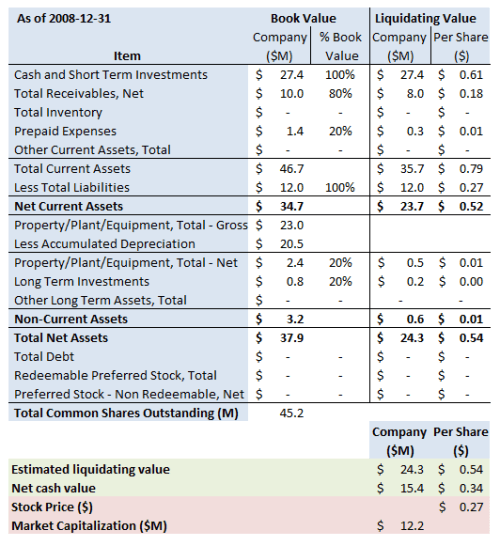
We’ve been following ABTL (see our post archive here) because it is trading at a discount to its liquidation value. We initially estimated the company’s liquidation value at $35.3M or $0.78 per share. We’ve now adjusted our valuation down significantly to $24.3M or $0.54 per share, partially because of the deterioration in ABTL’s balance sheet and partially because our initial analysis was overly optimistic (ABTL was one of our earliest posts). This is a disappointing outcome, but with the stock trading at less than half its liquidation value and 80% of its net cash value we plan to hold on for the moment.

The value proposition updated

ABTL has consumed a great deal of cash over the last 12 months, using $20M net cash in operating activities primarily from a net operating loss and an increase in its net working capital. Its principal sources of liquidity are from proceeds from dispositions of non-core businesses and the patent litigation settlement payments. ABTL has no debt and its cash and cash equivalents totaled $27.4 million as of December 31, 2008 compared to cash and cash equivalents of $27.6 million as of December 31, 2007. Our estimate for ABTL’s liquidation value is set out below (the “Book Value” column shows the assets as they are carried in the financial statements, and the “Liquidating Value” column shows our estimate of the value of the assets in a liquidation):

abtl-summary-2008-1-311We estimate ABTL’s net cash position at $15.4M or $0.34 per share and its liquidation value at $24.3M or $0.54 per share. Further cash payments are expected from the settlement with Dealix Corporation of $2.7M in March 2009 and 2010, which should bolster this position further.
Off-balance sheet arrangements and Contractual obligations

ABTL does not have any off-balance sheet arrangements. Its contractual obligations are around $3.4M in total through 2011, consisting of $1.8M in operating leases and $1.5M in purchase obligations.

A trancript of the company’s earnings conference call is available here.

Conclusion

Our position in ABTL has been a disappointing one, and has dragged down the performance of the portfolio. We propose to hold on for the time being, however, as the stock is trading at a price at which we would enter it, and so it makes no sense to exit.

[Full Disclosure:  We do not have a holding in ABTL. This is neither a recommendation to buy or sell any securities. All information provided believed to be reliable and presented for information purposes only. Do your own research before investing in any security.]

Read Full Post »

Soapstone Networks Inc (NASDAQ:SOAP) has filed its 10K for the year ended December 31, 2008.

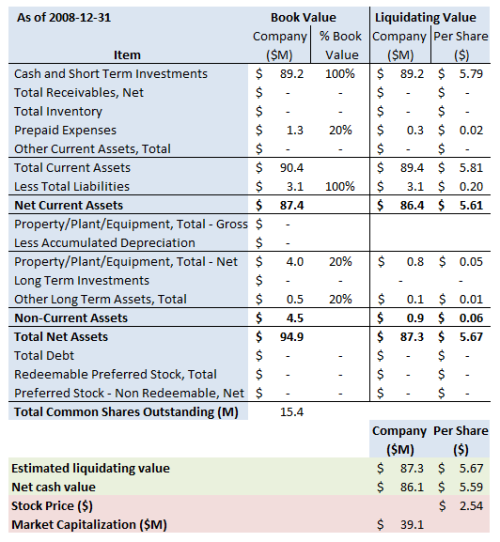
We started following SOAP on February 2 this year (see our post archive here) because it was trading well below its net cash value with an activist investor, Mithras Capital, disclosing an 8.7% holding in October last year. The stock is up 18.8% from $2.50 when we initiated our position to close Friday at $2.97, giving SOAP a market capitalization of $39.1M. We last estimated the company’s net cash value to be $86.1M or $5.78 per share. We are maintaining our estimate of the company’s net cash value but reducing the per share estimate to $5.59 because there is additional stock on issue.

The value proposition updated

The company’s balance sheet value is now almost wholly cash (the “Book Value” column shows the assets as they are carried in the financial statements, and the “Liquidating Value” column shows our estimate of the value of the assets in a liquidation):

soap-summary-2009-1-31

Off-balance sheet arrangements and Contractual obligations

SOAP does not have any off-balance-sheet arrangements and its contractual obligations, which consist entirely of operating leases, are $4.1M. These operating lease payments are the minimum lease payments under SOAP’s non-cancellable operating leases. SOAP treats payments made under its operating leases as rent expense for the facilities, including its head office.

Conclusion

As we’ve said on a number of occasions, we continue to believe that SOAP is one of the best opportunities available at the moment. The company’s ongoing business is small in comparison to its net cash position, so it shouldn’t dissipate its cash any time soon. It has no off-balance sheet arrangements, little in the way of ongoing contractual obligations and no material litigation, so the cash position seems reasonably certain. The company’s engagement of an investment bank to explore strategic alternatives is a promising step in the right direction. The only concern for us is the continued issuance of stock and options at a huge discount to liquidation value. The sooner Mithras Capital gets control of this situation the better.

[Full Disclosure:  We have a holding in SOAP. This is neither a recommendation to buy or sell any securities. All information provided believed to be reliable and presented for information purposes only. Do your own research before investing in any security.]

Read Full Post »

OrthoLogic Corporation (NASDAQ:CAPS) has filed its 10K for the year ended December 31, 2008.

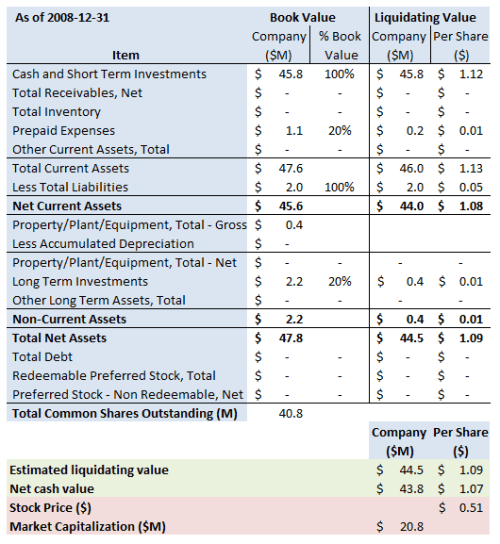
We’ve been following CAPS (see our post archive here) because it trades below its net cash value and Biotechnology Value Fund (BVF) has disclosed a 13.42% holding. It’s an unusual holding for us because BVF’s holding is passive. At CAPS’s $0.51 close Friday it has a market capitalization of $20.8M. Our initial estimate for CAPS’s net cash value was $44.1M or $1.08 per share. We’ve now adjusted that valuation to $43.8M or $1.07 per share. CAPS’s cash burn rate is quite high relative to its net cash position, so rapid steps need to be taken for this to be a profitable investment.

The value proposition updated

The summary of our estimate for the company’s liquidation value is set out below (the “Book Value” column shows the assets as they are carried in the financial statements, and the “Liquidating Value” column shows our estimate of the value of the assets in a liquidation):

caps-summary-2009-1-31

Off-balance sheet arrangements and Contractual obligations

There is no discussion in the 10K about CAPS’s off-balance sheet arrangements. CAPS’s only contractual obligation disclosed in 10K is for the company’s Tempe, Arizona facility and is $1.3M through 2012.

Conclusion

At its $0.51 close Friday, CAPS is trading at 47% of our estimate of its $1.07 per share net cash value. The risk for this investment continues to be that CAPS dissipates its cash before it or BVF can salvage any value. Management is taking steps to reduce its cash burn and repurchase undervalued stock, which is encouraging.

[Full Disclosure:  We do not have a holding in CAPS. This is neither a recommendation to buy or sell any securities. All information provided believed to be reliable and presented for information purposes only. Do your own research before investing in any security.]

Read Full Post »

Ditech Networks Inc (NASDAQ:DITC) has filed its 10Q for the period ended January 31, 2009.

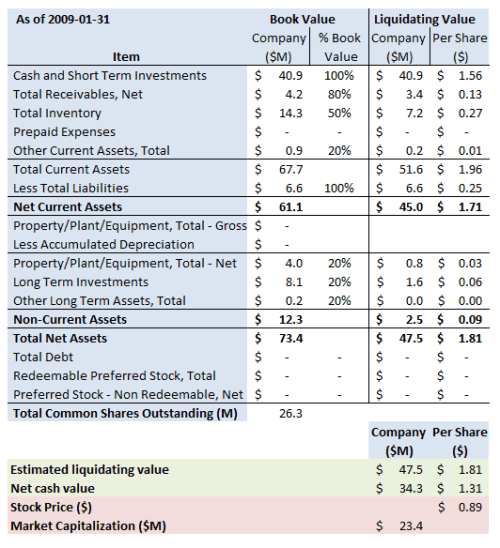
We’ve been following DITC (see our archive here) because it is trading well below its net cash value with an investor, Lamassu Holdings LLC, disclosing a 9.4% holding in November last year. Lamassu has offered to acquire DITC for $1.25 per share in cash. Lamassu says that it “anticipates its due diligence requirement will take no more than two weeks and there is no financing contingency.” The stock is up 19.1% from $0.89 to close Friday at $1.09, giving the company a market capitalization of $27.8M. We initially estimated the net cash value to be $37.9M or $1.44 per share. We’ve now adjusted our valuation down slightly to $34.3M or $1.31 per share.

The value proposition updated

DITC has continued to consume cash in its operations through the last quarter, bringing the cash burn in the last three quarters to $15.1M. As of January 31, 2009, DITC also had long-term investments of $8.2 million as compared to $15.1 million at April 30, 2008. These long-term investments are tied to auction rate securities that failed to settle at auction. Although these securities would normally be classified as short-term, as they typically settle every 7, 28 or 35 days, because they failed to settle at auction DITC has reclassified them to long-term pending them settling at auction. As of February 28, 2009, DITC continued to hold auction rate securities with a par value of $13.7M. Our updated valuation follows (the “Book Value” column shows the assets as they are carried in the financial statements, and the “Liquidating Value” column shows our estimate of the value of the assets in a liquidation):

ditc-summary-2009-1-31The company believes its “legacy business to be at or near cash flow break even” and this “will begin to be more evident in our financial results in the coming quarters:”

However, we do expect to continue to invest in our newer product offerings, which we believe will help diversify our customer base and hopefully add more predictability to our revenue streams. We expect that the investments in our new products will result in continued negative cash flows from operations until such time that we experience a resurgence of demand for our legacy products closer to their historical levels or our new products gain traction in the market and begin to generate meaningful revenue streams.

This is unfortunate. We think the best use of the company’s cash is its own undervalued stock.

Off-balance sheet arrangements and Contractual obligations

According to the 10Q, DITC has around $5.4M in contractual commitments (including $2.7M in operating leases and $2.7M in purchase commitments), around $2.9 of which falls due this year and the remainder falling due within the next 3 years. DITC has no other material commitments.

Conclusion

We propose to maintain our position in DITC and will continue to hold it in the Greenbackd Portfolio.

[Full Disclosure:  We do not have a holding in DITC. This is neither a recommendation to buy or sell any securities. All information provided believed to be reliable and presented for information purposes only. Do your own research before investing in any security.]

Read Full Post »

« Newer Posts - Older Posts »