Feeds:
Posts
Comments

Archive for the ‘Activist Investors’ Category

Avigen Inc (NASDAQ:AVGN) has filed its 10Q for the period ended March 31, 2009.

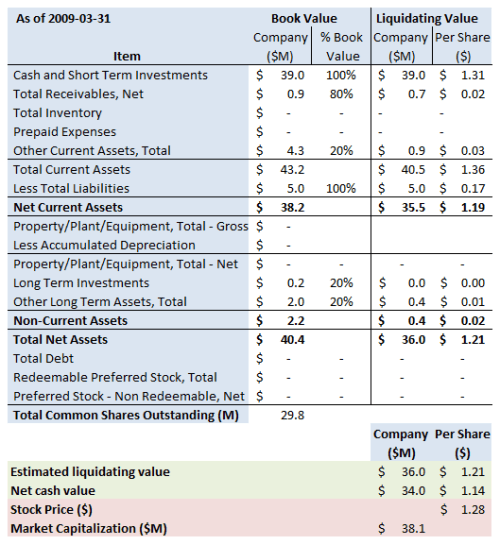
We started following AVGN in December last year (see archived posts here) because it was a net cash stock (i.e. it was trading at less than the value of its cash after deducting all liabilities), albeit a cash burning net cash stock, and specialist biotechnology investor Biotechnology Value Fund (BVF) was pushing it to liquidate and return its cash to shareholders. Despite BVF’s failure to remove the board, we continued to maintain our position in AVGN because BVF won a number of important concessions from the board that made AVGN a much more attractive stock than it was when we started following it. The stock price reflects this: AVGN is up 97% from $0.65 when we initiated the position to close yesterday at $1.28. We’ve reduced our estimate of the net cash slightly to $34M or $1.14 per share. We believe that the there is a good chance that AVGN will yield considerably more than its net cash value. The net cash estimate does not take into account AVGN’s AV411 assets and program or near term payments from Genzyme, which could be worth as much as $6M to $25M or between $0.18 or $0.75 per share more.

The value proposition updated

Set out below is our adjusted balance sheet for AVGN (the “Book Value” column shows the assets as they are carried in the financial statements, and the “Liquidating Value” column shows our estimate of the value of the assets in a liquidation):

AVGN Summary 2009 3 31Conclusion

While BVF’s slate was not successful at the special meeting, AVGN’s board is now developing its own plan of liquidation, which should put a floor on AVGN’s stock at around its net cash value of $34M or $1.14 per share less wind down costs. There exists a good chance that AVGN will yield considerably more than its net cash value. The net cash estimate does not take into account AVGN’s AV411 assets and program or near term payments from Genzyme, which could be worth as much as $6M to $25M or between $0.18 or $0.75 per share more. With the downside protected, and a good chance at a substantial $0.18 or $0.75 per share upside from here, we think AVGN still represents good value, and we’re going to maintain our position accordingly.

[Full Disclosure: We have a holding in AVGN. This is neither a recommendation to buy or sell any securities. All information provided believed to be reliable and presented for information purposes only. Do your own research before investing in any security.]

Read Full Post »
Axcelis Technologies Inc (NASDAQ:ACLS) has filed its 10Q for the period ended March 31, 2009.

We started following ACLS on January 8 this year (see our post archive here) because it is an undervalued asset play with an activist investor, Sterling Capital Management, holding 10.7% of its outstanding stock. ACLS has completed the sale of its 50% interest in SEN Corporation, its joint venture with Sumitomo Heavy Industries, Ltd. (SHI) to SHI for proceeds of $122.3 million. ACLS received around $35.9M in cash after applying $86.4M of the proceeds to meet obligations to the holders of the company’s 4.25% Convertible Senior Subordinated Notes, upon which ACLS defaulted in January. We last estimated ACLS’s liquidation value at around $147M or $1.43 per share based on our reconstruction of the balance sheet following the sale. We’ve now had an opportunity to review the actual balance sheet and reduced our estimate to $117.8M or $1.14 per share, which is more than 170% higher than its close yesterday of $0.42.

The value proposition updated

During the three months ended March 31, 2009, ACLS continued to burn cash in its operations, which it attributes to the depressed semiconductor equipment market and the resultant decline in revenues. Cash and cash equivalents at March 31, 2009 were $71.2M, compared to $37.7M at December 31, 2008. The $33.5M increase in cash and cash equivalents was primarily attributable to the net cash proceeds from the sale of its investment in SEN, offset by cash used in operations. Set out below is our adjusted balance sheet for ACLS (the “Book Value” column shows the assets as they are carried in the financial statements, and the “Liquidating Value” column shows our estimate of the value of the assets in a liquidation):

ACLS Summary 2009 3 31

Conclusion

ACLS has made substantial operating losses over the last two years, and it is likely to be continue to do so. While its liquidation value of around $117.8M or $1.14 per share is more than 170% higher than its close yesterday of $0.42, it is likely to deteriorate while it continues its operating losses. ACLS has been our problem child, and we don’t think there is any good news on the horizon near-term, but we find it difficult to exit the position while it’s trading at a such a large discount to its (albeit deteriorating) liquidation value. Accordingly, we’re going to hold on for the moment, and see how the position plays out. If we get an opportunity to exit at close to value, however, we’ll take it.

[Full Disclosure:  We have a holding in ACLS. This is neither a recommendation to buy or sell any securities. All information provided believed to be reliable and presented for information purposes only. Do your own research before investing in any security.]

Read Full Post »

MathStar Inc (OTC:MATH) has received another merger offer from PureChoice, Inc., this one providing for a $1.04 per share cash payment to the MATH stockholders.

We’ve been following MATH since December last year (see our post archive here) when it was trading at $0.68. We initiated the position because MATH was trading below its net cash value and had two substantial stockholders lobbying management to liquidate. The stock is up 33.8% to $0.91 yesterday, giving it a market capitalization of $8.4M. We estimate MATH’s liquidation value to be around $12.0M or $1.31 per share. That value is predominantly cash and short term investments and doesn’t take into account any further value that the sale of the FPOA technology and intellectual property may yield. The two activist investors, Mr. Zachary McAdoo of The Zanett Group and Mr. Salvatore Muoio of S. Muoio & Co., have been urging MATH’s board to consider liquidation rather than a merger. MATH’s board seems to agree, twice rejecting unsolicited merger proposals from PureChoice, Inc., suspending the company’s operations and exploring “strategic alternatives, which could include merger, acquisition, increasing operations in another structure or liquidation.”

The press release from PureChoice, Inc. (via Earth Times) is as follows:

BURNSVILLE, Minn., May 11 /PRNewswire/ — PureChoice, Inc., a leader in building performance software, has made a merger offer to MathStar, Inc. providing for a $1.04 per share cash payment to the MathStar stockholders. The offer represents a 23 percent premium over Friday, May 8, 2009 market close of $.84 per share.

The merger offer was outlined Monday in a letter to the MathStar board of directors from Bryan Reichel, President and CEO of PureChoice.

The merger offer is contingent upon several factors, including minimum MathStar cash balances and maximum MathStar liabilities at closing, and the absence of certain specified transactions, commitments or other arrangements between January 1, 2009 and the closing date.

We need to see the full terms of the offer, but it seems to be pitched at a large discount to MATH’s liquidation value. We would hope that any merger offer would, at the minimum, reflect MATH’s liquidation value of $12.0M or $1.31 per share. We’ll keep a weather eye on the negotiations.

[Full Disclosure:  We do not have a holding in MATH. This is neither a recommendation to buy or sell any securities. All information provided believed to be reliable and presented for information purposes only. Do your own research before investing in any security.]

Read Full Post »

Bill Ackman’s Pershing Square has filed the presentation to be delivered to the shareholders of Target Corporation (NYSE: TGT) at TGT’s 2009 Annual Meeting of Shareholders. See our post TGT archive here.

See Bloomberg’s interview with Bill Ackman about his slate (via The Manual of Ideas):

Read Full Post »

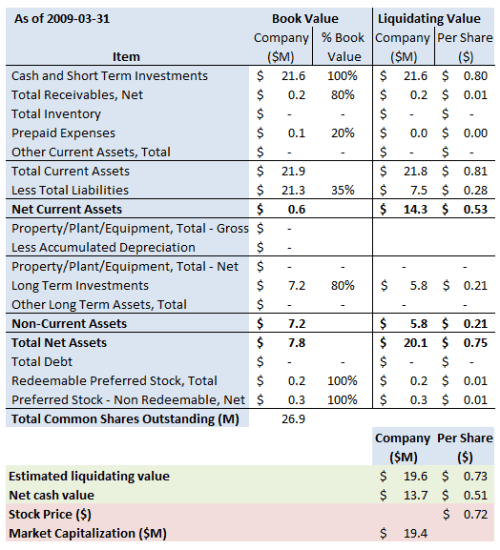
Neurobiological Technologies Inc (NASDAQ:NTII) has filed its 10Q for the period ended march 31, 2009. After reviewing the 10Q, we have reduced our estimate of NTII’s liquidation value to $19.6M or $0.73 per share. NTII closed on Friday at $0.72, which is approximately our estimate of its value, and so we are taking the opportunity to exit. We opened the position on February 23, 2009 at $0.53, so we are up 35.9% on an absolute basis. The S&P500 Index was at 770.05 when we opened the position, and closed Friday at 929.23, which means we are up 15.2% on a relative basis.

We started following NTII (see our post archive here) because it was trading at a substantial discount to our estimate of its $21.9M or $0.81 per share liquidation value and Biotechnology Value Fund, Millennium Technology Value Partners and Highland Capital Management held approximately 45% of NTII’s outstanding stock (one stockholder estimated 65%) and were calling for its liquidation. NTII has now reached our reduced estimate of its liquidation value, so we are exiting the position.

The value proposition updated

NTII expects “cash, cash equivalents, short-term and long-term investments to total approximately $23 million at June 30, 2009,” which is up slightly from our estimate as at March 31, 2009. The summary of our estimate for the company’s liquidation value is set out below (the “Book Value” column shows the assets as they are carried in the financial statements, and the “Liquidating Value” column shows our estimate of the value of the assets in a liquidation):

NTII Summary 2009 3 31

Conclusion

At its $0.72 close on Friday, NTII is trading at just under our estimate of its $0.73 per share liquidating value. While we believe that there may be slightly more value in NTII (for example, if it receives a portion of the net proceeds paid to Celtic Pharmaceuticals upon a sale of XERECEPT), we ‘re not certain of that value, so we’re taking the opportunity to exit now.

[Full Disclosure:  We do not have a holding in NTII. This is neither a recommendation to buy or sell any securities. All information provided believed to be reliable and presented for information purposes only. Do your own research before investing in any security.]

Read Full Post »

Vanda Pharmaceuticals Inc. (NASDAQ:VNDA) yesterday announced that the US Food and Drug Administration (FDA) had granted marketing approval following its Phase III clinical study of Fanapt™ (iloperidone). Tang Capital Partners has ended its proxy contest by withdrawing its nominations of director candidates for election to VNDA’s Board of Directors and its stockholder proposal to liquidate VNDA. We are closing our position too. The stock ran 900% on the announcement to $10.00 in after-hours trade and closed yesterday at $7.84. We opened the position on March 12, 2009 at $0.78, so we’re up 905.1% on an absolute basis. The S&P500 Index closed at 721.36 on the same day, and closed yesterday at 907.39, which means we’re up 881.7% on a relative basis.

We started following VNDA (see our post archive here) because it was trading below its net cash value and Tang Capital Partners (TCP) had called for the company to “cease operations immediately, liquidate [VNDA]’s assets and distribute all remaining capital to the Stockholders.” TCP had filed a preliminary proxy statement for the 2009 Annual Meeting urging stockholders to support TCP’s slate of two director nominees, Kevin C. Tang and Andrew D. Levin, M.D., Ph.D. We estimated VNDA’s net cash value to be around $38.6M or $1.45 per share, and believed that the investment turned on TCP’s ability to get control of the board at the Annual Meeting. It seems we were wrong about that. The big run up in the stock occurred because the FDA granted marketing approval of Fanapt™, which demonstrates one of the great things about investing in liquidation plays: good surprises. We generally ascribe zero value to the intangibles, because more often than not, that’s what they’re worth. Very occassionaly, however, the  intangibles are worth something, and purchasers below liquidation value have a free option on them. We’re not going to pretend that we thought it was a real possibility in this instance. As Lefty Gomez liked to say, “I’d rather be lucky than good.”

Here’s the text of the announcement of the FDA approval:

FDA Approves Vanda Pharmaceuticals’ Fanapt for the Treatment of Schizophrenia

Rockville, MD. (May 6, 2009)— Vanda Pharmaceuticals Inc. (NASDAQ: VNDA) announced today that the US Food and Drug Administration (FDA) has granted marketing approval of Fanapt™ (iloperidone) for the acute treatment of adult patients with schizophrenia. The approval was supported by two placebo-controlled Phase III clinical studies comparing Fanapt™ to placebo and active control in patients with schizophrenia, as well as safety data from more than 3,000 patients.

Fanapt™ is a mixed dopamine D2 / serotonin 5HT2A receptor antagonist, and belongs to the class of atypical antipsychotics.

“The approval of Fanapt™ marks a new opportunity for many patients with schizophrenia, who experience only partial responses to current therapies, to achieve better control of their symptoms,” remarked Dr. Peter J. Weiden, Professor of Psychiatry and Director of the Psychotic Disorders Program at the University of Illinois at Chicago. “Having Fanapt™ available is a major help for our patients in offering an effective antipsychotic with an excellent side effect profile across a wide range of major tolerability problems associated with other antipsychotic therapies.”

The efficacy of Fanapt™ for the treatment of schizophrenia was supported by two placebo-controlled short-term (4- and 6-week) trials. Both trials enrolled patients who met the DSM-III/IV criteria for schizophrenia, and Fanapt™ was shown to be superior to placebo in controlling symptoms of schizophrenia across doses of 12mg to 24mg per day. The recommended target dose range of Fanapt™ is 12mg to 24 mg per day. Titration to the target dose of 12mg per day can be achieved in 4 days.

Vanda plans to make Fanapt™ available in pharmacies later this year.

–snip–

And TCP’s withdrawal of its director nominees:

Vanda Pharmaceuticals Announces Withdrawal of Director Nominees and Proposal to Liquidate Submitted by Tang Capital

Rockville, MD. (May 7, 2009) — Vanda Pharmaceuticals Inc. (NASDAQ: VNDA) (“Vanda” or the “Company”) announced today that Tang Capital Partners, LP (“TCP”) has ended its proxy contest by withdrawing its nominations of director candidates for election to Vanda’s Board of Directors and its stockholder proposal to liquidate the Company. TCP had previously notified the Company of its intention to solicit proxies for the election of two of its candidates to the Vanda Board at the Company’s 2009 Annual Meeting and for its proposal that the Board take action to liquidate the Company.

Kevin Tang, the managing director of the general partner of TCP, notified Vanda of TCP’s intention not to pursue a proxy contest on May 6, 2009 in an email to Vanda’s Chief Executive Officer, Mihael H. Polymeropoulos, M.D. and Chairman of the Board, Argeris N. Karabelas, Ph.D. TCP’s withdrawal of its nominations and stockholder proposal follows Vanda’s announcement that the U.S. Food & Drug Administration had granted marketing approval of its product, Fanapt™ (iloperidone), for the acute treatment of adult patients with schizophrenia.

[Full Disclosure:  We do not have a holding in VNDA. This is neither a recommendation to buy or sell any securities. All information provided believed to be reliable and presented for information purposes only. Do your own research before investing in any security.]

Read Full Post »

Dr. Roderick Wong has withdrawn his slate of director nominees for election at Facet Biotech Corporation’s (NASDAQ:FACT) 2009 annual meeting of stockholders. Wong’s withdrawal means that our investment thesis is gone, and we’re closing the position.

We opened the position at $9.13 and closed it at $8.96, which means we’re down 1.86% on an absolute basis. The S&P500 Index closed at 850.08 on the day we opened the position and closed yesterday at 919.53, which means we’re off 10% on a relative basis.

Post mortem

FACT was a new category of investment for us: special situations (see our post archive here). It was an activist play with a catalyst in the form of Dr. Roderick Wong’s nomination for the annual meeting of an alternative slate of directors, including well-known activist investor Robert. L. Chapman. The dissident slate called for a cash dividend of up to $15 per share and demanded the sale of the other non-cash assets, estimating they may be worth an additional $8 to $16 per share, which represented a substantial upside at FACT’s $9.13 closing price (equivalent to a market capitalization of $216.8M) at the time we opened the position. We estimated the liquidation value to be anywhere from nil to $259M or ~$10.85 per share and the net cash value from nil to $228M or $10.54 per share, so it wasn’t a typical liquidation play for us. The company was burning through its cash at a rapid rate, so the main risk to the investment was that the status quo was maintained. Although Wong et al held only 0.5% of FACT’s outstanding stock, we thought the presence of Bob Chapman and other noted activist and deep value investors on the register (Baupost Group holds ~18%) indicated a good chance of success for the dissidents.

The position started falling apart when Chapman and Broenniman withdrew their consents:

In March 2009, Facet Biotech Corporation (the “Company”) received a notice of intention to nominate five candidates for election to the Company’s five-person Board of Directors at the Company’s 2009 Annual Meeting of Stockholders (the “Annual Meeting”). Sent by Roderick Wong, the notice stated the intent to nominate Philip R. Broenniman, Robert L. Chapman, Jr., David Gale, Bradd Gold and Roderick Wong, for election to the Company’s Board of Directors. On April 30, 2009, Philip R. Broenniman and Robert L. Chapman, Jr. each separately notified the Company in writing that they were withdrawing their consent to being named as nominees for election to the Company’s Board of Directors at the Annual Meeting.

And the death knell was Wong withdrawing the entire slate:

RODERICK WONG WITHDRAWS DIRECTOR NOMINATIONS

Redwood City, Calif., May 4, 2009 — Facet Biotech Corporation (Nasdaq: FACT) and Roderick Wong, M.D., today jointly announced that based on productive discussions between Facet and Dr. Wong, Dr. Wong has withdrawn his slate of director nominees for election at Facet’s 2009 annual meeting of stockholders and will not present, recommend or move for the election of any of the nominees he had submitted for election.

Faheem Hasnain, president and chief executive officer of Facet, said, “We thank Dr. Wong for raising important concerns held by some of Facet’s stockholders and advocating for these stockholders. Our Board values his insights regarding the future of the company and we look forward to an ongoing constructive dialogue with Dr. Wong.”

Dr. Wong said “I am pleased to have brought this situation to an amicable conclusion. Our discussions have focused on issues that are critical to Facet’s success and I appreciate the time and attention that the company has devoted to our discussions.”

Wong gives no indication in the press release what, if any, concessions were made by FACT to bring the situation to an “amicable conclusion.” There were no reasons given for Chapman and Broenniman’s withdrawl either. It could be that, without Chapman and Broenniman, Wong felt he didn’t have the support to roll the board and so sought a face-saving resolution with the company. We don’t know, but we welcome speculation in the comments.

[Full Disclosure:  We do not have a holding in FACT. This is neither a recommendation to buy or sell any securities. All information provided believed to be reliable and presented for information purposes only. Do your own research before investing in any security.]

Read Full Post »

Soapstone Networks Inc (NASDAQ:SOAP) has filed its 10Q for the quarter ended March 31, 2009.

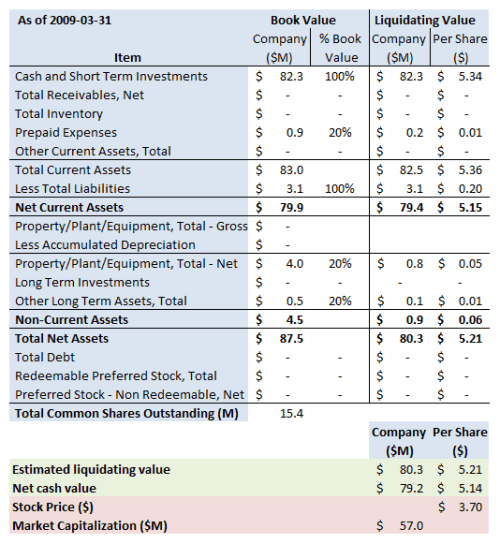
We been following SOAP (see our post archive here) because it is trading well below its net cash value with an activist investor, Mithras Capital, disclosing an 8.7% holding in October last year. The stock is up 48.0% from $2.50 when we initiated our position to close yesterday at $3.70, giving SOAP a market capitalization of $52.0M. We last estimated the company’s net cash value to be $86.1M or $5.59 per share. Following our review of the Q1 10Q, we’ve adjusted our valuation down 6% to $80.3M or $5.21 per share as a result of $6.7M of cash burned.

The value proposition updated

The company’s balance sheet value is almost wholly cash, which it continues to burn (the “Book Value” column shows the assets as they are carried in the financial statements, and the “Liquidating Value” column shows our estimate of the value of the assets in a liquidation):

soap-summary-2009-3-311

Balance sheet adjustments

We need to make the following adjustments to the balance sheet estimates above:

  • Cash burn: The company used $6.7M in cash in the first quarter. They expect cash burn to continue to be between $6M and $6.5M per quarter.
  • Off-balance sheet arrangements and contractual obligations: SOAP does not have any off-balance-sheet arrangements and its contractual obligations, which consist entirely of operating leases, are $3.9M. These operating lease payments are the minimum rent expense for SOAP’s facilities, including its head office.

Conclusion

We continue to believe that SOAP is a very good opportunity. The company’s ongoing business is small in comparison to its net cash position, so it shouldn’t dissipate its cash any time soon. It has no off-balance sheet arrangements, little in the way of ongoing contractual obligations and no material litigation, so the cash position seems reasonably certain. The company’s engagement of an investment bank to explore strategic alternatives is a promising step in the right direction. We continue to be concerned by the continued issuance of options at a huge discount to liquidation value. The sooner Mithras Capital gets control of this situation the better.

[Full Disclosure:  We have a holding in SOAP. This is neither a recommendation to buy or sell any securities. All information provided believed to be reliable and presented for information purposes only. Do your own research before investing in any security.]

Read Full Post »

Vanda Pharmaceuticals Inc. (NASDAQ:VNDA) has reported its results for the first quarter ended March 31, 2009.

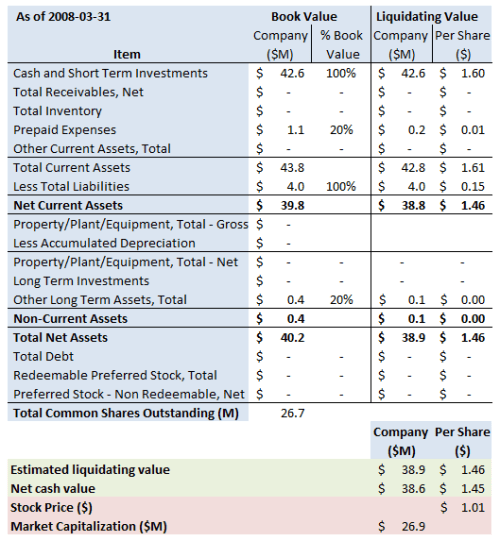
We’ve been following VNDA (see our post archive here) because it’s trading below its net cash value and Tang Capital Partners (TCP) has called for the company to “cease operations immediately, liquidate [VNDA]’s assets and distribute all remaining capital to the Stockholders.” TCP has now filed a preliminary proxy statement for the 2009 Annual Meeting urging stockholders to support TCP’s slate of two director nominees, Kevin C. Tang and Andrew D. Levin, M.D., Ph.D. The stock is up 29.5% since we initiated the position to close yesterday at $1.01, giving the company a market capitalization of $24.3M. We initially estimated the net cash value to be around $42.6M or $1.60 per share. We’ve now reduced our estimate of the net cash value to $38.6M or $1.45 per share. The company continues to hemorrhage cash, so the investment turns on TCP’s ability to get control of the board at the Annual Meeting and staunch the bleeding. If TCP cannot get onto the board quickly, the company will continue to burn cash and the investment will be a dud. VNDA has a staggered board, which makes TCP’s task difficult.

The value proposition updated

In the first quarter of 2009 VNDA burned through $3.8M in cash, which reduces our estimate of the net cash value from $42.6M to $38.6M or $1.45 per share (the remaining difference is due to the slight increase in shares on issue). Set out below is our summary balance sheet  (the “Book Value” column shows the assets as they are carried in the financial statements, and the “Liquidating Value” column shows our estimate of the value of the assets in a liquidation):

vnda-summary-2009-12-31

Conclusion

VNDA continues to be an interesting play. While the stock is up nearly 30% since we initiated the position, it is still trading at a 45% discount to our estimate of its $1.45 per share net cash value. That value is of course deteriorating rapidly, and the challenge for investors is to determine which of two outcomes is more likely: If TCP can get on the board quickly, stop the cash burn and liquidate the company, we’re likely to see a good return. If TCP cannot get onto the board quickly or at all, the company will continue to burn cash and the investment will be a dud. VNDA has a staggered board, so this will make TCP’s task difficult. We’re inclined to maintain our position and see how this plays out.

[Full Disclosure:  We do not have a holding in VNDA. This is neither a recommendation to buy or sell any securities. All information provided believed to be reliable and presented for information purposes only. Do your own research before investing in any security.]

Read Full Post »

In Now a baker’s dozen in North Dakota, footnoted.org’s Michelle Leder tracks the small, but growing number of companies whose shareholders are requesting via the annual proxy process that their companies relocate to North Dakota:

Last week, 11 companies, including Exxon Mobil (EOM), Southwest (LUV), and Amgen (AMGN), were on the list. But since Friday, two more companies have been targeted, which makes it a baker’s dozen. Over the past two days, shareholder activist John Chevedden, who has introduced proposals at Southwest and two others, added Continental Airlines (CAL) and Staples (SPLS) to his list.

The rush is on because the corporations law in North Dakota is intended to be much friendlier to shareholders. Shareholders in North Dakota can expect the following (from the 2007 press release announcing the bill):

· Majority voting in election of directors. In an uncontested election of directors, shareholders have the right to vote “yes” or “no” on each candidate, and only those candidates receiving a majority of “yes” votes are elected.

· Advisory shareholder votes on compensation reports. The compensation committee of the board of directors must report to the shareholders at each annual meeting of shareholders and the shareholders have an advisory vote on whether they accept the report of the committee.

· Proxy access. The corporation must include in its proxy statement nominees proposed by 5% shareholders who have held their shares for at least two years.

· Reimbursement for successful proxy contests. The corporation must reimburse shareholders who conduct a proxy contest to the extent the shareholders are successful. Thus, if a shareholder conducts a proxy contest to place three directors on a corporation’s board and two of the candidates are elected, the shareholder will be entitled to reimbursement of two-thirds of the cost of the proxy contest.

· Separation of roles of Chair and CEO. The board of directors must have a chair who is not an executive officer of the corporation.

As we’ve discussed previously, Carl Icahn is a supporter of North Dakota’s initiative, and has even proposed a federal law that allows shareholders to vote by simple majority to migrate a company from its state of incorporation to more shareholder-friendly states, including North Dakota. At present, that power is vested in boards, which means that even if the proposal passes, the boards must embrace the proposal before it is binding on the company. Leder thinks this means it’s unlikely that the companies will up stakes for North Dakota, but it’s interesting to watch.

Read Full Post »

« Newer Posts - Older Posts »