Feeds:
Posts
Comments

Archive for the ‘Activist Investors’ Category

Soapstone Networks Inc (NASDAQ:SOAP) has announced that the stockholders have approved the liquidation and dissolution of the company.

We started following SOAP (see our post archive here) because it was trading well below its net cash value with an activist investor, Mithras Capital, disclosing an 8.7% holding in October last year. The stock is up 68.4% from $2.50 when we initiated our position to close today at $4.13, giving SOAP a market capitalization of $61.0M. We last estimated the company’s net cash value to be $80.3M or $5.21 per share. The company has now announced that it proposes to liquidate. It estimates that the total distribution, including an extraordinary cash dividend of $3.75 per share, will be between $4.00 and $4.50 per share. The initial dividend was paid yesterday and the stock trade’s ex-dividend today.

The press release from the company is set out below:

BILLERICA, MA–(Marketwire – July 28, 2009) – Soapstone Networks Inc. (NASDAQ: SOAP), today announced that, at the Company’s annual meeting of stockholders held on July 28, 2009, the stockholders of Soapstone Networks voted to approve the liquidation and dissolution of the Company pursuant to a Plan of Liquidation and Dissolution (the “Plan of Liquidation”).

As previously announced by the Company, in connection with the approval of the Plan of Liquidation, the Company’s Board of Directors has approved an extraordinary cash dividend of $3.75 per share of the Company’s common stock. The dividend will be paid on July 29, 2009 and the Company’s stock will trade ex-dividend commencing July 30, 2009.

The Company intends to file a certificate of dissolution on July 31, 2009 with the Delaware Secretary of State in accordance with the Plan of Liquidation. At the close of business on July 31, 2009, the Company expects to close its stock transfer books and cease recording transfers of shares of its common stock. At that time, the Company’s common stock, and stock certificates evidencing the shares of common stock, will no longer be assignable or transferable on the Company’s books. We have notified Nasdaq OMX of the date we intend to file our certificate of dissolution, and we will seek to delist our shares of common stock as soon as practicable thereafter. In addition, we requested that the Nasdaq Global Market suspend the trading of our common stock effective at the close of business on July 31, 2009. After the Company ceases trading on the Nasdaq Global Market as a result of such suspension, shares of the Company’s common stock held in street name with brokers may be traded in the over-the-counter market on an electronic bulletin board established for unlisted securities such as the OTC Bulletin Board or the Pink Sheets. Such trading will reduce the market liquidity of the Company’s common stock. As a result, an investor would find it more difficult to dispose of, or obtain accurate quotations for the price of the Company’s common stock, if they are able to trade the Common Stock at all.

The Board of Directors has fixed July 31, 2009 as the record date for determining stockholders entitled to receive any future distributions of available assets and as the final date for the recording of stock transfers. Only those stockholders of record as of the close of business on July 31, 2009 (the “Record Stockholders”), will be entitled to such future distributions. The Company anticipates that its first distribution after the July 31, 2009 record date is not likely to occur prior to the first quarter of 2010. Prior to winding up its affairs under Delaware law, the Company intends to make at least one additional liquidating distribution to the Record Stockholders. The Company has not yet established the timing or per share amount of any such distributions.

[Full Disclosure:  We have a holding in SOAP. This is neither a recommendation to buy or sell any securities. All information provided believed to be reliable and presented for information purposes only. Do your own research before investing in any security.]
Read Full Post »

Autobytel Inc (NASDAQ:ABTL) has filed its 10Q for the quarter ended June 30, 2009.

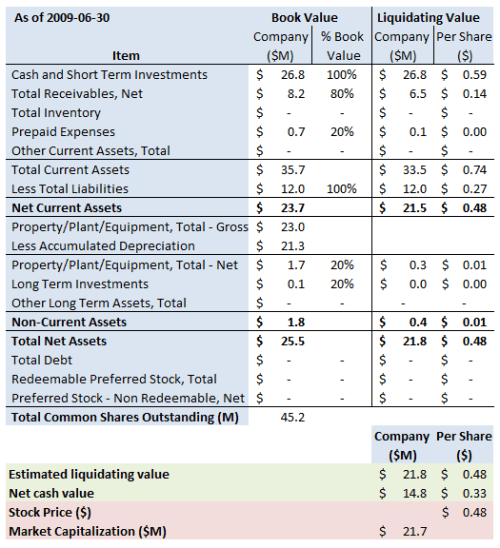
We last estimated ABTL’s liquidation value at $24.3M or $0.54 per share. Following our review of the 10Q, we’ve reduced our estimate to$21.8M or $0.48 per share. The stock closed yesterday at $0.48, which means it’s trading at our estimate of the liquidation value. On that basis, we’re exiting. We opened our position at $0.43, so we’re up 11.6% on an absolute basis. The S&P500 closed yesterday at 979.62, and was at 899.24 when we started following ABTL in December, which means we’re up 2.7% on a relative basis.

Post mortem

We started following ABTL (see our post archive here) because it was trading at a substantial discount to its liquidation and net cash values and Trilogy had filed a 13D notice disclosing a 7.4% holding. Trilogy had also launched a tender offer for ABTL at $0.35 per share. When Trilogy launched its offer, we wrote that we believed that $0.35 per share was only the opening salvo and a higher price was possible if the board terminated the rights plan poison pill. The board rejected the offer out of hand and Trilogy did not make a further offer before the initial offer expired. On expiry of the offer, Trilogy sent a letter to the board saying that it would “continue to evaluate [ABTL’s] business, its cash position, and its operating performance” and called on the board to communicate to its shareholders the break-up value of Autobytel, such that shareholders can determine if that is the best course to maximize value.” That did not eventuate.

ABTL has consumed a great deal of cash over the last years. Its principal sources of liquidity are from proceeds from dispositions of non-core businesses and the patent litigation settlement payments. Our estimate for ABTL’s liquidation value is set out below (the “Book Value” column shows the assets as they are carried in the financial statements, and the “Liquidating Value” column shows our estimate of the value of the assets in a liquidation):

ABTL Summary 2008 6 30

Conclusion

Our position in ABTL has been a disappointing one, and has dragged down the performance of the portfolio. That aside, we can’t be too unhappy with a slightly positive result in a declining company.

[Full Disclosure:  We do not have a holding in ABTL. This is neither a recommendation to buy or sell any securities. All information provided believed to be reliable and presented for information purposes only. Do your own research before investing in any security.]

Read Full Post »

Catalyst Investment Research, the collaboration between Damien J. Park of Hedge Fund Solutions and The Official Activist Investing Blog, and Jonathan Heller, CFA, of Cheap Stocks, has a new Special Report on the Steel Partners II Investment Portfolio (.pdf).

In the Special Report, Damien and Jonathan analyze the Steel Partners II portfolio companies to determine which have been “unfairly impacted by the recent selloff” following Steel Partners II’s announcement that it will restructure as a publicly-traded holding company.

Damien and Jonathan describe the opportunity as follows:

Following months of litigation with several investors seeking to block the restructuring, Steel was granted Court approval to move forward with the plan on June 19. As a result, on July 15, Steel Partners distributed approximately half of the economic value of their fund via cash and a pro rata in-kind distribution of securities to those investors seeking to exit the fund immediately. Following the distribution, a number of smaller, illiquid securities observed enormous selloffs – causing a massive imbalance in supply and demand, and resulting in a precipitous decline in the market value of certain companies. We believe the dramatic reduction in value at a few of these companies is a short-term phenomenon and not correlated with the fundamental value intrinsic to the company.

Read the rest of the Special Report by clicking here (.pdf).

Read Full Post »

The Official Activist Investing Blog has published its list of activist investments for June:

Ticker Company Investor
ACMR A.C. Moore Arts & Crafts, Inc. Glenhill Advisors
ADF ACM Managed Dollar Income Fund Bulldog Investors
ASUR Asure Software Red Oak Partners
ATGN AltiGen Communications Wanger Investment Management
AXC Advanced Technology Acquisition Corp Bulldog Investors
BASI Bioanalytical Systems Peter Kissinger
BASI Bioanalytical Systems Thomas Harenburg
CAMD California Micro Devices Gamco Investors
CFW Cano Petroleum Carlson Capital
COHM.PK Coachmen Industries Inc Gamco Investors
CTO Consolidated Tomoka Land Co Wintergreen Advisers
CWLZ Cowlitz Bancorporation Crescent Capital
DCS Dreman/Claymore Dividend & Income Fund Bulldog Investors
DITC Ditech Networks Lloyd Miller
ENTU Entrust Inc. Arnhold & S. Bleichroeder Advisers
FMMH.OB Fremont Michigan Insurance Corp Harry Long
FPU Florida Public Utilities Co Energy West
FTGX Fibernet Telecom Group Carlson Capital
GGP General Growth Properties Pershing Square Capital
HBRF.OB Highbury Financial Peerless Systems
HDIX Home Diagnostics Discovery Group
HEOP Heritage Oaks Bancorp Patriot Financial Partners
IPAS iPass, Inc. Foxhill Capital
JTX Jackson Hewitt Tax Service Shamrock Activist Value Fund
KANA.OB Kana Software KVO Capital Management
KONA Kona Grill BBS Capital Management
LGF Lions Gate Entertainment Carl Icahn
MZF MBIA Capital Claymore Man Dur Inv Grd Muni Fund Western Investment
NUF Nuveen Florida Quality Income Municipal Fund Western Investment
OPTV OpenTV Corp Kudelski SA
OPTV OpenTV Corp Discovery Capital
PHH PHH Corporation Pennant Capital
PLCE The Childrens Place Retail Stores, Inc. Ezra Dabah
PTSG.OB Petrosearch Energy Corp Tiberius Capital
PYMX.OB PolyMedix, Inc. Target Capital Management
QGLY Quigley Corp Ted Karkus
SLRY Salary.com Raging Capital Management
SNG Canadian Superior Energy Inc. Palo Alto Investors
STAA Staar Surgical Co Broadwood Partners
SUAI Specialty Underwriters Alliance Hallmark Financial Services
TICC TICC Capital Corp Raging Capital Management
TLX Trans Lux Corp Gamco Investors
TTSP.OB TransTech Services Partners Bulldog Investors
TXI Texas Industries Shamrock Activist Value Fund
UAHC United American Healthcare Corp. Strategic Turnaround Equity Partners
VXGN.OB Vaxgen Inc Steven Bronson

Read Full Post »

In Blank Checks Firing Blanks (Breakingviews.com via NYTimes.com), Lauren Silva Laughlin and George Hay write about the recent performance of blank check companies, otherwise known as special-purpose acquisition corporations or SPACs. Blank checks are shell companies that raise money from the public in order to acquire a business the identity of which is not known at the time the capital is raised. The trick is that a deal must be consumated before a certain date or the funds must be returned to the investors.

Many of the blank checks raised in 2007 are running out of time to complete an aquisition. While some 2007 SPACs did manage to seal a deal, it seems most were unable to do so because of the turmoil in the markets and were forced to liquidate:

About 40 of 66 SPACs that started in 2007 have been liquidated or will probably end up being liquidated, according to SPAC Research Partners.

It turns out that those SPACs forced to liquidate have outperformed those that actually completed a transaction:

And SPACs that sat on cash and safe investments have actually outperformed those that did deals. Take the GSC Acquisition Company, established by GSC Group, a debt-focused investment firm. The SPAC’s bosses tried to acquire Complete Energy, a power producer. But the deal wasn’t completed in time, and GSC Acquisition was liquidated last month.

Investors received around $9.80 a share in cash, just shy of the $10 they paid in its initial public offering two years earlier.

Investors in SPACs that did deals haven’t been so lucky. Shares of Aldabra 2 Acquisition Corporation, for instance, have plunged more than 75 percent since that SPAC bought Boise Cascade’s paper, packaging and transportation business and changed its name to Boise Inc. in February 2008.

From a deep value investor’s point of view, SPACs present an interesting investment opportunity. The value analysis is simple enough: Most trade at a discount to net cash. The difficulty is in assessing which will actually return the cash and which will spray it away on an acquisition. In making such an assessment, it helps to have a large activist investor sitting on the register. Cue Daniel Loeb and Third Point LLC. Third Point’s most recent 13F filing shows a number of SPACs in Loeb’s portfolio, including the following (via Market Folly):

  1. Liberty Acquisition Holdings (LIA): 11.75% of Loeb’s portfolio
  2. Victory Acquisition Corp (VRY): 5% of Loeb’s portfolio
  3. Trian Acquisition (TUX): 4.95% of Loeb’s portfolio
  4. Triplecrown Acquisition (TCW): 4.35% of Loeb’s portfolio
  5. Global Brands Acquisition (GQN): 2.4% of Loeb’s portfolio
  6. Global Consumer Acquisition (GHC): 1.8% of Loeb’s portfolio

We haven’t looked at any of these in detail, but they might present a happy hunting ground for the liquidation value investor. We’ll return to these stocks if there’s further turmoil in the market.

[Full Disclosure: We do not have a holding in any of the securities listed above. This is neither a recommendation to buy or sell any securities. All information provided believed to be reliable and presented for information purposes only. Do your own research before investing in any security.]

Read Full Post »

Avigen Inc (NASDAQ:AVGN) is back in negotiations with MediciNova, Inc. regarding a proposed acquisition of AVGN by MediciNova. The consideration for the deal is AVGN’s “net cash liquidation value plus $3 million” and “a contingent payment right for a specific product program milestone payment associated with Avigen’s Assignment Agreement with Genzyme Corporation, potentially subject to certain adjustments.”

We started following AVGN in December last year (see archived posts here) because it was a net cash stock and specialist biotechnology investor Biotechnology Value Fund (BVF) was pushing it to liquidate and return its cash to shareholders. Despite BVF’s failure to remove the board, we continued to maintain our position in AVGN because BVF won a number of important concessions from the board that made AVGN a much more attractive stock than it was when we started following it. The stock price reflects this: AVGN closed yesterday at $1.32, up 103.8% from our $0.65 purchase price. We last estimated the net cash liquidation value at around $34M or $1.14 per share. Including the $3M from MediciNova would increase that value to around $37M or $1.24 per share. We believe that there is a reasonable chance that AVGN will yield more than its current $1.32 share price when the “contingent payment right” capturing the near term payments from Genzyme is taken into account. AVGN shareholders also have an option-like exposure to any value in AVGN’s AV411 assets and program, although we cannot estimate the value of this with any certainty.

The press release from AVGN regarding the business combination with MediciNova is set out below:

MediciNova and Avigen Confirm Understanding for Key Terms for a Business Combination

SAN DIEGO and ALAMEDA, Calif., June 25, 2009 (GLOBE NEWSWIRE) — MediciNova, Inc., a biopharmaceutical company that is publicly traded on the Nasdaq Global Market (Nasdaq:MNOV – News) and the Hercules Market of the Osaka Securities Exchange (Code Number:4875), and Avigen, Inc. (Nasdaq:AVGN – News), a biopharmaceutical company, today announced that they have confirmed their understanding of certain key terms for a proposed acquisition of Avigen by MediciNova that would combine the companies’ broad neurological clinical development programs based on ibudilast (Avigen’s AV-411 and MediciNova’s MN-166).

MediciNova and Avigen currently contemplate that the terms of the merger would provide that Avigen shareholders receive consideration approximating Avigen’s net cash liquidation value plus $3 million. Avigen shareholders would be able to elect to receive this consideration in cash at closing or to receive a convertible security by which that cash consideration may be converted into MediciNova stock at a conversion price equal to the greater of $4.00 or a mutually agreeable volume-weighted average price of MediciNova common stock. At the end of 18 months, any unexercised convertible securities would be paid out at their cash value. This would allow shareholders of both companies the opportunity to participate in the future value created by combining the companies’ product portfolios. In addition to the consideration above, all Avigen shareholders would receive a contingent payment right for a specific product program milestone payment associated with Avigen’s Assignment Agreement with Genzyme Corporation, potentially subject to certain adjustments.

Yuichi Iwaki, M.D., Ph.D., MediciNova’s President and Chief Executive Officer, said, “We are excited to announce this important step towards a potential acquisition of Avigen and believe that the proposed merger presents clear advantages for the shareholders of both companies, most notably, the ability to more fully take advantage of the opportunities that the ibudilast compound and analogs provide in a variety of indications and markets. We look forward to finalizing definitive documentation as expeditiously as possible and to presenting this transaction for shareholder approval in due course.”

“Avigen believes the proposed merger on the terms currently contemplated would be in the best interests of our shareholders and we intend to continue to negotiate with the goal of reaching agreement on all of the terms and presenting it to our shareholders for approval in the third quarter of 2009,” commented Andrew Sauter, Avigen’s Chief Executive Officer, President and Chief Financial Officer. “We believe that combining our ibudilast programs, AV411 and MN-166, would enhance the global development potential for the compound in a range of neurological indications, including Multiple Sclerosis, neuropathic pain and drug addiction.”

The understanding reached by the parties is nonbinding and subject to definitive documentation and due diligence. The closing of any proposed merger would also be subject to customary closing conditions, including required shareholder and regulatory approvals and the absence of material adverse changes. MediciNova and Avigen are not legally obligated to continue discussions regarding the proposed transaction on the terms described herein or on any other terms. No definitive agreements have been reached, and there can be no assurances that definitive agreements will be successfully negotiated, that the proposed terms will not be revised or that the proposed merger will be completed.

[Full Disclosure: We have a holding in AVGN. This is neither a recommendation to buy or sell any securities. All information provided believed to be reliable and presented for information purposes only. Do your own research before investing in any security.]

Read Full Post »

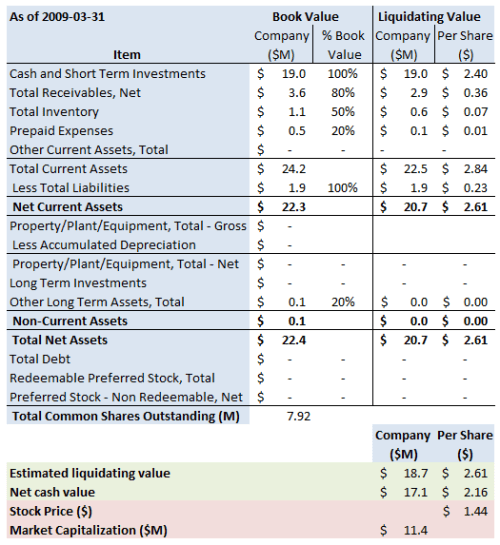
Forward Industries Inc (NASDAQ:FORD) is a new position for us. We haven’t deviated from our love of deep value (it’s trading at a discount to net cash and liquidation value), but there’s no obvious catalyst in the stock at this stage. Management appears to be considering a “strategic transaction” of some kind, although this might include an “acquisition or some other combination.” At its $1.44 close Friday, FORD has a market capitalization of $11.4M. We estimate the liquidation value to be around 60% higher at $18.7M, or $2.60 per share. Trinad Management did have an activist position in the stock, but has been selling recently and only one stockholder owns more than 5% of the stock. We’re attracted to it because it looks cheap, and we think the elements are in place for a catalyst to emerge, so we’re adding it to the Greenbackd Portfolio.

About FORD

FORD designs, markets, and distributes “custom-designed, soft-sided carrying cases and other carry solutions products made from leather, nylon, vinyl, and other synthetic fabrics.” The cases and other products protect “portable electronic devices such as medical devices and cellular phones.” It sells directly to original-equipment-manufacturers in Europe, the “APAC Region,” and the Americas and to retailers and distributors in the United States, Canada, and Europe. It has been in operation since 1961.

The value proposition

FORD has been confronted with blustery headwinds over the last four years. FORD management write in the most recent 10Q (for the year ended March 31, 2009) that “deteriorating economic conditions, rising unemployment, tight credit markets, and heightened uncertainty in financial markets” has “adversely impacted discretionary consumer spending, including spending on the types of electronic devices that are accessorized by [FORD’s] products. [FORD’s management] expect this challenging business environment to continue in the foreseeable future.” Revenues are down from $50M+ in 2005 to less than $20M this year. The drop in net income has been even more precipitous, from a profit of $12M in 2005 to a loss of $1.1M in the most recent quarter, bringing the loss for the last 12 months to around $1.9M. Despite this, FORD still had around $19M of cash and equivalents at the end of March (the “Book Value” column shows the assets as they are carried in the financial statements, and the “Liquidating Value” column shows our estimate of the value of the assets in a liquidation):

FORD SummarySummary balance sheet adjustments

We’ve made the following adjustments to the balance sheet estimates (included in the valuation above):

  • Cash burn: We’ve got no real idea about FORD’s prospects. Its cash burn over the last 6 months has been around $0.8M. That was made up of a net loss of $1.3M, reduced by $0.6M for non-cash items, and changes in working capital items of $0.1M. Accounts payable decreased $0.6M, which had the effect of contributing to the net cash used by operating activities. If we assume, as management has, that the company will face a similarly tough operating environment over the next 12 months, we estimate cash burn of around $2M.
  • Off-balance sheet arrangements: According to FORD’s most recent 10Q, it has no off-balance sheet arrangements.
  • Contractual obligations: FORD’s contractual obligations are minimal, totalling $0.6M.

After making the adjustments above, we estimate FORD’s liquidation value at around $18.7M or $2.60 per share.

Possible catalysts

FORD’s President and Acting Chairman, Mr. Doug Sabra, said in the letter to FORD shareholders accompanying the notice of annual shareholders’ meeting, that in 2008 “management began to implement operational and strategic initiatives in order to put [FORD]’s business on a stronger, more sustainable footing. …  This past August we retained an outside consultant to assist us in vetting possible partners for a strategic transaction.” It seems that the “strategic transaction” might include a “possible acquisition or other combination that makes sense in the context of [FORD’s] existing business, without jeopardizing the strong financial position that we have worked so hard to build.” FORD’s focus on a “strategic transaction” is a positive, in our view, although our vast preference is for a sale of the company, buyback, special dividend or return of capital over an acquisition.

Any transaction will require the consent of FORD’s board. While it has a free float of around 92%, the company’s so-called “Anti-takeover Provisions” authorize the board to issue up to 4M shares of “blank check” preferred stock. From the 10Q:

The Board of Directors has the authority and discretion, without shareholder approval, to issue preferred stock in one or more series for any consideration it deems appropriate, and to fix the relative rights and preferences thereof including their redemption, dividend and conversion rights.

Conclusion

At its $1.44 close Friday, FORD is trading at a substantial 60% discount to its $2.60 per share liquidation value and $2.16 per share net cash value. While there’s no obvious catalyst in the stock at this stage, management’s consideration of a “strategic transaction” is a positive. The risk to this position is management spending the cash on an acquisition. We think a far better use of the company’s cash is a buyback, special dividend or return of capital. Another concern is Trinad Management exiting its activist position in the stock. Those concerns aside, we’re attracted to FORD because it looks cheap at such a discount to net cash. We’re adding it to the Greenbackd Portfolio.

FORD closed Friday at $1.44.

The S&P500 Index closed Friday at 940.38.

Hat tip PP.

[Full Disclosure:  We do not have a holding in FORD. This is neither a recommendation to buy or sell any securities. All information provided believed to be reliable and presented for information purposes only. Do your own research before investing in any security.]

Read Full Post »

Lamassu Holdings has blasted the board of Ditech Networks Inc (NASDAQ:DITC). In a letter to the board, Lamassu Holdngs accuses DITC management of “spending as though Ditech Networks has money to burn, adding to the amount of money you have already lost for shareholders during your tenure,” “aggressively [overstepping] the bounds of good corporate governance” and “clearly [violating] your fiduciary responsibility.”

We’ve been following DITC (see our archive here) because it is trading below its net cash value with an investor, Lamassu Holdings LLC, disclosing a 9.4% holding in November last year. Lamassu has previously offered to acquire DITC for $1.25 per share in cash. Lamassu says that it “anticipates its due diligence requirement will take no more than two weeks and there is no financing contingency.” Lamassu has now nominated two candidates for election to the board “who are committed to enhancing shareholder value through a review of the Company’s business and strategic direction.” Lloyd I Miller III has also disclosed a 5.9% holding and has come out in support of Mr. Leehealey and Mr. Sansone – the director candidates nominated by Lamassu Holdings for election to the board of directors at the DITC annual meeting – as “candidates who are independent of management and he seeks to encourage greater attention to corporate governance by all members of the Board of Directors.” The stock is up 44.9% from our initial $0.89 to close yesterday at $1.29, giving the company a market capitalization of $33.9M. We last estimated the net cash value at around $32.2M or $1.23 per share and the liquidation value at around $43.4M or $1.65 per share. While the deterioration in value is a concern, Mr. Miller’s support of Lamassu Holding’s director candidates introduces a new element to the position. We’re inclined to hold on to see how the annual meeting plays out.

The press release setting out the text of the letter from Lamassu Holdings is set out below (via Yahoo Finance):

NEWPORT BEACH, Calif.–(BUSINESS WIRE)–Lamassu Holdings, LLC (“Lamassu”) has sent the following letter to the Board of Directors of Ditech Networks, Inc. (NASDAQ:DITC – News) (“Ditech Networks”) Members of the Board:

Over the past month a significant number of shareholders have either publicly, through filings, or privately rejected your leadership by expressing their support for Lamassu’s director nominees. Instead of listening to these shareholders and correcting your course, you push forward spending as though Ditech Networks has money to burn, adding to the amount of money you have already lost for shareholders during your tenure. Your recent decision to tie executive compensation to a level of investment associated with mStage/toktok, an unproven technology that to date has produced no revenues and has no immediate prospects, is outrageous and limits management’s ability to make the hard but intelligent decisions to reduce investment in that technology if its prospects for revenue continue to be elusive. With this measure we believe you have aggressively overstepped the bounds of good corporate governance and have clearly violated your fiduciary responsibility.

Investors in Ditech Networks (NASDAQ: DITC – News) are not venture capitalists and did not sign up for this type of speculative investing with such a large portion of the Company’s assets. Management needs to have the latitude to make the decisions that are appropriate given the revenue prospects of each product and the Board should ensure that no individual investment puts the Company in as much jeopardy of total failure as the mStage/toktok investment does.

In addition, given the level of support for Lamassu’s slate of director nominees, we remain completely perplexed by your apparent desire to engage in a pointless proxy fight and waste Company resources to protect your own interests. It is obvious shareholders will aggressively reject the idea of spending millions of dollars of their money in this manner when the addition of Lamassu’s nominees to the Board will clearly provide a much needed new perspective that is not steeped in the countless mistakes of the past or married to visions and dreams that produce little or nothing in the way of actual revenue.

For the sake of all investors we encourage you to radically alter your behavior and begin listening to shareholders as opposed to pursuing your own interests and extremely risky agendas. While you personally will not be significantly harmed if mStage/toktok is unsuccessful and Ditech Networks ultimately fails, many investors are not in a position to so casually lose their money.

Sincerely Lamassu Holdings, LLC

Hat tip to Toby.

[Full Disclosure:  We do not have a holding in DITC. This is neither a recommendation to buy or sell any securities. All information provided believed to be reliable and presented for information purposes only. Do your own research before investing in any security.]

Read Full Post »

MathStar Inc’s (OTC:MATH) board has announced a “possible merger” with a company called Sajan, Inc, presumably the private company discussed in the presentation at the annual meeting. Douglas M. Pihl, MATH’s CEO, has resigned in protest, saying in his resignation letter that he was resigning because of the board’s “rejection of the plan I have presented to restart MathStar based on Video Encoding technology.” Pihl goes on to say:

I do not believe the proposed Sajan acquisition is in the best interest of MathStar shareholders. I do not believe that Sajan, or the advisors hired to do the due diligence, have presented a business plan that warrants committing over $13 million of cash, nearly half of which will not remain in the combined company but will be distributed to the current Sajan shareholders. In addition the newly issued shares will result in nearly a 50% dilution of the equity currently held by MathStar shareholders.

The full text of Pihl’s letter is set out below. We tend to agree with Pihl’s assessment that the Sajan acquisition is a loser for MATH shareholders. On that basis, we’re out at yesterday’s close of $1.20. We initiated the position on December 17 last year at $0.68, which means we’re up 76.5% on an absolute basis. The S&P500 closed at 913.18 when we intiated the position, and closed yesterday at to close yesterday at 932.68, which means we’re up 74.3% on a relative basis.

Post mortem

We started following MATH in December last year (see our post archive here) because it was trading below its net cash value and had two substantial stockholders lobbying management to liquidate. MATH’s board had suspended the company’s operations and had been exploring “strategic alternatives, which could include merger, acquisition, increasing operations in another structure or liquidation.” Two activist investors, Mr. Zachary McAdoo of The Zanett Group and Mr. Salvatore Muoio of S. Muoio & Co., urged MATH’s board to consider liquidation rather than merger, but MATH’s management seem intent on a merger. The liquidation was presented to stockholders on Friday last week, and rejected. Tiberius Capital has a tender offer for MATH at $1.25 per share in cash expiring on July 20. We’ve elected to sell our stock on market rather than tender to Tiberius Capital because there’s no certainty that Tiberius Capital will be successful, and it’s time to get as far away from MATH’s management as humanly possible. While the position didn’t play out as we had hoped, we’re still satisfied with the result.

The company’s press release announcing the merger is set out below:

MathStar Announces Letter of Intent for Possible Merger;

Board Announces Special Committee

HILLSBORO, Ore., July 15, 2009 — MathStar, Inc. (MATH.PK) today announced that it has entered into a non-binding Letter of Intent with Sajan, Inc. regarding a potential merger. Sajan is a leading provider of language translation management solutions. Sajan’s language translation services use advanced process and quality management through their next generation SaaS technology. Sajan’s patent-pending data management and on-demand collaboration and workflow platform create a unique blend of technology and service, resulting in the most advanced and measurable solution available today. Among their clients are several Fortune 500 companies.

MathStar also announced that on July 14, 2009, the Board of Directors appointed a special committee consisting of MathStar’s independent directors, Richard C. Perkins and Benno G. Sand, to negotiate the completion of a definitive merger and ancillary agreements with Sajan. Craig-Hallum Capital Group, LLC is representing MathStar as its investment banker in connection with the proposed transaction.

The Mathstar Board, in conjunction with Craig-Hallum and several independent technology and financial consultants, has conducted extensive due diligence of Sajan; however, entry into definitive merger and ancillary agreements with Sajan is subject to the completion of due diligence, among other customary conditions. Final terms and conditions of the proposed transaction will be disclosed upon any signing of the definitive merger agreement.

Statements in this press release, other than historical information, may be “forward-looking” in nature within the meaning of the Private Securities Litigation Reform Act of 1995 and are subject to various risks, uncertainties and assumptions. These statements are based on management’s current expectations, estimates and projections about MathStar and include, but are not limited to, those set forth in the section of MathStar’s Annual Report on Form 10-K for the year ended December 31, 2008 filed with the Securities and Exchange Commission on March 31, 2009 under the heading “Item 1A. Risk Factors” and in our Quarterly Report on Form 10-Q for the quarter ended March 31, 2009. Except as may be required by law, MathStar undertakes no obligation to update any forward-looking statements in order to reflect events or circumstances that may arise after the date of this release.

The CEO’s resignation letter is set out below:

July 14, 2009

Gentlemen;

In response to your decision today to pursue the Sajan acquisition I hereby tender my resignation as President, CEO and CFO of MathStar and also my position on the Board of Directors, effective immediately. I am disappointed by the actions you took regarding Sajan and by your rejection of the plan I have presented to restart MathStar based on Video Encoding technology.

Further, I do not believe the proposed Sajan acquisition is in the best interest of MathStar shareholders. I do not believe that Sajan, or the advisors hired to do the due diligence, have presented a business plan that warrants committing over $13 million of cash, nearly half of which will not remain in the combined company but will be distributed to the current Sajan shareholders. In addition the newly issued shares will result in nearly a 50% dilution of the equity currently held by MathStar shareholders.

Douglas M. Pihl

[Full Disclosure:  We do not have a holding in MATH. This is neither a recommendation to buy or sell any securities. All information provided believed to be reliable and presented for information purposes only. Do your own research before investing in any security.]

Read Full Post »

Northstar Neuroscience Inc (NASDAQ:NSTR) has paid an initial distribution of $2.06 per share.

We’ve been following NSTR (see our post archive here) because it was a net cash stock that had announced a plan to liquidate. We estimated that the final pay out figure in the liquidation would be around $59M or $2.26 per share, which presented an upside of around 18% from our initial $1.91 position. The company had estimated a slightly lower pay out figure of between $1.90 and $2.10 “assuming we are unable to sell our non-cash assets” and expected the initial distribution to be approximately $1.80 per share. The $2.06 distribution returns our initial capital and makes our profit since inception 7.9%, with further distributions to come.

From the relevant report:

As previously disclosed, on June 12, 2009 Northstar Neuroscience, Inc. (the “Company”) filed Articles of Dissolution (the “Articles of Dissolution”) with the Secretary of State of the State of Washington in accordance with the Company’s Plan of Complete Liquidation and Dissolution (the “Plan of Dissolution”). The Articles of Dissolution became effective, and the Company became a dissolved corporation under Washington law, on July 2, 2009 (the “Effective Date”) at 5:00 p.m. Pacific Time.

In addition, the Company’s common stock (the “Common Stock”) was officially delisted from the NASDAQ Global Market at the opening of trading on the Effective Date, pursuant to the previously filed Form 25, which the Company filed with the Securities and Exchange Commission and The NASDAQ Stock Market, Inc. on June 22, 2009. The Company has instructed its transfer agent to close the Company’s stock transfer records as of the close of business on the Effective Date and no longer to recognize or record any transfers of shares of the Common Stock after such date except by will, intestate succession or operation of law.

On July 13, 2009, pursuant to the Plan of Dissolution, the board of directors of the Company approved an initial liquidating distribution of $2.06 per share to the shareholders of record of the Common Stock as of the Effective Date. The Company expects to pay this initial liquidating distribution in cash on or about July 15, 2009.

Pursuant to the requirements of Washington law, the Company intends to retain certain of the remaining assets of the Company to satisfy and make reasonable provision for the satisfaction of any current, contingent or conditional claims and liabilities of the Company until such time as the Company’s board of directors determines that it is appropriate to distribute some or all of such remaining assets. The amount and timing of any subsequent and final distributions will be at the discretion of the Company’s board of directors.

(emphasis added)

[Full Disclosure:  We do not have a holding in NSTR. This is neither a recommendation to buy or sell any securities. All information provided believed to be reliable and presented for information purposes only. Do your own research before investing in any security.]

Read Full Post »

« Newer Posts - Older Posts »