Feeds:
Posts
Comments

Archive for the ‘Biotechnology Value Fund’ Category

Avigen Inc (Nasdaq: AVGN) has filed amended proxy material in its opposition to the proxy solicitation of Biotechnology Value Fund (BVF).

We’ve been following AVGN (see archived posts here) because it’s a net cash stock (i.e. it’s trading at less than the value of its cash after deducting all liabilities) and specialist biotechnology activist fund BVF has been pushing it to liquidate and return its cash to shareholders. MediciNova Inc (NASDAQ:MNOV) has made an offer for AVGN that we think represents a clever way for AVGN’s stockholders to receive cash equivalent to that which they would receive in a liquidation (less $7M to be paid to MNOV) with the possibility for “an extraordinary, uncapped return” if MNOV is successful post-merger. We estimate AVGN’s cash at around $1.22 per share (BVF estimates $1.20 per share), which is around 26% higher than AVGN’s $0.97 close yesterday.

AVGN’s amended proxy material sets out an interesting background to the proxy solicitation. The background is quite lengthy, so we’ll pick it up from AVGN’s February 11 conference call:

On February 11, 2009, senior management of Avigen hosted a conference call relating to its fiscal year ended December 31, 2008. Senior management also updated stockholders on Avigen’s strategic process and responded to questions and answers.

On February 13, 2009, Dr. Horovitz spoke with Mr. Lampert and attempted to reassure him that Avigen was preserving its assets and that the competitive process to identify potential strategic opportunities was proceeding well. Mr. Horovitz indicated to Mr. Lampert that once the process was complete Avigen would communicate its findings to stockholders and that the Board did not believe that it would be prudent to make public commitments until that time.

On February 20, 2009, Mr. Lampert sent a letter to the Board, again demanding “downside protection” for all stockholders.

On February 21, 2009, Dr. Chahine was informed by multiple parties that Mr. Nodelman, a BVF Nominee, had learned of confidential early negotiations Avigen had with a company, and that during the previous week, Mr. Nodelman contacted one or more of the members of the board of that company to warn that BVF would withhold its support for any potential strategic transaction between Avigen and that company.

On February 23, 2009, the Board sent BVF a letter offering to discuss their differences with a view to arriving at a mutually beneficial outcome for all stockholders. Later that day, Drs. Horovitz and Chahine met with representatives of BVF to discuss whether there was a solution to avoid a proxy contest.

On February 24, 2009, MediciNova and Avigen reached a tentative agreement that they would sign a mutual confidentiality agreement with no standstill, with the understanding that only information that the companies were comfortable disclosing without a standstill would be exchanged.

On February 27, 2009, the Board reiterated to BVF its earlier offer to compromise and conveyed its desire to come to a mutually beneficial outcome for all stockholders and cease the proxy fight. Although no agreement was reached, the Board also reiterated its offer to continue to work collaboratively and professionally with BVF.

[Full Disclosure: We have a holding in AVGN. This is neither a recommendation to buy or sell any securities. All information provided believed to be reliable and presented for information purposes only.]

Read Full Post »
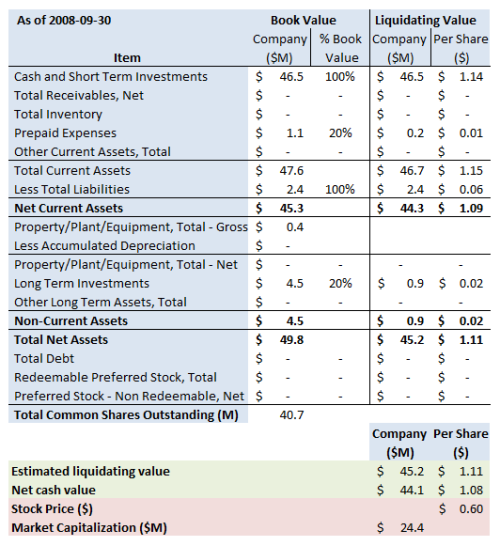
OrthoLogic Corporation (NASDAQ:CAPS) is a little unusual for us. While it trades below its net cash value and Biotechnology Value Fund (BVF) has disclosed a 13.42% holding, BVF’s holding is passive. At CAPS’s $0.60 close yesterday it has a market capitalization of $24.4M. We estimate the net cash value to be 80% higher at $1.08 per share. CAPS’s cash burn rate is quite high relative to its net cash position, so rapid steps need to be taken for this to be a profitable investment. We think that BVF is a good bet, so we’re adding CAPS to the Greenbackd Portfolio.

About CAPS

CAPS is a development stage biotechnology company focused on the development and commercialization of the synthetic peptides Chrysalin (TP508) and AZX100. Effective October 1, 2008, OrthoLogic Corp. is known and doing business as Capstone Therapeutics. The company’s investor relations website is here.

The value proposition

The summary of our estimate for the company’s liquidation value is set out below (the “Book Value” column shows the assets as they are carried in the financial statements, and the “Liquidating Value” column shows our estimate of the value of the assets in a liquidation):

caps-summary

Note that we have used the September 10Q. CAPS’s most recent filings indicate that cash is actually $48M (see slide 13), but we don’t know what the rest of the balance sheet looks like. The presentation also gives cash burn guidance this year of $14M to $16M.

The company also included the following in its 10Q, which seems to indicate a shift to cash preservation:

We announced that we have no immediate plans to re-enter clinical trials for Chrysalin-based product candidates and a strategic shift in our development approach to our Chrysalin Product Platform. We currently intend to pursue development partnering or licensing opportunities for our Chrysalin-based product candidates, a change from our previous development history of independently conducting human clinical trials necessary to advance our Chrysalin-based product candidates to market. We will continue to explore Chrysalin’s therapeutic value in tissues and diseases exhibiting endothelial dysfunction as well as the science behind and potential of Chrysalin. We will also continue research and development expenditures for further pre-clinical studies supporting multiple indications for AZX100 and plan to continue AZX100 dermal scarring human clinical trials.

Off-balance sheet arrangements and Contractual obligations

There is no discussion in the September 10Q about CAPS’s off-balance sheet arrangements or contractual obligations.

The catalyst

Given that BVF has filed a 13G notice, which indicates a passive investment, we’re not entirely sure what BVF has planned for CAPS. It’s possible that it is simply a passive holding. We’re reasonably comfortable following BVF into CAPS because of their efforts with Avigen Inc (NASDAQ:AVGN) and Neurobiological Technologies Inc (NASDAQ:NTII).

CAPS has been undertaking a stock repurchase program since March 5, 2008. At September 30, 2008, the company had repurchased 1.1.M shares of its common stock, at a total cost of $1.0M, and had allocated approximately a further $1.1M to fund possible future stock repurchases. We don’t know the status of the buy-back at this time.

Conclusion

At its $0.60 close yesterday, CAPS is trading at 55% of our estimate of its $1.08 per share net cash value. The risk for this investment – as it is for all of these types of investment – is that CAPS dissipates its cash before it or BVF can salvage that value. Management is taking steps to reduce its cash burn and repurchase undervalued stock, which is encouraging. Perhaps this is what BVF has seen, and the reason BVF hasn’t filed a 13D notice. We think that BVF is a good bet, so we’re adding CAPS to the Greenbackd Portfolio.

CAPS closed yesterday at $0.60.

The S&P500 Index closed yesterday at 752.83.

Hat tip to ef.

[Full Disclosure:  We do not have a holding in CAPS. This is neither a recommendation to buy or sell any securities. All information provided believed to be reliable and presented for information purposes only. Do your own research before investing in any security.]

Read Full Post »

Biotechnology Value Fund (BVF) has extended its tender offer for the outstanding shares of Avigen Inc (Nasdaq: AVGN).

We’ve been following AVGN (see archived posts here) because it’s a net cash stock (i.e. it’s trading at less than the value of its cash after deducting all liabilities) and specialist biotechnology activist fund BVF has been pushing it to liquidate and return its cash to shareholders. MediciNova Inc (NASDAQ:MNOV) has made an offer for AVGN that we think represents a clever way for AVGN’s stockholders to receive cash equivalent to that which they would receive in a liquidation (less $7M to be paid to MNOV) with the possibility for “an extraordinary, uncapped return” if MNOV is successful post-merger. We estimate AVGN’s cash at around $1.22 per share (BVF estimates $1.20 per share), which is around 20% higher than AVGN’s $1.01 close yesterday.

The full text of BVF’s press release is reproduced below:

BVF Acquisition LLC (the “Purchaser”), an affiliate of Biotechnology Value Fund L.P. (“BVF”), which has commenced a cash tender offer to purchase all of the outstanding shares of Avigen, Inc. (Nasdaq: AVGN) (“Avigen”) for $1.00 per share, announced today that it has extended the expiration date for the tender offer to 6:00 p.m., New York City time, on Friday, March 6, 2009. The tender offer was previously set to expire at 12:00 midnight, New York City time, on Monday, February 23, 2009. As of the close of business on February 20, 2009, a total of 1,132,192 shares had been tendered in and not withdrawn from the offer, which together with the shares owned by BVF and affiliates, represents approximately 33% of the total shares outstanding of Avigen.

[Full Disclosure: We have a holding in AVGN. This is neither a recommendation to buy or sell any securities. All information provided believed to be reliable and presented for information purposes only.]

Read Full Post »
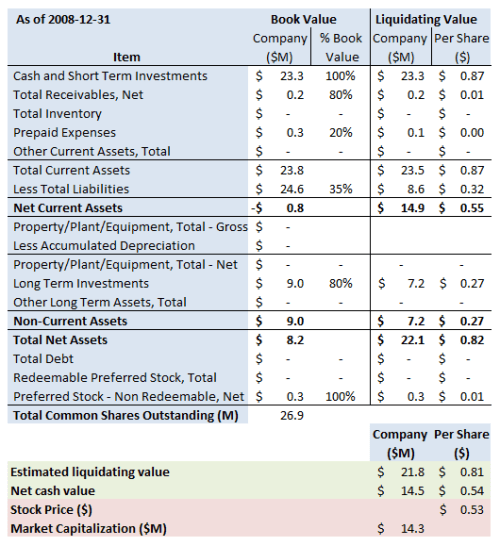
Neurobiological Technologies Inc (NASDAQ:NTII) is a particularly interesting play. Prima facie, it appears to be a cash-burning biotechnology stock trading at a premium to its liquidating value. In other words, a stock we wouldn’t touch with a ten foot pole. On closer inspection, however, it becomes clear that NTII is trading at its net cash value, has other readily valuable assets and offers the possibility of substantial additional upside. At its $0.53 close on Friday, NTII has a market capitalization of just $14.3M, which is right on our $14.5M estimate for its net cash value. Our estimate for its liquidating value is around 50% higher at $21.9M or $0.81 per share with the possibility that it is significantly higher again. Three activist investors, Biotechnology Value Fund (BVF), Millennium Technology Value Partners and Highland Capital Management, hold approximately 45% of NTII’s outstanding stock and have called for its liquidation. We’re adding it to the Greenbackd Portfolio.

About NTII

NTII is a biopharmaceutical company historically focused on developing treatments for central nervous system conditions and other serious unmet medical needs. The company recently terminated development of its most advanced product candidate, ViprinexTM. The company has the right to receive royalty payments from the sales of Namenda (memantine HCL), an approved drug marketed for Alzheimer’s disease, and potential milestone and royalty payments from the development of XERECEPT, an investigational drug which has completed a Phase 3 clinical trial for the treatment of swelling associated with cerebral tumors. Additionally, NTII’s earlier stage pipeline includes rights to a protein in preclinical development for the treatment of Alzheimer’s disease. The company’s investor relations website is here.

The value proposition

NTII has no material ongoing operations as of December 2008. It continued to burn cash through the last quarter.  According to the most recent 10Q, however, its cash burn rate should now be “significantly curtailed since the Viprinex program for acute ischemic stroke was terminated in December 2008.” The summary of our estimate for the company’s liquidation value is set out below (the “Book Value” column shows the assets as they are carried in the financial statements, and the “Liquidating Value” column shows our estimate of the value of the assets in a liquidation):

ntii-summaryThere are two unusual elements in our summary balance sheet:

  1. Total Liabilities, carried in the balance sheet at $24.6M, have been adjusted down to 35% to remove $16M attributable to deferred revenue and warrant liability. We would not normally adjust the Total Liabilities at all. We have excluded these amounts from the Total Liabilities in this instance because the company “[does] not believe these items will ever require cash payments from us” (see Liquidity and Capital Resources in the most recent 10Q).
  2. Long Term Investments, carried in the balance sheet at $9M, have only been discounted by 20%, rather than our usual 80%. The Long Term Investments are predominantly AAA-rated auction rate securities (ARS) that continue to pay interest. The figure for the ARS in the balance sheet reflects the ARS’s purchase price less impairment charges of $1.6M at December 31, 2008. From the most recent 10Q:

Beginning in February 2008, failed auctions occurred throughout the ARS market, and since then all auctions for NTI’s ARS have been unsuccessful. While the credit rating of these securities remains high and the ARS are paying interest according to their terms, as a result of the potentially long maturity and lack of liquidity for ARS, the Company believes the value of the ARS in NTI’s portfolio has been impaired. During the fiscal year ended June 30, 2008, the Company recorded an impairment charge to reduce the carrying value of the ARS. The impairment charge was based on a model of discounted future cash flows and assumptions regarding interest rates. The Company has also recorded an unrealized loss of $1,360,000 on its ARS at December 31, 2008 based on a decrease in the estimated fair value since the impairment charge was initially recorded. Due to recent wide and rapid fluctuations in the credit markets, combined with the Company’s low forecasted operating expenses in comparison to its cash and investments balances, the Company believes the current fiscal year decline in estimated market price for the ARS to be temporary. The Company believes it has the ability to hold its ARS until recovery of the temporary decline in value. All other unrealized gains and losses were immaterial. The Company has classified its ARS as long-term at December 31, 2008, and all other investments are classified as short-term.

Accordingly, we believe that a 20% discount to the value of the ARS carried in the Long Term Investments is sufficient, if overly cautious.

XERECEPT®

NTII sold the rights to XERECEPT to Celtic Pharmaceuticals in 2005. Celtic Pharmaceuticals has continued to develop XERECEPT and recently announced that it has retained an investment bank to assist with the sale of XERECEPT. NTII is entitled to receive between 13% and 22% of the net proceeds received by Celtic Pharmaceuticals upon the sale of XERECEPT. We don’t know if the sale process will be successful or if NTII will receive any payment, but it does present the possibility of additional value to stockholders of NTII.

Off-balance sheet arrangements

According to the 10Q, NTII has “no off-balance sheet arrangements that have or are reasonably likely to have a current or future effect on our consolidated financial condition, changes in our consolidated financial condition, revenues or expenses, consolidated results of operations, liquidity, capital expenditures or capital resources.”

Contractual obligations

NTII’s noncancelable contractual obligations set out in its 10Q are as follows:

  • Active ingredient production/purification and operation of a snake farm. Raw venom of the Malayan pit viper was the starting material for the active ingredient in Viprinex, and was produced by Nordmark in Germany where Nordmark maintained a colony of snakes in a manufacturing facility. We agreed to make monthly payments to Nordmark for our supply of the active ingredient and for the fully burdened costs of operating the snake farm until such time as either 1) the agreement is terminated pursuant to specified terms or 2) commercial production commences. If the agreement is terminated by us prior to commercialization, we are required to make a termination payment of up to €2.8 million (or approximately $3.7 million at the December 31, 2008 exchange rate) to Nordmark. We have notified Nordmark of our intent to terminate the agreement and remove the snakes located at the facility. Under the terms of the agreement, we are responsible for specified operating costs of the facility as long as the snakes are at the facility. We have identified several reptile zoos willing to take snakes, and are in process of completing the arrangements for the transfer of the snakes. We cannot estimate the costs for this process, but we currently expect it to be completed by March 31, 2009.
  • Clinical Research Organizations. We had agreements in place with several Clinical Research Organizations for work needed on the clinical trials in various foreign countries. We generally paid the CROs on a monthly or quarterly basis for work as it was performed, and the terms of most of the agreements allow them to be cancelled with no obligations beyond the costs incurred by the CROs to the time of termination. Our CROs have closed down the clinical trial and are in the process of reconciling pass-through costs for the clinical trial and amounts we have paid compared to actual costs incurred. We have accrued expenses as of December 31, 2008 which we believe are appropriate under the agreements, and are holding further payments to the CROs until we are satisfied that all costs are justified under the agreements. We expect resolution with all CROs in the third or fourth quarter of our fiscal year ending June 30, 2009.
  • Medical facilities conducting the clinical trials. We generally pay medical facilities for each patient enrolled into our trials, and withhold a portion of total site compensation until all data required in the clinical trial protocol is received. The portion withheld is recorded as a liability in our consolidated financial statements. As we receive the final data from each site we authorize the release of the final payments called for under the agreements. We expect this process to be completed by March 31, 2009.
  • Data management. We pay outside service organizations on a monthly or quarterly basis for services related to managing the data collected from the clinical trial. We have recorded an accrued liability for the charges we expect to incur, and the service organizations are in process of reconciling the payments from NTI to the actual charges incurred. We expect this process to be completed by June 30, 2009.
  • License agreement for Viprinex. We have an exclusive worldwide license for all human therapeutic indications for Viprinex from Abbott. Under this license, we have an obligation to use commercially reasonable efforts to develop Viprinex for the treatment of acute ischemic stroke. If we do not use commercially reasonable efforts to develop Viprinex for stroke Abbott may reclaim rights to develop the product. While no license maintenance payments are required to Abbott, milestone payments of up to $2 million would be due upon various regulatory approvals of Viprinex, along with royalty payments based on worldwide Viprinex sales. In the event we sublicense the rights to Viprinex, additional payments may be due to Abbott based on the terms of the sublicense. We have the right to terminate the agreement upon providing 90 days notice to Abbott, and Abbott has the right to terminate the agreement only in the event of our breach. We presently do not intend to develop Viprinex further under the license from Abbott and expect rights will ultimately be returned under the terms of the agreement. Upon returning the rights to Abbott, we are also required to return all drug material, data and intellectual property to Abbott.
  • Employees. All of our employees are employed on an “at-will” basis.
  • Buck Institute for Age Research. We have entered into agreements with Buck for rights to preclinical proteins for the treatment of Alzheimer’s disease and Huntington’s disease. The research programs under these agreements may be extended annually and we have the right to terminate the agreements upon 60 days notice if we determine the research program objectives cannot be substantially met. In addition, we have certain milestone obligations to Buck in the event that specified research goals are met. We have notified Buck that we do not intend to extend the research program for Huntington’s disease, and are currently reviewing the Buck proposal for the second year of the Alzheimer’s disease research program.

While these contractual obligations are significant relative to NTII’s net assets, we believe that NTII’s interest income and the royalty revenue ($2m in the last quarter) should wash these obligations for the next 12 months, or at least reduce the cash burn rate to between $1M and $2M. The royalty ends in 2009.

The catalyst

Three large shareholders, BVF, Millennium Technology Value Partners and Highland Capital, hold 45% of NTII’s outstanding stock. BVF initiated its position in June last year, disclosing a 19.7% holding. According to a later 13D amendment,  BVF sent a letter on December 23, 2008 calling on NTII’s board:

…to exercise its fiduciary duty to shareholders by winding up NTII in order to return cash to shareholders as quickly and efficiently as possible. The letter explains that costs associated with a liquidation could be limited by immediate, decisive action because  [NTII]’s remaining assets are financial and passive in nature requiring negligible activity to manage. The letter calls on [NTII] to take immediate action to maximize shareholder value by returning capital to shareholders, consistent with its fiduciary duties, and to refrain from engaging investment bankers or other advisors (except for the sole purpose of winding up the company), whose self-interests would likely lead to a further drain of capital.

Samuel L. Schwerin (Managing Partner of Millennium Technology Value Partners) filed a 13D amendment on  January 6, 2009 disclosing a 7.7% holding (which includes the Millennium Technology Value Partners’ holdings disclosed below). Schwerin’s purpose for the filing is as follows:

On January 6, 2009, in the context of the failure of the clinical trial for Viprinex, [NTII]’s primary asset, Millennium Technology Value Partners delivered a letter urging [NTII] to take immediate and decisive action to monetize the remaining value of [NTII]’s assets for the benefit of its shareholders. The letter details Millennium’s belief that the only remaining course of action for [NTII]’s management and board to pursue is the immediate dissolution and liquidation of the company. Millennium has communicated to management that such dissolution should take the form of an immediate distribution of cash to shareholders, followed by an efficient and timely monetization of remaining assets in a manner designed to maximize proceeds to shareholders. Millennium’s letter further suggests that during nearly a dozen conversations between management of [NTII] and Millennium over the past year, management made assurances to Millennium that contingency liquidation plans had been developed in the event of failed Viprinex trials. Millennium expressed its strong belief that these plans should be implemented immediately and that there is no need, nor reason, to waste time or shareholder resources on advisors or to delay the liquidation process in order to explore risky alternative strategies, courses that Millennium believes are likely to result in further diminution of value for all shareholders.

Highland Capital disclosed a 17.6% holding in its original 13D notice filed January 9, 2009. According to the notice:

Highland Capital delivered a letter to NTII requesting the expeditious wind down of [NTII]’s business. In the letter, Highland Capital expressed its belief that, due to the failure of the Viprinex program, [NTII] has no incremental value as an ongoing concern. Highland Capital expressed a strong belief that the only way to return value to the shareholders is through liquidation of [NTII]’s assets. The letter notes that [NTII] is seeking to hire a new CEO and President, and that such action shows an intention to continue operations. Highland Capital believes that the Board should immediately decide to liquidate [NTII], and that hiring a new CEO and President is unnecessary if such action is to be taken.. Highland Capital expressly lists various assets, including cash, currently held by [NTII] which are all capable of near-term liquidation. Highland Capital asserts that it is [NTII]’s Board of Directors’ fiduciary duty to the public shareholders to liquidate these assets, wind down business, and return all proceeds to the public shareholders. Highland Capital expressed concern that the Board was considering “strategic options” to continue business which would result in the immediate degradation and eventual loss of all shareholder value.

Millennium Technology Value Partners disclosed a 3.7% holding in its original 13D filing dated January 23, 2009. Annexed to the filing was the following letter:

The Board of Directors of Neurobiological Technologies, Inc.
c/o Abraham E. Cohen, Chairman of the Board
2000 Powell Street, Suite 800
Emeryville, CA 94608

Dear Members of the Board:

As you know, on January 6, 2009 Millennium Technology Value Partners L.P. (“Millennium”) delivered a letter to the Board of Neurobiological Technologies, Inc. (“NTI” or the “Company”) urging it to take immediate and decisive action to monetize and distribute the Company’s remaining assets for the benefit of shareholders. We have since learned through a review of public filings and discussions with you that the Company has received correspondence from stockholders representing 65% of NTI shares expressing a similar point of view. This would appear to constitute a clear mandate from the stockholders of the Company for you to take immediate action to commence an orderly liquidation. We are disappointed that in the face of such an overwhelming directive from your stockholders, you are able to act other than with absolute immediacy to carry out the will of your constituency.

Over the past 14 months, management and members of the Board repeatedly assured Millennium that contingency plans involving liquidation had been developed and would be implemented immediately should Viprinex fail. Now that Viprinex has failed, we can’t help but wonder, where is the contingency plan and why hasn’t it been implemented? While we appreciate the Company’s January 13 announcement regarding the reduction of staff and the trimming of costs, the ultimate inaction on the Board’s behalf is alarming. Trimming costs merely lowers the cash burn and slows the rate of decline in shareholder value. It does not stop the decline, and more importantly, it does not seek to return maximum value to shareholders.

We are further concerned by discussions involving the potential engagement of financial advisors. As you know, financial and strategic advisors often require a considerable period of time to “evaluate strategic alternatives” and are compensated in such a way as to place an inherent bias against recommending liquidation, which in NTI’s case, is the best, and most immediate, course of action. There is no need, nor reason, to waste time or shareholder resources on advisors or to delay the liquidation process in order to explore risky alternative strategies, courses certain to result in further diminution of value for all shareholders, when the majority of the stockholders of the Company appear to have already made their views perfectly clear. The Board should understand that any action that it takes that would require the approval of its stockholders — other than the prompt liquidation of the Company — will not receive sufficient votes to pass. Accordingly, and by definition, any such attempts would clearly constitute a waste of corporate assets.

Recent discussions with management and members of the Board have further confirmed that “the process of exploring alternatives is ultimately most likely to conclude that liquidation is the best course of action for the shareholders of NTI.” Yet 37 days have passed since the failure of Viprinex, “the sole major asset of the Company,” without the Board communicating or enacting a plan designed to maximize shareholder value through the dissolution and liquidation of NTI assets. We have even gone so far as to outline a plan of liquidation to the Company that we believe could be approved by a substantial majority of the Company’s stockholders. In that plan, excess cash would be immediately distributed to shareholders, with the remaining assets to be liquidated in a timely and orderly manner over the coming months by a shareholder appointed fiduciary, with all proceeds being distributed directly to shareholders immediately upon receipt.

Should the Board have any question that the plan outlined above is in the best interests of shareholders, and that any attempts to pursue an alternative course of action would be over the objection of your stockholders, then we urge you to call a Special Meeting to allow the shareholders to reinforce our own conclusions and those suggested in correspondence from shareholders representing 65% of NTI stock.

To reiterate what we said in our January 6, 2009 letter and have repeated numerous times during our discussions with management, we believe that any action other than the immediate dissolution and liquidation of the Company is an irresponsible waste of corporate assets and will result in a severe impairment of shareholder value. We trust that the best interests of NTI shareholders continue to be of utmost importance to you, the members of the Board, and look forward to your prompt response. If either the Board or management has any questions about the appropriate liquidation plan and how best to implement it, we would welcome the opportunity to discuss it further.

With every day that you fail to take action, the value of the Company declines. We urge you to consider very carefully your primary obligations to your stockholders, and the consequences of your failure to honor these obligations.

Respectfully,

Samuel L. Schwerin
Managing Partner

Conclusion

At its $0.53 close on Friday, NTII is trading at its net cash value and around two-thirds of our estimate of its $0.81 per share liquidating value. The difference between our estimates for NTII’s net cash value and its liquidation value is the $9M in ARS, which we’ve discounted by 20% to $7.2M, and which the company believes will eventually yield full value. The possibility exists that the upside might be even greater if NTII receives a portion of the net proceeds paid to Celtic Pharmaceuticals upon a sale of XERECEPT. With stockholders representing 45% (note that Samuel L. Schwerin estimates 65%) of the outstanding stock of NTII calling for its liquidation, we feel the company will be under some pressure to accede and that should lead to a reasonably quick resolution. NTII is reminiscent of our position in Avigen Inc (NASDAQ:AVGN), which seems to be working out well. We’re adding it to the Greenbackd Portfolio.

NTII closed yesterday at $0.53.

The S&P500 Index closed yesterday at 770.05.

[Full Disclosure:  We do not have a holding in NTII. This is neither a recommendation to buy or sell any securities. All information provided believed to be reliable and presented for information purposes only. Do your own research before investing in any security.]

Read Full Post »

Avigen Inc (Nasdaq: AVGN) has filed the transcript of its earnings call held last Wednesday. In the call, AVGN’s management addresses their estimate of AVGN’s net cash value, their attitude to the MediciNova Inc (NASDAQ:MNOV) offer, and the possibility of a liquidation or a return of capital.

We’ve been following AVGN (see archived posts here) because it’s a net cash stock (i.e. it’s trading at less than the value of its cash after deducting all liabilities) and specialist biotechnology activist fund BVF has been pushing it to liquidate and return its cash to shareholders. MNOV has made an offer for AVGN that we think represents a clever way for AVGN’s stockholders to receive cash equivalent to that which they would receive in a liquidation (less $7M to be paid to MNOV) with the possibility for “an extraordinary, uncapped return” if MNOV is successful post-merger. We estimate AVGN’s cash at around $1.22 per share (BVF estimates $1.20 per share), which is a little less than 15% higher than AVGN’s $1.05 close yesterday.

Selected portions of the transcript follow:

On the possibility of liquidation

Ken Chahine [President and Chief Executive Officer]

Oh, okay. So yes, our — so was the question are we committed to liquidation at some point?

Juan Sanchez, [Ladenburg and Thalmann]

Yes. You don’t come out with a real — a proposal to the investors. And in the exercise you guys are going through, are you committing to returning the money back to investors? And is $42 million the money that is going to be available to investors by then, or is a different amount? You see?

Ken Chahine

Juan, our commitment is very, very simple. We’re going to maximize the value. If liquidation ends up being the best offer we have, then liquidation is the best offer we have. There’s no hidden agenda here. It’s simply a matter of maximizing the value.

Is MediciNova the best deal? I don’t really — at this point I honestly don’t know. Could it be? It could be. Is it? I don’t know.

And I think if — let me give you an example, Juan. If you were selling a house and you got an offer for your house and your realtor came by and said you have three more offers that are coming in today, and we have three more that we think are coming next week. I think it’s fair to say that you would probably not take that first offer unless you had at least an opportunity to look at the other three and wait for the other three to come in.

Now, even if you like that first offer, you might say, I think this one is going to be hard to beat. I think you would say that it would be negligent not to at least look at those other offers.

So I think what we’re asking here is not unreasonable. I think it’s absolutely logical, and I think it’s exactly what you and other shareholders on this call would expect — would do. And so that’s all we’re saying.

And so if at the end of the day, is it going to be MediciNova, is it going to be a liquidation, is it going to be sale to a larger company? I don’t know. But I think the commitment absolutely is that whatever it is, it’s going to maximize the value to the shareholders. And if it turns out to be, in our opinion, an M&A transaction, we will propose that transaction and the shareholders will have the right to either vote for it or not vote for it, right?

So at the end of the day, the fate of this Company is not in our hands. The fate of this Company is squarely in the hands of the shareholders. And we’ve protected the burden so that there’s no risk that we’re squandering the money in the meantime.

And again, going back to your — Andy can answer some of the specific questions on the finances, but again, the severance package may or may not be payable at all by the Avigen shareholders. If it turns out that a company comes in and buys us out and retains some of the employees, then the answer is, no, there would be none.

So I think, again, we’re not trying to avoid the question.

Juan Sanchez

So the $42 million doesn’t include the severance package?

Ken Chahine

I don’t know. I’m going to pass that on to Andy, and he can answer that specifically.

Andy Sauter [Chief Financial Officer]

All right, Juan. So the $42 million does not remove any severance payments. At the end of the year we will still have a year of obligations with regard to our lease billing. Again, that’s only one more year. We avoided any extensions that could’ve put further future monies that risk.

Obviously, the process of liquidation involves a number of things. There would most likely be significant monies put in escrow to cover potential unidentified obligations for a period of time. A custodian would have to wrap up any remaining corporate rights and obligations, and that could take a couple of years.

So how exactly liquidation would spill out is something that is very hard to project, exactly what the net payment to shareholders would be and that those delays in distribution further reduce the value. And right now we believe that the value of our current assets and the potential to enter into a successful M&A has significant value over liquidation.

On the MNOV offer

Juan Sanchez

Just one last question before I move on (inaudible). In a nutshell, what do you guys find fundamentally slow or wrong with the MediciNova offer? What’s — what don’t you like about this offer that you’re not willing to entertain it in a more active way, so that –(multiple speakers) See what I mean?

Ken Chahine

Juan, can you — yes. I’d like you to please clarify, though. What have we said that’s said it’s not attractive, and what have we done to not entertain it more aggressively? — so I can answer your question more directly.

Juan Sanchez

The — it’s more like the body language that you guys transmit seems to be that the MediciNova offer is the last option that you guys have and it’s not attractive for you at this point. So from the financial point of view, what’s not to like and what’s to like?

Ken Chahine

Well, I’m very curious at that statement because we have tried, as we stated clearly in our 14D9, to engage MediciNova. As of yesterday, I am very pleased that MediciNova and Avigen came to an agreement to initiate diligence. Up until now MediciNova has been unwilling to sign a confidentiality agreement that every other company has signed.

So we’re not — and this is not a special one for them at all. So again, I take a little bit of issue with that because I think that we have not put them in any special box or disadvantaged them in any way. They’d like to preserve their right to continue to file press releases and other documents, and that’s fine. We respect that. It’s their right, and we respect their right to do that.

However, we do have a common asset in AV411, and I think it’s important that we protect that asset for Avigen shareholders in the event that if a transaction is not consummated with MediciNova and a larger pharmaceutical company would like to come in here and purchase that asset, that we haven’t devalued the asset by sharing a bunch of confidential information with MediciNova.

So we are now just starting to assess MediciNova, and we’re going to look at it very carefully. If it is the winning bid, I guarantee that it will be up to the shareholders to decide whether they like that transaction or not.

I absolutely have no judgment on that right now because we haven’t had a chance to do diligence. So I’m pleased that we’re going to get started, and we’ll see how it stacks up to the rest of the offers.

On AVGN’s net cash value

Edgar Bordovski, [Burlingame Asset Management]

Can you guys put a bound on the time at which shareholders can decide on the state of the Company and whether all possible transactions that you consider attractive will be presented before Management decides to proceed with those transactions? I understand you can’t pinpoint when that will be, but can you put an upper bound on how long we have to wait before we have clarity on all the attractive transactions?

And then my second question is, what is the lower bound on the cash, net of liabilities including remaining liabilities like the leases that you will still have to pay and liabilities that you may not be sure you have to pay? What is the net number at the end of the year? Thank you.

Ken Chahine

Was that — I think I got it right. It’s Edgar? So, Edgar, yes. So thanks for your question.

So yes, we are moving actually pretty rapidly. And I think — I will be honest with you, I think a lot of the pressure is coming from more the capital markets than any other. There’s a lot of companies out there that are in need of cash. Some of them have very attractive assets. And I think that’s what’s really driving the process.

I firmly believe in the next month or two we’re going to have some really good clarity. This is not something that’s going to drag out at all. I just don’t think that, A, we have any desire to drag it out, and, I don’t see any need to drag it out.

So I think in the next month or two we’re going to have a lot of clarity. And again I want to reiterate, I don’t know that we will find something, but I think it’s our duty and I think it’s in all shareholders’ best interest for us to go out there and see if we can find something that’s better.

And at the end, you and other shareholders are going to vote as to whether you agree that that transaction is better.And we know that that’s a high hurdle, and we don’t intend to present anything to shareholders that we don’t think is going to meet that hurdle.

So if — okay again, in a month or two I think we’re going to have some clarity, we will present it. We’ll present what we have to shareholders, and then we’ll go from there. So — then Andy, if you can just address –?

Andy Sauter

Yes. I mean, I guess just to try to reiterate, your question about what’s the lower bound on our cash. At this point, if we go through the year with this limited burn and obligations and nothing else happens, at the end of the year we believe our cash will be between $40 million and $42 million.

At that point we will have one year left on our lease obligations. That’s probably a two-year obligation — or a two-year cost that would have to be paid no matter what. And in the meantime we have significant opportunity to bring in additional cash that exceed our expenses, both through the transaction related to AV411, both through keeping up with potential Genzyme milestone payments, and then basically giving us a free look at these M&A opportunities that could create significant value for the shareholder base and give them a chance to choose something that they might not otherwise have access to.

So that’s how we look at the cash. It’s been preserved. We’ve set our year-end estimates. We’ll have very little obligations left after that. And there’s a lot more potential upside in the meantime than that lower bound is that you’re asking about.

Edgar Bordovski

So just to clarify, when you say very little liabilities, can you put an upper bound on those liabilities at the end of the year?

Ken Chahine

So, Edgar, I guess what we’re trying to say — and I will say it since I’m not a CFO — that — maybe I will say it a different way that maybe you can relate to better.

What is the only expense that shareholders would have to incur let’s say in 2009 that you wouldn’t have to incur otherwise? The reality is that it’s about — it’s under $3 million worth of salaries going forward. So even a very modest, I would argue, almost unattractive transaction in 411 will more than make up for that expense.

Other than that, I think the public listing is something that’s worth keeping up because we think we can get the value, and I can tell you now some of the offers that we have, there’s definitely value in that public listing. I think the public listing could more than make up for all of that.

So what’s really variable here — it’s very little. It’s $2 million in the salaries. There’s some in the listing, which I would argue absolutely we should maintain. And that’s it, everything else has to be paid out whether we are here for the remainder of the year or not.

So does that help a little bit?

Edgar Bordovski

So just to conclude, number one, shareholders will be able to vote within say several months as to all the possible transactions that Avigen is considering, and Avigen will not pursue a transaction without that vote. And number two, the liability at the end of the year that remains, you’ll have $40 million in cash, but you will have some liabilities relating to leases and other things. That number is going to be $2 million, $3 million, $4 million. It’s not going to be more than that.

Ken Chahine

I think that’s right. It is very difficult to think that we can cut the expenses significantly, if at all, without starting to significantly impair the value of the assets that are here.

So I think, yes, you are absolutely right. The cash is safe. The one thing that is a little bit of a variable cost — and we hate to bring it up, but it’s the reality — is the legal costs. We’ve probably spent more on legal costs now than we have spent in any other year since I have been here. I’m an attorney. We handle our finances and our legal costs very modestly, like we do the rest of the company. That’s a variable cost that I can’t help you with because I don’t know what’s down the pipe.

But shareholders will absolutely have the opportunity to vote. There’s a special meeting that has been called. We absolutely plan to have that special meeting. By the bylaws, it’s 120 days from when it’s called. When are we going to have that meeting? We really have not set a date, but we just want to make sure that you had the opportunity to say, yes, I either like this transaction or don’t like this transaction — at the time that you make the vote. And we’re happy with the decision. Whatever it is that the shareholders want, we will abide by.

Edgar Bordovski

Okay. Can I just get an answer on the net liability at the end of the year in terms of putting an upper bound on it? You mentioned it’s going to be very little, but can I — is it possible to quantify that number?

Ken Chahine

I’ll try this — Andy, please feel free to jump in — because I think I have these memorized, right? It’s — we have the leases. Those are in the 10-K. Andy went through them. It’s $2 million on the leases. They would be more except that we’ve been very aggressive at subleasing.

There is some accrued liabilities that came in the fourth quarter. You can’t just stop a trial and decide that you’re not going to pay anything further. There has been work that has been accrued up until the time that we terminated the trial. Those have now been paid, so there’s really no further obligations or very little on the AV650 and other trials.

I’m trying to think. There’s some wind-down costs that would normally have to happen. If we were to — there’s a potential of a severance — partial payment or full payment, depending on, again, what the transaction is or isn’t.

And am I missing anything?

Andy Sauter

No. Again, the only last thing here is that to wind up a company there is some sort of cost of custodialship and execution. So if we are not able to deal with the AV411 asset during 2009, there would be some cost to dealing with it after 2009. It’s hard for us to project what that would be, but as far as you can tell — or as far as we can reassure you — the only obligations we’re committed to that are on the books that you can see is going to be the one last year of leases, which is $2 million net. So we’ve certainly tried to point that out a couple of times.

Ken Chahine

Yes. And we’re certainly not trying to avoid the question. It’s just that it’s not as simple of an answer. A judge in a dissolution proceeding, for example, is not going to just take the AV411 asset and leave it completely untouched, right? There’s going to be a duty for that dissolution judge to actually try to monetize that asset, right? Well who’s going to do it? Well, it could be the Management. It could be somebody else.

But what we’re trying to point out here is that it will be someone and there will be some cost. Okay? So exactly what that, we can’t tell you for sure.

The other thing is, the judge — dissolution judge — isn’t necessarily going to say, okay, that’s it; we’re not going to keep any reserves for liabilities.

We’ve run some clinical trials, and so there may be some liabilities on the D&O side. It could be liabilities for clinical trials. There may be a reservation there that is held out. What that’s going to be? Again, we’re not trying to avoid it. There’s just no really good way for us to do it. That’s typical in a dissolution proceeding.

So I really hope I’m — we’re answering your question as clearly as possible. And we’re not trying to complicate it any further.

On the chances for a return of capital

Joe Spiegel, [Chalet Capital]

Great. I’ve got just two other quick questions. The first is, you guys talk a lot about the value of the public listing, but you said yourself it’s costing you $1.5 million. Now, we can all go and look at the present value of negative $1.5 million going out till infinity.

It seems to me that the value of the public listing is far less than your advisers are telling you. It’s a great drain. So I don’t think you should put too much weight on that.

The number two — and then I guess that was a statement, not a question. But the question becomes, have you looked at NUCRYST and this situation there? The largest holder wanted a return of capital. NUCRYST was tremendously overcapitalized. And I believe they were going to have their special meeting, which they agreed to hold, and the vote’s tomorrow, and the chances are, I would say, 100% that NUCRYST shareholders will receive a return of capital. It will leave the company with plenty of cash to pursue their business objectives or have an acquirer acquire their programs.

What — why do you guys feel that returning capital is an either/or? Capital — a dollar in the bank is only worth a dollar. There’s no multiplier in acquisitions for money, for cash. Why not return capital to shareholders, give us $1.00 a share. BVF is happy. Your other shareholders are thrilled, and you still have more than enough money to run the business. Why is that not the top option?

Ken Chahine

It may very well be. We’re not saying that it’s not.

Joe Spiegel

If it’s the top option, do it. Just do it.

Ken Chahine

Well, but I mean (multiple speakers) I’m sorry. Did I get the — is it “Joe”?

Joe Spiegel

Yes.

Ken Chahine

Joe, I mean, I don’t know this other company’s situation.

Joe Spiegel

Take a look, NCST.

Ken Chahine

That’s fine. I don’t know how long they were operating without sort of the business model. I want to just take a step back.

We are absolutely not dragging our feet. I think you can go back — and I think you even said that in many ways we’re handling this in a professional and admirable way, because we aren’t dragging our feet, and so — but this happened — the third week of October is when we announced the data. We’ve restructured. We’ve cut costs. We’ve sold one asset, and we have just engaged the process. So — and we said it’s going to take a month or two.

I’ve seen this play out many, many times. If we in the next month or two come to some decision as to where we are, we’re going to be at the very top of quick and efficient processes. So all we’re saying is, look, that may be very well the answer. And if that’s the answer, we will absolutely pursue it.

But I think — we’ve been in this thing for two months, and I think we’ve had the strategic process for three or four weeks. So I don’t think it’s even been four weeks. I think it’s been like three weeks. So all we’re saying is that. We’ve had very honest discussions in the Board, and I can tell you unequivocally, the Board is not at a position where it says, it’s an M&A or bust. We’re definitely not that way.

But we’re saying, look, we’re in a very interesting situation where capital markets are obviously shut. Where would a company that they had just launched a product — or was just about to launch a product — where would they normally get their working capital? Well, normally they would go to the credit market. That would be the most efficient way, and that’s the least dilutive way for shareholders. And then they would launch a product and then repay that debt.

Well, that whole market is shut down, right? So (multiple speakers) I guess — would you be completely opposed to the concept — if we could have a Company that would be cash flow positive in the very near term and have revenues by the end of let’s say the year — just throwing it out — would that be something that you would absolutely not consider?

Joe Spiegel

Well guys, you have to understand. You are not a bank. You’re a biotechnology Company that unfortunately is seeing hard times. You can still run your business and still bring value to the shareholders through the AV411 program while returning capital to your investors. It doesn’t have to be either/or. But remember, you’re not a bank.

Ken Chahine

Understood. And I think we do have very strong expertise in identifying opportunities that are good. And all we’re saying is, we can present it if we find one. And if we do, great. And if not, we do not intend to be a bank. But a bank is also not — doesn’t have the expertise we have.

So all we’re saying is, hey, if we can find an opportunity that makes sense — and we may not — then that’s fine. I mean, we’ll do that.

Again I want to continue to reiterate, we really — there is absolutely no hidden agenda here. The Board is completely open. And if that is the best option, we can guarantee that we’re going to pursue it.

Joe Spiegel

Well, great. I appreciate you guys taking the time to explain all of this on the conference call. And like I said, a lot of companies wouldn’t even go that far. So I do think you are doing a good job. Do see what happens at NUCRYST. And do consider the fact that these are not either/or proposals. You can satisfy all your constituents.

[Full Disclosure: We have a holding in AVGN. This is neither a recommendation to buy or sell any securities. All information provided believed to be reliable and presented for information purposes only.]

Read Full Post »

Biotechnology Value Fund (BVF) yesterday called for the management of Avigen Inc (Nasdaq: AVGN) to “address certain fundamental questions BVF believes need to be answered in order for stockholders to effectively evaluate [AVGN]’s future strategic direction.”

We’ve been following AVGN (see archived posts here) because it’s a net cash stock (i.e. it’s trading at less than the value of its cash after deducting all liabilities) and specialist biotechnology activist fund BVF has been pushing it to liquidate and return its cash to shareholders. MediciNova Inc (NASDAQ:MNOV) has made an offer for AVGN that we think represents a clever way for AVGN’s stockholders to receive cash equivalent to that which they would receive in a liquidation (less $7M to be paid to MNOV) with the possibility for “an extraordinary, uncapped return” if MNOV is successful post-merger. We estimate AVGN’s cash at around $1.22 per share (BVF estimates $1.20 per share), which is a little less than 20% higher than AVGN’s $1.04 close yesterday.

The full text of BVF’s press release is reproduced below:

Biotechnology Value Fund, L.P. Requests Avigen Board to Provide Critical Information to Stockholders

Tuesday February 10, 2009, 1:04 pm EST

Raises Questions to be Addressed by Board and Management on Avigen’s February 11, 2009 Conference Call

SAN FRANCISCO, Feb. 10 /PRNewswire/ — Biotechnology Value Fund, L.P. (“BVF”), today called for the management of Avigen, Inc. (Nasdaq: AVGN – News) to address certain fundamental questions BVF believes need to be answered in order for stockholders to effectively evaluate Avigen’s future strategic direction. Avigen announced in its January 14, 2009 press release that it will hold a conference call on Wednesday, February 11, 2009 (time to be announced) to, among other things, “provide an update on the progress of the strategic review.” To make that update more effective, BVF raises the following questions and challenges the Board and management to finally address these fundamental issues:

1. Why has Avigen failed to call the special meeting of stockholders that would permit stockholders to have a say in Avigen’s future? BVF delivered its request for a special meeting to the Board over a month ago. To date, the Board has failed to call the requested special meeting. This meeting would provide stockholders with the ability to exercise their fundamental right to vote on Avigen’s strategic direction. If stockholders agree with BVF, they can vote to remove existing directors and elect BVF’s nominees. If the Board does not act prior to Wednesday, March 11, 2009 to set a meeting date, BVF can unilaterally set the date of the special meeting and would anticipate setting a meeting date for early April.

2. Why has Avigen not offered downside protection to stockholders? BVF has repeatedly called on Avigen to commit to protecting stockholder value by offering all stockholders a fixed amount of cash under any resulting scenario. Management has continually resisted this suggestion, leading us to believe that Avigen intends to gamble that money. MediciNova has proposed a transaction that offers critical downside protection to stockholders. So why hasn’t Avigen done so directly?

3. Why does Avigen not consider the MediciNova proposed merger to be a compelling outcome for stockholders? BVF does not understand why Avigen appears to be resisting the MediciNova transaction. Economically, based on publicly available information, we believe this proposed transaction to be in the best interest of all stockholders. In a worst case scenario, stockholders would receive approximately Avigen’s liquidation value. In a best-case scenario, stockholders would own 45% of the combined company.

4. Is management requiring downside protection for Avigen stockholders as a condition to all potential “strategic alternatives?” If this is the case, Avigen should state so explicitly so stockholders can stop worrying about losing the bulk of their investment. If not, please explain how any alternative without downside protection could be more attractive to stockholders. Most biotech companies in Avigen’s shoes have managed to destroy the majority of stockholder value through by pursuing their favorite merger. How can Avigen justify standing in the way of the downside protection being offered by MediciNova?

5. What is the estimated net liquidation value of Avigen? In response to our tender offer, management claimed that Avigen is currently worth more than our offer of $1 per share, without support of any kind. We call on management to publicly provide their estimate of Avigen’s liquidation value, together with a detailed analysis. Management should also disclose how much cash was burned by Avigen since its last public filing on September 30, 2008 and how much cash net of debt and obligations will be available on March 31, 2009.

6. What are Avigen’s total “golden parachute” obligations and how much time did Avigen’s CEO spend in Utah versus California during the critical months of December and January? In a shameless example of acting in their own self-interest, in October 2008 management increased its “golden parachute” payments in order to “to attract and retain key executive talent.” At the time, we estimated these payouts to total at least $3 million, an incredible 16.5% of Avigen’s entire market value at the time of adoption. BVF believes this is particularly egregious given the current economic environment. What is the current value of these obligations and how many employees stand to receive these payouts?

7. What is Avigen’s relationship with its financial advisers and how are they being compensated? In January 2009, the Board of Directors announced that it had retained not one but two financial advisers, RBC Capital Markets and Pacific Growth Equities LLC. Why did the Board find it necessary to engage two financial advisers? Will these advisors be paid in the same currency as stockholders or will they, like management, take cash and leave stockholders with paper?

Mark N. Lampert, the General Partner of BVF stated, “Since management announced the failure of AV650 in October of last year, we have found their reluctance to address certain issues, which we believe are integral for stockholders’ assessment of Avigen’s current prospects and future direction, to be incredibly frustrating. We are hopeful management will not hide behind vague generalities, and will provide specific answers to these important questions.

Mr. Lampert continued, “We hope the Board and management will address our questions and concerns and provide stockholders with the disclosure necessary to properly evaluate and determine the best strategic direction for Avigen. We call on each Board member, consistent with his fiduciary duties, to act in the best interests of all stockholders. If we determine this Board has acted inconsistently with its fiduciary duties, we will not hesitate to take any and all actions within our rights as stockholders, including commencing litigation and/or seeking an injunction, in order to protect our investment in Avigen. We look forward to the Board’s and management’s response.”

[Full Disclosure: We have a holding in AVGN. This is neither a recommendation to buy or sell any securities. All information provided believed to be reliable and presented for information purposes only.]

Read Full Post »

Biotechnology Value Fund (BVF) responded on Friday to Avigen, Inc.’s (NASDAQ:AVGN) announcement that its board is “considering ‘strategic alternatives,'” announcing that it is “gravely concerned” that AVGN’s announcement is “silent on downside protection for all stockholders.”

The full text of BVF’s announcement is reproduced below:

BVF WARNS STOCKHOLDERS: AVIGEN CONTINUES TO REMAIN SILENT ON DOWNSIDE PROTECTION

AVIGEN’S LATEST MOVES REINFORCE TROUBLING PATTERN OF DISMISSING ALTERNATIVES WHICH PROTECT STOCKHOLDER VALUE

BVF URGES AVIGEN BOARD TO CALL SPECIAL MEETING SO STOCKHOLDERS CAN VOTE FOR DIRECTORS COMMITTED TO MAXIMIZING VALUE AND MINIMIZING RISK AND WASTE

NEW YORK, February 6, 2009 – BVF Acquisition LLC (the “Purchaser”), an affiliate of Biotechnology Value Fund L.P. (“BVF”), announced today that it is gravely concerned that today’s announcement by the Board of Directors of Avigen, Inc. (NASDAQ:AVGN) that it is considering “strategic alternatives” is silent on downside protection for all stockholders.

Speaking on behalf of BVF, Mark Lampert, BVF’s General Partner, stated, “As the largest stockholder in Avigen, holding 8,819,600, or approximately 29.63% of Avigen’s outstanding shares, we are worried that this Board is embarking on a path that will use the companies cash and valuable assets in a misguided transaction which offers no downside protection to stockholders — a key feature of the proposed merger with MediciNova . The landscape is littered with numerous parallels in which cash shells like Avigen have entered into transactions promoted as value-creating, but which ultimately left investors holding nearly worthless stock. Our nominees are committed to closing the downside-protected merger with MediciNova. We are disappointed that the current Board seems to be more interested in entrenching itself by means of implementing golden parachutes and a poison pill, actions that we believe are detrimental to the creation of value at Avigen. We reiterate our call to the Avigen Board to institute downside protection for all stockholders.”

Separately, BVF is notifying the SEC of significant and blatant inaccuracies in Avigen’s 14D-9 filing. BVF will hold Avigen responsible for any harm caused to BVF by these inaccuracies.

“We believe Avigen’s board and management has a long history of failure and waste and do not believe this Board should be making any decisions about Avigen’s future. Any decision by this Board for the direction of Avigen should be subject to a vote of stockholders,” Mr. Lampert said. “We note that Avigen’s directors and officers own an aggregate of 48,233 shares of Avigen stock, as opposed to BVF’s over 8.8 million shares. BVF shares the interests of all stockholders in the direction of the Company, and has never requested any benefit in which all stockholders would not fully participate. Our tender offer provides other stockholders with a liquidity option. We welcome any stockholders who do not wish to tender to continue as holders alongside BVF.”

BVF continues to urge the Avigen Board to stop stalling and to promptly call a special meeting of stockholders to enable the true owners of the company, the stockholders, to determine the fate of their investment. BVF submitted a request on January 9, 2009 for Avigen to call special meeting. Today, nearly one month later, the Company has taken no action in this regard. At the special meeting, stockholders will be asked to replace the existing Board with directors who would be dedicated to maximizing value and minimizing risk and waste on behalf of all Avigen stockholders. BVF believes that stockholders who are concerned about the continuing destruction of value at Avigen – whether or not they intend to tender their shares – should urge the Board to call a meeting as soon as possible.

On January 23, 2009, BVF commenced a tender offer at $1.00 per share, which represented a premium of 35% over the closing stock price of $0.74 on January 8, 2009, the day before BVF announced its desire to replace Avigen’s incumbent Board of Directors. Subsequent to the commencement of BVF’s tender, Avigen’s stock price has increased to above the tender price. The offer, which is not subject to any financing condition, was and is intended to give certain stockholders, who desire near-term liquidity, an alternative to the proposed merger with MediciNova. Each stockholder should make their own decision on whether or not to tender.

The tender offer is conditioned upon, among other things, the BVF nominees being elected or appointed to the Avigen Board of Directors so that they would constitute a majority of the Board. If placed on the Board, the BVF nominees would, subject to their fiduciary duties, pursue merger negotiations with MediciNova, Inc. or other actions that would be designed to enhance value and minimize risk for all Avigen stockholders.

MacKenzie Partners, Inc. is the Information Agent for the tender offer and any questions or requests for the Offer to Purchase and related materials with respect to the tender offer or the special meeting may be directed to MacKenzie Partners, Inc.

[Full Disclosure: We have a holding in AVGN. This is neither a recommendation to buy or sell any securities. All information provided believed to be reliable and presented for information purposes only.]

Read Full Post »

The board of Avigen Inc (NASDAQ: AVGN) has responded to Biotechnology Value Fund’s (BVF) cash tender offer to purchase the outstanding common stock of AVGN, writing that the offer is “inadequate and not in the best interests of stockholders.”

We’ve been following AVGN (see archived posts here) because it’s a net cash stock (i.e. it’s trading at less than the value of its cash after deducting all liabilities) and specialist biotechnology activist fund BVF has been pushing it to liquidate and return its cash to shareholders. MediciNova Inc (NASDAQ:MNOV) has made an offer for AVGN that we think represents a clever way for AVGN’s stockholders to receive cash equivalent to that which they would receive in a liquidation (less $7M to be paid to MNOV) with the possibility for “an extraordinary, uncapped return” if MNOV is successful post-merger. We estimate AVGN’s cash at around $1.22 per share (BVF estimates $1.20 per share), which is a little less than 20% higher than AVGN’s $1.04 close yesterday.

The letter to AVGN stockholders is reproduced below:

Dear Avigen Stockholder:

Your Board of Directors has determined that the unsolicited conditional offer (“Offer”) by BVF Acquisition LLC (“BVF”) to acquire your shares is inadequate and not in the best interests of stockholders. The Board strongly urges you not to tender any shares into BVF’s Offer, and to withdraw any previously tendered shares. We believe we can create more value for your investment than the $1.00 per share that has been offered by BVF.

To that end, we are pleased to report good progress in our process of considering strategic alternatives to maximize stockholder value. In the last few weeks, Avigen has received multiple proposals that place significant value on its cash position, intellectual property portfolio, AV411 product development program, and public listing on the NASDAQ Global Market. We expect to receive additional proposals in the weeks ahead and are optimistic about achieving our objective of creating significant value for all stockholders.

Reasons for the Board’s Recommendation to Reject the BVF Offer

The Board cited the following reasons for recommending that stockholders reject BVF’s Offer:

* The Offer price is inadequate and substantially undervalues Avigen. The Board believes the Offer price substantially undervalues Avigen’s business, including its cash position, AV411 development program, intellectual property, license with Genzyme, experienced management team and public listing.

* We believe we can structure a transaction that will allow you to receive value for many or all of the company’s assets. The Board believes that the current global economic crisis provides significant strategic opportunities to companies such as Avigen that have a strong cash position and public listing. In addition to pursuing a potential strategic relationship with MediciNova, Inc., we have recently received other written proposals which appear competitive to the MediciNova proposal. These proposals place significant value on many or all of Avigen’s assets, and we believe we will receive additional proposals in the weeks ahead.

* The Avigen stock price has recently traded as high as $1.06 per share, and closed February 5, 2009 at a price of $1.00 per Share.

* The BVF Offer transfers to BVF any future increases in the price of your Avigen stock. Under the terms of BVF’s Offer, if you tender your shares, and the Offer is consummated, you would not receive more than $1.00 per share. The Board does not believe that BVF would make this Offer unless it expected the stock price to increase.

In fact, BVF states in its Offer that “[t]he Purchaser is making this Offer because BVF believes that the purchase of Shares at the purchase price pursuant to the Offer represents an attractive investment for the Purchaser.” If you tender your shares to BVF and the Offer is consummated, BVF will benefit from any gains in Avigen’s stock price, not you.

* The BVF Offer is not a firm commitment to you and is unlikely to close by the Expiration Time. The Offer has conditions that make it unlikely to close on February 23, 2009 as stated in the Offer, and carries significant uncertainty that the Offer will be consummated at all.

Avigen’s Board is committed to listening to its stockholders and working with them to achieve the maximum value of the company’s assets. The Board has met and interacted with BVF a number of times, received and evaluated its proposals, and tried to draw on its ideas in a collaborative manner. These efforts to work with BVF are described in detail in Avigen’s Schedule 14D-9, which accompanies this letter and has been filed with the Securities and Exchange Commission.

The Board also has worked diligently to engage in discussions with MediciNova, Inc., which in December 2008 proposed acquiring Avigen. Since making that unsolicited proposal, however, MediciNova has been slow to advance discussions, as more fully described in Avigen’s Schedule 14D-9 filing.

Our Pledge to Stockholders

Avigen’s Board and management took decisive action since the announcement of our AV650 trial results on October 21, 2008, and acted swiftly to preserve cash. We believe the value of Avigen’s remaining assets is significant and the potential for a strategic transaction is worthy of consideration. Whatever the outcome, we intend to apply the same financial judgment used in the past to decisions going forward.

In the meantime, Avigen intends to provide its stockholders with regular updates and to continue to work with all its stockholders in a thoughtful, collaborative and respectful manner.
Respectfully,

Signed for the Board of Directors:

/s/ Zola Horovitz, Ph.D.
Zola Horovitz, Ph.D. as Chairman of the Board

/s/ Kenneth G. Chahine, Ph.D., J.D.
Kenneth G. Chahine, Ph.D., J.D. as Chief Executive Officer

The relevant portion of AVGN’s Schedule 14D-9 filing follows:

Although BVF had previously been a significant stockholder of Avigen, BVF’s filings with the SEC show that BVF had sold almost all of its Shares prior to October 21, 2008. Specifically, in the two months prior to October 21, BVF sold more than 640,000 Shares, at prices ranging from $3.95 to $4.60 per Share.

On October 21, 2008, Avigen announced that the top-line data from its AV650 trial for the treatment of spasticity in patients with multiple sclerosis did not meet its primary endpoint. As a result of this announcement, Avigen’s stock price dropped by more than 80% and, on the same day, BVF purchased more than 8,100,000 Shares in the open market at an average price of approximately $0.58 per Share.

Avigen held a conference call announcing the data from the AV650 trial. On the call, Avigen stated that the management and Board were pleased with the trial design and execution, but unfortunately the results were unequivocal. As a result, the AV650 program would be immediately terminated and no additional investment in the program was planned.

On October 22, 2008, Avigen’s representatives met with BVF’s representatives. At the meeting, BVF’s representatives expressed admiration for the team’s past performance in creating stockholder value. BVF proposed that Avigen, given its expertise and cash balance, look for attractive companies to merge with or acquire. BVF expressed its belief that such a strategy could lead to a significant return on its recent investment.

Avigen’s Chairman, Dr. Zola Horovitz, invited Mark Lampert, President of BVF, to present his views to the Board at the upcoming Board meeting on October 30, 2008. Mr. Lampert presented at the meeting and again expressed his admiration of the Board and management on taking swift and decisive action to terminate the AV650 program. However, instead of pursuing strategic alternatives, Mr. Lampert recommended to the Board that Avigen immediately liquidate. Following Mr. Lampert’s participation, the Board approved management’s recommendation to significantly reduce head count and to monetize both the AV513 and AV411 assets through either a partnership or sale transaction, and authorized management to initiate a process to identify potential strategic opportunities that could maximize stockholder value and result in returns that exceeded Avigen’s liquidation value.

On the next day, and without waiting for any response from the Board, BVF filed an amendment to its Schedule 13D expressing the same view Mr. Lampert had expressed at the Board meeting and threatening to bring a proposal for liquidation directly to a vote of the stockholders.

On November 3, 2008, Avigen announced a significant restructuring aimed at preserving cash and reassessing strategic opportunities, including staff reductions of over 70 percent of Avigen’s total workforce, as approved by the Board on October 30.

Dr. Kenneth Chahine, Avigen’s CEO, continued to have an open dialogue with Mr. Lampert through phone conversations and emails. Dr. Chahine tried to reassure BVF that Avigen was going to conduct an orderly and efficient process and that Avigen was being fiscally prudent. Mr. Lampert expressed his opinion that Avigen should grant BVF a “put option” (an option to sell its Shares back to Avigen at a set price in the future) to guarantee the minimum “worst case outcome” for BVF. Dr. Chahine expressed that such a put option could potentially weaken Avigen’s negotiating position in its efforts to monetize AV411 or a sale of Avigen. Dr. Chahine explained his concerns by using the analogy of someone trying to sell their house for full value when the buyers know the house is scheduled to go into foreclosure at a fraction of the price in the future.

On November 21, 2008, Avigen entered into the Rights Agreement described in more detail in Item 8 below, in order to discourage a hostile takeover by a third party at a price that would prevent stockholders from obtaining fair value for their Shares.

During the next two weeks Avigen continued discussions with strategic advisors and began negotiating engagement letters with Pacific Growth Equities (“Pacific Growth”) and RBC Capital Markets (“RBC”).

On December 4, 2008, Dr. Chahine, along with one of the strategic advisors, spoke with Mr. Lampert. Dr. Chahine stated that he had spoken with counsel, strategic advisors, and several Board members regarding BVF’s demand for a put option. Dr. Chahine conveyed that numerous legal and business concerns had been raised and cautioned that a put option might have unintended consequences that would disadvantage all stockholders, including BVF. Nevertheless, Dr. Chahine stated that he remained open-minded and invited Mr. Lampert to provide Avigen’s strategic advisors at Pacific Growth support and rationale for BVF’s proposal for presentation and consideration by the Board at a meeting to be held on December 9.

On December 8, 2008, Dr. Horovitz received a letter from MediciNova, Inc. (“MediciNova”), proposing an acquisition of Avigen by MediciNova and setting forth very general terms for the proposed acquisition. Dr. Horovitz promptly contacted MediciNova’s Chairman and expressed that Avigen was in the process of retaining strategic advisors to consider proposals such as this early in the new year. This timing was necessary to permit Avigen’s management to focus on the ongoing restructuring efforts and to complete the negotiation of the sale of AV513 to Baxter Healthcare, and to formally retain strategic advisors.

On December 9, 2008, the Board met. While not formally engaged, strategic advisors from Pacific Growth and RBC gave presentations outlining their expertise and the review process. The Board discussed the MediciNova proposal and Dr. Horovitz stated that he had contacted MediciNova’s Chairman and had proposed a timeline for discussion. BVF did not provide any supporting material to strategic advisors on the mechanism or rationale for a put option.

On December 11, 2008, BVF published an open letter to the Board. In the letter BVF accused management and the Board of general mismanagement and reiterated BVF’s demand that the Board “guaranty” an outcome for stockholders.

On December 18, 2008, Avigen announced the sale of its AV513 product candidate for $7,000,000 ($0.23 per Share) to Baxter Healthcare.

On December 22, 2008, Drs. Horovitz and Chahine issued a letter to stockholders underscoring the Board’s and management’s commitment to act in the best interests of Avigen’s stockholders and emphasizing the swift and decisive actions already taken to preserve cash since the AV650 announcement. The letter to stockholders also reminded stockholders of the significant value of Avigen’s remaining assets, and of the Board’s and management’s commitment to pursue possible strategic transactions that would be in the best interests of all of Avigen’s stockholders. The letter concluded with a pledge to stockholders that Avigen would continue to use the same fiscally prudent approach that had allowed it to preserve cash.

On that same day, Dr. Horovitz received a second (and modified) proposal from MediciNova. In the letter, MediciNova proposed terms substantially similar to those contained in MediciNova’s December 8 letter, modified to reflect the $7,000,000 received from the sale of AV513.

The Board subsequently reviewed the proposal from MediciNova and concluded that the MediciNova proposal, as revised, should be carefully considered and that due diligence should commence early in the new year following the engagement of strategic advisors. Dr. Horovitz again contacted MediciNova’s Chairman and communicated the Board’s conclusion.

On December 29, 2008, BVF filed an amended Schedule 13D advocating that Avigen should “consummate the Proposed Merger expeditiously.” It was the Board’s view that BVF’s publicly-stated support for the MediciNova proposal weakened Avigen’s negotiating position, making it more difficult for Avigen to negotiate a better transaction with MediciNova on behalf of all of Avigen’s stockholders.

On January 9, 2009, BVF delivered a notice to Avigen, demanding that Avigen call a special meeting of stockholders to, among other things, remove the current members of Avigen’s Board, without cause, and for the proposed election of BVF’s slate of director nominees (the “BVF Nominees”).

On January 14, 2009, Avigen announced that it had engaged RBC to oversee the review of merger and acquisition opportunities for Avigen and had engaged Pacific Growth primarily to assist in monetizing Avigen’s AV411 assets.

On the very next day, BVF publicly announced its intention to make a tender offer to purchase all of the outstanding Shares of Avigen. In its offering documents filed subsequently, BVF incorrectly stated that Avigen had rejected the MediciNova proposal and expressed BVF’s view that, if elected to the Board of Avigen, the BVF Nominees would pursue the MediciNova proposal.

On January 19, 2009, Avigen sent a confidentiality agreement to MediciNova’s Chairman of the Board, in order to initiate the due diligence process and negotiations regarding a possible transaction between Avigen and MediciNova. The Board proposed in the confidentiality agreement that both Avigen and MediciNova share information with each other in order to permit the Board and, if a transaction is agreed upon, Avigen stockholders, to understand key aspects of MediciNova’s business, including anticipated expenses, development plans, and commercialization strategy in order to properly evaluate the proposal and determine whether it is appropriate to recommend or, if recommended, approve.

In the days following, Avigen’s strategic advisors at RBC met with representatives of BVF to engage in further discussions.

On January 20, 2009, RBC presented various financial analyses and an overview and update of the process of evaluating Avigen’s strategic alternatives to the Board. On that date, Avigen received multiple proposals from companies to engage in strategic transactions that, on their face, appeared competitive with the MediciNova proposal. Avigen contacted these companies and initiated discussions to assess these potential strategic transactions.

Avigen’s strategic advisors at RBC sent an email to MediciNova’s Chairman on January 22, 2009, stating that efforts to reach MediciNova’s CEO and CFO were unsuccessful and urging him to review and return the confidentiality agreement so that due diligence could commence as soon as possible. The Chairman responded that he would remind the MediciNova management. RBC subsequently received a communication from MediciNova’s CFO promising that they would review the draft and return it with any comments.

In spite of Avigen’s continuing efforts to assess potential strategic transactions and the Board’s and management’s efforts to engage Mr. Lampert in productive discussions, on January 23, 2009, the Purchaser filed a Schedule TO with the SEC, formally initiating the Offer.

At Board meetings held on January 26 and 29, 2009, at each of which the Board assessed the Offer, RBC presented various financial analyses and an overview and update regarding the process of evaluating Avigen’s strategic alternatives.

One week after MediciNova’s prior communication, on January 29, 2009, strategic advisors at RBC once again contacted MediciNova’s Chairman reiterating that efforts to reach MediciNova’s CEO and CFO were unsuccessful and urging him to review and return the confidentiality agreement so that diligence could commence as soon as possible. The Chairman responded that he would remind the management again.

On January 30, 2009, RBC received a revised version of the confidentiality agreement from MediciNova with suggested changes. The draft was reviewed by Avigen’s counsel and on February 3, 2009, promptly returned to MediciNova. RBC proposed that MediciNova’s counsel call Avigen’s counsel to expedite the process and resolve any issues so that the due diligence process could be initiated as soon as possible.

As of the date of this statement, MediciNova’s counsel had not yet contacted Avigen’s counsel.

AVGN’s other proxy documents can be found here.

[Full Disclosure: We have a holding in AVGN. This is neither a recommendation to buy or sell any securities. All information provided believed to be reliable and presented for information purposes only.]

Read Full Post »

The Official Activist Investing Blog has published its list of activist investments for January (the investments with links are to our latest update at the time of this post):

Ticker Company Activist Investor
ABVA Alliance Bankshares Corp John Edgemond
AMLN Amylin Pharmaceuticals Carl Icahn; Eastbourne Capital
AVGN Avigen Inc. Biotechnology Value Fund
BIOD Biodel Inc Moab Partners
BKS Barnes & Noble, Inc Yucaipa Companies
CHUX O’Charley’s Inc Crescendo Partners
CITZ CFS Bancorp Financial Edge Fund
CLCT Collectors Universe Shamrock Activist Fund
CNBC Center Bancorp Lawrence Seidman
CPWM Cost Plus Inc Stephens Investment Holdings
CRGN CuraGen Corp DellaCamera Capital
CTO Consolidated Tomoka Land Co Wintergreen Advisers
CWLZ Cowlitz Bancorporation Crescent Capital
DFZ R.G. Barry Corporation Mill Road Capital
DITC Ditech Networks Lamassu Holdings
EDCI EDCI Holdings Chapman Capital
ENZN Enzon Pharmaceuticals DellaCamera Capital; Carl Icahn
EPL Energy Partners Wexford Capital
FNHM.OB FNBH Bancorp Andrew Parker
FSBI Fidelity Bancorp Finacial Edge Fund
FSCI Fisher Communications Gamco Investors
FSFG First Savings Financial Group Joseph Stilwell
GET Gaylord Entertainment TRT Holdings
ICGN ICAgen Inc Xmark Opportunity Partners
INFS InFocus Corp Nery Capital Partners
ISH International Shipholding Corporation Liberty Shipping Group
JTX Jackson Hewitt Tax Service Shamrock Activist Value Fund
KANA Kana Software Inc KVO Capital Management
KFS Kingsway Financial Sevices Joseph Stillwell
KONA Kona Grill Mill Road Capital
LAQ The Latin America Equity Fund City of London Investment Management
MGAM Multimedia Games Inc Dolphin Limited Partnership
MIPI Molecular Insight Pharmaceuticals David Barlow
NDD Neuberger Berman Dividend Advantage Western Investment
NTII Neurobiological Technologies Highland Capital Management
NTMD Nitromed Inc Deerfield Capital Management
OFIX Orthofix Ramius Capital
PIF Insured Municipal Income Fund Inc Bulldog Investors
PPCO PenWest Pharmaceuticals Perceptive Advisors;

Tang Capital Partner

PRSC Providence Service Corp 73114 Investments
PRXI Premier Exhibitions, Inc Sellers Capital
QDHC Quadramed Corp BlueLine Capital
RDC Rowan Companies Steel Partners
SLTC Selectica Inc Trilogy
SONS Sonus Networks Legatum Limited
SSE Southern Connecticut Bancorp Lawrence Seidman
SUAI Specialty Underwriters Alliance Hallmark Financial Services
SUG Southern Union Co Sandell Asset Management
SUMT SumTotal Systems Discovery Capital
SUTM.PK Sun Times Media Group Davidson Kempner Partners
TEC Teton Energy Corp First New York Securities
TESS Tessco Technologies Discovery Equity Partners
TIER Tier Technologies Inc Parthenon Capital
TMI TM Entertainment & Media Bulldog Investors
TRGL Toreador Resources Nanes Delorme Partners
TRMA Trico Marine Services Kistefos AS
TUTR Plato Learning Stephen Becker
TWMC TransWorld Entertainment Riley Investment Management
VLCY.PK Voyager Learning Company FoxHill Opportunity
WFMI Whole Foods Market Inc Yucaipa Companies
WMPN.OB William Penn Bancorp Joseph Stilwell
WOC Wilshire Enterprises Bulldog Investors
WRLS Telular Corp Simcoe Partners
YSI U-Store-It Trust Todd Amsdell
ZEP Zep Inc. Gamco

Read Full Post »

The board of Avigen Inc (NASDAQ: AVGN) has announced that it will review BVF’s tender offer and advise AVGN’s stockholders of the board’s position by February 6.

We’ve been following AVGN (see archived posts here) because it’s a net cash stock (i.e. it’s trading at less than the value of its cash after deducting all liabilities) and specialist biotechnology activist fund BVF has been pushing it to liquidate and return its cash to shareholders. MediciNova Inc (NASDAQ:MNOV) has made an offer for AVGN that represents a clever way for AVGN’s stockholders to receive cash equivalent to that which they would receive in a liquidation (less $7M to be paid to MNOV) with the possibility for “an extraordinary, uncapped return” if MNOV is successful post-merger. We estimate AVGN’s net cash at around $1.22 per share (BVF estimates $1.20 per share), which is 30% higher than AVGN’s $0.94 close yesterday.

AVGN’s press release is as follows:

Avigen, Inc. (Nasdaq: AVGN), a biopharmaceutical company, today confirmed that BVF Acquisition LLC, a wholly owned subsidiary of Biotechnology Value Fund, L.P. (collectively, “BVF”), had commenced an unsolicited tender offer to purchase all of the outstanding shares of Avigen’s common stock that BVF does not already own for $1.00 per share in cash.

Avigen’s Board of Directors, consistent with its fiduciary duties, and in consultation with its financial and legal advisors, will carefully review and consider BVF’s unsolicited tender offer and will, on or before February 6, 2009, advise Avigen’s stockholders of the position of the Board of Directors regarding the offer as well as the reasons for the position taken.

Accordingly, Avigen’s Board of Directors urges Avigen’s stockholders to defer making a determination whether to accept or reject BVF’s unsolicited tender offer until they have been advised of the position of the Board of Directors.

[Full Disclosure: We have a holding in AVGN. This is neither a recommendation to buy or sell any securities. All information provided believed to be reliable and presented for information purposes only.]

Read Full Post »

« Newer Posts - Older Posts »