Feeds:
Posts
Comments

Archive for the ‘About’ Category

There are two great new papers on the global “predictiveness” of the Graham / Shiller Cyclically Adjusted Price Earnings (CAPE) ratio. The first, Value Matters: Predictability of Stock Index Returns, by Natascia Angelini, Giacomo Bormetti, Stefano Marmi, and Franco Nardini examines the ability of the CAPE to predict long-run stock market performance over several different periods in developed markets like the U.S., Belgium, France, Germany, Japan, the Netherlands, Norway, Sweden and Switzerland. From the abstract:

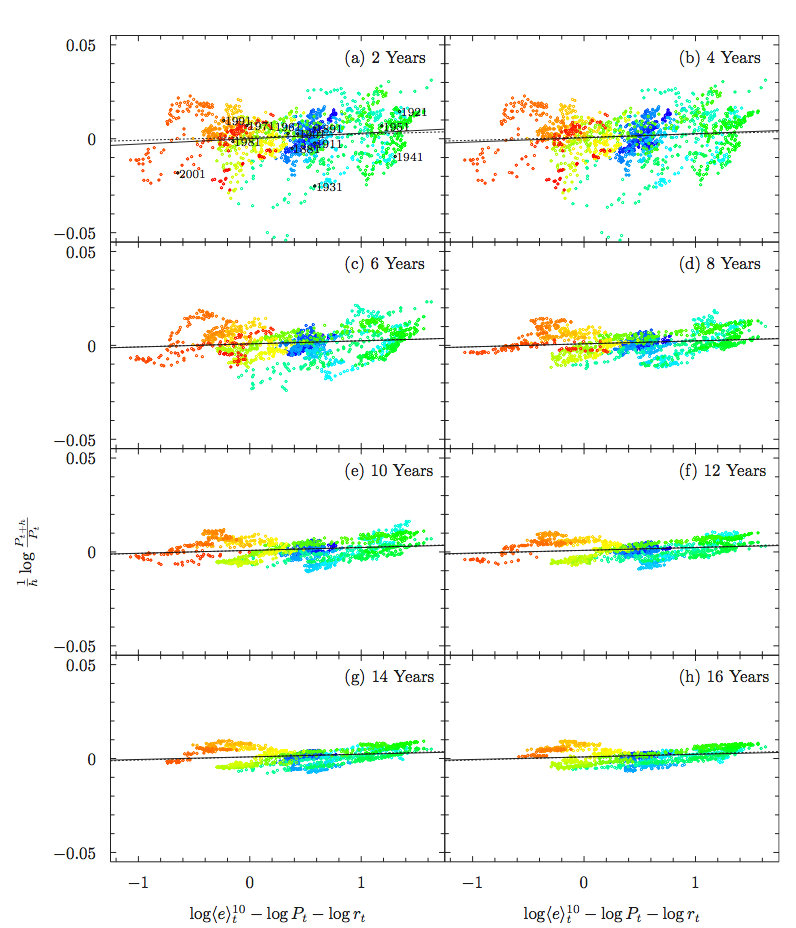
The aim of this paper is twofold: to provide a theoretical framework and to give further empirical support to Shiller’s test of the appropriateness of prices in the stock market based on the Cyclically Adjusted Price Earnings (CAPE) ratio. We devote the first part of the paper to the empirical analysis and we show that the CAPE is a powerful predictor of future long run performances of the market not only for the U.S. but also for countries such us Belgium, France, Germany, Japan, the Netherlands, Norway, Sweden and Switzerland. We show four relevant empirical facts: i) the striking ability of the logarithmic averaged earning over price ratio to predict returns of the index, with an R squared which increases with the time horizon, ii) how this evidence increases switching from returns to gross returns, iii) moving over different time horizons, the regression coefficients are constant in a statistically robust way, and iv) the poorness of the prediction when the precursor is adjusted with long term interest rate. In the second part we provide a theoretical justification of the empirical observations. Indeed we propose a simple model of the price dynamics in which the return growth depends on three components: a) a momentum component, naturally justified in terms of agents’ belief that expected returns are higher in bullish markets than in bearish ones; b) a fundamental component proportional to the log earnings over price ratio at time zero. The initial value of the ratio determines the reference growth level, from which the actual stock price may deviate as an effect of random external disturbances, and c) a driving component ensuring the diffusive behaviour of stock prices. Under these assumptions, we are able to prove that, if we consider a sufficiently large number of periods, the expected rate of return and the expected gross return are linear in the initial time value of the log earnings over price ratio, and their variance goes to zero with rate of convergence equal to minus one. Ultimately this means that, in our model, the stock prices dynamics may generate bubbles and crashes in the short and medium run, whereas for future long-term returns the valuation ratio remains a good predictor.

Figure 1 from the paper (extracted below) shows 2 year to 16 year regressions for the period 1871-2010 (Points are organized in chronological order according to the color scale ranging from dark blue to red passing through light blue, green, yellow, and orange; labels in the top left panel refer to points corresponding to the first month of the specified year.):
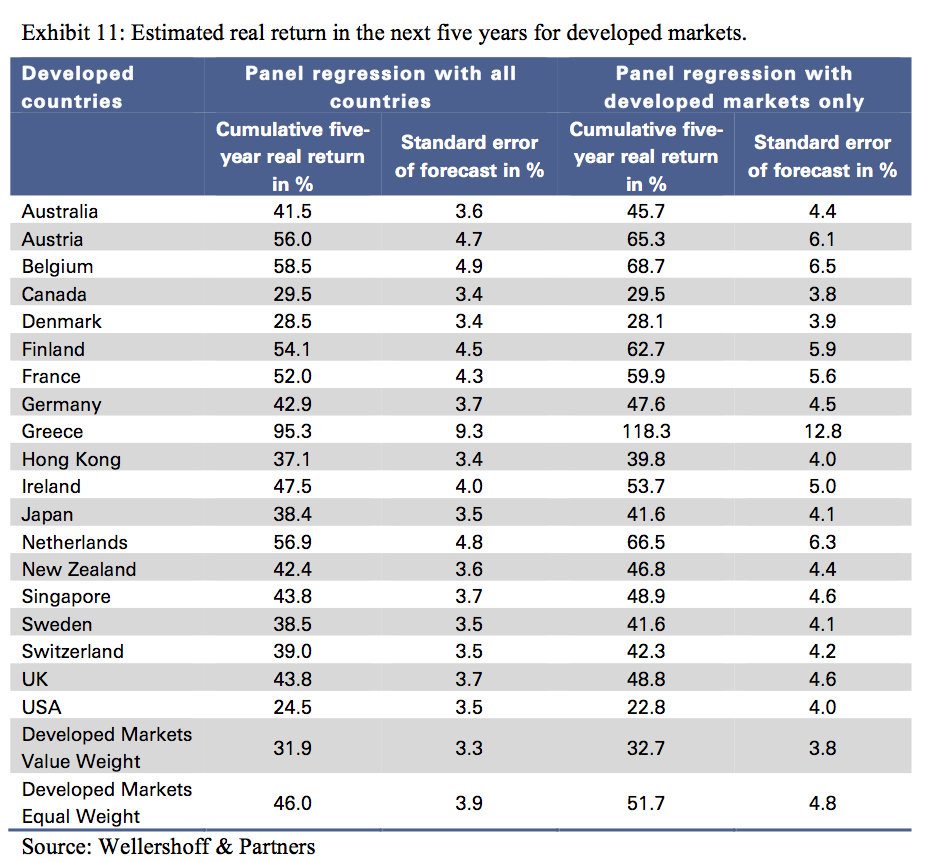
The second paper, Does the Shiller-PE Work in Emerging Markets? by Joachim Klement examines the reliability of CAPE as a forecasting and valuation tool for 35 countries including emerging markets. Klement finds that CAPE is a reliable long-term valuation indicator for developed and emerging markets. Klement uses the indicator to predict real returns on local equity markets over the next five to ten years (shown in Exhibits 11 and 12 extracted below):

Developed Markets
Emerging Markets

Klement makes some interesting observations about developed markets:

Looking at the forecasts for different markets the following observations stand out:

For all developed equity markets the expected real return in local currencies is positive and the probability of negative real returns after ten years is generally low.

The market with the lowest expected future return is the United States which together with Canada and Denmark promises real returns that are quite a bit lower than developed markets overall.

• Because of the low expected returns for US stock markets, an equal weighted portfolio of developed market equities is expected to perform significantly better than a typical value weighted portfolio. The current debate about optimal sector and country weights in a stock market index is still ongoing and there are many different rivaling approaches like equal weighting, fundamental weighting, GDP-weighting or equal risk contribution or minimum variance. The jury is still out which one of these approaches is the best for long-term investors, but our calculations indicate that an equal weighted portfolio should outperform a value weighted one.

• Looking at individual markets again, we see that the most attractive markets are generally the crisis-ridden European equity markets and in particular Greece which currently has such low valuations that real returns over the next five years could come close to 100%. But more stable markets like Finland, France or Germany also offer attractive long-term return possibilities.

And Klement on the emerging markets:

While the forecasts for emerging markets generally have a somewhat higher forecast error associated with them we can still observe some general trends:

Emerging market equities seem to be poised for significantly lower real returns than developed equities at the moment.

• Particularly smaller emerging countries like Peru, Colombia or Indonesia offer less attractive returns at the moment than more developed neighbors like Brazil or Thailand.

Some currently fashionable investment countries like China or India offer only average return prospects.

• From a regional perspective it seems that Eastern European countries together with Turkey and South Africa offer the highest future equity markets while Asia overall should be only average and in Latin America only Brazil seems a worthwhile investment at the moment.

H/T World Beta

Read Full Post »

Research Affiliates’ Jason Hsu has a new article Selling Hope (.pdf) in which he discusses the reason investors persist in the seemingly irrational behavior of paying high fees for active management despite the numerous studies that show most active managers fail to deliver “alpha” over time net of fees:

The empirical evidence that the average fund manager underperforms and the recent top-performing funds do not outperform subsequently are irrefutable. Why, then, do investors insist on paying for investment management expertise, which isn’t all that useful? Perhaps investors are not really that interested in holding their investment managers accountable for outperformance. The Economist’s Buttonwood column 5 argues that investors might only be interested in securing advice that confirms their own investment beliefs. The false sense of security that comes from hearing a “professional” concurring with one’s own opinions on unpredictable affairs makes the randomness that is inherent in investing almost tolerable. Clearly, not all aspects of investment management are related to generating outperformance; many managers and advisors are really in the business of preventing their clients from making bad financial decisions, such as overconcentrating the portfolio, trading excessively or making decisions under emotional distress. Barber and Odean, in their 2000 Journal of Finance paper, found that aggressive self-directed investors underperform the market by an average of 6.5% per annum.6 These investors simply own too few stocks and trade too much due to overconfidence in their own stock-picking and market-timing skills. Jason Zweig, in his 2002 investigative report, documented that retail mutual fund investors underperformed the average mutual fund by 4.7% per annum.7 Again, this poor result is driven by investors actively switching between funds and market-timing their investment contributions.

Read the article here (.pdf).

See an earlier post on fundamental indexation.

H/T Tom Brakke’s @researchpuzzler

Read Full Post »

Greenbackd has been quiet over the last few days while I finished “Simple But Not Easy,” my latest white paper for Eyquem (embedded below). If you want to receive similar future missives, shoot me an email at greenbackd at gmail dot com. Thoughts, criticisms, and questions are all welcome too.

Read Full Post »

Greenbackd was honored to be one of the bloggers asked to participate in Abnormal Returns “Finance Blogger Wisdom” series. Tadas asked a range of questions and will publish them on Abnormal Returns over the course of the week. The first question is, “If you had a son or daughter just beginning to invest, what would you tell them to do to best prepare themselves for a lifetime of good investing?

I answered as follows:

Inspired by Michael Pollan’s edict for healthy eating (“Eat food. Not too much. Mostly plants.”), for good investing I’d propose “Buy value. Diversify globally. Stay invested.”

I feel that I should justify the answer a little in the context of the “What to do in sideways markets” post about Vitaliy Katsenelson‘s excellent book “The Little Book of Sideways Markets“. To recap, Vitaliy’s thesis is that equity markets are characterized by periods of valuation expansion (“bull market”) and contraction (“bear market” or “sideways market”). A sideways market is the result of earnings increasing while valuation drops. Historically, they are common:

We’ve clearly been in a sideways market for all of the 2000s, and yet the CAPE presently stands at 21.22. CAPE has in the past typically fallen to a single-digit low following a cyclical peak. The last time a sideways market traded on a CAPE of ~21 (1969) it took ~13 years to bottom (1982). The all-time peak US CAPE of 44.2 occurred in December 1999, all-time low US CAPE of 4.78 occurred in December 1920. The most recent CAPE low of 6.6 occurred in August 1982. I’m fully prepared for another 13 years of sideways market (although, to be fair, I don’t really care what the market does).

If you subscribe to Vitaliy’s thesis – as I do – that the sideways market will persist until we reach a single-digit CAPE, then it might seem odd to suggest staying fully invested. In my defence, I make the following two points:

First, I am assuming a relatively unsophisticated beginner investor.

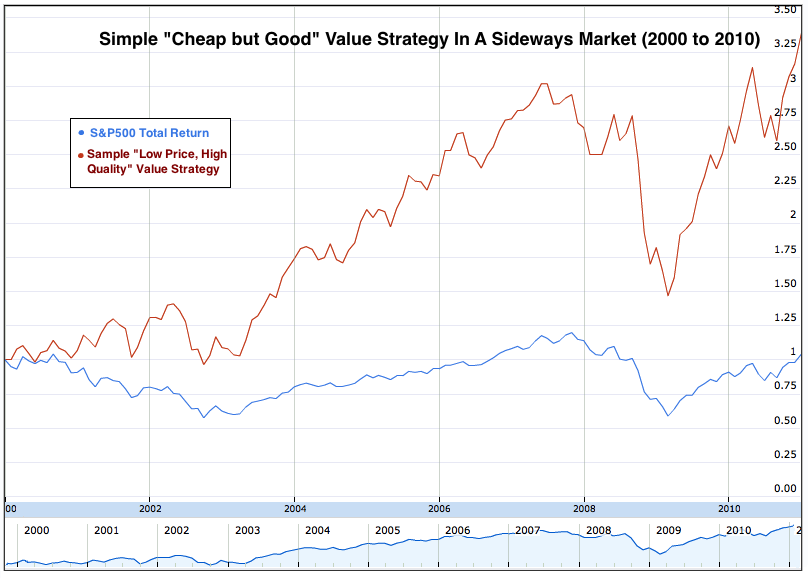
Second, this chart:

Source: Turnkey Analyst Backtester.

A simple, quantitative, “cheap but good” value strategy has delivered reasonable returns over the last decade in a flat market. I don’t think these returns are worth writing home about, but if my kids can dollar cost average into an ~11-12 percent per year in a flat market, they’ll do fine over the long run.

The other responses are outstanding. See them here.

Read Full Post »

From Michael Lewis’s Princeton University 2012 Baccalaureate Remarks:

The “Moneyball” story has practical implications. If you use better data, you can find better values; there are always market inefficiencies to exploit, and so on. But it has a broader and less practical message: don’t be deceived by life’s outcomes. Life’s outcomes, while not entirely random, have a huge amount of luck baked into them. Above all, recognize that if you have had success, you have also had luck — and with luck comes obligation. You owe a debt, and not just to your Gods. You owe a debt to the unlucky.

Read Full Post »

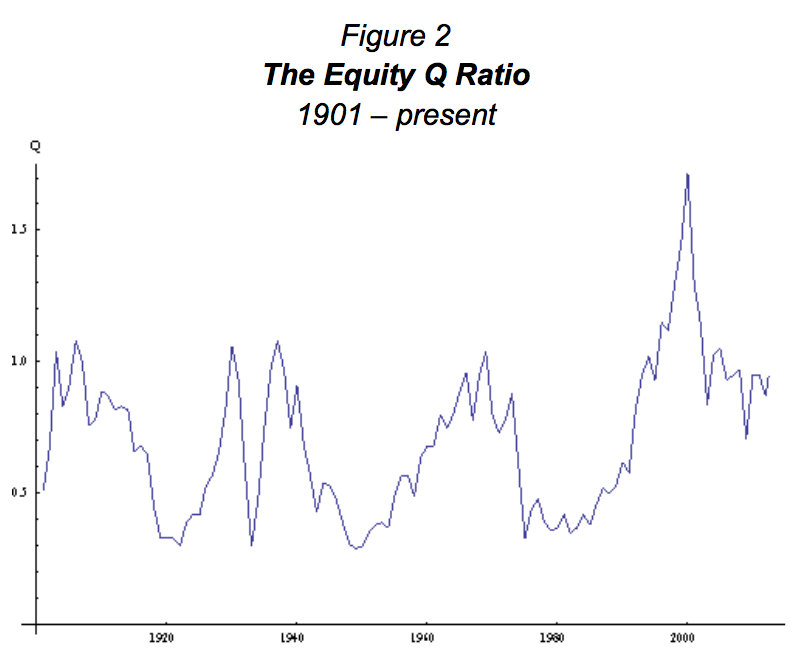
Mark Spitznagel, CIO of Universa, released in May a prescient white paper called “The Austrians and the Swan: Birds of a Different Feather” in which he discussed the theory behind the “Equity Q Ratio,” a variation of Tobin’s Q ratio, and the expected returns to the market from various levels of Equity Q Ratio.

Tobin’s Q ratio is the ratio between the market value of the stock market and against the aggregate net worth of the constituent stocks measured at replacement cost.

It can be defined to include or exclude debt. We exclude debt for ease of calculation, and refer to it in this form as “Equity Q”.

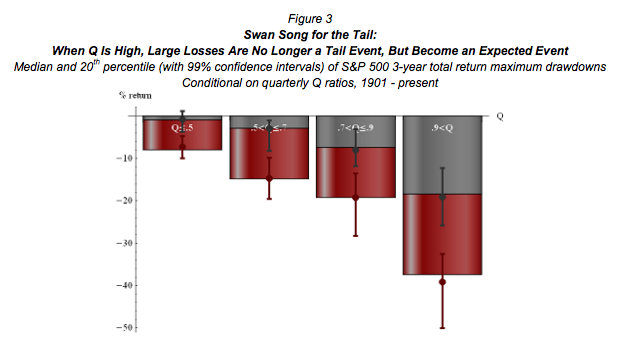
Spitznagel observes that the aggregate US stock market has suffered very few sizeable annual losses (which Spitznagel defines as “20% or more”). By definition, we can categorize such extreme stock market losses “tail events.”

However, when the Equity Q ratio is high, large losses are “no longer a tail event, but become an expected event.”

Equity Q ratios over 0.9 lead to some very ugly results. So where are we now?

Ugly.

H/T Zero Hedge.

Read Full Post »

Meb Faber’s World Beta has a great series of posts on  Graham / Shiller PEs globally as at May 24:

Meb says:

If you look at the history of country CAPEs, they tend to bottom out in single digits around 7. Bull markets can push this number up into the 40s, with the median around 18. These may be slightly skewed by most of these markets being in existence since 1970. (Note: All time lows register at 3 (Thailand and Korea) and top out near 100 (Japan).

Belgium, Netherlands, France, Spain, Russia, and Italy are all trading at CAPEs below 10. Generational buying opportunity or prelude to more pain?

The market has moved a little since Meb posted these. The S&0 500 stands this morning at 20.66, down from 21.76 on May 24. It’s still well above its long term mean of 15.48, and median of 14.45.

Read Full Post »

Yesterday I covered a 2006 talk, “Journey Into the Whirlwind: Graham-and-Doddsville Revisited,” by Louis Lowenstein*, then a professor at the Columbia Law School, in which he compared the performance of a group of “true-blue, walk-the-walk value investors” and “a group of large cap growth funds”.

Lowenstein based the talk on an earlier paper he had written “Searching for Rational Investors In a Perfect Storm:”

In October, 1991, there occurred off the coast of Massachusetts a “perfect storm,” a tempest created by a rare coincidence of events. In the late ‘90s, there was another perfect storm, an also rare coincidence of forces which caused huge waves in our financial markets, as the NASDAQ index soared, collapsed, and bounced part way back.

What had happened to the so-called “rational” investors, the smart money, whom economists have for decades said would keep market prices in close touch with the underlying values? Despite the hundreds of papers on markets and their efficiency, it is a remarkable fact that no scholar, not one, has looked to see who are these rational, i.e., value, investors, how they operate, and with what results.

In the paper, Lowenstein decided to see how a group of ten value funds, selected by a knowledgeable manager, performed in the turbulent boom–crash–rebound years of 1999-2003. Did they suffer the permanent loss of capital of so many who invested in the telecom, media and tech stocks? How did their overall performance for the five years compare with the returns on the S&P 500?

To bring a group of rational/value investors out of the closet, I asked Bob Goldfarb, the highly regarded chief executive of the Sequoia Fund, to furnish the names of ten “true-blue” value funds, those which, as they say on the Street, don’t just talk the talk but walk the walk. (Had I prepared the list, I would have included Sequoia, but Goldfarb’s ten is Goldfarb’s ten.) They are all mutual funds, except for Source Capital, a closed-end fund which invests much like a mutual fund. The funds are as follows:

  • Clipper Fund
  • FPA Capital
  • First Eagle Global
  • Mutual Beacon
  • Oak Value
  • Oakmark Select
  • Longleaf Partners
  • Source Capital
  • Legg Mason Value
  • Tweedy Browne American Value

How did they perform?

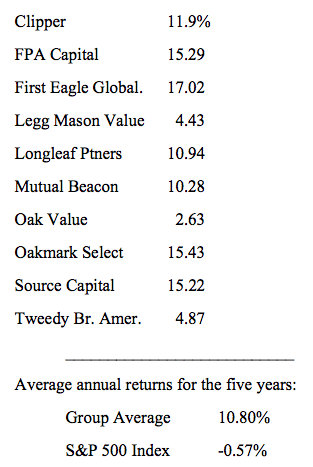
For most managers, mimicking the index, it was difficult not to own Enron, Oracle and the like, but the ten value funds had stayed far away. Instead, they owned highly selective portfolios, mostly 34 stocks or less, vs. the 160 in the average equity fund. Reflecting their consistent and disciplined approach, they turned their portfolios at one-sixth the rate of the average fund. Bottom line: every one of the ten outperformed the index over the five year period, and as a group they did so by an average of 11% per year, the financial equivalent of back-to-back no-hitters.

The five-year 1999-2003 average annual returns were as follows:

Here’s a link to the article.

Read Full Post »

The Superinvestors of Graham-and-Doddsville is a well-known article (see the original Hermes article here.pdf) by Warren Buffett defending value investing against the efficient market hypothesis. The article is an edited transcript of a talk Buffett gave at Columbia University in 1984 commemorating the fiftieth anniversary of Security Analysis, written by Benjamin Graham and David L. Dodd.

In a 2006 talk, “Journey Into the Whirlwind: Graham-and-Doddsville Revisited,” Louis Lowenstein*, then a professor at the Columbia Law School, compared the performance of a group of “true-blue, walk-the-walk value investors” (the “Goldfarb Ten”) and “a group of large cap growth funds” (the “Group of Fifteen”).

Here are Lowenstein’s findings:

For the five years ended this past August 31, the Group of Fifteen experienced on average negative returns of 8.89% per year, vs. a negative 2.71% for the S&P 500.4 The group of ten value funds I had studied in the “Searching for Rational Investors” article had been suggested by Bob Goldfarb of the Sequoia Fund.5 Over those same five years, the Goldfarb Ten enjoyed positive average annual returns of 9.83%. This audience is no doubt quick with numbers, but let me help. Those fifteen large growth funds underperformed the Goldfarb Ten during those five years by an average of over 18 percentage points per year. Hey, pretty soon you have real money. Only one of the fifteen had even modestly positive returns. Now if you go back ten years, a period that includes the bubble, the Group of Fifteen did better, averaging a positive 8.13% per year.Even for that ten year period, however, they underperformed the value group, on average, by more than 5% per year.6 With a good tailwind, those large cap funds were not great – underperforming the index by almost 2% per year – and in stormy weather their boats leaked badly.

Lowenstein takes a close look at one of the Group of Fifteen (a growth fund):

The first was the Massachusetts Investors Growth Stock Fund, chosen because of its long history. Founded in 1932, as the Massachusetts Investors Second Fund, it was, like its older sibling, Massachusetts Investors Trust, truly a mutual fund, in the sense that it was managed internally, supplemented by an advisory board of six prominent Boston businessmen.7 In 1969, when management was shifted to an external company, now known as MFS Investment Management, the total expense ratio was a modest 0.32%.

I am confident that the founders of the Massachusetts Investors Trust would no longer recognize their second fund, which has become a caricature of the “do something” culture. The expense ratio, though still below its peer group, has tripled. But it’s the turbulent pace of trading that would have puzzled and distressed them. At year-end 1999, having turned the portfolio over 174%, the manager said they had moved away from “stable growth companies” such as supermarket and financial companies, and into tech and leisure stocks, singling out in the year- end report Cisco and Sun Microsystems – each selling at the time at about 100 X earnings – for their “reasonable stock valuation.” The following year, while citing a bottom-up, “value sensitive approach,” the fund’s turnover soared to 261%. And in 2001, with the fund continuing to remark on its “fundamental . . .bottom-up investment process,” turnover reached the stratospheric level of 305%. It is difficult to conceive how, even in 2003, well after the market as a whole had stabilized, the managers of this $10 billion portfolio had sold $28 billion of stock and then reinvested that $28 billion in other stocks.

For the five years ended in 2003, turnover in the fund averaged 250%. All that senseless trading took a toll. For the five years ended this past August, average annual returns were a negative 9-1/2%. Over the past ten years, which included the glory days of the New Economy, the fund did better, almost matching the index, though still trailing our value funds by 4% a year. Net assets which had been a modest $1.9 billion at Don Phillips’ kickoff date in 1997, and had risen to $17 billion in 2000, are now about $8 billion.

If you’re feeling some sympathy for the passengers in this financial vehicle, hold on. Investors – and I’m using the term loosely – in the Mass. Inv. Growth Stock Fund were for several years running spinning their holdings in and out of the fund at rates approximating the total assets of the fund. In 2001, for example, investors cashed out of $17-1/2 billion in Class A shares, and bought $16 billion in new shares, leaving the fund at year end with net assets of about $14 billion. Having attracted, not investors, but speculators trying to catch the next new thing, management got the shareholders they deserved.

And the value investors?

Having updated my data through August of this year, I am happy to report that the Goldfarb Ten still look true blue – actually better than at year-end 2003. The portfolio turnover rates have dropped on average to 16% – translation, an average holding period of six years. Honey, what did you do today? Nothing, dear.The average cash holding is 14% of the portfolio, and five of the funds are closed to new investors.f Currently, however, two of the still open funds, Mutual Beacon and Clipper, are losing their managers. The company managing the Clipper Fund has been sold twice over and Jim Gipson and two colleagues recently announced they’re moving on. At Mutual Beacon, which is part of the Franklin Templeton family, David Winters has left to create a mutual fund, ah yes, the Wintergreen Fund. It will be interesting to see whether Mutual Beacon and Clipper will maintain their discipline.

Speaking of discipline, you may remember that after Buffett published “The Superinvestors,” someone calculated that while they were indeed superinvestors, on average they had trailed the market one year in three.20 Tom Russo, of the Semper Vic Partners fund, took a similar look at the Goldfarb Ten and found, for example, that four of them had each underperformed the S&P 500 for four consecutive years, 1996-1999, and in some cases by huge amounts. For the full ten years, of course, that underperformance was sharply reversed, and then some. Value investing thus requires not just patient managers but also patient investors, those with the temperament as well as intelligence to feel comfortable even when sorely out of step with the crowd. If you’re fretting that the CBOE Market Volatility Index may be signaling fear this week, value investing is not for you.

* Louis was father to Roger Lowenstein of Buffett: The Making of an American Capitalist.

Read Full Post »

A recent study by Wes Gray and Jack Vogel, Dissecting Shareholder Yield, makes the stunning claim that dividend yield doesn’t predict future returns, but more complete measures of shareholder yield might hold some promise. Gray and Vogel say that, “regardless of the yield metric chosen, the predictive power of separating stocks into high and low yield portfolios has lost considerable power in the last twenty years.”

This seems to be part of a trend away from dividends and towards share repurchases, presumably for tax reasons:

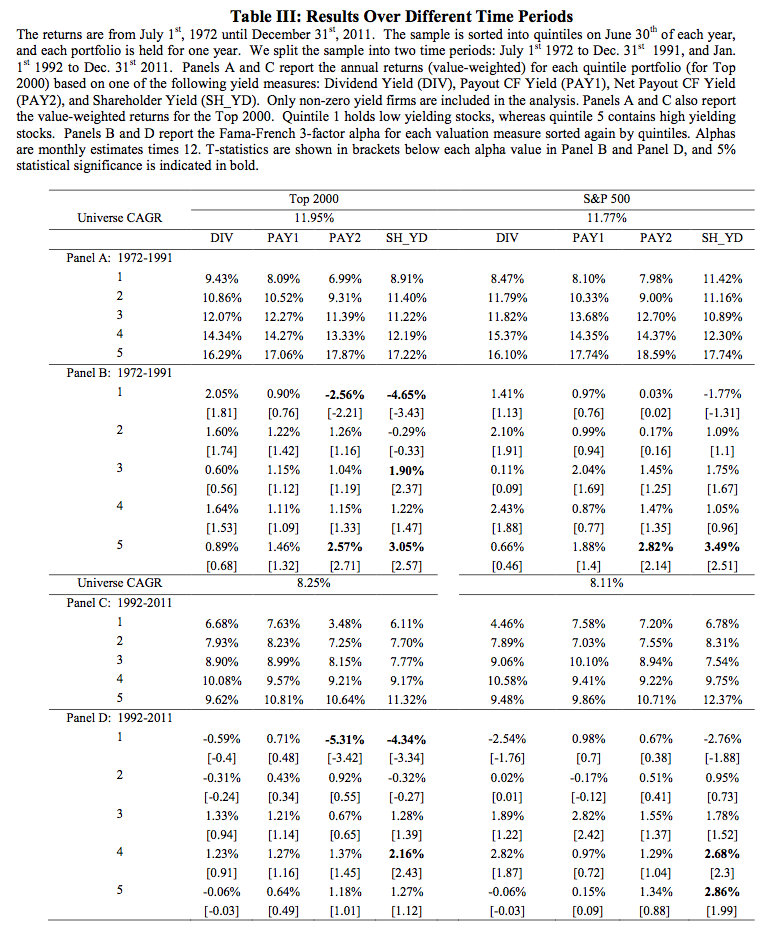
Our work is related to previous research on payout yield as a predictor of future returns. Grullen and Michaely [2002] find that firms have substituted away from dividends towards share repurchases. Boudoukh et al (2007) construct two measures of payout yields (Dividends plus repurchases, as well as Dividends plus net repurchases). They find that these payout measures have more predictive ability than the dividend yield. We contribute to the literature by examining an additional variable to our payout yield, namely net debt pay down. Net debt pay down was first proposed by Priest and McClelland (2007), but is not rigorously analyzed. As a preview of our results, we find that the addition of net debt pay down helps performance, but is not a panacea. Similar to all yield metrics, results in the latter half of the sample (1992-2011) are not as strong as those in the first half of the sample (1972-1991).

Gray and Vogel examine four yield measures:

  • Dividends (DIV)
  • Dividends plus repurchases (PAY1)
  • Dividends plus net repurchases (repurchases minus equity issuance) (PAY2)
  • Dividends plus net repurchases plus net debt paydown (SH_YD)

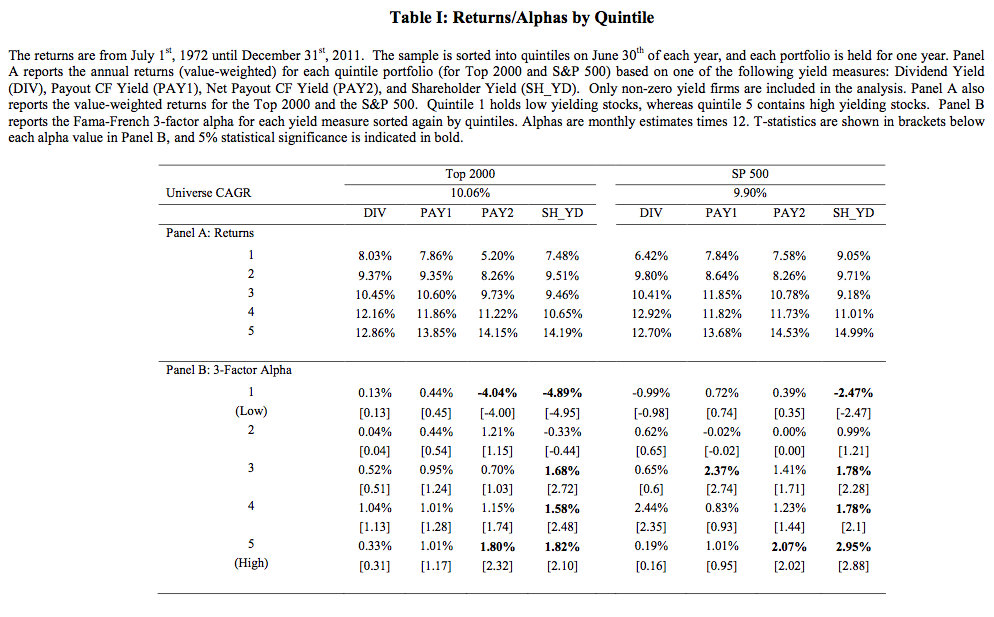
Here’s their table of returns:

They find as follows:

We perform a similar study as Patel et al. on all our yield metrics, but focus on the dividend yield (DIV) and our complete shareholder yield metric (SH_YD) to assess the “high yield, low payout” outperformance hypothesis. We confirm the basic conclusion from Patel et al. that low payout firms outperform high payout firms across all yield quintiles. For example, in the top DIV quintile, high DIV firms earn 12.16% CAGR from 1972-2011, however, low payout firms earn 13.43%, and high payout firms earn 12.15%. After risk adjusting the results with the 3-factor model we find no evidence of outperformance for any DIV portfolio. In Table V we assess a variety of additional risk/reward characteristics. There is no clear evidence that splitting high DIV yield firms into low and high payout adds risk-adjusted value relative to the standard high DIV yield strategy. For example, max drawdowns suggest that high DIV, low payout strategies are actually riskier than high DIV, high payout strategies (64.35% drawdown compared to 58.27%). However, Sharpe and Sortino ratios are marginally higher for high DIV, low payout strategies relative to high DIV, high payout strategies.

When we examine high SH_YD stocks, we come to a similar conclusion: there is no conclusive evidence that separating stocks on payout percentage within a given yield category can systematically add value to an investment strategy.

In summary, we confirm that separating yield quintiles into low and high payout bins has worked historically on a raw returns basis for DIV. Nonetheless, an investigation of the strategy on a risk-adjusted basis and across different yield metrics and samples suggest there is no evidence that a high yield low payout strategy can help an investor predict stocks. If anything, the evidence suggests that investors should potentially investigate strategies that focus on low SH_YD low payout strategies. The alphas for these stocks are -6.30% for the Top 2000 sample and -5.33% for the S&P 500 sample; the additional risk/reward ratios in Table V also show terrible performance for the low SH_YD low payout strategies.

And the table showing the reduction in performance over time:

Gray and Vogel make three key points in their conclusion:

1. More complete yield measures improve performance.

2. All yield measures are becoming less effective over time.

3. Attempting to improve yield measures by separating on payout percentages is not a reliable tool to enhance investment returns.

Read Full Post »

« Newer Posts - Older Posts »