Feeds:
Posts
Comments

Archive for the ‘About’ Category

Two recent articles, Was Benjamin Graham Skillful or Lucky? (WSJ), and Ben Graham’s 60-Year-Old Strategy Still Winning Big (Forbes), have thrown the spotlight back on Benjamin Graham’s investment strategy and his record. In the context of Michael Mauboussin’s new book The Success Equation, Jason Zweig asks in his WSJ Total Return column whether Graham was lucky or skillful, noting that Graham admitted he had his fair share of luck:

We tend to think of the greatest investors – say, Peter Lynch, George Soros, John Templeton, Warren Buffett, Benjamin Graham – as being mostly or entirely skillful.

Graham, of course, was the founder of security analysis as a profession, Buffett’s professor and first boss, and the author of the classic book The Intelligent Investor. He is universally regarded as one of the best investors of the 20th century.

But Graham, who outperformed the stock market by an annual average of at least 2.5 percentage points for more than two decades, coyly admitted that much of his remarkable track record may have been due to luck.

John Reese, in his Forbes’ Intelligent Investing column, notes that Graham’s Defensive Investor strategy has continued to outpace the market over the last decade:

Known as the “Father of Value Investing”—and the mentor of Warren Buffett—Graham’s investment firm posted annualized returns of about 20% from 1936 to 1956, far outpacing the 12.2% average return for the broader market over that time.

But the success of Graham’s approach goes far beyond even that lengthy period. For nearly a decade, I have been tracking a portfolio of stocks picked using my Graham-inspired Guru Strategy, which is based on the “Defensive Investor” criteria that Graham laid out in his 1949 classic, The Intelligent Investor. And, since its inception, the portfolio has returned 224.3% (13.3% annualized) vs. 43.0% (3.9% annualized) for the S&P 500.

Even with all of the fiscal cliff and European debt drama in 2012, the Graham-based portfolio has had a particularly good year. While the S&P 500 has notched a solid 13.7% gain (all performance figures through Dec. 17), the Graham portfolio is up more than twice that, gaining 28.5%.

Reese’s experiment might suggest that Graham is more skillful than lucky.

In our recently released book, Quantitative Value: A Practitioner’s Guide to Automating Intelligent Investment and Eliminating Behavioral Errors, Wes and I examine one of Graham’s simple strategies in the period after he described it to the present day. Graham gave an interview to the Financial Analysts Journal in 1976, some 40 year after the publication of Security Analysis. He was asked whether he still selected stocks by carefully studying individual issues, and responded:

I am no longer an advocate of elaborate techniques of security analysis in order to find superior value opportunities. This was a rewarding activity, say, 40 years ago, when our textbook “Graham and Dodd” was first published; but the situation has changed a great deal since then. In the old days any well-trained security analyst could do a good professional job of selecting undervalued issues through detailed studies; but in the light of the enormous amount of research now being carried on, I doubt whether in most cases such extensive efforts will generate sufficiently superior selections to justify their cost. To that very limited extent I’m on the side of the “efficient market” school of thought now generally accepted by the professors.

Instead, Graham proposed a highly simplified approach that relied for its results on the performance of the portfolio as a whole rather than on the selection of individual issues. Graham believed that such an approach “[combined] the three virtues of sound logic, simplicity of application, and an extraordinarily good performance record.”

Graham said of his simplified value investment strategy:

What’s needed is, first, a definite rule for purchasing which indicates a priori that you’re acquiring stocks for less than they’re worth. Second, you have to operate with a large enough number of stocks to make the approach effective. And finally you need a very definite guideline for selling.

What did Graham believe was the simplest way to select value stocks? He recommended that an investor create a portfolio of a minimum of 30 stocks meeting specific price-to-earnings criteria (below 10) and specific debt-to-equity criteria (below 50 percent) to give the “best odds statistically,” and then hold those stocks until they had returned 50 percent, or, if a stock hadn’t met that return objective by the “end of the second calendar year from the time of purchase, sell it regardless of price.”

Graham said that his research suggested that this formula returned approximately 15 percent per year over the preceding 50 years. He cautioned, however, that an investor should not expect 15 percent every year. The minimum period of time to determine the likely performance of the strategy was five years.

Graham’s simple strategy sounds almost too good to be true. Sure, this approach worked in the 50 years prior to 1976, but how has it performed in the age of the personal computer and the Internet, where computing power is a commodity, and access to comprehensive financial information is as close as the browser? We decided to find out. Like Graham, Wes and I used a price-to-earnings ratio cutoff of 10, and we included only stocks with a debt-to-equity ratio of less than 50 percent. We also apply his trading rules, selling a stock if it returned 50 percent or had been held in the portfolio for two years.

Figure 1.2 below taken from our book shows the cumulative performance of Graham’s simple value strategy plotted against the performance of the S&P 500 for the period 1976 to 2011:
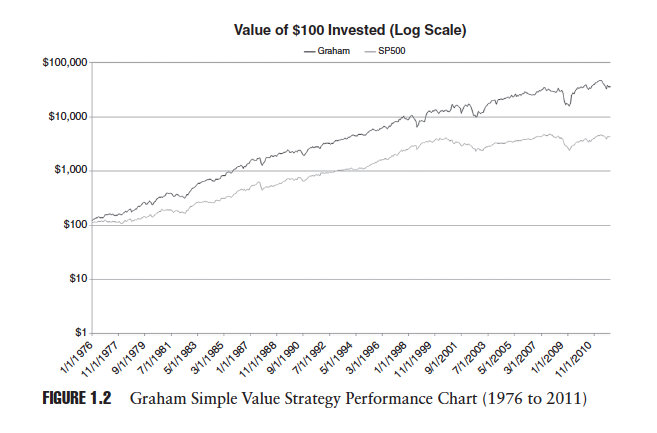
Graham Strategy

Amazingly, Graham’s simple value strategy has continued to outperform.

Table 1.2 presents the results from our study of the simple Graham value strategy:

Graham Chart

Graham’s strategy turns $100 invested on January 1, 1976, into $36,354 by December 31, 2011, which represents an average yearly compound rate of return of 17.80 percent—outperforming even Graham’s estimate of approximately 15 percent per year. This compares favorably with the performance of the S&P 500 over the same period, which would have turned $100 invested on January 1, 1976, into $4,351 by December 31, 2011, an average yearly compound rate of return of 11.05 percent. The performance of the Graham strategy is attended by very high volatility, 23.92 percent versus 15.40 percent for the total return on the S&P 500.

The evidence suggests that Graham’s simplified approach to value investment continues to outperform the market. I think it’s a reasonable argument for skill on the part of Graham.

It’s useful to consider why Graham’s simple strategy continues to outperform. At a superficial level, it’s clear that some proxy for price—like a P/E ratio below 10—combined with some proxy for quality—like a debt-to-equity ratio below 50 percent—is predictive of future returns. But is something else at work here that might provide us with a deeper understanding of the reasons for the strategy’s success? Is there some other reason for its outperformance beyond simple awareness of the strategy? We think so.

Graham’s simple value strategy has concrete rules that have been applied consistently in our study. Even through the years when the strategy underperformed the market  our study assumed that we continued to apply it, regardless of how discouraged or scared we might have felt had we actually used it during the periods when it underperformed the market. Is it possible that the very consistency of the strategy is an important reason for its success? We believe so. A value investment strategy might provide an edge, but some other element is required to fully exploit that advantage.

Warren Buffett and Charlie Munger believe that the missing ingredient is temperament. Says Buffett, “Success in investing doesn’t correlate with IQ once you’re above the level of 125. Once you have ordinary intelligence, what you need is the temperament to control the urges that get other people into trouble in investing.”

Was Graham skillful or lucky? Yes. Does the fact that he was lucky detract from his extraordinary skill? No because he purposefully concentrated on the undervalued tranch of stocks that provide asymmetric outcomes: good luck in the fortunes of his holdings helped his portfolio disproportionately on the upside, and bad luck didn’t hurt his portfolio much on the downside. That, in my opinion, is strong evidence of skill.

Buy my book The Acquirer’s Multiple: How the Billionaire Contrarians of Deep Value Beat the Market from on Kindlepaperback, and Audible.

Here’s your book for the fall if you’re on global Wall Street. Tobias Carlisle has hit a home run deep over left field. It’s an incredibly smart, dense, 213 pages on how to not lose money in the market. It’s your Autumn smart read. –Tom Keene, Bloomberg’s Editor-At-Large, Bloomberg Surveillance, September 9, 2014.

Click here if you’d like to read more on The Acquirer’s Multiple, or connect with me on Twitter, LinkedIn or Facebook. Check out the best deep value stocks in the largest 1000 names for free on the deep value stock screener at The Acquirer’s Multiple®.
 

Read Full Post »

Quantitative Value Cover

I’m excited to announce that the book Quantitative Value: A Practitioner’s Guide to Automating Intelligent Investment and Eliminating Behavioral Errors (hardcover, 288 pages, Wiley Finance) is now available.

In Quantitative Value, we make the case for quantitative value investment in stock selection and portfolio construction. Our rationale is that quantitative value investing assists us to defend against our own behavioral errors, and exploit the errors made by others. We examine in detail industry and academic research into a variety of fundamental value investing methods, and simple quantitative value investment strategies. We then independently backtest each method, and strategy, and combine the best into a new quantitative value investment model.

The book can be ordered from Wiley Finance, Amazon, or Barnes and Noble.

Look Inside

(more…)

Read Full Post »

Update: See Ryan’s interview on Bloomberg.

Great article from Businessweek about Ryan Morris, the 28-year-old Canadian managing partner of Meson Capital Partners, LLC who “resembles a sandy-haired Mitt Romney,” and seems to be all out of bubblegum:

Ryan Morris spent a week steeling himself for the showdown. Then 27 years old, he was in his first campaign as an activist investor, trying to wrest control of a small company named InfuSystem (INFU), which provides and services pumps used in chemotherapy. In the meeting, Morris would confront InfuSystem’s chairman and vice chairman, two men in their 40s, and tell them that as a shareholder, he thought the company was heading in the wrong direction.

Morris is competitive—his high school rowing teammates nicknamed him “Cyborg,” and he took a semester off college to race as a semi-pro cyclist—but face-to-face confrontation wasn’t something he relished. “I like the thrill of the hunt, but not the kill,” he says. To prepare, Morris outlined questions, guessed potential responses, and tried to anticipate what tense “pregnant moments” could arrive. He built his clout by lining up support from InfuSystem’s largest shareholder as well as a veteran activist investor. Morris knew his own looks—he resembles a sandy-haired Mitt Romney—could help mask his youth, and decided he’d wear a tie, much as he hates to.

The company, with just $47 million in revenue, was spending too much money, and in the wrong places. In the previous year, InfuSystem’s board and CEO earned more than $11 million combined. This was for a company whose stock had lost 40 percent of its value over the previous three years. Morris figured that as a shareholder voice on the board, he could help cut expenses—including the high pay—and, once it was clean enough to sell, reap a return for his own small hedge fund.

On Dec. 13, 2011, he finally sat at a conference table across from the two directors. After 45 minutes of discussion, he still didn’t think his concerns were being acknowledged. So he got to the point: He wanted three board seats.

It’s a great story. Read the rest of the article on Businessweek.

Read Full Post »

Richard Zeckhauser’s Investing in the Unknown and Unknowable (.pdf) is a fantastic 2006 paper about investing in “unknown and unknowable” (UU) situations in which “traditional finance theory does not apply” because each is unique, so past data are non-existent, and therefore an obviously poor guide to evaluating the investment.

Zeckhauser gives as an example David Ricardo’s purchase of British government bonds on the eve of the Battle of Waterloo:

David Ricardo made a fortune buying bonds from the British government four days in advance of the Battle of Waterloo. He was not a military analyst, and even if he were, he had no basis to compute the odds of Napoleon’s defeat or victory, or hard-to-identify ambiguous outcomes. Thus, he was investing in the unknown and the unknowable. Still, he knew that competition was thin, that the seller was eager, and that his windfall pounds should Napoleon lose would be worth much more than the pounds he’d lose should Napoleon win. Ricardo knew a good bet when he saw it.

The financing of 36 million pounds was floated on the London Stock Exchange. Ricardo took a substantial share. His frequent correspondent Thomas Malthus took 5,000 pounds on Ricardo’s recommendation, but sold out shortly before news of the Waterloo outcome was received. The evidence is clear that Ricardo, in his words, understood the “dismal forebodings” of the situation, including “its consequences, on our [England’s] finances.”

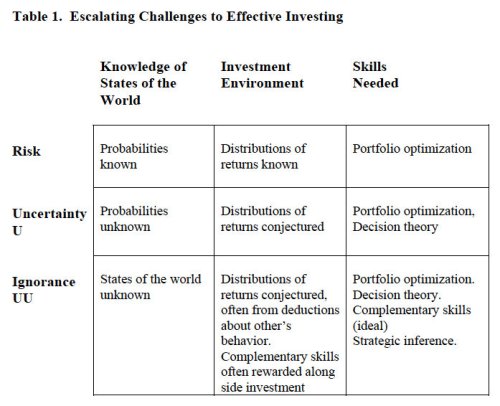
Zeckhauser’s Table 1 below shows the UU world:

UU Table

Zeckhauser says that many great investors, from David Ricardo to Warren Buffett, have made most of their fortunes by betting on “UUU” or unique UU situations:

Ricardo allegedly made 1 million pounds (over $50 million today) – roughly half of his fortune at death – on his Waterloo bonds.5 Buffett has made dozens of equivalent investments. Though he is best known for the Nebraska Furniture Mart and See’s Candies, or for long-term investments in companies like the Washington Post and Coca Cola, insurance has been Berkshire Hathaway’s firehose of wealth over the years. And insurance often requires UUU thinking.

Not all UU situations are unique:

Some UU situations that appear to be unique are not, and thus fall into categories that lend themselves to traditional speculation. Corporate takeover bids are such situations. When one company makes a bid for another, it is often impossible to determine what is going on or what will happen, suggesting uniqueness. But since dozens of such situations have been seen over the years, speculators are willing to take positions in them. From the standpoint of investment, uniqueness is lost, just as the uniqueness of each child matters not to those who manufacture sneakers.

These strategies are distilled into eight investment maxims:

  • Maxim A: Individuals with complementary skills enjoy great positive excess returns from UU investments. Make a sidecar investment alongside them when given the opportunity.

  • Maxim B: The greater is your expected return on an investment, that is the larger is your advantage, the greater the percentage of your capital you should put at risk.

  • Maxim C: When information asymmetries may lead your counterpart to be concerned about trading with you, identify for her important areas where you have an absolute advantage from trading. You can also identify her absolute advantages, but she is more likely to know those already.

  • Maxim D: In a situation where probabilities may be hard for either side to assess, it may be sufficient to assess your knowledge relative to the party on the other side (perhaps the market).

  • Maxim E: A significant absolute advantage offers some protection against potential selection. You should invest in a UU world if your advantage multiple is great, unless the probability is high the other side is informed and if, in addition, the expected selection factor is severe.

  • Maxim F: In UU situations, even sophisticated investors tend to underweight how strongly the value of assets varies. The goal should be to get good payoffs when the value of assets is high.

  • Maxim G: Discounting for ambiguity is a natural tendency that should be overcome, just as should be overeating.

  • Maxim H: Do not engage in the heuristic reasoning that just because you do not know the risk, others do. Think carefully, and assess whether they are likely to know more than you. When the odds are extremely favorable, sometimes it pays to gamble on the unknown, even though there is some chance that people on the other side may know more than you.

The essay is brilliant. Zeckhauser acknowledges in the conclusion that it offers “more speculations than conclusions,” and its theory is “often tentative and implicit” in seeking to answer the question, “How can one invest rationally in UU situations?” but, if anything, it’s the better for it. Thinking as Zeckhauser proposes about UU situations may vastly improve investment decisions where UU events are involved, and should yield substantial benefits because “competition may be limited and prices well out of line.”

Read Investing in the Unknown and Unknowable (.pdf).

h/t @trengriffin via @mjmauboussin

Read Full Post »

Zero Hedge has an article Buy Cash At A Discount: These Companies Have Negative Enterprise Value in which Tyler Durden argues that stock market manipulation has led to valuation dislocations, and gives as evidence the phenomenon of stocks trading with a negative enterprise value (EV):

With humans long gone from the trading arena and algorithms left solely in charge of the casino formerly known as “the stock market”, in which price discovery is purely a function of highly levered synthetic instruments such as ES and SPY or, worse, the EURUSD and not fundamentals, numerous valuation dislocations are bound to occur. Such as company equity value trading well below net cash (excluding total debt), or in other words, negative enterprise value, meaning one can buy the cash at a discount of par and assign zero value to all other corporate assets.

Just as the fact of your paranoia does not exclude the possibility that someone is following you*, you don’t need to believe in manipulation to believe that negative EV is a “valuation dislocation.” Negative EV stocks are often also Graham net nets or almost net nets, and so perform like net nets. For example, Turnkey Analyst took a look at the performance of negative EV stocks (click to enlarge):

Long story short: they ripped, but they were few (sometimes non-existent), and small (mostly micro), which means you would have been heavily concentrated in a few mostly very small stocks, and regularly carried a lot of cash. If you eliminated the tiniest (i.e. the smallest 10 or 20 percent), much of the return disappeared, and volatility spiked markedly. Says Wes:

A few key points:

  1. After you eliminate the micro-crap stocks, you end up being invested in a few names at a time (sometimes you go all-in on a single firm!)
  2. Sometimes the strategy isn’t invested.
  3. The amazing Bueffettesque returns for the “all firms” portfolio above are exclusively tied to micro-craps.

Here’s the frequency of negative EV opportunities according to Turnkey (click to enlarge):

No surprise, there were more following a crash (1987, 2001, 2009) and fewer at the peak (1986, 1999, 2007). If your universe eliminated the smallest 20 percent (the green line), you spent a lot of time in cash. If your universe was unrestricted (the red line), then you’d have had some prospects to mine most of the time. Clearly, it’s not an institutional-grade strategy, but it has worked for smaller sums.

Zero Hedge screened Russell 2000 companies finding 10 companies with negative enterprise value, and then further subdivided the screen into companies with negative, and positive free cash flow (defined here as EBITDA – Cap Ex). Here’s the list (click to enlarge):

Including short-term investments yields a bigger list (click to enlarge):

Like Graham net nets, negative EV stocks are ugly balance sheet plays. They lose money; they burn cash; the business, if they actually have one, usually needs to be taken to the woodshed (so does management, for that matter). Frankly, that’s why they’re cheap. Says Durden:

Typically negative EV companies are associated with pre-bankruptcy cases, usually involving large cash burn, in other words, where the cash may or may not be tomorrow, and which may or may not be able to satisfy all claims should the company file today, especially if it has some off balance sheet liabilities.

You can cherry-pick this screen or buy the basket. I favor the basket approach. Just for fun, I’ve formed four virtual portfolios at Tickerspy to track the performance:

  1. Zero Hedge Negative Enterprise Value Portfolio
  2. Zero Hedge Negative Enterprise Value Portfolio (Positive FCF Only)
  3. Zero Hedge Negative Enterprise Value (Inc. Short-Term Investments) Portfolio
  4. Zero Hedge Negative Enterprise Value (Inc. Short-Term Investments) Portfolio (Positive FCF Only)

I’ll check back in occasionally to see how they’re doing. My predictions for 2013:

  1. All portfolios beat the market
  2. Portfolio 1 outperforms Portfolio 2 (i.e. all negative EV stocks outperform those with positive FCF only)
  3. Portfolio 3 outperforms Portfolio 4 for the same reason that 1 outperforms 2.
  4. Portfolios 1 and 2 outperform Portfolios 3 and 4 (pure negative EV stocks outperform negative EV including short-term investments)

Take care here. The idiosyncratic risk here is huge because the portfolios are so small. Any bump to one stock leaves a huge hole in the portfolio.

* Turn around. I’m right behind you.

Read Full Post »

New research co-authored by London Business School’s Elroy Dimson suggests that investors who actively engage with the companies they own to improve governance and strategy outperform more passive rivals.

The paper, Active Ownership with Oguzhan Karakas and Xi Li, focuses on corporate social responsibility engagements on environmental, social and governance issues.

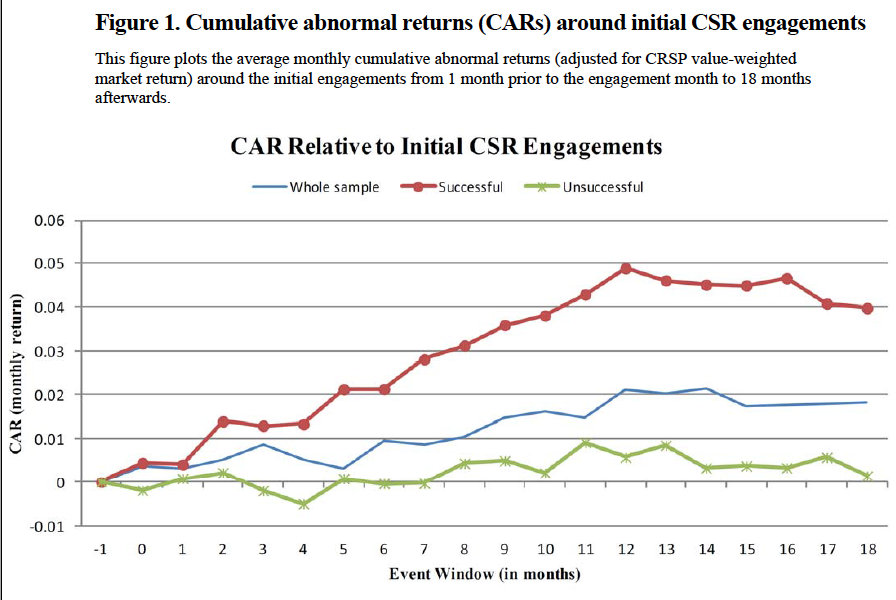
The authors find average one-year abnormal return after initial engagement is 1.8%, with 4.4% for successful engagements whereas there is no market reaction to unsuccessful ones. The positive abnormal returns are most pronounced for engagements on the themes of corporate governance and climate change:

We find that reputational concerns and higher capacity to implement corporate social responsibility changes increase the likelihood of a firm being engaged and being successful in achieving the engagement objectives. Target firms experience improvements in operating performance, profitability, efficiency, and governance indices after successful engagements.

Figure 1 from the paper shows cumulative abnormal returns around corporate social responsibility engagements (click to enlarge):

Returns to CSR Activism

Dimson is perhaps best known for his global equity premia research (for example, Triumph of the Optimists and Equity Premia Around the World) with LBS colleagues Paul Marsh and Mike Staunton.

A version of the paper can be found on SSRN here.

Via Financial News’ Studies reveal the value of activism.

Read Full Post »

What do requests for confidentiality reveal about hedge fund portfolio holdings? In Uncovering Hedge Fund Skill from the Portfolio Holdings They Hide, a paper to be published in the upcoming Journal of Finance (or see a February 2012 version on the SSRN), authors Vikas Agarwal, Wei Jiang, Yuehua Tang, and Baozhong Yang ask whether confidential holdings exhibit superior performance to holdings disclosed on a 13F in the ordinary course.

Institutional investment managers must disclose their quarterly portfolio holdings in a Form 13F. The 13(f) rule allows the SEC to delay disclosure that is “necessary or appropriate in the public interest or for the protection of investors.” When filers request confidential treatment for certain holdings, they may omit those holdings off their Form 13F. After the confidentiality period expires, the filer must reveal the holdings by filing an amendment to the original Form 13F.

Confidential treatment allows hedge funds to accumulate larger positions in stocks, and to spread the trades over a longer period of time. Funds request confidentiality where timely disclosure of portfolio holdings may reveal information about proprietary investment strategies that other investors can free-ride on without incurring the costs of research. The Form 13F filings of investors with the best track records are followed by many investors. Warren Buffett’s new holdings are so closely followed that he regularly requests confidential treatment on his larger investments.

Hedge funds seek confidentiality more frequently than other institutional investors. They constitute about 30 percent of all institutions, but account for 56 percent of all the confidential filings. Hedge funds on average relegate about one-third of their total portfolio values into confidentiality, while the same figure is one-fifth for investment companies/advisors and one-tenth for banks and insurance companies.

The authors make three important findings:

  1. Hedge funds with characteristics associated with more active portfolio management, such as those managing large and concentrated portfolios, and adopting non-standard investment strategies (i.e., higher idiosyncratic risk), are more likely to request confidentiality.
  2. The confidential holdings are more likely to consist of stocks associated with information-sensitive events such as mergers and acquisitions, and stocks subject to greater information asymmetry, i.e., those with smaller market capitalization and fewer analysts following.
  3. Confidential holdings of hedge funds exhibit significantly higher abnormal performance compared to their original holdings for different horizons ranging from 2 months to 12 months. For example, the difference over the 12-month horizon ranges from 5.2% to 7.5% on an annualized basis.

Read a February 2012 version on the SSRN.

Read Full Post »

Embedded below is my Fall 2012 strategy paper, “Hunting Endangered Species: Investing in the Market for Corporate Control.

From the executive summary:

The market for corporate control acts to catalyze the stock prices of underperforming and undervalued corporations. An opportunity exists to front run participants in the market for corporate control—strategic acquirers, private equity firms, and activist hedge funds—and capture the control premium paid for acquired corporations. Eyquem Fund LP systematically targets stocks at the largest discount from their full change‐of‐control value with the highest probability of undergoing a near‐term catalytic change‐of‐control event. This document analyzes in detail the factors driving returns in the market for corporate control and the immense size of the opportunity.


Hunting Endangered Species: Investing in the Market for Corporate Control Fall 2012 Strategy Paper

This is the investment strategy I apply in the Eyquem Fund. It is obviously son-of-Greenbackd (deep value, contrarian and activist follow-on) and, although it deviates in several crucial aspects, it is influenced by the 1999 Piper Jaffray research report series, Wall Street’s Endangered Species.

For more of my research, see my white paper “Simple But Not Easy: The Case For Quantitative Value” and the accompanying presentation to the UC Davis MBA value investing class.

As always, I welcome any comments, criticisms, or questions.

Read Full Post »

A new Journal of Finance paper examines whether improvements in a company’s internal corporate governance create value for shareholders. In The Vote is Cast: The Effect of Corporate Governance on Shareholder Value Vicente Cuñat, Mireia Gine, and Maria Guadalupe analyze the market reaction to governance proposals that pass or fail by a small margin of votes in annual meetings to identify the  impact of shareholder sponsored changes to governance rules on shareholder values and management behavior. Cuñat et al find that passing a proposal leads to significant positive abnormal returns:

Adopting one governance proposal increases shareholder value by 2.8%. The market reaction is larger in firms with more antitakeover provisions, higher institutional ownership, stronger investor activism, and for proposals sponsored by institutions. In addition, we find that acquisitions and capital expenditures decline and long-term performance improves.

The authors also conclude that, besides establishing how much shareholder value is generated by increasing shareholder rights and improving corporate governance inside firms, shareholder activism can create significant value:

Improving democracy inside firms, so that shareholder proposals that fall short of the majority threshold pass, would be value-increasing. We are able to precisely quantify that value.

We find that institutional activists’ proposals have higher effects, with an abnormal return of 2.1% on the day of the vote and a further 2.2% over the following six days. For individual proponents, the cumulative effect after one week is just 1.1%, and it is not statistically different from zero.

Read the full paper here: The Vote is Cast: The Effect of Corporate Governance on Shareholder Value (February 17, 2010 version on SSRN)

Read Full Post »

On Monday I presented an expanded version of my white paper “Simple But Not Easy: The Case For Quantitative Value” to the UC Davis MBA value investing class.

Click the link to be taken to the UC Davis video:

Presentation to UC Davis Value Investing Class

A special thank you to the instructors Jacob Taylor, and Lonnie Rush, and UCD value investing class. Go Aggies!

Read Full Post »

« Newer Posts - Older Posts »