Feeds:
Posts
Comments

Archive for the ‘About’ Category

Sponsored Content

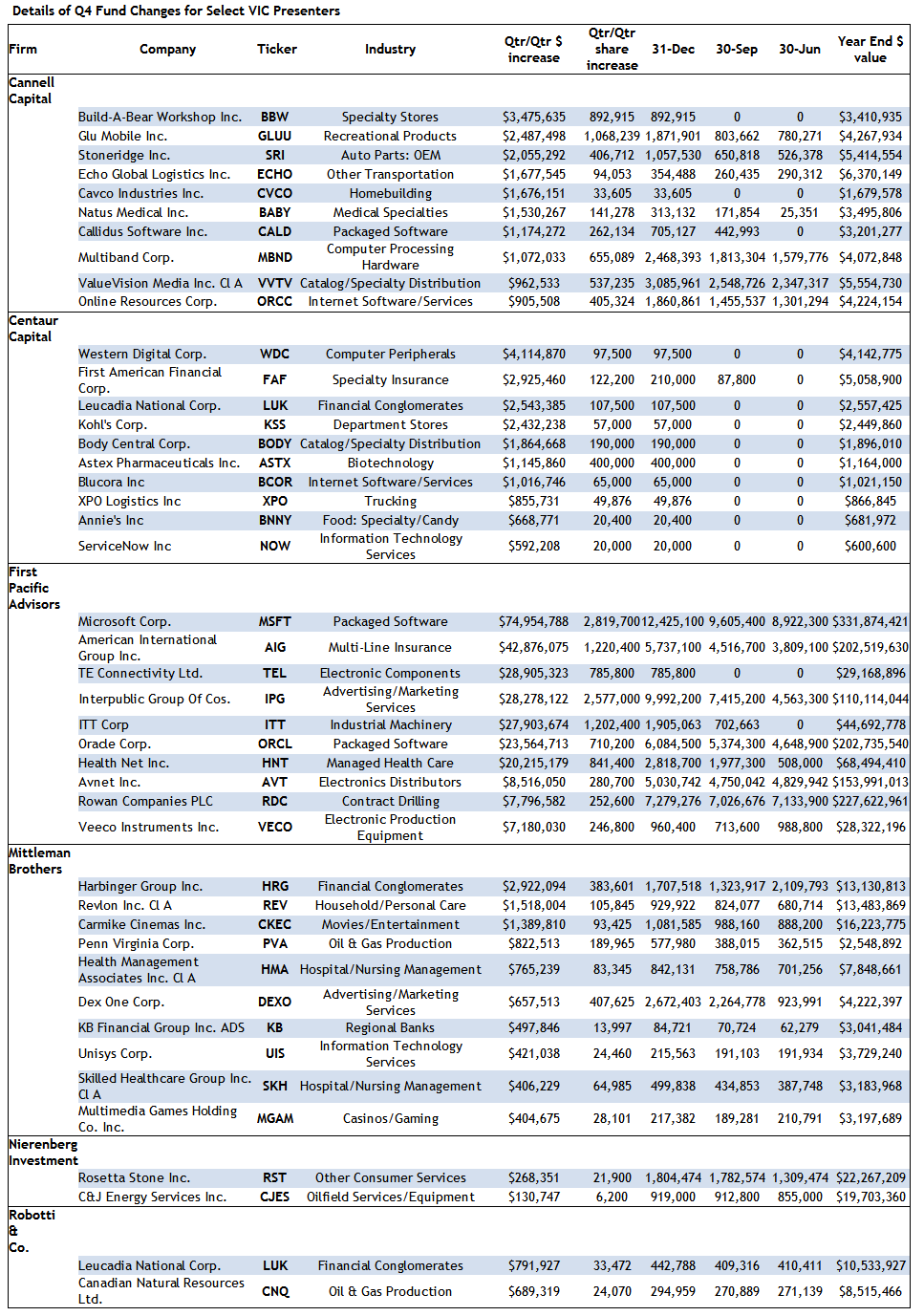
Briefing.com has provided a fantastic spreadsheet showing a few of the changes in the portfolios of several notable presenters at this spring’s Value Investing Congress. (Click to enlarge.)

Briefing.com VIC Portfolios

The organizers expect the Congress to sell out, so intending participants are encouraged to register early. Those who sign up by Monday, March 18th will save $1,400. Go to www.ValueInvestingCongress.com/Greenbackd and use discount code is S13GB7.

Read Full Post »

In a new paper, Using Maximum Drawdowns to Capture Tail Risk, my Quantitative Value co-author Wes Gray and Jack Vogel propose a new easily measurable and intuitive tail-risk measure that they call “maximum drawdown.” Maximum drawdown is the maximum peak-to-trough loss across a time series of compounded returns. From the abstract:

We look at maximum drawdowns to assess tail risks associated with market neutral strategies identified in the academic literature. Our evidence suggests that academic anomalies are not anomalous: all strategies endure large drawdowns at some point in the time series. Many of these losses would trigger margin calls and investor withdrawals, forcing an investor to liquidate.

The authors apply their maximum drawdown metric to existing studies, for example, momentum anomaly originally outlined in Jegadeesh and Titman (1993) to demonstrate why maximum drawdown adds to the analyses:

Jegadeesh and Titman claim large alphas associated with long/short momentum strategies over the 1965 to 1989 time period. What these authors fail to mention is that the long/short strategy endures a 33.81% holding period loss from July 1970 until March 1971. When we look out of sample from 1989 to 2012, there is still significant alpha associated with the long/short momentum strategy, but the strategy endures an 86.05% loss from March 2009 to September 2009. An updated momentum study reporting alpha estimates would claim victory, an investor engaged in the long/short momentum strategy would claim bankruptcy. Tail risk matters to investors and it should matter in empirical research.

Gray and Vogel examine maximum drawdowns for eleven long/short academic anomalies:

When looking at the worst drawdown in the history of the long/short return series, we find that 6 of the 11 strategies have maximum drawdowns of more than 50%. The Oscore, Momentum, and Return on Assets, endure maximum drawdowns of 83.50%, 86.05% and 84.71%, respectively! These losses would trigger immediate margin calls and liquidations from brokers. We do find that Net Stock Issuance and Composite Issuance limit maximum drawdowns, with maximum drawdowns of 29.23% and 26.27%, respectively. If a fund employed minimal leverage, a fund implementing these strategies would likely survive a broker liquidation scenario.

In addition to broker margin calls and liquidations, investment managers face liquidation threats from their investors. Liquidations occur for two primary reasons: there are information asymmetries between investors and investment managers, and 2)investors rely on past performance to ascertain expected future performance (Shleifer and Vishny (1997)). To understand the potential threat of liquidation from outside investors, we examine the performance of the S&P 500 during the maximum drawdown period and the twelve month drawdown period for each of our respective academic anomalies. In 9/11 cases, the S&P 500 has exceptional performance during the largest loss scenarios for the value-weighted long/short strategies. In the case of the Net Stock Issuance and the Composite Issuance anomaly—the long/short strategies with the most reasonable drawdowns—the S&P 500 returns 56.40% and 49.46% during the respective drawdown periods. One can conjecture that investors would find it difficult to maintain discipline to a long/short strategy when they are underperforming a broad equity index by over 75%. Stories about the benefits of “uncorrelated alpha” can only go so far.

Gray and Vogel find that maximum drawdown events are often followed by exceptional performance for the strategy examined:

One prediction from this story is that returns to long/short anomalies are high following terrible performance. We test this prediction in Table 5. We examine the returns on the 11 academic anomalies following their maximum drawdown event. We compute three-, six-, and twelve-month compound returns to the long/short strategies immediately following the worst drawdown. The evidence suggests that performance following a maximum drawdown event is exceptional. All the anomalies experience strong positive returns over three-, six-, and twelve-month periods following the drawdown event.

Read Using Maximum Drawdowns to Capture Tail Risk.

Read Full Post »
One of my favorite Benjamin Graham quotes:

Chairman: … One other question and I will desist. When you find a special situation and you decide, just for illustration, that you can buy for 10 and it is worth 30, and you take a position, and then you cannot realise it until a lot of other people  decide it is worth 30, how is that process brought about – by advertising, or what happens? (Rephrasing) What causes a cheap stock to find its value?

Graham: That is one of the mysteries of our business, and it is a mystery to me as well as to everybody else. [But] we know from experience that eventually the market catches up with value.

Benjamin Graham
Testimony to the Committee on Banking and Commerce
Sen. William Fulbright, Chairman
(11 March 1955)

Read Full Post »

Last May in How to beat The Little Book That Beats The Market: An analysis of the Magic Formula I took a look at Joel Greenblatt’s Magic Formula, which he introduced in the 2006 book The Little Book That Beats The Market (now updated to The Little Book That (Still) Beats the Market).

Wes and I put the Magic Formula under the microscope in our book Quantitative Value. We are huge fans of Greenblatt and the Magic Formula, writing in the book that Greenblatt is Benjamin Graham’s “heir in the application of systematic methods to value investment”.

The Magic Formula follows the same broad principles as the simple Graham model that I discussed a few weeks back in Examining Benjamin Graham’s Record: Skill Or Luck?. The Magic Formula diverges from Graham’s strategy by exchanging for Graham’s absolute price and quality measures (i.e. price-to-earnings ratio below 10, and debt-to-equity ratio below 50 percent) a ranking system that seeks those stocks with the best combination of price and quality more akin to Buffett’s value investing philosophy.

The Magic Formula was born of an experiment Greenblatt conducted in 2002. He wanted to know if Warren Buffett’s investment strategy could be quantified. Greenblatt read Buffett’s public pronouncements, most of which are contained in his investment vehicle Berkshire Hathaway, Inc.’s Chairman’s Letters. Buffett has written to the shareholders of Berkshire Hathaway every year since 1978, after he first took control of the company, laying out his investment strategy in some detail. Those letters describe the rationale for Buffett’s dictum, “It’s far better to buy a wonderful company at a fair price than a fair company at a wonderful price.” Greenblatt understood that Buffett’s “wonderful-company-at-a-fair-price” strategy required Buffett’s delicate qualitative judgment. Still, he wondered what would happen if he mechanically bought shares in good businesses available at bargain prices. Greenblatt discovered the answer after he tested the strategy: mechanical Buffett made a lot of money.

Wes and I tested the strategy and outlined the results in Quantitative Value. We found that Greenblatt’s Magic Formula has consistently outperformed the market, and with lower relative risk than the market. Naturally, having found something not broke, we set out to fix it, and wondered if we could improve on the Magic Formula’s outstanding performance. Are there other simple, logical strategies that can do better? Tune in soon for Part 2.

Read Full Post »

Update 3: I’m reliably informed that the Value Investing Forum run by Stig and Preston at The Investors Podcast is also a good location.

Update 3: We’ve set up a forum at The Acquirer’s Multiple® along with a free deep value stock screener.

Update 2: I think the Corner of Berkshire or the Reddit Security Analysis threads are money. I’m leaning towards Reddit because it’s free, but shout me down. I’m going to stick the link into the menu at the top of the page and then loiter there.

Update: I’d also like to hear your thoughts on the best forums (on any subject) from which I can shamelessly steal.

Folks, I’d like to hear your opinions on the best value investing forums on the web. The bigger the community, the more frequent the posting, and the freer the better. If none exist, then I plan to set one up.

Buy my book The Acquirer’s Multiple: How the Billionaire Contrarians of Deep Value Beat the Market from on Kindlepaperback, and Audible.

Here’s your book for the fall if you’re on global Wall Street. Tobias Carlisle has hit a home run deep over left field. It’s an incredibly smart, dense, 213 pages on how to not lose money in the market. It’s your Autumn smart read. –Tom Keene, Bloomberg’s Editor-At-Large, Bloomberg Surveillance, September 9, 2014.

Click here if you’d like to read more on The Acquirer’s Multiple, or connect with me on Twitter, LinkedIn or Facebook. Check out the best deep value stocks in the largest 1000 names for free on the deep value stock screener at The Acquirer’s Multiple®.

Read Full Post »

From Montier’s most recent piece, Hyperinflations, Hysteria, and False Memories (.pdf) (via GMO):

In the past, I’ve admitted to macroeconomics being one of my dark, guilty pleasures. To some “value” investors this seems like heresy, as Marty Whitman¹ once wrote, “Graham and Dodd view macro factors . . . as crucial to the analysis of a corporate security. Value investors, however, believe that macro factors are irrelevant.” I am clearly a Graham and Doddite on this measure (and most others as well). I view understanding the macro backdrop (N.B. not predicting it, as Ben Graham said, “Analysis of the future should be penetrating rather than prophetic.”) as one of the core elements of risk management.

¹. Martin J. Whitman, Value Investing: A Balanced Approach, John Wiley & Sons, 1999.

Read Full Post »

Robert Prechter’s prediction of a 100-year bear market reminds of this great story told in the introduction to my 2003 copy of Philip A. Fisher’s Common Stocks and Uncommon Profits and Other Writings. Phil’s son Kenneth L. Fisher recounts a story about his father that has stuck with me since I first read it. For me, it speaks to Phil Fisher’s eclectic genius, and quirky sense of humor:

But one night in the early 1970’s, we were together in Monterey at one of the first elaborate dog-and-pony shows for technology stocks – then known as “The Monterey Conference” – put on by the American Electronics Association. At the Monterey Conference, Father exhibited another quality I never forgot. The conference announced a dinner contest. There was a card at each place setting, and each person was to write down what he or she thought the Dow Jones Industrials would do the next day, which is, of course, a silly exercise. The cards were collected. The person who came closest to the Dow’s change for the day would win a mini-color TV (which were hot new items then). The winner would be announced at lunch the next day, right after the market closed at one o’clock (Pacific time). Most folks, it turned out, did what I did – wrote down some small number, like down or up 5.57 points. I did that assuming that the market was unlikely to do anything particularly spectacular because most days it doesn’t. Now in those days, the Dow was at about 900, so 5 points was neither huge nor tiny. That night, back at the hotel room, I asked Father what he put down; and he said, “Up 30 points,” which would be more than 3 percent. I asked why. He said he had no idea at all what the market would do; and if you knew him, you knew that he never had a view of what the market would do on a given day. But he said that if he put down a number like I did and won, people would think he was just lucky – that winning at 5.57 meant beating out the guy that put down 5.5 or the other guy at 6.0. It would all be transparently seen as sheer luck. But if he won saying, “up 30 points,” people would think he knew something and was not just lucky. If he lost, which he was probable and he expected to, no one would know what number he had written down, and it would cost him nothing. Sure enough, the next day, the Dow was up 26 points, and Father won by 10 points.

When it was announced at lunch that Phil Fisher had won and how high his number was, there were discernable “Ooh” and “Ahhhh” sounds all over the few-hundred-person crowd. There was, of course, the news of the day, which attempted to explain the move; and for the rest of the conference, Father readily explained to people a rationale for why he had figured out all that news in advance, which was pure fiction and nothing but false showmanship. But I listened pretty carefully, and everyone he told all that to swallowed it hook, line, and sinker. Although he was socially ill at ease always, and insecure, I learned that day that my father was a much better showman than I had ever fathomed. And, oh, he didn’t want the mini-TV because he had no use at all for change in his personal life. So he gave it to me and I took it home and gave it to mother, and she used it for a very long time.

Common Stocks and Uncommon Profits and Other Writings is, of course, required reading for all value investors.

Read Full Post »

In March 1976 a Mr. Hartman L. Butler, Jr., C.F.A. sat down for an hour long interview with Benjamin Graham in his home in La Jolla, California. Hartman recorded the discussion on his cassette tape recorder, and transcribed it into the following document. There are many great insights from Graham. Here are several of the best parts:

On the GEICO disaster unfolding at the time: 

It makes me shudder to think of the amounts of money they were able to lose in one year. Incredible! It is surprising how many of the large companies have managed to turn in losses of $50 million or $100 million in one year, in these last few years. Something unheard of in the old days. You have to be a genius to lose that much money.

On changes in his investment methodology, a subject we cover in detail in Quantitative Value:

I have lost most of the interest I had in the details of security analysis which I devoted myself to so strenuously for many years. I feel that they are relatively unimportant, which, in a sense, has put me opposed to developments in the whole profession. I think we can do it successfully with a few techniques and simple principles. The main point is to have the right general principles and the character to stick to them.

I have a considerable amount of doubt on the question of how successful analysts can be overall when applying these selectivity approaches. The thing that I have been emphasizing in my own work for the last few years has been the group approach. To try to buy groups of stocks that meet some simple criterion for being undervalued-regardless of the industry and with very little attention to the individual company. My recent article on three simple methods applied to common stocks was published in one of your Seminar Proceedings.

I am just finishing a 50-year study-the application of these simple methods to groups of stocks, actually, to all the stocks in the Moody’s Industrial Stock Group. I found the results were very good for 50 years. They certainly did twice as well as the Dow Jones. And so my enthusiasm has been transferred from the selective to the group approach. What I want is an earnings ratio twice as good as the bond interest ratio typically for most years. One can also apply a dividend criterion or an asset value criterion and get good results. My  research indicates the best results come from simple earnings criterions.

We looked at the performance of Graham’s simple strategy in Quantitative Value. For more see my overview piece, Examining Benjamin Graham’s Record: Skill Or Luck?

Hat tip to Tim Melvin @timmelvin

Buy my book The Acquirer’s Multiple: How the Billionaire Contrarians of Deep Value Beat the Market from on Kindlepaperback, and Audible.

Here’s your book for the fall if you’re on global Wall Street. Tobias Carlisle has hit a home run deep over left field. It’s an incredibly smart, dense, 213 pages on how to not lose money in the market. It’s your Autumn smart read. –Tom Keene, Bloomberg’s Editor-At-Large, Bloomberg Surveillance, September 9, 2014.

Click here if you’d like to read more on The Acquirer’s Multiple, or connect with me on Twitter, LinkedIn or Facebook. Check out the best deep value stocks in the largest 1000 names for free on the deep value stock screener at The Acquirer’s Multiple®.

Read Full Post »

Abnormal Returns’ Tadas Viskanta has posted a great interview with my Quantitative Value co-author, the Turnkey Analyst Wes Gray:

AR: You write in the book that there are two arguments for value investing: “logical and empirical.” It seems like the value investing community heavily emphasizes the former as opposed to the latter. Why do you think that is?

WG: Human beings tend to favor good stories over evidence, but this can lead to problems. As Mark Twain says, “All you need is ignorance and confidence and the success is sure.”

This tendency to embrace stories might help explain why being “logical” is more heavily relied upon by investors, – good logic makes as good story. Relying on the evidence, or being “empirical,” is under appreciated because it is sometimes counterintuitive.  I’m actually a big fan of a logical story backed by empirical data. This is the essence of our book Quantitative Value. We present a compelling story on the value investment philosophy, but at each step along our journey we pepper our analysis with empirical analysis and academic rigor.

AR: You note in the book the importance of Ben Graham and how a continued application of his “simple value strategy” would still generate profits today. Have you seen the recent video about him? He seems to have been as interesting a guy as he was investor/teacher.

WG: As Toby and I conducted background research for the book, we became more and more convinced that Ben Graham was the original systematic value investor. In Quantitative Value we backtest a strategy Graham suggested in the 1976 Medical Economics Journal titled “The Simplest Way to Select Bargain Stocks.” We show that Graham’s strategy performed just as well over the past 40 years as it did in the 50 years prior to 1976. This is a remarkable “out-of-sample” test and highlights the robustness of a systematic value investment approach.

With respect to your question on the video: the recent video circulating the web reinforces our belief that Graham was an empiricist by nature and relied heavily on the scientific method to make his decisions. I also find it interesting that his discussions are so focused on the fallibility of human decision-making ability. Many of the ideas and concepts Graham mentioned regarding human behavior have been backed by behavioral finance studies written the past 20 years. He was well ahead of his time.

AR: The value community loves to continue to claim Warren Buffett as a disciple. However today he would be best described as a “quality and price” investor more than anything. What is the relevance of how Warren Buffett’s approach to investing has changed over time?

WG: The irony here is that, on average, Warren Buffett’s “new” approach to value investing is inferior to the approach originally described by Ben Graham. Buffett describes an approach that is broader in perspective and allows an investor to move along the cheapness axis to capture high quality firms. Graham, who studied the actual data, was much more focused on absolute cheapness. This concept is highlighted in many of his recommended investment approaches, where the foundation of the strategy prescribed is to simply purchase stocks under a specific price point (e.g., P/E <10).

After studying data from the post-Graham era, we have come to the same conclusion as Graham: cheapness is everything; quality is a nice-to-have. For example, the risk-adjusted returns on the higher-priced, but very high quality firms (i.e., Buffett firms) are much worse on a risk-adjusted basis than the returns on a basket of the cheapest firms that are of extreme low quality (i.e., Graham cigar butts). In the end, if you aren’t exclusively digging in the bargain bin, you’re missing out on potential outperformance.

Read the rest of the interview here. As Tadas says, the answers are illuminating.

For more on Quantitative Value, read my overview here.

Read Full Post »

Last week I wrote about the performance of one of Benjamin Graham’s simple quantitative strategies over the 37 years he since he described it (Examining Benjamin Graham’s Record: Skill Or Luck?). In the original article Graham proposed two broad approaches, the second of which we examine in Quantitative Value: A Practitioner’s Guide to Automating Intelligent Investment and Eliminating Behavioral Errors. The first approach Graham detailed in the original 1934 edition of Security Analysis (my favorite edition)—“net current asset value”:

My first, more limited, technique confines itself to the purchase of common stocks at less than their working-capital value, or net-current asset value, giving no weight to the plant and other fixed assets, and deducting all liabilities in full from the current assets. We used this approach extensively in managing investment funds, and over a 30-odd year period we must have earned an average of some 20 per cent per year from this source. For a while, however, after the mid-1950’s, this brand of buying opportunity became very scarce because of the pervasive bull market. But it has returned in quantity since the 1973–74 decline. In January 1976 we counted over 300 such issues in the Standard & Poor’s Stock Guide—about 10 per cent of the total. I consider it a foolproof method of systematic investment—once again, not on the basis of individual results but in terms of the expectable group outcome.

In 2010 I examined the performance of Graham’s net current asset value strategy with Sunil Mohanty and Jeffrey Oxman of the University of St. Thomas. The resulting paper is embedded below:

While Graham found this strategy was “almost unfailingly dependable and satisfactory,” it was “severely limited in its application” because the stocks were too small and infrequently available. This is still the case today. There are several other problems with both of Graham’s strategies. In Quantitative Value: A Practitioner’s Guide to Automating Intelligent Investment and Eliminating Behavioral Errors Wes and I discuss in detail industry and academic research into a variety of improved fundamental value investing methods, and simple quantitative value investment strategies. We independently backtest each method, and strategy, and combine the best into a sample quantitative value investment model.

The book can be ordered from Wiley FinanceAmazon, or Barnes and Noble.

[I am an Amazon Affiliate and receive a small commission for the sale of any book purchased through this site.]

Read Full Post »

« Newer Posts - Older Posts »