Feeds:
Posts
Comments

Archive for the ‘About’ Category

Business Week has an article, Fighting takeovers by playing the debt card, describing Amylin Pharmaceuticals Inc.’s (NASDAQ:AMLN) attempts to fend off Carl Icahn through the use of a “Poison Put.” A poison put is a change-of-control debt covenant the effect of which is to require the borrower to pay back an outstanding loan if investors buy a sufficiently large stake in the company or elect a slate of directors. In this case, AMLN says it would be forced to pay back a $125M loan if Icahn’s slate gets control of its board, which could in turn cause it to default on up to $900M in debt. That makes AMLN an unpalatable activist target.

Business Week says the covenant is the “choice du jour” for an increasing number of companies seeking to avoid the attention of activists and raiders:

Many companies have such change of control covenants in their bond or loan agreements, among them J.C. Penney (JCP), Kroger (KR), Ingersoll-Rand (IR), and Dell (DELL). That’s not to say they would use them to ward off an Icahn. Nor is it clear how many companies are using these covenants to do so. But shareholder activists have little doubt that they have become a takeover defense. “[These change of control provisions] are designed to deter a proxy fight,” says Chris Young, director of mergers and acquisitions research for the shareholder advisory firm RiskMetrics Group (RMG).

Change in control provisions are nothing new. In fact they are a standard condition in most loan agreements:

Change of control provisions first began appearing in 1980 when corporate raiders started taking over companies and loading them up with debt. Concerned that these companies would be unable to pay back their loans, lenders insisted on covenants requiring them to repay their original lenders. These provisions became fashionable again during the private equity boom of recent years. Now, with credit tight, they have become a potent deterrent to corporate raiders leery of being forced to repay a company’s debt and then refinance the loans at higher rates.

What is new, however, is companies actively seeking the inclusion of such a covenant as a device to fend off a suitor, as Lions Gate Entertainment Corp. (USA) (NYSE:LGF) and Exelon Corporation (NYSE:EXC) seemed to do recently:

When JPMorgan Chase (JPM) extended Lions Gate’s revolving line of credit last year, the terms included a provision that triggers instant repayment if an investor buys more than 20% of the company’s stock. Since then Icahn has acquired 14% of Lions Gate. In late March, Lions Gate “strongly urged” investors-while taking no formal position-to scrutinize an offer by Icahn to buy $316 million in debt. (He could convert it into stock and boost his ownership stake.) In the same letter, Lions Gate, without mentioning Icahn, said it could be forced to repay both its bank debt and notes.

In another case, the giant electric utility Exelon (EXC) wants to buy rival NRG Energy (NRG) for $5 billion and is waging a proxy battle to elect nine members to NRG’s board. In a letter to shareholders, NRG warned that such an outcome would trigger “an acceleration” of its $8 billion of debt. Exelon General Counsel William A. Von Hoene Jr. counters that NRG is “using the debt issue as a threat” to scare off NRG’s shareholders from considering its bid.

AMLN shareholders aren’t taking it lying down. The San Antonio Fire & Police Pension Fund, an AMLN investor, has sued the company for agreeing to the poison put about the time takeover speculation began in 2007. For its part, AMLN says it has since tried unsuccessfully to get bondholders to waive a provision blocking outsiders from taking over the board and has asked its bankers for a similar waiver. Steven M. Davidoff, The Deal Professor, has a superb analysis of the issues in his NYTimes.com DealBook column, Icahn, Amylin and the New Nuances of Activist Investing. Says Davidoff:

The pension fund’s claim is mainly that these poison put provisions are void. In support of this claim, the plaintiff appears to be arguing that the provision violates the Unocal standard in Delaware, which requires that director action in response to a threat to the corporation not be coercive vis-à-vis stockholders.

In addition, the plaintiff claims that the poison put provisions violate Section 141(a) of the Delaware General Corporation Law which requires that the business and affairs of a Delaware corporation be run by the board. Here, the plaintiff claims that the poison put provisions hinder the board’s exercise of its fiduciary duties to ensure a free and fair election, since the directors cannot approve all nominees for election.

The more problematic issue is with the language in the credit agreement for the term loan. … [If] in a two-year period the board changes control due to a proxy contest, the provision is triggered. The actions of Mr. Icahn and Eastbourne, if successful, would do the trick.

So, we are left with the issue of whether this provision violates Unocal. The answer is likely no. Delaware has broadly interpreted the doctrine, and here there is an opening for a change of control to occur – it will just take two years. This conceivably could be only two proxy contests, and therefore I suspect will likely not be found coercive. After all if Delaware tolerates staggered boards, why wouldn’t it tolerate a provision which has a similar effect?

Shareholder activist Nell Minow says companies shouldn’t use the poison put if their object is to disenfranchise stockholders:

These are shareholder rights that can’t be negotiated away by someone else.

We agree. Unfortunately, as Davidoff points out, lenders do have legitimate reasons for asking for such a provisions: they want to know who they are dealing with. This means that lenders will keep proposing poison puts and boards will “avoid resisting” them because they deter shareholder activism.

Read Full Post »

You may have noticed that the frequency with which we post new ideas on this site has slowed somewhat over the last month or so. Our earlier ideas are generally up substantially, but that’s nothing to crow about given that the market as a whole, after falling 56.8% from its peak, is up 24.4% from its trough. Anyone who thinks that the bounce means that the current bear market is over would do well to study the behavior of bear markets past (quite aside from simply looking at the plethora of data about the economy in general, the cyclical nature of long-run corporate earnings and price-earnings multiples over the same cycle). They might find it a sobering experience.

CalculatedRisk has an ongoing series of graphs from Doug Short showing how the current bear market compares to three other bear markets: the Dow Crash of 1929 (1929-1932), the Oil Crisis (1973-1974) and the Tech Wreck (2000-2002) (click for a larger version from dshort.com via CalculatedRisk):

four-bad-bears

The current bear market has been deeper and faster than either the Oil Crisis or the Tech Crash, but it really pales into insignificance beside the Dow Crash of 1929 (maybe not insignificance, but you get the picture. If this was the Dow Crash of 1929 we’d have another third to go). We’re not sure what one can deduce from the graphs, other than several big (>20-30%) rallies in the middle of a bad bear market is nothing unusual and there’s no obvious price behavior that heralds the end of a bear market. We think it’s worth keeping in mind.

Read Full Post »

In a post last week, Tracking our portfolio performance with Tickerspy, we mentioned that we were using Tickerspy to track our portfolio. We said that we like Tickerspy because it tracks the performance of each stock in the portfolio and the portfolio performance against the S&P500 and automatically updates it all on a daily basis. We wrote in the post, “It’s almost there, but Tickerspy is not entirely satisfactory. Ideally, we’d like a widget for the site that does all of this and doesn’t require our readers to open an account.” In a world of faceless bureaucracies, it’s rare to find a business that’s responsive to the needs of its customers, so we thought we’d mention the email that we’ve received from C. Max Magee at Tickerspy:

Hi,

I helped create and now run tickerspy, and I saw from a recent post at greenbackd that you are trying out tickerspy for tracking your portfolio.

You are probably aware of this, but your readers who aren’t registered with tickerspy will be able to see everything on your tickerspy portfolio page except the graph and the similar portfolios. This means that, even when not logged in, they’ll be able to see the daily, one-month, and all-time actual returns and returns relative to the S&P 500. So, at the very least, the numbers will be available to your readers even if they haven’t registered with tickerspy. (Of course, there are lots of benefits to registering for free at tickerspy. They can create their own portfolios, more easily track the greenbackd portfolio moves, etc.)

We do like the idea of an embeddable portfolio graph widget and it’s something we’ve been exploring. We’ll keep you posted on our progress there, and please let us know if there are any other tools that we might be able to offer that might be useful to you at greenbackd or just as an investor.

Best,

Max

Thanks, Max. Tickerspy has gone up immeasurably in our estimation. We look forward to seeing the “embeddable portfolio graph widget” and we’ll continue to support you as long as you continue to treat your customers this well.

Read Full Post »

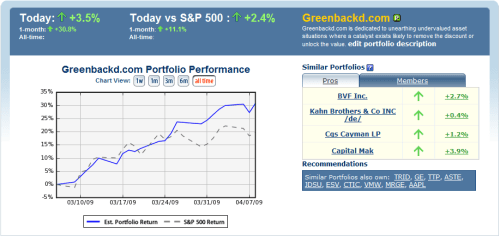
We’ve been tracking our performance using Tickerspy. You can see our up-to-date portfolio and performance here (You’ll need to set up an account with Tickerspy, which is free). We’re providing the link to the Tickerspy account so that you don’t need to wait for our quarterly report to see how the Greenbackd Portfolio is performing. For those who don’t want to set up a Tickerspy account, here’s a screen grab showing our performance since we opened our account on March 6, 2009 through April 8, 2009 (The usual caveat applies: one month is too short a period of time to determine whether Greenbackd’s strategy is working.):

tickerspy

We’re using Tickerspy because it tracks the performance of each stock in the portfolio and the portfolio performance against the S&P500 and automatically updates it all on a daily basis. It’s almost there, but Tickerspy is not entirely satisfactory. Ideally, we’d like a widget for the site that does all of this and doesn’t require our readers to open an account. We haven’t found anything like that yet. Does anyone have any suggestions for a service like this? If so, please drop us a line at greenbackd [at] gmail [dot] com or leave a comment below.

Read Full Post »

In an article on his Breakout Performance blog, Activist Investors Sidelined by Brutal Market, Dr. Eric Jackson gives some advice to the next generation of activist investors. Jackson is the founder of Ironfire Capital, an activist fund manager that uses “Internet-based social networking tools to gather information and amplify the impact of current focus campaigns,” and is perhaps best known for his campaign against Yahoo! Inc (NASDAQ:YHOO). Jackson believes that, to be successful, the next generation of activists must do the following:

  1. Hedge, in order to preserve partner capital in the event of terrible years like 2008. The days of long-only are over.
  2. Build a reputation for always doing right for shareholders (especially long-term holders). Some of the “quick fix” activists of the last five years never won the trust of large mutual funds and pension funds, who tend to be the biggest holders of stock of the large-cap companies. As a result, proxy contests failed to win over the support of this important constituency, for fear of how these activists would represent their interests properly.
  3. Focus more on strategy and operations, less on single events. There will always be a place for activist investors to go after a company, advocating they sell a single division, or do a quick dividend to shareholders. However, these situations tend to be more prevalent in small-cap companies. Large-cap companies, by definition, have more complex problems and require more complex solutions. The next generation of top activists will understand this and have deep expertise in their firms on strategy and operations.
  4. Use the tools of the Internet and social networking. In 2007, when I ran a successful activist campaign against Yahoo!, which resulted in unseating Terry Semel as CEO after a large “no” vote at the annual meeting, I owned 96 shares of Yahoo! However, I was able to get my message out to large and small shareholders via my blog, YouTube, wikis, Facebook and Twitter. More than calling attention to my ideas, these social networking tools allowed fellow shareholders to pledge support to my group and encouraged them to suggest additional ideas for how Yahoo! could improve. I was most surprised and pleased with how many existing Yahoo! employees participated. Yet, their interests were perfectly aligned with our groups: We were all stockholders of Yahoo! and wanted to see the stock price go up through needed changes, which the current board and management were not making. The next generation of large activist investors will be masters at using the Internet to conduct their campaigns.
  5. Be more collaborative, less combative with target companies. It will always be necessary to run successful — sometimes nasty — proxy contests against entrenched boards and management. In my opinion, the Yahoo! board, for example, will never respond to a “nice guy” activist approach. It is so entrenched and disconnected from the opinions of shareholders that it would be impossible to reason with them. There’s a time to knock heads. However, some activists only knock heads. They only know how to hit one key on the piano. The next generation of activist investors will be able to play hard ball but tend to be much more collaborative with the board and the CEO — at least at the beginning, until reasonable dialog leads nowhere. Such an approach is also far less expensive than an “all-negative, all-the-time” approach.

Jackson makes an interesting point. A full blown proxy battle is prohibitively expensive for all but the very biggest stockholders (and even then it is an unappetizing prospect if it will materially reduce returns). If regulatory reform makes nominating directors a simpler and cheaper process – which the SEC’s proposed “proxy access” rules do – then the “tools of Internet and social networking” become potent weapons that act to level the playing field for the smaller investor. Such a change could create a new generation of web-savvy micro activists, who control only a handful of shares but understand how to use social networking media to influence boards, much like Jackson does with Ironfire Capital and his blog. But with a small capital base, how does Jackson make the campaign worth his while? In other words, how does he get paid?

Read Full Post »

Empirical Finance Research Blog has a review of a new paper, Repurchases, Reputation, and Returns, which finds that long-run stock returns are higher for companies announcing buybacks that had substantially completed a previous buyback. In other words, companies with a track record for following through on announced buybacks enjoy higher returns following a subsequent buyback announcement than companies that did not follow through on a previously announced buyback. While that might seem obvious, the paper makes two observations that we find particularly interesting in the context of our investment strategy:

  1. Past buyback completion rates are predictive of future buyback completion rates.
  2. Stocks with high completion rates but low stock returns following previous buybacks enjoy abnormally large returns following a subsequent buyback announcement.

It’s worth remembering that a buyback announcement does not bind a company to undertake a buyback, a situation we encountered recently: RACK suspends buyback and enters agreement to acquire Silicon Graphics; Greenbackd exits position. Companies frequently fail to follow through on announced repurchase plans. Empirical Finance Research cites a 1998 study by Stephens and Weisbach that found that firms on average repurchase only about 80% of the sum announced.

Empirical Finance Research summarizes the paper as follows:

This author measures the level of completion of previous buybacks, as measured by the shares bought as a fraction of the amount specified in the announcement, then uses this to explain how well various stocks do after subsequent buyback announcements. What she finds is that companies that had low completion rates on a previous share buyback experience much lower returns upon the announcement of another buyback. She interprets this as evidence of the company’s credibility, that investors don’t really believe a company about a share buyback when the company has failed to complete one in the past.

First the author confirms that past buyback completion rates are predictive of future buyback completion rates. Next she shows that the stock returns to a company making a buyback announcement are much higher for those with high past completion rates. Companies in the 90th percentile of past completion rate see returns 2.5% higher than those in the 10th percentile of past completion rate in the three days after a the new announcement.

Despite the size of these returns, this isn’t a very good trading strategy, because buyback announcements are clearly unexpected. However, in the next part of the paper the author finds that long-run returns are also reliably higher for repeat buyback companies with high past completion rates. Two year returns are 13.64% for those companies with above-median past completion rates versus 7.43% for those below the median. We should be leery of these results, however as they are not statistically significant.

Next the author splits her sample of repeat buyback companies into quintiles based on the return to the stock during the previous buyback. The two-year abnormal returns to companies in the lowest quintile (those with the lowest returns after their last buyback) are 17.33% after their subsequent buyback. This result is very statistically significant too.

But if we split this quintile in half based on past completion rates, and buy only those stocks with above-median past completion rate, the returns explode to 27.13% for the two year period.

Empirical Research Blog’s takeaway?

The value of this paper is not necessarily in a specific investment strategy but rather in the insight it provides in to a trading strategy we already knew about. I would be hesitant to implement this stand-alone for the practical difficulty in doing so. But any trading strategy that already uses share buybacks as a signaling factor might benefit from an augmentation that accounts for past buyback completion rate.

(Emphasis added)

Quite.

Read Full Post »

Tweedy Browne, the deep value investment firm established in 1920, has updated its booklet, What Has Worked In Investing (.pdf). First published in 1992 and now updated for 2009, the booklet discusses over fifty academic studies of investment criteria that have produced high rates of investment return. Our interest in the booklet stems from its examination of a group of investment styles falling under the rubric, “Assets bought cheap,” in particular, Benjamin Graham’s “Net current asset value” method and the “Low price to book value” method.

Graham’s “Net current asset value” method

Says Tweedy Browne of Graham’s “Net current asset value” method:

The net current asset value approach is the oldest approach to investment in groups of securities with common selection characteristics of which we are aware. Benjamin Graham developed and tested this criterion between 1930 and 1932. The net current assets investment selection criterion calls for the purchase of stocks which are priced at 66% or less of a company’s underlying current assets (cash, receivables and inventory) net of all liabilities and claims senior to a company’s common stock (current liabilities, long-term debt, preferred stock, unfunded pension liabilities). For example, if a company’s current assets are $100 per share and the sum of current liabilities, long-term debt, preferred stock, and unfunded pension liabilities is $40 per share, then net current assets would be $60 per share, and Graham would pay no more than 66% of $60, or $40, for this stock. Graham used the net current asset investment selection technique extensively in the operations of his investment management business, Graham-Newman Corporation, through 1956. Graham reported that the average return, over a 30-year period, on diversified portfolios of net current asset stocks was about 20% per year

The booklet discusses a study conducted by Henry Oppenheimer, an Associate Professor of Finance at the State University of New York at Binghamton, in which he examined the returns of such stocks over a 13-year period from December 31, 1970 through December 31, 1983. Oppenheimer’s study assumed that all stocks meeting the investment criterion were purchased on December 31 of each year, held for one year, and replaced on December 31 of the subsequent year by stocks meeting the same criterion on that date. The total sample size was 645 net current asset selections. The smallest annual sample was 18 companies and the largest was 89 companies.

Oppenheimer’s conclusion about the returns from such stocks was nothing short of extraordinary:

The mean return from net current asset stocks for the 13-year period was 29.4% per year versus 11.5% per year for the NYSE-AMEX Index. One million dollars invested in the net current asset portfolio on December 31, 1970 would have increased to $25,497,300 by December 31, 1983. By comparison, $1,000,000 invested in the NYSE-AMEX Index would have increased to $3,729,600 on December 31, 1983. The net current asset portfolio’s exceptional performance over the entire 13 years was not consistent over smaller subsets of time within the 13-year period. For the three-year period, December 31, 1970 through December 31, 1973, which represents 23% of the 13-year study period, the mean annual return from the net current asset portfolio was .6% per year as compared to 4.6% per year for the NYSE-AMEX Index.

Perhaps most intriguing, though, was Oppenheimer’s conclusion about the relative outperformance of the loss-making stocks over the profitable ones:

The study also examined the investment results from the net current asset companies which operated at a loss (about one-third of the entire sample of companies) as compared to the investment results of the net current asset companies which operated profitably. The companies operating at a loss had slightly higher investment returns than the companies with positive earnings: 31.3% per year for the unprofitable companies versus 28.9% per year for the profitable companies.

We believe that Oppenheimer’s study presents a compelling argument for such an investment approach.

Low price in relation to book value

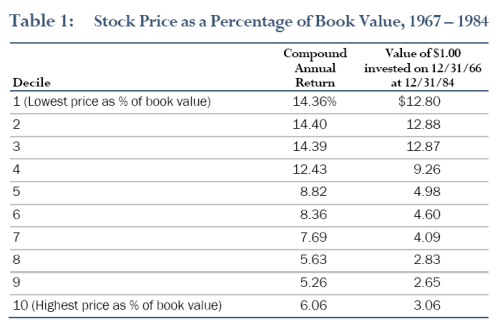
The second investment method falling under the rubric of “Assets bought cheap” is the “Low price in relation to book value” method. The booklet discusses a study conducted by Roger Ibbotson, Professor in the Practice of Finance at Yale School of Management and President of Ibbotson Associates, Inc., a consulting firm specializing in economics, investments and finance. In “Decile Portfolios of the New York Stock Exchange, 1967 – 1984,” Working Paper, Yale School of Management, 1986, Ibbotson studied the relationship between stock price as a proportion of book value and investment returns. To test this relationship, all stocks listed on the NYSE were ranked on December 31 of each year, according to stock price as a percentage of book value, and sorted into deciles. Ibbotson then measured the compound average annual returns for each decile for the 18-year period, December 31, 1966 through December 31, 1984.

Ibbotson found that stocks with a low price-to-book value ratio had significantly better investment returns over the 18-year period than stocks priced high as a proportion of book value. Tweedy Browne set out Ibbotson’s results in the following Table 1:

tweedy-table-1

A second study conducted by Werner F.M. DeBondt and Richard H. Thaler, Finance Professors at University of Wisconsin and Cornell University, respectively, examined stock price in relation to book value in “Further Evidence on Investor Overreaction and Stock Market Seasonality,” The Journal of Finance, July 1987. DeBondt and Thaler ranked all companies listed on the NYSE and AMEX, except companies that were part of the S&P 40 Financial Index, according to stock price in relation to book value and then sorted them into quintiles on December 31 in each of 1969, 1971, 1973, 1975, 1977 and 1979. DeBondt and Thaler then calculated the investment return against the equal weighted NYSE Index over the subsequent four years for all of the stocks in each selection period. The four-year returns against the market index were then averaged.

The stocks in the lowest quintile had an average market price to book value ratio of 0.36 and an average earnings yield (the inverse of the P/E ratio) of 0.10 (indicating a P/E of 10). DeBondt and Thaler found a cumulative average return in excess of the market index over the four years of 40.7%. Meanwhile, the stocks in the highest quintile, those with an average market price to book value ratio of 3.42 and an average earnings yield of 0.147 (a P/E of 6.8), returned 1.3% less than the market index over the four years after portfolio formation.

Perhaps the most striking finding by DeBondt and Thaler, and one that accords with our view about the difficulty of predicting earnings with any degree of accuracy, was the contrast between the earnings pattern of the companies in the lowest quintile (average price/book value of 0.36) and the highest quintile (average price/book value of 3.42). Tweedy Browne set out DeBondt and Thaler’s findings in Table 3 below, which describes the average earnings per share for companies in the lowest and highest quintile of price/book value in the three years prior to selection and the four years subsequent to selection:

tweedy-table-3

In the four years after the date of selection, the earnings of the companies in the lowest price/book value quintile increase 24.4%, more than the companies in the highest price/book value quintile, whose earnings increased only 8.2%. DeBondt and Thaler attribute the earnings outperformance of the companies in the lowest quintile to the phenomenon of “mean reversion,” which Tweedy Browne describes as the observation that “significant declines in earnings are followed by significant earnings increases, and that significant earnings increases are followed by slower rates of increase or declines.”

The booklet continues to discuss Tweedy Browne’s own findings confirming those of the studies described above, and a range of other studies that confirm the findings over different periods of time and in different countries. The findings form a compelling argument for an investment philosophy rooted in deep value and focused on assets, such as Greenbackd’s.

Buy my book The Acquirer’s Multiple: How the Billionaire Contrarians of Deep Value Beat the Market from on Kindlepaperback, and Audible.

Here’s your book for the fall if you’re on global Wall Street. Tobias Carlisle has hit a home run deep over left field. It’s an incredibly smart, dense, 213 pages on how to not lose money in the market. It’s your Autumn smart read. –Tom Keene, Bloomberg’s Editor-At-Large, Bloomberg Surveillance, September 9, 2014.

Click here if you’d like to read more on The Acquirer’s Multiple, or connect with me on Twitter, LinkedIn or Facebook. Check out the best deep value stocks in the largest 1000 names for free on the deep value stock screener at The Acquirer’s Multiple®.

Read Full Post »

Steven M. Davidoff, The Deal Professor, has an analysis of the proxy fight between William. A. Ackman’s Pershing Square Capital and Target Corporation (NYSE:TGT) in his NYTimes.com DealBook column, Target’s Challenge.  Pershing Square has fund dedicated to its investment in TGT, which Davidoff says controls 7.9% of the company through stock and call options. TGT has a staggered board with twelve directors, four of whom are up for reelection for this year’s meeting, which is scheduled for May 28. Pershing Square, claiming that TGT’s board really comprises thirteen members, has submitted a slate comprising five nominees.

Davidoff writes that Pershing Square’s claim of an extra member relates to Robert J. Ulrich’s resignation from the board in January this year:

Pershing contends that, under Target’s articles of incorporation, the board does not automatically shrink as a result of a resignation; rather, a vacancy is created – in this case, a vacancy for a 13th director to be elected this year.

Pershing bases its claim on Article VI of Target’s articles of incorporation. The article states that:

The business and affairs of the corporation shall be managed by or under the direction of a Board of Directors consisting of not less than five nor more than twenty-one persons, who need not be shareholders. The number of directors may be increased by the shareholders or Board of Directors or decreased by the shareholders from the number of directors on the Board of Directors immediately prior to the effective date of this Article VI; provided, however, that any change in the number of directors on the Board of Directors (including, without limitation, changes at annual meetings of shareholders) shall be approved by the affirmative vote of not less than seventy-five percent (75%) of the votes entitled to be cast by the holders of all then outstanding shares of Voting Stock (as defined in Article IV), voting together as a single class, unless such change shall have been approved by a majority of the entire Board of Directors.”

(emphasis added)

Pershing bases its argument on the italicized language, which states that only a 75 percent vote of the shareholders can reduce the size of the board. Target has disputed this claim, presumably relying instead upon the clause after the italicized language, which provides the power to the board to approve the change.

Target is claiming that the clause modifies the entire requirement for shareholder approval. In contrast, I presume that Pershing is claiming that this language modifies only the part about a 75 percent vote requirement, and otherwise a shareholder vote is mandatory. The ambiguity is certainly there, and given the penchant of courts to interpret articles and bylaws against the drafting companies and in favor of the shareholder franchise, Pershing has a viable claim. It would be more certain if Target were incorporated in Delaware, but it is actually incorporated in Minnesota.

Last week, Pershing offered to arbitrate the issue. Instead, Target has simply and rather cleverly put the matter to its shareholders in its proxy filed Monday. Target has ceded the issue to its shareholders, and asserted that because the change has been approved by a majority of the board of directors, it now only needs the affirmative vote of the majority of the outstanding shares of Target common stock voting at a meeting where the quorum requirement is met. Thus, Target has avoided an initial litigation skirmish that it had a real chance of losing, while appearing shareholder-friendly at the same time. A nice trick.

A nice trick indeed. It seems to us that the net effect of TGT’s fancy footwork is to reduce the threshold for the resolution to shrink the board from 75% of the votes entitled to be cast to a simple majority, which could have been their intention all along. As we’ve discussed recently in the context of the Biotechnology Value Fund (BVF) proxy fight for the board of Avigen Inc (NASDAQ:AVGN) (see our post archive here), achieving a supermajority is nigh on impossible. In BVF’s case it was two-thirds, rather than three-quarters, of the votes entitled to be cast. BVF was unable to get over the line, even at that slightly lower threshold, though they held around 30% of AVGN’s stock and therefore only needed the support of a little over half of the other stockholders. We believe that BVF was ultimately unsuccessful because 30% of AVGN’s stockholders neglected to vote at all, and those votes not cast counted for the incumbents. TGT is clearly concerned it might find itself in a similar position. Even though TGT has the distinct advantage of being the incumbent, they clearly recognize that the 75% threshold is improbably high. At such a high threshold, votes not cast can be fatal to the resolution, so they’ve taken measures to reduce the threshold to a simple majority. We think this will still prove too high for the incumbents, but it’s a nice card to play if you have it in your hand to do so. Davidoff notes that only Pershing Square has nominated a fifth director to take office. This means that if the resolution does not pass and TGT’s board remains at thirteen members, one of Pershing Square’s nominees is automatically elected. We’ll watch the outcome with interest.

Read Full Post »

Rackable Systems Inc (NASDAQ:RACK) has filed its 10K for the year ended January 3, 2009.

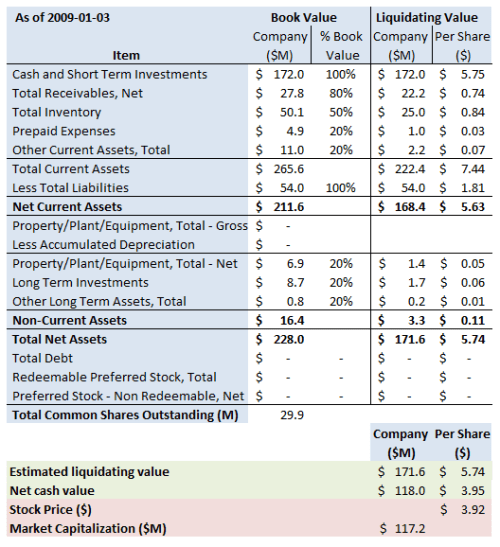
We’ve been following RACK (see our post archive here) because it is an undervalued asset play with a plan to repurchase almost 40% of its stock. The stock is up 10.1% from $3.56 when we added it to the Greenbackd Portfolio on March 11 this year to close yesterday at $3.92. The company now has a market capitalization of $117.2M. We initially estimated the company’s liquidation value to be 46% higher at $171.6M or $5.74 per share. We’ve now had an opportunity to review the 10K and see no reason to vary our initial estimate. If the buy back is completed at the current stock price, the company’s per share liquidation value will increase by 17% to $6.69, which presents considerable upside from the present price.

The value proposition updated

RACK has had a tough year, burning through $15.7M in the 12 months to January 3, 2009. The company’s value resides in the huge amounts of cash and equivalents on its balance sheet, much of which is from the $138.5 million follow-on public offering completed in March 2006. Set out below is our estimate of the company’s liquidation value (the “Book Value” column shows the assets as they are carried in the financial statements, and the “Liquidating Value” column shows our estimate of the value of the assets in a liquidation):

rack-summary-2009-1-3We estimate the company’s liquidation value to be around $171.6M or $5.74 per share, which is predominantly cash and equivalents in the amount of $172M or $5.75 per share. RACK’s net cash value is around $118M or $3.95 per share.

Off balance sheet arrangements and contractual obligations

According to the 10K, the company has no off-balance sheet arrangements. The contractual obligations as at January 3, 2009 were around $17.1M, around $9.5M of which falls due in the next 12 months. Those committments are $2.0M minimum lease payments under the company’s operating leases and $7.5 in purchase obligations. The company also had purchase committments in the amount of $7.6M in total.

Catalyst

According to the 10K, RACK plans to buy back almost $40M of its own stock:

In February 2009, our Board of Directors authorized a share repurchase program of up to $40 million of our common stock. The duration of the repurchase program is open ended. Under the program, we are able to purchase shares of common stock through open market transactions and privately negotiated purchases at prices deemed appropriate by management. The timing and amount of repurchase transactions under this program will depend on market conditions, corporate and regulatory considerations, alternative investment opportunities, and other relevant considerations. The program may be discontinued at any time by the Board of Directors. Shares we repurchase will be held in treasury for general corporate purposes, including issuances under employee equity incentive plans.

Conclusion

We like it when a company recognizes that its stock is deeply undervalued and takes radical action to capitalize on it. If the market is pricing a company’s stock below its liquidation value, the company’s priority should be investing in its own stock. With its stock at $3.92, RACK has a market capitalization of $117.2M, which means it’s trading at a discount to both its net cash value of $118M or $3.95 per share and its liquidation value of $171.6M or $5.74 per share. The cash burn is a risk, but we’re going to retain RACK in the portfolio.

[Full Disclosure:  We do not have a holding in RACK. This is neither a recommendation to buy or sell any securities. All information provided believed to be reliable and presented for information purposes only. Do your own research before investing in any security.]

Read Full Post »

Today we complete our series on Seth Klarman, the founder of The Baupost Group, a deep value-oriented private investment partnership that has generated an annual compound return of 20% over the past 25 years, and the author of an iconic book on value investing, Margin of Safety: Risk-Averse Value Investing Strategies for the Thoughtful Investor

Following on from our earlier posts, Seth Klarman on Liquidation Value, and Seth Klarman on Catalysts, we present Seth Klarman’s application of liquidation value investment principles to a specific case: the City Investment Liquidating Trust (from Chapter 10 Areas of Opportunity for Value Investors: Catalysts, Ineficiences, and Institutional Constraints):

Investing in Corporate Liquidations

Some troubled companies, lacking viable alternatives, voluntarily liquidate in order to preempt a total wipeout of shareholders’ investments. Other, more interesting corporate liquidations are motivated by tax considerations, persistent stock market undervaluation, or the desire to escape the grasp of a corporate raider. A company involved in only one profitable line of business would typically prefer selling out to liquidating because possible double taxation (taxes both at the corporate and shareholder level) would be avoided. A company operating in diverse business lines, however, might find a liquidation or breakup to be the value-maximizing alternative, particularly if the liquidation process triggers a loss that results in a tax refund. Some of the most attractive corporate liquidations in the past decade have involved the breakup of conglomerates and investment companies.

Most equity investors prefer (or are effectively required) to hold shares in ongoing businesses. Companies in liquidation are the antithesis of the type of investment they want to make. Even some risk arbitrageurs (who have been known to buy just about anything) avoid investing in liquidations, believing the process to be too uncertain or protracted. Indeed, investing in liquidations is sometimes disparagingly referred to as cigarbutt investing, whereby an investor picks up someone else’s discard with a few puffs left on it and smokes it. Needless to say, because other investors disparage and avoid them, corporate liquidations may be particularly attractive opportunities for value investors.

City Investing Liquidating Trust

In 1984 shareholders of City Investing Company voted to liquidate. The assets of this conglomerate were diverse, and the most valuable subsidiary, Home Insurance Company, was particularly difficult for investors to appraise. Efforts to sell Home Insurance failed, and it was instead spun off to City Investing shareholders. The remaining assets were put into a newly formed entity called City Investing Liquidating Trust, which became a wonderful investment opportunity.

Table 2

table-2-margin-of-safetyAs shown in table 2, City Investing Liquidating Trust was a hodgepodge of assets. Few investors had the inclination or stamina to evaluate these assets or the willingness to own them for the duration of a liquidation likely to take several years. Thus, while the units were ignored by most potential buyers, they sold in high volume at approximately $3, or substantially below underlying value.

The shares of City Investing Liquidating Trust traded initially at depressed levels for a number of additional reasons. Many investors in the liquidation of City Investing had been disappointed with the prices received for assets sold previously and with City’s apparent inability to sell Home Insurance and complete its liquidation. Consequently many disgruntled investors in City Investing quickly dumped the liquidating trust units to move on to other opportunities. Once the intended spinoff of Home Insurance was announced, many investors purchased City Investing shares as a way of establishing an investment in Home Insurance before it began trading on its own, buying in at what they perceived to be a bargain price. Most of these investors were not interested in the liquidating trust, and sold their units upon receipt of the Home Insurance spinoff. In addition, the per unit market price of City Investing Liquidating Trust was below the minimum price threshold of many institutional investors. Since City Investing Company had been widely held by institutional investors, those who hadn’t sold earlier became natural sellers of the liquidating trust due to the low market price. Finally, after the Home Insurance spinoff, City Investing Liquidating Trust was delisted from the New York Stock Exchange. Trading initially only in the over-the-counter pink-sheet market, the units had no ticker symbol. Quotes were unobtainable either on-line or in most newspapers. This prompted further selling while simultaneously discouraging potential buyers.

The calculation of City Investing Liquidating Trust’s underlying value in table 2 is deliberately conservative. An important component of the eventual liquidating proceeds, and something investors mostly overlooked (a hidden value), was that City’s investment in the stock of Pace Industries, Inc., was at the time almost certainly worth more than historical cost. Pace was a company formed by Kohlberg, Kravis and Roberts (KKR) to purchase the Rheem, Uarco, and World Color Press businesses of City Investing in a December 1984 leveraged buyout. This buyout was profitable and performing well nine months later when the City Investing Liquidating Trust was formed.

The businesses of Pace had been purchased by KKR from City Investing in a financial environment quite different from the one that existed in September 1985. The interest rate on U.S. government bonds had declined by several hundred basis points in the intervening nine months, and the major stock market indexes had spurted sharply higher. These changes had almost certainly increased the value of City’s equity interest in Pace. This increased the apparent value of City Investing Liquidating Trust units well above the $5.02 estimate, making them an even more attractive bargain.

As with any value investment, the greater the undervaluation, the greater the margin of safety to investors. Moreover, approximately half of City’s value was comprised of liquid assets and marketable securities, further reducing the risk of a serious decline in value. Investors could reduce risk even more if they chose by selling short publicly traded General Development Corporation (GDV) shares in an amount equal to the number of GDV shares underlying their investment in the trust in order to lock in the value of City’s GDV holdings.

As it turned out, City Investing Liquidating Trust made rapid progress in liquidating. GDV shares surged in price and were distributed directly to unitholders. Wood Brothers Homes was sold, various receivables were collected, and most lucrative of all, City Investing received large cash distributions when Pace Industries sold its Rheem and Uarco subsidiaries at a substantial gain. The Pace Group debentures were redeemed prior to maturity with proceeds from the same asset sales. Meanwhile a number of the trust’s contingent liabilities were extinguished at little or no cost. By 1991 investors who purchased City Investing Liquidating Trust at inception had received several liquidating distributions with a combined value of approximately nine dollars per unit, or three times the September 1985 market price, with much of the value received in the early years of the liquidation process.

That concludes our series on Seth Klarman.

Read Full Post »

« Newer Posts - Older Posts »