Feeds:
Posts
Comments

Archive for the ‘About’ Category

Northstar Neuroscience Inc (NASDAQ:NSTR) has paid an initial distribution of $2.06 per share.

We’ve been following NSTR (see our post archive here) because it was a net cash stock that had announced a plan to liquidate. We estimated that the final pay out figure in the liquidation would be around $59M or $2.26 per share, which presented an upside of around 18% from our initial $1.91 position. The company had estimated a slightly lower pay out figure of between $1.90 and $2.10 “assuming we are unable to sell our non-cash assets” and expected the initial distribution to be approximately $1.80 per share. The $2.06 distribution returns our initial capital and makes our profit since inception 7.9%, with further distributions to come.

From the relevant report:

As previously disclosed, on June 12, 2009 Northstar Neuroscience, Inc. (the “Company”) filed Articles of Dissolution (the “Articles of Dissolution”) with the Secretary of State of the State of Washington in accordance with the Company’s Plan of Complete Liquidation and Dissolution (the “Plan of Dissolution”). The Articles of Dissolution became effective, and the Company became a dissolved corporation under Washington law, on July 2, 2009 (the “Effective Date”) at 5:00 p.m. Pacific Time.

In addition, the Company’s common stock (the “Common Stock”) was officially delisted from the NASDAQ Global Market at the opening of trading on the Effective Date, pursuant to the previously filed Form 25, which the Company filed with the Securities and Exchange Commission and The NASDAQ Stock Market, Inc. on June 22, 2009. The Company has instructed its transfer agent to close the Company’s stock transfer records as of the close of business on the Effective Date and no longer to recognize or record any transfers of shares of the Common Stock after such date except by will, intestate succession or operation of law.

On July 13, 2009, pursuant to the Plan of Dissolution, the board of directors of the Company approved an initial liquidating distribution of $2.06 per share to the shareholders of record of the Common Stock as of the Effective Date. The Company expects to pay this initial liquidating distribution in cash on or about July 15, 2009.

Pursuant to the requirements of Washington law, the Company intends to retain certain of the remaining assets of the Company to satisfy and make reasonable provision for the satisfaction of any current, contingent or conditional claims and liabilities of the Company until such time as the Company’s board of directors determines that it is appropriate to distribute some or all of such remaining assets. The amount and timing of any subsequent and final distributions will be at the discretion of the Company’s board of directors.

(emphasis added)

[Full Disclosure:  We do not have a holding in NSTR. This is neither a recommendation to buy or sell any securities. All information provided believed to be reliable and presented for information purposes only. Do your own research before investing in any security.]

Read Full Post »
We’re back in the office after hiking some of the John Muir Trail through Yosemite. There have been some interesting developments in a number of our holdings and we look forward to updating our open positions over the course of this week.

Read Full Post »

Update June 16, 2009: SOAP has announced that it proposes to liquidate. See our post below.

Update June 3, 2009: We’ve pinned this post to the front page. Any new posts between now and July 4th will appear below this post.

June 1, 2009 marked the end of Greenbackd’s second quarter. It’s time again to report on the performance of the Greenbackd Portfolio and the positions in the portfolio, discuss the evolution of our valuation methodology and outline the future direction of Greenbackd.com.

Second quarter performance of the Greenbackd Portfolio

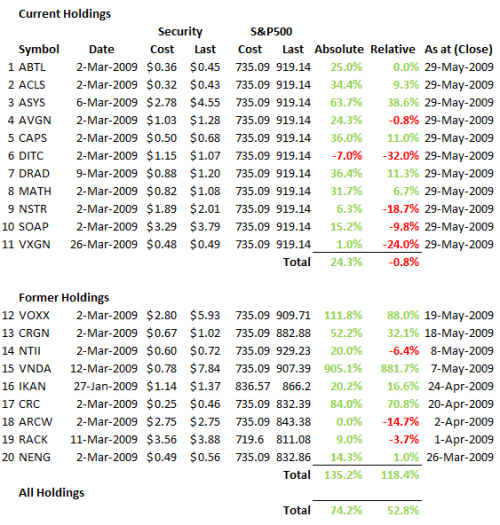
The second quarter was nothing short of a blockbuster for the Greenbackd Portfolio, up 74.2% on an absolute basis, which was 52.8% higher than the return on the S&P500 return over the same period. A large positive return for the period is heartening, but our celebration is tempered by the fact that it is difficult to avoid a good return in a market that rises 25.0% in a quarter. Our Q1 performance was -3.7% (see our first quarter performance here), which means that our total return since inception (assuming equal weighting in each quarter) is 67.8% against a return on the S&P500 of 11.6%, or an outperformance of 56.2% over the return in the S&P500.

It is still too early to determine how Greenbackd’s strategy of investing in undervalued asset situations with a catalyst is performing, but we believe we are heading in the right direction. Set out below is a list of all the stocks in the Greenbackd Portfolio and the absolute and relative performance of each from the close of the last trading day of the first quarter, Friday, February 28, 2009, to the close on the last trading day in the second quarter, May 29, 2009:

Greenbackd Portfolio Performance 2009 Q2You may have noticed something odd about our presentation of performance. The S&P500 index rose by 25.0% in our second quarter (from 735.09 to 919.14). Our +74.2% performance might suggest an outperformance over the S&P500 index of 49.2%, while we report outperformance of 52.8%. We calculate our performance on a slightly different basis, recording the level of the S&P500 index on the day each stock is added to the portfolio and then comparing the performance of each stock against the index for the same holding period. The Total Relative performance, therefore, is the average performance of each stock against the performance of the S&P500 index for the same periods. As we discussed above, the holding period for Greenbackd’s positions has been too short to provide any meaningful information about the likely performance of the strategy over the long term (2 to 5 years), but we believe that the strategy should outperform the market by a small margin.
Greenbackd’s valuation methodology

We started Greenbackd in an effort to extend our understanding of asset-based valuation described by Benjamin Graham in the 1934 Edition of Security Analysis. (You can see our summary of Graham’s approach here). Through some great discussion with our readers, many of whom work in the fund management industry as experienced analysts or even managing members of hedge funds, and by incorporating the observations of Marty Whitman (see Marty Whitman’s adjustments to Graham’s net net formula here) and Seth Klarman (our Seth Klarman series starts here), we have refined our process. We believe that what started out as a pretty unsophisticated application of Graham’s liquidation value methodology has evolved into a more realistic analysis of the balance sheet and the relationship of certain disclosures in the financial statements to asset value. Our analyses are now quantitatively more robust than when we started and that has manifest itself in better performance.

Tweedy Browne offers some compelling evidence for the asset based valuation approach here.

Update on the holdings in the Greenbackd Portfolio

There are eleven stocks remaining in the Greenbackd Portfolio:

  1. VXGN (added March 26, 2009 @ $0.48)
  2. DRAD (added March 9, 2009 @ $0.88)
  3. ASYS (added March 5, 2009 @ $2.78)
  4. CAPS (added February 27, 2009 @ $0.60)
  5. DITC (added February 19, 2009 @ $0.89)
  6. SOAP (added February 2, 2009 @ $2.50)
  7. NSTR (added January 16, 2009 @ $1.91)
  8. ACLS (added January 8, 2009 @ $0.60)
  9. MATH (added December 17, 2008 @ $0.68)
  10. ABTL (added December 11, 2008 @ $0.43)
  11. AVGN (added December 1, 2008 @ $0.65)

The future of Greenbackd.com

We are taking a brief vacation. We’ll be back full-time after July 4th, always reserving the right to post interesting ideas in the interum and update our open positions. If you’re looking for net nets in the meantime, there are two good screens:

  1. GuruFocus has a Graham net net screen ($249 per year)
  2. Graham Investor NCAV screen (Free)

Greenbackd is a labor of love. We try to create new content every week day, and to get the stock analyses up just after midnight Eastern Standard Time, so that they’re available before the markets open the following day. Most of the stocks that are currently trading at a premium to the price at which we originally identified them traded for a period at a discount to the price at which we identified them. This means that there are plenty of opportunities to trade on our ideas (not that we suggest you do that without reading our disclosures and doing your own research). If you find the ideas here compelling and you get some value from them, you can support our efforts by making a donation via PayPal.

We look forward to bringing you the best undervalued asset situations we can dig up in the next quarter.

Read Full Post »

Gretchen Morgenson of The NYTimes reports in Elect a Dissident, and You May Win a Prize that a new study of 120 “hybrid” boards (those formed when activist shareholders won one or more director seats) from 2005 through 2008 found that, on average, these companies’ shares outperformed their peers in both the short and long-term. The study was conducted by the Investor Responsibility Research Center Institute, a nonprofit organization, and Proxy Governance, a proxy advisory firm.

The results are compelling:

From the beginning of the contest period for a board seat through the first year of a hybrid board’s existence, companies’ total returns were 19.1 percent, or 16.6 percentage points better than peers’. And total share price performance through the three-year anniversary of the hybrid boards averaged 21.5 percent, almost 18 percentage points more than their peers.

According to Morgenson, much of the excess return occurs shortly after an activist announces his or her intention to seek board seats:

Investors, taking their cue that the company may be undervalued, typically bid up its shares in the three months leading up to the formation of a hybrid board. Keep in mind, too, that averages mask both exceptional and disastrous outcomes.

The size of the stake held by the dissident shareholder affects results: The bigger the shareholding, the bigger the gains:

At companies at which dissidents held 5 to 10 percent of shares, for instance, results over the following 15 months moderately exceeded those of their peer groups. But for companies in which the dissidents owned 10 percent to one-quarter of the stock, price appreciation significantly outshone peers, averaging almost 68 percentage points higher over the ensuing 15 months.

Performance at the companies where dissidents held less than 5 percent of shares was only in line with peers, on average.

Says Jon Lukomnik, director of the Investor Responsibility Research Center:

I think what it says is there is some value to owners being able to challenge existing management and that there are also some limits to that value.

The study is timely, coinciding with the Securities and Exchange Commission’s consideration of steps to make it easier for investors to nominate alternative directors to corporate boards.

Read Full Post »

Trilogy, Inc’s $0.35 per share tender offer for Autobytel Inc (NASDAQ:ABTL) expired yesterday without Trilogy purchasing any shares. Trilogy has sent a letter to the board saying that it will “continue to evaluate [ABTL’s] business, its cash position, and its operating performance” and has called on the board to communicate to its shareholders the break-up value of Autobytel, such that shareholders can determine if that is the best course to maximize value.”

We started following ABTL (see our post archive here) because it was trading at a substantial discount to its liquidation and net cash values and Trilogy had filed a 13D notice disclosing a 7.4% holding. Trilogy had also launched a tender offer for ABTL at $0.35 per share, which was at our estimate of ABTL’s $15.4M or $0.34 per share net cash value, but at a substantial discount to our estimate of ABTL’s $24.3M or $0.54 per share liquidation value. When Trilogy launched its offer, we wrote that we believed that $0.35 per share was only the opening salvo and a higher price was possible if the board terminated the rights plan poison pill. The board rejected the offer out of hand and Trilogy did not make a further offer before the initial offer expired.  The stock closed yesterday at $0.46, which is at a substantial premium to Trilogy’s offer price and suggests the market may be anticipating a second offer. The stock is up 6.8% since we started following it in December.

Trilogy’s letter to the board of ABTL on the expiry of the offer is set out below:

May 19, 2009

Autobytel Inc.

18872 MacArthur Boulevard, Suite 200

Irvine, California 92612-1400

Attention: Mr. Jeffrey H. Coats, President and Chief Executive Officer

Ladies and Gentlemen:

We have reviewed Autobytel’s response to our recently expired tender offer. We are disappointed in Autobytel’s categorical refusal to engage us in discussions that may result in improving shareholder value. You have made it clear that you are not willing to negotiate. Given that, we elected not to increase our tender offer price and allowed the tender offer to expire unchanged.

In addition, we find Autobytel’s accusation that we have used confidential information in conjunction with our tender offer to be wholly irresponsible and baseless. It is difficult to comprehend Autobytel’s objective in making such an accusation.

We have noted that the Board believes the break-up value of Autobytel is “substantially in excess of the offers made…during the sale process”. We ask that the Board communicate to its shareholders the break-up value of Autobytel, such that shareholders can determine if that is the best course to maximize value.

We further note that Autobytel’s stock traded approximately 7 million shares during the tender offer. This is significantly in excess of normal trading volumes and provides evidence that shareholders do want liquidity.

We will continue to evaluate your business, its cash position, and its operating performance. We have noted your views regarding your cash position. We do agree that maintaining and growing cash from operations is important.

The automotive business continues to announce bad news daily. Dealerships are consolidating and the viability of key manufacturers is uncertain. We believe that now is the time for Autobytel to preserve as much shareholder value as possible. We cannot negotiate if the Board is unwilling. Accordingly, we elected not to extend our offer.

Regards,

Trilogy Enterprises, Inc.

Sean Fallon

Senior Vice President

[Full Disclosure:  We do not have a holding in ABTL. This is neither a recommendation to buy or sell any securities. All information provided believed to be reliable and presented for information purposes only. Do your own research before investing in any security.]

Read Full Post »

Amtech Systems Inc (NASDAQ:ASYS) has filed its 10Q for the period ended March 31, 2009.

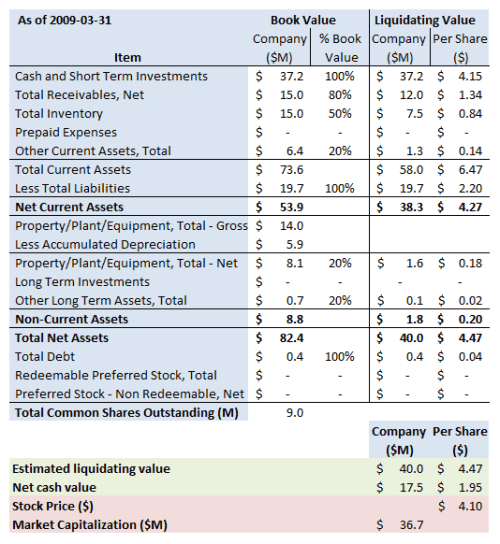
We started following ASYS (see our post archive here) because it was an undervalued asset play with a private investor disclosing a substantial holding. The private investor, Mr. Richard L. Scott, disclosed a 7.0% holding in July last year and Mr Scott has continued to purchase stock. As of February 17 this year, Mr. Scott holds 9.1% of ASYS’s outstanding stock. The stock is up 47.5% since we opened the position to close yesterday at $4.10, giving the company a market capitalization of $36.7M. We initially estimated the liquidation value to be around $40M or $4.40 per share. After reviewing the 10Q, we’ve maintained our estimate of the liquidation value at $40M, and slightly increased our estimate of the the per share liquidation value to $4.47 because the company repurchased around 144,ooo shares in the last quarter.

The value proposition updated

ASYS is generated positive operating earnings of $1.5M in the six months to March 31, which is encouraging. The summary of our estimate for the company’s liquidation value is set out below (the “Book Value” column shows the assets as they are carried in the financial statements, and the “Liquidating Value” column shows our estimate of the value of the assets in a liquidation):

ASYS Summary 2009 3 31

Conclusion

At its $4.10 close yesterday, ASYS is trading at a little under 10% discount of our estimate of its value in liquidation. Given that it has continued to generate positive operating cash flow and earnings in a difficult operating environment, we think ASYS represents very good value at a discount to its liquidation value. The stock traded over $5.00 last week, but we elected to hold on because we believe that ASYS should be worth more. Management seem to have recognized that the stock is too cheap, and have taken the right steps by authorizing a $4M stock buy-back, and repurchasing 144,000 shares in the last quarter. Our only criticism is that the buy-back could be bigger and more stock should be bought back. This is a very small criticism, and ASYS has the option to increase the buy-back in subsequent quarters if the stock price continues to trade at a discount to liquidation value. We don’t know anything about Mr. Scott, but we like to see large stockholders increasing their stakes when the stock price drops. We think ASYS is very good value, and that’s why we’re maintaining our position.

[Full Disclosure:  We have a holding in ASYS. This is neither a recommendation to buy or sell any securities. All information provided believed to be reliable and presented for information purposes only. Do your own research before investing in any security.]

Read Full Post »

Long-term readers of Greenbackd might remember our initial struggle to apply the net net / liquidation formula described by Benjamin Graham in the 1934 Edition of Security Analysis in the context of modern accounting. Putting aside our attempt to include and tweak the discounts to PP&E (kind of like fixing the smile on the Mona Lisa), most embarassing was our failure to factor into the valuation off-balance sheet liabilities and contractual obligations. The best thing that we can say about the whole sorry episode is that we got there in the end and we’ve been applying a more robust formulation for the last quarter. With that in mind, we thought it was particularly interesting to see the Financial Post’s article, Veteran tweaks Graham’s rule to find bargains (via Graham and Doddsville), which details the refinements legendary value investor Marty Whitman makes to Graham’s net-net formulation.

According to the article, Whitman makes the following adjustments to Graham’s 90-year old formula:

  • Companies must be well-financed

First and foremost, companies must be well-financed in keeping with the core tenet of Third Avenue’s “safe and cheap” method of value investing.

The goal is to own companies that are going concerns, not ones destined for liquidation. This difference is a crucial point of distinction between the focus of equity investors, who are often wiped out in liquidation, and bond investors, who have rights to the assets of a company in liquidation.

  • Whitman includes long-term assets that are easily liquidated

The second adjustment is to the assets themselves. Graham and Dodd focused exclusively on current assets when calculating liquidation value whereas Whitman includes long-term assets that are easily liquidated.

For example, roughly one third of long-term assets of Toyota Industries Corp. are investment securities, including a 6% position in Toyota Motor Corp. (TM/TSX), says Ian Lapey, portfolio manager at Third Avenue and designated successor to Whitman on the Third Avenue Value Fund.

These securities are therefore included in Third Avenue’s calculations of net-net.

Closer to home, oil and gas producer Encana Corp. (ECA/ TSX) has proved reserves of oil and natural gas that are not included in current assets, says Lapey.

“They are liquid in that there is a real market, current commodity prices notwithstanding, for high-quality proved reserves of oil and gas.” Encana is a top holding in AIC Global Focused Fund, sub-advised by Third Avenue and managed by Lapey.

  • Adjust for off-balance sheet liabilities

The third adjustment is the inclusion of off-balance-sheet liabilities. Here, U. S. banks’ structured investment vehicles readily spring to mind.

  • Include some PP&E

The fourth and final adjustment to Graham and Dodd is the inclusion of “some property, plant and equipment” for their liquidated cash value and associated tax losses that often produce cash savings.

Hong Kong real estate companies, such as top holding Henderson Land Development Co. Ltd. (0012/HK),are required to mark property values to market prices, so liquidation values are easily ascertained.

“In most time periods, the market for fully leased office buildings is quite liquid,” says Lapey, justifying their inclusion in net-net calculations of these companies.

The article also discusses one of Whitman’s current positions, Sycamore Networks Inc (NASDAQ:SCMR):

Sycamore Networks Inc. (SCMR/NASDAQ) is the most compelling example of a net-net situation in the United States offered up by Lapey.

The telecom equipment company has more cash — US$935-million in all — than the total value assessed to it by the market, in light of its US$800-million market capitalization and US$38-million in total liabilities.

“We feel that there is value to their technology that is being recognized by some of the large telecom carriers,” says Lapey of Sycamore Networks, but he acknowledges its current weak earnings power. Lapey is also attracted to the one-third of outstanding share ownership by management because it presents an important alignment of their interests with those of Third Avenue, who are by and large passive investors.

These large valuation discounts in the market are reassuring words for investors from the one of the finest practitioners of Graham and Dodd.

“We are holding these companies trading at huge discounts,” says Lapey, “and if these companies were to sell assets or sell the whole companies we think the result would be a terrific return for our investment.”

As we discussed in our review of our first quarter, we started Greenbackd in an effort to extend our understanding of asset-based valuation described by Graham. Over the last few quarters we have refined our process a great deal, and it’s pleasing to us that we already include the adjustments identified by Whitman. We believe that our analyses are now qualitatively more robust than when we started out and seeing Whitman’s adjustments gives us some confidence that we’re on the right track.

Read Full Post »

We’re getting on the Twitter train. Catch us here: http://twitter.com/Greenbackd

Read Full Post »

Empirical Finance Research Blog has a review of a new paper, Hedge Fund Activism, Corporate Governance, and Firm Performance, which finds that the “market reacts favorably to hedge fund activism, as the abnormal return upon announcement of potential activism is in the range of seven percent, with no return reversal during the subsequent year.” Further, the paper “provides important new evidence on the mechanisms and effects of informed shareholder monitoring.”

The authors seek to address the questions posed by “critics and regulators” about the benefits of hedge fund activism to shareholders and the claim that hedge fund activists “destroy value by distracting managers from long-term projects.” Specifically, the paper seeks to answer the following questions:

  • Which firms do activists target and how do those targets respond?
  • How does the market react to the announcement of activism?
  • Do activists succeed in implementing their objectives?
  • Are activists short-term in focus?

We’ve set out below brief answers to the questions posed in the paper:

Which firms do activists target and how do those targets respond?

Hedge fund activists tend to target companies that are typically “value” firms, with low market value relative to book value, although they are profitable with sound operating cash flows and return on assets. Payout at these companies before intervention is lower than that of a matched sample. Target companies also have more takeover defenses and pay their CEOs more than comparable companies. Relatively few targeted companies are large-cap firms, which is not surprising given the relatively high cost of amassing a meaningful stake in such a target. Targets exhibit significantly higher institutional ownership and trading liquidity. These characteristics make it easier for activists to acquire a significant stake quickly.

How does the market react to the announcement of activism?

We find that the market reacts favorably to activism, consistent with the view that it creates value. The filing of a Schedule 13D revealing an activist fund’s investment in a target firm results in large positive average abnormal returns, in the range of 7 to 8 percent, during the (-20,+20) announcement window. The increase in both price and abnormal trading volume of target shares begins one to ten days prior to filing. We find that the positive returns at announcement are not reversed over time, as there is no evidence of a negative abnormal drift during the one-year period subsequent to the announcement. We also document that the positive abnormal returns are only marginally lower for hedge funds that disclosed substantial ownership positions (through quarterly Form 13F filings) before they file a Schedule 13D, which is consistent with the view that the abnormal returns are due to new information about activism, not merely that about stock picking. Moreover, target prices decline upon the exit of a hedge fund only after it has been unsuccessful, which indicates that the information reflected in the positive announcement returns conveys the market’s expectation for the success of activism.

Activism that targets the sale of the company or changes in business strategy, such as refocusing and spinning-off non-core assets, is associated with the largest positive abnormal partial effects of 8.54 percent and 5.95 percent, respectively (the latter figure is lower than the overall sample average because most events target multiple issues). This evidence suggests that hedge funds are able to create value when they see large allocative inefficiencies. In contrast, we find that the market response to capital-structure related activism – including debt restructuring, recapitalization, dividends, and share repurchases – is positive, yet insignificant. We find a similar lack of statistically meaningful reaction for governance-related activism-including attempts to rescind take-over defenses, to oust CEOs, to enhance board independence, and to curtail CEO compensation. Hedge funds with a track record of successful activism generate higher returns, as do hedge funds that initiate activism with hostile tactics.

Do activists succeed in implementing their objectives?

The positive market reaction is also consistent with ex-post evidence of overall improved performance at target firms. On average, from the year before announcement to the year after, total payout increases by 0.3-0.5 percentage points (as a percentage of the market value of equity, relative to an all-sample mean of 2.2 percentage points), and book value leverage increases by 1.3-1.4 percentage points (relative to an all-sample mean of 33.5 percentage points). Both changes are consistent with a reduction of agency problems associated with free cash flow and subject managers to increased market discipline.

We also find improvement in return on assets and operating profit margins, but this takes longer to happen. The post-event year sees little change compared to the year prior to intervention. However, EBITDA/Assets (EBITDA/Sales) at target firms increase by 0.9-1.5 (4.7-5.8) percentage points by two years after intervention. Analyst expectations also suggest improved prospects at target firms after hedge fund intervention. During the months before Schedule 13D filings, analysts downgrade (future) targets more than they upgrade them whereas after intervention is announced analysts maintain neutral ratings. Given that successful activism often leads to attrition through sale of the target company, ex post performance analysis based on surviving firms may underestimate the positive effect of activism.

Are activists short-term in focus?

Hedge fund activists are not short-term in focus, as some critics have claimed. The median holding period for completed deals is about one year, calculated as running from the date a hedge fund files a Schedule 13D to the date when the fund no longer holds a significant stake in a target company. The calculation substantially understates the actual median holding period, because it necessarily excludes events where no exit information is available by March 2007. Analysis of portfolio turnover rates of the funds in our sample suggests holding periods of closer to twenty months.

Empirical Finance Research has some tips for implementing the “hedge fund activist alpha strategy” based on their experience watching real-world activists work their magic:

1. Focus on small companies

2. Watch for activists who are entering companies at the same time mutual funds are dumping (watch for 13-G’s filed concurrently with 13Ds). This way you can buy at cheap prices while the mutual funds are putting pressure on the stock. Eventually, the selling pressure is gone AND you have an activist there to make sure the ship is sailing straight ahead.

3. Call the company in question and assess how ‘open’ they are. Sometimes even the best activist campaign can’t beat an overly entrenched and crooked management.

4. Call the activist and get a feel for what they want to do with the company. In my experience, activist investors are usually class-act capitalists and may give you hints as to the direction they want to take a company.

5. Do your own due diligence and determine where the ‘hidden’ value is located. If you have an assessment of exactly what the activist is after, you may be able to determine how successful they will be in their attempts to unlock this value. Here is a quick example. If you determine the activist wants to unlock value when there is a discrepancy between the value of an asset on the books and the value of an asset in the real-world (i.e. a real estate holding), but you determine that selling the asset would be a nightmare (maybe you live down the street from the property) and/or involves abusive tax treatment that not many people understand, you may shy away from following the activist.

Read Full Post »

In Ackman and Target Tangle in Ballot Brawl, The New York Times’ Dealbook has coverage of the “universal ballot” spat between William A. Ackman’s Pershing Square Capital and Target Corporation (NYSE:TGT).  A candidate on Pershing Square’s ticket, Ronald J. Gilson, who is a law professor at Stanford University and an expert in corporate governance, has proposed that TGT place all the nominees running for election to the board on a single ballot, the so-called “universal ballot.” Presently, shareholders in most proxy fights receive two proxy cards and can vote only for one slate of candidates. Gilson’s proposal would give TGT’s shareholders the chance to pick candidates from both management and Pershing Square’s proxies.

Dealbook reports that the shareholder advisory firm RickMetrics Group support the universal ballot proposal:

“Pershing appears to be astutely exploiting the current pro-(shareholder)-choice zeitgeist, and puts Target on its back foot,” RiskMetrics said in a research note issued Tuesday. “It will be challenging for Target, absent some sort of unwaivable legal impediment, to argue against Pershing’s proposal without coming across as anti-shareholder.”

Here is Gilson’s letter to the board:

RONALD J. GILSON

Charles J. Meyers Professor
of Law and Business

April 21, 2009

Mr. Gregg Steinhafel
Chairman of the Board
Chief Executive Officer and President
Mr. Timothy R. Baer
Executive Vice President
Corporate Secretary and General Counsel
Target Corporation
1000 Nicollet Mall
Minneapolis, Minnesota 55403

Re: Proposal to Use a Universal Proxy at the2009 Annual Meeting of Shareholders

Dear Messrs. Steinhafel and Baer:

On March 17, 2009, Pershing Square Capital Management, L.P. publicly announced that its affiliates had delivered a Notice of Nomination to you proposing to nominate five individuals for election as directors of Target at the company’s 2009 Annual Meeting of Shareholders. I am one of those nominees.

Both Target and Pershing Square have a unique opportunity to make this election historic from a corporate governance perspective. As you may know, the press has reported that SEC chair Mary Schapiro has directed the Commission’s staff to draft proposals for rules governing shareholder proxy access by mid-May 2009. I expect those proposed rules will provide the opportunity for the use of a universal proxy card whereby shareholders can choose – on one proxy card – from among the candidates nominated both by the company and by shareholders. The benefit to shareholders, who may want to choose members from both slates, would be substantial.

I first wrote about the need to remove the barriers to non-control proxy contests some 19 years ago.1 The occasion then was to recommend a change in the bona fide nominee rule to allow a shareholder running a short slate to include the names of the company’s nominees on the shareholder’s proxy card. That recommendation was accepted by the SEC, as I recall at the urging of Mary Schapiro, who was then a Commissioner.

Target and Pershing Square now have the opportunity to proactively provide good corporate governance to the Target shareholders by making it convenient for them to make a choice in what, in the end, is their election. This is not a control contest. The qualifications of the candidates will be fully vetted by the time of the May 28th election, and Target shareholders are entirely capable of assessing the candidates and making a choice. There is simply no excuse to deny shareholders the benefit of the use of a universal proxy card. The alternative will make it procedurally more difficult for Target shareholders to exercise their franchise. This is a problem that we, together, have the power to solve.

I have received assurance from Pershing Square that they would support a universal proxy card for Target’s upcoming Annual Meeting. I now seek the same from you. In the alterative, I ask that you consider allowing the company’s nominees to be named on the Pershing Square Gold proxy card. In either instance, shareholders would have the benefit of being able to choose the best nominees for the job. Target now has the opportunity to hold an election that will be a credit to the company’s corporate governance. I urge you to carefully consider this proposal and do the right thing for Target shareholders.

Very truly yours,

/s/ Ronald J. Gilson

1 Ronald J. Gilson, Lilli A. Gordon & John Pound, How the Proxy Rules Discourage Constructive Engagement: Regulatory Barriers to Electing a Minority of Directors, 17 Journal of Corporate Law 29 (with L. Gordon & J. Pound) (1992).

Here is TGT’s response:

TARGET CORPORATION COMMENTS ON LETTER FROM PERSHING SQUARE NOMINEE RONALD GILSON

MINNEAPOLIS, April 21, 2009 – Target Corporation (NYSE:TGT) today commented on the letter from Pershing Square nominee, Professor Ronald J. Gilson, that Pershing Square filed with the Securities and Exchange Commission (“SEC”). In the letter, Professor Gilson references possible future SEC changes to the federal proxy rules and proposes the use of a universal proxy card by Target and Pershing Square. Pershing Square has initiated a proxy contest to elect its own nominees, including Professor Gilson, to Target’s Board of Directors.

The company said, “We believe Professor Gilson’s proposal, coming at this stage of the proxy contest, would cause delay and confusion. Shareholders have a clear choice between our independent nominees on our WHITE proxy card and Bill Ackman’s slate on Pershing Square’s gold proxy card. We note, as does Professor Gilson, that the SEC may be considering a proxy access proposal. Any such proposal should be allowed to proceed on an appropriate timetable allowing for careful review and consideration by the SEC of a number of issues, including whether proxy access should be available to an entity, like Pershing Square, which has initiated its own proxy contest. In the meantime, the current proxy rules provide a framework for the conduct of the proxy voting process that is perfectly adequate for resolving the issues that Pershing Square is raising.

“With Target’s Annual Meeting only five weeks away, we believe our shareholders clearly understand the choice between our independent directors and the Pershing Square slate. We will be mailing our proxy materials shortly and encourage our shareholders to use our WHITE proxy card to support the reelection of the directors nominated by our Board.”

Shareholders who have questions about voting or the matters to be voted upon at the Annual Meeting are encouraged to call MacKenzie Partners, Inc. at 800-322-2885 Toll-Free or Georgeson at 866-295-8105 Toll-Free. The company will hold the 2009 Annual Meeting of Shareholders on Thursday, May 28, 2009. Target will be distributing proxy materials to shareholders of record as of March 30, 2009.

And Pershing Square’s response:

Pershing Square Comments on
Target’s Objection to Universal Ballot Proposal

New York – Pershing Square Capital Management, L.P., and Professor Ronald J. Gilson, who has been nominated by Pershing Square to serve as an independent director of Target Corporation (NYSE: TGT), expressed disappointment with Target’s response to Professor Gilson’s letter seeking the use of a universal proxy card, naming both Target’s and Pershing Square’s nominees, for use in connection with Target’s upcoming Annual Meeting of Shareholders.

“Rather than causing confusion, the proposal would eliminate confusion by giving shareholders something they would otherwise lack – the simple chance to choose the best among all of the candidates, rather than between two slates of candidates.” commented Professor Gilson. Pershing Square believes that the adoption by both Target and Pershing Square of a universal proxy card would reflect best-in-class corporate governance, and would result in the most qualified directors being elected, regardless of which proxy card a shareholder returned.

On the universal proxy card proposal, Bill Ackman of Pershing Square said, “it’s important for shareholders to have a choice so that they can vote for whichever candidates they prefer, regardless of which proxy card they submit. Pershing Square wants to provide shareholders with that freedom of choice. We are hoping Target will as well.”

Because proxy cards have not yet been mailed, and because new proxy cards are easy to print from the company’s or Pershing Square’s website, Pershing Square does not believe that adopting a universal proxy card would add any material expense to the proxy contest. Pershing Square also noted that it would be willing to bear the additional printing costs of the universal proxy cards.

Furthermore, Target’s public explanation for its refusal to use a universal proxy card does not address why Target would not permit its nominees to be named on Pershing Square’s Gold proxy card. Indeed, based on the timing of Target’s public response, Pershing Square questions how the matter could have been raised with its Board of Directors and whether Target’s nominees were given the opportunity to consent to being named on a universal proxy card or Pershing Square’s Gold proxy card.

Pershing Square requests Target’s nominees for permission to be included on the Gold proxy card in the event that the company will not consent to a universal proxy card.

[Full Disclosure:  We do not have a holding in TGT. This is neither a recommendation to buy or sell any securities. All information provided believed to be reliable and presented for information purposes only. Do your own research before investing in any security.]

Read Full Post »

« Newer Posts - Older Posts »