Feeds:
Posts
Comments

Archive for the ‘About’ Category

Rolfe Winkler of Reuters blog Contingent Capital has a great summary of David Einhorn’s talk to the Value Investing Congress. Despite what we say in the title, Einhorn is hardly fickle (we just couldn’t resist). If anything, he’s stubborn to a fault, so it is interesting that he’s changed his mind so dramatically about the influence of macro events on his traditional bottom-up investment style. In his speech (.pdf via Winkler’s blog), he sets out the rationale behind the change, what he perceives the current macro risks to be, and what he’s doing in response. Apologies in advance for the huge blocks of text. We believe that this is the most important factor influencing the market and the economy, and will be for the next 5-10 years. Ignore it at your peril.

Speaking of his change in attitude to secular macro trends, Einhorn said:

I want to revisit [Greenlight’s 2005 position in MDC Holdings, a homerbuilder] because the loss was not bad luck; it was bad analysis. I down played the importance of what was then an ongoing housing bubble. On the very same day, at the very same conference, a more experienced and wiser investor, Stanley Druckenmiller, explained in gory detail the big picture problem the country faced from a growing housing bubble fueled by a growing debt bubble. At the time, I wondered whether even if he were correct, would it be possible to convert such big picture macro-thinking into successful portfolio management? I thought this was particularly tricky since getting both the timing of big macro changes as well as the market’s recognition of them correct has proven at best a difficult proposition. Smart investors had been complaining about the housing bubble since at least 2001. I ignored Stan, rationalizing that even if he were right, there was no way to know when he would be right. This was an expensive error.

The lesson that I have learned is that it isn’t reasonable to be agnostic about the big picture. For years I had believed that I didn’t need to take a view on the market or the economy because I considered myself to be a “bottom up” investor. Having my eyes open to the big picture doesn’t mean abandoning stock picking, but it does mean managing the longshort exposure ratio more actively, worrying about what may be brewing in certain industries, and when appropriate, buying some just-in-case insurance for foreseeable macro risks even if they are hard to time.

What, according to Einhorn, is the secular macro trend most influencing the market and economy? The inflationary policies of the current administration:

Presently, Ben Bernanke and Tim Geithner have become the quintessential short-term decision makers. They explicitly “do whatever it takes” to “solve one problem at a time” and deal with the unintended consequences later. It is too soon for history to evaluate their work, because there hasn’t been time for the unintended consequences of the “do whatever it takes” decision-making to materialize.

Rather than deal with these simple problems with simple, obvious solutions, the official reform plans are complicated, convoluted and designed to only have the veneer of reform while mostly serving the special interests. The complications serve to reduce transparency, preventing the public at large from really seeing the overwhelming influence of the banks in shaping the new regulation.

In dealing with the continued weak economy, our leaders are so determined not to repeat the perceived mistakes of the 1930s that they are risking policies with possibly far worse consequences designed by the same people at the Fed who ran policy with the short term view that asset bubbles don’t matter because the fallout can be managed after they pop. That view created a disaster that required unprecedented intervention for which our leaders congratulated themselves for doing whatever it took to solve. With a sense of mission accomplished, the G-20 proclaimed “it worked.”

We are now being told that the most important thing is to not remove the fiscal and monetary support too soon. Christine Romer, a top advisor to the President, argues that we made a great mistake by withdrawing stimulus in 1937.

An alternative lesson from the double dip the economy took in 1938 is that the GDP created by massive fiscal stimulus is artificial. So whenever it is eventually removed, there will be significant economic fall out. Our choice may be either to maintain large annual deficits until our creditors refuse to finance them or tolerate another leg down in our economy by accepting some measure of fiscal discipline.

Over the last couple of years we have adopted a policy of private profits and socialized risks. We are transferring many private obligations onto the national ledger. Although our leaders ought to make some serious choices, they appear too trapped in short-termism and special interests to make them. Taking no action is an action.

In the nearer-term the deficit on a cash basis is about $1.6 trillion or 11% of GDP. President Obama forecasts $1.4 trillion next year, and with an optimistic economic outlook, $9 trillion over the next decade. The American Enterprise Institute for Public Policy Research recently published a study that indicated that “by all relevant debt indicators, the U.S. fiscal scenario will soon approximate the economic scenario for countries on the verge of a sovereign debt default.”

Further, the Federal Open Market Committee members may not recognize inflation when they see it, as looking at inflation solely through the prices of goods and services, while ignoring asset inflation, can lead to a repeat of the last policy error of holding rates too low for too long.

At the same time, the Treasury has dramatically shortened the duration of the government debt. As a result, higher rates become a fiscal issue, not just a monetary one. The Fed could reach the point where it perceives doing whatever it takes requires it to become the buyer of Treasuries of first and last resort.

I believe there is a real possibility that the collapse of any of the major currencies could have a similar domino effect on re-assessing the credit risk of the other fiat currencies run by countries with structural deficits and large, unfunded commitments to aging populations.

I believe that the conventional view that government bonds should be “risk free” and tied to nominal GDP is at risk of changing. Periodically, high quality corporate bonds have traded at lower yields than sovereign debt. That could happen again.

His response has been to buy physical gold “as insurance against sovereign default(s).”

Now, the question for us as investors is how to manage some of these possible risks. Four years ago I spoke at this conference and said that I favored my Grandma Cookie’s investment style of investing in stocks like Nike, IBM, McDonalds and Walgreens over my Grandpa Ben’s style of buying gold bullion and gold stocks. He feared the economic ruin of our country through a paper money and deficit driven hyper inflation. I explained how Grandma Cookie had been right for the last thirty years and would probably be right for the next thirty as well. I subscribed to Warren Buffett’s old criticism that gold just sits there with no yield and viewed gold’s long-term value as difficult to assess.

However, the recent crisis has changed my view. The question can be flipped: how does one know what the dollar is worth given that dollars can be created out of thin air or dropped from helicopters? Just because something hasn’t happened, doesn’t mean it won’t. Yes, we should continue to buy stocks in great companies, but there is room for Grandpa Ben’s view as well.

I have seen many people debate whether gold is a bet on inflation or deflation. As I see it, it is neither. Gold does well when monetary and fiscal policies are poor and does poorly when they appear sensible. Gold did very well during the Great Depression when FDR debased the currency. It did well again in the money printing 1970s, but collapsed in response to Paul Volcker’s austerity. It ultimately made a bottom around 2001 when the excitement about our future budget surpluses peaked.

Prospectively, gold should do fine unless our leaders implement much greater fiscal and monetary restraint than appears likely. Of course, gold should do very well if there is a sovereign debt default or currency crisis.

A few weeks ago, the Office of Inspector General called out the Treasury Department for misrepresenting the position of the banks last fall. The Treasury’s response was an unapologetic expression that amounted to saying that at that point “doing whatever it takes” meant pulling a Colonel Jessup: “YOU CAN’T HANDLE THE TRUTH!” At least we know what we are dealing with.

When I watch Chairman Bernanke, Secretary Geithner and Mr. Summers on TV, read speeches written by the Fed Governors, observe the “stimulus” black hole, and think about our short-termism and lack of fiscal discipline and political will, my instinct is to want to short the dollar. But then I look at the other major currencies. The Euro, the Yen, and the British Pound might be worse. So, I conclude that picking one these currencies is like choosing my favorite dental procedure. And I decide holding gold is better than holding cash, especially now, where both earn no yield.

For years, the discussion has been that our deficit spending will pass the costs onto “our grandchildren.” I believe that this is no longer the case and that the consequences will be seen during the lifetime of the leaders who have pursued short-term popularity over our solvency. The recent economic crisis and our response has brought forward the eventual reconciliation into a window that is near enough that it makes sense for investors to buy some insurance to protect themselves from a possible systemic event. To slightly modify Alexis de Tocqueville: Events can move from the impossible to the inevitable without ever stopping at the probable.
Read Full Post »

The old Wall Street saw, variously attributed to Warren Buffett or Humphrey B. Neill, author of the Art of Contrary Thinking, goes, “Never confuse genius with a bull market.” With that in mind, we present to you the performance of the Wilshire 5000 Equal Weight Index, which is one of the broadest measures of the stock market.

For the month of September the Wilshire 5000 Equal Weight Index was up 15.8% and for the last quarter to September 30 it was up 36.0%.  You can see for yourself at the Wilshire Index Calculator (it’s a little clunky – you’ll need to select “Wilshire 5000 Equal Weight” in the “Broad/Style” box and set the date to September 30 2009). Year to date the index is up a whopping 83.02%. From March through September, the average stock is up 113.1%. If we take the Wilshire 4500 Equal Weight Index, which excludes the top 500 stocks by market capitalization of the 5000 Equal Weight Index, the return is +120% from March to September 2009. Sobering.

Hat tip Bo.

Read Full Post »

You may be familiar with the “Peter Schiff was right” Internet meme that’s been doing the rounds for a year or so. If you are not, the meme is a montage of Peter’s appearances on various business television shows between 2006 and 2007. In each clip he is alone in arguing that the US stands at the precipice of a collapse and is roundly derided by the other participants and the anchor. One such example is set out below:

Peter was indeed right about the ensuing collapse. What’s more, he was right for the right reasons, as opposed to the “permabears” who are right the way a stopped clock is right twice a day (ordinarily we’d include Nouriel Rubini in this club, but won’t do so on this occasion for reasons which will shortly become obvious). Is Peter clairvoyant? No. He’s a disciple of the Austrian School of Economics (about which we came out of the closet a few weeks back). Given Schiff’s prescience and well-known adherence to Austrian economics, one might think that the Austrian School deserves a second look, especially so given that the Keynesian orthodoxy completely missed the crash. One such paper seeks to do just that, but with a wider lense that doesn’t presuppose the conclusion.

In No One Saw This Coming: Understanding Financial Crisis Through Accounting Models (.pdf) Dirk J Bezemer of Groningen University takes a scholarly look at which macroeconomic models helped anticipate the credit crisis and economic recession and which did not. Says Bezemer:

The credit crisis and ensuing recession may be viewed as a ‘natural experiment’ in the validity of economic models. Those models that failed to foresee something this momentous may need changing in one way or another. And the change is likely to come from those models (if they exist) which did lead their users to anticipate instability. The plan of this paper, therefore, is to document such anticipations, to identify the underlying models, to compare them to models in use by official forecasters and policy makers, and to draw out the implications.

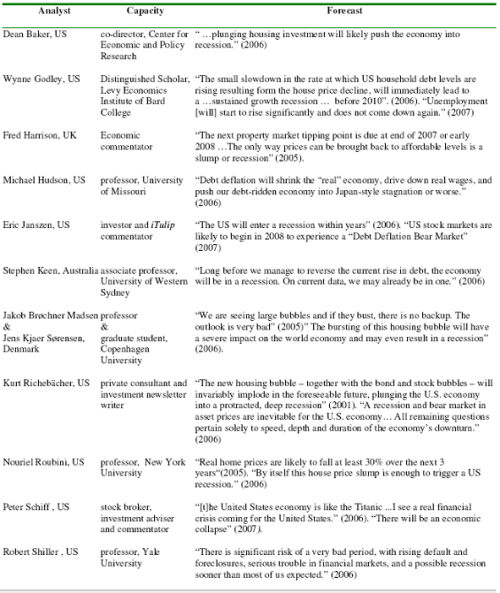
There are two broad ideas in the paper most interesting to us: The first is Bezemer’s documentation of the “sense of surprise at the credit crisis among academics and policymakers,” which gave rise to the erroneous view that “no one saw this coming”. The second “is a careful survey – applying a number of selection criteria – of those professional and academic analysts who did ‘see it coming’, and who issued public predictions of financial instability induced by falling real estate prices and leading to recession.”

“No-one saw this coming”

Bezemer makes the arguement that the view that it was impossible to know that a crash was imminent has gone unchallenged and unexamined by the mainstream press and academia:

The view that “[n]o one foresaw the volume of the current avalanche” appears justified by a lack of discussion, in the academic and policy press, of the possibility that financial globalization harboured significant risks, or that the US real estate market and its derivative products were in dangerous waters. Wellink (2009) quoted a 2006 IMF report on the global real estate boom asserting that there was “little evidence (..) to suggest that the expected or likely market corrections in the period ahead would lead to crises of systemic proportions”. On the contrary, those developments now seen as culprits of the crisis were until recently lauded by policy makers, academics, and the business community.

These assessments by the experts carried over to a popular view, enunciated in the mass media, that the recessionary impacts of the credit crisis came out of the blue. USA Today in December 2006 reported on the fall in house prices that had just started that summer, “the good news is that far more economists are in the optimist camp than the pessimist camp. Although a handful are predicting the economy will slide into a housing-led recession next year, the majority anticipate the economy will continue to grow” (Hagenbauch 2006). Kaletsky (2008) wrote in the Financial Times of “those who failed to foresee the gravity of this crisis – a group that includes Mr King, Mr Brown, Alistair Darling, Alan Greenspan and almost every leading economist and financier in the world.”

The surprise at this gravity was proportionate to the optimism beforehand. Greenspan (2008) in his October 2008 testimony before the Committee of Government Oversight and Reform professed to “shocked disbelief” while watching his “whole intellectual edifice collapse in the summer of [2007]”. Das (2008) conceded that contrary to his earlier view of financial globalization ‘eliminating’ credit risks, in fact “[p]artial blame for the fall 2008 meltdown of the global financial market does justly go to globalization.” The typical pattern was one of optimism shortly before and surprise shortly after the start of the crisis.

The common elements of the alternative view

Bezemer notes that, despite the foregoing, there was an “alternative, less sanguine interpretation of financial developments” and it was “not confined to the inevitable fringe of bearish financial commentators.” Bezemer is mindful that among those expressing the alternative view, the lucky guesses must be distinguished from the insightful predictions. Here he discusses the problem and his methodology for doing so:

A major concern in collecting these data must be the ‘stopped clock syndrome’. A stopped clock is correct twice a day, and the mere existence of predictions is not informative on the theoretical validity of such predictions since, in financial market parlance, ‘every bear has his day’. Elementary statistical reasoning suggests that given a large number of commentators with varying views on some topic, it will be possible to find any prediction on that topic, at any point in time. With a large number of bloggers and pundits continuously making random guesses, erroneous predictions will be made and quickly assigned to oblivion, while correct guesses will be magnified and repeated after the fact. This in itself is no indication of their validity, but only of confirmation bias.

In distinguishing the lucky shots from insightful predictions, the randomness of guesses is a feature to be exploited. Random guesses are supported by all sorts of reasoning (if at all), and will have little theory in common. Conversely, for a set of correct predictions to attain ex post credibility, it is additionally required that they are supported by a common theoretical framework. This study, then, looks to identify a set of predictions which are not only ex post correct but also rest on a common theoretical understanding. This will help identify the elements of a valid analytical approach to financial stability, and get into focus the contrast with conventional models.

In collecting these cases in an extensive search of the relevant literature, four selection criteria were applied. Only analysts were included who provide some account on how they arrived at their conclusions. Second, the analysts included went beyond predicting a real estate crisis, also making the link to real-sector recessionary implications, including an analytical account of those links. Third, the actual prediction must have been made by the analyst and available in the public domain, rather than being asserted by others. Finally, the prediction had to have some timing attached to it. Applying these criteria led to the exclusion of a number of (often high profile) candidates – as detailed in the Appendix – so that the final selection is truly the result of critical scrutiny.

The twelve analysts described there – the number is entirely an outcome of the selection criteria – commented on the US, UK, Australian, Danish and global conditions in housing, finance and the broader economy. All except one are (or were) analysts and commentators of global fame. They are a mixed company of academics, government advisers, consultants, investors, stock market commentators and one graduate student, often combining these roles. Already between 2000 and 2006 they warned specifically about a housingled recession within years, going against the general mood and official assessment, and well before most observers turned critical from late 2007. Together they belie the notion that ’no one saw this coming’, or that those who did were either professional doomsayers or lucky guessers.

So who were those analysts able to make an accurate and cogent prediction? Here’s the table:

No One Saw This Coming Table 1

What are the common elements of these analysts?

A broadly shared element of analysis is the distinction between financial wealth and real assets. Several of the commentators (Schiff and Richebächer) adhere to the ‘Austrian School’ in economics, which means that they emphasize savings, production (not consumption) and real capital formation as the basis of sustainable economic growth. Richebächer (2006a:4) warns against ““wealth creation” though soaring asset prices” and sharply distinguishes this from “saving and investment…” (where investment is in real-sector, not financial assets). Likewise Shiller (2003) warns that our infatuation with the stock market (financial wealth) is fuelling volatility and distracting us from more the durable economic prospect of building up real assets. Hudson (2006a) comments on the unsustainable “growth of net worth through capital gains”.

A concern with debt as the counterpart of financial wealth follows naturally. “The great trouble for the future is that the credit bubble has its other side in exponential debt growth” writes Richebächer (2006b:1). Madsen from 2003 worried that Danes were living on borrowed time because of the mortgage debt which “had never been greater in our economic history”. Godley in 2006 published a paper titled Debt and Lending: A Cri de Coeur where he demonstrated the US economy’s dependence on debt growth. He argued it would plunge the US into a “sustained growth recession … somewhere before 2010” (Godley and Zezza, 2006:3). Schiff points to the low savings rate of the United States as its worst malady, citing the transformation from being the world’s largest creditor nation in the 1970s to the largest debtor nation by the year 2000. Hudson (2006a) emphasized the same ambiguous potential of house price ‘wealth’ already in the title of his Saving, Asset-Price Inflation, and Debt-Induced Deflation, where he identified the ‘large debt overhead – and the savings that form the balance-sheet counterpart to it’ as the ‘anomaly of today’s [US] economy’. He warned that ‘[r]ising debt-service payments will further divert income from new consumer spending. Taken together, these factors will further shrink the “real” economy, drive down those already declining real wages, and push our debt-ridden economy into Japan-style stagnation or worse.” (Hudson 2006b). Janszen (2009) wrote that “US households and businesses, and the government itself, had since 1980 built up too much debt. The rate of increase in debt was unsustainable… Huge imbalances in the US and global economy developed for over 30 years. Now they are rebalancing, as many non-mainstream economists have warned was certain to happen sooner or later.” Keen (2006) wrote that the debt-to-GDP ratio in Australia (then 147 per cent) “will exceed 160 per cent of GDP by the end of 2007. We simply can’t keep borrowing at that rate. We have to not merely stop the rise in debt, but reverse it. Unfortunately, long before we manage to do so, the economy will be in a recession.”

Of the analysts holding the “alternative, less sanguine” view, most were from the Austrian School. It would be nice if a few more Keynesians had Greenspan’s “shocked disbelief” while watching his “whole intellectual edifice collapse in the summer of [2007]”. We’re not holding our breath. While we don’t necessarily agree with all of Bezemer’s conclusions, the paper is superbly written and an engaging read.

Read Full Post »

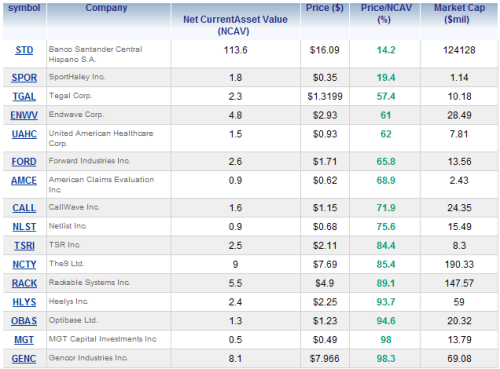
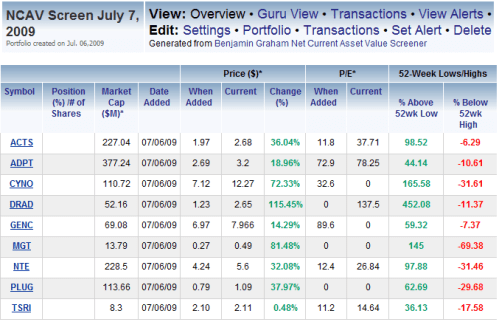
We’ve recently been using the GuruFocus Benjamin Graham Net Current Asset Value Screener (subscription required) to generate regular watchlists of net net stocks. The GuruFocus NCAV screen has some superb functionality that makes it possible to create the watchlist from the screen and then track the performance of those stocks. We created our first watchlist on July 7 of this year using the July 6 closing prices. The performance of the stocks in that first watchlist over the last quarter has been nothing short of spectacular. Here is a screen grab (with some columns removed to fit the space below):

GuruFocus NCAV Screen

We know the market’s been somewhat frothy recently, but those returns are still notable. The average return to date across the nine stocks in the watchlist is 45.5% against the return on the S&P500 of 20.05% over the same period, an outperformance of more than 25% in ~three months. We’ve decided to run another screen today and we’ll track the return of that watchlist over the coming months. The stocks in the watchlist are set out below (again, with a column removed to fit the space below):

GuruFocus NCAV Screen 2009 10 13

We’ve done no research on these firms beyond running the screen. If you plan on buying anything in this screen, at the absolute minimum we recommend that you do some research to determine whether they are currently net net stocks and not just caught in the screen because of out-of-date filings. We’ll compare the performance of the stocks against the S&P500, which closed yesterday at 1,076.18.

[Full Disclosure:  We have a holding in FORD. This is neither a recommendation to buy or sell any securities. All information provided believed to be reliable and presented for information purposes only. Do your own research before investing in any security.]

Benjamin Graham Net Current Asset Value Screener

Read Full Post »

In keeping with our penchant for stories about idiosyncratic investors who trade in odd securities found off the beaten track, we bring you perhaps the best unknown activist investment of 2009. With a far away land, a young protagonist, an odd treasure, an unexpected twist and a narrow escape, it’s a bullwhip and a fedora short of being an Indiana Jones movie. In the role of young protagonist is Nicholas Bolton, a 27-year old investor who made A$4.5M ($4M) almost bringing down BrisConnections, the developer of a A$4.8B ($4.3B) Australian toll road. What’s most amazing is that he achieved this with an initial stake worth just A$47,000 ($42,000). In so doing, he became the bête noire of his fellow BrisConnections investors, attracted the attention of the Australia Securities and Investments Commission (similar to the SEC) and drew the ire of the Australian media, who variously described him as a “meddling kid,” “Australia’s foremost prat,” “the ultimate poster-boy for the much-maligned Generation Y” and “the best proof that karma does not exist.” How did he do it and why all the vitriol? Read on.

BrisConnections: The Temple of Doom

Several unusual elements make the Nicholas Bolton versus BrisConnections story reasonably complex. Bear with us, to understand the story it’s necessary to understand the BrisConnections security in detail.

BrisConnections, backed by Deutsche Bank, Credit Suisse Group, JPMorgan Chase & Co. and Macquarie Bank, raised A$1.23B ($1.16B) in July last year through the sale of an unusual equity security called a stapled unit. The BrisConnections stapled unit is a unit in the trust holding the toll road assets and a share in the corporate trustee. The trust unit and the share must trade together, and hence are said to be stapled. The reasons for creating such a security are beyond the scope of this post, but suffice it to say that stapled securities offer certain tax benefits. What really makes this story interesting is that the BrisConnections stapled units were issued on an installment basis. Installment means that on application purchasers paid A$1 ($0.90) for each stapled unit and were then obliged to make two further installments of A$1 ($0.90) each, payable nine months and 18 months after the IPO. In a world of rapidly rising stock prices, installment securities present no problem. When stockmarkets are in decline, however, the securities can trade down dramatically as investors attempt to avoid paying further installments.

The BrisConnections’ IPO tanked spectacularly, dropping 60% on the first day of trading before falling into terminal decline. A few months before the first installment was to fall due, the units had traded down to A$0.001 (that’s 1/10th of a cent). At a unit price of $0.001, a BrisConnections unit became a very dangerous security for those not realising that the units came with two A$1.00 installments for each $0.001 paid. That meant, for example, that a purchaser of $1,000 of the units owed $2M in installments and a purchaser of $10,000 owed $20M. It seems that there were many purchasers at $0.001 who were unable to fulfil their obligations and then decided that they would rather not own BrisConnections units. Unfortunately for them, they had run out of greater fools. As Charlie Munger might say, they were like the mouse who cries, “Let me out of the trap, I’ve decided I don’t want the cheese.” A month out from the first installment, there were ~70M units on the ask at $0.001 – the minimum price at which a security can trade on the Australian Stock Exchange – and no bids.

Enter Nicholas Bolton.

Bolton: Raider of the Lost Ark

Bolton had started acquiring BrisConnections units through an investment company, Australian Style Investments, in November last year. Before too long, he’d spent A$47,000 to acquire a 15% stake and become BrisConnections largest unitholder. He’d also taken on a A$94M liability, money that he did not have. What he did next comes straight from the World Poker Tour. No, he didn’t fold. He went all in, upping his stake to 19.9%. Why 19.9%? Under Australian law, a purchaser of 20% of a company’s stock is obliged to make a takeover bid to all remaining stockholders. By sitting at 19.9%, Bolton had the option of making a bid for the remaining stock, but not the obligation. He then approached BrisConnections about refinancing the liability. When BrisConnections failed to respond, he moved to have management removed and the trust dissolved. The application achieved its end: It got the attention of management. It was, however, a long shot. Bolton needed the support of 75 per cent of his fellow investors to have the dissolution resolution passed. It was also not clear that it would prevent the fund from collecting the first installment. Under Australian law, the trust had 21 days to call a general meeting and 45 days to hold it, by which date the notice demanding the first installment fee would have been issued. If BrisConnections management was nervous about the dissolution, they didn’t show it in the media. The chairman, a Mr. Trevor Rowe, described the application as “frivolous,” while a spokesman described it as “a mere sideshow to a $5B infrastructure project that is promising to provide 11,000 jobs.” They also made it known that a liquidation of the trust would not extinguish the first A$1 liability owing on each unit. BrisConnections advisers where not so sanguine: one, Macquarie, co-underwriter and financier of BrisConnections, brought an injunction action against him seeking to prevent him from holding the meeting. In a two-minute hearing, the judge did not uphold any of Macquarie’s claims, or grant the injunction to stop the meeting of unitholders from proceeding. It was swift justice, and it seemed to set the scene for something very rare: a highly entertaining general meeting.

The Last Crusade

After succeeding against Macquarie and BrisConnections in an extensive court battle, it seemed that BrisConnections was a general meeting away from dissolution. Bolton held 19.9% of the units on issue, and a sizeable number of the other holders had purchased their units at $0.001. Perhaps sensing that Bolton had the momentum, management told those investors present at the meeting were told their units would be worthless if BrisConnections was liquidated, as BrisConnections would have ”zero value” as a company. Bolton, however, was not one of the investors present at the meeting. Why? He had already voted against the resolutions he had proposed and defended at court. BrisConnections chairman told the startled unitholders present at the meeting that Australian Style Investments had voted against all seven resolutions when its proxies were received several days before the meeting. Accordingly, the special resolution fell short of the required 75% voting threshold. The unitholders might have seen Bolton as a savior after he went to court to ensure the vote took place, but they were cursing his name by the end of the day. What had happened to cause Bolton to vote against his own resolution?

Unknown to the investors at the meeting, Bolton had already sold his voting rights to Thiess John Holland, the design and construction contractor for the Airport Link. The price? A$4.5M. It seems this had been Bolton’s strategy all along. Rowe, the chairman, described to Inside Business a discussion he had with Bolton as he was searching for a buyer for his voting rights:

I called [Nicholas Bolton’s] adviser and asked him what he had in mind. He mentioned some numbers to me. I said I thought they were pretty excessive and I gave him a lower number. And he said well Mr Bolton needs $5 million otherwise he is not going to do this. And we thought about it and we decided that we would not engage further.

I said to him when he proposed a number which I thought was preposterous that it’s more like a two to three [million] number than a seven and half [million] number.

I didn’t engage in a negotiation.

Rowe didn’t want to cough up for the votes. Thiess, however, was happy to part with A$4.5M to prevent the A$4.8B project from falling over. BrisConnections other investors were unhappy. A hedge fund that was BrisConnections’s second biggest investor at 13%, threatened legal action, telling the The Sydney Morning Herald:

He’s not going to get (the $4.5 million), I can promise you that.

He’s just ruined his corporate life forever.

I’d trust Mr Bolton like I’d trust a rabbit with a lettuce leaf.

Post mortem

To date, we are not aware of any proceedings being started against Bolton. It seems he got away with the A$4.5M. Not a bad payday for an initial $47,000 investment and a little negotiation. What about the liability? Did Bolton know that the securities came with that huge downside? It seems he did. He contained the liability to his investment vehicle, Australian Style Investments. The A$4.5M was paid to an another entity of Bolton’s, Australian Style Holdings, to quarantine it from the $120M liability in Australian Style Investments. The Weekend Financial Review also reported that Bolton had been searching for an opportunity like BrisConnections for a while: A company in which he could take a large interest quickly and easily. In a confidential strategy document emailed to Ernst & Young and Deloitte in early December last year, Bolton detailed a plan to increase his holding in BrisConnections up to 49.9 per cent of the listed units and then recapitalize the company. Those advisers rejected his takeover plan, so he adjusted his strategy in late December or early January to a liquidation. He told one newspaper he was “playing a game” from the start” and “the result of that game was to extract a benefit from the carcass of BrisConnections:”

I took a commercial approach to this before buying in.  I saw an opportunity to improve the position of unit holders through our entry in the company, and the actions we were planning to undertake. It was a commercial transaction, intended for commercial gain, for unit holders and for myself.

To the extent there was an altruistic outcome it was unintended, in that my interests were aligned with the interests of all other unit holders. But there was always a commercial intention on our part. We didn’t seek the tag of white knight, and it doesn’t fit.

[Let] me say it would be commercially remiss and foolish of me, on a matter of indifference, not to take a dollar or to leave a dollar. It’s a commercial decision.

Conclusion

What’s the lesson? It’s better to be lucky than good? Well, yes, but that’s doing a disservice to young Nick. We think the lesson is that there’s value in the control or influence of a company beyond the underlying intrinsic value of the stock. It’s why we have in the past followed activist investors into stocks when it’s possible that there’s no underlying asset value, and it’s why we’ll do it again in the future.

What happened to the other investors? Well, it’s a happy ending for them too. Macquarie Bank has now thrown them a lifeline and agreed to buy their obligations if they give up their holding and 100 per cent of their units for free.

So that’s our nominee for the best unknown activist investment of 2009. Let us know if you’ve got a better one.

[Full disclosure: We don’t have a holding in BrisConnections.]

Read Full Post »

In Shell Games: On the Stock Price Performance of Shell Companies, Ioannis V. Floros and Travis R. Sapp examine the stock price performance of shell companies over the period 2006 to 2008. Floros and Sapp’s findings are quite amazing:

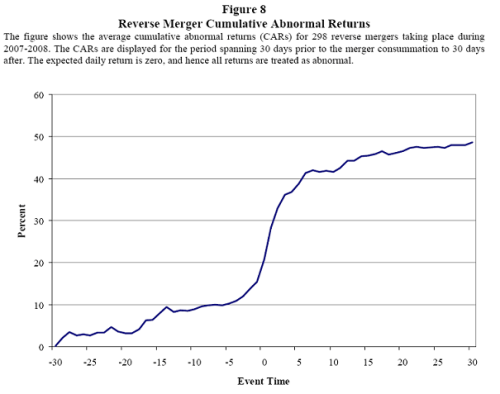
When a takeover agreement is consummated, shell company three-month abnormal returns are 48.1%.

What’s a shell?

The SEC defines any company with “no or nominal operations, and with no or nominal assets or assets consisting solely of cash and cash equivalents” as a shell company. All companies reporting to the SEC must indicate whether they declare themselves a shell company according to Rule 12b-2. Shell firms are traded either on the OTC Bulletin Board (OTCBB) or through Pink Sheets. According to the authors, “[most] shells come into existence either with the sole intent of merging with unidentified single or multiple companies (these are called virgin shells), after being created with a business plan that fails to materialize (these are called development stage shells), or after selling their operations and assets following bankruptcy (these are called natural shells).” The sole purpose of most shells is to “find a suitor for a reverse merger agreement.”

Why a reverse merger rather than an IPO?

The paper sets out five primary advantages to a reverse merger (RM) over an IPO:

First, by engaging in a RM with an existing reporting shell company, a firm can avoid having to go through the lengthy SEC review process. This can save the firm anywhere from 2-12 months. Second, less legal groundwork is needed, and therefore less legal expense. A RM typically costs $200,000 – 300,000 less than an IPO, and this does not include indirect IPO costs such as underpricing. Third, the firm does not need to time the market since a limited percentage of the total stock is typically traded in the immediate post-RM period. Many IPOs are withdrawn at the last minute due to a perceived lack of interest among investors. Fourth, the private firm’s managers don’t have to spend lots of time doing road shows. And finally, the current owners generally own a large majority of the resulting public company.

How big is the opportunity?

RMs have grown in popularity from only three in 1990 to 236 in 2008, and shell companies are providing fuel for much of this growth. Only 26 of the RMs in 2008 were between two operating companies; the other 210 were shell RMs. There are currently over 1,400 reporting shell companies in existence.

What’s a shell worth?

This is where the rubber hits the road for we deep value folk:

Shells that are already trading in the market typically sell for around $1,000,000 and virgin shells, which do not trade, sell for around $100,000 (Feldman (2006)).

Why invest in shells?

The authors found that the stock price of most shell firms “tends to decay rapidly over time. The half-life of shell share prices is 172 trading days, or about eight months.” This leads them to ask why investors continue to hold shell shares and why the number of shell firms growing:

We find that approximately half of all trading shell companies consummate a RM in a given year. Since these firms have no operations, investors must be solely attracted by an expectation of a future RM agreement.

Is that a rational expectation? You bet:

We find a three-month cumulative abnormal return of 48.1%, which far surpasses other target firm abnormal returns in the takeover literature.

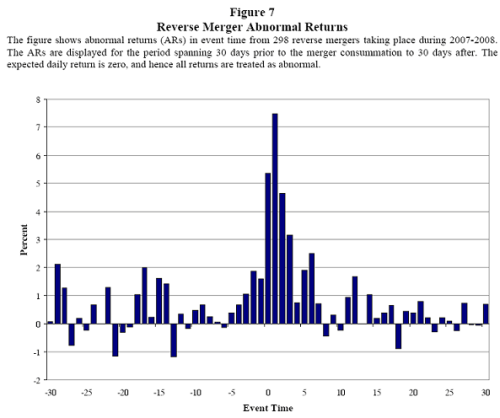
Here is a graph showing the abnormal returns for the period 30 days prior to the merger consummation to 30 days after:

Reverse merger abnormal returnsAnd a cumulative version of the same graph:
Reverse merger 2

Be careful of the longer-term performance:

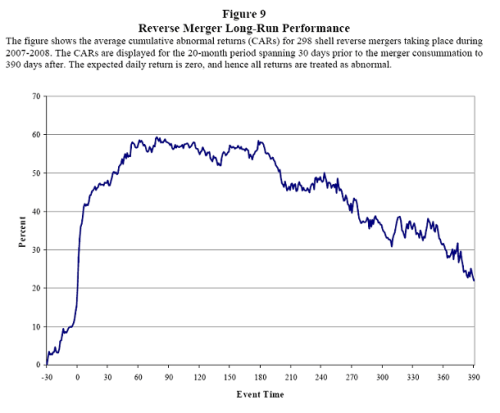
Following a RM, we find that the longer-term performance of the RM firms erases the high initial returns. The average surviving firm earns an annual post-event return of -91.2%. Shell companies engaging in RM transactions attract blockholder investment, largely from insiders or family trusts, which persists beyond lock-up periods. We find evidence suggesting that naked short-selling occurs, mainly after the lock-up period of six months, for at least one-fifth of these firms. We show that this helps explain the decline in returns that begins about nine months after the RM. We also examine liquidity and find increased trading volume and a significant decrease in the quoted spread following a RM.

Here’s a graph showing the long-run performance of the shells following a reverse merger:

Reverse merger 3

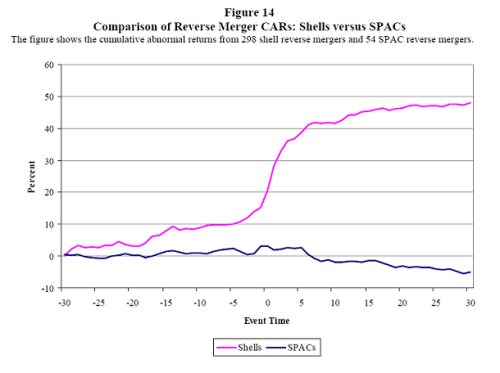
This is an interesting graph. It show a comparison of compound average returns from shells and Special Purpose Acquisition Companies (SPACs), which we previously discussed in the post, Blank checks: Fertile fishing grounds for liquidation value investors:

Shells v SPACs

Conclusion

Floros and Sapp conclude as follows:

Our results present a fascinating choice for investors. Namely, does it make sense to invest in an empty shell firm that has no assets or operations? Our results suggest that such an investment is rational as long as the probability of a RM happening soon is high. In the event of a RM deal, the shell firm returns are substantial. However, the wait can be painful. Over time, the shell burns cash to meet ongoing reporting costs and the share price tends to fall. Being able to identify shells that are more likely to consummate a deal sooner thus becomes key. Also, the extent to which shell firms are an investable alternative asset largely depends upon the depth of this rather illiquid market. Most shell firms have fewer than three market makers and trading tends to be thin and concentrated among a relatively small shareholder base. The median number of shareholders in our shell sample is 57 and on average 12% of shell outstanding shares are held by shell managers. Further, the median quoted half spread is 22.3%, showing that transaction costs for an investment in shell firms are non-trivial. We argue that the substantial average return surrounding a RM is compensation for shell stock illiquidity and the uncertainty of finding a reverse merger suitor. Further, the payoff from a shell investment is marginally sufficient to justify the growth in the number of shells alongside the growing RM industry.

Hat tip Wes and Andy.

Read Full Post »

In an August post, Applying value principles at a country level, we discussed The growth illusion, an article appearing in a Buttonwood’s notebook column of The Economist. In that article, Buttonwood argued that valuation, rather than economic growth, determined investment returns at a country or market level. Buttonwood highlighted research undertaken by Elroy Dimson, Paul Marsh and Mike Staunton from the London Business School, which suggested that chasing growth economies is akin to chasing growth stocks, and generates similarly disappointing results. Buttonwood concluded that higher valuations – determined on an earnings, rather than asset basis – led to lower returns:

What does work? Over the long run (but not the short), it is valuation; the higher the starting price-earnings ratio when you buy a market, the lower the return over the next 10 years. That is why buying shares back in 1999 and 2000 has provided to be such a bad deal.

It raised an interesting question for us: Can relative price-to-asset values be used to determine which countries are likely to provide the best investment returns? It took some time, but we’ve tracked down some research that answers the question.

In Fundamental Determinants of International Equity Returns: A Perspective on Conditional Asset Pricing (9.17MB .pdf) Journal of Banking and Finance 21, (1997): 1625-1665. (P42), Campbell Harvey and Wayne Ferson examined, among other things, the relationship between price-to-book value and future returns from a global asset pricing perspective. Harvey and Ferson found that “the price-to-book value ratio has cross-sectional explanatory power at the country level,” although they believe that its use is mainly in determining “global stock market risk exposure.”

An earlier – and slightly more readable – study by Leila Heckman, John J . Mullin and Holly Sze, Valuation ratios and cross-country equity allocation, The Journal of Investing, Summer 1996, Vol. 5, No. 2: pp. 54-63 DOI: 10.3905/joi.5.2.54, also examined the link between equity returns at a market level and valuation measures. Heckman et al found that, despite the substantial accounting differences across countries, price-to-book measures are useful for predicting the “cross-sectional variation of national index returns.”

The results are perhaps unsurprising given the various studies demonstrating the relationship between valuation determined on a price-to-earnings basis and country level returns. We believe they are useful nonetheless given the ease with which one can invest in many global markets and our own predisposition for assets over earnings valuations.

Read Full Post »

Dr. Chris Leithner has prepared a paper for the von Mises Institute, Ludwig von Mises, Meet Benjamin Graham: Value Investing from an Austrian Point of View, in which he argues that Grahamite value investors and economists from the Austrian School hold “compatible views about a range of fundamental economic and financial phenomena” and Austrian economics should therefore be compelling to value investors “because it subsumes real economic and financial events within justifiable laws of human action.”

This paper shows that value investors and Austrians hold compatible views not only about the price and value, but also about other vital economic and financial phenomena. These include risk and arbitrage; capital and entrepreneurship; and time-preference and interest. Indeed, with respect to these matters each group may have more in common with the other than each has with the mainstream of its respective field.

While we’ve never explicitly said so on this site, many of you will have guessed that we subscribe to the Austrian School of economics. We know that view is unpopular with some of our readers, but we ask that you read Leithner’s paper before inveighing in the comments or the mail bag. Leithner is the principal of Leithner & Company, a private investment company based in Brisbane, Australia, and a strict adherent to the “traditional “value” approach to investment pioneered by Benjamin Graham and adapted by his colleagues Warren Buffett, Thomas Knapp and Walter Schloss.” His paper is a tour de force on both Grahamite value investment and Austrian economics, and describes our views with a clarity that escapes us.

Set out below are some important excerpts from Leithner’s paper. The first describes the Austrian view of the operation of markets and its rejection of Efficient Market Theory, which is relevant given the discussion in the comments on Jim Hodge’s guest post several weeks ago:

A deep chasm separates the theory of entrepreneurial discovery from the mainstream model of perfect competition. To mainstream economists, the decisions to buy and sell in the market are mere mathematical derivations. A decision, in other words, is “made” by a “given” model, probability distribution and data. The mainstream model thus eliminates the real-life, flesh-and-blood decision-maker – the heart of the Austrian economics and value investing – from the market. Market automatons do not err; accordingly, it is unthinkable that an opportunity for pure profit is not instantly noticed and grasped. The mainstream economist, goes the revealing joke, does not take the $10 banknote lying on the floor because he believes that if it were really there then somebody would already have grabbed it.

In sharp contrast, Austrians recognise that decisions are taken by real people whose plans are imperfectly clear, indistinctly ranked, often internally-inconsistent and always subject to change. Further, at any given moment a market participant will be largely unaware of other market participants’ present and future plans. It is participation in the market that makes buyers and sellers a bit more knowledgeable about their own plans and slightly less unaware of others’ plans. Market participants will inevitably make mistakes; further, it is probable that they will not automatically notice them. Accordingly, it is not just possible – it is typical – that opportunities for gain (“pure profit”) appear but are not instantly detected. Recognising the obvious – namely that he has possibly been the first to notice it – the Austrian will therefore take the $10 note inadvertently dropped on the floor and ignored by his mainstream colleague. An “Austrian” act of entrepreneurial discovery, then, occurs when a market participant seeks and finds what others have overlooked.

It is important to emphasise that this discovery, like Buffett’s and Graham’s many others, did not derive from information that other buyers and sellers could not possess. These acts of entrepreneurial discovery stemmed from the alert analysis of publicly available information and the superior detection of opportunities that others had simply overlooked. On numerous occasions, Graham and his students and followers have found promising places to look and have been the first, in effect, to detect the piles of notes that others have disregarded and left lying on the floor. Anybody, for example, could have bought parts of American Express, The Washington Post, GEICO (whose enormous potential Graham was the first to find) and Coca-Cola when Mr Buffett did; but few saw what he saw, ignored the irrelevancies and reasoned so clearly. Instead, most were distracted by myriad worries – and economic and financial fallacies – and so very few followed Buffett’s lead.

In this second excerpt, Leithner discusses the Grahamite approach to investment in an uncertain world (as it ever is), and why Grahamites pay no heed to mainstream economists’ forecasts about macroeconomic aggregates such as inflation, exchange rates, joblessness, trade and budget deficits and the like:

Grahamites recognise that the future is inherently uncertain. That is to say, there is no probability distribution and there are no data that can “model” it. The future is not radically uncertain, in the sense that Ludwig Lachmann maintained, but it is largely so. Like many Austrians, Grahamites accept that one can know some things (such as historical data, relationships of cause and effect and hence the laws of economics), and therefore that to some extent the past does project into the future. Grahamites do not agree, in other words, that anything can happen; but they are acutely aware – because they have learnt from unpleasant personal experience – that the unexpected can and often does happen. They also acknowledge that forecasting the future is the job of entrepreneurs, not economists or bureaucrats, and therefore that the entrepreneur-investor-forecaster must be cautious and humble.

Market timers, commentators and mainstream economists, then, cannot foresee economic events and developments with any useful degree of accuracy. And even if they could, the aggregate phenomena upon which they fixate are typically of little interest to Grahamites. Hence value investors ignore analysts, economists and others who claim that they possess clear crystal balls. But Grahamite investors do not ignore the future per se. Quite the contrary: they plan not by making particular predictions about what will happen but by considering general scenarios – particularly pessimistic scenarios – of what might conceivably happen. They then structure their actions and investments in order to reduce the risk of permanent loss of capital in the event that undesirable eventsand developments actually occur.

Grahamites also recognise that if markets tend towards but never attain a state of equilibrium, and if profit-seeking entrepreneurs constitute the “oil” that enables the market mechanism to operate and adapt so smoothly, then over time particularly talented and shrewd and lucky entrepreneurs will tend, more often than not and relatively consistently, to accumulate capital. Less successful entrepreneurs, on the other hand, will consistently lose some – and eventually all – of their capital. It is for this reason that Grahamites search incessantly for businesses that possess consistently solid and relatively stable track records, and the demonstrated ability to surmount a variety of unexpected changes and vicissitudes.

In this final excerpt, Leithner discusses the calculation of desired rates of return, and the relationship to firm value:

On what bases, then, do Grahamites reason towards an assessment of a given security’s value? First, they assess the structure of the underlying firm’s capital and the stability of its earnings. Second, they ascertain their time preference (i.e., the extent to which they are prepared forego consumption today in order to consume more in the future) and thus their desired rate of return. Although value investors have never used the term “time preference,” embedded within the Grahamite approach to the valuation of securities is a notion of time preference and interest that is compatible with Austrian understandings of these concepts.

What is an appropriate payback period? The answer depends upon one’s time preference; and that, in turn, will vary from one investor to another. But a few general points can be made. First, a shorter payback period (i.e., a higher rate of return) is preferable to a longer one (i.e., lower rate of return). This is because the longer the time required in order to recoup an investment, the riskier that investment becomes. The longer the payback period, the more a decision to invest depends upon the veracity of its underlying assumptions, i.e., the more imperative it becomes that those assumptions correspond to reality. With each additional year of waiting, the chances increase that unforseen or uncontrollable factors – a recession, a decrease of the purchasing power of the currency, new competition, the loss of key contracts, employees and other innumerable and perhaps unimaginable factors – will decrease (or halt the rate of increase of) the size of the yearly coupon and hence prolong further the payback period.

Second, a high natural rate of interest implies a large required rate of return and a more stringent hurdle for potential investments to surmount. For example, a natural rate of 12-15% (which Leithner & Co. uses to conduct its investment operations) and a constant stream of coupons imply a payback period of 6-8 years. By that criterion, both the Telstra stock’s and the Commonwealth bond’s payback period is unacceptably long; and by this absolute, more challenging – and, to mainstream investors, virtually unknown – yardstick, neither of these securities are compelling. Since the late 1990s, in other words, wide swaths of the investment universe (i.e., most equities, bonds and real estate) have been unacceptably dear; and the five-year investment results of most mainstream investors confirm the sad consequences of buying securities at inflated prices.

Leithner’s paper is superb,and well worth reading. His explication of the concept of “capital goods” and capital, and the relationship to firm value should not be missed.

Read Full Post »

BusinessWeek aims to keep its impeccable market forecasting record intact (via BusinessInsider):

Business Week Cover

This is the seventh sign of the apocalypse.

Disclosure: Long tinned food and shot-gun shells.

Read Full Post »

We’ll be in San Diego next week for the Hedge Fund Activism and Shareholder Value Summit. If you’re going too, and you’d like to catch up, we’d love to hear from you. You can reach us at greenbackd [at] gmail [dot] com.

We’ll be posting intermittently next week, but we’ll be back to our regular schedule starting from Monday, 28 September. Hopefully we’ll have some new insights to share.

Read Full Post »

« Newer Posts - Older Posts »