Feeds:
Posts
Comments

Archive for the ‘About’ Category

I’m back from the Value Investing Congress in Las Vegas. There were a number of outstanding presentations, but, for mine, the best was Vitaliy Katsenelson’s epic presentation based on his Little Book of Sideways Markets.

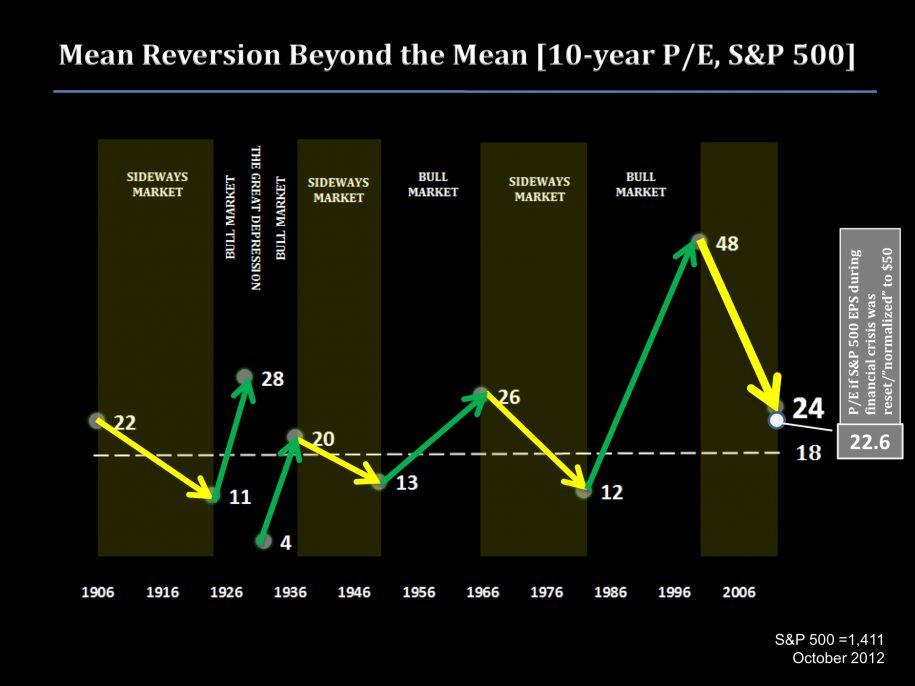
12 years into this sideways market, valuations are still 30% above the historical average, while in 1982 they were about 30% percent below average! Also, historically, stocks spent a good amount of time at below-average valuations before sideways market turned into a secular bull market.

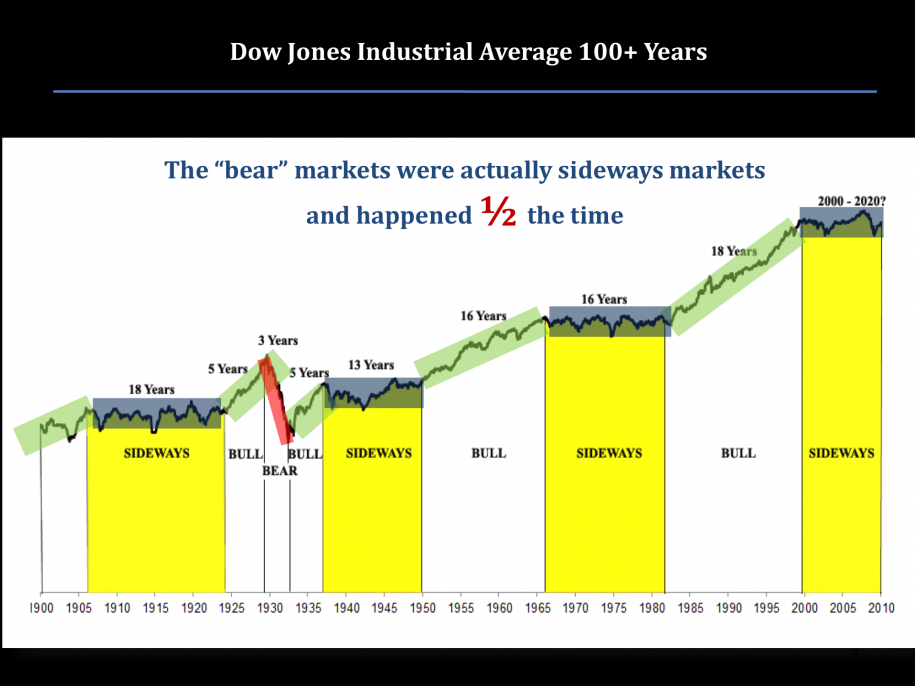
Vitaliy shows that genuine 1930s-style bear markets are rare. Most of the time the market trades sideways or up.

slide-31

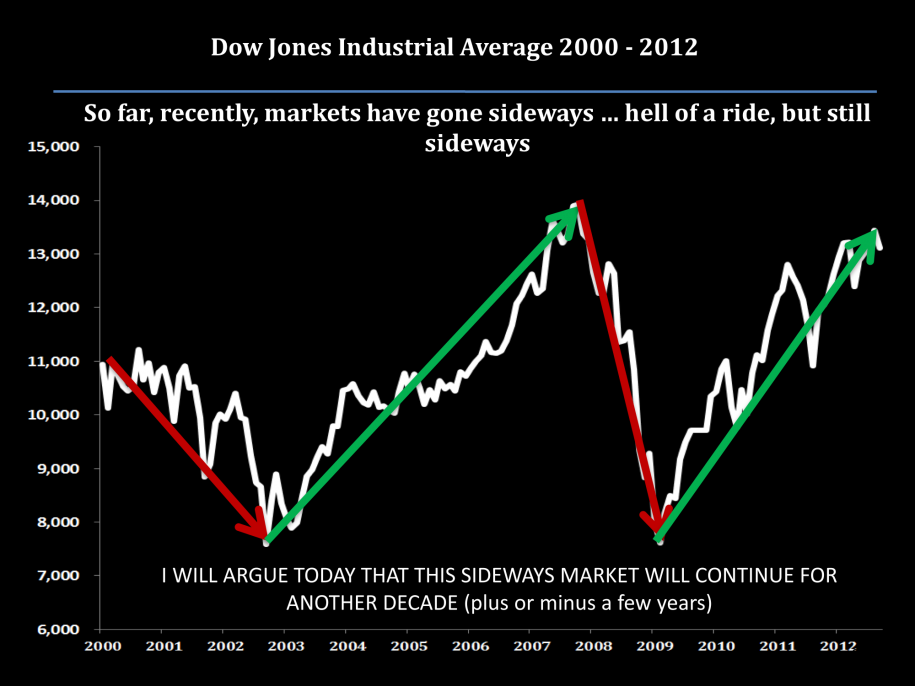
Since 2000, the market has traded sideways. Vitaliy expects this to continue for another decade:

slide-41

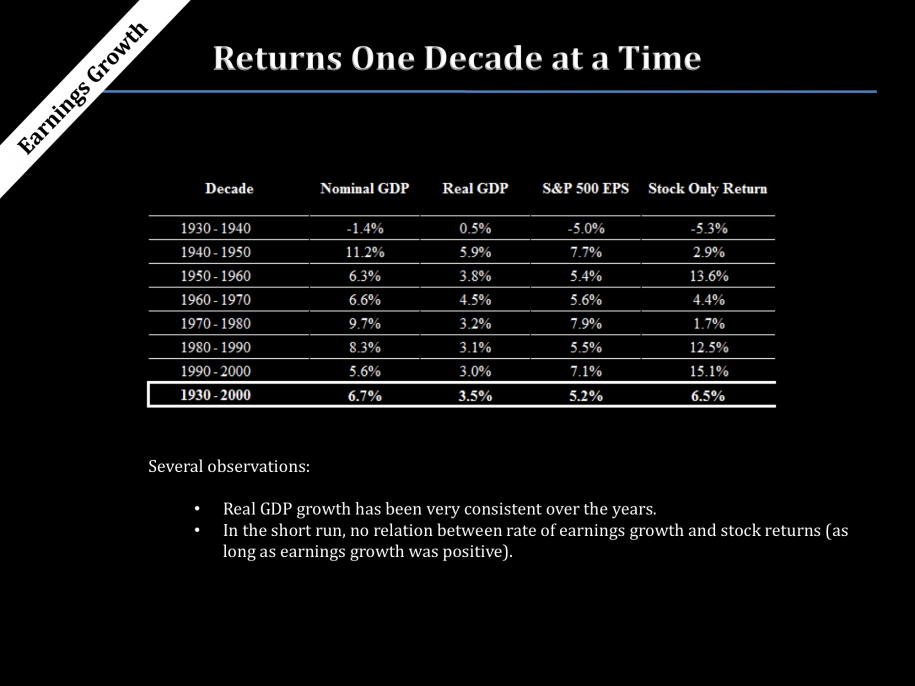
Read GDP growth has been consistent. There’s little relationship between earnings growth and stock returns.

slide-61

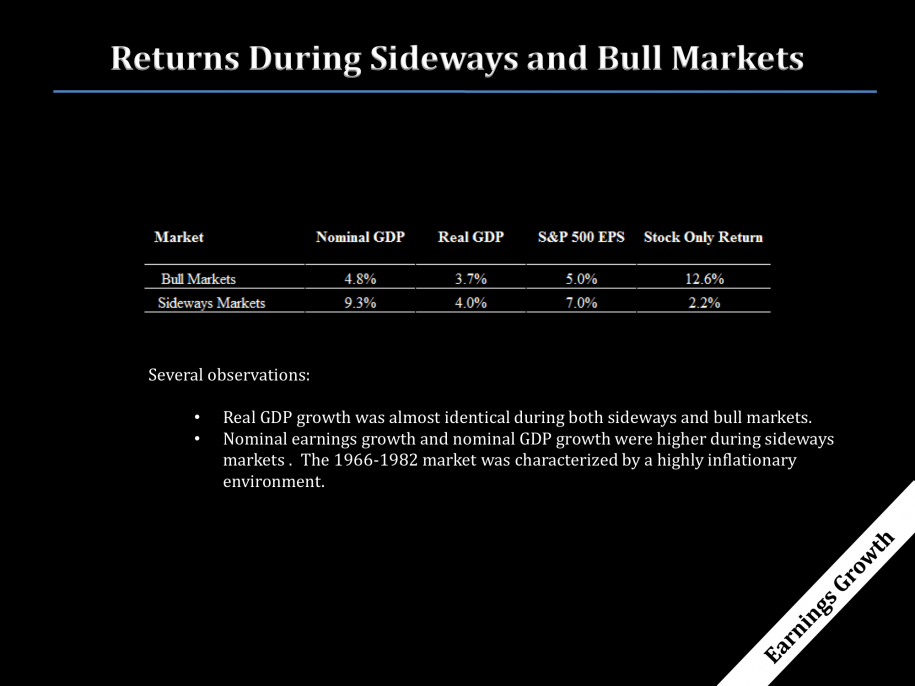
Real GDP growth is very similar in both sideways and bull markets…

slide-71

…the difference in returns is the change in valuation.

slide-121

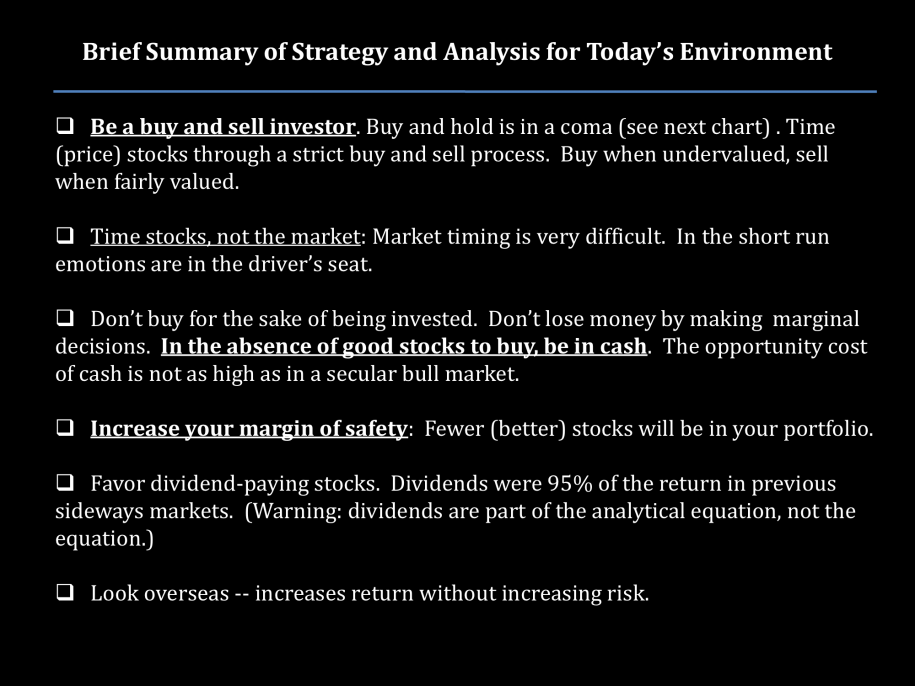
Don’t chase stocks. In the absence of good stocks, hold cash.

slide-311

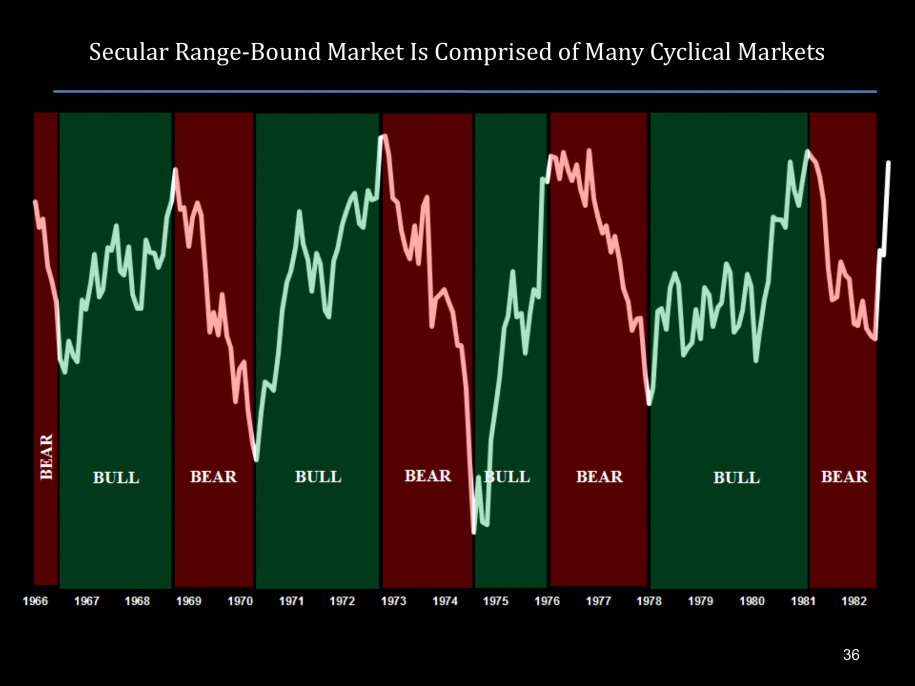
Sideways markets contain many cyclical bull and bear markets.

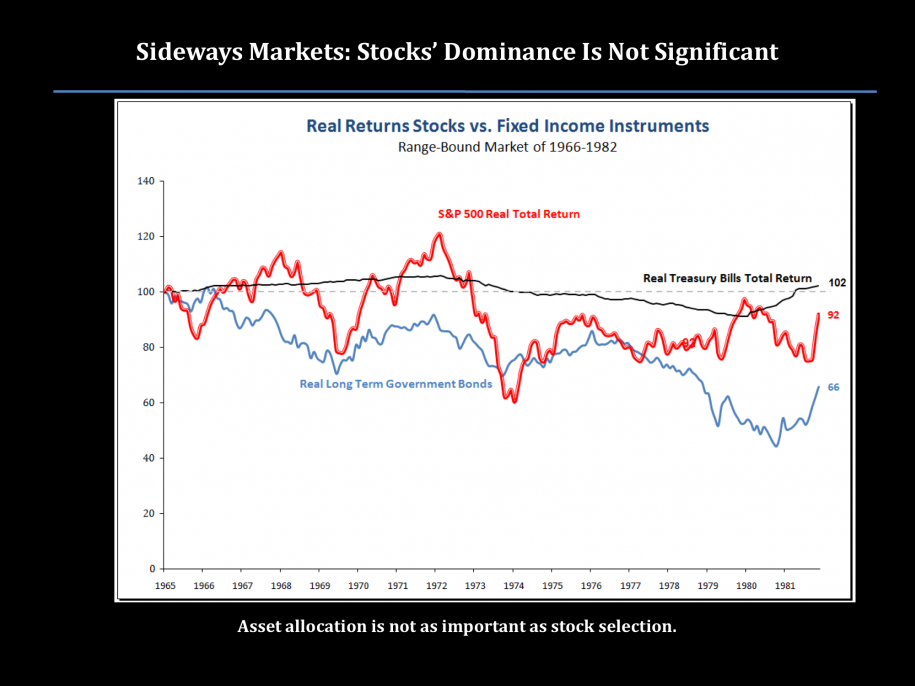
slide-321During a sideways market, asset allocation is not as important as stock selection.

slide-341


See the full presentation:

Order Quantitative Value from Wiley FinanceAmazon, or Barnes and Noble.

Click here if you’d like to read more on Quantitative Value, or connect with me on LinkedIn.

Read Full Post »

Chris Turner has a guest post at Doug Short’s Advisor Perspectives called When Warren Buffett Talks … People Listen examining Warren Buffett’s favored market valuation metric: Market Value divided by Gross National Product. (I’ve also examined market value-to-GNP several times. See Warren Buffett and John Hussman On The Stock MarketFRED on Buffett’s favored market measure: Total Market Value-to-GNPThe Physics Of Investing In Expensive Markets: How to Apply Simple Statistical Models)

Here Chris looks at the metric using the CPI deflator on both the numerator — market value — and the denominator — Gross National Product.

Here Chris calculates two fair values for the S&P 500. The blue line shows the historical mean and the green line shows Buffett’s 80 percent value estimate:

Chris comments:

Readers can see from the chart that based on both Buffett’s rule and the historical mean, the S&P would be trading much lower from present levels. The S&P would be sub 1000 based on the historical mean and around 1150 based on the 80% Buffett rule.

Read When Warren Buffett Talks … People Listen.

Order Quantitative Value from Wiley FinanceAmazon, or Barnes and Noble.

Click here if you’d like to read more on Quantitative Value, or connect with me on LinkedIn.

Read Full Post »

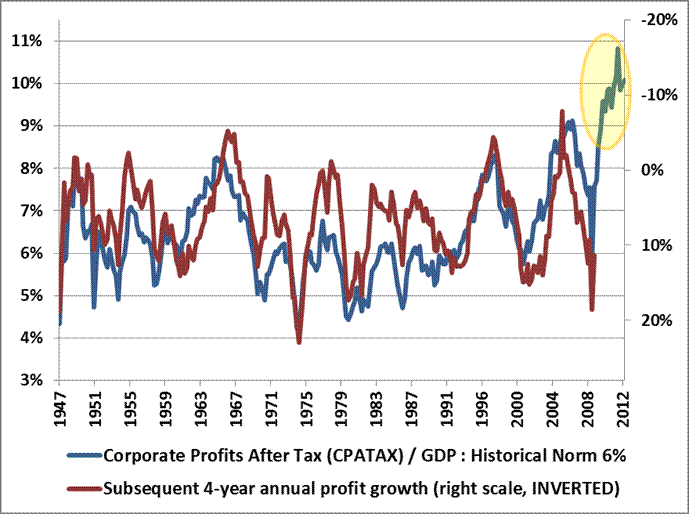
I’ve posted here regularly about the implications of mean reversion in elevated profit margins (see, for example, The Temptation To Abandon Proven Models In Speculative and Fearful Markets: Why This Time Isn’t Different, What Record Corporate Profit Margins Imply For Future Profitability and The Stock MarketWarren Buffett, Jeremy Grantham, and John Hussman on Profit, GDP and Competition). Those posts sparked some intense debate in the comments and offline about the increasing influence of foreign profits on corporate profit margins, and how this change may have permanently shifted up the mean for corporate profits as a proportion of GDP. The impact of such a structural change in the mean is twofold: First, it implies that the current cyclical extreme in the level of corporate profits as a proportion of GDP is less extreme than it appears on its face; and, second, that the ratio of corporate profits-to-GDP is less predictive as an indicator than it has been historically.

This is the chart, and the following comment, that sparked the debate:

Source: Hussman Weekly Comment “Taking Distortion at Face Value,” (April 8, 2013)

Hussman commented in relation to the chart (in Two Myths and a Legend, March 11, 2013):

In general, elevated profit margins are associated with weak profit growth over the following 4-year period. The historical norm for corporate profits is about 6% of GDP. The present level is about 70% above that, and can be expected to be followed by a contraction in corporate profits over the coming 4-year period, at a roughly 12% annual rate. This will be a surprise. It should not be a surprise.

Raj Yerasi, a money manager based in New York, has taken on the unenviable task in the following guest post of arguing the case that the increasing influence of foreign earnings on corporate profit margins means that the ratio in the chart overstates future mean reversion in earnings:

Profiting From Profits

Today more than ever the question of whether the stock market is overvalued or reasonably valued depends on whether corporate profit margins are abnormally elevated or sustainable. Some astute investors (such as Hussman and GMO) have argued in essence that the combination of record government deficit spending and unemployment levels has propped up corporate revenues while lowering labor costs, thereby boosting corporate profit margins by as much as 70 percent above historical averages. They contend that the withdrawal of fiscal stimulus as well as competitive dynamics will sooner or later cause profit margins to revert to the mean, unmasking substantial equity overvaluation.

This analysis purports to show that profits are indeed elevated above historical levels, but not nearly as much as some investors think, due to issues in the BEA’s NIPA data series they are using. Furthermore, the impact of any mean reversion in profit margins on overall equity market profits may be lower than people think.

To understand this, it is important to note that current analyses do not directly measure profit margins per se (meaning, profits divided by revenues). Rather, they measure corporate profits as a percentage of GDP, which captures not total revenues but the total value addition of corporations (along with other components). While there are multiple potential data issues in comparing profits to GDP, it nonetheless stands to reason that profits as a percentage of GDP should generally correlate with profit margins.

However, one big source of error is that the most widely known NIPA corporate profits data series, which the analyses referenced above appear to be using, represents profits generated by corporations that are considered US residents. As such, this data series includes profits generated by US companies’ international operations (e.g. Coca-Cola India, Coca-Cola China) and excludes profits generated by foreign companies’ US operations (e.g. Toyota USA). GDP, meanwhile, captures all economic activity within US borders, whether undertaken by US companies or foreign companies, and it excludes any economic activity abroad. It should be clear that one cannot compare these two metrics, since the corporate profits data series introduces profits generated by other economies and excludes profits generated by the US economy.

Since we are interested in how profit levels have changed over time, this mismatch might not matter, except that US companies’ profits from abroad have grown tremendously over the last 10 years, much more so than foreign companies’ profits from US operations:
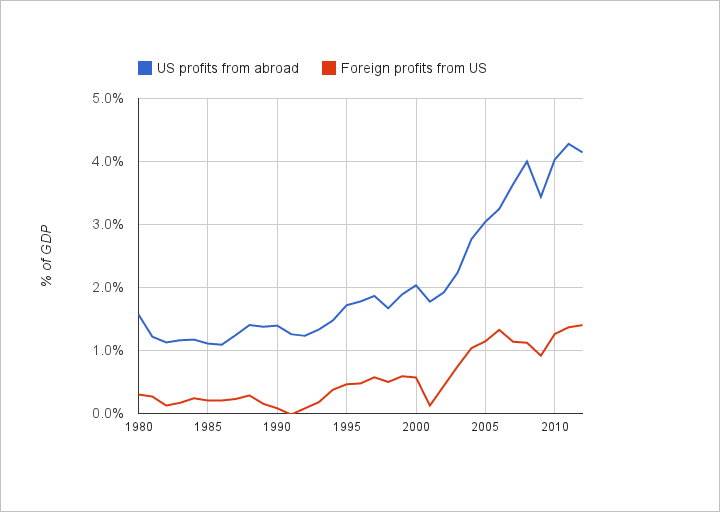


This skews the calculated profits level upwards and by an increasing amount over time, making profit levels today look exceedingly elevated.

To do the analysis correctly, we need to use data that are more apples-to-apples. Fortunately, the NIPAs do include a data series of corporate profits that simultaneously excludes US companies’ profits from abroad and includes foreign companies´ profits from US operations, called “domestic industries” profits. Comparing these profits to GDP, profit levels still appear elevated but now not as much as when using the prior “national” profits data series:
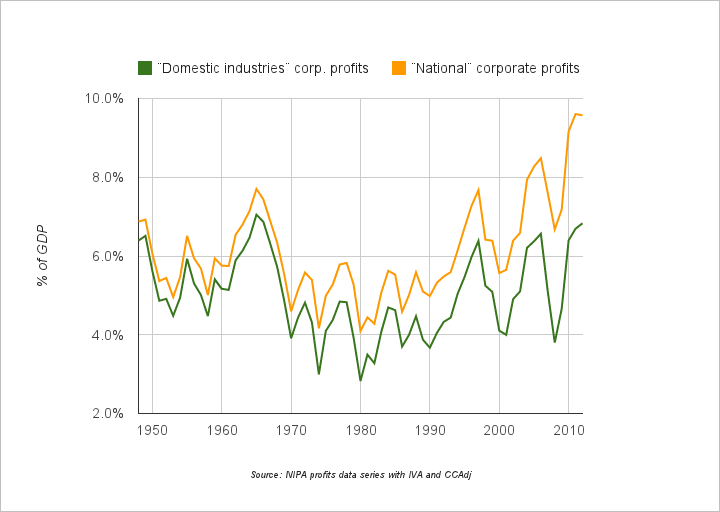


Profits now appear to be at levels matching previous highs rather than at levels far exceeding previous highs. Comparing these levels to the average level since 1948, current profit levels are 40 percent above the average, with this average including an extended contractionary period in the 70s and 80s.

It is worth noting that these percentages match very closely with those cited by Warren Buffett in his 1999 article “Mr. Buffett On The Stock Market“. If we use the 4.0 percent to 6.5 percent range that Mr. Buffett observed as a “normalcy” band, then profit levels today are about 30 percent above the midpoint of that band. That is high, no doubt, but not as terrifying as 70 percent above the average.

It is also worth noting that effective corporate tax rates are lower today than in the past. Per the NIPA data, tax rates have decreased from about 45 percent in the 80s to 40 percent in the 90s to 30 percent in recent years. Using pre-tax “domestic industries” profits as a percentage of GDP, profit levels today may be closer to 20 percent elevated relative to historical norms. One may wish to focus solely on after-tax profit levels, since in theory companies target minimum after-tax returns on capital, but on the other hand, a consumer deciding whether it’s worth paying a premium for a company’s product or service may not be affected by that company’s tax burden. The right approach could be somewhere in between.

So what are the implications of all this? The actual extent and pace of mean reversion in profit margins will depend on other factors besides fiscal consolidation and unemployment: trade deficits, credit creation, tax policy, antitrust enforcement, etc. Setting all that aside, if we assume that profit margins of domestic businesses are, say, 30 percent higher than where they should be and will be, then we also need to figure out what percentage of equity market index earnings come from domestic operations. If we assume that, say, 1/3 of index earnings are from international operations that will not be affected by mean reversion in US profits, then the total drop in index earnings might only be 15 percent (since mean reversion from a 30 percent higher level implies a 23 percent drop, but only on 2/3 of earnings).

This is not to say, of course, that the consequences of mean reversion would be evenly distributed by sector. Perhaps investors are better off taking into account mean reversion on a sector by sector basis, given that we do not seem to be looking at a scenario of plummeting earnings that will sink all boats.

Special thanks to Andrew Hodge of BEA for clarifying certain NIPA data. Any remaining misunderstandings are the author´s responsibility.

Many thanks to Raj for a well-written argument.

Hussman anticipated Raj’s argument earlier. See The Temptation To Abandon Proven Models In Speculative and Fearful Markets: Why This Time Isn’t Different for Hussman’s rejoinder.

Order Quantitative Value from Wiley FinanceAmazon, or Barnes and Noble.

Click here if you’d like to read more on Quantitative Value, or connect with me on LinkedIn.

Read Full Post »
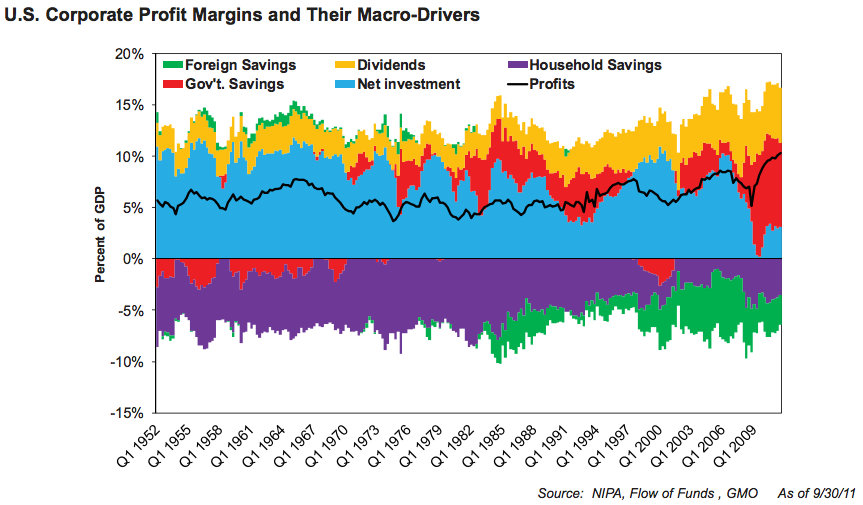
Montier Corporate Profit Margins

Source: “What Goes Up Must Come Down!” James Montier (March 2012)

In his recent piece The Endgame is Forced Liquidation John Hussman eloquently describes the reason why investors need to be wary of structural arguments intended to dispose of indicators with a very reliable cyclical record:

On the temptation to disregard proven indicators

As a side-note, it’s important for investors to be wary of “structural” arguments intended to discard indicators that have very reliable cyclical records. For example, hardly a day goes by that we don’t see an attempt to harness some long-term structural factor, such as increasing globalization of trade, to explain away the spike in profit margins over the past few years – in the hope of proving that these margins will be permanent this time. Some of these arguments are discussed in recent weekly comments. But these factors don’t explain the cyclical fluctuations in profit margins at all, and can’t be used to discard the accounting relationships and decades of evidence that corporate profits have a strong secular and tight cyclical mirror-image relationship with the combined total of government and household savings.

Investors get themselves in trouble when they embrace “new economy” theories not because those new theories can be demonstrated in the data; not because existing approaches fail to fully explain the subsequent historical outcomes; but solely because time-tested approaches suggest uncomfortable outcomes in the present instance.

The same sort of structural second-guessing is evident in the gold market here – a good example of what forced liquidation looks like, as my impression is that leveraged longs have been forced into a fire-sale in recent weeks, creating good values for longer-term investors, but with continued near-term risks.  If we look at the ratio of gold prices to the Philadelphia gold index (XAU), we do believe there are structural factors that affect that ratio (primarily the increasing cost of extracting gold over time). But these don’t explain away or eliminate the strong cyclical relationship between the gold/XAU ratio and subsequent returns on the XAU over the following 3-4 year periods. So while we don’t believe that the record high gold/XAU ratio can be taken entirely at face value, there’s no question that it is elevated even on a cyclical basis (that is, even allowing for a gradual structural increase over time), and there’s no question in the data that cyclically elevated gold/XAU ratios have been associated with strong subsequent gains in the XAU index over a 3-4 year period on average, though certainly not without risk or volatility.

As a final example, some analysts (such as the Dow 36,000 authors) have argued that the proper risk premium on stocks, relative to Treasury securities, should be zero. This line of argument was used in 2000 to suggest that stocks were still cheap despite high apparent valuations. But this “secular” argument for high valuations ultimately did not weaken the long-term evidence and tight cyclical relationship between valuations and subsequent market returns. Despite all the new economy arguments about productivity growth,  the internet, globalization, the great moderation, and the outdated relevance of risk premiums, stocks still went on to lose half their value over the next two years, and to produce negative returns over the decade that followed.

The bottom line is that it becomes very tempting – both in speculative markets and fearful ones – to discard well-proven indicators as meaningless by arguing that some “structural” change in the market or the economy makes things different this time. True, those arguments can sometimes be used to explain very long-term changes in the level of an indicator. But even then, new economy arguments are typically ineffective at explaining away the informative cyclical variations in good indicators. Be particularly hesitant about ignoring indicators whose cyclical variations have been effective even in recent data, as is true of the ability of time-tested valuation approaches to explain subsequent 10-year market returns even during the period since the late-1990’s, and the ability of government and household savings to tightly explain cyclical swings in profit margins and subsequent profit growth, even in the most recent economic cycle.

Order Quantitative Value from Wiley FinanceAmazon, or Barnes and Noble.

Click here if you’d like to read more on Quantitative Value, or connect with me on LinkedIn.

h/t Joe

Read Full Post »

Corporate profit margins are presently 70 percent above the historical mean going back to 1947, as I’ve discussed earlier (see, for example, Warren Buffett, Jeremy Grantham, and John Hussman on Profit, GDP and Competition). John Hussman attributes it to the record negative low in combined household and government savings:

The deficit of one sector must emerge as the surplus of another sector. Corporations benefit from deficit spending despite wages at record lows as a share of economy.

John Hussman spoke recently at the 2013 Wine Country conference. Here he describes the relationship between corporate profits, and government, and household savings (starting at 22.08):

Hussman’s whole talk is well worth hearing.

Order Quantitative Value from Wiley FinanceAmazon, or Barnes and Noble.

Click here if you’d like to read more on Quantitative Value, or connect with me on LinkedIn.

h/t Meb Faber

Read Full Post »

headerBkgnd

We wrote an article for the April issue of Value Investing Letter giving an overview of Quantitative Value, discussing the quantitative value model outlined in the book, and applying it to Apple Inc. (AAPL). It’s been smashed up since then, and there was also some big news yesterday — which is that AAPL is going to return $100 billion to its shareholders by the end of 2015 — so I’m highlighting it here. To put that $100 billion capital return in context, AAPL closed Tuesday with a market capitalization of $380 billion. Incredibly, its $145 billion cash pile won’t shrink because the new buyback brings its return of capital up to about the level of its current free cash flow. Weirdly, it’s now regarded as the “animal investors like least: a slow-growing tech stock.” From our earlier article:

We ran our model on March 13, 2013, finding Apple Inc. (AAPL) to be one of the highest quality stocks in the bargain bin. AAPL designs, manufactures and markets a variety of mobile devices, including the iPhone, iPad, and iPod, along with Mac products, operating systems, cloud products, related software and services, and many other products. Its devices are ubiquitous, and are catnip to consumers, driving one of the most valuable brands in the world. Why has the company shed over a third of its market capitalization since peaking near $700 per share in September of 2012?

In short, this former hedge fund darling has become the company that everyone loves to hate. iPod and Mac sales are down from last year. The media has pounced on reports of weakness in the sale of the iPhone 5 and now questions whether AAPL will be competitive with the newest smartphones. The market did not react well to AAPL’s latest earnings announcement, and dozens of analysts have reduced their price targets over the past few months. So what’s going on here? Is AAPL again headed for the technology dustbin of history? Or might this be a manifestation of investors’ behavioral bias?

Our model leads us to believe that AAPL offers exceptional franchise characteristics and is statistically cheap, with an EBIT/TEV yield of nearly 21 percent, which is among the very cheapest within the cheapest decile of stocks in the market. Below are some additional highlights from the quantitative output of our screens, which will give the reader a high-level view of the company’s profile, and then we will dig deeper on some details. Clearly, the fact that Mr. Market is offering us a company of this quality at this price should raise some questions.

AAPL Summary Statistics (As At March 13, 2013)

(Click to enlarge)

AAPL

To continue reading the article please click here.

Buy my book Deep Value: Why Activist Investors and Other Contrarians Battle for Control of Losing Corporations (hardcover or Kindle, 240 pages, Wiley Finance) from Wiley Finance, Amazon, or Barnes and Noble.

Here’s your book for the fall if you’re on global Wall Street. Tobias Carlisle has hit a home run deep over left field. It’s an incredibly smart, dense, 213 pages on how to not lose money in the market. It’s your Autumn smart read. –Tom Keene, Bloomberg’s Editor-At-Large, Bloomberg Surveillance, September 9, 2014.

Click here if you’d like to read more on Deep Value, or connect with me on Twitter, LinkedIn or Facebook. Check out the best deep value stocks in the largest 1000 names for free on The Acquirer’s Multiple.

No position.

Read Full Post »

Value Line’s Median Appreciation Potential (VLMAP) 2009

3to5year4yrchart10-8-10

Marketwatch’s Mark Hulbert has a great article Finding the best four-year market forecaster examining Value Line’s Median Appreciation Potential (VLMAP), which is the median three-to-five year gain that Value Line’s analysts estimate for the 1,700 stocks they cover.

From Value Line October 2010 update:

The estimate of the median price appreciation potential is found by first calculating the percentage change between the current price of each stock in our universe and the middle of its 3- to 5-year Target Price Range. These figures are then arrayed, and the median price appreciation potential is determined. We select the median of the array (the middle) as the most likely price, in order to play down the effect of outliers, that is, excessively large or small percentage price changes.

The chart included [above] depicts the results of those projections from 1983 to 2009, using the Value Line Arithmetic Index as our measure of the market. The actual price is taken as the average of the middle year of the 3- to 5-year forecast, so that a projection made at the end of 1983 would be compared to the average price of the index in 1987. Accordingly, we are comparing actual results to a 3 ½ year forecast.

Those who follow the VLMAP often adjust it downward when translating it into a forecast because Value Line’s analysts — like most of Wall Street (see my post on forward earnings) — are on average too optimistic. Note that the 2009 projection has turned out to be roughly right:

Our estimate for the year 2009 (made at the end of 2005) was 2683. The average price of the Value Line Arithmetic Index in 2009 was 1758. The large deviation arises from the effects of the recession that followed in the wake of the financial turmoil in late 2008 and early 2009. Meanwhile, the average deviation between the projected and actual average prices during this period was 18% (ignoring signs). The median deviation during this period was 11%. The projection for 2013 now stands at 3500. The 4-year projected price of 3500 now stands at 40% above the current level—suggesting respectable returns for patient investors.

The market closed Friday at 3,444. Why does this model work so well?

Mark Robertson, founder and managing partner of the Detroit-based advisory service Manifest Investing, also uses a version of the VLMAP. He thinks one answer lies in the willingness of Value Line’s analysts to focus on a longer-term horizon than is typical for most Wall Street analysts.

It may seem “counterintuitive,” he acknowledges, but “long-term forecasting is actually easier and more accurate than the quarterly whispering and chasing that we see from and on Wall Street.”

Because they are focusing on where the stocks they follow will be trading in three- to five-years’ time, Value Line’s analysts are less likely to get swept away by whatever mood has captured Wall Street’s attention, Robertson says.

Compared with analysts who focus on just the next couple of quarters, for example, Value Line’s are less likely to adjust their price targets based on the latest earnings. This makes them less inclined to get more bullish as the market goes higher — a tendency that leads to being excessively bullish at market tops.

Over the past five years the VLMAP has been as low as 45 percent and as high as 185 percent. It currently stands at 50 percent, which is close to the five-year low and only slightly higher than the 35 percent estimate logged in the weeks leading up to the bull-market high in October 2007.

Read Finding the best four-year market forecaster.

Order Quantitative Value from Wiley FinanceAmazon, or Barnes and Noble.

Click here if you’d like to read more on Quantitative Value, or connect with me on LinkedIn.

Read Full Post »
Ratio of Corporate Profits-to-GDP and Returns (1947 to Present)

Source: Hussman Weekly Comment “Taking Distortion at Face Value,” (April 8, 2013)

Warren Buffett, 1999

[F]rom 1951 on, the percentage settled down pretty much to a 4% to 6.5% range.

In my opinion, you have to be wildly optimistic to believe that corporate profits as a percent of GDP can, for any sustained period, hold much above 6%. One thing keeping the percentage down will be competition, which is alive and well.

— Warren Buffett, Mr. Buffett on the Stock Market (November 1999)

Jeremy Grantham, 2006

Profit margins are probably the most mean-reverting series in finance, and if profit margins do not mean-revert, then something has gone badly wrong with capitalism. If high profits do not attract competition, there is something wrong with the system and it is not functioning properly.

— Jeremy Grantham, Barron’s (c. 2006), via Katsenelson, The Little Book of Sideways Markets.

John Hussman, 2013

In general, elevated profit margins are associated with weak profit growth over the following 4-year period. The historical norm for corporate profits is about 6% of GDP. The present level is about 70% above that, and can be expected to be followed by a contraction in corporate profits over the coming 4-year period, at a roughly 12% annual rate. This will be a surprise. It should not be a surprise.

— John Hussman, Two Myths and a Legend (March 11, 2013)

h/t Butler|Philbrick|Gordillo and Associates

Order Quantitative Value from Wiley FinanceAmazon, or Barnes and Noble.

Click here if you’d like to read more on Quantitative Value, or connect with me on LinkedIn.

Read Full Post »
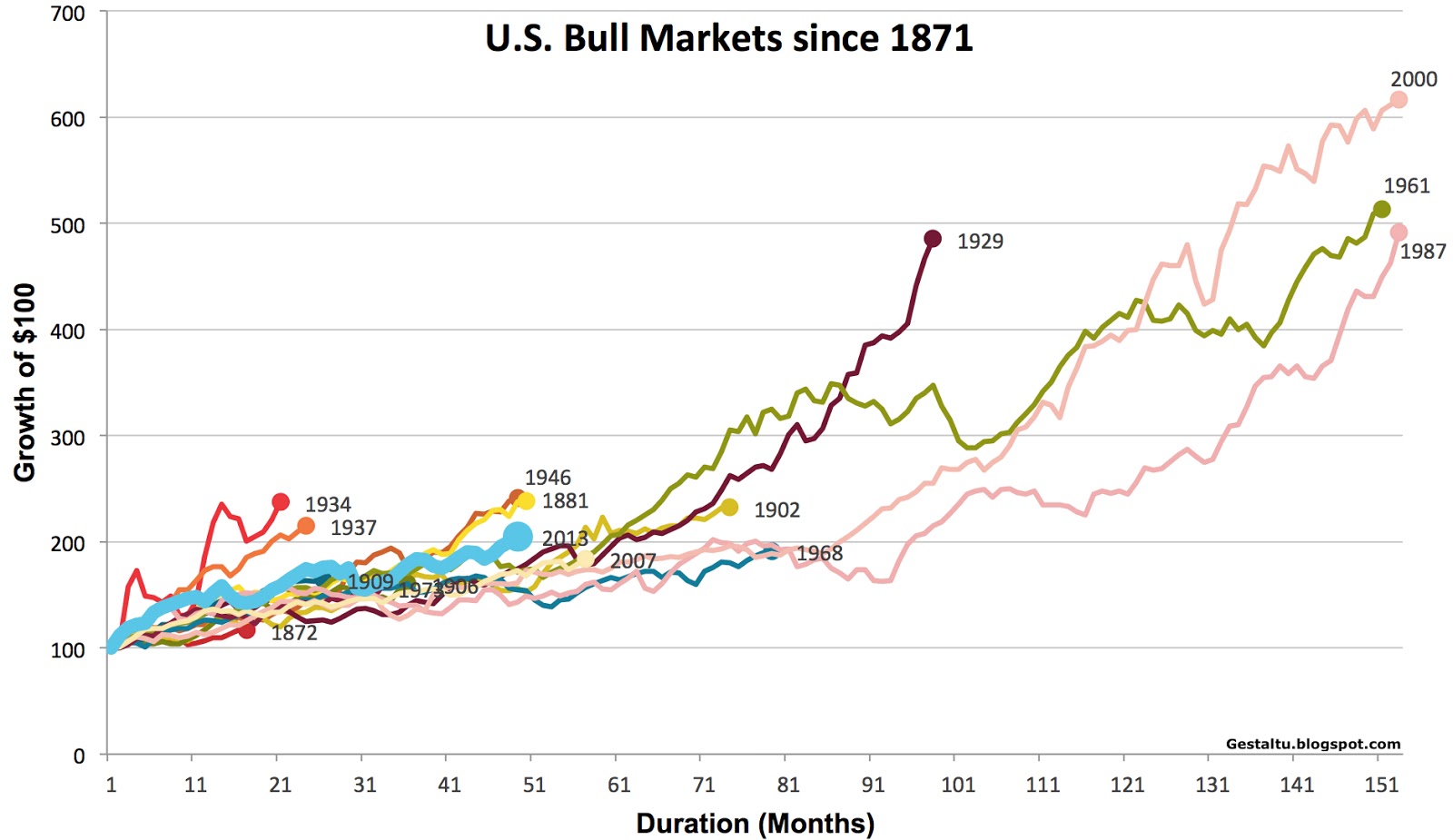
Butler|Philbrick|Gordillo and Associates have an interesting post called What the Bull Giveth, the Bear Taketh Away on the duration and magnitude of all bull and bear market periods in U.S. stocks since 1871.

For the purpose of the study below, we examined the S&P 500 price series from Shiller’s publicly available database to understand the duration and magnitude of all bull and bear market periods in U.S. stocks since 1871. We defined a bear market as a drop in prices of at least 20% from any peak, and which lasted at least 3 months. Bull markets were then defined as a rise of at least 50% from the bottom of a bear market, over a period lasting at least 6 months.

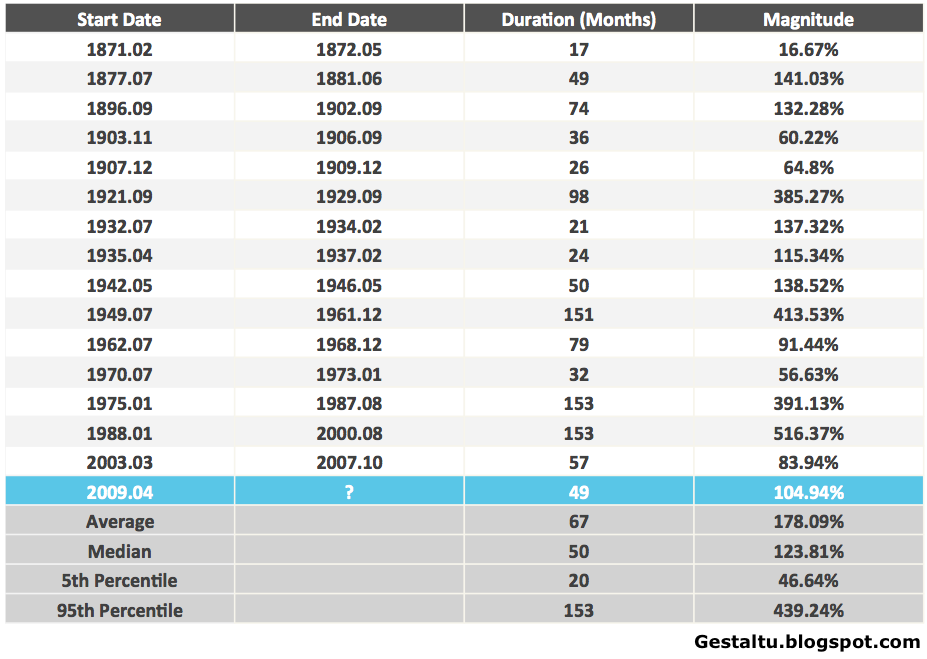
Chart 1 and Table 1 describe every bull market since 1871 in the S&P, including duration and magnitude information. The lesson from this analysis is uninspiring for equity bulls, as we will see. The core hurdle is that the current bull market has (through end of February) already delivered 105% of gains, against the median 124% bull market run through history (using monthly data). Of course, this means that, should this bull market deliver an average surge, investors can hope for less than 20% more growth from this cycle. Further, given that the median bull market has historically lasted 50 months, and we are currently in our 49th bull month, we are about due for a wipeout.

Chart 1. Bull Markets since 1871

Source: Shiller (2013)

Table 1. Bull Markets since 1871 – Statistics

Source: Shiller (2013)

The current bull market has already delivered 85 percent of the gains, and lasted about as long, as the median historical bull market.

Read What the Bull Giveth, the Bear Taketh Away for the bear market equivalents of the preceding bull table and chart. Butler|Philbrick|Gordillo and Associates demonstrate that, if it follows the median bear market, it will wipe out 38 percent of all prior gains.

Buy my book The Acquirer’s Multiple: How the Billionaire Contrarians of Deep Value Beat the Market from on Kindlepaperback, and Audible.

Here’s your book for the fall if you’re on global Wall Street. Tobias Carlisle has hit a home run deep over left field. It’s an incredibly smart, dense, 213 pages on how to not lose money in the market. It’s your Autumn smart read. –Tom Keene, Bloomberg’s Editor-At-Large, Bloomberg Surveillance, September 9, 2014.

Click here if you’d like to read more on The Acquirer’s Multiple, or connect with me on Twitter, LinkedIn or Facebook. Check out the best deep value stocks in the largest 1000 names for free on the deep value stock screener at The Acquirer’s Multiple®.


Read Full Post »

Butler|Philbrick|Gordillo and Associates’ argue in Valuation Based Equity Market Forecasts – Q1 2013 Update that “there is substantial value in applying simple statistical models to discover average estimates of what the future may hold over meaningful investment horizons (10+ years), while acknowledging the wide range of possibilities that exist around these averages.”

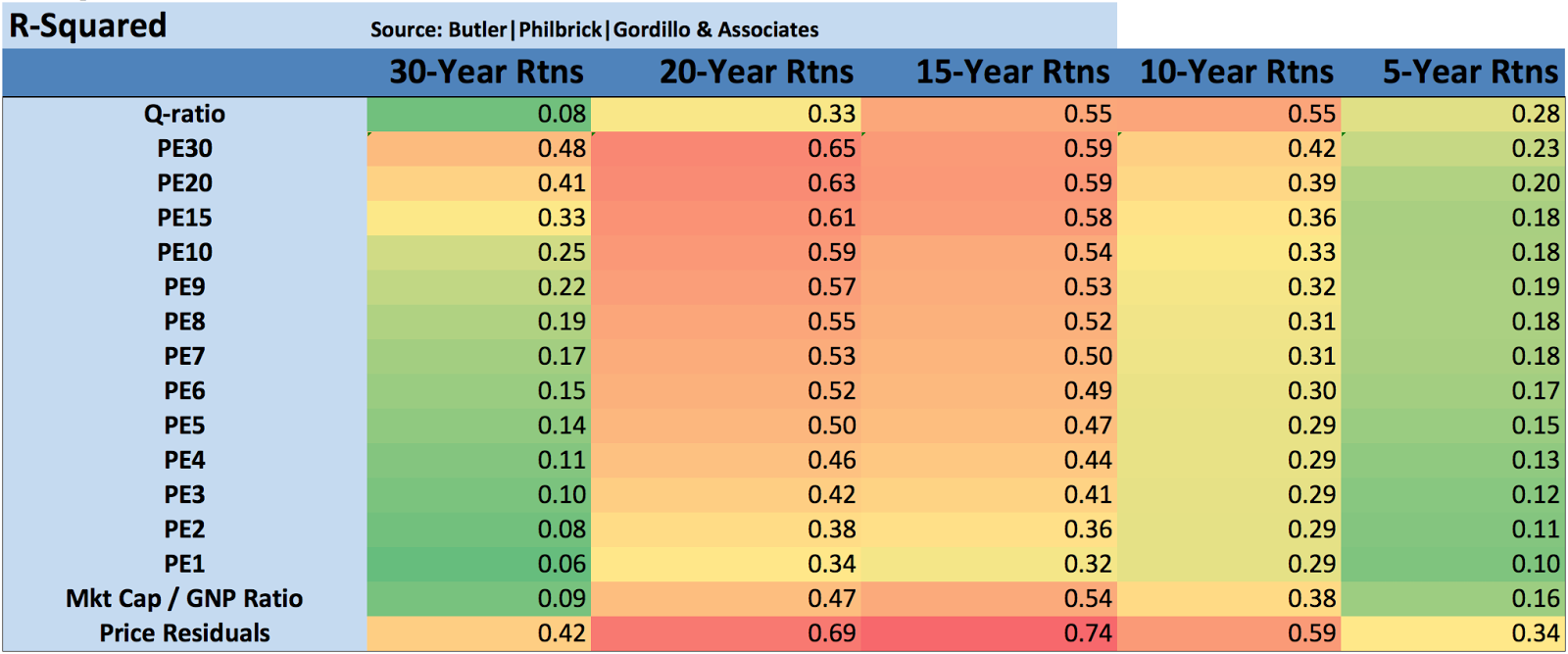
Butler|Philbrick|Gordillo use linear regression to examine several variations of the Shiller PE (and other cyclically adjusted PE ratios over periods ranging from one to 30 years), Tobin’s q ratio and Buffett’s total market capitalization-to-gross national product ratio (“TMC/GNP”). They have analyzed the power of each measure to explain inflation-adjusted stock returns including reinvested dividends over subsequent multi-year periods, setting their findings out in the following matrix:

Matrix 1. Explanatory power of valuation/future returns relationships

Source: Shiller (2013), DShort.com (2013), Chris Turner (2013), World Exchange Forum (2013), Federal Reserve (2013), Butler|Philbrick|Gordillo & Associates (2013).
Butler|Philbrick|Gordillo comment:
Matrix 1. contains a few important observations. Notably, over periods of 10-20 years, the Q ratio, very long-term smoothed PE ratios, and market capitalization / GNP ratios are equally explanatory, with R-Squared ratios around 55%.  The best estimate (perhaps tautologically given the derivation) is derived from the price residuals, which simply quantify how extended prices are above or below their long-term trend.The worst estimates are those derived from trailing 12-month PE ratios (PE1 in Matrix 1 above). Many analysts quote ‘Trailing 12-Months’ or TTM PE ratios for the market as a tool to assess whether markets are cheap or expensive. If you hear an analyst quoting the market’s PE ratio, odds are they are referring to this TTM number. Our analysis slightly modifies this measure by averaging the PE over the prior 12 months rather than using trailing cumulative earnings through the current month, but this change does not substantially alter the results.As it turns out, TTM (or PE1) Price/Earnings ratios offer the least information about subsequent returns relative to all of the other metrics in our sample. As a result, investors should be extremely skeptical of conclusions about market return prospects presented by analysts who justify their forecasts based on trailing 12-month ratios.

Butler|Philbrick|Gordillo note:

Our analysis provides compelling evidence that future returns will be lower when starting valuations are high, and that returns will be higher in periods where starting valuations are low.

So where are we now? Table 1 below from the post provides a snapshot of some of the results from Butler|Philbrick|Gordillo’s analysis. The table shows estimated future returns based on an aggregation of several factor models over some important investment horizons:

Table 1. Factor Based Return Forecasts Over Important Investment Horizons

Source: Shiller (2013), DShort.com (2013), Chris Turner (2013), World Exchange Forum (2013), Federal Reserve (2013), Butler|Philbrick|Gordillo & Associates (2013)

Butler|Philbrick|Gordillo note that:
You can see from the table that, according to a model that incorporates valuation estimates from 4 distinct domains, and which explains over 80% of historical returns since 1871, stocks are likely to deliver 1% or less in real total returns over the next 5 to 20 years. Yikes.

They conclude:

[T]he physics of investing in expensive markets is that, at some point in the future, perhaps years from now, the market has a very high probability of trading back below current prices; perhaps far below.

The post is a well-researched, and comprehensive analysis of several long-term market-level valuation measures. It is a worthy contribution to the research in this area. Read Valuation Based Equity Market Forecasts – Q1 2013 Update.

Order Quantitative Value from Wiley FinanceAmazon, or Barnes and Noble.

Click here if you’d like to read more on Quantitative Value, or connect with me on LinkedIn.

Read Full Post »
« Newer Posts - Older Posts »