Feeds:
Posts
Comments

Archive for the ‘About’ Category

In MarketBeat’s Stocks Too Cheap? Or Earnings Estimates Too Rosy? (subscription required), Matt Phillips has an interesting article on forward price-to-earnings ratios:

The forward-earnings in question are really consensus forward-earnings estimates, churned out by Wall Street’s broker dealers,  the so-called “sell side.” And the “sell-side” as a whole tend to be a bullish bunch.

Phillips takes Oppenheimer Asset Management analysts to task for their Monday report:

With that in mind, we turn to the question of whether stocks are cheap right now, or not. Some look at the numbers and argue, of course they are.  On a price-to-forward-earnings basis, you can make that argument. Oppenheimer Asset Management analysts did so Monday. They write:

The S&P 500’s current forward multiple of 12.9x represents the lowest level for the index since early 1995. According to our analysis, market performance has been relatively strong in all periods following similar forward P/E levels. The S&P 500 averaged a roughly 12% 12-month return in all periods since 1960 when the forward P/E was between 10x and 15x.

In the same note, Oppenheimer says that some clients are starting to wonder whether analyst expectations being too high could be the reason stocks look so cheap. “Based on our client conversations, there appears to be a growing concern that 2010 earnings expectations have become too optimistic and that forward price multiples are thereby understated,” Oppenheimer writes. Oppenheimer analysts counter this concern saying the firm doesn’t “find earnings expectations out of context from a normalized growth perspective,” writing that after a recession as sharp as the one we had, it’s reasonable to expect the earnings growth rate to be a bit higher than usual as the economy recovers.

Phillips points to Robert Shiller’s calculation of Graham’s P/E10 ratio as evidence that stocks are not be as cheap as Oppenheimer’s one-year forward estimates might have us believe:

Prof. Shiller tracks P/E ratios back to the 19th century, smoothing out short-term ups and downs in profits by using a 10-year earnings average. Even after the May declines, his P/E ratio still is almost 20, well above the historical average of about 16.
Read Full Post »

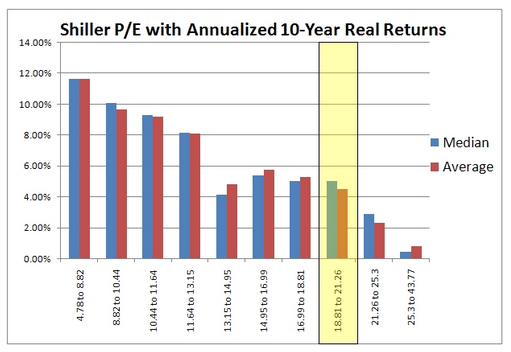
Mebane Faber has an interesting analysis of the expected ten-year annualized real returns to investors in the various Shiller / Graham P/E10 deciles:

I’ve discussed the Graham / Shiller PE10 metric before (see my April 9 post Graham’s PE10 ratio). In that article, Doug Short described the PE10 ratio thus:

Legendary economist and value investor Benjamin Graham noticed the same bizarre P/E behavior during the Roaring Twenties and subsequent market crash. Graham collaborated with David Dodd to devise a more accurate way to calculate the market’s value, which they discussed in their 1934 classic book, Security Analysis. They attributed the illogical P/E ratios to temporary and sometimes extreme fluctuations in the business cycle. Their solution was to divide the price by the 10-year average of earnings, which we’ll call the P/E10. In recent years, Yale professor Robert Shiller, the author of Irrational Exuberance, has reintroduced the P/E10 to a wider audience of investors. …  The historic P/E10 average is 16.3.

I assume that the 8th decile – the decile highlighted by Mebane – is the decile in which the market presently sits (although it’s right on the threshold between the 8th and the 9th decile). This would suggest that the median expected annualized real return for the market over the next decade is between 3% and 5%. Not great, but better than it was in April, when Dylan Grice was anticipating returns of 1.7%.

Read Full Post »

Jon Heller at Cheap Stocks has a great post on The Downside of Net/Net Investing- Lazare Kaplan (LKI). Says Jon:

In July of 2009,we initiated a new position in the $1.15 range. The shares subsequently ran up to $2.50, but in September, trading was halted,and not a share has traded since.

The company has repeatedly delayed filing it’s financial reports with the SEC, due to:

a material uncertainty concerning (a) the collectability and recovery of certain assets, and (b) the Company’s potential obligations under certain lines of credit and a guaranty (all of which, the “Material Uncertainties”).

The NYSE AMEX granted the company several extensions to regain compliance; the latest on April 26th, which gave the company until May 31st to regain compliance with listing standards.

Pretty standard fare in net net world. Here’s where the going gets weird. LKI is a diamond vendor. It seems that it has been in a trading halt because some of its diamonds have gone missing. Quite a few of them. When the going gets weird, as Hunter S. Thompson used to say before he was shot out of a cannon, the weird turn pro: LKI is suing its insurers for $640M. From the May 20 press release:

LAZARE KAPLAN INTERNATIONAL SUES ITS INSURERS FOR $640 MILLION

New York, NY – May 20, 2010 – Lazare Kaplan International Inc. (AMEX:LKI) (“Lazare Kaplan”) announced today that in a federal lawsuit filed on Monday, May 17, 2010, it sued various Lloyds of London syndicates and European insurers for $640 million in damages arising out of the disappearance of diamonds that were insured by the defendants, including consequential damages. The lawsuit alleges that the insurers breached two “all risk” New York property insurance policies, and an Agreement for Interim Payment under which the insurers made a non-refundable interim payment of $28 million to Lazare Kaplan in January of this year. After making the $28 million payment, the insurers abruptly reversed course and refused to acknowledge coverage or to pay any covered losses under the policies. The complaint alleges, among other things, that the insurers, which also issued separate policies to Lazare Kaplan under English law, created a virtual coverage “whipsaw” by denying coverage under the English policies on the ground that Lazare Kaplan does not have an insurable interest in the largest portion of the property at issue while at the very same time asserting under the New York policies that there is no coverage because Lazare Kaplan insured the same property under the English policies. Lazare Kaplan expects to conduct broad-ranging discovery around the world in the course of the lawsuit.

Jon asks the obvious questions:

What happened to the diamonds? Why isn’t the company willing to speak with it’s shareholders on the issue? Why are the insurers unwilling to pay? And again, what happened to the diamonds?

This is why investing in net nets will always be pure Gonzo investing. Even though the situation with the missing diamonds is ugly, if LKI trades again it might be an interesting lottery ticket. With a market capitalization of $21M, success in the $640M suit represents a 30:1 payout.

Read Full Post »

Jason Zweig has unearthed an original typewritten text of a speech Benjamin Graham gave in San Francisco one week before John F. Kennedy was assassinated. Says Zweig:

In this brilliant presentation, Graham explores how an investor should go about determining whether the market is overvalued, how to tell what asset allocation is right for you, and how to pick stocks wisely. This speech is a rare opportunity to see the workings of Graham’s mind in the raw.

Click here to see “A rediscovered Graham Masterpiece” at Jason’s site.

Read Full Post »

Mario Gabelli has long been criticized for his outsized remuneration at Gamco Investors Inc (NYSE:GBL). In 2005, a large investor in Gabelli Group Capital Partners, or G.G.C.P., Gabelli’s private company, sued him for, among other things, “looting the assets of the company.” According to this New York Times article, document disclosure in the case revealed that Gabelli “pays himself 20 percent of G.G.C.P.’s pretax revenue as a “management fee.” As recently as yesterday, the Wall Street Journal noted in its “Heard on the Street” column (subscription required):

… Mr. Gabelli’s compensation package has been a severe drag on earnings. In 2008, Gamco’s assets fell by a third and net income totaled $25 million. Even so, Mr. Gabelli received $46 million in cash compensation, 13 times as much as the second-highest-paid executive.

Gamco took an activist position in Biglari Holdings Inc (NYSE:BH) back when it was the humble Steak n Shake Company. Gamco’s most recent amendment to its 13D filing is an interesting change in direction. From Item 4 Purpose:

GAMCO has announced that, to the extent it has voting authority over its investment advisory accounts, GAMCO intends to vote AGAINST approval of the Incentive Bonus Agreement between the Issuer and Sardar Biglari, dated April 30, 2010 (the “Agreement”) at a special meeting of shareholders of the Issuer at which the Agreement will be submitted for approval by the shareholders of the Issuer. Consistent with applicable laws and regulations, GAMCO may discuss its plans to so vote with a limited number of institutional shareholders and others.

What’s in the Incentive Bonus Agreement? This:

Company shall pay to Executive, determined as of the last day of each fiscal year of Company (including any fiscal year in which any of the events set forth in Section 4(a) occur) (“Incentive Compensation Calculation Date”), incentive compensation equal to the Incentive Compensation Amount (as defined below) as of such Incentive Compensation Calculation Date; provided, however, that no duplicate Incentive Compensation Amount shall be paid to Executive in any fiscal year. The Incentive Compensation Amount shall be paid to Executive as promptly as practicable after each Incentive Compensation Calculation Date, and in no event later than 75 days thereafter (the “Payment Date”), subject to Section 6(c). The “Incentive Compensation Amount” means the amount computed (subject to proration with respect to any fiscal year during the term of this Agreement in which any of the events set forth in Section 4(a) occurs, determined based on the date of such event) using the following formula where “x” equals 1.05 (subject to proration for the 2010 fiscal year and any short fiscal year during the term of this Agreement) and “n” equals the number of years between the most recent Incentive Compensation Calculation Date and the Incentive Compensation Calculation Date on which the High Water Mark was achieved:

(0.25)(New Book Value – ((High Water Mark)(x)n))

In summary, Biglari gets 25% of the annual gain in book value over 5%. Gabelli gets 20% of pretax revenue. Mario thinks Sardar is going to be paid too much. Isn’t this a case of  the pot calling the kettle greedy? Or is this just gamesmanship on Gabelli’s part?

Read Full Post »

Sahm Adrangi and Jeff Borack of Kerrisdale Capital have provided a guest post on Coventree Inc. (TSXV:COF.H). Kerrisdale Capital  is a private investment manager that focuses on value and special situations investments. Here’s their take on COF.H:

Coventree Inc. is a liquidation-oriented investment. When it was operational, the company was a Canadian specialty finance company that would package and sell non-bank asset-backed commercial paper. When the asset-backed commercial paper market shut down in August 2007 because of the credit crunch, Coventree ceased operations and announced that it would wind down its business. Management intends to distribute net proceeds to shareholders. Before it can do that, however, it must resolve ongoing litigation with the Ontario Securities Commission. Based on our estimates of Coventree’s potential liability from the lawsuits, ongoing expenses and timing of the litigation / distributions, we think that shares of Coventree are attractive.

Accounts managed by Kerrisdale currently hold Coventree stock, and we may buy or sell shares at any time. We will not disclose our sale if and when we sell, and we will not necessarily disclose that we have changed our thesis if we discover something faulty with our analysis at a later date.

All dollar amounts in this analysis are in Canadian dollars. Coventree trades on the Toronto Stock Exchange.

Assets

Coventree most recently published financial statements on May 6th for the period ending March 31, 2010:

The company has $84mm of cash. It has $5mm of Other Investments which are comprised of shares of Xceed Mortgage Corp., a publicly traded company on the Toronto Stock Exchange. The $3mm of promissory notes on the assets side of the balance sheet are offset by $3mm of limited recourse debentures on the liabilities side.

To be conservative, we’ll use a zero value for restricted cash, accounts receivable, other assets and income taxes receivable. That leaves us with a Net Asset Value of $85mm for Coventree. Here are the relevant adjustments and pro forma “Shareholders equity”, which equates to our Net Asset Value as of March 31, 2010.

Potential Losses

Our net asset value will be reduced by potential losses from the Ontario Securities Commission (OSC) case, legal expenses, and ongoing administrative costs. The potential loss from the OSC case will likely be lump-sum, while the legal expenses and administrative costs will probably be ongoing until distributions are made.

First we’ll deal with the lump-sum litigation expenses regarding the outcome of the OSC trial. In the Statement of Allegations, we see four primary allegations, two of which are substantially the same.

  • Coventree failed to disclose the fact that the third party rating service it relied upon for credit ratings “adopted more restrictive credit rating criteria”.
  • Coventree misled investors regarding exposure to US subprime housing markets.
  • Coventree failed to disclose liquidity-related disruptions to the market in a timely fashion.

We can see in the Canadian Securities Act that the maximum penalty for these offenses is the greater of $5mm or triple the profit made or losses avoided as a result of prohibited actions. It would be difficult to prove that the allegations resulted in Coventree making a profit or avoiding losses, so it seems like even in the worst case scenario, Coventree would be penalized $20mm ($5mm for four allegations). If this results in a $20mm loss, the equity per share is still ~$4.30. Coventree would therefore need to incur an additional $10mm of legal and liquidation expenses (compared to $2.2mm of legal expenses in the first quarter) for Coventree investors to realize a loss.

Here is a link to an article from the Canadian Press claiming that Coventree refused a $12mm settlement offer. As our base-case scenario, we’re going to assume that losses (excluding legal fees) total $12mm. Upside scenarios exist, including the possibility that COF is acquitted of all charges and is awarded a restitution payment to cover at least a portion of their legal fees. Reporters at the hearing have indicated to us that the facts of the case as presented in the opening hearings seem to favor Coventree. But the hearings are ongoing and will continue for the next few weeks. A schedule can be found on the OSC website.

Other expenses include legal fees, which will likely continue for the next few quarters, and some managerial fees. We will assume (and we believe this is conservative) that legal expenses continue to be $2mm per quarter until the end of 2010, and then subside. We estimate managerial fees will continue to be $530k per quarter for as long as the company takes to liquidate.

On the upside, one source of funds for the company is a pair of insurance policies protecting the directors and officers against securities claims. One policy provides coverage for $1mm minus a $35k retention, and the other provides $5mm with a $500k retention. The insurer with the $1mm limit has advised that it will provide coverage for a portion of the defense expenses up to the limit of the policy. Negotiations with both insurers are ongoing. Because of this D&O insurance, it is possible that a portion of the legal fees will be returned even if COF loses the case.


Timing

Coventree has agreed not to make any distributions until the OSC case has been settled and they have redundantly agreed to give the OSC 45 days notice before any distributions are made. Proceedings are expected to continue into October and November of this year.


Valuation

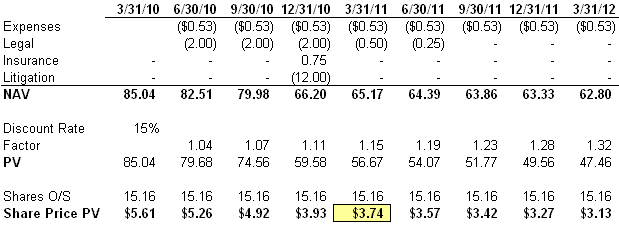
The assumptions behind our valuation table below include $2mm quarterly legal fees for the next 3 quarters and then smaller fees in subsequent quarters; a $530k quarterly expense indefinitely; a lump-sum litigation loss of $12mm; the smaller insurance policy paying out; and a discount rate of 15%. Below is the per-share present value of COF based on the quarter in which a distribution occurs (note that distributions will probably be made in multiple installments, whereas we are assuming a single lump-sum distribution):

If a distribution occurs in the first quarter of 2011, investors who buy at $3.74 will realize a 15% return on investment. But we also see that the NAV never falls below the present market cap of approximately $57mm, meaning investors wouldn’t suffer a real loss unless a) litigation losses are greater than we expect or b) this drags on far beyond 2012. If COF is acquitted, legal fees are returned by a cost order or insurance payout, and liquidation comes in the first quarter of 2011, shareholders could see a nearly 50% annualized return. Not bad for an investment uncorrelated with the rest of the market and with limited downside risk.


Conclusion

In conclusion, we’re expecting a return in the range of 15% with limited risk of loss and some respectable upside scenarios. The main risk is the opportunity cost as this is an illiquid investment and investors might not have an easy time getting out, especially if negative news is released regarding proceedings. But for investors with a 2-year+ time horizon, COF is a nice alternative to cash.

As usual, this email does not constitute investment advice or a recommendation of any sorts. Kerrisdale Capital may buy, sell or short any of the stocks mentioned at any time. I may be wrong; it would not be the first or last time.

LEGAL:

THIS COMMUNICATION IS FOR INFORMATIONAL AND EDUCATIONAL PURPOSES ONLY AND SHALL NOT BE CONSTRUED TO CONSTITUTE INVESTMENT ADVICE. NOTHING CONTAINED HEREIN SHALL CONSTITUTE A SOLICITATION, RECOMMENDATION OR ENDORSEMENT TO BUY OR SELL ANY SECURITY OR OTHER FINANCIAL INSTRUMENT OR TO BUY ANY INTERESTS IN ANY INVESTMENT FUNDS OR OTHER ACCOUNTS. THE AUTHOR HAS NO OBLIGATION TO UPDATE THE INFORMATION CONTAINED HEREIN AND MAY MAKE INVESTMENT DECISIONS THAT ARE INCONSISTENT WITH THE VIEWS EXPRESSED IN THIS COMMUNICATION. THE AUTHOR MAKES NO REPRESENTATIONS OR WARRANTIES AS TO THE ACCURACY, COMPLETENESS OR TIMELINESS OF THE INFORMATION, TEXT, GRAPHICS OR OTHER ITEMS CONTAINED IN THIS COMMUNICATION. KERRISDALE CAPITAL MANAGEMENT, LLC OR AFFILIATED ENTITIES MAY OWN SECURITIES OF OR OTHERWISE HAVE AN INVESTMENT RELATED TO ANY COMPANIES MENTIONED IN THIS COMMUNICATION. THE SENDER EXPRESSLY DISCLAIMS ALL LIABILITY FOR ERRORS OR OMISSIONS IN, OR THE MISUSE OR MISINTERPRETATION OF, ANY INFORMATION CONTAINED IN THIS COMMUNICATION.

[Full Disclosure:  I do no hold COF.H. This is neither a recommendation to buy or sell any securities. All information provided believed to be reliable and presented for information purposes only. Do your own research before investing in any security.]

Read Full Post »

Lawndale Capital Management, LLC filed an amended 13D on May 26 for its holding in P & F Industries Inc (NASDAQ:PFIN). Lawndale has been lobbying PFIN regarding “certain operational and corporate governance concerns that include, but are not limited to, what Lawndale believes to be excessive compensation paid to PFIN’s Chairman and CEO, Richard Horowitz, for poor performance. This further leads to serious concerns regarding the Board’s current composition and independence.”

Lawndale’s 13D exhibits its May 25 letter to PFIN board, which also annexes Proxy Governance’s Comparative Performance Analysis of PFIN. It is well worth reading.

Purpose of the Transaction

Extracted from the most recent 13D filing:

On May 25, 2010, Lawndale sent PFIN’s Board a letter (a copy of which is attached at Exhibit B hereto, and incorporated by reference to this filing) informing them of Lawndale’s intent to vote 272,812 shares, equal to 7.5% of eligible shares to “WITHOLD authority for ALL NOMINEES” on Proposal 1, Election of Directors, at PFIN’s annual meeting scheduled for June 3 2010 and noting independent proxy advisory services, Proxy Governance and RiskMetrics also recommended voting to “WITHHOLD ALL” and WITHHOLD Dubofsky”, respectively. (a copy of the Proxy Governance recommendation is attached as part of this exhibit)

As disclosed in greater detail in the letter, among the reasons for its vote, Lawndale cited the following:

· For P&F’s Small Size And Business Structure, Horowitz’ Compensation Is Wholly Inappropriate

· The Only Shareowner That Has Benefited From The Horowitz Era Has Been Horowitz

· P&F’s Board Requires Increased Independence Via New Directors From Outside “The Club”

At the invitation of the Nominating Committee Chairman, Marc Utay, in February 2010 Lawndale submitted the names and backgrounds of five highly qualified and independent individuals for possible addition to P&F’s Board. Although these nominations were made long before the deadline for setting PFIN’s slate and Proxy for the upcoming June 3 Annual Meeting, none of Lawndale’s suggested nominees appeared on PFIN’s final Proxy. Lawndale was recently informed that two of its nominees have been invited to meet with certain members of the Board in the week following PFIN’s Annual Meeting.

It is the view of Lawndale that a board comprised of qualified directors who are independent, and whose interests are better aligned with shareholders via meaningful purchased equity ownership, would more objectively and aggressively oversee the compensation and corporate acquisition decisions of PFIN.

Lawndale believes the public market value of PFIN is undervalued by not adequately reflecting the value of PFIN’s business segments and other assets, including certain long-held real estate.

While Lawndale acquired the Stock solely for investment purposes, Lawndale has been and may continue to be in contact with PFIN management, members of PFIN’s Board, other significant shareholders and others regarding alternatives that PFIN could employ to maximize shareholder value. Lawndale may from time to time take such actions, as it deems necessary or appropriate to maximize its investment in the Company’s shares. Such action(s) may include, but is not limited to, buying or selling the Company’s Stock at its discretion, communicating with the Company’s shareholders and/or others about actions which may be taken to improve the Company’s financial situation or governance policies or practices, as well as such other actions as Lawndale, in its sole discretion, may find appropriate.

About PFIN

PFIN operates in two primary lines of business, or segments: tools and other products (Tools) and hardware and accessories (Hardware). The Company conduct its Tools business through a wholly owned subsidiary, Continental Tool Group, Inc. (Continental), which in turn operates through its wholly owned subsidiaries, Florida Pneumatic Manufacturing Corporation (Florida Pneumatic) and Hy-Tech Machine, Inc. (Hy-Tech). The Company conducts its Hardware business through a wholly owned subsidiary, Countrywide Hardware Inc. (Countrywide), which in turn operates through its wholly owned subsidiaries, Nationwide Industries, Inc. (Nationwide), Woodmark International, L.P. (Woodmark) and Pacific Stair Products, Inc. (Pacific Stair).

[Full Disclosure:  I do no hold PFIN. This is neither a recommendation to buy or sell any securities. All information provided believed to be reliable and presented for information purposes only. Do your own research before investing in any security.]

Read Full Post »

A lesson on the perils of projecting earnings from the Harvard Business Review’s The Daily Stat:

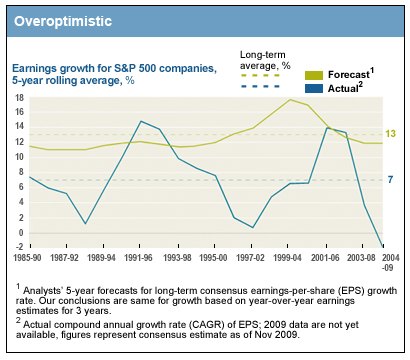
For the past quarter century, equity analysts’ earnings-growth estimates have been almost 100% too high. Their overoptimistic projections have generally ranged from 10% to 12% annually, compared with actual growth of 6% (excluding the spike in growth from 1998–2001), according to McKinsey research. Only in strong-growth years such as 2003 to 2006 did forecasts hit the mark.

As Robert Bruce says (via The Fallible Investor):

Perhaps the most surprising thing to me is the inability of even market professionals to adjust for profit margins. People will talk about how the P/E ratio is reasonable at 19 times without mentioning that it is 19 times the highest profit margins ever recorded. The least we can do, as professionals, is to normalise between economic boom and economic bust, between low profit margins such as those in 1982 when they were ½ normal and very high profit margins such as those of today. A lot of people think profit margins can be sustained. Profit margins are the most mean-reverting series in finance.

For more, see the McKinsey Quarterly’s Equity Analysts: Still too bullish.

Read Full Post »

Following on from the Klarman sees another lost decade for stocks post, here are the full notes of Seth Klarman’s interview with Jason Zweig at the CFA Institutes Annual Conference (via ZeroHedge):

Read Full Post »

Jim Hodges has contributed today’s guest post on Century Casinos Inc (NASDAQ:CNTY) using the Socratic method beloved by Soros, Munger, and…er…Socrates:

Century Casinos, Inc. is a new holding for me. Following is a condensed version of how I valued the business’ assets and was able to find the existence of significant value after a margin of safety was applied without the need of adding its positive “owner earnings” year over year.

Much of the value of Century Casinos, Inc. is tangible in the form of Cash and their Property. I first valued their Property by obtaining the most recent Property Assessments of where each of their Properties reside. Incidentally, these Properties are 100% owned by Century.

Property #1: Central City, CO
Market Value: $28,289,378
Assessment Date: 2009

Property #2: Calgary, Alberta, Canada
Market Value in U.S.: $15,366,479.84
Assessment Date: December 26th, 2009

Property #3: Edmonton, Alberta, Canada
Market Value in U.S.: $28,485,487.12
Assessment Date: December  31st, 2009

Property #4: Cripple Creek, CO
Market Value: $7,811,715
Assessment Date: 2009

Total Assessed Market Value Of Properties: $79,953,059.96

At this point, a few questions need to be asked concerning the justification of the Properties values.

Q: How do we know these prices are relevant to the value that could be realized on the open market?

A: A quick scan of various real-estate websites reveal that, in every location of these properties, similar buildings are being offered for sale in excess of their Assessed values and nearly every relative property that sold did so for at least its assessed value.

Note: It would be impossible to make available this information due to its length, therefore I’m leaving it up to the individual investor to come to his own conclusion. The providing of the source is sufficient for you to carry on your research.

Q: What does the Assessed Value include?

A: The structural building and land. It does not include property such as slot machines and gaming tables that are within the casino.

Q: What is not included in this Valuation?

A: Century Casinos, Inc. 33% ownership in a Polish Casino chain. It was nearly impossible for me to value those assets because the Polish commercial real-estate market is not within my circle of competence. However, I did come to the conclusion that the value Century places on their books concerning this property is most likely correct. That value represents an additional $2+ Million. I also did not add the value of the 4 luxury cruise ships in which Century does not directly own the cruise ships itself but does own the rights to have an operating casino on those cruise ships. All of the cruise ships are very similar and I found through discovery that until recently they had operations on 5 cruise ships. They recently sold their rights on one of the cruise ships for more than $1 Million. These items are all “sugar on top of it” and I’ve elected to not include their values regarding this write up for simplicity sake.

Back to the Properties of this discussion:

The four casinos own, collectively, 2,150 Slot Machines. A new casino grade slot machine costs between $9,000 – $12,000 per slot machine. They have a lifespan on average of 7 years before they need to be upgraded, repaired, or completely replaced. On the open market, the average price of a repaired used casino grade slot machine sells for $1,000.

2,150 Slot Machines x $1,000 = $2,150,000

In addition, Century owns all 154 of the slot machines used for their luxury liner casino operations but to keep with my condensed valuation, I am not adding their appraisals to this valuation nor have I included the 90 table games that Century owns.

Property Asset Value:  $82,103,059.96

Q: Is the reported Book Value ($88.24 Million)of Century Casinos PPE reliable?

A: It certainly seems so.

Other Assets: Century Casino has $25.49M of Cash on hand ($11.5M not deducted on recent 10-K for the acquisition in Calgary.

Property + Cash Value: $107,595,060

Not taking into account the value of Inventory, Recievables, or any other tangible assets that could be readily liquidated and turned into cash – we can form our decision from this basis alone.
Century Casino currently owes $27.02 Million in Total Liabilities.

$107,595,060 – $27,020,000 = $80,575,060

As of today, April 13th, 2010, Century Casinos, Inc. is selling for $59.52 Million.

Not taking into consideration the excess cash Century generates or the additional asset values, I believe an investment in Century Casino is more than justified.

[Full Disclosure:  I do not hold CNTY. This is neither a recommendation to buy or sell any securities. All information provided believed to be reliable and presented for information purposes only. Do your own research before investing in any security.]

Read Full Post »

« Newer Posts - Older Posts »