Feeds:
Posts
Comments

Archive for the ‘About’ Category

The WSJ has an article on Standard & Poor’s Valuation & Risk Strategies list of 10 publicly traded companies that could be LBO targets:

Analysts at S&P Valuation & Risk Strategies chose companies in the consumer discretionary and industrial sectors, because these sectors, along with financials, have been especially active for buyouts. Also, they picked companies that have market values of $1 billion to $4 billion, in keeping with the size of recent top LBOs. And finally, they picked companies trading at less than their respective industry’s coming year-end price-to-earnings ratio, which would indicate that the market currently undervalues them.

S&P’s top pick for an LBO is Eastman Kodak, with a market capitalization of roughly $1.2 billion. Private-equity firm KKR already owns a stake in Eastman Kodak. Here is the rest of the list:

  • Eastman Kodak ($1.2 billion)
  • Oshkosh ($2.8 billion)
  • GameStop ($2.9 billion)
  • EMCOR Group ($1.6 billion)
  • Cooper Tire & Rubber Co ($1.3 billion)
  • DSW ($1 billion)
  • TRW Automotive ($3.6 billion)
  • Dillard’s ($1.4 billion)
  • Alaska Air Group ($1.7 billion)
  • Gymboree ($1.2 billion)

Read the article.

No positions.

Read Full Post »

The NYTimes has an article on Anthony Ward and his attempt to corner the cocoa market. The British news media has amusingly christened him “Chocolatefinger” in homage to the Bond villain Auric Goldfinger:

LONDON — To some, he is a real-life Willy Wonka. To others, he is a Bond-style villain bent on taking over the world’s supply of chocolate.

In a stroke, a hedge fund manager here named Anthony Ward has all but cornered the market in cocoa. By one estimate, he has bought enough to make more than five billion chocolate bars.

Chocolate lovers here are crying into their Cadbury wrappers — and rival traders are crying foul, saying Mr. Ward is stockpiling cocoa in a bid to drive up already high prices so he can sell later at a big profit. His activities have helped drive cocoa prices on the London market to a 30-year high.

Mr. Ward, 50, is not some rabid chocoholic, former employees say. He simply has a head for cocoa. And, through his private investment firm, Armajaro, he now controls a cache equal to 7 percent of annual cocoa production worldwide, a big enough chunk to sway prices.

Read the article here.

The article notes that attempts to corner markets come and go in the rough-and-tumble world of commodities trading. During the 1970s, Nelson Hunt and his brother, William, tried but failed to corner the world market in silver. For more on the Hunt brothers, see Silver Thursday: How Two Wealthy Traders Cornered The Market.

Read Full Post »

Interesting commentary out of Minyanville (Today’s Market Is Missing Valuation, Fundamental Metrics) from a self-described “old valuation guy” lamenting the disappearance of value and value investors from the market. I usually enjoy these articles. I like sitting on Uncle Warren’s knee while he talks about the time he swapped a bag of cocoa beans for a controlling interest in Berkshire Hathaway:

For several weeks I busily bought shares, sold beans, and made periodic stops at Schroeder Trust to exchange stock certificates for warehouse receipts. The profits were good and my only expense was subway tokens.

Great story, Uncle Warren. I’m right now trying to buy Pfizer with a paper clip and some pocket lint, but I digress. I was just getting settled onto Old Valuation Guy’s lap when he springs this one on me:

One of the most frustrating aspects of the current market to an old valuation guy is the complete absence of a focus on fundamental valuation metrics and apparent lack of understanding of the relationship among leverage, growth, and value. Old Mr. Market is just not doing what he’s supposed to.

“Old Mr. Market is just not doing what he’s supposed to.” Say what? Isn’t the whole point of Ben Graham’s Mr. Market analogy that Mr. Market is a manic depressive who does silly things? What Mr. Market is supposed to do is act irrationally. You say he’s acting irrationally? He’s doing what he’s supposed to! I don’t think Old Mr. Market is the problem here. I think Old Valuation Guy is the one who’s not doing what he’s supposed to, which is to say, valuing things and taking advantage of Old Mr. Market. Reading between the lines, I think what Old Valuation Guy is saying is that the market refuses to go up. In my book, that’s not conclusive evidence that you’re not a value investor, but it’s strike one.

So-called Old Valuation Guy continues:

For those of us who grew up with a nod to Graham and Dodd, efficient market theory, or even discounted cash flow, this is one tough time, as increased volatility, whipsaw-like moves, and technical “tells” seem to be in ascension. Perhaps this is the inevitable volatility reflecting the combined uncertainty about the upcoming elections, the outlook for global recovery, and general economic uncertainty, and Mr. Market is merely going through the inevitable digestion required after the gluttony of the last decade; but I’d posit that there’s a bigger risk sitting in the wings.

Placing the words “efficient market theory” right after the words “Graham and Dodd” is vanishingly close to blasphemy. Wash your mouth out, and strike two. I’d give you a third strike for that line about “increased volatility” and “whipsaw-like moves”, but then you’d be out of strikes, and I want to send you to the showers for this gem:

Should investors and professional money managers come to believe that metrics like P/E ratios, TEV to EBITDA, book values, hurdle rates, or WACC are meaningless and antiquated tools in the current post-Armageddon financial meltdown, it may be a long time before folks come back to the market and provide the necessary liquidity to break us out of the doldrums.

WACC? WACC?? WACC is meaningless. And useless. And meaningless (Did I mention that?). Strike three. You’re outta here. I’ve got news for you, Old Valuation Guy: You’re not a value guy.

Value guys like volatility. Crazy, gyrating market? Giddyup. Whipsawing prices? Yee hah. “Uncertainty about the upcoming elections?” Beautiful. Follow that red herring. No liquidity? Along with raindrops on roses and whiskers on kittens, these are a few of my favorite things. Why? It is axiomatic to value investing that volatility is not risk, but the generator of opportunity. We want Mr. Market manic depressive for the rest of our lives. We want him bucking like a bronco. We want him scaring people away.

These articles pop up occasionally. Remember the article What Would Warren Do? where Megan McArdle interviewed a fund manager under the Omaha twilight who suddenly said, “The only way to make money these days is leverage”?  This sort of fuzzy thinking needs to be beaten back with a stick. If you’re going to go around calling yourself a value guy, at least have the common decency to find out what a value guy believes. A good place to start would be that Graham and Dodd book you nodded at as you were coming up.

Read the rest of it here. It improves slightly until he asks if “Edwards and Magee [have] finally beaten Graham and Dodd? Have momentum investing, computers, and flash trading killed the value investor?” Ugh. No.

Read Full Post »

Greenbackd readers, get your exclusive $1,800 discount for the 6th Annual Value Investing Congress on October 12 & 13, 2010 in New York City. This offer expires in 8 days, so get your ticket now using dicount code: N10GB4.

The Value Investing Congress is the place for value investors from around the world to network with other value investors. I went to the May event earlier this year in Pasadena, and it was well worth it. The speakers seem to mingle freely and are generally available for a chat. Weather permitting, I’ll be in New York for this event.

Speakers include:

  • David Einhorn, Greenlight Capital Management
  • Lee Ainslie, Maverick Capital
  • John Burbank, Passport Capital
  • J Kyle Bass, Hayman Capital
  • Mohnish Pabrai, Pabrai Investment Funds
  • Amitabh Singhi, Surefin Investments
  • J. Carlo Cannell, Cannell Capital
  • Zeke Ashton, Centaur Capital Partners
  • Whitney Tilson & Glenn Tongue, T2 Partners

This offer expires midnight on July 30. Use using dicount code: N10GB4 and get your ticket now .

Read Full Post »

The inestimable Market Folly has a wonderful post on East Coast Asset Management’s long case for Becton, Dickinson and Co. (NYSE:BDX). Jay says:

East Coast Asset Management is out with an in-depth presentation on Becton Dickinson (BDX). They lay out the bullish case for the company and assume that if you hold it for three years that an internal rate of return (IRR) on BDX if purchased now would be 17.6% annualized. … So, how do they come to this conclusion on BDX?

Let’s first start with the thesis behind this play. Anant Ahuja, Christopher Begg, and Jack McManus have laid out the model for East Coast Asset Management and point out that Becton Dickinson is a niche business with a diverse set of products aimed at capitalizing on the increasing amount of aging baby boomers. Shares have been under pressure due to concerns over exposure to Europe, weak 2009 sales, and unfavorable foreign exchange trends.

The stock currently trades at 8x EV/EBITDA, well below the historical 5 year average of 10.1x EV/EBITDA. They argue that the business has an intrinsic value of $90-95 per share, representing 35-40% upside in the stock. East Coast highlights that Becton Dickinson has an impressive past of shareholder value creation. Over the past five years, BDX has seen 23.5% ROIC, 22.2% ROE, EPS CAGR of 15.8%, and 37 consecutive years of dividend increases. Not to mention, the company has repurchased a consistent amount of shares, with $450 million allocated this year. Given that these are attributes Warren Buffett often likes to see in a business, it should come as no surprise that his Berkshire Hathaway added to its BDX position in the first quarter.

Download ECAM’s report here (.pdf via Market Folly).

Read Full Post »

Hervé Jacques has provided a guest post on the accuracy of guru prognostications. Here’s Hervé’s bio:

Hervé is a veteran of 30-year of market activity on the official sector side (central banks, International Financial Organizations) with first hand experience of FX and fixed income markets. He is now consulting for official and private institutions, targeting International financial organizations, sovereign wealth funds, central banks, commercial and investment banks, hedge funds.

In parallel to his professional career, he has a successful track record as a personal investor in stocks, bonds and commodities over several decades.

His market experience from an unusual perspective (the nexus between policy making and investors/traders) gives him unparalleled insight into the post-crisis world of capital markets.

Hervé Jacques on Guru Calls: Better lucky than smart?:

I came across this today, by accident. Check the date. Yes, it’s 2009.

Makes you modest, doesn’t it? That was back in May 2009. So David got it almost exactly right, month-wise. He was just a year early, as the market didn’t peak until April 23rd, 2010, so about 12 months later. The S&P500 went all the way from 920 to 1217 during those 12 months.

And this was coming from one of the (rightfully) most respected Wall Street voices, at the top of his career, crowning many years of leading presence at Merrill on his valedictorian interview.

Not picking on him here: there are dozens of examples of such calls ending way out of the ballpark, starting with quite a few of mine…

In 2001, the IMF did a 63 country-study on how well economists predicted recessions. The punch line of the result?

“The record of failure to predict recessions is virtually unblemished.”

Goes to show that both the economy as well as Mr. Market do as they please, no matter how intricate the research, how strong the gut feeling and how extensive the experience of whoever places calls, especially as regards the future of stock prices.

David’s point was right, mind you. I would subscribe even today to everything he said, on the fundamentals.

Nevertheless, the “animal spirits”, “market sentiment”, “investor psychology” or whatever you call it meant that Mr. Market would keep going strong for another year, despite all the appropriately highlighted issues.

So where does that leave us? Taking cheap shots at highly respected gurus? Nope.

The lesson is that no matter how authorized the voices, whatever they come up with is one of the potential “states of the world” that will materialize. There is this somewhat sarcastic saying that “promises only commit those that receive them”. I think it applies to forecasting as well.

Any forecast, no matter how carefully crafted, is a probability. Nothing more than that. Which explains, by the way, why we get so many different forecasts, based on so many different expectations, which make the market that superior voting and weighing machine described by Ben Graham.

So next time we read some intricately motivated forecast from a star Wall Street authority, let’s keep in mind that this is just as much as the human mind-at its best? -can conceive, but that reality will result of the competing expectations of millions of other “votes”.

Not necessarily better-informed “votes”, by the way. Which means that the outcome might be less “efficient” than the most carefully forecasted one. Being smart does not always lead to riches, as “the market can stay inefficient longer than you can stay solvent”, as we know.

So, away from philosophy, what does that mean in real trading life?

The practical consequence is that, no matter how strong the gut feeling, how grounded the analytics and how big the firepower backing it, any market position is a bet that needs to be backed by a stop-loss (“risk management”).

Any such position is only based on the existing information (public or private).

Therefore two things can derail the plans: new information (potentially “black swans”, but even more mundane events); and an unexpected reaction of other players (“Mr. Market”) to the existing information. That’s more than enough to mess up the best plans.

As my mom used to say: “Better lucky than smart”.
Read Full Post »

In September last year I picked up a small position in Cadus Corporation (OTC:KDUS). The idea was as follows:

Cadus Corporation (OTC:KDUS) is an interesting play, but not without hairs on it. First, the good news: It’s trading at a discount to net cash with Carl Icahn disclosing an activist holding in 2002, and Moab Capital Partners disclosing an activist holding more recently. At its $1.51 close yesterday, the company has a market capitalization of $19.9M. The valuation is straight-forward. We estimate the net cash value to be around $20.6M or $1.57 per share and the liquidation value to be around $23.2M or $1.77 per share. The liquidation value excludes the potential value of federal and New York State and City net operating loss carry-forwards. It’s not a huge upside but it’s reasonably certain, and we think that’s a good thing in this market. The problem with the position is the catalyst. It’s a relatively tiny position for Icahn, so he’s got no real incentive to do anything with it. He’s been in the position since 2002, so he’s clearly in no hurry. That said, he’s not ignoring the position. He last updated his 13D filing in March this year, disclosing an increased 40% stake. He’s also got Moab Capital Partners to contend with. Moab holds 9.8% of the stock and says that it “has had good interaction with the CEO of Cadus, David Blitz, and feels comfortable that he will structure a transaction with an operating business that will generate significant long-term value for Cadus holders.” KDUS could end up being a classic value trap, but we think it’s worth a look at a discount to net cash, and two interested shareholders.

Fast forward to Friday’s close, and the stock is at $1.44. I got out a little while ago as I was liquidating holdings outside of my fund, breaking even on the position. In For Investors, Shaking Up Is Hard to Do (subscription required) Jason Zweig of the WSJ’s The Intelligent Investor column has some background on the goings on in KDUS:

Just ask Matthew Crouse of Salt Lake City. Starting in 2002, he sank roughly $190,000 into Cadus Corp., a classic “value” stock. The tiny company was selling for less than the amount of its cash minus debt.

In February 2009, Mr. Crouse wrote to Cadus, requesting that the board sell the company and return the cash proceeds to investors. He drafted a resolution to that effect, which he asked the board to include in Cadus’ proxy statement when shareholders were next asked to vote.

Yet Cadus didn’t hold an annual meeting last year. One large shareholder says that “time and again, we have brought opportunities [for mergers or acquisitions] to the attention of the board.” Each time, he says, the suggestion was rebuffed or ignored. “It’s been a decade of complete nonaction,” he says.

A little over a week ago—17 months after Mr. Crouse’s letter—Cadus informed him that it will hold its annual meeting on Oct. 6, that his resolution will be included and that the board will recommend that shareholders reject it.

“My goal is to get it on Icahn’s radar screen so that he’ll need to deal with us, not just ignore us,” Mr. Crouse says. “If you push for shareholder activism in other companies, I’d think you’d want to take care of your own.”

It isn’t that simple, Mr. Icahn counters. “We’ve been looking assiduously for three years for opportunities,” he told me this week. “But I don’t want to make a bad acquisition and lose the cash.” He added, “I strongly believe that in today’s type of market we will find a company [to buy] fairly soon.”

Furthermore, Mr. Icahn says, if Cadus distributed its cash to shareholders, it would have no money for an acquisition, losing the opportunity to use its tax benefits directly. “I don’t want to waste $25 million,” he says. Of course, Cadus could still be acquired by another firm that could make use of the tax break.

Cadus is less a company than a publicly traded checking account with a tax perk attached. The insiders are the only ones who can write checks. The minority shareholders can always vote with their feet by selling the stock—although they would have little to show for it.

For the proposal to pass, nearly 90% of all the minority shareholders would have to vote for it, since Mr. Icahn controls 40% of the stock.

I still think KDUS is good value, but the stock doesn’t trade, so good luck getting any. I don’t see Icahn just wasting the tax shelter, some of which starts rolling off in the next few years, but it’s all academic to me.

[Full Disclosure:  No position. This is neither a recommendation to buy or sell any securities. All information provided believed to be reliable and presented for information purposes only. Do your own research before investing in any security.]

Read Full Post »

It’s always fascinating for me to see which posts draw the most attention. Here are the top 10 posts for the last quarter:

  1. Graham’s P/E10 ratio
  2. The long and short of The St. Joe Company
  3. Absolute Return interviews Seth Klarman
  4. Seahawk Drilling (NASDAQ:HAWK) redux and HAWK liquidation values
  5. Whitney Tilson and Glenn Tongue on BP Plc
  6. ROIC and reversion to the mean: Part 1
  7. The long and short of Berkshire Hathaway
  8. Grantham on the potential disadvantages Graham-and-Dodd investing
  9. Seth Klarman sees another lost decade for stocks
  10. Lost Graham speech rediscovered

See you Monday.

Read Full Post »

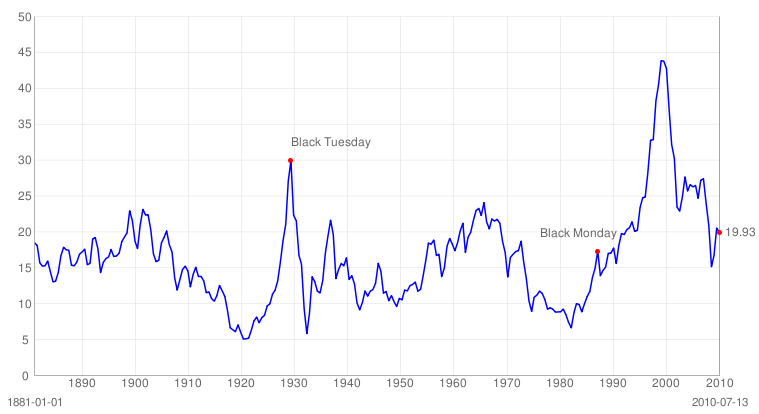
Multpl.com has a handy Graham / Shiller PE10 chart for the S&P500 that updates on daily basis. Where is the PE10 today? 19.93:

Interested in the mean, median, minimum or the maximum? Multpl.com has those too:

Mean: 16.37
Median: 15.74
Min: 4.78 (Dec 1920)
Max: 44.20 (Dec 1999)?

Read Full Post »

In St. Joe can afford to be patient, Morningstar analyst Anthony Dayrit shares his thoughts on The St. Joe Company (NYSE:JOE) with Phil Guziec, Co-Editor and Portfolio Manager of Morningstar’s OptionInvestor research service. I’ve written about JOE previously (see The long and short of The St. Joe Company (NYSE:JOE)) arguing that it’s undervalued at present.

Morningstar’s valuations

On an assets basis:

Guziec: So it actually brings us to how we value the company. Could you talk about the couple of ways you come up with a value for St. Joe?

Dayrit: Yeah. Well, our main valuation, it’s pretty simple is that, we take the – we’d use the net asset value and we take the roughly 400,000 of coastal acres, coastal land and assign that a per acre value of $10,000. And then we take the remaining 172,000 acres and assign that a value of $1,500 an acre and we consider that to be either rural or swampland, and the $1,500 estimate is pretty much where the land has been going – rural land has been selling for around these last few years and when we net out the liabilities, we get an equity value of $4.4 billion, which is right around our $50 fair value estimate.

Guziec: And the share is trading in the low 20s right now?

Dayrit: Yes. The share is trading at the low 20s, and at that valuation, we’d assume a per acre value of all of St. Joe’s land at roughly $3,400 an acre.

On a cash flow basis:

Guziec: Okay. Now, the land is really, for an investor, only worth the eventual cash flows that come from it.

Dayrit: Yes.

Guziec: Could you talk about the other way that you look at the valuation for the company?

Dayrit: Sure. The other way that we’ve tried to look at St. Joe is by basically isolating the West Bay Sector. Now, there is around…

Guziec: And that’s the land around that airport that they drive at?

Dayrit: Yes. Yes. It’s around the New Panama City Airport, which has just opened at the end of May. And we take the 35,000 acres around that airport, and we assume that the company will be able to sell 700 acres per year over the next 50 years and assume that they can sell each acre for around $100,000 an acre.

And when we use that model, we get a per share value for just that West Bay project of $13, and if we take everything else of St. Joe’s land and put that into a $1,500 per acre bucket, we get an additional $9. So that also gets us to around $22, $23. And we think those are both pretty conservative assumptions.

Despite Dayrit’s assertion that the cash flow assumptions are conservative, I think Morningstar’s assumptions are pretty heroic (700 acres per year over the next 50 years for around $100,000 an acre? Ha ha ha, that’s a good one.). Those assumptions only get a valuation around the present stock price on a cash flow basis, which gives me some pause. Perhaps Jon Heller is right. Still, they’re only discussing a very small portion of JOE’s land, so I prefer the assets valuation, but I’ll bear in mind Jon Heller’s warning that “the assets need to be converted into cash in order for value to be realized”.

See St. Joe can afford to be patient to hear Dayrit and Guziec discuss JOE in more detail.

[Full Disclosure:  I hold JOE. This is neither a recommendation to buy or sell any securities. All information provided believed to be reliable and presented for information purposes only. Do your own research before investing in any security.]

Read Full Post »

« Newer Posts - Older Posts »