Feeds:
Posts
Comments

Archive for the ‘About’ Category

Vitaliy Katsenelson’s Contrarian Edge has a great post on Medtronic Inc. (NYSE:MDT) (Barron’s is wrong on Medtronic). Katsenelson’s post is a rebuttal to a Barron’s article, Should Medtronic Investors Lose Heart?, in which the author argues that MDT is a sick man. His post is a superb line-by-line refutation of Barron’s thesis:

“The stock looks cheap, trading at about 8.2 times expected forward earnings, but the company’s 10% long-term-earnings growth rate is below the industry average…

At 8.2 times earnings, the market prices in zero growth. If any growth is produced, even half of its “below-industry-average” growth, the stock will not be trading at 8.2 times earnings, but at a much higher valuation. Ironically, today’s low valuation gives MDT earnings a yield of 12%. If MDT remains at this valuation for a long time, it can buy back 12% of the company year after year, and this in itself would result in 12% earnings growth.

“… and it carries a fair amount of debt….

The amount of debt seems high at first, at $10.5 billion; but the company has $3.9 billion in cash and short-term investments, thus net debt is closer to $6.6 billion. MDT generates $3.4 billion of free cash flows – it can pay off ALL of its net debt in less than two years. Also, don’t confuse MDT with low-quality, highly cyclical stocks that were in vogue in the first half of 2010. This is a company that maintained a return on capital of over 20% for decades – an indication of a significant moat. Its revenues are extremely predictable, cash flows are very stable, and thus debt levels are very reasonable. Medtronic’s stock was punished with a 10% decline for lowering its guidance by an astonishingly minor 2%.

“The stock is also a historical underperformer, turning in losses year-to-date, as well as in the last one-, two-, and five-year periods that are greater than its peers in the Dow Jones U.S. Medical Equipment Index and the overall market….

This argument fails to draw a distinction between fundamental performance and stock performance. Over the last ten years, MDT grew both sales and earnings per share at 14% a year. It increased dividends 17% a year. These are not the vital signs of an “underperformer.” As the article pointed out, MDT’s stock has gone nowhere over the past decade – that is true, but not because MDT was mismanaged or failed to grow, but rather because at the turn of the last century MDT was trading at almost 50 times earnings. Medtronic is a typical sideways-market stock: it was severely overvalued at the end of the secular bull market, thus its earnings and cash flows grew while P/Es contracted. This happened to a battalion of stocks, from Wal-Mart to J&J to Pepsico. In fact when I hear the statement that a stock has “not gone anywhere,” I immediately start looking at the stock to see if it is a buy.

Read the article.

No position.

Read Full Post »

One of my favorite strategies is the Endangered Species / Darwin’s Darlings strategy I discussed in some detail earlier this year (see Hunting endangered species and Endangered Species 2001). The strategy is based on a Spring 1999 Piper Jaffray research report called Wall Street’s Endangered Species by Daniel J. Donoghue, Michael R. Murphy and Mark Buckley, then at Piper Jaffray and now at Discovery Group, a firm founded by Donoghue and Murphy. The premise of the report was that undervalued small capitalization stocks (those with a market capitalization between $50M and $250M) lacked a competitive auction for their shares and required the emergence of a catalyst in the form of a merger or buy-out to close the value gap.

The NYTimes.com has an article, Accretive Uses “Take Private” Tactic In Equities, discussing hedge fund Accretive Capital Partners, which uses a strategy described thus:

Accretive Capital’s strategy is to buy long-only stakes in small- and micro-cap stocks that [founder Rick] Fearon believes would be attractive “take private” companies. The benefits of being public just don’t add up for such companies, he said.

Years ago when Fearon was a principal at private equity firm Allied Capital, he was struck by the wide gap in value the public and private equity markets assigned companies.

In private equity, companies were valued at six to seven times their cash flow, while public companies, especially the smallest businesses, were valued at almost half that, he said.

Fearon believes that market inefficiency, where prices often fail to reflect a company’s intrinsic value, and the $400 billion or so that pension funds and endowments currently have committed to private equity, will help spur returns.

Fearon is fishing in waters where, because the market capitalization of the smallest companies is less than $100 million, Wall Street research fails to adequately cover their operations. In addition to helping create an inefficient market, it has eroded the benefits of being a public company.

With an undervalued stock, stock options are never in the money, erasing the use of stock as a motivator for management and employees; cash becomes preferable to stock for acquisitions, and management holds on to undervalued shares.

“Management teams that have a strategy of A, B, C and D for creating shareholder value may in the back of their minds be thinking, ‘Well, maybe strategy E is the take private transaction, or we sell the company to a strategic buyer, because we’re not recognizing any of the benefits of being public,'” Fearon said.

In essence, the strategy is Endangered Species / Darwin’s Darlings. How has Accretive Capital performed?

Accretive Capital has been involved in 19 take-private transactions, or about one-third of the positions it has closed over the past decade.

Fearon has managed to take the $2 million in capital he started with from mostly high-net worth friends and family to about $20 million on his own. His fund plunged in 2008, but returned 132 percent last year and is up about 20 percent as of July.

Assuming no additional outside capital, turning $2M into $20M in ten years is a compound return of around 25%, which is impressive. [Update: As Charles points out in the comments, the article clearly says he’s returned 4x, not 10x, which is a compound return of around 15%, which is still impressive in a flat market, but not as amazing as 25%.]

Says Fearon of the investment landscape right now:

“We’re not lacking investment ideas or opportunities, our primary restraint is capital right now.”

Read Full Post »

Zero Hedge has a great post on the quarterly Goldman Hedge Fund Trend Monitor. The most interesting aspect of the piece is the relative performance of stocks with the highest concentration of hedge fund holders against the performance of stocks with the lowest concentration of hedge fund holders:

We define “concentration” as the share of market capitalization owned in aggregate by hedge funds. The strategy of buying the 20 most concentrated stocks has a strong track record over more than eight years. Since 2001, the strategy has outperformed the market by an average of 312 bp per quarter (not annualized). The back test suggests that this strategy works in an upward trending market but tends to perform poorly during choppy or flat markets. The stocks in the basket tend to be mid-caps (at the lower end of the S&P 500 capitalization distribution), which have outperformed large-caps from 2004 to 2007, contributing to the attractive back-test results. The baskets are not sector neutral versus the S&P 500.

As you might have guessed, the “least concentrated” basket has outperformed the “most concentrated” portfolio since 2007:

The stocks with the “most concentrated” hedge fund ownership have outperformed the S&P 500 in 2010 ytd by 191 bp (+1.1% vs. -0.8%). The “most concentrated” stocks underperformed steadily for most of 2007 and 2008, but significantly outperformed in 2009. Our “most concentrated” basket outperformed the S&P 500 by 237 bp in 1Q 2010 (+7.7% vs. +5.4%) but lagged by 303 bp in 2Q 2010 (-14.5% vs. -11.4%).

Our “least concentrated” basket has outperformed the S&P 500 in 2010 ytd by 693 bp (+6.1% vs. -0.8%). The “least concentrated” basket outpaced the market by 50 bp in 1Q 2010 (+5.9% vs. +5.4%) and by 440 bp in 2Q (-7.0% vs. -11.4%).

So which stocks are currently in the “least” and “most” concentrated baskets:

Read the article.

Read Full Post »

Richard H. Thaler, Chicago School economist and co-author (along with Werner F.M. DeBondt) of Further Evidence on Investor Overreaction and Stock Market Seasonality, and the “Thaler” in Fuller & Thaler Asset Management, has written an opinion piece for the NYTimes.com “The Overconfidence Problem in Forecasting.”

Thaler says:

BUSINESSES in nearly every industry were caught off guard by the Great Recession. Few leaders in business — or government, for that matter — seem to have even considered the possibility that an economic downturn of this magnitude could happen.

What was wrong with their thinking? These decision-makers may have been betrayed by a flaw that has been documented in hundreds of studies: overconfidence.

Most of us think that we are “better than average” in most things. We are also “miscalibrated,” meaning that our sense of the probability of events doesn’t line up with reality. When we say we are sure about a certain fact, for example, we may well be right only half the time.

He then discusses a recent paper that shows that overconfidence permeates the top reaches of large companies:

In that paper, three financial economists — Itzhak Ben-David of Ohio State University and John R. Graham and Campbell R. Harvey of Duke — found that chief financial officers of major American corporations are not very good at forecasting the future. The authors’ investigation used a quarterly survey of C.F.O.’s that Duke has been running since 2001. Among other things, the C.F.O.’s were asked about their expectations for the return of the Standard & Poor’s 500-stock index for the next year — both their best guess and their 80 percent confidence limit. This means that in the example above, there would be a 10 percent chance that the return would be higher than the upper bound, and a 10 percent chance that it would be less than the lower one.

It turns out that C.F.O.’s, as a group, display terrible calibration. The actual market return over the next year fell between their 80 percent confidence limits only a third of the time, so these executives weren’t particularly good at forecasting the stock market. In fact, their predictions were negatively correlated with actual returns. For example, in the survey conducted on Feb. 26, 2009, the C.F.O.’s made their most pessimistic predictions, expecting a market return of just 2.0 percent, with a lower bound of minus 10.2 percent. In fact, the market soared 42.6 percent over the next year.

Thaler concludes:

Two lessons emerge from these papers. First, we shouldn’t expect that the competition to become a top manager will weed out overconfidence. In fact, the competition may tend to select overconfident people. One route to the corner office is to combine overconfidence with luck, which can be hard to distinguish from skill. C.E.O.’s who make it to the top this way will often stumble when their luck runs out.

The second lesson comes from Mark Twain: “It ain’t what you don’t know that gets you into trouble. It’s what you know for sure that just ain’t so.”

Read the article.

For more on Richard H. Thaler, see the post archive.

Read Full Post »

Minyanville has an article analyzing Liberty Media Corp (Capital) (NASDAQ:LCAPA) on a sum-of-the-parts basis:

The key for investors: Liberty Capital stock trades at a 58% discount to the value of all the assets that back it. The stock recently sold for $48 [now $45], but the collection of assets it represents add up to $82 after debt, according to Robert Routh a media analyst with Wedge Partners.

What does a share of LCAPA represent?

As a tracking stock, Liberty Capital represents the value of the stock holdings of its parent Liberty Media in Sirius XM Radio, Time Warner Cable (TWC), Time Warner (TWX), Sprint Nextel (S), Viacom (VIA), Motorola (MOT), AOL (AOL), Live Nation Entertainment (LYV), and CenturyLink (CTL). All of this plus a few other stocks and the value of some media assets recently added up to $107 per share for Liberty Capital, calculates Routh, who regularly makes some great calls on media stocks. Subtract around $25 in debt, and you get an enterprise value of around $82 for Liberty Capital. That’s the tracking stock that sells for just $48.

Why the discount?

First of all, a lot of mutual funds cannot own tracking stocks, which reduces demand for the Liberty Capital tracker. Second, Liberty Capital is saddled with a “complexity discount” — meaning the situation is so confusing many investors just avoid it. Plus, there’s no guarantee the discount will ever go away.

Any catalysts?

For buy-and-hold investors, what might make that happen? One catalyst will be ongoing share buybacks, believes Scott Stevens of Strata Capital Management, which owns the Liberty Capital tracking stock. Stevens is worth listening to because Strata Capital Management was up 11.1% year-to-date net of fees as of August 17, compared to a 2% decline for the S&P 500. Next, believes Stevens, Liberty Capital has over $2 billion in cash, and it might use some of for an accretive acquisition

And eventually, Liberty Capital should be converted from a tracking stock to a regular asset-backed common stock, which would help the complexity discount go away. Malone should get the ball rolling on this front when he converts another stock tracking assets in the Liberty Media parent company. That tracker is Liberty Media Interactive (LINTA) which represents the Liberty Media’s home-shopping channel QVC and a stake in Home Shopping Network.

The conversion should happen around the end of this year or in the first quarter of 2011. That alone might wake other investors to the potential in Liberty Capital because it’s on the same track, and put a bid underneath the stock. A third Liberty Media tracker will also be converted at some point, or Liberty Starz Group (LSTZA) which represents Liberty Media’s Starz Encore pay TV channel. Another catalyst might be the sale of the Atlanta Braves by the end of 2011.

Read the article.

Nop positions.

Read Full Post »

Carl Icahn’s former lieutenant Mark Rachesky has opened a position in Seahawk Drilling Inc (NASDAQ:HAWK), a stock I’ve covered in some detail (see the post archive here). Rachesky holds the position in his investment vehicle, MHR Fund Management LLC. Rachesky’s most recent 13F filing indicates he picked up around 1.2M shares for around $11.4M, which implies an average purchase price of about $9.72 per share. According to Business Insider:

Rachesky, 49, spent six years working for Icahn, including serving as a senior investment officer and chief investment advisor for his last three years at Icahn Holding Corporation. He left Icahn in 1996 and opened his own New York-based firm, MHR Fund Management, for which he still serves as president.

Rachesky is perhaps best known for his position in Lions Gate:

He first took a 5.9% stake in Lionsgate in August 2005, but he boosted his ownership to 14.1% as of last July and has rapidly increased the size of his position over the past two months—at the same time Icahn enhanced his own stake—after Lionsgate reported its disastrous third-quarter earnings. Up until last week, Rachesky’s investment in Lionsgate was passive, meaning he didn’t seek to influence the company’s operations. But now he’s an active investor in the studio.

The $11.4M holding in HAWK represents around 0.8% of Rachesky’s $1.4B fund.

Hat tip JG.

Long HAWK.

Read Full Post »

Adam Sues, author of Value Uncovered, has provided a guest post on AMCON Distributing Co. (AMEX:DIT). Adam describes himself thus:

I’ve always enjoyed reading about the stock market and started studying in earnest in 2007 right before the whole financial world crashed.  I sold a few positions at a loss (a mistake) but managed to pick up some great names at bargain prices.  Over the past two years, I’ve started to study the principles of value investing and special situations, molding my philosophy after famous investors like Warren Buffett and Benjamin Graham.

Here’s his take on DIT:

AMCON Distributing (DIT)

AMCON Distributing Company (DIT) is just the type of business upon which many value investors focus: a micro-cap stock in a boring industry that the market has largely ignored.

With a market cap of only $33M, AMCON is incredibly producing almost $1B in sales, an outstanding number for such a small company.

Company Background

DIT has been around since 1986, and is currently the 8th largest convenience store distributor in the United States.

Distribution

The company currently operates 4,200 retail outlets, consisting of grocery stores, liquor stores, tobacco shops, and convenience stores across the Central and Rocky Mountain region of the country, selling over 14,000 different products.

The company’s products would be familiar to any normal citizen who has spent time in a corner store – cigarettes, tobacco products, candy, groceries, paper products, and frozen foods, among others.

Stores are serviced by 5 large distribution hubs totaling approx. 487,000 square feet, and are stocked by major suppliers including Phillip Morris, RJ Reynolds, and Proctor & Gamble.

Retail – Health Foods

The second business segment consists of retail health food stores operating under the name Chamberlin’s Market & Café and Akin’s Natural Foods Market. These stores focus on high-quality, organic, & specialty foods.  Both store brands have been around since 1935, with 13 stores between them. Overall, AMCON has exposure to two completely different segments of the market – low-end, commodity type distribution and high-end organic food purchases.

While distribution still makes up for the vast majority of revenues, the retail health food concept is sweeping across the country and could provide a future engine for company growth (just witness the explosion of organic food advertisements and sustainable food awareness campaigns over the past few years).

The company has enjoyed record financial performance over the past two years under the leadership of its Chairman & CEO – Christopher H. Atayan.  AMCON is a remarkable turnaround story.

Financials

AMCON’s industry is highly competitive and low margin business.  Gross margins have averaged 7.3% over the past 10 years, with little variance.  Net margins are very tight, averaging 0.2%, although the trend has been increasing.

Breaking down the business segments, margins on the retail side are much better, with gross margins in the 42% range compared to 6.1% on the wholesale side. Despite the wide range of products, the company is heavily dependent on the sale of cigarettes.  In 2009, approx. 71% of company revenue came from sales of these products, although only 27% of gross profits.

Sales growth has been steady, but slow, at approx. 3% per year.  The company has been able to raise revenue due to price increases, new store openings, and strategic acquisitions.

Most recently, the company owned a new retail store in Oklahoma and expanded its distribution network by purchasing the assets of another distributor:

“On October 30, 2009, the Company acquired the convenience store distribution assets of Discount Distributors from its parent Harps Food Stores, Inc. (“Harps”). Discount Distributors is a wholesale distributor to convenience stores in Arkansas, Oklahoma, and Missouri with annual sales of approximately $59.8 million”

Positives

Improved Financial Health:

AMCON is the type of business that turns over a ton of inventory (almost 25x per year).  Combine this fact with a low margin business, and the company must fund most of their operations through debt financing – there is little cash on the balance sheet.

Management has taken steps to improve the financial health of the business.  Long-term debt has shrunk from $58.2m in 2005 to 27.7M last year.  At the same time, shareholder equity has increased from $-0.2M to $23.8M.

Interest coverage has increased to 9.5, putting the company on much better financial footing.

Turnaround Story:

Since the arrival of Mr. Atayan, the company’s current CEO and Chairman, AMCON has undergone an amazing turnaround.  A few years ago, AMCON was in rough shape:

The business had negative availability of $2 million on its bank lines, it was being sued in four separate jurisdictions, it was being delisted by the American Stock Exchange, it was behind on taxes, it was losing business, and it was more than $65 million in debt.

The company sold off non-essential businesses and turned two consecutive record years in 2008 and 2009.

Management:

Insiders own 44.1% of outstanding shares, including 37.5% by the CEO and Chairman, Christopher Atayan.  Mr. Atayan bought out the company’s original founder, William Wright, purchasing over 200k shares last year.

The company re-instituted a cash dividend in 2008, and has more than doubled the quarterly payment to $0.18 during one of the toughest economic times in recent memory.

Last year, AMCON’s board also announced a share repurchase program for up to 50,000 shares, or 9% of outstanding.

Negatives

Regulatory Challenges:

Although the company has worked to diversify its business, it still relies heavily on the distribution of cigarettes.  Cigarette sale and distribution is a highly regulated affair, and overall use has declined due to social stigma and education on the health risks of smoking.

In June 2009, the FDA was granted even greater powers for regulating the sale and distribution of cigarettes.  The agency almost immediately banned the sale of certain flavored cigarettes, and then substantially increased the federal excise tax on cigarette sales.

Increased prices put continued pressure on sales – to date, AMCON has been able to pass along the higher prices to its customers but it remains a big risk for the company.

Competition:

The company is part of a very competitive industry, and the low profit margins do not leave much room for error.  An inventory miscalculation or fuel price increase could severely impact the business.

AMCON currently depends on a $55M credit agreement with Bank of America.  Average borrowings for last year were $31.2M – the company obviously depends on this line of credit.

The current agreement matures in June 2011, and the outcome of that negotiation will have a substantial impact to the business.

On the retail side, the company’s retail stores face intense competition not only from stand alone health stores, but also major grocery chains who are trying to capitalize on the health movement as well.

Stock Float:

DIT is a micro-cap stock, with a market cap of approx. $34M.  The stock is also very illiquid and suffers from a tiny float.  The company only has 577k share outstanding – with the high levels of insider ownership, float is only 350k.

According to Lowfloat.com, DIT is actually one of the top 3 lowest float stocks trading on any of the major exchanges.

Average 3 month volume is only 1000 shares so picking up large blocks of shares is difficult.  Many institutions will pass on the stock because of these challenges, allowing individual investors to benefit.

Valuation

The stock touched a low of $14 back in November 2008, before shooting upwards to $78 in December 2009 – not a bad return for one year.

Current P/E ratio sits at 4.8 – higher than 2008 (2.4) but lower than 2006/2007 (6.2), the first two years of the turnaround.
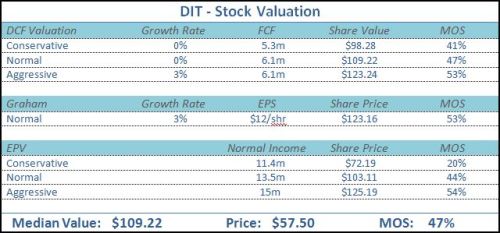
DIT’s 2010 EPS should come in around $15-17 – applying a normal P/E of 6 to these EPS numbers results in a share price of $90-$102.

Conclusion

Through the first three quarters of the company’s fiscal year, revenues, operating income, and FCF are all higher than 2009, setting the company up for another record year.

With regards to buying a significant personal stake in the company, Mr Atayan had this to say:

“This is a significant personal investment for my family and reflects my confidence in the management team of our company and the strong relationships we have with our vendors and customers.”

With this type of conviction – not only his professional livelihood and reputation, but putting his family’s stake behind the words as well – I have no doubt that Atayan is committed to making the company succeed.

Based on recent performance, he is off to a good start.

No position.

Read Full Post »

Carl Icahn has plowed $1 billion into energy stocks over the last 6 months according to his latest SEC filing. Says The NYTimes Dealbook column:

Yet speculation is rife given the activist investor’s history with energy companies and his reputation for focusing on companies that he believes are undervalued and ripe for a shake-up in some way — with a restructuring or a sale among the possibilities.

One company that may have attracted his interest is one he already knows:  Anadarko Petroleum. Shares of Anadarko, a Texas-based Independent oil company, tumbled in the spring after the explosion and spill at a BP-operated well in the Gulf of Mexico. Anadarko owns a 25 percent stake in the well.

Anadarko’s stock price fell below $35, wiping $19 billion off its market capitalization. (The stock has since recovered, closing at $56.35 on Monday.)

Mr. Icahn goes back several years with Anadarko.  In 2005, Mr. Icahn and a fellow activist investor, Jana Partners, accumulated a 7 percent stake in Kerr-McGee, an Oklahoma-based energy exploration and production company. The Icahn group demanded the company sell off certain units and commence a big stock buyback.  Kerr-McGee did, and then sold itself to Anadarko for $16.4 billion, representing a rich premium of 40 percent.

Mr. Icahn built his stake in the combined company, and by the beginning of 2008 he had 14.8 million Anadarko shares worth around $971 million.

“Investors who bought Kerr McGee stock on the same date I invested and profited from the acquisition by Anadarko realized an approximate 234 percent return,” Mr. Icahn wrote on his blog, the Icahn Report, in 2008.

He rode Anadarko up to its high price of around $80 a share in May of 2008 as oil prices  headed to $147 a barrel.  But Mr. Icahn appeared to be focusing more of his attention and money on his campaign against Yahoo. Oil prices slid to under $35 a barrel as the financial crisis took hold.  Mr. Icahn began selling off his stake and was completely out of Anadarko by May 2009.

Read the article.

Read Full Post »

Sham Gad has provided the following guest post on Paragon Technologies (OTCBB: PGNT), which Daniel Rudewicz of Furlong Samex also covered in January. Sham is the managing partner of Gad Capital Management, a value-focused investment firm modeled after the Buffett Partnerships based in Athens, Georgia. Gad is also the author of the recently released,  “The Business of Value Investing: Six Essential Elements to Buying Companies Like Warren Buffett.” He earned his BBA and MBA at the University of Georgia.

Paragon Technologies: Catalyst to Unlock Shareholder Value

Paragon Technologies (OTCBB: PGNT) is a $3.7 million market cap company with $5.5 million in cash and $5.2 million in equity. It’s operating subsidiary, SI Systems, has a 50 year history as a quality provider of material handling systems for many of the world’s top corporations. Unfortunately over the past decade, current management has not succeeded in growing this company. Since 2001, sales have been on a steady decline and the company has generated positive operating income in only 3 of those years. Clearly management can not hide behind the veil of economic turmoil.

A Strategic Alternative

It’s obvious why value oriented investors may be attracted to Paragon. Shares trade for $2.40, there is $3.60 in cash per share, and tangible book value of $3.40 a share. As you can see, the vast majority of book value is cash, not inventory or other hard to sell assets. Yet this cash margin of safety has been eroding for the past couple of years as SI Systems deteriorating operations have consumed cash. Left unchecked, what cash cushion remains today will likely disappear under the current status quo. Since year end 2009, cash per share has declined from $4.15 to $3.60.

In the meantime, current management continues to sit still waiting for one of two things to happen:

1. A pick up in new material handling systems orders; or

2. A sale of the company

As I discuss below, here is why shareholders can not wait for this to happen.

New Order Demand

While there is no doubt that the recession has had a profound effect on the new order volume of Paragon, the company counts names like Caterpillar, Harley Davidson, and Honda Motor as previous customers. Clearly the company has (or at least had) the infrastructure to support Fortune 500 companies. These industrial giants expend hundreds of millions if not billions of dollars annually on cap ex. A mere basis point allocation of this cap ex would significantly impact Paragon which today does less than $10 million in annual sales. Yet somehow the company has not been able to find a way to achieve new orders for years. If you accept management’s argument that new orders lag an economic recovery, then any realistic uptick in new order won’t occur until 2012 based on the current economic data. With SG&A expenses now accounting for 50% of sales, I don’t think this company has the luxury of time.

Sale of the Company

This one is quite simple, yet management seems perplexed. Based on my conversations with the CEO, the only offers being made value the company for its cash. While I will agree that the industrial operations are indeed worth something, any buyer today is buying those operations generating losses not profits. So management waits, refusing cash offers, while allowing the cash to decline. According to the CEO, the company has been trying to sell itself for a couple of years. The offers back then were materially higher than today, yet management continues to wait it out.

An Elegant Solution

While management waits for better days, the only thing they have done is reduce expenses here and there. While I will be the first to applaud this effort, its clear those actions alone are no longer enough. More so, despite the reductions, the company overhead looks bloated given its size today. As the company’s largest shareholder, I have proposed the following 4 point solution in my efforts to salvage this company and unlock shareholder value. In one way or another I have discussed these alternatives with management that I would like to aggressively explore as a member of its Board:

1. Addressing the company’s current compensation package – until the company demonstrates substantial operational improvement, compensation needs to be reflective of the current reality. As of the most recent quarterly filing, SG&A expenses constituted over 50% of sales.

2. Review and analyze efforts to sell the company – for over a year, management has indicated its preference for selling Paragon. I want to work with the Board to ensure that all avenues are explored in order to determine if an attractive sale price exists.

3. Immediately work towards bringing SI Systems back to operational break even – Paragon has had positive operating income in only 3 of the past 10 years. Moreover, it’s only because of asset disposals that the company has been able to increase cash on the balance sheet. Clearly something needs to be done at the operating level.

4. Examine alternative strategies with the balance sheet – The current investment legitimacy and marketability of this company squarely hinges on the cash on the balance sheet. Over the past 2 years this has declined as the operating business has not been a provider of cash, but a user of it. Any future value of Paragon is significantly influenced by the amount of cash on the balance sheet. I believe current management has spent the past year or more looking for a buyer. If today’s economic reality is such that no buyer exists at a mutually attractive price, then the Board has a fiduciary duty to, at a basic minimum, explore alternative options which may include utilizing the cash to make investments unrelated to the current operations of Paragon. By not doing so, they are effectively allowing the cash to deteriorate, while they wait for a potential buyer to appear. Unfortunately, as each week, month, and quarter passes by, the cash declines bringing any potential sale price down with it.

Clearly this company is need of change. While the current Board may sincerely be working in the best interest of shareholders, they have not delivered over the past several years. More importantly, the fact that they refuse to consider alternative solutions suggests a lack of fiduciary responsibility. While economic turmoil has clearly been a weighing factor, one can not continue to hide behind such conditions permanently. I welcome any and all emails and question.

Disclosure: Long PGNT

Shareholders in PGNT may send any inquiries to shamgad@gmail.com.

No position.

Paragon Technologies: Catalyst to Unlock Shareholder Value

Paragon Technologies (OTCBB: PGNT) is a $3.7 million market cap company with $5.5 million in cash and $5.2 million in equity. It’s operating subsidiary, SI Systems, has a 50 year history as a quality provider of material handling systems for many of the world’s top corporations. Unfortunately over the past decade, current management has not succeeded in growing this company. Since 2001, sales have been on a steady decline and the company has generated positive operating income in only 3 of those years. Clearly management can not hide behind the veil of economic turmoil.
A Strategic Alternative
It’s obvious why value oriented investors may be attracted to Paragon. Shares trade for $2.40, there is $3.60 in cash per share, and tangible book value of $3.40 a share. As you can see, the vast majority of book value is cash, not inventory or other hard to sell assets. Yet this cash margin of safety has been eroding for the past couple of years as SI Systems deteriorating operations have consumed cash. Left unchecked, what cash cushion remains today will likely disappear under the current status quo. Since year end 2009, cash per share has declined from $4.15 to $3.60.
In the meantime, current management continues to sit still waiting for one of two things to happen:
1. A pick up in new material handling systems orders; or
2. A sale of the company
As I discuss below, here is why shareholders can not wait for this to happen.
New Order Demand
While there is no doubt that the recession has had a profound effect on the new order volume of Paragon, the company counts names like Caterpillar, Harley Davidson, and Honda Motor as previous customers. Clearly the company has (or at least had) the infrastructure to support Fortune 500 companies. These industrial giants expend hundreds of millions if not billions of dollars annually on cap ex. A mere basis point allocation of this cap ex would significantly impact Paragon which today does less than $10 million in annual sales. Yet somehow the company has not been able to find a way to achieve new orders for years. If you accept management’s argument that new orders lag an economic recovery, then any realistic uptick in new order won’t occur until 2012 based on the current economic data. With SG&A expenses now accounting for 50% of sales, I don’t think this company has the luxury of time.
Sale of the Company
This one is quite simple, yet management seems perplexed. Based on my conversations with the CEO, the only offers being made value the company for its cash. While I will agree that the industrial operations are indeed worth something, any buyer today is buying those operations generating losses not profits. So management waits, refusing cash offers, while allowing the cash to decline. According to the CEO, the company has been trying to sell itself for a couple of years. The offers back then were materially higher than today, yet management continues to wait it out.
An Elegant Solution
While management waits for better days, the only thing they have done is reduce expenses here and there. While I will be the first to applaud this effort, its clear those actions alone are no longer enough. More so, despite the reductions, the company overhead looks bloated given its size today. As the company’s largest shareholder, I have proposed the following 4 point solution in my efforts to salvage this company and unlock shareholder value. In one way or another I have discussed these alternatives with management that I would like to aggressively explore as a member of its Board:
1. Addressing the company’s current compensation package – until the company demonstrates substantial operational improvement, compensation needs to be reflective of the current reality.  As of the most recent quarterly filing, SG&A expenses constituted over 50% of sales.
2. Review and analyze efforts to sell the company – for over a year, management has indicated its preference for selling Paragon. I want to work with the Board to ensure that all avenues are explored in order to determine if an attractive sale price exists.
3. Immediately work towards bringing SI Systems back to operational break even – Paragon has had positive operating income in only 3 of the past 10 years. Moreover, it’s only because of asset disposals that the company has been able to increase cash on the balance sheet. Clearly something needs to be done at the operating level.

4. Examine alternative strategies with the balance sheet – The current investment legitimacy and marketability of this company squarely hinges on the cash on the balance sheet. Over the past 2 years this has declined as the operating business has not been a provider of cash, but a user of it. Any future value of Paragon is significantly influenced by the amount of cash on the balance sheet. I believe current management has spent the past year or more looking for a buyer.  If today’s economic reality is such that no buyer exists at a mutually attractive price, then the Board has a fiduciary duty to, at a basic minimum, explore alternative options which may include utilizing the cash to make investments unrelated to the current operations of Paragon. By not doing so, they are effectively allowing the cash to deteriorate, while they wait for a potential buyer to appear. Unfortunately, as each week, month, and quarter passes by, the cash declines bringing any potential sale price down with it.

Clearly this company is need of change. While the current Board may sincerely be working in the best interest of shareholders, they have not delivered over the past several years. More importantly, the fact that they refuse to consider alternative solutions suggests a lack of fiduciary responsibility. While economic turmoil has clearly been a weighing factor, one can not continue to hide behind such conditions permanently. I welcome any and all emails and question.

Disclosure: Long PGNT


Read Full Post »

Abnormal Returns has a great post, Blind Men And The Equity Risk Premium, with links to various estimates of the equity risk premium. Tadas says the equity risk premium is sensitive to recent performance, and mean reverting:

A recent post at Systematic Relative Strength shows just how different the equity market can look given recent history.  They show the flip-flop in trailing 10-year total returns for the S&P 500 from June 30th, 2010 and June 30th, 2000:  -0.8% vs. 17.8%.  This reversal in fortune not surprisingly affects the way individuals think about the stock market.  They do not however that:

Performance in a given asset class over the last 10 years doesn’t guarantee returns over the next 10 years.  Given the tendency for markets to revert to the mean, it is quite possible that the returns of the S&P 500 over the next 10 years will be very good.  Giving up on equities may prove to be a very poor decision over the next decade.

This idea of mean reversion is also found over at EconomPic Data.  The chart below shows that historically the US stock market has bounced back after periods of low real returns.

Read the post.

Read Full Post »

« Newer Posts - Older Posts »