Feeds:
Posts
Comments

Archive for the ‘About’ Category

Oozing Alpha has a write-up on the valuation of Aviat Networks, Inc. (NASDAQ:AVNW) (see the post archive here). AVNW is an interesting Ramius activist target trading at a small premium to net current asset value. Here’s the write-up from Oozing Alpha:

Investment Thesis
AVNW is an excellent opportunity to invest in a leading wireless backhaul producer at 19% EV/Sales and below tangible book value, while backhaul traffic continues to grow rapidly, bookings have bottomed and North American business activity begins to pick up.

AVNW has a very overcapitalized balance sheet with $137mm of net cash ($2.30/share) as of 6/30, a returning CEO who has tremendous knowledge and background in the business, and a new cost cutting program that will boost operating margins inline with business conditions and yield sustainable profitability at current trough revenue levels. Not to mention a recently announced active 6% shareholder Ramius, which outlines the opportunity well in a recent 13D filing.

I believe an investment in AVNW today has very little downside risk and 100%+ upside potential over next 1-2 years. Last night’s quarterly results and large guidance range for next quarter may provide a great entry point tomorrow.

Business
Developed market wireless subscriber growth appears to have stalled, but developing markets are growing rapidly and in many cases, the entire telecom infrastructure is wireless, providing a nice tailwind for Aviat. The keys for Aviat are new network placements and add on capacity as backhaul bottlenecks continue to occur globally.

60% of Aviat’s revenue is outside of North America currently, with Africa revenue being volatile the last 23 years as only 2 real customers historically and consolidation of carriers has hurt Aviat. Europe is having problems and it appears both it and Africa are currently losing money in their operations. Russia activity is picking up and is a key region for AVNW. Asia Pac continues to grow and management is optimistic in its future and ability to generate sound profitability, albeit exact margins there now are tough to determine.

The 10k breaks out North America vs. International operators and it appears N.A is breakeven, but a lot of costs associated with N.A. are really International given AVNW is based in CA and a lot of corporate costs associated with running the International ops are baked into the N.A. #s. Tough to say how much but management acknowledges this issue.

The general consensus is networks are moving rapidly to 4G/LTE, however, in reality Aviat believes there still exists a very large market for TDM/3G equipment, as voice uptime is more critical than data uptime. Aviat is very strong in TDM and will continue to leverage this as they build out there 4G/WIMAX abilities, given backhaul networks require more and more traffic provisioning cellular base station traffic is up 10 fold in 3 years and expected to double every 2 years, according to Yankee Group.

There is quite a bit of competition in this area with Ceragon and Dragonwave being 2 pure play comps and obviously Ericsson and Alcatel/Lucent. Ceragon is a very good competitor with strong product portfolio and have been aggressively recruiting Aviat personnel, especially in sales. Huawei in Taiwan has been a thorn in the industry’s side so to speak as Bank of China has offered them absurd financing and Huawei is financing their sales at or below cost, trying to capture market share. It has hurt industry pricing but can’t last forever.

Customers are aware of this and continue to want multiple vendors. Generally customers seem happy with Aviat (candidly, have only talked to 2 and most feedback is from analyst community), continue to require multiple vendors and Aviat should get a nice share of the market going forward given its strong customer list, global footprint and competitive product portfolio.

The new CEO Chuck Kissner was the CEO of Stratex Networks and due diligence on him over the last few weeks has come back pretty positive. He seems to be a no nonsense guy who realized the cost structure was too bloated for current business conditions and has an aggressive plan in place to adjust it the next few months. He has been there a month but knows from the board level that many investors were fed up with Harold’s growth ambitions that weren’t in sync with customer’s spending plans and the overall economic environment.

Recent changes
New strategic plan highlights and cost cutting program, per last night’s release and conference call:

* Focus on wireless transmission and their microwave backhaul solutions, where they have a strong presence and portfolio.
* Make WIMAX part of the wireless product offering, not a separate business.
* Expand its service businesses network mgmt, design, implementation.
* Achieve profitability on current revenue run rate levels of $110-120mm per quarter.
– Reduce overall cost structure by $30-35mm annually; $6-8mm per quarter in SG&A and rest in COGS through manufacturing efficiencies.

The company took major charges this quarter and made it a kitchen sink quarter dropped intangibles $71mm and PP&E $10mm, sold TX manufacturing facility, announced plans to close Raleigh facility and are moving to a 100% outsourced manufacturing model. D&A will drop $12mm annually as a result. Moved to Santa Clara will save $1.5mm annually, took $2mm of cash to do it however but still a smart move.

Company produced $28.3mm of operating cash flow in FY2010 (June), lower than previous years but decent given poor operating performance and bloated cost structure.

$10-12mm of cash will be burned to complete this restructuring, mainly over next 2 quarters. Gross margins will be weak in the 1Q due to scrap inventory charge on India WIMAX equipment, but will return to 32-33% range by 2H. If not for this charge, GM%would be up nventory charge on India WIMAX equipment, but will return to 32-33% range by 2H. If not for this charge, GM% would be up QoQ over last quarter. OPEX was $43mm last quarter and will be down $6-7mm by Q311 (3/31/11).

Worst case, if not turned around and successful by end of next year, I see 2 scenarios:

1) Deemphasize WIMAX altogether and shun Telsima acquisition operations, focus purely on TDM/3G microwave business that continues to be the core and most successful product offering, thereby reducing costs even further; or

2) Close down Africa and Europe, focus on North America and AsiaPac, dramatically reducing cost structure and running a 10% EBIT margin, albeit on $250-300mm of revenue. Less growth prospects, but highly profitable. This is a drastic move and most likely wouldn’t happen until 2012. Shareholder pressure may also cause this or a cleanup of the business to dress it up for a sale to strategic. Private equity would also be interested, especially today, but shareholders wouldn’t be rewarded enough as private equity would want the upside of the cost cuts and restructuring.

Balance sheet/Liquidity
Pristine condition with $137mm of net cash, $189mm of net working capital (current asset minus total liab) and $80mm untapped credit facility.

Buyback would be a good use of cash and board has considered it, as well as tuck in acquisitions, but neither is in the cards for now until business turns and cost structure is reset. If stock doesn’t respond in a reasonable amount of time, I fully expect the board to feel pressure to consider a sale to either a strategic like Juniper or Cisco, or to private equity worst case, both of which should be at nice premiums to today’s quote.

Valuation
$500mm revenue business with 33-35% gross margins and nice medium-long term prospects for $90mm enterprise value. Stock has traded on balance sheet value principally the last few months and appears to have bottomed.

Once cost cutting is complete and assuming revenue stays flat, AVNW should do $40-50mm of EBITDA on $450-500mm in revenue. Did $20mm on $479mm last year, plus $30-35mm of cost reductions. This would be conservative as management fully expects to grow revenue in the future given backhaul traffic growth and excellent microwave product portfolio and R&D team.

At 6x, $270mm EV would yield $6.62/share. That is my base case. D&A will be down $12mm annually so I am assuming $25mm in annual D&A and $15mm of annual capex, and 25% tax rate. At $45mm in EBITDA, that would be $15mm in net income, or $.25/share, and $25mm in FCF or $.42/share.

Please see below comp chart with Ceragon and Dragonwave. Ceragon is a better comp as Dragonwave is principally a WIMAX business even thought they are focused on expanding. DRWI blew up recently as its main customer Clearwire cut back its growth capex.

{My note: The table presented in the write-up is really “busy” and unreadable. Instead, just look up the EV/2010 Estimated EBITDA multiples of the two comps, CRNT and DRWI, on FirstCall. CRNT is trading at 12x and DRWI at 10x.}

Risks
* Bookings remain soft in Africa and N.A. doesn’t turn.
* Cost cutting cuts muscle, not just fat, hurting product portfolio, performance and company’s reputation.
* Huawei continues to take share with unprofitable bids.
* Continued pushout of deal closings and supply shortages causes further revenue weakness below $110-120mm quarterly.

Catalyst:
* Achieving cost cutting program in size and on target, generating profitable quarters once again.
* Bookings and revenue growth return.
* Market recognizes turnaround and growth potential, assigning a reasonable earnings and sales multiple.

Long AVNW.
Read Full Post »

Matt Schifrin’s Forbes “Buffetts next door” blog shines the spotlight on Tim Eriksen, one of Marketocracy’s best stock pickers (see his track record). Eriksen identifies a few stocks that I hold, and for the same reasons:

Vodafone (VOD). Vodafone is one of the world’s largest mobile communications providers in the world.  Vodafone owns 45% of Verizon Wireless, which it has not been getting any dividend from due to cash flow being used to pay down debt.  Verizon Wireless is expected to be debt free relatively soon, leaving the business with significant cash flow that can be distributed to the owners (Verizon and Vodafone). Shares trade at approximately 10 times earnings and the stock has a near 6% yield.

Reading International (RDI). RDI is in the business of owning and operating cinemas, as well as developing real estate in the U.S., Australia and New Zealand. RDI has 23 million shares outstanding and trades just under its book value of $4.85 per share.  It recently announced that it is selling a large property in Australia.  I believe the sale could bring close to $100 million, or a $50 million pre-tax gain.  The sale should increase book value by $1.50 per share.  More importantly the sale will provide the company with $80 million in cash, after taxes, which the company can use to reduce debt, develop other real estate parcels, and repurchase stock.

See the RDI archive here.

Long VOD and RDI.

Read Full Post »

Bill Ackman’s Pershing Square Capital Management has opened up an 11% stake in Fortune Brands, Inc. (NYSE:FO). The 13D filed 4 October doesn’t disclose much about the position, but the NYTimes has a great REUTERS BREAKINGVIEWS article Fortune’s Links discussing the position:

After a round of golf with his Titleist clubs, a guy pops into the clubhouse for a Maker’s Mark neat before rinsing off under a Moen showerhead. That’s about the closest Fortune Brands comes to synergies. No wonder the conglomerate makes such a tempting target for an activist investor.

Shareholders won’t be alone rooting for Bill Ackman, whose Pershing Square Capital Management hedge fund revealed an 11 percent stake last week, to break Fortune up. Diageo, the big alcohol company, may one day toast him. The company has long wanted a major bourbon brand. Fortune has two: Maker’s Mark and Jim Beam.

Hypothetical examples aside, Fortune’s three main divisions — spirits, golf equipment and home products — don’t hang together naturally. And there are potentially better, more motivated owners for them. But drinks, accounting for some two-thirds of Fortune’s profit, deserves the primary focus.

The group — which also sells Hornitos tequila, Courvoisier Cognac and Canadian Club whisky — is expected to generate earnings before interest, taxes, depreciation and amortization, a business measure known as Ebitda, of $635 million this year, according to Longbow Research. At 15 times — less than the 20 times Pernod Ricard paid for Sweden’s Absolut vodka — Diageo’s price tag could come to about $9.5 billion.

Subtract that from Fortune’s enterprise value of $12 billion (an $8.4 billion market cap plus $3.6 billion of debt) and the remaining two divisions would be trading at around four times Ebitda, as estimated by Longbow. Citigroup notes that the sporting goods maker Adidas and home products manufacturers like Masco fetch valuations of eight to nine times Ebitda.

Diageo would scramble to pay a top-shelf price for a portfolio that includes some less attractive brands, a few in categories it already dominates. But a handful of smaller players like Gruppo Campari have shown an interest in what insiders call “tail brands.” That would allow Diageo to finance part of a deal with divestitures.

It’s too soon to say for sure whether Mr. Ackman wants to carve up Fortune. But with a thirsty buyer waiting, and a corporate strategy best exemplified by a tipsy golfer in need of a shower, the odds are good.

No position.

Read Full Post »

This is an oldie, but a goodie (via CNN). The travails of buying net nets, as told by the master’s apprentice:

Warren Buffett says Berkshire Hathaway is the “dumbest” stock he ever bought.

He calls his 1964 decision to buy the textile company a $200 billion dollar blunder, sparked by a spiteful urge to retaliate against the CEO who tried to “chisel” Buffett out of an eighth of a point on a tender deal.

Buffett tells the story in response to a question from CNBC’s Becky Quick for a Squawk Box series on the biggest self-admitted mistakes by some of the world’s most successful investors.

Buffett tells Becky that his holding company (presumably with a different name) would be “worth twice as much as it is now” — another $200 billion — if he had bought a good insurance company instead of dumping so much money into the dying textile business.

Here’s his story:

BUFFETT:  The— the dumbest stock I ever bought— was— drum roll here— Berkshire Hathaway.  And— that may require a bit of explanation.  It was early in— 1962, and I was running a small partnership, about seven million.  They call it a hedge fund now.

And here was this cheap stock, cheap by working capital standards or so.  But it was a stock in a— in a textile company that had been going downhill for years.  So it was a huge company originally, and they kept closing one mill after another.  And every time they would close a mill, they would— take the proceeds and they would buy in their stock.  And I figured they were gonna close, they only had a few mills left, but that they would close another one.  I’d buy the stock.  I’d tender it to them and make a small profit.

So I started buying the stock.  And in 1964, we had quite a bit of stock.  And I went back and visited the management,  Mr. (Seabury) Stanton.  And he looked at me and he said, ‘Mr. Buffett.  We’ve just sold some mills.  We got some excess money.  We’re gonna have a tender offer.  And at what price will you tender your stock?’

And I said, ‘11.50.’  And he said, ‘Do you promise me that you’ll tender it 11.50?’  And I said, ‘Mr. Stanton, you have my word that if you do it here in the near future, that I will sell my stock to— at 11.50.’  I went back to Omaha.  And a few weeks later, I opened the mail—

BECKY:  Oh, you have this?

BUFFETT:   And here it is:  a tender offer from Berkshire Hathaway— that’s from 1964.  And if you look carefully, you’ll see the price is—

BECKY:  11 and—

BUFFETT:   —11 and three-eighths.  He chiseled me for an eighth.  And if that letter had come through with 11 and a half, I would have tendered my stock.  But this made me mad.  So I went out and started buying the stock, and I bought control of the company, and fired Mr. Stanton.  (LAUGHTER)

Now, that sounds like a great little morality table— tale at this point.  But the truth is I had now committed a major amount of money to a terrible business.  And Berkshire Hathaway became the base for everything pretty much that I’ve done since.  So in 1967, when a good insurance company came along, I bought it for Berkshire Hathaway.  I really should— should have bought it for a new entity.

Because Berkshire Hathaway was carrying this anchor, all these textile assets.  So initially, it was all textile assets that weren’t any good.  And then, gradually, we built more things on to it.  But always, we were carrying this anchor.  And for 20 years, I fought the textile business before I gave up.  As instead of putting that money into the textile business originally, we just started out with the insurance company, Berkshire would be worth twice as much as it is now.  So—

BECKY:  Twice as much?

BUFFETT:  Yeah.  This is $200 billion.  You can— you can figure that— comes about.  Because the genius here thought he could run a textile business. (LAUGHTER)

BECKY:  Why $200 billion?

BUFFETT:  Well, because if you look at taking that same money that I put into the textile business and just putting it into the insurance business, and starting from there, we would have had a company that— because all of this money was a drag.  I mean, we had to— a net worth of $20 million.  And Berkshire Hathaway was earning nothing, year after year after year after year.  And— so there you have it, the story of— a $200 billion— incidentally, if you come back in ten years, I may have one that’s even worse.  (LAUGHTER)

Hat tip SD and David Lau.

Read Full Post »

Travis Dirks has provided a guest post on the voting power of differently sized shareholdings, which has important implications for activist investors seeking to impose their influence on a management. Travis is an expert in Nanotechnology, and received his Ph.D. from the world’s leading institution for the study of condensed matter physics, University of Illinois at Urabana-Champaign. Travis has also taught informal workshops on sustainable competitive advantage, business valuation, and the wider applications of behavioral finance and prospect theory, in addition to running a concentrated deep value/special-situations equity portfolio, which has returned 69.53% since inception in June 2006 relative to the S&P 500’s -6.08%. An entrepreneur at heart, Travis has co-founded one successful local business and one technology startup. He is currently working on a book – Voting Power in Business. Travis can be reached at TravisDirks@gmail.com.

(I would greatly appreciate feedback on whether the information below is new and/or useful to you)

Process over outcome. The watch words of all great investors. By thinking probabilistically in terms of relevant long-term averages, such investors gain control over a field swayed by random events. Yet, it appears that this method of thought has not yet been thoroughly applied to shareholders’ only means of control: the shareholder vote. When probabilistic thinking is applied to the proxy battle the activist investor, and those of us who rely on him to catalyze our deep value investments, gain a counterintuitive and valuable edge! Here, I outline the strategic value of voting power – a measure of a shareholder’s true influence – via two examples: a simplified hypothetical and a real world company.

How does ownership differ from power?

Pop quiz: 1) Does 10% ownership of a company imply 10% influence on the vote? 2) Does buying 1% more of the company imply proportionally more power? 3) Is your influence on the vote impervious to other shareholder’s buying or selling?

Answers: No, no and NO!

Voting power is not related to ownership in a straightforward way – it is a function of the entire ownership structure of the company, i.e., how much everyone else owns. Voting power measures the percentage of all outcomes where a voter gets to decide the result of the vote. In fact, you can gain more or less power depending on who you buy from! The counterintuitive nature of these answers hints at an opportunity for the enterprising investor.

A simple example of voting power analysis

Alice and Bob each owned 50% of a successful rapidly growing small business. Like so many before them, they lost sight of cash flow and needed money fast. With no bank to turn to, they decided to sell 2% of their business to uncle Charlie. So the ownership structure looks like this: Alice –> 49%, Bob –> 49%, Charlie –> 2%. Does Charlie, with only 2% ownership, really have any influence on the company? The astounding fact is that Charlie now has just as much power over the business as Alice and Bob. When matters come to a vote, Alice, Bob, and Charlie are in exactly the same situation: to win the vote they each have to convince one of the other two to agree with them and it doesn’t matter which one.

Not everyone is as fortunate as Charlie – a voter can have drastically less control than his ownership would indicate. In fact, he may even have no control at all!

Let’s rejoin the story a few years later. Charlie now owns a third of the company, as do Alice and Bob. They’d like to raise more capital to buy out a weak competitor so, at Charlie’s suggestion, they do something clever: they sell Dan 20% of the business (new ownership structure: Alice –> 26.66%, Bob –> 26.66%, Charlie –> 26.66%, Dan –> 20%).  Interestingly, though Dan paid for 20% of the business, he received zero voting power! The reason is that there is no possible voting outcome in which Dan could change the result by changing his vote. All possible voting outcomes have a winning majority even without Dan’s vote! Effectively, Dan is wasted conference space. Thus:

Rule 1 of voting power analysis: a voter can have drastically more or less voting power than his ownership would indicate.

Driving strategy via voting power analysis: Breitburn Energy Partners

What strategically valuable information can such statistical analysis reveal for a large public company?  Consider such a company from my (and Seth Klarman’s) portfolio: BreitBurn Energy Partners L.P. (NYSE: BBEP)

BBEP’s is a beautifully intricate story in which the oil crash, the market crash, an angry majority shareholder, a convenient bank loan covenant, 5 years of hedged production, and the fleeing of dividend-loving stock holders combined to create the easiest purchasing decision I’ve ever made! Voting power analysis sheds new light on one part of this story – a dispute between the majority shareholder and the company over voting rights.

In June 2008 the board decided to give the limited partners the right to vote on who would sit on the board of directors—with one caveat. No one share holder could vote more than 20% of the company’s shares. In the event that a shareholder owned more than 20% of the outstanding shares, the final vote would be counted as if the rest of the shareholder’s votes did not exist. This understandably upset Quicksilver Resources Inc., who held 40% of the outstanding shares. Strategically, how should Quicksilver and The Baupost Group (the other large shareholder) react to these unique voting rules?[i]


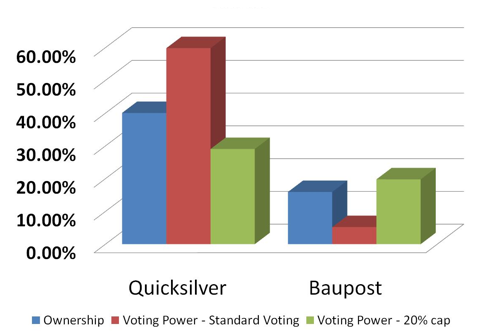
Figure 1: Percentage ownership (blue), and voting power under two schemes –  standard (red) and BBEP’s 20% cap (green) for Quicksilver Resources Inc. and The Baupost Group, the two largest stakeholders of Breitburn Energy Partners.

In Figure 1 the blue bars show Quicksilver’s and Baupost’s percentage ownership of BBEP as of March 2010. The red bars show each company’s voting power under a standard voting scheme. Notice that under a standard voting scheme  Quicksilver has drastically more voting power than their ownership indicates and Baupost has drastically less. This disparity, with some shareholders having more power and some less, is closer to the rule, than the exception. Under the 20% cap rule (green bars), however, Quicksilver’s voting power is cut in half and Baupost’s tripled, but both have influence that is more in proportion with their ownership – a powerful insight that could have been used in BBEP’s defense in the inevitable lawsuit that followed.

The lawsuit was settled and a voting system in which Quicksilver got to vote all its shares (but others who crossed the 20% threshold did not) was agreed on. The resulting power distribution is now exactly the same as under a standard voting scheme (red bars). Therefore, in the event of a disagreement between Quicksilver and Baupost, Baupost’s chances of success are much worse than their ownership percentage would suggest.

How to use voting power analysis to minimize influence loss?

The settlement also seemed to indicate that Quicksilver would be selling down its majority position. It has already sold nearly a quarter of its holdings, most of which went to a new share holder, M.R.Y. Oil Co. Now, assuming Quicksilver would like to retain some ownership, what strategic insight can voting power analysis lead to? Because voting power is a function of both individual ownership and the overall ownership structure, it is actually possible to minimize your lost voting power (on a per share basis) by strategically selecting low-impact buyers.[ii]

Consider two options open to Quicksilver to drop below the 20% ownership threshold: selling a third of its holdings (10% of the company) to the second largest stakeholder, Baupost, or selling it to small shareholders on the open market.[iii]

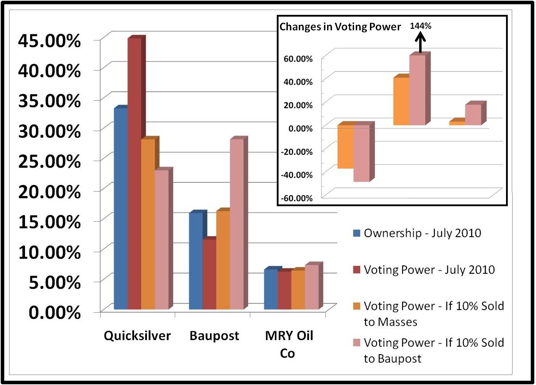
Figure 2: The current voting power structure at Breitburn Energy Partners (blue: ownership, red: voting power), as of July 2010, and two hypotheticals in which Quicksilver Resource Inc. sells another 10% of the company. In the first scenario, the shares are distributed among the smallest shareholders (orange bars). In the second, the shares are sold in a lump sum directly to The Baupost Group (pink bars). The inset shows the percentage change in power from the current situation for each hypothetical.

Figure 2 shows each company’s ownership stake (in blue), as of July 2010, along with the associated voting power (in red). First, note that Baupost’s voting power has improved significantly from March (see Figure 1) without buying any shares because the ownership structure has changed. Second, Quicksilver’s voting power changes depending on whether it sells its shares to the smallest shareholders (in orange) or to Baupost (in pink). When Quicksilver sells to the masses, Baupost’s power again increases substantially, even though they have not increased their holdings by a single share! (The same is true for M.R.Y. Oil Co.) Thus:

Rule 2 of voting power analysis:  voting power can be increased by influencing others to buy or sell!

In the inset in Figure 2 we can see that if Quicksilver sells its shares to Baupost, Quicksilver loses nearly 50% of their voting power. Whereas, if they sell to smaller shareholders they lose only 37% of their voting power. Thus, even a simple application of voting power analysis has profound implications – given the choice, Quicksilver can buffer its loss of influence by a whopping 13% by distributing its shares to smaller shareholders, rather than selling a lump sum to Baupost.

Voting power analysis: what else is it good for?

Stakeholders can use voting power (and related) analysis to help guide key strategic decisions like:

  • Who to buy from and who not to buy from to maximize their purchased control
  • Who to sell to and who not to sell to minimize any lost influence
  • When to be greedy by identifying situations where the purchase of a few more shares will result in a large increase in influence
  • When not to be greedy by identifying situations when the sale of just a few shares will result in a large decrease in influence
  • How to increase their influence without buying any more ownership
  • How much of a company can be sold, while giving up ZERO voting power

and more…

In conclusion, control isn’t worth much – until it is. When trying to change the course of a business in crisis, voting power analysis might prove essential. As voters form coalitions, the effective sizes of the voting blocs grow and so can the disparity between voting power and percentage ownership. It is here in the crucible where, I believe, voting power analysis plus intelligence about key voters’ stances can provide a real edge to investors trying to decide whether the proxy battle is worth the expense and, if so, how best to win it.

Again, I would really appreciate feedback – especially on whether such voting power analyses are commonly applied either in the boardroom or by activist investors.

Travis Dirks, Ph.D. (TravisDirks@gmail.com)

I’d like to thank my co-authors, Radhika Rangarajan and Guy Tal for their insightful conversations that both inspired and fleshed out these ideas as well as for their heroic efforts in helping me to (hopefully) make this tricky subject understandable!


[i] I have made two main assumptions for ease of calculation. The first is that all shareholders vote their shares. The second is that the shares held by groups and individuals with small enough position to not file a 13d are held in equally sized small pieces. While a more realistic assumption, such as a power law distribution in shareholder size, will change the values of voting power, it will not change the main results: percentage ownership alone does not equal voting power, allowing for full optimization of voting power. Also, a Shapley-Shubik index is used to measure voting power.

[ii] It is also possible to optimize in other ways. For instance we can  buy shares to maximize our voting power gain or even our voting power gain plus competitors’ voting power loss.

[iii] Here I’ve assumed that Baupost would get to vote all 25% of its shares, as it would in most other companies, after its own lawsuit. Interestingly, if Baupost were to suffer the 20% cap, selling to Baupost or the masses becomes nearly equivalent options for Quicksilver (Q = 28% , B = 22% , M = 7% ).

Read Full Post »

LCV Capital Management and Raging Capital Management are running an activist campaign against ModusLink Global Solutions(TM) Inc (NASDAQ:MLNK) calling on MLNK to immediately implement a $50 to $75M share repurchase program and align executive compensation with performance. The two fund managers, calling themselves “The ModusLink Full Value Committee,” say that the full potential of MLNK is not being realized due to shortcomings in MLNK’s “operational and capital market strategies” and has “concerns regarding the Company’s corporate governance practices.”  The committee has nominated a slate of three independent director nominees for election to the board at MLNK’s upcoming annual meeting of shareholders.

The full text of the letter follows:

THE MODUSLINK FULL VALUE COMMITTEE
Raging Capital Management, LLC254 Witherspoon Street

Princeton, New Jersey 08542

LCV Capital Management, LLCFifteen Churchill Road, Suite 1000

Pittsburgh, Pennsylvania 15235

October 7, 2010

The Board of Directors

ModusLink Global Solutions, Inc.

1100 Winter Street

Waltham, MA 02451

To the Board of Directors of ModusLink:

The ModusLink Full Value Committee (“The Committee”) owns approximately 5.5% of the outstanding shares of ModusLink Global Solutions, Inc. (“ModusLink” or the “Company”).  We are well informed, long-term investors who have met with senior management and several board members on numerous occasions since representatives of The Committee began investing in ModusLink in 2008.

As we have communicated to you, we believe that the full potential of the Company is not being realized due to shortcomings in the Company’s operational and capital markets strategies.  We are concerned about the Company’s strategic direction, approach to capital allocation, and weak governance oversight.  In our opinion, these factors are key contributors to ModusLink’s lackluster stock price performance over the past several years.

Our view is that ModusLink has a tremendous opportunity to unlock and drive substantial shareholder value.  The Company’s $174 million in cash and investments are equal to approximately $4.00 per share, and working capital on hand exceeds $220 million, or 80% of the Company’s current market capitalization.  Yet the Company’s enterprise value totals just $120 million, or less than three times its Fiscal 2010 EBITDA of $46 million.  Unfortunately, the Company will likely continue as a chronic underperformer in the marketplace until change is implemented.

IMPROVE CAPITAL ALLOCATION AND OPERATING FOCUS; DIVEST NON-CORE ASSETS

Shareholder value has been destroyed via a series of poorly timed and poorly executed business acquisitions by ModusLink.  Since 2004, ModusLink has spent more than $315 million on acquisitions, including $87 million on three separate businesses acquired since 2008.  The Company has since taken material goodwill impairment charges on the bulk of these acquisitions in the last two years.  With a current enterprise value of $120 million, it’s fair to say that the return on deployed acquisition capital over the past six years has been abysmal.

Instead of making additional acquisitions, we believe the Company should focus on optimizing and streamlining existing operations, while divesting underperforming and non-core assets.  We believe a simpler, more transparent business would be easier for management to operate and for investors to comprehend and support, thus leading to improved operating results and shareholder returns.

Furthermore, given the relative stability of the cash flows of the Company’s core business, the significant discount to intrinsic/replacement value that the stock currently trades at, and the strength of the balance sheet, we believe ModusLink should immediately implement a $50 to $75 million share repurchase program.  This would be highly accretive to shareholders and magnify the potential upside of any improvement in the Company’s operating results.

INSUFFICIENT CORPORATE GOVERNANCE AND INSIDER OWNERSHIP

We have also communicated to you our serious suggestions to improve ModusLink’s corporate governance shortcomings. While many publicly traded companies have prudently separated the respective roles of Chairman and CEO, ModusLink continues to operate under an archaic structure where the Chairman also holds the position of CEO and President.  This structure fails to provide the appropriate checks and balances needed between the Board and management and engenders a harmful and value-destroying perception by the market of a general lack of accountability.

We are also deeply concerned that this Board has failed to align executive compensation with performance.  According to the Company’s 2009 proxy statement, ModusLink paid out more than $13.8 million to its top three senior executives over a period of three years while Company’s market value declined by hundreds of millions of dollars. This is not acceptable to us as active and concerned shareholders.  It is noteworthy that we are not alone in our opinion on this matter: At last year’s annual meeting, one of the leading corporate governance and proxy advisory firms recommended that shareholders withhold their vote against the election of the chairman of the compensation committee because of the Company’s propensity to overcompensate management for an underperforming stock.  We firmly believe that, in accordance with its fiduciary obligation to shareholders, it is imperative that the Board aligns compensation with the enhancement of shareholder value, since shareholders are the true owners of the Company.

We propose that part of the failure to align compensation with performance can be traced to the low level of stock ownership held by senior management and the Board.  In fact, excluding ModusLink’s Chairman & CEO, the other six members of the board own approximately 35,000 shares in total, or less than one tenth of one percent of the Company.

NEW SHAREHOLDER REPRESENTATIVES ARE NEEDED TO UNLOCK VALUE

As significant shareholders, our objective is to see the full value of our shares and the shares of all other owners of this Company be recognized in the marketplace.  We are committed to working on behalf of all shareholders to ensure that shareholders’ interests are represented in the boardroom.

As you know, we have nominated three individuals to fill the director positions up for election at the Company’s next annual meeting.  All three of our nominees have the appropriate skills and fortitude to implement the significant changes necessary to benefit all ModusLink shareholders and we believe they will be valuable additions to the Board.

We continue to welcome an open dialogue with you but to date we have been unable to reach an understanding with the Company that will result in the Company immediately taking the necessary steps to unlock shareholder value.  Our sincere hope is that this Board will take a fresh look at the opinions we have outlined above and take immediate action to embrace change rather than engage in a protracted and costly proxy contest in an effort to preserve the status quo.

We remain open to speaking with you at any time.

Sincerely,

/s/ Lodovico C. de Visconti

_____________________________

Lodovico de Visconti

Managing Member, LCV Capital Management, LLC

/s/ William C. Martin

_____________________________

William C. Martin

Managing Member, Raging Capital Management, LLC

The company responded in a press release yesterday:

WALTHAM, Mass.–(BUSINESS WIRE)– ModusLink Global Solutions(TM), Inc. (NASDAQ:MLNK), today issued the following statement in response to the public letter from dissident hedge funds, LCV Capital Management, LLC, Raging Capital Management, LLC and certain of their affiliates:

ModusLink values the opinions of all stockholders and strives to maintain an open dialogue with them. To that end, members of ModusLink’s senior management have met with LCV and Raging Capital representatives on numerous occasions, and throughout the discussions the Company gave these dissidents every indication that their concerns could be resolved in a manner that would be beneficial to all stockholders.

ModusLink’s directors, six of seven of whom are independent, are all highly qualified and committed to represent the best interests of all ModusLink stockholders. Consistent with their fiduciary duties, members of the Board’s Nominating and Corporate Governance Committee have interviewed each one of the dissident nominees and are in the process of evaluating their qualifications.

ModusLink recommends that stockholders defer making any determination with respect to the letter from LCV and Raging Capital, which distorts the Company’s record on a number of matters, until they have been advised of the Board’s evaluation of the dissident’s nominees and proposals.

ModusLink remains firmly committed to creating value for all its stockholders through the successful execution of the Company’s strategy. The Company’s Board and management have taken actions to improve the financial and operational performance of the Company and create value for stockholders, including:

  • Investing $55.3 million to repurchase shares since early fiscal 2008. In total the Company has purchased 5.6 million shares, which represents 12% of the fully diluted outstanding share count at the time the program was first announced.
  • Effectively managing through a very difficult economic environment, taking decisive actions to reduce expenses and maintain a strong balance sheet.
  • Focusing on maximizing profitability, resulting in record free cash flow from operations in fiscal 2010.

It’s an interesting situation worth watching. The record date is next Friday, so stock buying will have to be complete by Tuesday for trades to clear in time for votes to count at the annual meeting.

No position yet.

Read Full Post »

Fortune has an article asking whether VCs can be value investors:

After all, the philosophy of value investing, in theory, should cut across all asset classes and managers. The precepts and principals therefore should apply to the venture capital business as well.

Sadly, they don’t.

Jeffrey Bussgang, the author, identifies the problem as an inability to invest with a margin of safety:

Klarman writes: “Investing in bargain-priced securities provides a “margin of safety” — room for error, imprecision, bad luck, or the vicissitudes of the economy and stock market.”

Unfortunately, VCs don’t operate with a margin of safety, even if they are able to find and negotiate good deals. Later stage investors may have downside protection if they buy smart, but early-stage VCs do not. If a portfolio company goes bad, there is typically barely any salvage value.

I don’t know that venture capital investing necessarily means investing without a margin of safety, but I agree that many early stage investments lack a margin of safety.

An estimate of intrinsic value is key to determining a margin of safety. Early stage businesses by definition lack a track record, and – BYD aside – not even Buffett can value a business without a track record. It is more difficult when the business has promise, but is burning cash, if only because the blue sky makes it easier to ignore the ugly financial statements.

Confronted with this state of affairs – no track record, no ability to see the future – most value investors would do as Buffett suggests and simply refuse to swing. This is one of the nice things about value investing. You don’t have to know everything about everything, or even much about anything. All you have to know is what you do know, and what you don’t know, and the location of the line separating the two.

Venture capitalists, however, must know stuff about the future, and must be able to “see around corners” (seriously?). To the extent that venture capitalists undertake any sort of valuation that a value investor might recognize, they must extrapolate revenue growth from non-existent revenue, hope that some of it eventually falls to the bottom line, and then into the hands of shareholders, and plug it into a model with the Gordon Growth Model (GGM) at its heart. (As an aside, I could barely type with a straight face that part about venture capitalists waiting for the dividends. I know they “exit” in a trade sale or IPO, which I guess is a euphemism for “sell to a greater fool.”)

Every value investor knows that big growth assumptions in the GGM – even those based on a historical track record – are a recipe for disaster. Why? Simply because the growth is always going to be so astronomical as to overwhelm the discount rate portion of the model, leading to a “Choose your own value” output. To wit:

Value = D / R – G

Where D is next year’s dividend, R is your discount rate and  G is the perpetuity growth rate

If R is say 10-12%, any G over 9-11% gives a value that is more than 100x dividends, which is pricey. I doubt there are any VCs getting out of bed for 10% growth assumptions, so I assume they crank up their discount rates, but the result is the same. As G approaches R, value approaches infinity, and, in some instances, beyond. The solution to this problem is obviously to assume a short period of supernormal growth and then a perpetuity of GDP (or some other, lower) growth figure. This just creates another problem, which, for mine, is too many assumptions, and too many moving parts to get a meaningful valuation.

In this vein, I had a chat with a friend who is a value guy about Facebook’s “valuation”. He says:

Originally thought that the $33b Facebook valuation was ridiculous but am beginning to breathe the fumes. It is taking over the world. Set me straight please!

I responded:

Sounds pretty crazy to me. Might be based on a Gordon Growth Model-type valuation which #Refs out once the assumed growth exceeds the discount rate (which it almost assuredly would for Facebook). That said, these crazies don’t seem to think it’s so crazy.

Says he:

One of the commenters on that site has set me straight:

“Google provides a relevant service. FB is a spam hole. No one is going to pay for spam unless it’s from the guy at the other end of the ad stealing your credit card #. FB is worthless. And of that 1 billion (doubt it), they still owe around 150 million for financing servers and other things. If they had the funds, don;t you think they’d be smart enough to pay CASH, instead of paying interest on a LOAN?”

Insightful stuff. Shame on me.

So the answer for VCs is simple. The valuation is too hard so ignore it, but buy a portfolio of interesting businesses and hope that you get a few home runs. Oh, also sell some of your early shares in Facebook at that $33B valuation because you never know what lurks around the corner.

Read Full Post »

FT.com’s Lex has an article (Sara Lee in play) on a possible bid for the food conglomerate Sara Lee (NYSE:SLE) by the old barbarians at the gates, Kohlberg Kravis Roberts:

Of course, a bid now might be opportunistic. Sara Lee has been without the architect of its restructuring since chief executive Brenda Barnes retired due to illness in August. Asset sales have brought debt down to moderate levels. And there is always a good price for a bad business. Sara Lee trades on about seven times prospective earnings before interest, tax, depreciation and amortisation – well below the double-digit multiples typical for attractive consumer goods acquisitions.

However, it is hard to see what might better be done with a collection of commoditised food businesses (bakery, meat processing and food service) and a low-growth coffee arm. Overall profitability has barely varied from a steady 8 per cent operating margin in two decades. Disposing of the North American bakery business, as management plans, should cause that to jump to 12 per cent, calculates CreditSights. But any sale also involves handing care of part of the Sara Lee brand to a third party, and buyers have not rushed to snap up an operation with expensive unionised labour. There seems little reason to linger at the gate.

I don’t think Lex will be buying the stock, but it’s still interesting. A portfolio of good brands with some commodity businesses thrown into the mix at ~7 times EBITDA. KKR could buy it, sell off the commodity businesses and do something with the brands (I don’t know, what am I, a PE guy?). It might be worth doing some work. Anybody got a buyout analysis they’d care to share?

No position.

Read Full Post »

The inimitable Distressed Debt Investing has another great analysis of Visteon (see my post archive here). Hunter says:

In my 8 years on the buy side, in distressed and high yield land, I have never seen a more consensus long than Visteon’s when issued equity. Simply put, Visteon’s equity to distressed funds is like Apple to Long/Short funds. Many people I know are long it (including myself) – The only thing I can’t figure out: who is selling?

Here’s Hunter’s analysis:

  1. Visteon owns 70% of Halla: At the USD equivalent market cap of ~$2B, gives us $1.4B of value
  2. Visteon owns 50% of Yanfeng: We will use a 10x multiple, ~$900M of value [note I am seeing analysts put a 12-15x multiple on this business]
  3. Cash at Exit: $785M
  4. Added Cash from Warrents: ~$100M

That gets us to $3.2B before adding any value to the US operations. From this we subtract:

  1. Term Loan: $500m
  2. Cash at Halla ~$150M (as to not double count)

Which nets us to $2.55B of equity value. Still before US operations. 54M shares outstanding translates to $47/share. Given the $56/share price today, there is a $9/delta or $500M. This is where the market is currently valuing Visteon’s US operations.

And that’s where we say: “You’ve got to be kidding me?”

Everyone in the market knows Visteon sandbagged their numbers. Why? Because management is getting a good deal of equity post emergence. But let’s say they are right – the 2011 plan calls for $550M of EBITDA. You have to deduct Halla from this which nets you do approximately $300M.

Therefore the market is valuing the US operations at 1.7x. For a company with a net cash position…Here are some 2011E EV/EBITDA comps for your reference: TRW: 4.1x, LEA: 3.9x, Fed Mo: 5.0x, Dana: 3.9x, Tenneco: 4.9x. Let’s be conservative and use 4.0x and see where the value gets us to: Add $1.2B to our sum of parts above, gets us to a $70/stock. And I will tell you, I am probably one of the more conservative estimates out there.

I want to know who is selling this stock? Is this side as one-sided as I believe it to be (at $55/share)?

Read Full Post »

Longterm Investing has a series of posts examining several scenarios in Seahawk (HAWK) following the recent conference call (see my post archive for the background). In particular, Neil has examined the effect of CEO Randy Stilley’s proposal to take on debt to buy rigs, rather than buyback stock. Here’s the analysis:

It’s important to understand how the risk-reward profile of HAWK is modified as they take on debt. In their quarterly call they indicated a strong preference for adding debt and adding rigs.

I’ve considered three scenarios.

1. HAWK retains their current leverage and uses asset sales to pay for operations. These asset sales will be at scrap values, around $7M per rig.

2. HAWK takes on 110M of debt and 50M of new assets. These new assets are 3M cash flow positive each quarter after interest. All of HAWKs rigs, new and old are security for this debt. It replaces the existing credit line. This amount of debt is below the scrap value of existing rigs + new asset value.

3. Hawk takes on $150M of debt and 50M of new assets. Similarly,  these new assets are 3M cash flow positive each quarter after interest. All of HAWKs rigs, new and old are security for this debt. It replaces the existing credit line. This amount of debt is about the liquidation value of current rigs and new rigs, net of liabilities.

The “good case” is where HAWK continues their current cash burn, as modified in the scenarios above, until a point in time when rig market values return to December 2008 levels.

The company values under each scenario are shown below assuming a return to December 2008 values in that period. The value added and subtracted by debt are shown along with the 40M residual value under case 2.

image

See the post.

Long HAWK.

Read Full Post »

« Newer Posts - Older Posts »