Feeds:
Posts
Comments

Archive for the ‘Net Current Asset Value’ Category

Continuing the quantitative value investment theme I’ve been trying to develop over the last week or so, I present my definition of a simple quantitative value strategy: net nets. James Montier, author of the essay Painting By Numbers: An Ode To Quant, which I use as the justification for simple quantitative investing, authored an article in September 2008 specifically dealing with net nets as a global investment strategy: Graham’’s net-nets: outdated or outstanding? (Edit: It seems this link no longer works as SG obliterates any article ever written by Montier). Quelle surprise, Montier found that buying net-nets is a viable and profitable strategy:

Testing such a deep value approach reveals that it would have been a highly profitable strategy. Over the period 1985-2007, buying a global basket of net-nets would have generated a return of over 35% p.a. versus an equally weighted universe return of 17% p.a.

An annual return of 35% over 23 years would put you in elite company indeed, so Montier’s methodology is worthy of closer inspection. Unfortunately he doesn’t discuss his methodology in any detail, other than to say as follows:

I decided to test the performance of buying net-nets on a global basis. I used a sample of developed markets over the period 1985 onwards, all returns were in dollar terms.

It may have been a strategy similar to the annual rebalancing methodology discussed in Oppenheimer’s Ben Graham’s Net Current Asset Values: A Performance Update. That paper demonstrates a purely mechanical annual rebalancing of stocks meeting Graham’s net current asset value criterion generated a mean return between 1970 and 1983  of “29.4% per year versus 11.5% per year for the NYSE-AMEX Index.” It doesn’t really matter exactly how Montier generated his return. Whether he bought each net net as it became a net net or simply purchased a basket on a regular basis (monthly, quarterly, annually, whatever), it’s sufficient to know that he was testing the holding of a basket of net nets throughout the period 1985 to 2007.

Montier’s findings are as follows:

  • The net-nets portfolio contains a median universe of 65 stocks per year.
  • There is a small cap bias to the portfolio. The median market cap of a net-net is US$21m.
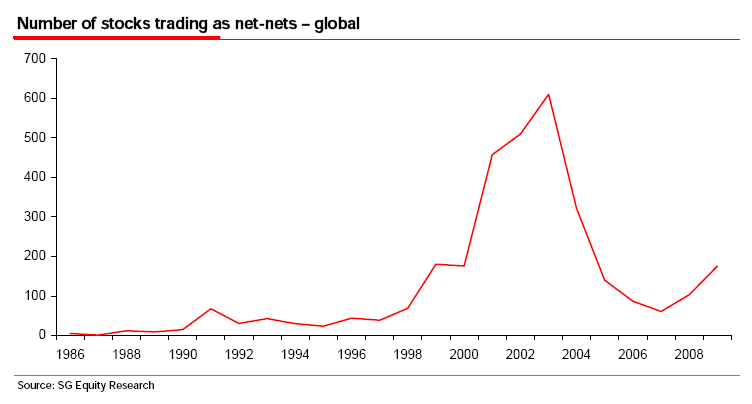
  • At the time of writing (September 2008), Montier found around 175 net-nets globally. Over half were in Japan.
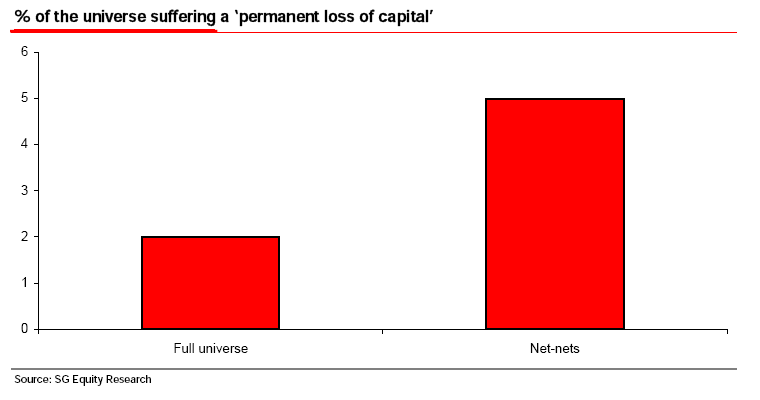
  • If we define total business failure as stocks that drop more than 90% in a year, then the net-nets portfolio sees about 5% of its constituents witnessing such an event. In the broad market only around 2% of stocks suffer such an outcome.
  • The overall portfolio suffered only three down years in our sample, compared to six for the overall market.

Several of Montier’s findings are particularly interesting to me. At an individual company level, a net net is more likely to suffer a permanent loss of capital than the average stock:

If we define a permanent loss of capital as a decline of 90% or more in a single year, then we see 5% of the net-nets selections suffering such a fate, compared with 2% in the broader market.

Here’s the chart:
This is interesting given that NCAV is often used as a proxy for liquidation value.

Very few companies turn out to have an ultimate value less than the working capital alone, although scattered instances may be found.

Montier believes this may provide a clue as to why the net net strategy continues to work:

This relatively poor performance may hint at an explanation as to why investors shy away from net-nets. If investors look at the performance of the individual stocks in their portfolio rather than the portfolio itself (known as ‘narrow-framing’), then they will see big losses more often than if they follow a broad market strategy. We know that people are generally loss averse, so they tend to feel losses far more than gains. This asymmetric response coupled with narrow framing means that investors in the net-nets strategy need to overcome several behavioural biases.

Paradoxically, it seems that what is true at the individual company level is not true at an aggregate level. The net net strategy has fewer down years than the market:

If one were to frame more broadly and look at the portfolio performance overall, the picture is much brighter. The net-net strategy only generated losses in three years in the entire sample we backtested. In contrast, the overall market witnessed some six years of negative returns.

Here’s the chart:

And it seems that the net net strategy is a reasonable contrary indicator. When the market is up, fewer can be found, and when the market is down, they seem to be available in abundance:
The main drawback to the net net strategy is its limited application. Stocks tend to be small and illiquid, which puts a limit on the amount of capital that can be safely run using it. That aside, it seems like a good way to get started in a small fund or with a individual account. Montier concludes:

…In various ways practically all these bargain issues turned out to be profitable and the average annual return proved much more remunerative than most other investments.

Good old Benjamin Graham. What a guy.

Buy my book The Acquirer’s Multiple: How the Billionaire Contrarians of Deep Value Beat the Market from on Kindlepaperback, and Audible.

Here’s your book for the fall if you’re on global Wall Street. Tobias Carlisle has hit a home run deep over left field. It’s an incredibly smart, dense, 213 pages on how to not lose money in the market. It’s your Autumn smart read. –Tom Keene, Bloomberg’s Editor-At-Large, Bloomberg Surveillance, September 9, 2014.

Click here if you’d like to read more on The Acquirer’s Multiple, or connect with me on Twitter, LinkedIn or Facebook. Check out the best deep value stocks in the largest 1000 names for free on the deep value stock screener at The Acquirer’s Multiple®.
Read Full Post »

Update: I’ve removed SIG from the list.

In Ben Graham’s Net Current Asset Values: A Performance Update Professor Henry Oppenheimer examined the return on stocks selected using Benjamin Graham’s net current asset value strategy over the period 1970 to 1983. Oppenheimer’s conclusion about the returns from such stocks was nothing short of extraordinary:

The mean return from net current asset stocks for the 13-year period was 29.4% per year versus 11.5% per year for the NYSE-AMEX Index. One million dollars invested in the net current asset portfolio on December 31, 1970 would have increased to $25,497,300 by December 31, 1983. By comparison, $1,000,000 invested in the NYSE-AMEX Index would have increased to $3,729,600 on December 31, 1983. The net current asset portfolio’s exceptional performance over the entire 13 years was not consistent over smaller subsets of time within the 13-year period. For the three-year period, December 31, 1970 through December 31, 1973, which represents 23% of the 13-year study period, the mean annual return from the net current asset portfolio was .6% per year as compared to 4.6% per year for the NYSE-AMEX Index.

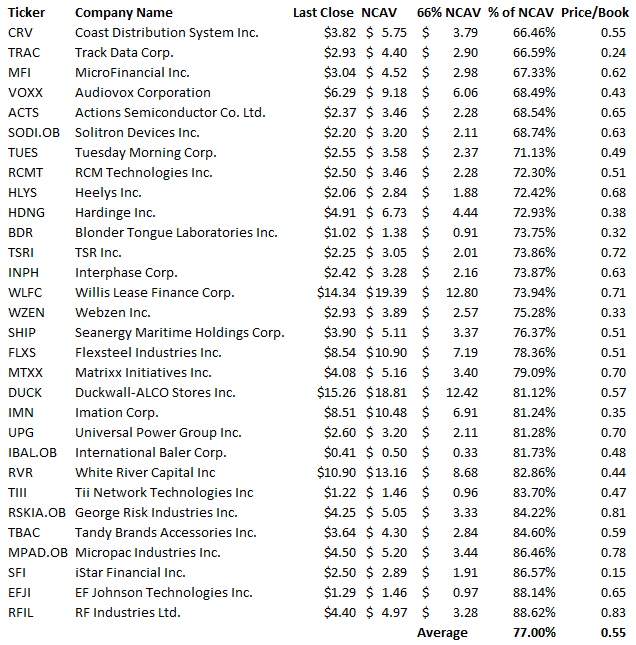
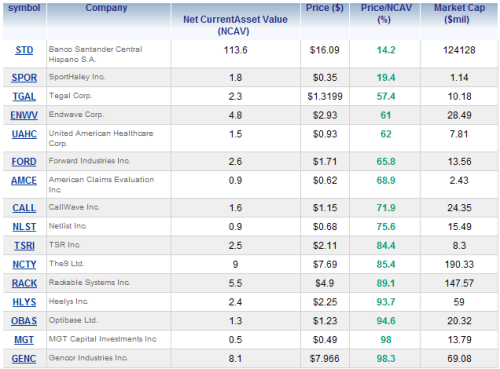
Oppenheimer’s methodology was to acquire all stocks meeting Graham’s investment criterion on December 31 of each year, hold those stocks for one year, and replace them on December 31 of the subsequent year. I’m introducing a new portfolio to track the performance of Graham NCAV stocks in real time. I’ll roll it over annually, like Oppenheimer did. Here’s the Greenbackd 2010 Graham NCAV Portfolio (extracted from the Graham Investor screen):

You can track the performance of the Greenbackd 2010 Graham NCAV Portfolio throughout 2010 with Tickerspy.

[Full Disclosure:  No positions. This is neither a recommendation to buy or sell any securities. All information provided believed to be reliable and presented for information purposes only. Do your own research before investing in any security.]

Read Full Post »

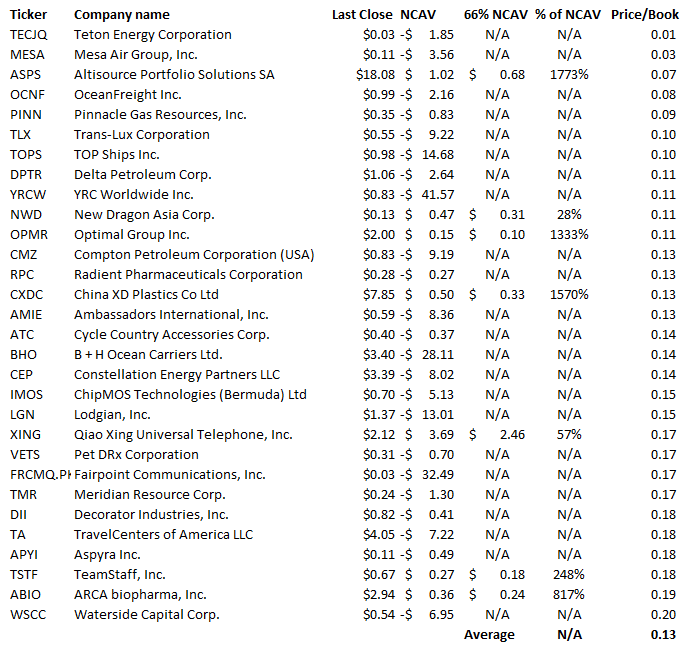
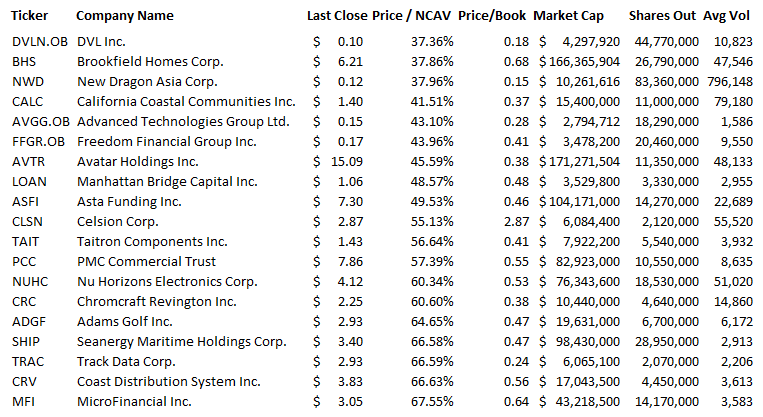
I’m setting up a new experiment for 2009/2010 along the same lines as the 2008/2009 Net Net vs Activist Legend thought experiment pitting a little Graham net net against activist investing legend Carl Icahn (Net Net vs Activist Legend: And the winner is…). This time around I’m pitting a small portfolio of near Graham net nets against a small portfolio of ultra-low price-to-book value stocks. The reason? Near Graham net nets are stocks trading at a small premium to Graham’s two-thirds NCAV cut-off, but still trading at a discount to NCAV. While they are also obviously trading at a discount to book, they will in many cases trade at a higher price-to-book value ratio than a portfolio of stocks selected on the basis of price-to-book only. I’m interested to see which will perform better in 2010. The two portfolios are set out below (each contains 30 stocks). I’ll track the equal-weighted returns of each through the year.

The Near Graham Net Net Portfolio (extracted from the Graham Investor screen):

The Ultra-low Price-to-book Portfolio:

The Ultra-low Price-to-book Portfolio contains a sickly lot from a net current asset value perspective. Most have a negative net current asset value, as their liabilities exceed their current assets. Where that occurs, the proportion of price to NCAV is meaningless, so I’ve just recorded it as “N/A”. The few stocks that do have a positive net current asset value are generally trading a substantial premium to that value, with the exception of NWD and ZING, which qualify as Graham net nets.

While the Net Net vs Activist Legend thought experiment didn’t amount to (ahem) a formal academic study, there are two studies relevant to the outcome in that experiment: Professor Henry Oppenheimer’s Ben Graham’s Net Current Asset Values: A Performance Update, which found “[the] mean return from net current asset stocks for the 13-year period [from 1970 to 1983] was 29.4% per year versus 11.5% per year for the NYSE-AMEX Index.” Also relevant was Hedge Fund Activism, Corporate Governance, and Firm Performance, by Brav, Jiang, Thomas and Partnoy, in which the authors found that the “market reacts favorably to hedge fund activism, as the abnormal return upon announcement of potential activism is in the range of [7%] seven percent, with no return reversal during the subsequent year.”

This experiment is similar to the Net Net vs Activist Legend thought experiment in that it isn’t statistically significant. There are, however, several studies relevant to divining the outcome. In this instance, Professor Oppenheimer’s study speaks to the return on the Near Graham Net Net Portfolio, as Roger Ibbotson’s Decile Portfolios of the New York Stock Exchange, 1967 – 1984 (1986), Werner F.M. DeBondt and Richard H. Thaler’s Further Evidence on Investor Overreaction and Stock Market Seasonality (1987), Josef Lakonishok, Andrei Shleifer, and Robert Vishny’s Contrarian Investment, Extrapolation and Risk (1994) as updated by The Brandes Institute’s Value vs Glamour: A Global Phenomenon (2008) speak to the return on the Ultra-low Price-to-book Portfolio. One wrinkle in that theory is that the low price-to-book value studies only examine the cheapest quintile and decile, where I have taken the cheapest 30 stocks on the Google Finance screener, which is the cheapest decile of the cheapest decile. I expect these stocks to do better than the low price-to-book studies would suggest. That said, I expect that the Near Graham Net Net Portfolio will outperform the Ultra-low Price-to-book Portfolio by a small margin. Let me know which horse you’re getting on and the reason in the comments.

[Full Disclosure:  I hold RCMT and TSRI. This is neither a recommendation to buy or sell any securities. All information provided believed to be reliable and presented for information purposes only. Do your own research before investing in any security.]

Read Full Post »

The wonderful Miguel Barbosa of Simoleon Sense has interviewed Joe Calandro, Jr., author of Applied Value Investing. The interview is first class. Joe Calandro, Jr. is an interesting guy. Deep value? Check. Activist investing? He’s for it. Austrian School of Economics? Check. I think I just wet myself.

Here’s Joe’s take on value:

Q. Can you give me an example of some of your best investments?

A. In the book I profile a value pattern that I call “base case value” which is simply net asset value reconciling with the earnings power value. Firms exhibiting that pattern, which sell at reasonable margins of safety have proved highly profitable to me. In the book, I show examples of this type of investment.

“Value investing” in general has 3 core principles:

(1) The circle of competence, which essentially relates to an information advantage and holds that you will do better if you stick to what you know more about than others.

(2) The principle of conservatism. You will have greater faith in valuations if you prepare them conservatively.

(3) The margin of safety. You should only invest if there is a price-to-value gap: when the gap disappears you exit the position.

Here’s Joe on activist investing:

Q. You’re primarily in the corporate sector now; in your book you touch upon the failure of corporate M&A groups to apply value investing.  Why do you think this is the case? What is your take on activist value investors?

A. That’s a good question and I don’t have a definitive answer for it. My take on it is that Corporate America hasn’t been trained in Graham and Dodd. For example, if you get away from Columbia and some of the other top schools you really don’t have courses of study based on Graham and Dodd. I think this lack of education carries over to practice. If educational institutions aren’t teaching something, then executives are going to have a difficult time applying it. And if they do try to apply it, their employees and boards may not understand it. Hopefully, my book will help to rectify this over time.

Regarding activist investors, I think every investor should be active. If you allocate money to a security (either equity or debt) you have the responsibility of becoming involved in the respective firm because, as Benjamin Graham noted, you invested in a business, not in a piece of paper or a financial device. This is real money in real businesses so there is a responsibility that comes with investing.

And Joe’s view on economics:

Q. Can you give us a tour of the major insights you obtained from the Austrian School of Economics.

A. I have two big academic regrets: I did not study Graham and Dodd or Austrian economics until I was in my mid 30’s. One of the major theories of Austrian economics is its business cycle theory. Just the other day (11/6/2009), that theory was mentioned in the WSJ by Mark Spitznagel, who is Nassim Taleb’s partner, in his article “The Man Who Predicted the Depression.” As you know, Taleb has also spoken highly of Austrian economics as have other successful traders/practitioners such as Victor Sperandeo, Peter Schiff and Bill Bonner.

Austrian economics finds success with practitioners because, I think, Austrian economists are truly economists; they do not try to be applied mathematicians. Therefore, Austrians tend to see economics for what it is; namely, a discipline built around general principles that can be applied broadly to economic phenomena. As a result, Austrian economics is generally very useful in areas such as the business cycle and the consequences of government intervention, which are very pertinent topics today.

Read the rest of the interview while I run out to buy the book.

Read Full Post »

It seems to me counterintuitive that book value should be useful as a value metric. Book value, after all, is a historical accounting measure of a company’s balance sheet. It has nothing to do with “intrinsic value,” which is the measure conceived by John Burr Williams in his 1938 treatise The Theory of Investment Value. Warren Buffett is a well-known proponent of “intrinsic value.” In his 1992 letter to shareholders he provided the following explication of the concept:

In The Theory of Investment Value, written over 50 years ago, John Burr Williams set forth the equation for value, which we condense here: The value of any stock, bond or business today is determined by the cash inflows and outflows – discounted at an appropriate interest rate – that can be expected to occur during the remaining life of the asset. Note that the formula is the same for stocks as for bonds. Even so, there is an important, and difficult to deal with, difference between the two: A bond has a coupon and maturity date that define future cash flows; but in the case of equities, the investment analyst must himself estimate the future “coupons.” Furthermore, the quality of management affects the bond coupon only rarely – chiefly when management is so inept or dishonest that payment of interest is suspended. In contrast, the ability of management can dramatically affect the equity “coupons.”

The investment shown by the discounted-flows-of-cash calculation to be the cheapest is the one that the investor should purchase – irrespective of whether the business grows or doesn’t, displays volatility or smoothness in its earnings, or carries a high price or low in relation to its current earnings and book value. Moreover, though the value equation has usually shown equities to be cheaper than bonds, that result is not inevitable: When bonds are calculated to be the more attractive investment, they should be bought.

Buffett’s explanation draws a sharp distinction between intrinsic value and book value – “The investment shown by the discounted-flows-of-cash calculation to be the cheapest is the one that the investor should purchase – irrespective of whether the business…carries a high price or low in relation to its…book value.” While Buffett’s statement may be true, that does not mean that book value is useless as a value metric. Far from it. As the various studies we have discussed recently demonstrate – Roger Ibbotson’s Decile Portfolios of the New York Stock Exchange, 1967 – 1984 (1986), Werner F.M. DeBondt and Richard H. Thaler’s Further Evidence on Investor Overreaction and Stock Market Seasonality (1987), Josef Lakonishok, Andrei Shleifer, and Robert Vishny Contrarian Investment, Extrapolation and Risk (1994) and The Brandes Institute’s Value vs Glamour: A Global Phenomenon (2008) – low price-to-book value stocks outperform higher priced stocks and the market in general. Why might that be so?

In Contrarian Investment, Extrapolation and Risk, Lakonishok, Shleifer, and Vishny frame their findings in the context of contrarianism, what I like to call the Ricky Roma style of investing:

I subscribe to the law of contrary public opinion. If everyone thinks one thing, then I say, “Bet the other way.”

The problem, as I see it, with low price-to-book investment is that the strategy always flashes a buy signal. When the market is getting very toppy, you can still find the cheapest decile, quintile, quartile, or whatever on a price-to-book basis to buy. That decile might not recede as much as the market in general, but I’d bet odds on that it will still recede. That might not be a problem if, in the aggregate, the price-to-book strategy is able to generate satisfactory long-term returns. A better strategy, however, would remove the opportunities to trade as the market gets expensive, forcing you to sit in cash. I believe this is why Piotroski’s F_SCORE and Graham’s Net Current Asset Value strategies perform so well. When the market gets expensive, those opportunities disappear.

The American Association of Individual Investors website offers various value and growth screens to its membership. Piotroski’s F_SCORE is one such screen. The AAII reports that, of the 56 screens it offers, the only screen that had positive results in 2008 was Piotroski’s F_SCORE (via Forbes):

Believe it or not, the five stocks that AAII bought using Piotroski’s strategy in 2008 gained 32.6% on average through the end of the year. The median performance for all of the AAII strategies last year? -41.7%.

It’s clearly an austere screening criteria if it only lets a handful of stocks get through when the market is high, and in this respect very similar to Graham’s Net Current Asset Value strategy. Right now it has one stock on its screen. That stock? Tune in next week for the full analysis. (I’m starting to sound like The Motley Fool).

Read Full Post »

November 30, 2009 marked the end of Greenbackd’s fourth quarter and first year, and so it’s time again to report on the performance of the Greenbackd Portfolio and the positions in the portfolio, and outline the future direction of Greenbackd.com.

Fourth quarter 2009 performance of the Greenbackd Portfolio

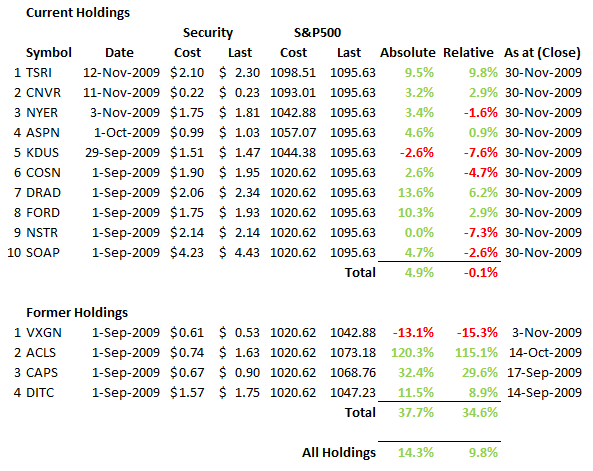
The fourth quarter was another satisfactory quarter for the Greenbackd Portfolioup 14.3% on an absolute basis, which was 9.8% higher than the return on the S&P500 return over the same period. A large positive return for the period is great, but my celebration is tempered once again by the fact that the broader market also had a pretty solid quarter, up 7.4%. The total return for Greenbackd’s first year (assuming equal weighting in all quarters) is 136.8% against a return on the S&P500 of 34.2%, or an outperformance of 102.6% over the return in the S&P500.

It is still too early to determine how well Greenbackd’s strategy of investing in undervalued asset situations with a catalyst is performing, but I believe Greenbackd is heading in the right direction. Set out below is a list of all the stocks in the Greenbackd Portfolio and the absolute and relative performance of each from the close of the last trading day of the third quarter, September 1, 2009, to the close on the last trading day in the fourth quarter, November 30, 2009:

*Note the returns for SOAP and NSTR include special dividends paid. See below for further detail.

You may have noticed something odd about my presentation of performance. The S&P500 index rose by 7.4% in the fourth quarter (from 1020.62 to 1,095.63). Greenbackd’s +14.3% performance might suggest an outperformance over the S&P500 index of 6.9%, while I report outperformance of 9.8%. I calculate Greenbackd’s performance on a slightly different basis, recording the level of the S&P500 Index on the day each stock is added to the portfolio and then comparing the performance of each stock against the index for the same holding period. The Total Relative performance, therefore, is the average performance of each stock against the performance of the S&P500 index for the same periods. As we discussed above, the holding period for Greenbackd’s positions has been too short to provide any meaningful information about the likely performance of the strategy over the long term (2 to 5 years), but I believe that the strategy should outperform the market by a small margin.

Update on the holdings in the Greenbackd Portfolio

There are currently ten stocks in the Greenbackd Portfolio:

  1. TSRI (added November 12, 2009 @ $2.10)
  2. CNVR (added November 11, 2009 @ $0.221)
  3. NYER (added November 3, 2009 @ $1.75)
  4. ASPN (added October 1, 2009 @ $0.985)
  5. KDUS (added September 29, 2009 @ $1.51)
  6. COSN (added August 6, 2009 @ $1.75)
  7. FORD (added July 20, 2009 @ $1.44)
  8. DRAD (added March 9, 2009 @ $0.88)
  9. SOAP (added February 2, 2009 @ $2.50. Initial $3.75 dividend paid July 30)
  10. NSTR (added January 16, 2009 @ $1.91. Initial $2.06 dividend paid July 15)

Greenbackd’s investment philosophy and process

I started Greenbackd in an effort to extend my understanding of asset-based valuation described by Benjamin Graham in the 1934 Edition of Security Analysis. (You can see a summary of Graham’s approach here). Through some great discussion with Greenbackd’s readers, many of who work in the fund management industry as experienced analysts or even managing members of hedge funds, and by incorporating the observations of Marty Whitman (see Marty Whitman’s adjustments to Graham’s net net formula here) and Seth Klarman (the Seth Klarman series starts here), I have refined Greenbackd’s process. I believe that the analyses are now pretty robust and that has manifest itself in satisfactory performance.

Tweedy Browne provides compelling evidence for the asset-based valuation approach. In conjunction with a reader of Greenbackd I have now conducted my own study into the performance of sub-liquidation value stocks over the last 25 years. The paper has been submitted to a practitioner journal and will also appear on Greenbackd in the future.

The future of Greenbackd.com

Greenbackd is a labor of love. I try to create new content every weekday, and to get the stock analyses up just after midnight Eastern Standard Time, so that they’re available before the markets open the following day. Most of the stocks that are currently trading at a premium to the price at which I originally identified them traded for a period at a discount to the price at which I identified them. This means that there are plenty of opportunities to trade on the ideas (not that I suggest you do that without reading the disclosures and doing your own research). If you find the ideas here compelling and you get some value from them, you can support my efforts by making a donation via PayPal.

If you’re looking for net nets in the meantime, here are two good screens:

  1. GuruFocus has a Graham net net screen, with some great functionality ($249 per year)
  2. Graham Investor NCAV screen (Free)

I look forward to bringing you the best undervalued asset situations I can dig up in the next quarter and the next year.

Read Full Post »

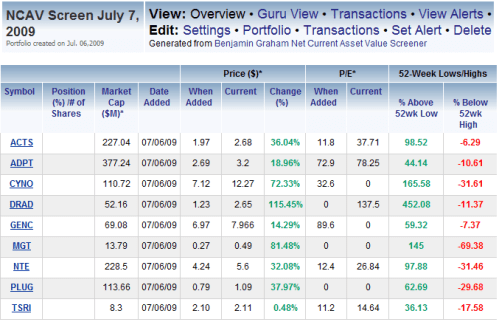
We’ve recently been using the GuruFocus Benjamin Graham Net Current Asset Value Screener (subscription required) to generate regular watchlists of net net stocks. The GuruFocus NCAV screen has some superb functionality that makes it possible to create the watchlist from the screen and then track the performance of those stocks. We created our first watchlist on July 7 of this year using the July 6 closing prices. The performance of the stocks in that first watchlist over the last quarter has been nothing short of spectacular. Here is a screen grab (with some columns removed to fit the space below):

GuruFocus NCAV Screen

We know the market’s been somewhat frothy recently, but those returns are still notable. The average return to date across the nine stocks in the watchlist is 45.5% against the return on the S&P500 of 20.05% over the same period, an outperformance of more than 25% in ~three months. We’ve decided to run another screen today and we’ll track the return of that watchlist over the coming months. The stocks in the watchlist are set out below (again, with a column removed to fit the space below):

GuruFocus NCAV Screen 2009 10 13

We’ve done no research on these firms beyond running the screen. If you plan on buying anything in this screen, at the absolute minimum we recommend that you do some research to determine whether they are currently net net stocks and not just caught in the screen because of out-of-date filings. We’ll compare the performance of the stocks against the S&P500, which closed yesterday at 1,076.18.

[Full Disclosure:  We have a holding in FORD. This is neither a recommendation to buy or sell any securities. All information provided believed to be reliable and presented for information purposes only. Do your own research before investing in any security.]

Benjamin Graham Net Current Asset Value Screener

Read Full Post »

Bespoke Investment Group (via The Reformed Broker) has a list of the biggest gainers for 2009. It should come as no surprise to regular readers of Greenbackd that a number of the stocks are former sub-liquidation value plays (most of which we missed):

Little ten baggersWe opened a position in VNDA and got a great return. We lost our nerve with BGP and missed out on a great return. We completely ignored ATSG, DTSG, SMRT, RFMD, PIR and CHUX although all appeared on our NCAV screen at some stage earlier this year. A little more evidence that diamonds can be found if you dig through enough trash.

Read Full Post »

In the following video, legendary value investor Marty Whitman discusses Benjamin Graham’s net-net formula and his adjustments to it. We’ve previously covered those adjustments here, but we’ve added the video because we think it’s quite amazing to see the great man explaining his rationale for making them. The highlight, from our perspective, is this gem:

We do net-nets based more on common sense. As, for example, you have an asset – a Class A office building – financed with recourse finance, fully tenanted by credit-worthy tenants; That, for accounting purposes, is classified as a fixed asset, but, given such a building, you pick up the telephone and sell it, and really it’s more current than K-Mart’s inventories, for example, which is classified as a current asset. 

 Enjoy the rest of his wit below:


Read Full Post »

Long-term readers of Greenbackd might remember our initial struggle to apply the net net / liquidation formula described by Benjamin Graham in the 1934 Edition of Security Analysis in the context of modern accounting. Putting aside our attempt to include and tweak the discounts to PP&E (kind of like fixing the smile on the Mona Lisa), most embarassing was our failure to factor into the valuation off-balance sheet liabilities and contractual obligations. The best thing that we can say about the whole sorry episode is that we got there in the end and we’ve been applying a more robust formulation for the last quarter. With that in mind, we thought it was particularly interesting to see the Financial Post’s article, Veteran tweaks Graham’s rule to find bargains (via Graham and Doddsville), which details the refinements legendary value investor Marty Whitman makes to Graham’s net-net formulation.

According to the article, Whitman makes the following adjustments to Graham’s 90-year old formula:

  • Companies must be well-financed

First and foremost, companies must be well-financed in keeping with the core tenet of Third Avenue’s “safe and cheap” method of value investing.

The goal is to own companies that are going concerns, not ones destined for liquidation. This difference is a crucial point of distinction between the focus of equity investors, who are often wiped out in liquidation, and bond investors, who have rights to the assets of a company in liquidation.

  • Whitman includes long-term assets that are easily liquidated

The second adjustment is to the assets themselves. Graham and Dodd focused exclusively on current assets when calculating liquidation value whereas Whitman includes long-term assets that are easily liquidated.

For example, roughly one third of long-term assets of Toyota Industries Corp. are investment securities, including a 6% position in Toyota Motor Corp. (TM/TSX), says Ian Lapey, portfolio manager at Third Avenue and designated successor to Whitman on the Third Avenue Value Fund.

These securities are therefore included in Third Avenue’s calculations of net-net.

Closer to home, oil and gas producer Encana Corp. (ECA/ TSX) has proved reserves of oil and natural gas that are not included in current assets, says Lapey.

“They are liquid in that there is a real market, current commodity prices notwithstanding, for high-quality proved reserves of oil and gas.” Encana is a top holding in AIC Global Focused Fund, sub-advised by Third Avenue and managed by Lapey.

  • Adjust for off-balance sheet liabilities

The third adjustment is the inclusion of off-balance-sheet liabilities. Here, U. S. banks’ structured investment vehicles readily spring to mind.

  • Include some PP&E

The fourth and final adjustment to Graham and Dodd is the inclusion of “some property, plant and equipment” for their liquidated cash value and associated tax losses that often produce cash savings.

Hong Kong real estate companies, such as top holding Henderson Land Development Co. Ltd. (0012/HK),are required to mark property values to market prices, so liquidation values are easily ascertained.

“In most time periods, the market for fully leased office buildings is quite liquid,” says Lapey, justifying their inclusion in net-net calculations of these companies.

The article also discusses one of Whitman’s current positions, Sycamore Networks Inc (NASDAQ:SCMR):

Sycamore Networks Inc. (SCMR/NASDAQ) is the most compelling example of a net-net situation in the United States offered up by Lapey.

The telecom equipment company has more cash — US$935-million in all — than the total value assessed to it by the market, in light of its US$800-million market capitalization and US$38-million in total liabilities.

“We feel that there is value to their technology that is being recognized by some of the large telecom carriers,” says Lapey of Sycamore Networks, but he acknowledges its current weak earnings power. Lapey is also attracted to the one-third of outstanding share ownership by management because it presents an important alignment of their interests with those of Third Avenue, who are by and large passive investors.

These large valuation discounts in the market are reassuring words for investors from the one of the finest practitioners of Graham and Dodd.

“We are holding these companies trading at huge discounts,” says Lapey, “and if these companies were to sell assets or sell the whole companies we think the result would be a terrific return for our investment.”

As we discussed in our review of our first quarter, we started Greenbackd in an effort to extend our understanding of asset-based valuation described by Graham. Over the last few quarters we have refined our process a great deal, and it’s pleasing to us that we already include the adjustments identified by Whitman. We believe that our analyses are now qualitatively more robust than when we started out and seeing Whitman’s adjustments gives us some confidence that we’re on the right track.

Read Full Post »

« Newer Posts - Older Posts »