Feeds:
Posts
Comments

Archive for the ‘Liquidation Value’ Category

Continuing the quantitative value investment theme I’ve been trying to develop over the last week or so, I present my definition of a simple quantitative value strategy: net nets. James Montier, author of the essay Painting By Numbers: An Ode To Quant, which I use as the justification for simple quantitative investing, authored an article in September 2008 specifically dealing with net nets as a global investment strategy: Graham’’s net-nets: outdated or outstanding? (Edit: It seems this link no longer works as SG obliterates any article ever written by Montier). Quelle surprise, Montier found that buying net-nets is a viable and profitable strategy:

Testing such a deep value approach reveals that it would have been a highly profitable strategy. Over the period 1985-2007, buying a global basket of net-nets would have generated a return of over 35% p.a. versus an equally weighted universe return of 17% p.a.

An annual return of 35% over 23 years would put you in elite company indeed, so Montier’s methodology is worthy of closer inspection. Unfortunately he doesn’t discuss his methodology in any detail, other than to say as follows:

I decided to test the performance of buying net-nets on a global basis. I used a sample of developed markets over the period 1985 onwards, all returns were in dollar terms.

It may have been a strategy similar to the annual rebalancing methodology discussed in Oppenheimer’s Ben Graham’s Net Current Asset Values: A Performance Update. That paper demonstrates a purely mechanical annual rebalancing of stocks meeting Graham’s net current asset value criterion generated a mean return between 1970 and 1983  of “29.4% per year versus 11.5% per year for the NYSE-AMEX Index.” It doesn’t really matter exactly how Montier generated his return. Whether he bought each net net as it became a net net or simply purchased a basket on a regular basis (monthly, quarterly, annually, whatever), it’s sufficient to know that he was testing the holding of a basket of net nets throughout the period 1985 to 2007.

Montier’s findings are as follows:

  • The net-nets portfolio contains a median universe of 65 stocks per year.
  • There is a small cap bias to the portfolio. The median market cap of a net-net is US$21m.
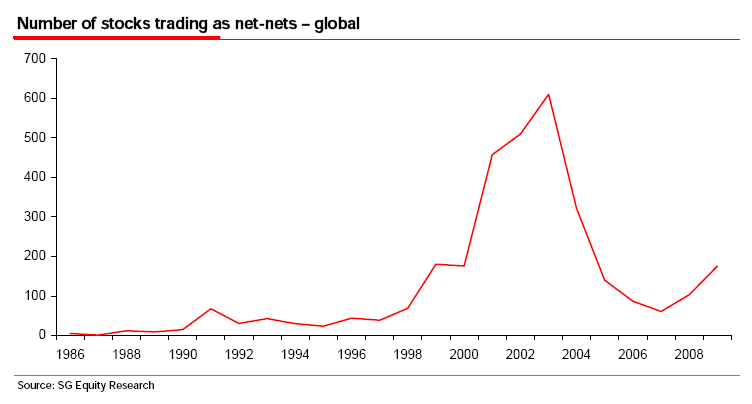
  • At the time of writing (September 2008), Montier found around 175 net-nets globally. Over half were in Japan.
  • If we define total business failure as stocks that drop more than 90% in a year, then the net-nets portfolio sees about 5% of its constituents witnessing such an event. In the broad market only around 2% of stocks suffer such an outcome.
  • The overall portfolio suffered only three down years in our sample, compared to six for the overall market.

Several of Montier’s findings are particularly interesting to me. At an individual company level, a net net is more likely to suffer a permanent loss of capital than the average stock:

If we define a permanent loss of capital as a decline of 90% or more in a single year, then we see 5% of the net-nets selections suffering such a fate, compared with 2% in the broader market.

Here’s the chart:
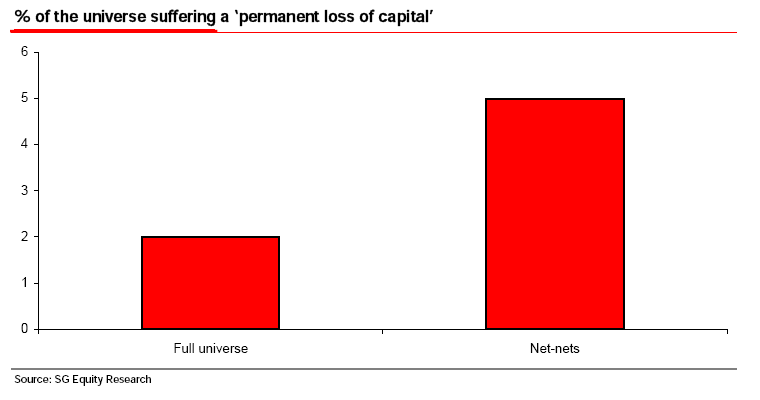
This is interesting given that NCAV is often used as a proxy for liquidation value.

Very few companies turn out to have an ultimate value less than the working capital alone, although scattered instances may be found.

Montier believes this may provide a clue as to why the net net strategy continues to work:

This relatively poor performance may hint at an explanation as to why investors shy away from net-nets. If investors look at the performance of the individual stocks in their portfolio rather than the portfolio itself (known as ‘narrow-framing’), then they will see big losses more often than if they follow a broad market strategy. We know that people are generally loss averse, so they tend to feel losses far more than gains. This asymmetric response coupled with narrow framing means that investors in the net-nets strategy need to overcome several behavioural biases.

Paradoxically, it seems that what is true at the individual company level is not true at an aggregate level. The net net strategy has fewer down years than the market:

If one were to frame more broadly and look at the portfolio performance overall, the picture is much brighter. The net-net strategy only generated losses in three years in the entire sample we backtested. In contrast, the overall market witnessed some six years of negative returns.

Here’s the chart:

And it seems that the net net strategy is a reasonable contrary indicator. When the market is up, fewer can be found, and when the market is down, they seem to be available in abundance:
The main drawback to the net net strategy is its limited application. Stocks tend to be small and illiquid, which puts a limit on the amount of capital that can be safely run using it. That aside, it seems like a good way to get started in a small fund or with a individual account. Montier concludes:

…In various ways practically all these bargain issues turned out to be profitable and the average annual return proved much more remunerative than most other investments.

Good old Benjamin Graham. What a guy.

Buy my book The Acquirer’s Multiple: How the Billionaire Contrarians of Deep Value Beat the Market from on Kindlepaperback, and Audible.

Here’s your book for the fall if you’re on global Wall Street. Tobias Carlisle has hit a home run deep over left field. It’s an incredibly smart, dense, 213 pages on how to not lose money in the market. It’s your Autumn smart read. –Tom Keene, Bloomberg’s Editor-At-Large, Bloomberg Surveillance, September 9, 2014.

Click here if you’d like to read more on The Acquirer’s Multiple, or connect with me on Twitter, LinkedIn or Facebook. Check out the best deep value stocks in the largest 1000 names for free on the deep value stock screener at The Acquirer’s Multiple®.
Read Full Post »

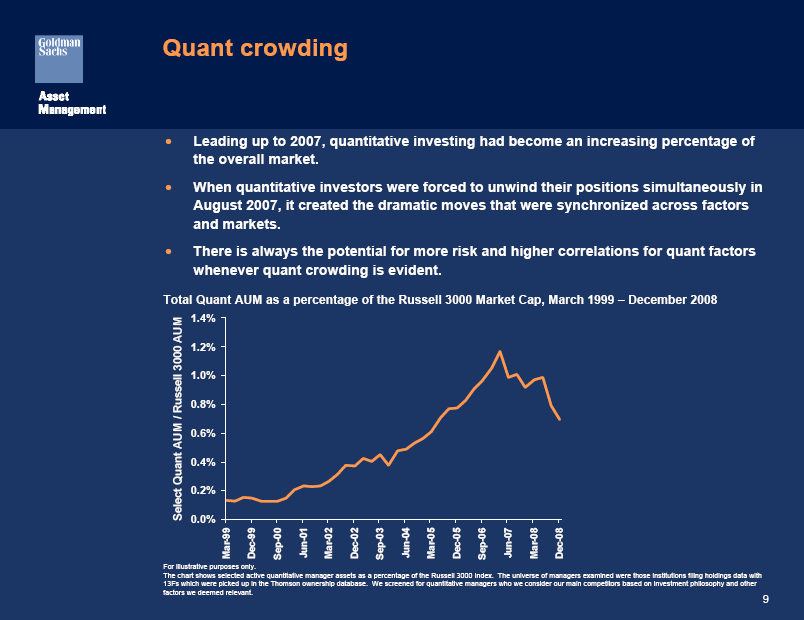
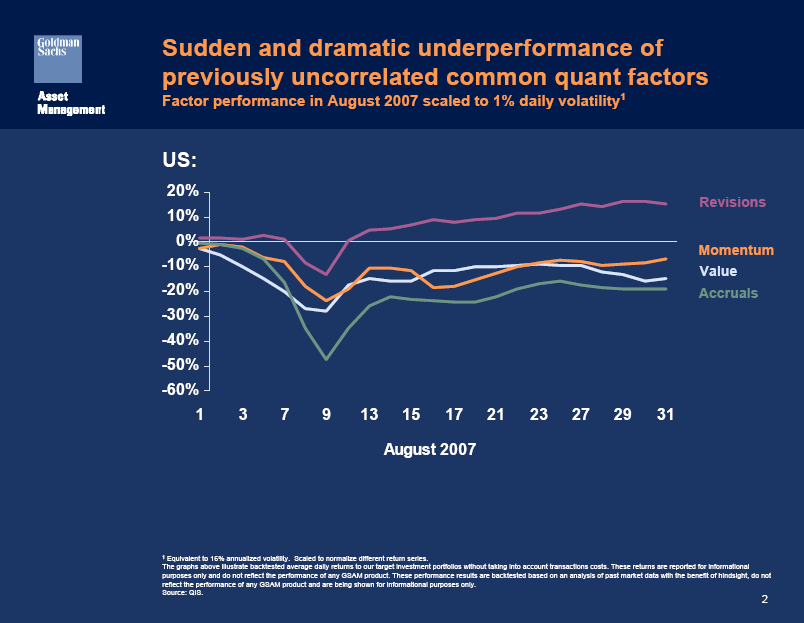
The phenomenal Zero Hedge has an article, Goldman Claims Momentum And Value Quant Strategies Now Overcrowded, Future Returns Negligible, discussing Goldman Sachs head of quantitative resources Robert Litterman’s view that  “strategies such as those which focus on price rises in cheaply-valued stocks…[have] become very crowded” since August 2007 and therefore unprofitable. The strategy to which Litterman refers is “HML” or “High Book-to-Price Minus Low Book-to-Price,” which is particularly interesting given our recent consideration of the merits of price-to-book value as an investment strategy and the various methods discussed in the academic literature for improving returns from a low P/B strategy. Litterman argues that only special situations and event-driven strategies that focus on mergers or restructuring provide opportunities for profit:

What we’re going to have to do to be successful is to be more dynamic and more opportunistic and focus especially on more proprietary forecasting signals … and exploit shorter-term opportunistic and event-driven types of phenomenon.

In a follow-up article, More On The Futility Of Groupthink Quant Strategies, And Why Momos Are Guaranteed To Lose Money Over Time, Zero Hedge provides a link to a Goldman Sachs Asset Management presentation, Maybe it really is different this time (.pdf via Zero Hedge), from the June 2009 Nomura Quantitative Investment Strategies Conference. The presentation supports Litterman’s view on the underperformance of HML since August 2007. Here’s the US:

Here’s a slide showing the ‘overcrowding” to which Litterman refers:

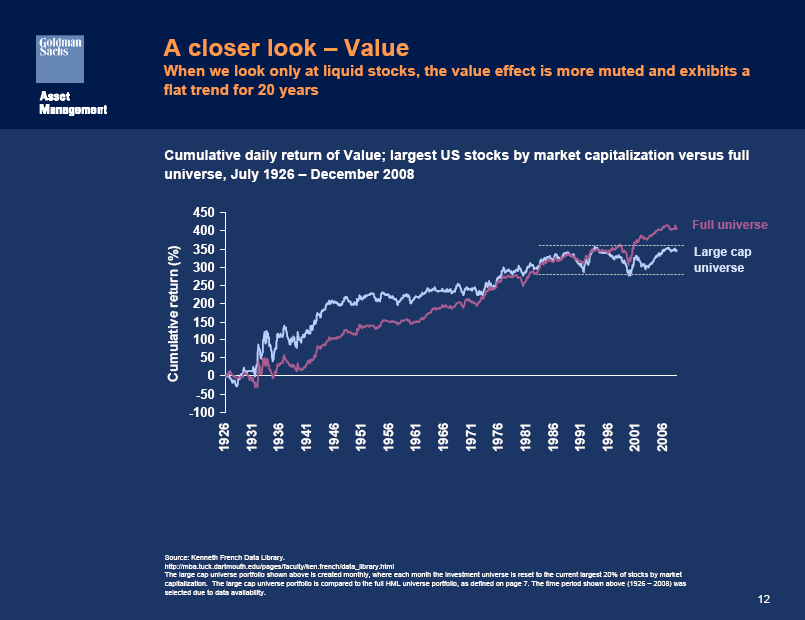
And its effect on the relative performance of large capitalization value to the full universe:

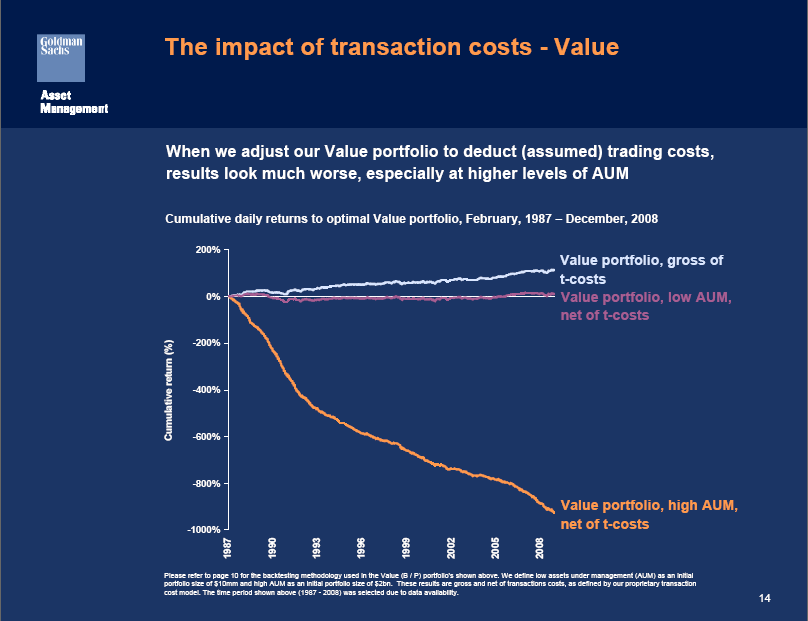
The returns get really ugly when transaction costs are factored into the equation:

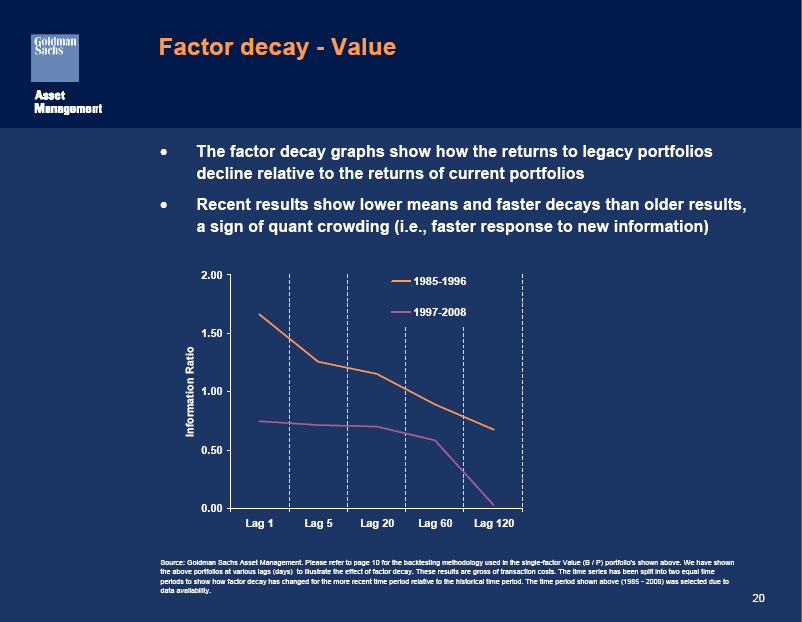
A factor decay graph showing the decline in legacy portfolios relative to current portfolios, lower means and faster decay indicating crowding:

Goldman says that there are two possible responses to the underperformance, and characterizes each as either a “sticker” or an “adapter.” The distinction, according to Zero Hedge, is as follows:

The Stickers believe this is part of the normal volatility of such strategies

• Long-term perspective: results for HML (High Book-to-Price Minus Low Book-to-Price) and WML (Winners Minus Losers) not outside historical experience

• Investors who stick to their process will end up amply rewarded

The Adapters believe that quant crowding has fundamentally changed the nature of these factors

• Likely to be more volatile and offer lower returns going forward

• Need to adapt your process if you want to add value consistently in the future

In Contrarian Investment, Extrapolation, and Risk, Josef Lakonishok, Andrei Shleifer, and Robert Vishny argued that value strategies produce superior returns because most investors don’t fully appreciate the phenomenon of mean reversion, which leads them to extrapolate past performance too far into the future. Value strategies “exploit the suboptimal behavior of the typical investor” by behaving in a contrarian manner: selling stocks with high past growth as well as high expected future growth and buying stocks with low past growth and as well as low expected future growth. It makes sense that crowding would reduce the returns to a contrarian strategy. Lending further credence to Litterman and Goldman’s argument is the fact that the underperformance seems to be most pronounced in the large capitalization universe (see the “A closer look – value” slide) where the larger investors must fish. If you’re not forced by the size of your portfolio to invest in that universe it certainly makes sense to invest where contrarian returns are still available. Special situations like liquidations and event-driven investments like activist campaigns offer a place to hide if (and when) the market resumes the long bear.

My firm Acquirers Funds® helps you put the acquirer’s multiple into action. Click here to learn more about our deep value strategy.

Read Full Post »

November 30, 2009 marked the end of Greenbackd’s fourth quarter and first year, and so it’s time again to report on the performance of the Greenbackd Portfolio and the positions in the portfolio, and outline the future direction of Greenbackd.com.

Fourth quarter 2009 performance of the Greenbackd Portfolio

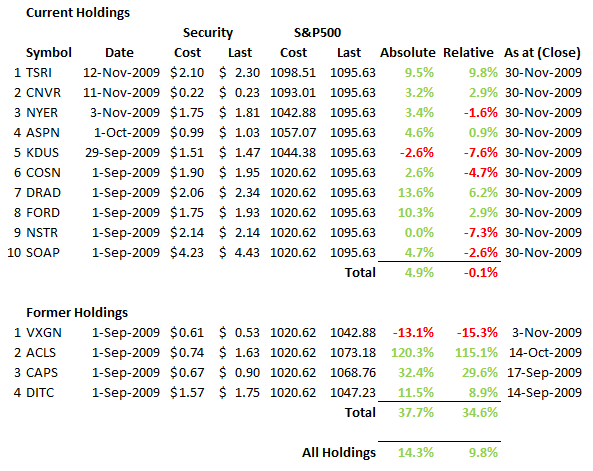
The fourth quarter was another satisfactory quarter for the Greenbackd Portfolioup 14.3% on an absolute basis, which was 9.8% higher than the return on the S&P500 return over the same period. A large positive return for the period is great, but my celebration is tempered once again by the fact that the broader market also had a pretty solid quarter, up 7.4%. The total return for Greenbackd’s first year (assuming equal weighting in all quarters) is 136.8% against a return on the S&P500 of 34.2%, or an outperformance of 102.6% over the return in the S&P500.

It is still too early to determine how well Greenbackd’s strategy of investing in undervalued asset situations with a catalyst is performing, but I believe Greenbackd is heading in the right direction. Set out below is a list of all the stocks in the Greenbackd Portfolio and the absolute and relative performance of each from the close of the last trading day of the third quarter, September 1, 2009, to the close on the last trading day in the fourth quarter, November 30, 2009:

*Note the returns for SOAP and NSTR include special dividends paid. See below for further detail.

You may have noticed something odd about my presentation of performance. The S&P500 index rose by 7.4% in the fourth quarter (from 1020.62 to 1,095.63). Greenbackd’s +14.3% performance might suggest an outperformance over the S&P500 index of 6.9%, while I report outperformance of 9.8%. I calculate Greenbackd’s performance on a slightly different basis, recording the level of the S&P500 Index on the day each stock is added to the portfolio and then comparing the performance of each stock against the index for the same holding period. The Total Relative performance, therefore, is the average performance of each stock against the performance of the S&P500 index for the same periods. As we discussed above, the holding period for Greenbackd’s positions has been too short to provide any meaningful information about the likely performance of the strategy over the long term (2 to 5 years), but I believe that the strategy should outperform the market by a small margin.

Update on the holdings in the Greenbackd Portfolio

There are currently ten stocks in the Greenbackd Portfolio:

  1. TSRI (added November 12, 2009 @ $2.10)
  2. CNVR (added November 11, 2009 @ $0.221)
  3. NYER (added November 3, 2009 @ $1.75)
  4. ASPN (added October 1, 2009 @ $0.985)
  5. KDUS (added September 29, 2009 @ $1.51)
  6. COSN (added August 6, 2009 @ $1.75)
  7. FORD (added July 20, 2009 @ $1.44)
  8. DRAD (added March 9, 2009 @ $0.88)
  9. SOAP (added February 2, 2009 @ $2.50. Initial $3.75 dividend paid July 30)
  10. NSTR (added January 16, 2009 @ $1.91. Initial $2.06 dividend paid July 15)

Greenbackd’s investment philosophy and process

I started Greenbackd in an effort to extend my understanding of asset-based valuation described by Benjamin Graham in the 1934 Edition of Security Analysis. (You can see a summary of Graham’s approach here). Through some great discussion with Greenbackd’s readers, many of who work in the fund management industry as experienced analysts or even managing members of hedge funds, and by incorporating the observations of Marty Whitman (see Marty Whitman’s adjustments to Graham’s net net formula here) and Seth Klarman (the Seth Klarman series starts here), I have refined Greenbackd’s process. I believe that the analyses are now pretty robust and that has manifest itself in satisfactory performance.

Tweedy Browne provides compelling evidence for the asset-based valuation approach. In conjunction with a reader of Greenbackd I have now conducted my own study into the performance of sub-liquidation value stocks over the last 25 years. The paper has been submitted to a practitioner journal and will also appear on Greenbackd in the future.

The future of Greenbackd.com

Greenbackd is a labor of love. I try to create new content every weekday, and to get the stock analyses up just after midnight Eastern Standard Time, so that they’re available before the markets open the following day. Most of the stocks that are currently trading at a premium to the price at which I originally identified them traded for a period at a discount to the price at which I identified them. This means that there are plenty of opportunities to trade on the ideas (not that I suggest you do that without reading the disclosures and doing your own research). If you find the ideas here compelling and you get some value from them, you can support my efforts by making a donation via PayPal.

If you’re looking for net nets in the meantime, here are two good screens:

  1. GuruFocus has a Graham net net screen, with some great functionality ($249 per year)
  2. Graham Investor NCAV screen (Free)

I look forward to bringing you the best undervalued asset situations I can dig up in the next quarter and the next year.

Read Full Post »

Aspen Exploration Corporation (OTC:ASPN) has announced that it will pay a cash dividend of $0.73 per share to stockholders of record on November 16, 2009 from the proceeds of the sale of its California oil and gas assets to Venoco, Inc. $0.73 per share represents $5.3M, which is just over the mid-point of the $5.0M to $5.5M range estimated by the company.

We’ve been following ASPN (see our ASPN post archive) because it’s trading at a discount to its $1.17 per share liquidation value and there are several potential catalysts in the stock, including a 13D filing from Tymothi O. Tombar, a plan to distribute substantially all of the net, after-tax proceeds from the completion of the Venoco sale to its stockholders ($5.3M), and the possibility that the company will dissolve. The stock is down 0.2% since we initiated the position to close yesterday at $0.983. This values the remaining stub of ASPN at $0.253 ($0.983 less $0.73) against a liquidating value I estimate at $0.44 ($1.17 less $0.73). I still think there’s obvious value here, and there might be another interesting play in the stub after the dividend. This is worth watching. It’s should also be noted, as reader bellamyj has pointed out, that, regardless of outcome of the upcoming shareholder vote, ASPN may not liquidate. This is not necessarily a bad thing if the controlling shareholder plans on monetizing the shell and its remaining cash. He owns 20% of the stock, so he’s got some incentive to do so, and he’s paying out a big cash dividend, which is a shareholder-friendly act. That said, it’s not clear whether that dividend was as a result of Timothy O. Tombar’s agitation or a spontaneous effort on behalf of the board. I’ve been wrong about managers before, but hope springs eternal.

Here’s the 8K filing:

On November 2, 2009 Aspen Exploration Corporation (“Aspen”) declared a cash dividend of $0.73 per share. The dividend will be paid to stockholders of record on November 16, 2009, with the dividend being paid on or about December 2, 2009. A copy of the news release describing the dividend is attached hereto as Exhibit 99.1. The distribution follows the final settlement of the sale of Aspen’s California oil and gas assets to Venoco, Inc., at which the parties made a number of immaterial adjustments to the purchase price paid at the June 30, 2009 closing, and made certain other payments that were not determined until after the closing. At the final settlement date Aspen received a net payment from Venoco, but was required to make various payments to third parties which ultimately resulted in a cash outflow from Aspen in an amount not considered to be material.

Aspen expects that after the payment of the dividend, and its anticipated operations through the end of the current calendar year, on December 31, 2009 it will have more than $3 million of working capital remaining. Aspen currently intends to utilize its remaining funds to maintain its corporate status as a reporting issuer under the Securities Exchange Act of 1934 and to explore other business opportunities. Pending developments with respect to any business opportunities Aspen identifies, Aspen may later reevaluate its status and plans and consider alternatives to wind up its affairs. Aspen’s projections and future plans described in this report are “forward-looking statements” (as such term is defined in Section 21E of the Securities Exchange Act of 1934, as amended) which are dependent upon a number of factors. There can be no assurance that Aspen’s projections will prove to be accurate or that Aspen will be able to successfully execute or implement its operations as described herein.

Hat tip Joe G.

[Full Disclosure:  I do not have a holding in ASPN. This is neither a recommendation to buy or sell any securities. All information provided believed to be reliable and presented for information purposes only. Do your own research before investing in any security.]

Read Full Post »

Nyer Medical Group Inc (NASDAQ:NYER) is to liquidate subject to the approval of its shareholders and the closing of two transactions. The board estimates that shareholders will receive a liquidating distribution of between $1.84 to $2.00 per share. At its $1.75 close yesterday, the low end of the range represents a 5% return and the high end represents a 15% return. This is the filing disclosing summaries of the two transaction agreements (the underlining is mine):

Asset Purchase Agreement

On October 22, 2009, D.A.W., Inc. (“DAW”), a wholly-owned subsidiary of Nyer Medical Group, Inc. (“Nyer”), and Nyer entered into an Asset Purchase Agreement (the “WAG Agreement”) with Walgreen Eastern Co., Inc., a New York corporation (“WAG”), for the sale of a substantial portion of DAW’s operating assets, including prescription files and inventory of a total of 12 neighborhood pharmacies which includes the assignment of eight leases (the “Acquired Assets”), for a purchase price, subject to certain adjustments, of $12.0 million plus up to $5.75 million of qualifying inventory and $1.1 million of operating equipment (the “WAG Transaction”).

DAW, Nyer and WAG made customary representations, warranties and covenants in the WAG Agreement. In addition, DAW and Nyer agreed that, for a period of three years, they would refrain (and cause their current controlled affiliates to refrain) from competing within a certain area of the pharmacies whose assets were included in the Acquired Assets, with certain exceptions set forth in the WAG Agreement.

The parties have agreed to indemnify each other against certain losses, including losses for breaches of representations, warranties and covenants. Each of DAW’s and Nyer’s indemnification obligations begin at an aggregate of $50,000 and are limited to a total of $1,200,000 or, with respect to the inaccuracy of certain fundamental representations, $4,000,000. Further, DAW’s and Nyer’s indemnification obligations terminate 90 days following the closing date, with certain exceptions, including an extension of the indemnification period for up to 12 months for claims related to certain representations and 3 years for claims related to noncompetition covenants. WAG agrees to indemnify DAW and Nyer for its breach of the WAG Agreement for a period of 12 months, except in certain circumstances set forth in the WAG Agreement, and its indemnification obligations are for an unlimited amount.

DAW, Nyer and WAG can terminate the WAG Agreement in certain specified instances, as provided in the WAG Agreement. If the closing does not occur and Nyer or DAW enters into an alternative transaction under certain conditions specified in the WAG Agreement, DAW would owe to WAG a breakup fee in the amount of $300,000 and reimbursement of actual out-of-pocket expenses in an amount up to $200,000.

The completion of the WAG Transaction is subject to certain closing conditions set forth in the WAG Agreement, including the approval of the WAG Transaction at a special meeting of Nyer’s shareholders which is expected to be held on or about December 15, 2009 (the “Special Meeting”).

Nyer’s Board of Directors engaged Newbury Piret Companies, Inc. (“Newbury Piret”) as financial advisor to evaluate the WAG Transaction. The Board of Directors of Nyer and DAW (the “Boards”) unanimously approved the WAG Transaction. In approving the WAG Transaction, the Boards considered the depressed market price of the stock, the historically low trading volume and volatility of bid prices; market pressures on margins and operating costs that would have an adverse effect on the operating results of the pharmacies, a fairness opinion from Newbury Piret and other considerations.

The foregoing description of the WAG Agreement is qualified in its entirety by reference to the full text of the WAG Agreement, a copy of which is attached hereto as Exhibit 2.1 to this Current Report on Form 8-K and incorporated herein.

Stock Purchase Agreement

On October 23, 2009, Nyer and DAW entered into a Transaction Agreement (the “DAW Stock Agreement”) with certain management investors named therein (the “Investors”) for the sale of the stock of DAW, under which Nyer will receive a benefit of $1,500,000 after giving effect to liabilities to be retained by DAW (the “DAW Stock Transaction”).

DAW and Nyer made customary representations, warranties and covenants in the DAW Stock Agreement. In addition, DAW and Nyer agreed, on the terms set forth in the DAW Stock Agreement, not to solicit or encourage any alternative sale transactions.

DAW, Nyer and the Investors can terminate the DAW Stock Agreement in certain specified instances, as provided in the DAW Stock Agreement. If the closing does not occur and Nyer and DAW enter into an alternative transaction under certain conditions specified in the DAW Stock Agreement, DAW and Nyer would owe to the Investors a breakup fee in the amount equal to the actual out-of-pocket expenses, including attorneys’ fees, incurred by the Investors in connection with the DAW Stock Transaction.

The completion of the DAW Stock Transaction is subject to certain closing conditions set forth in the DAW Stock Agreement, including the approval of the DAW Stock Transaction at the Special Meeting and the approval and closing of the WAG Transaction.

The DAW Stock Transaction was reviewed by a special committee of the Board of Directors of Nyer comprised of independent directors (the “Special Committee”). The Special Committee engaged Newbury Piret to evaluate the DAW Stock Transaction. The DAW Stock Transaction was unanimously approved by the Special Committee and recommended to the Boards by the Special Committee. The Boards also unanimously approved the DAW Stock Transaction. In approving the DAW Stock Transaction, the Special Committee and the Boards considered the fact that substantially all of the assets of DAW would be sold to WAG under the WAG Agreement, the lack of interest by WAG in the assets subject to the DAW Stock Agreement, a fairness opinion from Newbury Piret and other considerations.

The foregoing description of the DAW Stock Agreement is qualified in its entirety by reference to the full text of the DAW Stock Agreement, a copy of which is attached hereto as Exhibit 2.2 to this Current Report on Form 8-K and incorporated herein.

The WAG Agreement and DAW Stock Agreement (the “Agreements”) have been included to provide investors with information regarding their terms. It is not intended to provide any other factual information about Nyer or DAW. The representations, warranties and covenants contained in the Agreements were made only for purposes of such agreements and as of the specific dates therein, were solely for the benefit of the parties to such agreements, and may be subject to limitations agreed upon by the contracting parties, including being qualified by confidential disclosures exchanged between the parties in connection with the execution of the Agreements. The representations and warranties may have been made for the purposes of allocating contractual risk between the parties to the agreements instead of establishing those matters as facts, and may be subject to standards of materiality applicable to the contracting parties that differ from those applicable to investors. Investors are not third party beneficiaries under the Agreements and should not rely on the representations, warranties and covenants or any descriptions thereof as characterizations of the actual state of facts or condition of the Nyer, DAW or any other party to the Agreements. Moreover, information concerning the subject matter of the representations and warranties may change after the dates of the Agreements, which subsequent information may or may not be fully reflected in Nyer’s public disclosures.

Here is the announcement of the board approval of the liquidation:

As previously disclosed on October 23, 2009, in conjunction with the sale of a substantial portion of the assets of D.A.W., Inc. (“DAW”), a wholly owned subsidiary of Nyer Medical Group, Inc. (“Nyer”), to Walgreen Easter Co. (the “WAG Transaction) and the sale of the stock of DAW to certain management investors (the “DAW Stock Transaction”), the Board of Directors of Nyer approved the liquidation and dissolution of Nyer pursuant to a Plan of Dissolution (the “Plan of Dissolution”), subject to obtaining shareholder approval of the WAG Transaction, the DAW Stock Transaction, and the Plan of Dissolution (the “Transactions”). Upon shareholder approval and the closing of the WAG Transaction and the DAW Stock Transaction, Nyer intends to proceed with the orderly wind down and dissolution of Nyer pursuant to the Plan of Dissolution. Nyer currently expects that upon dissolution of Nyer, shareholders of Nyer will receive a liquidating distribution in the range of $1.84 to $2.00 a share, depending on the ultimate amount of assets and liabilities to be realized upon liquidation.

Management tend to underestimate liquidation distributions (for obvious reasons), so this is probably worth playing. With a market capitalization of just $7M, it’s a small company, but that’s nothing new around here. I’m adding it to the Greenbackd Portfolio at $1.75.

The S&P500 closed yesterday at $1042.88

Hat tip William Wang.

[Full Disclosure:  We have a holding in NYER. This is neither a recommendation to buy or sell any securities. All information provided believed to be reliable and presented for information purposes only. Do your own research before investing in any security.]

Read Full Post »

Following my Simoleon Sense interview with Miguel Barbosa, I’ve had a few requests for a post on Tom Evans. Here it is, hacked together like Frankenstein’s monster from all the public information I could track down:

Thomas Mellon Evans was a one of the first modern corporate raiders, taking Graham’s net current asset analysis and using it to wreak havoc on the gray flannel suits of the 40s and 50s. He’s not particularly well-known today, but he waged numerous takeover battles using tactics that are forerunners of those employed by many of the takeover artists of the 1980s and the activists of the 1990s and 2000s. Proxy battles? Check. Greenmail? Check. Liquidations? Check.

Born September 8, 1920 in Pittsburgh, and orphaned at the age of 11, Evans grew up poor. Despite his famous middle name (his grandmother’s first cousin was Andrew Mellon), he began his financial career at the bottom. After graduating from Yale University in 1931 in the teeth of the Great Depression, he landed a $100-a-month clerk’s job at Gulf Oil.

While his friends headed out in the evening, Evans would stay home reading balance sheets and looking for promising companies: those he could he could buy for less than the assets were worth in liquidation. Evans found such companies by calculating their “net quick assets,” the long forgotten name for “net current assets.” His friends teased him about his obsession and gave him a nickname: “Net Quick” Evans. From the 1944 Time Magazine article, Young Tom Evans:

With only some fatherly advice from Gulf’s Board Chairman, W. L. Mellon, Tom Evans made his way alone. For six years he saved money, like an Alger hero; and played the stockmarket, unlike an Alger hero. Thus he collected $10,000. He wanted to find and buy a family-owned business that had gone to pot. In the down-at-the-heels H. K. Porter Co., in Pittsburgh’s slummy Lawrenceville section, he found it. Once a No. 1 builder of industrial locomotives, Porter Co. was down to 40 workers.

Tom Evans bought up Porter bonds at 10 to 15 cents on the dollar, reorganized the company under 77B, and became president at 28.

From then on, Evan was the chief terror of the sleepy boardrooms of the era, much like Icahn would be 30 years later. As a connoisseur of deep value on the balance sheet, one has to admire his methods (From the New York Times obituary, Thomas Evans, 86, a Takeover Expert, Dies):

‘He was never really an operator; he was a financial guy — a balance sheet buyer,” one of his sons, Robert Sheldon Evans, told Forbes magazine in 1995. ”He would buy something for less than book value and figure the worst that could happen was he would liquidate it and come out O.K. What he didn’t want to do was lose money on the deal. If he knew his downside was covered, then he figured the upside would probably take care of itself.

”It was a very shrewd policy in the 50’s and 60’s, when there were highly inefficient markets: buying undervalued assets, running them for cash and selling off pieces. The 80’s leveraged buyout guys were just taking a lot of his deals to their logical extension.”

The book The White Sharks of Wall Street: Thomas Mellon Evans and the Original Corporate Raiders by Diana B. Henriques is an excellent biography on Evans. More than that, it describes many of the battles for corporate control in the 40s, 50s and 60s. In contradistinction to the takeover battles of the 80s, the dogfights in the 40s, 50s, and 60s were largely proxy fights, and in as much, should be familiar to today’s “activist investors.” James B. Stewart’s Let’s make a deal, his review of Henriques’ book, does it justice:

There are surely few phenomena more remarkable in American business than the periodic ability of cash-poor but swashbuckling newcomers, using little or none of their own money, to seize control of some of the country’s most valuable corporations. In its most recent, frenzied incarnation, dot-com entrepreneurs have exchanged stock in companies with few tangible assets and even fewer profits for control of established, profitable companies. Fifteen years ago, the currency was junk bonds rather than inflated stock. And before that, it was bank loans using a target’s assets as collateral.

Wall Street greets each wave of takeovers as the dawning of a new era. But the proposition that nothing has fundamentally changed is convincingly set forth in ”The White Sharks of Wall Street,” an engaging and thorough history of early corporate takeovers by Diana B. Henriques, a financial reporter for The New York Times. Her central character is Thomas Mellon Evans, who surfaces in what seems like nearly every trendsetting corporate battle from 1945 until his retirement in 1984, and whose tactics remain essential to practitioners of corporate warfare. Junk bonds? Greenmail? Scorched earth? Evans had been there long before investment bankers coined a catchy vocabulary to describe the maneuvers of people like T. Boone Pickens, Carl Icahn and Saul Steinberg.

Though Evans seems to have escaped the widespread public resentment and envy the others generated, and Henriques’s portrait is carefully nonjudgmental, it is difficult for a reader to work up much sympathy for him. He was ruthless, bad-tempered, usually indifferent to workers and communities. He repeatedly displayed what appears to be a criminal disregard for the antitrust laws (though he was never prosecuted). He divorced two wives (the second later committed suicide), and both times a replacement was conspicuously at hand long before any legal proceedings had begun. He betrayed two of his own sons in his quest for corporate dominance and wealth.

Yet as a deal maker Evans displayed a natural audacity and genius. In 1935, 24 years old and lacking any money to speak of, he decided he wanted to gain control of Pittsburgh’s struggling H. K. Porter Company, a manufacturer of steam locomotives. Inspired by a Fortune magazine account of Floyd Odlum, who became rich by using borrowed securities as collateral for loans to buy undervalued stock, Evans borrowed shares from a Mellon mentor, took out a loan and invested in Gulf Oil stock, then a Mellon enterprise. When Gulf’s stock rose handsomely as the nation emerged from the Depression, Evans used his profits to buy Porter bonds, then selling for a small fraction of their face value. When Porter finally had to declare bankruptcy and was reorganized, Evans, as the largest creditor, traded his bonds for equity and became the largest shareholder. Porter, essentially acquired for junk bonds, would be Evans’s vehicle for most of his life.

I highly recommend The White Sharks of Wall Street: Thomas Mellon Evans and the Original Corporate Raiders by Diana B. Henriques for fans of deep value and activist investment.

Read Full Post »

We’ve just completed an interview with Miguel Barbosa of the wonderful Simoleon Sense. Go there now, and get trapped in an endless loop as you are recirculated back here and so on.

Read Full Post »

Yesterday was the record date for the first dividend in the liquidation of Leadis Technology Inc (NASDAQ:LDIS). The dividend is likely to be approximately $0.93 per share. The board estimates that “if we are able to dispose of substantially all of our non-cash assets, the aggregate amount of all liquidating distributions that will be paid to stockholders will be in the range of approximately $0.93 to $1.20 per share of Leadis common stock.” After the initial $0.93 dividend, the remaining dividends will be in the range of nil to $0.27 ($1.20 less $0.93). LDIS closed yesterday at $0.99. If the stub starts trading tomorrow at $0.06 ($0.99 less $0.93), it becomes an interesting security offering the potential for some substantial upside.

The definitive proxy filings have the detail:

How much can stockholders expect to receive if the Plan of Dissolution is approved at the special meeting?

At this time, we cannot predict with certainty the amount of any liquidating distributions to our stockholders. However, based on information currently available to us, assuming, among other things, no unanticipated actual or contingent liabilities, we estimate that over time stockholders will receive one or more distributions that in the aggregate range from approximately $0.93 to $1.20 per share. This range of estimated distributions represents our estimate of the amount to be distributed to stockholders during the liquidation, but does not represent the minimum or maximum distribution amount. Actual distributions could be higher or lower.

This estimated range is based upon, among other things, the fact that as of August 31, 2009, we had approximately $28.6 million in cash, cash equivalents, restricted cash equivalents and short-term and non-current investments. In addition, subsequent to August 31, 2009, we received approximately $3.2 million in connection with the sale of certain assets to IXYS Corporation. We expect to use cash of approximately $2.3 million to satisfy liabilities on our unaudited balance sheet after August 31, 2009. In addition to converting our remaining non-cash assets to cash and satisfying the liabilities currently on our balance sheet, we have used and anticipate using cash for a number of items, including but not limited to: satisfying capital leases and other contractual commitments. In addition to the satisfaction of our liabilities, we have used and anticipate continuing to use cash in the next several months for a number of items, including, but not limited to, the following:

• ongoing operating expenses;

• expenses incurred in connection with extending our directors’ and officers’ insurance coverage;

• expenses incurred in connection with the liquidation and dissolution process;

• severance and related costs;

• resolution of pending and potential claims, assessments and obligations; and

• professional, legal, consulting and accounting fees.

We are unable at this time to predict the ultimate amount of our liabilities because the settlement of our existing liabilities could cost more than we anticipate and we may incur additional liabilities arising out of contingent claims that have not been quantified, are not yet reflected as liabilities on our balance sheet and have not been included in the estimated range of potential distributions, such as liabilities relating to claims that have not been resolved and claims or lawsuits that could be brought against us in the future. If any payments are made with respect to the foregoing, the estimated range of distributions to stockholders will be negatively impacted and less than estimated. If the ultimate amount of our liabilities is greater than what we anticipate, the distribution to our stockholders may be substantially lower than anticipated. Therefore, we are unable at this time to predict the precise nature, amount and timing of any distributions due in part to our inability to predict the ultimate amount of our liabilities. Accordingly, you will not know the exact amount of any liquidating distributions you may receive as a result of the Plan of Dissolution when you vote on the proposal to approve the Plan of Dissolution. You may receive substantially less than the low end of the current estimate.

For some further background, see Shake&Bake’s take on LDIS.

Hat tip Joseph.

[Full Disclosure:  We have a holding in LDIS. This is neither a recommendation to buy or sell any securities. All information provided believed to be reliable and presented for information purposes only. Do your own research before investing in any security.]

Read Full Post »

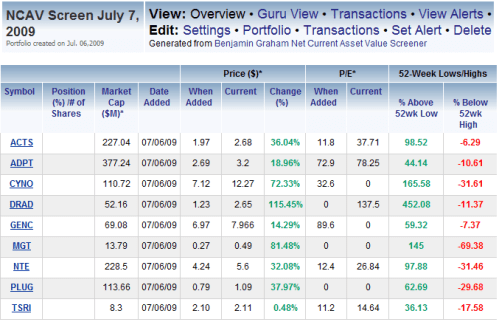
We’ve recently been using the GuruFocus Benjamin Graham Net Current Asset Value Screener (subscription required) to generate regular watchlists of net net stocks. The GuruFocus NCAV screen has some superb functionality that makes it possible to create the watchlist from the screen and then track the performance of those stocks. We created our first watchlist on July 7 of this year using the July 6 closing prices. The performance of the stocks in that first watchlist over the last quarter has been nothing short of spectacular. Here is a screen grab (with some columns removed to fit the space below):

GuruFocus NCAV Screen

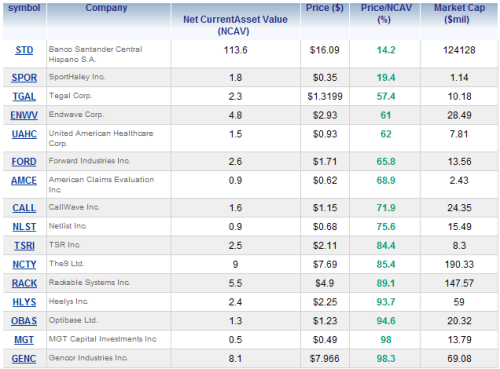
We know the market’s been somewhat frothy recently, but those returns are still notable. The average return to date across the nine stocks in the watchlist is 45.5% against the return on the S&P500 of 20.05% over the same period, an outperformance of more than 25% in ~three months. We’ve decided to run another screen today and we’ll track the return of that watchlist over the coming months. The stocks in the watchlist are set out below (again, with a column removed to fit the space below):

GuruFocus NCAV Screen 2009 10 13

We’ve done no research on these firms beyond running the screen. If you plan on buying anything in this screen, at the absolute minimum we recommend that you do some research to determine whether they are currently net net stocks and not just caught in the screen because of out-of-date filings. We’ll compare the performance of the stocks against the S&P500, which closed yesterday at 1,076.18.

[Full Disclosure:  We have a holding in FORD. This is neither a recommendation to buy or sell any securities. All information provided believed to be reliable and presented for information purposes only. Do your own research before investing in any security.]

Benjamin Graham Net Current Asset Value Screener

Read Full Post »

Updated.

Megan McArdle has written an article for The Atlantic, What Would Warren Do?, on Warren Buffett and the development of value investing, arguing that better information, more widely available, will erode the “modest advantage” value investors have over “a broader market strategy” and Warren Buffett’s demise will be the end of value investment. We respectfully disagree.

The article traces the evolution of value investing from Benjamin Graham’s “arithmetic” approach to Buffett’s “subjective” approach. McCardle writes that the rules of value investing have changed as Buffett – standard bearer for all value investors – has “refined and redefined” them for “a new era”:

When Benjamin Graham and David L. Dodd wrote the value-investing urtext, Security Analysis, in 1934, the rules were more hard-and-fast. Graham and Dodd looked for companies whose price was less than their intrinsic value, and offered various formulas for divining this value.

Buying stock in firms where the intrinsic value of the assets is higher than the market capitalization worked well in the depths of the Great Depression, when investors were wary of holding equity. Between 1929 and 1932, the Dow lost just about 90 percent of its value, bottoming out at 41.22. What economists call the “equity premium”—the extra return that investors demand to compensate for the risk of holding stocks—has never since been so high. That’s why Graham and Dodd could find companies whose liquidation value offered a substantial “margin of safety” for people who bought their equity.

Moreover, book value and other balance-sheet-based metrics have become less useful, as the market, and the economy, have changed. Persistent inflation means that the historical cost of the assets on the balance sheet in many cases bears only passing resemblance to their actual worth. Meanwhile, firms get more and more of their value from intangible assets, like intellectual property or strong brands, that don’t show up in the financial statements. Geico, one of Buffett’s crown jewels, gets much of its value not from physical equipment or even investment savvy, but from a sterling brand name built on relentless advertising.

McCardle says that the rules have changed so much that Graham’s approach no longer offers any competitive advantage:

Much of what Graham and Dodd did so well was simply hard coolie labor. In an era before spreadsheets or financial databases, they looked at company reports and painstakingly did the arithmetic to see where a company stood. That effort offers no competitive advantage in today’s information-saturated market. So while value investors still hew to the core notion of determining a company’s intrinsic value, waiting for the market to misprice the stock, and then buying on the cheap, nowadays that determination has much more of a subjective skill element.

As proof of this assertion, McCardle offers this:

Well, for starters, the market still hasn’t fallen to Graham-and-Dodd levels; most of the managers I talked to groused that they were finding few real bargains. The market was irrational enough to drag down their investment results, but too rational to offer stocks at deep discounts from intrinsic value. Meanwhile, many of their potential investors had just lost half their money.

Value investors love to deride academics and the efficient-market hypothesis, but they can’t deny that stock-screening tools and other analytics have taken away many of the best bargains. At least some managers have lost the will to wait patiently for superdeals and have taken on more risk to get more return. As we walked to dinner through the soft Omaha twilight, a fund manager I had encountered at a “meet and greet” suddenly said, “The only way to make money these days is leverage.”

And my dinner companion seemed to be saying that value managers couldn’t compete with other funds without taking at least some of those bets.

McCardle concludes with the following:

Right now, the academic literature suggests that value investing has a modest advantage over a broader market strategy. Better information, more widely available, may continue to erode that edge. But the principles of prudence, patience, and thrift will always, in the end, offer a better chance at outsize returns. The question is whether, once Saint Warren passes, his followers will find the courage to stick to them.

In response, we’d like to make the following observations:

Better information, more widely available, will not erode value’s edge

There are as many different styles of value investment as there are value investors, the uniting element being an adherence to the concept of “intrinsic value,” which is simply defined as a measure of value distinct from price. Many investors describing themselves as value investors have subtly different measures of intrinsic value, from liquidation value, to asset value, to earning power, to private market value and, if the fund manager McCardle met at the twlight “meet and greet” is an indication, some of the investors wearing the “value” badge do nothing of the sort. While investors of the same stripe often coalesce around the same opportunity, there are so many different perspectives that one type (say, the liquidation value investor) could easily sell to another (say, the earning power investor), and both could be right in their assessment of the intrinsic value of the stock, and have made money in the process. This means that diffusion of information won’t cause the value opportunities to disappear, because the interpretation of that information is the key step. As Shai points out in the comments with his Klarman quote, value investment is as much about attititude as it is about intellect or access to information. Being smart, having five screens and a Bloomberg terminal won’t get you close to Walter Schloss’ record, which he achieved with a borrowed copy of Value Line working 9.30am to 4.30pm.

Buffett has not rejected Graham, and has not redefined value

Graham’s contribution was to establish the value investment framework – the concept of intrinsic value – and to describe how one could operate successfully as an investor, most notably through the concept of margin of safety. Graham discussed a number of ideas about the manner in which intrinsic value could be assessed, and was so expansive in his teaching that he left very little ground uncovered for future value investors. It is a tribute to Buffett’s genius that he was able to find new ground within Graham’s framework, which he did by blending Phil Fisher’s philosophy with Graham’s. Buffett’s divergence from Graham’s methods was not, however, a rejection of Graham’s philosophy. Buffett has said on occassions too numerous to quote that he still works within Graham’s framework and has said that his change was a function of the increasingly large sums of capital he had to invest, and not a problem with Graham’s approach. In a June 23, 1999 Business Week article, Buffett said:

If I was running $1 million today, or $10 million for that matter, I’d be fully invested. Anyone who says that size does not hurt investment performance is selling. The highest rates of return I’ve ever achieved were in the 1950s. I killed the Dow. You ought to see the numbers. But I was investing peanuts then. It’s a huge structural advantage not to have a lot of money. I think I could make you 50% a year on $1 million. No, I know I could. I guarantee that.

When asked in 2005 what his approach would be if he had to invest less than $10M, Buffett still indicated that he preferred Graham style securities. That’s not a rejection of Graham’s investment philosophy, or his approach.

Don’t bother looking for Graham-style opportunities, they’ve disappeared

Leave them all for us. If there was ever an investment style that should suffer from too many practioners, Graham’s “net current asset value” proxy for liquidation value investing is it. NCAV investing is about as simple as investing gets, and a free screen is all that an investor requires to find NCAV opportunities. Yet our research demonstrates that even this strategy continues to outperform the market. We probably can’t run a multi-billion dollar portfolio on the basis of a simple NCAV screen, but we’ll cross that bridge when we get to it. For the average investor, investing in Graham-style NCAV opportunities is all we’ll ever need. You say those opportunities have disappeared? Have a look at the screens on our blogroll. There are plenty there. When those opportunities do disappear – and they will eventually – it won’t be because of all those supercomputers chasing them, it’ll be a function of valuation. Prices go up, and prices come down. When they’re up, it’s hard to find investable opportunities, and when they come down, it’s easier to do so. It has always been thus, and it will always be so. When there aren’t many opportunities around, that’s a signal from the market. It’s telling you to wait. As a friend of Greenbackd says, “Patience can be a bitter plant, but it has sweet fruit.”

There are other value practitioners who will carry the torch forward

Klarman, Tweedy Browne, Greenblatt, Tilson, Dreman, Gabelli, Miller, Price, Whitman, Pabrai, Biglari (please insert any names I’ve forgotten into the comments) and a host of others toiling away in obscurity will carry the torch forward. Value investment is in good hands.

Read Full Post »

« Newer Posts - Older Posts »