Feeds:
Posts
Comments

Archive for the ‘Greenbackd’ Category

Bespoke Investment Group (via The Reformed Broker) has a list of the biggest gainers for 2009. It should come as no surprise to regular readers of Greenbackd that a number of the stocks are former sub-liquidation value plays (most of which we missed):

Little ten baggersWe opened a position in VNDA and got a great return. We lost our nerve with BGP and missed out on a great return. We completely ignored ATSG, DTSG, SMRT, RFMD, PIR and CHUX although all appeared on our NCAV screen at some stage earlier this year. A little more evidence that diamonds can be found if you dig through enough trash.

Read Full Post »

We’re back in the office after hiking some of the John Muir Trail through Yosemite. There have been some interesting developments in a number of our holdings and we look forward to updating our open positions over the course of this week.

Read Full Post »

Update June 16, 2009: SOAP has announced that it proposes to liquidate. See our post below.

Update June 3, 2009: We’ve pinned this post to the front page. Any new posts between now and July 4th will appear below this post.

June 1, 2009 marked the end of Greenbackd’s second quarter. It’s time again to report on the performance of the Greenbackd Portfolio and the positions in the portfolio, discuss the evolution of our valuation methodology and outline the future direction of Greenbackd.com.

Second quarter performance of the Greenbackd Portfolio

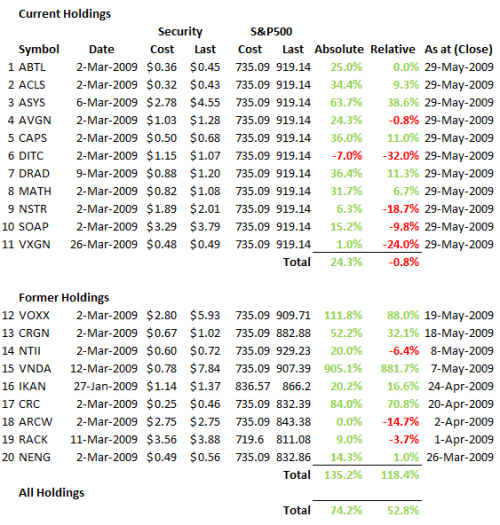
The second quarter was nothing short of a blockbuster for the Greenbackd Portfolio, up 74.2% on an absolute basis, which was 52.8% higher than the return on the S&P500 return over the same period. A large positive return for the period is heartening, but our celebration is tempered by the fact that it is difficult to avoid a good return in a market that rises 25.0% in a quarter. Our Q1 performance was -3.7% (see our first quarter performance here), which means that our total return since inception (assuming equal weighting in each quarter) is 67.8% against a return on the S&P500 of 11.6%, or an outperformance of 56.2% over the return in the S&P500.

It is still too early to determine how Greenbackd’s strategy of investing in undervalued asset situations with a catalyst is performing, but we believe we are heading in the right direction. Set out below is a list of all the stocks in the Greenbackd Portfolio and the absolute and relative performance of each from the close of the last trading day of the first quarter, Friday, February 28, 2009, to the close on the last trading day in the second quarter, May 29, 2009:

Greenbackd Portfolio Performance 2009 Q2You may have noticed something odd about our presentation of performance. The S&P500 index rose by 25.0% in our second quarter (from 735.09 to 919.14). Our +74.2% performance might suggest an outperformance over the S&P500 index of 49.2%, while we report outperformance of 52.8%. We calculate our performance on a slightly different basis, recording the level of the S&P500 index on the day each stock is added to the portfolio and then comparing the performance of each stock against the index for the same holding period. The Total Relative performance, therefore, is the average performance of each stock against the performance of the S&P500 index for the same periods. As we discussed above, the holding period for Greenbackd’s positions has been too short to provide any meaningful information about the likely performance of the strategy over the long term (2 to 5 years), but we believe that the strategy should outperform the market by a small margin.

Greenbackd’s valuation methodology

We started Greenbackd in an effort to extend our understanding of asset-based valuation described by Benjamin Graham in the 1934 Edition of Security Analysis. (You can see our summary of Graham’s approach here). Through some great discussion with our readers, many of whom work in the fund management industry as experienced analysts or even managing members of hedge funds, and by incorporating the observations of Marty Whitman (see Marty Whitman’s adjustments to Graham’s net net formula here) and Seth Klarman (our Seth Klarman series starts here), we have refined our process. We believe that what started out as a pretty unsophisticated application of Graham’s liquidation value methodology has evolved into a more realistic analysis of the balance sheet and the relationship of certain disclosures in the financial statements to asset value. Our analyses are now quantitatively more robust than when we started and that has manifest itself in better performance.

Tweedy Browne offers some compelling evidence for the asset based valuation approach here.

Update on the holdings in the Greenbackd Portfolio

There are eleven stocks remaining in the Greenbackd Portfolio:

  1. VXGN (added March 26, 2009 @ $0.48)
  2. DRAD (added March 9, 2009 @ $0.88)
  3. ASYS (added March 5, 2009 @ $2.78)
  4. CAPS (added February 27, 2009 @ $0.60)
  5. DITC (added February 19, 2009 @ $0.89)
  6. SOAP (added February 2, 2009 @ $2.50)
  7. NSTR (added January 16, 2009 @ $1.91)
  8. ACLS (added January 8, 2009 @ $0.60)
  9. MATH (added December 17, 2008 @ $0.68)
  10. ABTL (added December 11, 2008 @ $0.43)
  11. AVGN (added December 1, 2008 @ $0.65)

The future of Greenbackd.com

We are taking a brief vacation. We’ll be back full-time after July 4th, always reserving the right to post interesting ideas in the interum and update our open positions. If you’re looking for net nets in the meantime, there are two good screens:

  1. GuruFocus has a Graham net net screen ($249 per year)
  2. Graham Investor NCAV screen (Free)

Greenbackd is a labor of love. We try to create new content every week day, and to get the stock analyses up just after midnight Eastern Standard Time, so that they’re available before the markets open the following day. Most of the stocks that are currently trading at a premium to the price at which we originally identified them traded for a period at a discount to the price at which we identified them. This means that there are plenty of opportunities to trade on our ideas (not that we suggest you do that without reading our disclosures and doing your own research). If you find the ideas here compelling and you get some value from them, you can support our efforts by making a donation via PayPal.

We look forward to bringing you the best undervalued asset situations we can dig up in the next quarter.

Read Full Post »

Long-term readers of Greenbackd might remember our initial struggle to apply the net net / liquidation formula described by Benjamin Graham in the 1934 Edition of Security Analysis in the context of modern accounting. Putting aside our attempt to include and tweak the discounts to PP&E (kind of like fixing the smile on the Mona Lisa), most embarassing was our failure to factor into the valuation off-balance sheet liabilities and contractual obligations. The best thing that we can say about the whole sorry episode is that we got there in the end and we’ve been applying a more robust formulation for the last quarter. With that in mind, we thought it was particularly interesting to see the Financial Post’s article, Veteran tweaks Graham’s rule to find bargains (via Graham and Doddsville), which details the refinements legendary value investor Marty Whitman makes to Graham’s net-net formulation.

According to the article, Whitman makes the following adjustments to Graham’s 90-year old formula:

  • Companies must be well-financed

First and foremost, companies must be well-financed in keeping with the core tenet of Third Avenue’s “safe and cheap” method of value investing.

The goal is to own companies that are going concerns, not ones destined for liquidation. This difference is a crucial point of distinction between the focus of equity investors, who are often wiped out in liquidation, and bond investors, who have rights to the assets of a company in liquidation.

  • Whitman includes long-term assets that are easily liquidated

The second adjustment is to the assets themselves. Graham and Dodd focused exclusively on current assets when calculating liquidation value whereas Whitman includes long-term assets that are easily liquidated.

For example, roughly one third of long-term assets of Toyota Industries Corp. are investment securities, including a 6% position in Toyota Motor Corp. (TM/TSX), says Ian Lapey, portfolio manager at Third Avenue and designated successor to Whitman on the Third Avenue Value Fund.

These securities are therefore included in Third Avenue’s calculations of net-net.

Closer to home, oil and gas producer Encana Corp. (ECA/ TSX) has proved reserves of oil and natural gas that are not included in current assets, says Lapey.

“They are liquid in that there is a real market, current commodity prices notwithstanding, for high-quality proved reserves of oil and gas.” Encana is a top holding in AIC Global Focused Fund, sub-advised by Third Avenue and managed by Lapey.

  • Adjust for off-balance sheet liabilities

The third adjustment is the inclusion of off-balance-sheet liabilities. Here, U. S. banks’ structured investment vehicles readily spring to mind.

  • Include some PP&E

The fourth and final adjustment to Graham and Dodd is the inclusion of “some property, plant and equipment” for their liquidated cash value and associated tax losses that often produce cash savings.

Hong Kong real estate companies, such as top holding Henderson Land Development Co. Ltd. (0012/HK),are required to mark property values to market prices, so liquidation values are easily ascertained.

“In most time periods, the market for fully leased office buildings is quite liquid,” says Lapey, justifying their inclusion in net-net calculations of these companies.

The article also discusses one of Whitman’s current positions, Sycamore Networks Inc (NASDAQ:SCMR):

Sycamore Networks Inc. (SCMR/NASDAQ) is the most compelling example of a net-net situation in the United States offered up by Lapey.

The telecom equipment company has more cash — US$935-million in all — than the total value assessed to it by the market, in light of its US$800-million market capitalization and US$38-million in total liabilities.

“We feel that there is value to their technology that is being recognized by some of the large telecom carriers,” says Lapey of Sycamore Networks, but he acknowledges its current weak earnings power. Lapey is also attracted to the one-third of outstanding share ownership by management because it presents an important alignment of their interests with those of Third Avenue, who are by and large passive investors.

These large valuation discounts in the market are reassuring words for investors from the one of the finest practitioners of Graham and Dodd.

“We are holding these companies trading at huge discounts,” says Lapey, “and if these companies were to sell assets or sell the whole companies we think the result would be a terrific return for our investment.”

As we discussed in our review of our first quarter, we started Greenbackd in an effort to extend our understanding of asset-based valuation described by Graham. Over the last few quarters we have refined our process a great deal, and it’s pleasing to us that we already include the adjustments identified by Whitman. We believe that our analyses are now qualitatively more robust than when we started out and seeing Whitman’s adjustments gives us some confidence that we’re on the right track.

Read Full Post »

We’re getting on the Twitter train. Catch us here: http://twitter.com/Greenbackd

Read Full Post »

You may have noticed that the frequency with which we post new ideas on this site has slowed somewhat over the last month or so. Our earlier ideas are generally up substantially, but that’s nothing to crow about given that the market as a whole, after falling 56.8% from its peak, is up 24.4% from its trough. Anyone who thinks that the bounce means that the current bear market is over would do well to study the behavior of bear markets past (quite aside from simply looking at the plethora of data about the economy in general, the cyclical nature of long-run corporate earnings and price-earnings multiples over the same cycle). They might find it a sobering experience.

CalculatedRisk has an ongoing series of graphs from Doug Short showing how the current bear market compares to three other bear markets: the Dow Crash of 1929 (1929-1932), the Oil Crisis (1973-1974) and the Tech Wreck (2000-2002) (click for a larger version from dshort.com via CalculatedRisk):

four-bad-bears

The current bear market has been deeper and faster than either the Oil Crisis or the Tech Crash, but it really pales into insignificance beside the Dow Crash of 1929 (maybe not insignificance, but you get the picture. If this was the Dow Crash of 1929 we’d have another third to go). We’re not sure what one can deduce from the graphs, other than several big (>20-30%) rallies in the middle of a bad bear market is nothing unusual and there’s no obvious price behavior that heralds the end of a bear market. We think it’s worth keeping in mind.

Read Full Post »

In a post last week, Tracking our portfolio performance with Tickerspy, we mentioned that we were using Tickerspy to track our portfolio. We said that we like Tickerspy because it tracks the performance of each stock in the portfolio and the portfolio performance against the S&P500 and automatically updates it all on a daily basis. We wrote in the post, “It’s almost there, but Tickerspy is not entirely satisfactory. Ideally, we’d like a widget for the site that does all of this and doesn’t require our readers to open an account.” In a world of faceless bureaucracies, it’s rare to find a business that’s responsive to the needs of its customers, so we thought we’d mention the email that we’ve received from C. Max Magee at Tickerspy:

Hi,

I helped create and now run tickerspy, and I saw from a recent post at greenbackd that you are trying out tickerspy for tracking your portfolio.

You are probably aware of this, but your readers who aren’t registered with tickerspy will be able to see everything on your tickerspy portfolio page except the graph and the similar portfolios. This means that, even when not logged in, they’ll be able to see the daily, one-month, and all-time actual returns and returns relative to the S&P 500. So, at the very least, the numbers will be available to your readers even if they haven’t registered with tickerspy. (Of course, there are lots of benefits to registering for free at tickerspy. They can create their own portfolios, more easily track the greenbackd portfolio moves, etc.)

We do like the idea of an embeddable portfolio graph widget and it’s something we’ve been exploring. We’ll keep you posted on our progress there, and please let us know if there are any other tools that we might be able to offer that might be useful to you at greenbackd or just as an investor.

Best,

Max

Thanks, Max. Tickerspy has gone up immeasurably in our estimation. We look forward to seeing the “embeddable portfolio graph widget” and we’ll continue to support you as long as you continue to treat your customers this well.

Read Full Post »

Tweedy Browne, the deep value investment firm established in 1920, has updated its booklet, What Has Worked In Investing (.pdf). First published in 1992 and now updated for 2009, the booklet discusses over fifty academic studies of investment criteria that have produced high rates of investment return. Our interest in the booklet stems from its examination of a group of investment styles falling under the rubric, “Assets bought cheap,” in particular, Benjamin Graham’s “Net current asset value” method and the “Low price to book value” method.

Graham’s “Net current asset value” method

Says Tweedy Browne of Graham’s “Net current asset value” method:

The net current asset value approach is the oldest approach to investment in groups of securities with common selection characteristics of which we are aware. Benjamin Graham developed and tested this criterion between 1930 and 1932. The net current assets investment selection criterion calls for the purchase of stocks which are priced at 66% or less of a company’s underlying current assets (cash, receivables and inventory) net of all liabilities and claims senior to a company’s common stock (current liabilities, long-term debt, preferred stock, unfunded pension liabilities). For example, if a company’s current assets are $100 per share and the sum of current liabilities, long-term debt, preferred stock, and unfunded pension liabilities is $40 per share, then net current assets would be $60 per share, and Graham would pay no more than 66% of $60, or $40, for this stock. Graham used the net current asset investment selection technique extensively in the operations of his investment management business, Graham-Newman Corporation, through 1956. Graham reported that the average return, over a 30-year period, on diversified portfolios of net current asset stocks was about 20% per year

The booklet discusses a study conducted by Henry Oppenheimer, an Associate Professor of Finance at the State University of New York at Binghamton, in which he examined the returns of such stocks over a 13-year period from December 31, 1970 through December 31, 1983. Oppenheimer’s study assumed that all stocks meeting the investment criterion were purchased on December 31 of each year, held for one year, and replaced on December 31 of the subsequent year by stocks meeting the same criterion on that date. The total sample size was 645 net current asset selections. The smallest annual sample was 18 companies and the largest was 89 companies.

Oppenheimer’s conclusion about the returns from such stocks was nothing short of extraordinary:

The mean return from net current asset stocks for the 13-year period was 29.4% per year versus 11.5% per year for the NYSE-AMEX Index. One million dollars invested in the net current asset portfolio on December 31, 1970 would have increased to $25,497,300 by December 31, 1983. By comparison, $1,000,000 invested in the NYSE-AMEX Index would have increased to $3,729,600 on December 31, 1983. The net current asset portfolio’s exceptional performance over the entire 13 years was not consistent over smaller subsets of time within the 13-year period. For the three-year period, December 31, 1970 through December 31, 1973, which represents 23% of the 13-year study period, the mean annual return from the net current asset portfolio was .6% per year as compared to 4.6% per year for the NYSE-AMEX Index.

Perhaps most intriguing, though, was Oppenheimer’s conclusion about the relative outperformance of the loss-making stocks over the profitable ones:

The study also examined the investment results from the net current asset companies which operated at a loss (about one-third of the entire sample of companies) as compared to the investment results of the net current asset companies which operated profitably. The companies operating at a loss had slightly higher investment returns than the companies with positive earnings: 31.3% per year for the unprofitable companies versus 28.9% per year for the profitable companies.

We believe that Oppenheimer’s study presents a compelling argument for such an investment approach.

Low price in relation to book value

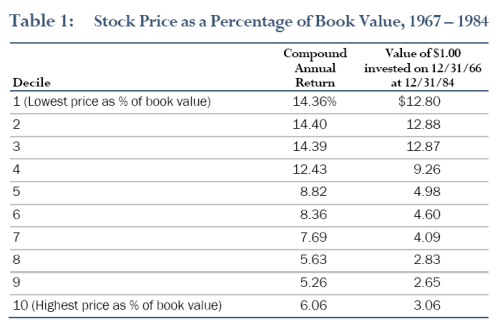
The second investment method falling under the rubric of “Assets bought cheap” is the “Low price in relation to book value” method. The booklet discusses a study conducted by Roger Ibbotson, Professor in the Practice of Finance at Yale School of Management and President of Ibbotson Associates, Inc., a consulting firm specializing in economics, investments and finance. In “Decile Portfolios of the New York Stock Exchange, 1967 – 1984,” Working Paper, Yale School of Management, 1986, Ibbotson studied the relationship between stock price as a proportion of book value and investment returns. To test this relationship, all stocks listed on the NYSE were ranked on December 31 of each year, according to stock price as a percentage of book value, and sorted into deciles. Ibbotson then measured the compound average annual returns for each decile for the 18-year period, December 31, 1966 through December 31, 1984.

Ibbotson found that stocks with a low price-to-book value ratio had significantly better investment returns over the 18-year period than stocks priced high as a proportion of book value. Tweedy Browne set out Ibbotson’s results in the following Table 1:
tweedy-table-1

A second study conducted by Werner F.M. DeBondt and Richard H. Thaler, Finance Professors at University of Wisconsin and Cornell University, respectively, examined stock price in relation to book value in “Further Evidence on Investor Overreaction and Stock Market Seasonality,” The Journal of Finance, July 1987. DeBondt and Thaler ranked all companies listed on the NYSE and AMEX, except companies that were part of the S&P 40 Financial Index, according to stock price in relation to book value and then sorted them into quintiles on December 31 in each of 1969, 1971, 1973, 1975, 1977 and 1979. DeBondt and Thaler then calculated the investment return against the equal weighted NYSE Index over the subsequent four years for all of the stocks in each selection period. The four-year returns against the market index were then averaged.

The stocks in the lowest quintile had an average market price to book value ratio of 0.36 and an average earnings yield (the inverse of the P/E ratio) of 0.10 (indicating a P/E of 10). DeBondt and Thaler found a cumulative average return in excess of the market index over the four years of 40.7%. Meanwhile, the stocks in the highest quintile, those with an average market price to book value ratio of 3.42 and an average earnings yield of 0.147 (a P/E of 6.8), returned 1.3% less than the market index over the four years after portfolio formation.

Perhaps the most striking finding by DeBondt and Thaler, and one that accords with our view about the difficulty of predicting earnings with any degree of accuracy, was the contrast between the earnings pattern of the companies in the lowest quintile (average price/book value of 0.36) and the highest quintile (average price/book value of 3.42). Tweedy Browne set out DeBondt and Thaler’s findings in Table 3 below, which describes the average earnings per share for companies in the lowest and highest quintile of price/book value in the three years prior to selection and the four years subsequent to selection:

tweedy-table-3

In the four years after the date of selection, the earnings of the companies in the lowest price/book value quintile increase 24.4%, more than the companies in the highest price/book value quintile, whose earnings increased only 8.2%. DeBondt and Thaler attribute the earnings outperformance of the companies in the lowest quintile to the phenomenon of “mean reversion,” which Tweedy Browne describes as the observation that “significant declines in earnings are followed by significant earnings increases, and that significant earnings increases are followed by slower rates of increase or declines.”

The booklet continues to discuss Tweedy Browne’s own findings confirming those of the studies described above, and a range of other studies that confirm the findings over different periods of time and in different countries. The findings form a compelling argument for an investment philosophy rooted in deep value and focused on assets, such as Greenbackd’s.

Buy my book The Acquirer’s Multiple: How the Billionaire Contrarians of Deep Value Beat the Market from on Kindlepaperback, and Audible.

Here’s your book for the fall if you’re on global Wall Street. Tobias Carlisle has hit a home run deep over left field. It’s an incredibly smart, dense, 213 pages on how to not lose money in the market. It’s your Autumn smart read. –Tom Keene, Bloomberg’s Editor-At-Large, Bloomberg Surveillance, September 9, 2014.

Click here if you’d like to read more on The Acquirer’s Multiple, or connect with me on Twitter, LinkedIn or Facebook. Check out the best deep value stocks in the largest 1000 names for free on the deep value stock screener at The Acquirer’s Multiple®.

Read Full Post »

In a paper published in February this year, Entrepreneurial Shareholder Activism: Hedge Funds and Other Private Investors, April Klein and Emanuel Zur examine recent “confrontational activism campaigns” by “entrepreneurial shareholder activists” and conclude that such strategies generate “significantly positive market reaction for the target firm around the initial Schedule 13D filing date” and “significantly positive returns over the subsequent year.”

The paper confirms our view that the filing of a 13D notice by an activist hedge fund is a catalytic event for a firm that heralds substantial positive returns in the stock.

Klien and Zur define an entrepreneurial shareholder activist as “an investor who buys a large stake in a publicly held corporation with the intention to bring about change and thereby realize a profit on the investment,” which seems quite broad. They define “confrontational activist campaign” very narrowly, including only campaigns beginning with the filing of a 13D notice in which the activist’s clear purpose is to redirect managements’ efforts without working with or communicating with management:

The redirections stated in the Schedule 13D purpose statement include (but are not limited to) seeking seats on the company’s board, opposing an existing merger or liquidation of the firm, pursuing strategic alternatives, or replacing the CEO. We exclude 13D filings that are filed because the investor is “unwilling to give up the option of affecting the firm” (Clifford (2008, p. 326)). We also exclude 13D filings if the investor states an interest in working with or communicating with management on a regular basis. These restrictions limit our analyses to activist campaigns that can be characterized as aggressive or confrontational. (Emphasis added)

Klien and Zur find that such strategies generate significant positive stock returns:

Specifically, hedge fund targets earn 10.2% average abnormal stock returns during the period surrounding the initial Schedule 13D. Other activist targets experience a significantly positive average abnormal return of 5.1% around the SEC filing window. These findings suggest that, on average, the market believes activism creates shareholder value. Our findings are consistent with those of Holderness and Sheehan (1985), who document significant price increases for firms targeted by “notorious” corporate raiders of the late 1970s and early 1980s, and also with those of Bethel, Liebeskind, and Opler (1998), who show similar results for firms targeted by individuals, rather than corporate or institutional large shareholders. The positive abnormal returns also are consistent with the work of Brav et al. (2008), who find positive market reactions for a sample of confrontational and nonconfrontational hedge fund Schedule 13D filings. Furthermore, our target abnormal returns do not dissipate in the 1-year period following the initial Schedule 13D. Instead, hedge fund targets earn an additional 11.4% abnormal return during the subsequent year, and other activist targets realize a 17.8% abnormal return over the year following the activists’ interventions.

One particularly interesting observation in the paper is the distinction between the strategies of hedge funds on one hand and other investors (individuals, private equity funds, venture capital firms, and asset management groups for wealthy investors) on the other. Klien and Zur believe that hedge funds address the “free cash flow problem:”

Under this theory, firms can reduce agency conflicts between managers and shareholders by reducing excess cash on hand, and by obligating managers to make continuous payouts in the form of increased dividends and interest payments to creditors. Consistent with this view, hedge fund targets initially have higher levels of cash on hand than do other entrepreneurial activist targets. In addition, hedge fund activists frequently demand that the target firm buy back its own shares, cut the CEO’s salary, or initiate dividends, whereas other activists do not make these demands. Consequently, over the fiscal year following the initial Schedule 13D, hedge fund targets, on average, double their dividends, significantly increase their debt-to assets ratio, and significantly decrease their cash and short-term investments.

In contrast to the hedge funds, the other investors seek to “redirect investment strategies:”

In their initial Schedule 13Ds, they most frequently demand changes in the targets’ operating strategies. Consistent with these requests, when comparing hedge fund and other entrepreneurial activist targets, we find significant differences in changes in R&D and capital expenditures in the year following the 13D filing, with the other entrepreneurial activist targets experiencing significant declines in both parameters.

We believe that Klien and Zur’s finding that confrontational activism campaigns by entrepreneurial shareholder activists generate significant positive returns in the 12 months following the filing of the 13D notice is further compelling evidence for Greenbackd’s investment strategy.

Read Full Post »

Regular readers of Greenbackd will note a few changes to the website. As we foreshadowed in our earlier post, Greenbackd Portfolio Q1 performance and update, we’ve amalgamated the old Contact us and Tips pages into a single Contact us / Tips page. We’ve also added a permanent Portfolio page, which contains our current holdings and which we will update whenever we add or remove a stock from the Greenbackd Portfolio.

Please let us know if you have any comments or suggestions for improving the site. If you don’t like this new layout, then let us know that too.

Read Full Post »

« Newer Posts - Older Posts »