Feeds:
Posts
Comments

Archive for the ‘Austrian Economics’ Category

The wonderful DShort.com blog has a post, Is the stock market cheap?, examining the S&P500 using Benjamin Graham’s P/E10 ratio. Doug Short describes the raison d’être of the Graham P/E10 ratio thus:

Legendary economist and value investor Benjamin Graham noticed the same bizarre P/E behavior during the Roaring Twenties and subsequent market crash. Graham collaborated with David Dodd to devise a more accurate way to calculate the market’s value, which they discussed in their 1934 classic book, Security Analysis. They attributed the illogical P/E ratios to temporary and sometimes extreme fluctuations in the business cycle. Their solution was to divide the price by the 10-year average of earnings, which we’ll call the P/E10. In recent years, Yale professor Robert Shiller, the author of Irrational Exuberance, has reintroduced the P/E10 to a wider audience of investors. …  The historic P/E10 average is 16.3.

Here’s the chart from DShort.com to April 1st:

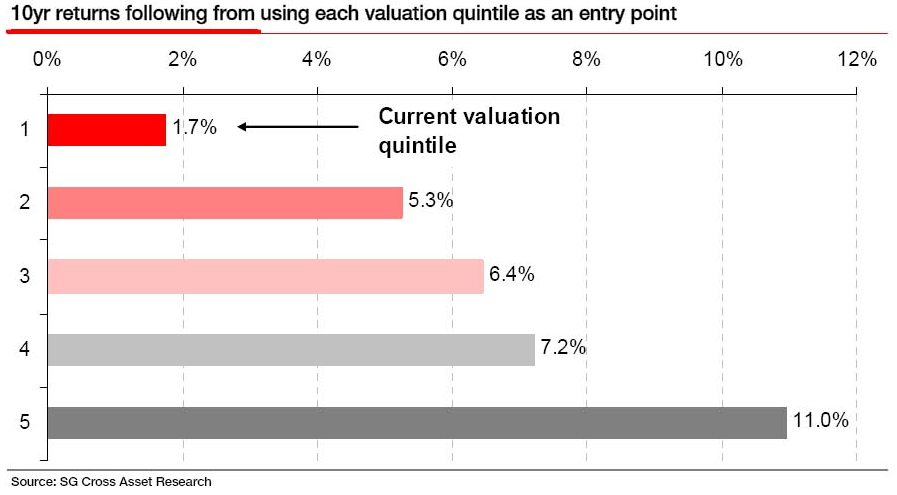
So what is the P/E10 ratio now saying about the market? In short, the market is expensive. The ratio has entered the most expensive quintile, which means it is more expensive than it has been 80% of the time. What are the implications for this? In his most recent Popular Delusions (via Zero Hedge), Dylan Grice has provided the following chart setting out the expected returns using each valuation quintile as an entry point:

Grice says:

If history is any guide, those investing today can expect a whopping 1.7% annualised return over the next ten years.

Doug Short has a more frightening conclusion:

A more cautionary observation is that every time the P/E10 has fallen from the first to the fourth quintile, it has ultimately declined to the fifth quintile and bottomed in single digits. Based on the latest 10-year earnings average, to reach a P/E10 in the high single digits would require an S&P 500 price decline below 540. Of course, a happier alternative would be for corporate earnings to make a strong and prolonged surge. When might we see the P/E10 bottom? These secular declines have ranged in length from over 19 years to as few as three. The current decline is now in its tenth year.

Or was March 2009 the beginning of a secular bull market? Perhaps, but the history of market valuations doesn’t encourage optimism.


Read Full Post »

As I foreshadowed last week in The New World, I want to explore Nassim Nicholas Taleb’s Fooled by Randomness and The Black Swan in some depth. The books aren’t strictly about investing, which Taleb regards as a “less interesting, more limited –and rather boring –applications of [his] ideas,” but my interest is in investment, particularly deep value investment, and so I’ll be exploring his ideas in that context. It is no small subject, and I don’t pretend to fully understand everything that Taleb has to say. Ideally, I’d complete it before springing it on you. Alas, my daily posting schedule won’t allow that. My apologies in advance, as this will likely progress in fits and starts, requiring “decisions and revisions which a minute will reverse.”

Taleb’s ideas appeal to me for a variety of reasons: I see Montaigne’s “Que sais-je?” (“What do I know?”) as a golden thread linking Austrian economics, value investment and a variety of other views I hold unrelated to finance and investment. Benjamin Graham, being the Latin, Greek and French-speaking polymath that he was, no doubt enjoyed Essais in its original form (whereas I had to grit my teeth through the Cotton translation, before learning that connoisseurs prefer M.A. Screech for his lyrical Raymond Sebond). Montaigne may have had some influence on Graham’s concept of margin of safety, his habit of professing to know little about the businesses of the securities in which he invested, and generally cautious and conservative approach. Montaigne writes about about the failure of his own faculties to aid him in his comprehension of the world.  We don’t even understand the past – despite our “fantastic, imaginary, false privileges that man has arrogated to himself, of regimenting, arranging, and fixing truth” – so how can we possibly see what will happen in the future? We can’t. The beauty of Montaigne is that he presents a way forward through the gloom. How do we proceed? Through waver, doubt and inquiry. Taleb offers a similar view in Fooled by Randomness and The Black Swan, and that’s what makes the books so enjoyable.

Malcolm Gladwell’s Blowing up is rich in biographical detail on Taleb, and reads to me like Fooled by Randomness in essay (despite Taleb’s protestations that “while flattering,” it put him in the “wrong box”). Gladwell sets the table by describing a meeting between Victor Niederhoffer, then “one of the most successful money managers in the country” and Taleb:

He didn’t talk much, so I observed him,” Taleb recalls. “I spent seven hours watching him trade. Everyone else in his office was in his twenties, and he was in his fifties, and he had the most energy of them all. Then, after the markets closed, he went out to hit a thousand backhands on the tennis court.” Taleb is Greek-Orthodox Lebanese and his first language was French, and in his pronunciation the name Niederhoffer comes out as the slightly more exotic Niederhoffer. “Here was a guy living in a mansion with thousands of books, and that was my dream as a child,” Taleb went on. “He was part chevalier, part scholar. My respect for him was intense.” There was just one problem, however, and it is the key to understanding the strange path that Nassim Taleb has chosen, and the position he now holds as Wall Street’s principal dissident. Despite his envy and admiration, he did not want to be Victor Niederhoffer — not then, not now, and not even for a moment in between. For when he looked around him, at the books and the tennis court and the folk art on the walls — when he contemplated the countless millions that Niederhoffer had made over the years — he could not escape the thought that it might all have been the result of sheer, dumb luck.

The punchline is that Niederhoffer blew up (for the second time, thereby fulfilling his own definition of a hoodoo):

Last fall, Niederhoffer sold a large number of options, betting that the markets would be quiet, and they were, until out of nowhere two planes crashed into the World Trade Center. “I was exposed. It was nip and tuck.” Niederhoffer shook his head, because there was no way to have anticipated September 11th. “That was a totally unexpected event.”

I’m not going to recapitulate Gladwell’s article here, but it’s well worth reading in its entirety. As an aside, Niederhoffer’s The Education of a Speculator is also an excellent read. It is interesting to compare Niederhoffer’s exhortation to “test everything that can be tested” against Taleb’s “naive empiricist,” but I’ll leave that for another day. For me, one of the most interesting aspects of Taleb’s philosophy is his attack on “epistemic arrogance” and its application to value investment. As I have said before, I believe there are several problems with the received wisdom on value investment, and this is one worthy of further exposition.

Read Full Post »

As I foreshadowed yesterday, there are several related themes that I wish to explore on Greenbackd. These three ideas are as follows:

  1. Quantitative value investing
  2. Pure contrarian investing
  3. Problems with the received wisdom on value investment

Set out below is a brief overview of each.

A quantitative approach to value investment

I believe that James Montier’s 2006 research report Painting By Numbers: An Ode To Quant presents a compelling argument for a quantitative approach to value investing. Simple statistical or quantitative models have worked well in the context of value investing, and I think there is ample evidence that this is the case. (Note that simple is the operative word: I’m not advocating anything beyond basic arithmetic or the most elementary algebra.) Graham was said to know little about the businesses of the net current asset value stocks he bought. It seems that any further analysis beyond determining the net current asset value was unnecessary for him (although he does discuss in Security Analysis other considerations for the discerning security analyst). Perhaps that should be good enough for us.

As Oppenheimer’s Ben Graham’s Net Current Asset Values: A Performance Update paper demonstrates, a purely mechanical application of Graham’s net current asset value criterion generated a mean return between 1970 and 1983  of “29.4% per year versus 11.5% per year for the NYSE-AMEX Index.” Oppenheimer puts that return in context thus, “[one] million dollars invested in the net current asset portfolio on December 31, 1970 would have increased to $25,497,300 by December 31, 1983.” That’s a stunning return. It would have put you in elite company if you had been running a fund blindly following Oppenheimer’s methodology from the date of publication of the paper. Other papers examining the returns over different periods and in different markets written after Oppenheimer’s paper have found similar results (one of the papers is by Montier and I will be discussing it in some detail in the near future). The main criticism laid at the feet of the net net method is that it can only accommodate a small amount of capital. It is an individual investor or micro fund strategy. Simple strategies able to accommodate more capital are described in Lakonishok, Shleifer, and Vishny’s Contrarian Investment, Extrapolation and Risk. In that paper, the authors found substantial outperformance through the use of only one or two value-based variables, whether they be price-to-book, price-to earnings, price-to-cash flow or price-to-sales.

I believe these papers (and others I have discussed in the past) provide compelling evidence for quantitative value investing, but let me flip it around. Why not invest solely on the basis of some simple value-based variables? Because you think you can compound your portfolio faster by cherry-picking the better stocks on the screen? This despite what Montier says in Painting By Numbers about quant models representing “a ceiling in performance (from which we detract) rather than a floor (to which we can add)”? Bonne chance to you if that is the case, but you are one of the lucky few. The preponderance of data suggest that most investors will do better following a simple model.

Pure contrarian investing

By “pure” contrarian investing, I mean contrarian investing that is not value investing disguised as contrarian investing. LSV frame their Contrarian Investment, Extrapolation and Risk findings in the context of “contrarianism,” arguing that value strategies produce superior returns because most investors don’t fully appreciate the phenomenon of mean reversion, which leads them to extrapolate past performance too far into the future. LSV argues that investors can profit from the market’s (incorrect) assessment that stocks that have performed well in the past will perform well in the future and stocks that have performed poorly in the past will continue to perform poorly. If that is in fact the case, then contrarian strategies that don’t rely on value should also work. Can I simply buy some list of securities at a periodic low (52 weeks or whatever) and sell some list of securities at a periodic high (again, say 52 weeks) and expect to generate “good” (i.e. better than just hugging the index) returns? If not, it’s not contrarianism, but value that is the operative factor.

It is in this context that I want to explore Nassim Nicholas Taleb’s “naive empiricist.” If contrarianism appears to work as a stand alone strategy, how do I know that I’m not mining the data? I also want to consider whether the various papers written about value investment discussed on Greenbackd and the experiences of Buffett, Schloss, Klarman et al “prove” that value works. Taleb would say they don’t.  How, then, do I proceed if I don’t know whether the phenomenon we’re observing is real or a trick? We try to build a portfolio able to withstand stresses, or changes in circumstance. How do we do that? The answer is some combination of employing Graham’s margin of safety, diversifying, avoiding debt and holding an attitude like Montaigne’s “Que sais-je?”‘ (“What do I know?”). It’s hardly radical stuff, but, what I believe is interesting, is how well such a sceptical and un-confident approach marries with quantitative investing.

Problems with the received wisdom on value investment

Within the value investment community there are some topics that are verboten. It seems that some thoughts were proscribed some time ago, and we are now no longer even allowed to consider them. I don’t want delve into them now, other than to say that I believe they deserve some further consideration. Some principles are timeless, others are prisoners of the moment, and it is often impossible to distinguish between the two. How can we proceed if we don’t subject all received wisdom to further consideration to determine which rules are sound, and which we can safely ignore? I don’t believe we can. I’ll therefore be subjecting those topics to analysis in any attempt to find those worth following. If I’m going to make an embarrassing mistake, I’m betting it’s under this heading.

There are several other related topics that I wish to consider, but they are tangential to the foregoing three.

Read Full Post »

The wonderful Miguel Barbosa of Simoleon Sense has interviewed Joe Calandro, Jr., author of Applied Value Investing. The interview is first class. Joe Calandro, Jr. is an interesting guy. Deep value? Check. Activist investing? He’s for it. Austrian School of Economics? Check. I think I just wet myself.

Here’s Joe’s take on value:

Q. Can you give me an example of some of your best investments?

A. In the book I profile a value pattern that I call “base case value” which is simply net asset value reconciling with the earnings power value. Firms exhibiting that pattern, which sell at reasonable margins of safety have proved highly profitable to me. In the book, I show examples of this type of investment.

“Value investing” in general has 3 core principles:

(1) The circle of competence, which essentially relates to an information advantage and holds that you will do better if you stick to what you know more about than others.

(2) The principle of conservatism. You will have greater faith in valuations if you prepare them conservatively.

(3) The margin of safety. You should only invest if there is a price-to-value gap: when the gap disappears you exit the position.

Here’s Joe on activist investing:

Q. You’re primarily in the corporate sector now; in your book you touch upon the failure of corporate M&A groups to apply value investing.  Why do you think this is the case? What is your take on activist value investors?

A. That’s a good question and I don’t have a definitive answer for it. My take on it is that Corporate America hasn’t been trained in Graham and Dodd. For example, if you get away from Columbia and some of the other top schools you really don’t have courses of study based on Graham and Dodd. I think this lack of education carries over to practice. If educational institutions aren’t teaching something, then executives are going to have a difficult time applying it. And if they do try to apply it, their employees and boards may not understand it. Hopefully, my book will help to rectify this over time.

Regarding activist investors, I think every investor should be active. If you allocate money to a security (either equity or debt) you have the responsibility of becoming involved in the respective firm because, as Benjamin Graham noted, you invested in a business, not in a piece of paper or a financial device. This is real money in real businesses so there is a responsibility that comes with investing.

And Joe’s view on economics:

Q. Can you give us a tour of the major insights you obtained from the Austrian School of Economics.

A. I have two big academic regrets: I did not study Graham and Dodd or Austrian economics until I was in my mid 30’s. One of the major theories of Austrian economics is its business cycle theory. Just the other day (11/6/2009), that theory was mentioned in the WSJ by Mark Spitznagel, who is Nassim Taleb’s partner, in his article “The Man Who Predicted the Depression.” As you know, Taleb has also spoken highly of Austrian economics as have other successful traders/practitioners such as Victor Sperandeo, Peter Schiff and Bill Bonner.

Austrian economics finds success with practitioners because, I think, Austrian economists are truly economists; they do not try to be applied mathematicians. Therefore, Austrians tend to see economics for what it is; namely, a discipline built around general principles that can be applied broadly to economic phenomena. As a result, Austrian economics is generally very useful in areas such as the business cycle and the consequences of government intervention, which are very pertinent topics today.

Read the rest of the interview while I run out to buy the book.

Read Full Post »

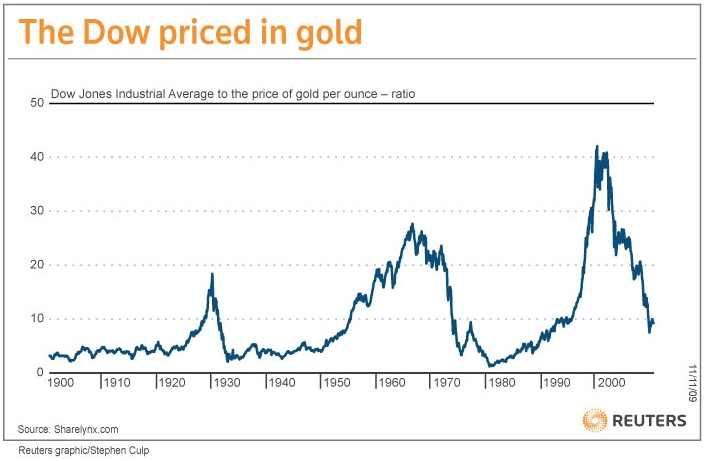
One of my favorite macro indicators is the long-term Dow:gold ratio. Rolph Winkler of Reuters blog Contingent Capital did the heavy lifting last week to produce a chart of the Dow Jones Industrial Average priced in gold per ounce since 1900:

The Dow:gold ratio is not everyone’s cup of tea. Paul Kedorosky likens it to measuring yo-yos in meerkats, but says it’s “semi-useful.” I agree. Several semi-useful observations that can be made from the chart include:

  1. Gold has outperformed the DJIA from the late 1990s to the present. In the late 1990s the Dow was more expensive in gold than it had ever been in the preceding 100 years.
  2. In 2009, the gold trade is getting long in the tooth. Most of the really big gains in gold have already been made. It’s no longer obviously cheap relative to equities, however
  3. …it’s probably not over yet. The Dow:gold ratio has traditionally bottomed at a point significantly lower than we have seen this time around. This might suggest that it still has a ways to fall before it reaches the nadir. For the bottom to come in, either gold has to go up, equities have to come down, or some combination of both has to occur. My guess is the latter, however, this is not the only view out there. For example, in the Buttonwood’s notebook column of the Economist, Buttonwood asks, “Is gold the next bubble?

WHAT are the preconditions for a bubble? Perhaps there are four: easy credit conditions, a significant trend-breaking event, the lack of plausible valuation measures and an appealing story.

Gold fulfils most of these conditions. One can argue about the credit conditions; lending is still weak but crucially interest rates are low. That helps given that gold has no yield; in effect, the opportunity cost of holding gold has disappeared. The event that changed minds was the credit crunch, which caused a partial loss of faith in banks. Gold has no valuation issues (no yield or earnings); since people hold it as a store of value, it can be worth whatever they want it to be worth. And it has a plausible backstory; spendthrift governments are monetising their deficits like the Weimar Republic before them.

…whereas one can say, based on historic valuation measures, that Wall Street is currently 40% overvalued, one can make no such bold statement on gold.The next stage of a bubble would be broad-based public interest.

One thing clear to me from the chart is that buying equities from the late 1990s to the present was like running up the down escalator. It was fun, but it wasn’t the easiest way to get to the top. Standing still on the up escalator was an easier ride. This was the point of my Buffett on gold post last week. The change in the Dow:gold ratio for the period 1964 to 1979 makes it clear why Buffett was bested by gold over that period. The change in the ratio for the period from the early 1980s through to the late 1990s, combined with Buffett’s otherworldly ability to identify undervalued equities, also explains the lollapalooza gains made by Berkshire Hathaway during that period. It might also suggest that at some stage in the near future equities will again be the up escalator, but not quite yet, for the reasons below.

In an inflationary environment a business must keep increasing the price of its goods or services just to keep its margins static, and any reinvestment in plant and machinery must be undertaken at increasingly higher prices. If it can’t increase its prices or it doesn’t earn enough to keep up with its maintenance capital expenditure, then it will shrink and risks falling behind any competitor that can. In other words, it has to run up the down escalator, and if it can’t run faster than the escalator, then it’s going backwards. Businesses with no pricing power and low returns-on-equity will therefore suffer in an inflationary environment. While it is true that a business with pricing power and high return-on-equity is better able to protect itself somewhat from inflation, it is not true that inflation is good for this business either. Since I (and, I suspect, most investors) can’t prospectively pick one from the other, perhaps stepping onto the up escalator in such times is not such a bad idea. All gold does is sit there, yes, but it can’t be printed, so it tends to appreciate against the dollar as the dollar is debauched.

Has the dollar been debauched? The Austrian economist in me thinks so. Einhorn, John Paulson, Rogers and Buffett’s commentary on US fiscal and monetary policy can’t all be wrong. Keeping interest rates too low for too long and printing too much money – what Buffett describes as “Greenback emissions” – will result in inflation measurable in the CPI in the not too distant future. (As an aside, I think there is inflation now, but because it’s not running through the CPI yet it doesn’t exist according to the orthodox view, which also happens to be the one in power, and on both sides of politics, for that matter).

What can we deduce from the foregoing? If gold does as it has done in past cycles, it should do well for the foreseeable future. That has to be tempered by the fact that the gold price has run a long way, both in dollar terms and in comparison to equities (as measured against the DJIA). Gold could have a big reversal – in the mid-1970s the DJIA rallied significantly against gold before sinking to its long-term bottom – before it continues onto historical highs. In this regard, Jim Rogers’ recent commentary is instructive [via The Globe and Mail]:

Jim Rogers: I don’t ever like to buy something making all time highs however I’m not selling my gold. Gold is going to go much higher in the course of the bull market. Doesn’t mean it can’t go down 20 per cent next year but during the course of the bull market it is going to go much higher it is certainly not a bubble yet.

Jim you are typically a contrarian investor. If everyone is buying, shouldn’t you be selling?

Jim Rogers : Yes, I should be selling at the top, but I don’t think this is the top. Gold, if you adjust it for its old highs, adjust it for inflation back in 1980, gold should be over $2000 an ounce right now. In my view, in this bull market in commodities gold will make all new highs adjust for inflation.

When will gold hit 2k?

Jim Rogers: I wish I was that smart. You should watch TheStreet.com. They know everything.

Read Full Post »

Warren Buffett’s position on gold is well known, if a little difficult to fathom. This is from Buffett’s appearance on CNBC’s Squawk Box on March 9, 2009, but could have been taken from any of his commentary over the last fifty years:

BECKY: OK. I want to get to a question that came from an investment club of seventh and eighth graders who invest $1 million in fake money every year. This is the Grizzell Middle School Investment Club in Dublin, Ohio, and the question is, where do you think gold will be in five years and should that be a part of value investing?

BUFFETT: I have no views as to where it will be, but the one thing I can tell you is it won’t do anything between now and then except look at you. Whereas, you know, Coca-Cola will be making money, and I think Wells Fargo will be making a lot of money and there will be a lot–and it’s a lot–it’s a lot better to have a goose that keeps laying eggs than a goose that just sits there and eats insurance and storage and a few things like that. The idea of digging something up out of the ground, you know, in South Africa or someplace and then transporting it to the United States and putting into the ground, you know, in the Federal Reserve of New York, does not strike me as a terrific asset.

Then there’s this comment from Buffett on the relative performance of Berkshire Hathway book value and an ounce of gold over fifteen years in the 1979 letter to shareholders:

One friendly but sharp-eyed commentator on Berkshire has pointed out that our book value at the end of 1964 would have bought about one-half ounce of gold and, fifteen years later, after we have plowed back all earnings along with much blood, sweat and tears, the book value produced will buy about the same half ounce. A similar comparison could be drawn with Middle Eastern oil. The rub has been that government has been exceptionally able in printing money and creating promises, but is unable to print gold or create oil.

Fifteen years of blood, sweat and tears from the greatest investor in the world and he just breaks even with gold, which “just sits there and eats insurance and storage and a few things like that.” And still he recommends avoiding gold.

For tis the sport to have the enginer
Hoist with his owne petar.

Read Full Post »

The WSJ has an article Profiting from the crash excerpting parts of the Gregory Zuckerman book The Greatest Trade Ever about John Paulson’s infamous bet against the housing market:

By early 2006 the 49-year-old Mr. Paulson had reached his twilight years in accelerated Wall Street-career time. He had been eclipsed by a group of investors who had amassed huge fortunes in a few years. It was the fourth year of a spectacular surge in housing prices, the likes of which the nation never had seen. Everyone seemed to be making money hand over fist. Everyone but John Paulson.

“This is crazy,” Mr. Paulson said to Paolo Pellegrini, one of his analysts.

Paulson’s response was to have Pellegrini look at the long term returns on house prices:

The answer was in front of him: Housing prices had climbed a puny 1.4% annually between 1975 and 2000, after inflation. But they had soared over 7% in the following five years, until 2005. The upshot: U.S. home prices would have to drop by almost 40% to return to their historic trend line. Not only had prices climbed like never before, but Mr. Pellegrini’s figures showed that each time housing had dropped in the past, it fell through the trend line, suggesting that an eventual drop likely would be brutal.

Paulson decided he wanted to bet that house prices would regress to the mean, but how to find the right instrument to allow him to do that:

By the spring, Mr. Paulson was convinced he had discovered the perfect trade. Insurance on risky home mortgages was trading at dirt-cheap prices. He would buy boatloads of credit-default swaps—or investments that served as insurance on risky mortgage debt. When housing hit the skids and homeowners defaulted on their mortgages, this insurance would rise in value—and Mr. Paulson would make a killing. If he could convince enough investors to back him, he could start a fund dedicated to this trade.

And then he stuck to his trade:

By the summer of 2006, Mr. Paulson had managed to raise $147 million, mostly from friends and family, to launch a fund. Soon, Josh Birnbaum, a top Goldman Sachs trader, began calling and asked to come by his office. Sitting across from Mr. Paulson, Mr. Pellegrini, and his top trader, Brad Rosenberg, Mr. Birnbaum got to the point.

Not only were Mr. Birnbaum’s clients eager to buy some of the mortgages that Paulson & Co. was betting against, but Mr. Birnbaum was, too. Mr. Birnbaum and his clients expected the mortgages, packaged as securities, to hold their value. “We’ve done the work and we don’t see them taking losses,” Mr. Birnbaum said.

After Mr. Birnbaum left, Mr. Rosenberg walked into Mr. Paulson’s office, a bit shaken. Mr. Paulson seemed unmoved. “Keep buying, Brad,” Mr. Paulson told Mr. Rosenberg.

What’s Paulson’s new big idea? Hint: It’s got distinctly Austrian tones:

By the middle of 2009, a record one in 10 Americans was delinquent or in foreclosure on their mortgages. U.S. housing prices had fallen more than 30% from their 2006 peak. In cities such as Miami, Phoenix, and Las Vegas, real-estate values dropped more than 40%. Several million people lost their homes. And more than 30% of U.S. home owners held mortgages that were underwater, or greater than the value of their houses, the highest level in 75 years.

As Mr. Paulson and others at his office discussed how much was being spent by the United States and other nations to rescue areas of the economy crippled by the financial collapse, he discovered his next targets, certain they were as doomed to collapse as subprime mortgages once had been: the U.S. dollar and other major currencies.

Mr. Paulson made a calculation: The supply of dollars had expanded by 120% over several months. That surely would lead to a drop in its value, and an eventual surge in inflation. “What’s the only asset that will hold value? It’s got to be gold,” Mr. Paulson argued.

Paulson & Co. had never dabbled in gold, and had no currency experts. He was also one of many warming to gold investments, worrying some investors. Some investors withdrew money from the fund, pushing his assets down to $28 billion or so.

Mr. Paulson acknowledged that his was a straightforward argument, but he paid the critics little heed.

“Three or four years from now, people will ask why they didn’t buy gold earlier,” Mr. Paulson said.

He purchased billions of dollars of gold investments. Betting against the dollar would be his new trade.

It is interesting to see a few well-respected investors on the same side of this trade. Einhorn made his views on gold known in his speech to the Value Investing Congress.

Read Full Post »

Rolfe Winkler of Reuters blog Contingent Capital has a great summary of David Einhorn’s talk to the Value Investing Congress. Despite what we say in the title, Einhorn is hardly fickle (we just couldn’t resist). If anything, he’s stubborn to a fault, so it is interesting that he’s changed his mind so dramatically about the influence of macro events on his traditional bottom-up investment style. In his speech (.pdf via Winkler’s blog), he sets out the rationale behind the change, what he perceives the current macro risks to be, and what he’s doing in response. Apologies in advance for the huge blocks of text. We believe that this is the most important factor influencing the market and the economy, and will be for the next 5-10 years. Ignore it at your peril.

Speaking of his change in attitude to secular macro trends, Einhorn said:

I want to revisit [Greenlight’s 2005 position in MDC Holdings, a homerbuilder] because the loss was not bad luck; it was bad analysis. I down played the importance of what was then an ongoing housing bubble. On the very same day, at the very same conference, a more experienced and wiser investor, Stanley Druckenmiller, explained in gory detail the big picture problem the country faced from a growing housing bubble fueled by a growing debt bubble. At the time, I wondered whether even if he were correct, would it be possible to convert such big picture macro-thinking into successful portfolio management? I thought this was particularly tricky since getting both the timing of big macro changes as well as the market’s recognition of them correct has proven at best a difficult proposition. Smart investors had been complaining about the housing bubble since at least 2001. I ignored Stan, rationalizing that even if he were right, there was no way to know when he would be right. This was an expensive error.

The lesson that I have learned is that it isn’t reasonable to be agnostic about the big picture. For years I had believed that I didn’t need to take a view on the market or the economy because I considered myself to be a “bottom up” investor. Having my eyes open to the big picture doesn’t mean abandoning stock picking, but it does mean managing the longshort exposure ratio more actively, worrying about what may be brewing in certain industries, and when appropriate, buying some just-in-case insurance for foreseeable macro risks even if they are hard to time.

What, according to Einhorn, is the secular macro trend most influencing the market and economy? The inflationary policies of the current administration:

Presently, Ben Bernanke and Tim Geithner have become the quintessential short-term decision makers. They explicitly “do whatever it takes” to “solve one problem at a time” and deal with the unintended consequences later. It is too soon for history to evaluate their work, because there hasn’t been time for the unintended consequences of the “do whatever it takes” decision-making to materialize.

Rather than deal with these simple problems with simple, obvious solutions, the official reform plans are complicated, convoluted and designed to only have the veneer of reform while mostly serving the special interests. The complications serve to reduce transparency, preventing the public at large from really seeing the overwhelming influence of the banks in shaping the new regulation.

In dealing with the continued weak economy, our leaders are so determined not to repeat the perceived mistakes of the 1930s that they are risking policies with possibly far worse consequences designed by the same people at the Fed who ran policy with the short term view that asset bubbles don’t matter because the fallout can be managed after they pop. That view created a disaster that required unprecedented intervention for which our leaders congratulated themselves for doing whatever it took to solve. With a sense of mission accomplished, the G-20 proclaimed “it worked.”

We are now being told that the most important thing is to not remove the fiscal and monetary support too soon. Christine Romer, a top advisor to the President, argues that we made a great mistake by withdrawing stimulus in 1937.

An alternative lesson from the double dip the economy took in 1938 is that the GDP created by massive fiscal stimulus is artificial. So whenever it is eventually removed, there will be significant economic fall out. Our choice may be either to maintain large annual deficits until our creditors refuse to finance them or tolerate another leg down in our economy by accepting some measure of fiscal discipline.

Over the last couple of years we have adopted a policy of private profits and socialized risks. We are transferring many private obligations onto the national ledger. Although our leaders ought to make some serious choices, they appear too trapped in short-termism and special interests to make them. Taking no action is an action.

In the nearer-term the deficit on a cash basis is about $1.6 trillion or 11% of GDP. President Obama forecasts $1.4 trillion next year, and with an optimistic economic outlook, $9 trillion over the next decade. The American Enterprise Institute for Public Policy Research recently published a study that indicated that “by all relevant debt indicators, the U.S. fiscal scenario will soon approximate the economic scenario for countries on the verge of a sovereign debt default.”

Further, the Federal Open Market Committee members may not recognize inflation when they see it, as looking at inflation solely through the prices of goods and services, while ignoring asset inflation, can lead to a repeat of the last policy error of holding rates too low for too long.

At the same time, the Treasury has dramatically shortened the duration of the government debt. As a result, higher rates become a fiscal issue, not just a monetary one. The Fed could reach the point where it perceives doing whatever it takes requires it to become the buyer of Treasuries of first and last resort.

I believe there is a real possibility that the collapse of any of the major currencies could have a similar domino effect on re-assessing the credit risk of the other fiat currencies run by countries with structural deficits and large, unfunded commitments to aging populations.

I believe that the conventional view that government bonds should be “risk free” and tied to nominal GDP is at risk of changing. Periodically, high quality corporate bonds have traded at lower yields than sovereign debt. That could happen again.

His response has been to buy physical gold “as insurance against sovereign default(s).”

Now, the question for us as investors is how to manage some of these possible risks. Four years ago I spoke at this conference and said that I favored my Grandma Cookie’s investment style of investing in stocks like Nike, IBM, McDonalds and Walgreens over my Grandpa Ben’s style of buying gold bullion and gold stocks. He feared the economic ruin of our country through a paper money and deficit driven hyper inflation. I explained how Grandma Cookie had been right for the last thirty years and would probably be right for the next thirty as well. I subscribed to Warren Buffett’s old criticism that gold just sits there with no yield and viewed gold’s long-term value as difficult to assess.

However, the recent crisis has changed my view. The question can be flipped: how does one know what the dollar is worth given that dollars can be created out of thin air or dropped from helicopters? Just because something hasn’t happened, doesn’t mean it won’t. Yes, we should continue to buy stocks in great companies, but there is room for Grandpa Ben’s view as well.

I have seen many people debate whether gold is a bet on inflation or deflation. As I see it, it is neither. Gold does well when monetary and fiscal policies are poor and does poorly when they appear sensible. Gold did very well during the Great Depression when FDR debased the currency. It did well again in the money printing 1970s, but collapsed in response to Paul Volcker’s austerity. It ultimately made a bottom around 2001 when the excitement about our future budget surpluses peaked.

Prospectively, gold should do fine unless our leaders implement much greater fiscal and monetary restraint than appears likely. Of course, gold should do very well if there is a sovereign debt default or currency crisis.

A few weeks ago, the Office of Inspector General called out the Treasury Department for misrepresenting the position of the banks last fall. The Treasury’s response was an unapologetic expression that amounted to saying that at that point “doing whatever it takes” meant pulling a Colonel Jessup: “YOU CAN’T HANDLE THE TRUTH!” At least we know what we are dealing with.

When I watch Chairman Bernanke, Secretary Geithner and Mr. Summers on TV, read speeches written by the Fed Governors, observe the “stimulus” black hole, and think about our short-termism and lack of fiscal discipline and political will, my instinct is to want to short the dollar. But then I look at the other major currencies. The Euro, the Yen, and the British Pound might be worse. So, I conclude that picking one these currencies is like choosing my favorite dental procedure. And I decide holding gold is better than holding cash, especially now, where both earn no yield.

For years, the discussion has been that our deficit spending will pass the costs onto “our grandchildren.” I believe that this is no longer the case and that the consequences will be seen during the lifetime of the leaders who have pursued short-term popularity over our solvency. The recent economic crisis and our response has brought forward the eventual reconciliation into a window that is near enough that it makes sense for investors to buy some insurance to protect themselves from a possible systemic event. To slightly modify Alexis de Tocqueville: Events can move from the impossible to the inevitable without ever stopping at the probable.

Read Full Post »

« Newer Posts