In their March 2012 paper, “Analyzing Valuation Measures: A Performance Horse-Race over the past 40 Years,” Wes Gray and Jack Vogel asked, “Do long-term, normalized price ratios outperform single-year price ratios?”
Benjamin Graham promoted the use of long-term, “normalized” price ratios over single-year price ratios. Graham suggested in Security Analysis that “[earnings in P/E] should cover a period of not less than five years, and preferably seven to ten years.”
Robert Shiller has also advocated for long-term price ratios because “annual earnings are noisy as a measure of fundamental value.” A study in the UK by Anderson and Brooks [2006] found that a long-term average (eight-years) of earnings increased the value premium (i.e. the spread in returns between value and growth stocks) by 6 percent over one-year earnings.
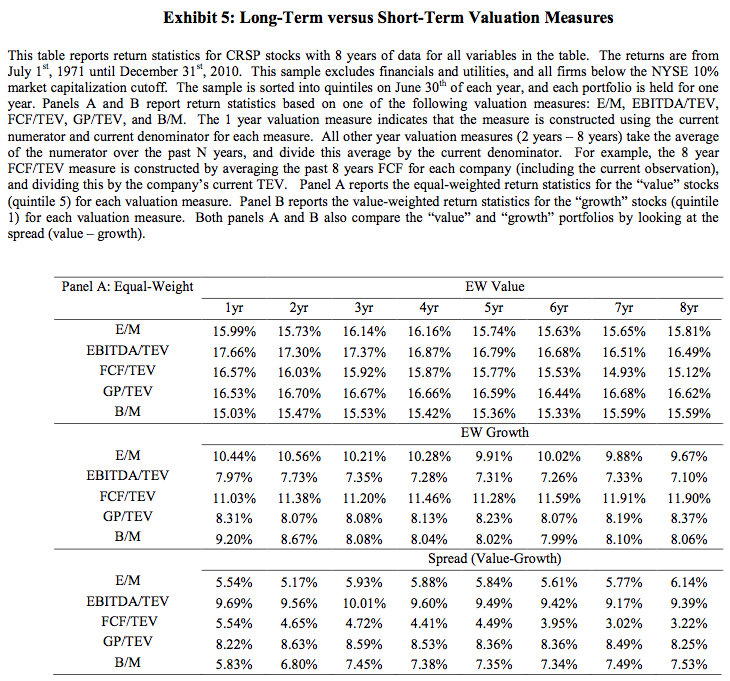
Gray and Vogel test a range of year averages for all the price ratios from yesterday’s post. The results are presented below. Equal-weight first:
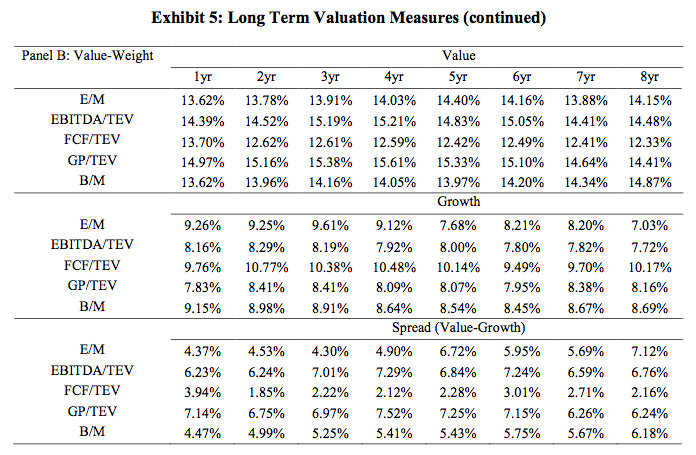
Market capitalization-weight:
Commentary
We can make several observations about the long-term averages. First, there is no evidence that any long-term average is consistently better than any other, measured either on the raw performance to the value decile, or by the value premium created. This is true for both equal-weight portfolios and market capitalization-weighted portfolios, which we would expect. For example, in the equal-weight table, the E/M value portfolio generates its best return using a 4-year average, but the spread is biggest using the 3-year average. Compare this with EBITDA/TEV, which generates its best return using a single-year ratio, and its biggest spread using a 3-year average, or FCF/TEV, which generates both its best return and biggest spread with a single-year average. There is no consistency, or pattern to the results that we can detect. If anything, the results appear random to me, which leads me to conclude that there’s no evidence that long-term averages outperform single-year price ratios.
We can make other, perhaps more positive observations. For example, in the equal-weight panel, the enterprise multiple is consistently the best performing price ratio across most averages (although it seems to get headed by GP/TEV near the 7-year and 8-year averages). It also generates the biggest value premium across all long-term averages. It’s also a stand-out performer in the market capitalization-weighted panel, delivering the second best returns to GP/TEV, but generating a bigger value premium than GP/TEV about half the time.
The final observation that we can make is that the value portfolio consistently outperforms the “growth” or expensive portfolio. For every price ratio, and over every long-term average, the better returns were found in the value portfolio. Value works.
Conclusion
While long-term average price ratios have been promoted by giants of the investment world like Graham and Shiller as being better than single-year ratios, there exists scant evidence that this is true. A single UK study found a significant premium for long-term average price ratios, but Gray and Vogel’s results do not support the findings of that study. There is no evidence in Gray and Vogel’s results that any long-term average is better than any other, or better than a single-year price ratio. One heartening observation is that, however we slice it, value outperforms glamour. Whichever price ratio we choose to examine, over any long-term average, value is the better bet.


 Greenbackd