Feeds:
Posts
Comments

Archive for August, 2010

Farukh Farooqi has a typically excellent post at Oozing Alpha on Furiex Pharmaceuticals Inc. (NASDAQ:FURX):

FURX, spun off from PPDI on 6/14/10, is a $10 stock with net cash (cash minus all liabilities) of $10 per share. It earns royalties on two drugs already in the market with potential milestone payments of $14.40 per share. It has three other programs in its R&D pipeline. According to some Street estimates, the value of Furiex’s royalties & pipeline is $30-$36 per share.

The entire float has traded since the spin-off, and selling pressure may soon begin to recede. As part of the spin-off, 18% of the equity is set aside for management. In addition, the Chairman owns 6% of the outstanding shares.

Spin-Off Background: On June 14, 2010, Pharmaceutical Products Development Inc. (PPDI), a Contract Research Organization, spun off its drug discovery business to shareholders in a tax free transaction.

The main motivation behind the spin-off was to separate a cash flow generating, service business (PPDI) from a cash utilizing, biotech division (FURX). PPDI has 118 mm shares and for every 12 shares of PPDI, shareholders got one share of FURX.

FURX has a market cap of $100 mm, tiny when compared to PPDI’s $2.9 billion equity cap.

Hence, the spun-off stock is not likely to have much appeal for PPDI shareholders who are mainly interested in the CRO business or those can’t own a small-cap stock.

Sure enough, FURX began trading in the high teens on June 1 and has dropped to $10 on no new news.

Value Proposition: I was browsing through some old analysts’ reports written when PPDI announced the spinoff to see what they thought of the development business (now Furiex).

In a report dated 10/29/2009, Barclays had assigned a value of $1 per PPDI share to Priligy and $1 per PPDI share to Alogliptin + Dermatology portfolio. This translates $236 mm since PPDI has 118 mm shares out. Add to this, net cash of $94 mm injected into the spin off and it adds up to $33 per FURX share.
Thomas Weisel, in a report dated 10/27/2009, valued Spinco at $2.50-$3.00 per PPDI share or $30-$36 per FURX share.

See the post at Oozing Alpha.

No Position.

Read Full Post »

Zero Hedge has a post on Pershing Square’s most recent 13F.  The most notable change is a big position in Citigroup:

He’s also increased his position in Kraft, which is interesting because Nelson Peltz has completely sold out of Trian’s position:

Trian has been whittling down its stake in Kraft since last year, when Kraft made a hostile bid for Cadbury. Kraft later acquired Cadbury for roughly $19 billion in February. Warren Buffett, Kraft’s largest shareholder, was not a big fan of the deal.

In 2007, Peltz pushed for changes at Kraft when he first reported owning a large stake in the world’s No. 2 food company. He eventually won two seats on its board.

Kraft reported Aug. 5 second-quarter profit rose 13% to $937 million as it reaped the benefit of Cadbury and overhead costs savings.

The profit topped the consensus analysts’ estimate. But Kraft softened its sales outlook, citing higher Cadbury inventories and aggressive discounting at U.S. food retailers.

Kraft shares closed Friday at $29.50. Shares are up more than 8% for 2010.

No positions.

Read Full Post »

Adam Sues, author of Value Uncovered, has provided a guest post on AMCON Distributing Co. (AMEX:DIT). Adam describes himself thus:

I’ve always enjoyed reading about the stock market and started studying in earnest in 2007 right before the whole financial world crashed.  I sold a few positions at a loss (a mistake) but managed to pick up some great names at bargain prices.  Over the past two years, I’ve started to study the principles of value investing and special situations, molding my philosophy after famous investors like Warren Buffett and Benjamin Graham.

Here’s his take on DIT:

AMCON Distributing (DIT)

AMCON Distributing Company (DIT) is just the type of business upon which many value investors focus: a micro-cap stock in a boring industry that the market has largely ignored.

With a market cap of only $33M, AMCON is incredibly producing almost $1B in sales, an outstanding number for such a small company.

Company Background

DIT has been around since 1986, and is currently the 8th largest convenience store distributor in the United States.

Distribution

The company currently operates 4,200 retail outlets, consisting of grocery stores, liquor stores, tobacco shops, and convenience stores across the Central and Rocky Mountain region of the country, selling over 14,000 different products.

The company’s products would be familiar to any normal citizen who has spent time in a corner store – cigarettes, tobacco products, candy, groceries, paper products, and frozen foods, among others.

Stores are serviced by 5 large distribution hubs totaling approx. 487,000 square feet, and are stocked by major suppliers including Phillip Morris, RJ Reynolds, and Proctor & Gamble.

Retail – Health Foods

The second business segment consists of retail health food stores operating under the name Chamberlin’s Market & Café and Akin’s Natural Foods Market. These stores focus on high-quality, organic, & specialty foods.  Both store brands have been around since 1935, with 13 stores between them. Overall, AMCON has exposure to two completely different segments of the market – low-end, commodity type distribution and high-end organic food purchases.

While distribution still makes up for the vast majority of revenues, the retail health food concept is sweeping across the country and could provide a future engine for company growth (just witness the explosion of organic food advertisements and sustainable food awareness campaigns over the past few years).

The company has enjoyed record financial performance over the past two years under the leadership of its Chairman & CEO – Christopher H. Atayan.  AMCON is a remarkable turnaround story.

Financials

AMCON’s industry is highly competitive and low margin business.  Gross margins have averaged 7.3% over the past 10 years, with little variance.  Net margins are very tight, averaging 0.2%, although the trend has been increasing.

Breaking down the business segments, margins on the retail side are much better, with gross margins in the 42% range compared to 6.1% on the wholesale side. Despite the wide range of products, the company is heavily dependent on the sale of cigarettes.  In 2009, approx. 71% of company revenue came from sales of these products, although only 27% of gross profits.

Sales growth has been steady, but slow, at approx. 3% per year.  The company has been able to raise revenue due to price increases, new store openings, and strategic acquisitions.

Most recently, the company owned a new retail store in Oklahoma and expanded its distribution network by purchasing the assets of another distributor:

“On October 30, 2009, the Company acquired the convenience store distribution assets of Discount Distributors from its parent Harps Food Stores, Inc. (“Harps”). Discount Distributors is a wholesale distributor to convenience stores in Arkansas, Oklahoma, and Missouri with annual sales of approximately $59.8 million”

Positives

Improved Financial Health:

AMCON is the type of business that turns over a ton of inventory (almost 25x per year).  Combine this fact with a low margin business, and the company must fund most of their operations through debt financing – there is little cash on the balance sheet.

Management has taken steps to improve the financial health of the business.  Long-term debt has shrunk from $58.2m in 2005 to 27.7M last year.  At the same time, shareholder equity has increased from $-0.2M to $23.8M.

Interest coverage has increased to 9.5, putting the company on much better financial footing.

Turnaround Story:

Since the arrival of Mr. Atayan, the company’s current CEO and Chairman, AMCON has undergone an amazing turnaround.  A few years ago, AMCON was in rough shape:

The business had negative availability of $2 million on its bank lines, it was being sued in four separate jurisdictions, it was being delisted by the American Stock Exchange, it was behind on taxes, it was losing business, and it was more than $65 million in debt.

The company sold off non-essential businesses and turned two consecutive record years in 2008 and 2009.

Management:

Insiders own 44.1% of outstanding shares, including 37.5% by the CEO and Chairman, Christopher Atayan.  Mr. Atayan bought out the company’s original founder, William Wright, purchasing over 200k shares last year.

The company re-instituted a cash dividend in 2008, and has more than doubled the quarterly payment to $0.18 during one of the toughest economic times in recent memory.

Last year, AMCON’s board also announced a share repurchase program for up to 50,000 shares, or 9% of outstanding.

Negatives

Regulatory Challenges:

Although the company has worked to diversify its business, it still relies heavily on the distribution of cigarettes.  Cigarette sale and distribution is a highly regulated affair, and overall use has declined due to social stigma and education on the health risks of smoking.

In June 2009, the FDA was granted even greater powers for regulating the sale and distribution of cigarettes.  The agency almost immediately banned the sale of certain flavored cigarettes, and then substantially increased the federal excise tax on cigarette sales.

Increased prices put continued pressure on sales – to date, AMCON has been able to pass along the higher prices to its customers but it remains a big risk for the company.

Competition:

The company is part of a very competitive industry, and the low profit margins do not leave much room for error.  An inventory miscalculation or fuel price increase could severely impact the business.

AMCON currently depends on a $55M credit agreement with Bank of America.  Average borrowings for last year were $31.2M – the company obviously depends on this line of credit.

The current agreement matures in June 2011, and the outcome of that negotiation will have a substantial impact to the business.

On the retail side, the company’s retail stores face intense competition not only from stand alone health stores, but also major grocery chains who are trying to capitalize on the health movement as well.

Stock Float:

DIT is a micro-cap stock, with a market cap of approx. $34M.  The stock is also very illiquid and suffers from a tiny float.  The company only has 577k share outstanding – with the high levels of insider ownership, float is only 350k.

According to Lowfloat.com, DIT is actually one of the top 3 lowest float stocks trading on any of the major exchanges.

Average 3 month volume is only 1000 shares so picking up large blocks of shares is difficult.  Many institutions will pass on the stock because of these challenges, allowing individual investors to benefit.

Valuation

The stock touched a low of $14 back in November 2008, before shooting upwards to $78 in December 2009 – not a bad return for one year.

Current P/E ratio sits at 4.8 – higher than 2008 (2.4) but lower than 2006/2007 (6.2), the first two years of the turnaround.
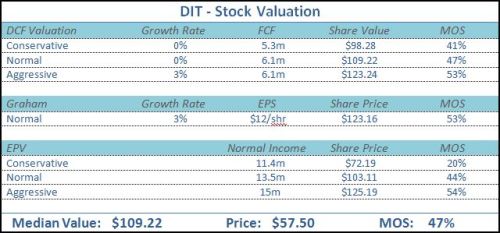
DIT’s 2010 EPS should come in around $15-17 – applying a normal P/E of 6 to these EPS numbers results in a share price of $90-$102.

Conclusion

Through the first three quarters of the company’s fiscal year, revenues, operating income, and FCF are all higher than 2009, setting the company up for another record year.

With regards to buying a significant personal stake in the company, Mr Atayan had this to say:

“This is a significant personal investment for my family and reflects my confidence in the management team of our company and the strong relationships we have with our vendors and customers.”

With this type of conviction – not only his professional livelihood and reputation, but putting his family’s stake behind the words as well – I have no doubt that Atayan is committed to making the company succeed.

Based on recent performance, he is off to a good start.

No position.

Read Full Post »

Carl Icahn has plowed $1 billion into energy stocks over the last 6 months according to his latest SEC filing. Says The NYTimes Dealbook column:

Yet speculation is rife given the activist investor’s history with energy companies and his reputation for focusing on companies that he believes are undervalued and ripe for a shake-up in some way — with a restructuring or a sale among the possibilities.

One company that may have attracted his interest is one he already knows:  Anadarko Petroleum. Shares of Anadarko, a Texas-based Independent oil company, tumbled in the spring after the explosion and spill at a BP-operated well in the Gulf of Mexico. Anadarko owns a 25 percent stake in the well.

Anadarko’s stock price fell below $35, wiping $19 billion off its market capitalization. (The stock has since recovered, closing at $56.35 on Monday.)

Mr. Icahn goes back several years with Anadarko.  In 2005, Mr. Icahn and a fellow activist investor, Jana Partners, accumulated a 7 percent stake in Kerr-McGee, an Oklahoma-based energy exploration and production company. The Icahn group demanded the company sell off certain units and commence a big stock buyback.  Kerr-McGee did, and then sold itself to Anadarko for $16.4 billion, representing a rich premium of 40 percent.

Mr. Icahn built his stake in the combined company, and by the beginning of 2008 he had 14.8 million Anadarko shares worth around $971 million.

“Investors who bought Kerr McGee stock on the same date I invested and profited from the acquisition by Anadarko realized an approximate 234 percent return,” Mr. Icahn wrote on his blog, the Icahn Report, in 2008.

He rode Anadarko up to its high price of around $80 a share in May of 2008 as oil prices  headed to $147 a barrel.  But Mr. Icahn appeared to be focusing more of his attention and money on his campaign against Yahoo. Oil prices slid to under $35 a barrel as the financial crisis took hold.  Mr. Icahn began selling off his stake and was completely out of Anadarko by May 2009.

Read the article.

Read Full Post »

Sham Gad has provided the following guest post on Paragon Technologies (OTCBB: PGNT), which Daniel Rudewicz of Furlong Samex also covered in January. Sham is the managing partner of Gad Capital Management, a value-focused investment firm modeled after the Buffett Partnerships based in Athens, Georgia. Gad is also the author of the recently released,  “The Business of Value Investing: Six Essential Elements to Buying Companies Like Warren Buffett.” He earned his BBA and MBA at the University of Georgia.

Paragon Technologies: Catalyst to Unlock Shareholder Value

Paragon Technologies (OTCBB: PGNT) is a $3.7 million market cap company with $5.5 million in cash and $5.2 million in equity. It’s operating subsidiary, SI Systems, has a 50 year history as a quality provider of material handling systems for many of the world’s top corporations. Unfortunately over the past decade, current management has not succeeded in growing this company. Since 2001, sales have been on a steady decline and the company has generated positive operating income in only 3 of those years. Clearly management can not hide behind the veil of economic turmoil.

A Strategic Alternative

It’s obvious why value oriented investors may be attracted to Paragon. Shares trade for $2.40, there is $3.60 in cash per share, and tangible book value of $3.40 a share. As you can see, the vast majority of book value is cash, not inventory or other hard to sell assets. Yet this cash margin of safety has been eroding for the past couple of years as SI Systems deteriorating operations have consumed cash. Left unchecked, what cash cushion remains today will likely disappear under the current status quo. Since year end 2009, cash per share has declined from $4.15 to $3.60.

In the meantime, current management continues to sit still waiting for one of two things to happen:

1. A pick up in new material handling systems orders; or

2. A sale of the company

As I discuss below, here is why shareholders can not wait for this to happen.

New Order Demand

While there is no doubt that the recession has had a profound effect on the new order volume of Paragon, the company counts names like Caterpillar, Harley Davidson, and Honda Motor as previous customers. Clearly the company has (or at least had) the infrastructure to support Fortune 500 companies. These industrial giants expend hundreds of millions if not billions of dollars annually on cap ex. A mere basis point allocation of this cap ex would significantly impact Paragon which today does less than $10 million in annual sales. Yet somehow the company has not been able to find a way to achieve new orders for years. If you accept management’s argument that new orders lag an economic recovery, then any realistic uptick in new order won’t occur until 2012 based on the current economic data. With SG&A expenses now accounting for 50% of sales, I don’t think this company has the luxury of time.

Sale of the Company

This one is quite simple, yet management seems perplexed. Based on my conversations with the CEO, the only offers being made value the company for its cash. While I will agree that the industrial operations are indeed worth something, any buyer today is buying those operations generating losses not profits. So management waits, refusing cash offers, while allowing the cash to decline. According to the CEO, the company has been trying to sell itself for a couple of years. The offers back then were materially higher than today, yet management continues to wait it out.

An Elegant Solution

While management waits for better days, the only thing they have done is reduce expenses here and there. While I will be the first to applaud this effort, its clear those actions alone are no longer enough. More so, despite the reductions, the company overhead looks bloated given its size today. As the company’s largest shareholder, I have proposed the following 4 point solution in my efforts to salvage this company and unlock shareholder value. In one way or another I have discussed these alternatives with management that I would like to aggressively explore as a member of its Board:

1. Addressing the company’s current compensation package – until the company demonstrates substantial operational improvement, compensation needs to be reflective of the current reality. As of the most recent quarterly filing, SG&A expenses constituted over 50% of sales.

2. Review and analyze efforts to sell the company – for over a year, management has indicated its preference for selling Paragon. I want to work with the Board to ensure that all avenues are explored in order to determine if an attractive sale price exists.

3. Immediately work towards bringing SI Systems back to operational break even – Paragon has had positive operating income in only 3 of the past 10 years. Moreover, it’s only because of asset disposals that the company has been able to increase cash on the balance sheet. Clearly something needs to be done at the operating level.

4. Examine alternative strategies with the balance sheet – The current investment legitimacy and marketability of this company squarely hinges on the cash on the balance sheet. Over the past 2 years this has declined as the operating business has not been a provider of cash, but a user of it. Any future value of Paragon is significantly influenced by the amount of cash on the balance sheet. I believe current management has spent the past year or more looking for a buyer. If today’s economic reality is such that no buyer exists at a mutually attractive price, then the Board has a fiduciary duty to, at a basic minimum, explore alternative options which may include utilizing the cash to make investments unrelated to the current operations of Paragon. By not doing so, they are effectively allowing the cash to deteriorate, while they wait for a potential buyer to appear. Unfortunately, as each week, month, and quarter passes by, the cash declines bringing any potential sale price down with it.

Clearly this company is need of change. While the current Board may sincerely be working in the best interest of shareholders, they have not delivered over the past several years. More importantly, the fact that they refuse to consider alternative solutions suggests a lack of fiduciary responsibility. While economic turmoil has clearly been a weighing factor, one can not continue to hide behind such conditions permanently. I welcome any and all emails and question.

Disclosure: Long PGNT

Shareholders in PGNT may send any inquiries to shamgad@gmail.com.

No position.

Paragon Technologies: Catalyst to Unlock Shareholder Value

Paragon Technologies (OTCBB: PGNT) is a $3.7 million market cap company with $5.5 million in cash and $5.2 million in equity. It’s operating subsidiary, SI Systems, has a 50 year history as a quality provider of material handling systems for many of the world’s top corporations. Unfortunately over the past decade, current management has not succeeded in growing this company. Since 2001, sales have been on a steady decline and the company has generated positive operating income in only 3 of those years. Clearly management can not hide behind the veil of economic turmoil.
A Strategic Alternative
It’s obvious why value oriented investors may be attracted to Paragon. Shares trade for $2.40, there is $3.60 in cash per share, and tangible book value of $3.40 a share. As you can see, the vast majority of book value is cash, not inventory or other hard to sell assets. Yet this cash margin of safety has been eroding for the past couple of years as SI Systems deteriorating operations have consumed cash. Left unchecked, what cash cushion remains today will likely disappear under the current status quo. Since year end 2009, cash per share has declined from $4.15 to $3.60.
In the meantime, current management continues to sit still waiting for one of two things to happen:
1. A pick up in new material handling systems orders; or
2. A sale of the company
As I discuss below, here is why shareholders can not wait for this to happen.
New Order Demand
While there is no doubt that the recession has had a profound effect on the new order volume of Paragon, the company counts names like Caterpillar, Harley Davidson, and Honda Motor as previous customers. Clearly the company has (or at least had) the infrastructure to support Fortune 500 companies. These industrial giants expend hundreds of millions if not billions of dollars annually on cap ex. A mere basis point allocation of this cap ex would significantly impact Paragon which today does less than $10 million in annual sales. Yet somehow the company has not been able to find a way to achieve new orders for years. If you accept management’s argument that new orders lag an economic recovery, then any realistic uptick in new order won’t occur until 2012 based on the current economic data. With SG&A expenses now accounting for 50% of sales, I don’t think this company has the luxury of time.
Sale of the Company
This one is quite simple, yet management seems perplexed. Based on my conversations with the CEO, the only offers being made value the company for its cash. While I will agree that the industrial operations are indeed worth something, any buyer today is buying those operations generating losses not profits. So management waits, refusing cash offers, while allowing the cash to decline. According to the CEO, the company has been trying to sell itself for a couple of years. The offers back then were materially higher than today, yet management continues to wait it out.
An Elegant Solution
While management waits for better days, the only thing they have done is reduce expenses here and there. While I will be the first to applaud this effort, its clear those actions alone are no longer enough. More so, despite the reductions, the company overhead looks bloated given its size today. As the company’s largest shareholder, I have proposed the following 4 point solution in my efforts to salvage this company and unlock shareholder value. In one way or another I have discussed these alternatives with management that I would like to aggressively explore as a member of its Board:
1. Addressing the company’s current compensation package – until the company demonstrates substantial operational improvement, compensation needs to be reflective of the current reality.  As of the most recent quarterly filing, SG&A expenses constituted over 50% of sales.
2. Review and analyze efforts to sell the company – for over a year, management has indicated its preference for selling Paragon. I want to work with the Board to ensure that all avenues are explored in order to determine if an attractive sale price exists.
3. Immediately work towards bringing SI Systems back to operational break even – Paragon has had positive operating income in only 3 of the past 10 years. Moreover, it’s only because of asset disposals that the company has been able to increase cash on the balance sheet. Clearly something needs to be done at the operating level.

4. Examine alternative strategies with the balance sheet – The current investment legitimacy and marketability of this company squarely hinges on the cash on the balance sheet. Over the past 2 years this has declined as the operating business has not been a provider of cash, but a user of it. Any future value of Paragon is significantly influenced by the amount of cash on the balance sheet. I believe current management has spent the past year or more looking for a buyer.  If today’s economic reality is such that no buyer exists at a mutually attractive price, then the Board has a fiduciary duty to, at a basic minimum, explore alternative options which may include utilizing the cash to make investments unrelated to the current operations of Paragon. By not doing so, they are effectively allowing the cash to deteriorate, while they wait for a potential buyer to appear. Unfortunately, as each week, month, and quarter passes by, the cash declines bringing any potential sale price down with it.

Clearly this company is need of change. While the current Board may sincerely be working in the best interest of shareholders, they have not delivered over the past several years. More importantly, the fact that they refuse to consider alternative solutions suggests a lack of fiduciary responsibility. While economic turmoil has clearly been a weighing factor, one can not continue to hide behind such conditions permanently. I welcome any and all emails and question.

Disclosure: Long PGNT


Read Full Post »

Abnormal Returns has a great post, Blind Men And The Equity Risk Premium, with links to various estimates of the equity risk premium. Tadas says the equity risk premium is sensitive to recent performance, and mean reverting:

A recent post at Systematic Relative Strength shows just how different the equity market can look given recent history.  They show the flip-flop in trailing 10-year total returns for the S&P 500 from June 30th, 2010 and June 30th, 2000:  -0.8% vs. 17.8%.  This reversal in fortune not surprisingly affects the way individuals think about the stock market.  They do not however that:

Performance in a given asset class over the last 10 years doesn’t guarantee returns over the next 10 years.  Given the tendency for markets to revert to the mean, it is quite possible that the returns of the S&P 500 over the next 10 years will be very good.  Giving up on equities may prove to be a very poor decision over the next decade.

This idea of mean reversion is also found over at EconomPic Data.  The chart below shows that historically the US stock market has bounced back after periods of low real returns.

Read the post.

Read Full Post »

I’ve recently run a few posts on Seahawk Drilling Inc (NASDAQ:HAWK) (see the post archive here). One of the major issues for HAWK is its Mexican tax dispute. It is a thorny, technical issue for which very few are adequately qualified to comment. Fortunately for holders of HAWK, I have found a practicing tax lawyer willing to provide some color to the matter. Andrew is an honors graduate of Harvard Law School currently practicing tax law in New York. He has over ten years of investment experience and is an avid reader of the value blogosphere and investment publications. His views are solely his own, do not constitute legal, tax or investment advice, and do not necessarily represent the views of any other person or organization.  Andrew welcomes comments and criticism and can be contacted at andrew48912 [at] gmail [dot] com.

Here’s Andrew’s take on HAWK:

Seahawk Drilling Inc. (HAWK) is a ~$100m company spun off from Pride International last year that has attracted considerable attention among value investors. HAWK’s business centers on renting out shallow-water jackup rigs, twelve of which are currently “cold-stacked” (inactive), to various drillers in the Gulf of Mexico and (when business is good) the Mexican coast.

Rather than analyze liquidation value, which Greenbackd did in multiple incisive posts, or discuss the company’s numerous challenges and opportunities, I examined tax issues discussed in HAWK’s recent filings. As a tax lawyer, I’m drawn to special situations involving complex tax issues.

Although there are tax issues with the CEO and directors’ stock compensation, and various tax assets and liabilities, these issues seem dwarfed by Mexican tax disputes.  Numerous posts have alluded to these disputes, but no one has tried to dig deeper (at least publicly) into how they may affect the company. I spent some time reading HAWK’s filings and exhibits in search of clues, and what I found surprised me.

Disputes with the Hacienda

HAWK’s most recent 10-Q states that the company is embroiled in several disputes with the Hacienda (the Mexican IRS), including:

a) Six disputes relating to tax years 2001 through 2003 totaling $97m.

b) Two disputes relating to tax years 2004 and 2006 totaling $42m.

c) Two Pride disputes relating to tax year 2003 totaling $5m, and

d) Several expected tax disputes for more recent years estimated to total $85m.

This represents estimated exposure of $229m, give or take foreign currency movements and any additional disputes.  $229m is a huge “scare” number, dwarfing the company’s reported cash of $48m as of 6/30 and ~$100m market cap, and so it seems likely to weigh on investor perceptions. But does it tell the whole story? I’m not so sure.

I have no special ability to predict the results of Mexican tax disputes,[1] and unfortunately the filings do not provide more guidance on the exact nature of the disputes, but there are more moving parts here. Before the spinoff, Pride and HAWK signed a Tax Sharing Agreement. The Agreement is included as an exhibit to the Form 10, and it addresses tax contests directly. More on that below.

The Tax Sharing Agreement

Under Section 2.1(b), Pride must compensate Seahawk for tax benefits allocated to Seahawk that Pride uses if such benefits arise from a pre-spin year and are used (a) to reduce Pride’s taxes in a post-spin year or (b) in the case of a tax contest or other dispute, to reduce Pride’s taxes in a pre-spin year. In a helpful move, the tax counsel set out an example of this compensation mechanic. This is great drafting, and I often wonder why more lawyers don’t do this.

The example says that if Seahawk has to pay Mexico as a result of a tax dispute attributable to the Seahawk business, Pride must amend its U.S. tax returns to the extent necessary to claim a foreign tax credit,[2] and must compensate Seahawk to the extent the credit is usable, either immediately if the credit can be used now or carried back, or, as it appears from the Agreement, in the future if the credit is used in a future year.

The foreign tax credit rules are very complex, and it’s not obvious whether the Mexican taxes at issue are creditable under U.S. law, or even if payments for a given year would generate tax credits that would be usable by Pride. However, the fact that Pride’s advisors chose to create a special provision for tax benefits attributable to tax contests and wrote an example to specifically illustrate this possibility as applied to a Mexican tax dispute is particularly striking. Agreements aren’t written in a vacuum – clients and lawyers discuss what should and shouldn’t be covered.

Why Things May Not Be As Bad As They Seem

Generally, foreign tax credits can be carried back one year and forward ten years (two and five for pre-2005 tax years), and refund claims must generally be made within ten years of the year to which the foreign tax payment relates.  If Pride can’t immediately use a credit, the present value of the credit is diminished, but this mechanism seems a potential way of mitigating the hit to HAWK of some of the Mexican judgments in a worst-case scenario.

In the absolute “best-case version” of this worst-case scenario, if credits were immediately usable by Pride and were allocated to Seahawk under the Agreement, requiring payments from Pride to Seahawk, payments to the Mexican tax authority for certain disputes could theoretically be “free” because the payments were offset one-to-one by immediately usable tax credits.[3] Moreover, the anticipation of needing to make a payment for which a compensating tax benefit payment by Pride may not arise until a future date could theoretically serve as a catalyst to dispose of less desirable rigs to provide interim liquidity. Such a sale could potentially generate taxable income to utilize tax benefits and put optimistic assessments of liquidation value to the ultimate test.

But what if HAWK wins?

Alternatively, there are scenarios in which the Mexican judgments could be a non-issue. HAWK could conceivably win some or all (as they appear to have done at a lower court in one dispute currently in appeals) of the cases. As another possibility, because the 10-K states that certain disputes are against subsidiaries that lack net assets or material operations, it appears conceivable that Mexico could be unable to collect in certain cases even if it does win (though query whether this could create politically-sensitive issues with respect to future rig business from state-owned Pemex).

With all these moving parts, it’s surprising that there is no direct discussion in HAWK’s filings that tax payments in the Mexican disputes could yield offsetting tax benefits. Rather, the 10-Q simply sets out the estimated maximum gross exposure without its connection to the Agreement, and only separately points out that the Agreement requires each party to reimburse the other in the event of a tax benefit arising from a tax dispute. I think it is unlikely that many people have taken the time to parse the interaction between the Agreement and the ongoing disputes, and I wonder if many investors are overweighting the disputes in their valuation of the company.

Conclusion

Taxes alone should (almost) never be the catalyst for an investment.  Without higher rig utilization, a favorable liquidation, or an asset sale, the cash burn could overwhelm the company, and potential tax benefits generally can’t save a firm if the underlying business model is unsustainable. HAWK is a highly risky play in a sea (or Gulf) of question marks, but one for which the risk may be justified by margin of safety and possibly significant upside, if one can stomach the volatility.

The author is currently long HAWK.

This is neither a recommendation to buy or sell any securities. All information provided believed to be reliable and presented for information purposes only. Do your own research before investing in any security

[1] It should be noted that the most recent 10-Q of Hercules Offshore, a competitor of HAWK’s, reports that Hercules settled multiple Mexican tax disputes for approximately $10.8m. Although both Hercules’ and HAWK’s filings mention that the disputes involve Mexican tax deductions, the extent of any issue overlap is unclear.

[2] In general, and with considerable limitations, a U.S. taxpayer may claim a foreign tax credit for foreign taxes paid with respect to activities carried out in a foreign branch, and may claim an “indirect” foreign tax credit upon repatriation of earnings from a foreign subsidiary in which it holds sufficient ownership.

[3] It should be noted, however, that Pride reported $25.5m in foreign tax credits of its own on its last 10-K which begin to expire in 2017. Therefore, it is unclear whether any tax benefits would be immediately usable by Pride for the tax year in which the benefit ultimately relates, or even during the carryback or carryforward period allowed under U.S. tax law, but the fact that Pride does not record a valuation allowance against its existing U.S. deferred tax assets suggests that Pride expects future profitability to allow it to use its tax benefits at some point.

Read Full Post »

The Kirk Report has an enjoyable interview with James Altucher, managing director of Formula Capital, an asset management firm and fund of hedge funds, and author of four books on investing: Trade Like a Hedge FundTrade Like Warren BuffettSuperCash, and The Forever Portfolio. I’ve extracted below several of my favorite parts:

Kirk:  … When and how did your interest in the market begin?

James Altucher:  From 1995 – 2000 I was building websites for entertainment companies. I built websites for HBO, Miramax, New Line Cinema, Loud Records, Bad Boy Records, Interscope, etc. It was the best time of my life. For HBO, for instance, I did a website called “3am” where I spent all my time interviewing drug dealers, prostitutes, homeless, whoever I could find at 3 in the morning in NYC. Other entertainment companies wanted that kind of flavor and suddenly I was doing websites for almost every media company in the city. The company I started, Reset, built up to about 50 employees and then we sold it. So I had some money which I promptly invested in Internet companies. All in the bust. So I decided I needed to learn more about the stock market.

Kirk:  What would you say is one of the most important lessons you learned early on?

James Altucher:  The only three things that are important are discipline, persistence, and psychology. Without those three things there isn’t a strategy in the world that will work for you. With those three things, just about any strategy will work.

Kirk:  …So, how has your approach toward the markets changed and improved over the years?

James Altucher:  No human or strategy can consistently beat the market. The best traders I know are some of the most humble guys out there and have no arrogance on their market opinions at all. They are able to switch opinions and strategies very quickly. I would say that over the years any arrogance I had about any strategy has probably disappeared and now I’m appreciative of just about any strategy out there as long as it comes with persistence, discipline, and positive psychology.

And, purely because it made me laugh out loud in the traditional, offline sense, extracted below from Go Ahead, Hate Me. I’ll Still Help You Make Money (subscription required), which Altucher links to as “7 reasons to hate me”:

Or when I went on CNBC once there was a Yahoo message board poster saying, “There was some homeless looking guy named James Altucher recommending stocks on CNBC today. Pretty cool of CNBC”

Read the interview.

P.S. I saw this Kudlow Report debate between Altucher and John Hussman of Hussman Funds in June and I’ve been trying to find an appropriate place to run it. Altucher believes the market is heading to 1,500 – watch Hussman’s face when he says “1,500” – while Hussman argues that the economy is in some trouble according to the ECRI and other indicators. The two debate back and forth, unable to agree, until Kudlow says words to the effect, “Give us your strategy. What would you buy right here?” Altucher says, “Exxon at 4 times earnings, Microsoft at 10 times next year’s earnings, IBM at 10 times next year’s earnings, Cliffs Natural Resources, makes iron ore, at 4 times earnings. These companies are cheap.” Hussman says, “I don’t mind James’ picks. They sound like reasonably valued stocks relative to the rest of the market.” I find it interesting that they can diverge on the economy and the market, and still come close to agreeing on individual stocks. See the debate.

Read Full Post »

I’m a huge fan of Mariusz Skonieczny’s work at Classic Value Investors, LLC. He’s recently written up the value proposition for International Speedway Corporation (NASDAQ:ISCA), Speedway Motorsports (TRK), and Dover Motorsports (NYSE:DVD). I think NASCAR is a great business. I’ve previously covered an activist filing for DVD, and I think ISCA is one of the cheapest genuine business franchises available in the market right now. I had been mulling my own post on ISCA, but Mariusz beat me to the punch, and I don’t think I can add anything else to his excellent post on NASCAR:

Famous drivers race against each other all over the United States and they only race at events sanctioned by NASCAR. Huge crowds attend these races and pay for admission tickets, food, and drinks. Advertisers pay big bucks to reach these crowds and television stations fight over the rights to broadcast NASCAR races.

Unfortunately, you cannot directly own NASCAR (National Association for Stock Car Auto Racing) because it is a private company controlled by the France family. However, you can own it indirectly through International Speedway Corporation (ISCA), Speedway Motorsports (TRK), or Dover Motorsports (DVD). I have written reports about International Speedway Corporation and Dover Motorsports.

NASCAR is a sanctioning body that controls who gets what race dates and when. For example, there are 38 Sprint Cup races, and NASCAR decides which facility gets which race. Companies like International Speedway Corporation, Speedway Motorsports, and Dover Motorsports own speedway facilities and are assigned Sprint Cup dates on an annual basis. While NASCAR can change these dates, it rarely does so. International Speedway Corporation has 21 out of 38 Sprint Cup races. One of them, LifeLock 400, is in the Chicago market, and I recently attended it.

While the experience was incredible, I went to the race to see why people go to these events and why sponsors and advertisers want to be part of the sport. While we were pulling in to our parking spot, it became clear that NASCAR is not just about racing. People attend races for the entire experience. Yes, they want to cheer on their favorite drivers, but also they want to tailgate and grill hamburgers and hot dogs, eat pizza, drink beer, throw a football, and get together with their friends. It’s not just a race; it’s family entertainment. Race fans are very loyal to the sport and they show it by the clothes they wear, the flags on their trucks, and even the tattoos on their bodies. When someone is willing to tattoo the symbol of the sport on his or her body, as this woman was (see left photo), you know you have something special. As of now, I have never met anyone with a tattoo of my name or my company’s logo. The day that I see it, I will know that I have made it big.

The enthusiasm of the fans is not the only thing that draws advertisers – race fans are extremely brand-oriented. They know exactly who sponsors the race series and the teams of their favorite drivers. They buy products from the companies that sponsor the sport because they know that operating a race team is expensive and racing teams rely on sponsors to keep them afloat. Race fans don’t mind being exposed to advertising. NASCAR is advertiser’s paradise, and as a result, cars, drivers’ uniforms, and speedway facilities are covered with advertising. Television stations want to broadcast events because they know that they can sell advertising spots to businesses wanting to reach home viewers.

What is interesting about companies such as International Speedway Corporation is that even though they own many speedway facilities, each of these facilities act almost as a separate business because they are located in different markets. For example, LifeLock 400 takes place in the Chicago market and doesn’t really compete against Daytona 500. As the owner of LifeLock 400, International Speedway Corporation has the exclusive rights to host a NASCAR race in the Chicago market. There is no one else who has this right. There is no competitor. You and I could build a race track in this area but it would be a big waste of money because we could not host a NASCAR race without having a race date, and getting one is not like applying for a drivers’ license. If we wanted to host a Sprint Cup race, which is the most popular NASCAR series, we are out of luck because as I mentioned before, there are only 38 of them and they all are already assigned to other tracks. We could buy one from someone but there are only five left that do not belong to International Speedway Corporation or Speedway Motorsports. The price tag for one Sprint Cup date is about $150 million, based some historical transactions.

Read the post at Classic Value Investors.

No position at the time of writing, but I am considering a long position in ISCA or DVD.

Read Full Post »

I burned some digital ink on these pages discussing the utility of quantitative investment processes over more qualitative approaches. The thesis was, in essence, as follows:

  1. Simple statistical models outperform the judgements of the best experts
  2. Simple statistical models outperform the judgements of the best experts, even when those experts are given access to the simple statistical model.

The reason? Humans are fallible, emotional and subject to all sorts of biases. They perform better when they are locked into some process (see here, herehere and here for the wordier versions).

I also examined some research on the performance of quantitative funds and their more qualitative brethren. The findings were as one might expect given the foregoing:

[Ludwig] Chincarini [the author] finds that “both quantitative and qualitative hedge funds have positive risk-adjusted returns,” but, ”overall, quantitative hedge funds as a group have higher [alpha] than qualitative hedge funds.”

All well and good. And then Morningstar spoils the party with their take on the matter:

The ups and downs of stocks since the credit crisis began roiling the equity markets in 2007 haven’t been kind to most stock-fund managers. But those who use quantitative stock-picking models have had an especially difficult time.

What went wrong?

Many quant funds rely primarily on models that pick stocks based on value, momentum, and quality factors. Those that do have been hit by a double whammy lately. Value models let quants down first. Stocks that looked attractive to value models just kept getting cheaper in the depths of the October 2007-March 2009 bear market. “All kinds of value signals let you down, and they’re a key part of many quant models,” said Sandip Bhagat, Vanguard’s head of equities and a longtime quant investor.

Morningstar quotes Robert Jones of GSAM, who argues that “quant managers need more secondary factors”:

Robert Jones, former longtime head of Goldman Sachs Asset Management’s large quant team and now a senior advisor for the team, recently asserted in the Journal of Portfolio Management that both value and momentum signals have been losing their effectiveness as more quant investors managing more assets have entered the fray. Instead, he calls for quant managers to search for more-sophisticated and proprietary measures to add value by looking at less-widely available nonelectronic data, or data from related companies such as suppliers and customers. Other quants have their doubts about the feasibility of such developments. Vanguard’s Bhagat, for example, thinks quant managers need more secondary factors to give them the upper hand, but he also wonders how many new factors exist. “There are so many smart people sorting through the same data,” he said. Ted Aronson of quant firm Aronson+Johnson+Ortiz is more blunt: “We’re not all going to go out and stumble on some new source of alpha.”

Jones’s comments echo Robert Litterman’s refrain (also of GSAM) in Goldman Sachs says P/B dead-as-dead; Special sits and event-driven strategies the new black. Litterman argued that only special situations and event-driven strategies that focus on mergers or restructuring provide opportunities for profit:

What we’re going to have to do to be successful is to be more dynamic and more opportunistic and focus especially on more proprietary forecasting signals … and exploit shorter-term opportunistic and event-driven types of phenomenon.

Read Full Post »

« Newer Posts - Older Posts »