Feeds:
Posts
Comments

Archive for April, 2010

Michael B. Rapps of Geosam Capital Inc has provided a guest post on WGI Heavy Minerals Inc (TSE:WG).

Michael recently joined Geosam Capital Inc., a Toronto-based private equity firm that focuses on small-capitalization activist investments and distressed debt investments. Prior to joining Geosam Capital Inc., he practiced law for 3 1/2 years at Davies Ward Phillips & Vineberg LLP where he focused on M&A and securities law. He is a graduate of McGill University with a BCL and L.LB (Bachelors of Civil and Common Laws).

Here’s his take on WGI Heavy Minerals Inc (TSE:WG):

WGI Heavy Minerals (“WGI”) operates two businesses: (i) the mining and sale of abrasive minerals; and (ii) the sale of aftermarket replacement parts for ultrahigh pressure waterjet machine cutting systems. WGI trades at $0.40/share on the Toronto Stock Exchange under the symbol “WG”. There are 23,617,610 shares outstanding for a market cap of approximately $9.4 million. I believe the upside in WGI’s share price is at least +65% and the downside is at least +22%.

Abrasive Minerals

WGI’s principal mineral product is garnet, which is used as an abrasive in sandblast cleaning and waterjet cutting of metals, stone, concrete, ceramics, and other materials. The majority of the company’s garnet is supplied pursuant to a distribution agreement with an Indian supplier that was formerly owned by WGI (WGI sold this company in 2008 and distributed the proceeds of the sale, together with a portion of its cash on hand, to shareholders). The distribution agreement guarantees WGI a supply of a minimum amount of garnet annually, with additional amounts to be supplied as mining capacity expands. This distribution agreement expires at the end of 2016. WGI also obtains garnet from its own mining operations in Idaho. Abrasive minerals represent 80-85% of WGI’s sales.

Waterjet Parts

WGI manufactures and distributes aftermarket replacement parts for ultrahigh pressure waterjet cutting machines under the “International Waterjet Parts” brand. Waterjet machines are used to cut a variety of materials using a thin, high pressure stream of fluid, often in very intricate and complex shapes. Waterjet technology continues to improve and take market share from older technologies, such as saws. According to WGI, the company competes in this market with OEMs, such as Flow International, Omax, Jet Edge, KMT and Accustream. Waterjet parts represent 15-20% of WGI’s sales.

Book and Liquidation Value

Below is an estimate of WGI’s book value and liquidation value:


Assuming additional liquidation costs of $500,000, the liquidation value would be reduced to $0.54/share (or $0.49/share on a diluted basis). As you can see, WGI trades at a meaningful discount to both its estimated liquidation value and its book value.

Profitability

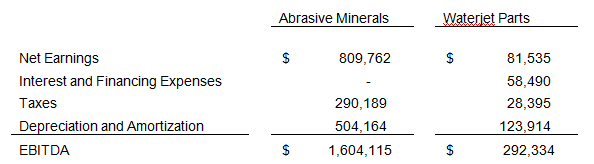
I generally prefer to rely on tangible asset values than estimates of future profitability when looking at an investment opportunity. In this case, WGI trades substantially below its book and liquidation values. However, it is also profitable. In 2009, WGI generated EBITDA of $1,896,449 as follows:


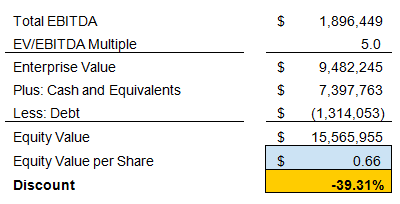
This implies an EV/EBITDA multiple of 1.8. Investors can argue about what an appropriate multiple is, but we would likely all agree that this multiple is too low. Applying an EV/EBITDA multiple of 5.0 (for the sake of conservatism), WGI’s equity value per share is $0.66/share (65% upside).


Catalyst

WGI has two large shareholders. Jaguar Financial Corporation owns 3,777,100 shares representing 16% of the outstanding shares (acquired at $0.35/share). Cinnamon Investments Limited owns 3,098,500 shares, representing 13.1% of the outstanding shares (a portion of these shares was acquired as recently as January 2010 at $0.41/share).

Jaguar is known in Canada as an activist investor and has launched a number of proxy contests and take-over bids to unlock value at Canadian companies. Jaguar recently successfully challenged the acquisition of Lundin Mining by Hudbay Minerals. In Q4 2009, Jaguar obtained a seat on WGI’s board and pushed for WGI to use a portion of it cash to repurchase shares, which it did in December 2009 (at a price of $0.395/share).

At WGI’s upcoming annual meeting, I would expect Jaguar and Cinnamon to vote against the confirmation of WGI’s shareholder rights plan. The plan was adopted after Jaguar announced its acquisition of shares but prior to the time Jaguar received a board seat. With 29.1% of WGI’s shares voting against the rights plan, there is a decent chance the rights plan will be defeated, allowing Jaguar to launch a take-over bid for WGI in order to put them in play (a tactic they use routinely). I would also expect Jaguar to push WGI to take additional value-enhancing actions, such as additional share buybacks, and for its patience to run out if such actions are not undertaken in the near term.

Risk

The principal risk I see in WGI relates to its Idaho mining operations. WGI’s disclosure indicates that the mineral resource at WGI’s operating mine in Idaho has been declining in recent years. Accordingly, WGI is undertaking exploration (and eventual development) of the lands contiguous to its current mine, which it believes contain additional garnet. A complete depletion of the existing garnet would negatively affect WGI as its Idaho mine currently contributes approximately 17% of revenues (although WGI increased the amount of garnet it receives annually from India last year, so this percentage should be lower now). Additionally, significant expenditures on exploration and development would reduce WGI’s cash on hand.

Conclusion

Given that WGI is a profitable and growing company, I would argue that WGI should trade at least at its book value (67-85% upside on a diluted/non-diluted basis) and we should look at its liquidation value to determine our downside protection (22-35% upside). On an EV/EBITDA basis, WGI should also trade at a minimum of $0.66/share, providing upside of at least 65%. In the case of an acquisition of each of WGI’s divisions, the upside could be even greater.

[Full Disclosure: I do not hold a position in WGI. This is neither a recommendation to buy or sell any securities. All information provided believed to be reliable and presented for information purposes only. Do your own research before investing in any security.]

Read Full Post »

Farukh Farooqi, long-time supporter of Greenbackd, founder of Marquis Research, a special situations research and advisory firm (for more on Farukh and his methodology see The Deal in the article “Scavenger Hunter”) and Greenbackd guest poster (see, for example, Silicon Storage Technology, Inc (NASDAQ:SSTI) and the SSTI archive here) has launched a blog, Oozing Alpha. Says Farukh:

Oozing Alpha is a place to share event driven and special situations with the institutional investment community.

We welcome and encourage you to submit your top ideas (farukh@marquisllc.com).

The only limitation we impose is that your recommendations should not be widely covered by the sell side and must not have an equity market capitalization greater than $1 billion.

The ideas will no doubt be up to Farukh’s usual high standards. The blog is off to a good start: the color scheme is very attractive.

Read Full Post »

In the Spring 1999 Piper Jaffray produced a research report called Wall Street’s Endangered Species by Daniel J. Donoghue, Michael R. Murphy and Mark Buckley, then at Piper Jaffray and now at Discovery Group, a firm founded by Donoghue and Murphy (see also Performance of Darwin’s Darlings). The premise of the report was that undervalued small capitalization stocks (those with a market capitalization between $50M and $250M) lacked a competitive auction for their shares and required the emergence of a catalyst in the form of a merger or buy-out to close the value gap.

In the first follow-up, Endangered species update: The extinct, the survivors, and the new watch list, from Summer 2000, Murphy and Buckley (Donoghue is not listed on the 2000 paper as an author) tested their original thesis and provided the “Darwin’s Darlings Class of 2000,” which was a list of what they viewed as “the most undervalued, yet profitable and growing small cap public companies” in 2000.

In the Fall of 2001, Donoghue, Murphy, Buckley and Danielle C. Kramer produced a further follow-up to the original report called Endangered Species 2001 (.pdf). Their thesis in the further follow up should be of particular interest to we value folk. Putting aside for one moment the purpose of the report (M&A research aimed at boards and management of Darwin’s darlings stocks to generate deal flow for the investment bank), it speaks to the very fertile environment for small capitalization value investing then in existence:

In the last few of years, many small public companies identified this [secular, small capitalization undervaluation] trend and agreed with the implications. Executives responded accordingly, and the number of strategic mergers and going-private transactions for small companies reached all-time highs. Shareholders of these companies were handsomely rewarded. The remaining companies, however, have watched their share prices stagnate.

Since the onset of the recent economic slowdown and the technology market correction, there has been much talk about a return to “value investing.” Many of our clients and industry contacts have even suggested that as investors search for more stable investments, they will uncover previously ignored small cap companies and these shareholders will finally be rewarded. We disagree and the data supports us:

Any recent increase in small-cap indices is misleading. Most of the smallest companies are still experiencing share price weakness and valuations continue to be well below their larger peers. We strongly believe that when the overall market rebounds, small-cap shareholders will experience significant underperformance unless their boards effect a change-of-control transaction.

In this report we review and refresh some of our original analyses from our previous publications. We also follow the actions and performance of companies that we identified over the past two years as some of the most attractive yet undervalued small-cap companies. Our findings confirm that companies that pursued a sale rewarded their shareholders with above-average returns, while the remaining companies continue to be largely ignored by the market. Finally, we conclude with our third annual list of the most attractive small-cap companies: Darwin’s Darlings Class of 2001.

Piper Jaffray’s data in support of their contention is as follows:

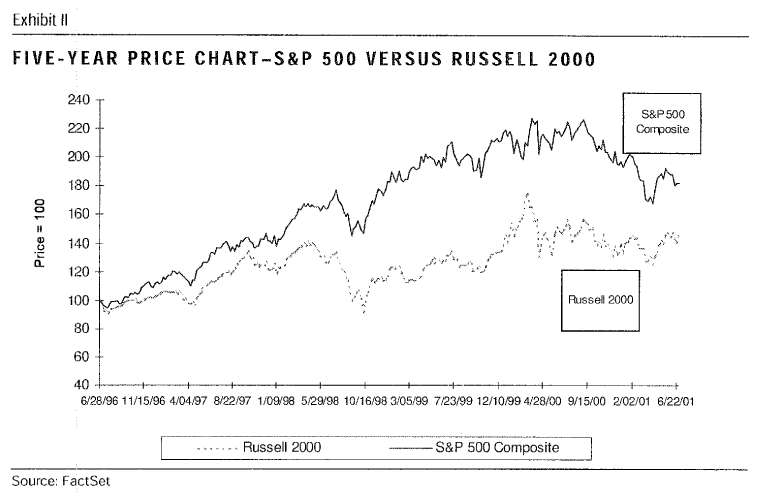
Looking back further than just the last 12 months, one finds that small-cap companies have severely lagged larger company indices for most periods. Exhibit II illustrates just how poorly the Russell 2000 compares to the S&P 500 during the longest bull market in history. In fact over the past five, seven and ten years, the Russell 2000 has underperformed the S&P 500. For the five, seven and 10 year periods, the S&P 500 rose 82.6 percent, 175.6 percent and 229.9 percent, respectively, while the Russell 2000 rose 47.9 percent, 113.4 percent, and 206.3 percent for the same periods.

The poor performance turned in by the Russell 2000 can be attributed to the share price performance of the smallest companies in the index. Our previous analysis has shown that the smallest companies in the index have generally underperformed the larger companies (see “Wall Streets Endangered Species,” Spring 1999). To understand the reasons for this differential, one must appreciate the breadth of the index. There is a tremendous gap in the market cap between the top 10 percent of the companies in the index, as ranked by market cap (“the first decile”) and the last 10 percent (“the bottom decile”). The median market capitalization of the first decile is $1.7 billion versus just $201.0 million for the bottom decile. There is almost an 8.0x difference between what can be considered a small cap company.

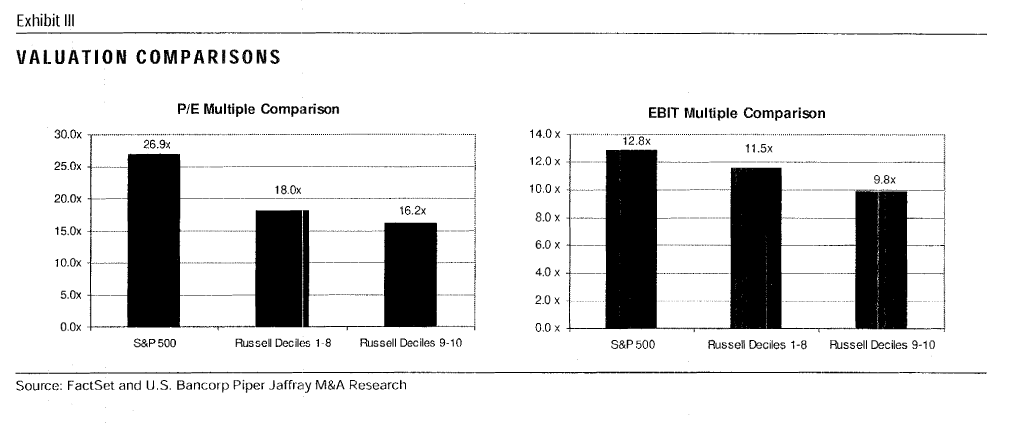
This distinction in size is important, because it is the smallest companies in the Russell 2000, and in the market as a whole, that have experienced the weakest share price performance and are the most undervalued. Exhibit III illustrates the valuation gap between the S&P 500 and the Russell 2000 indices. Even more noticeable is the discount experienced by the smallest companies. The bottom two deciles of the index are trading at nearly a 25 percent discount to the EBIT multiple of the S&P 500 and at nearly 40 percent below the PIE multiple on a trailing 12-month basis.

This valuation gap has been consistently present for the last several years, and we fully expect it to continue regardless of the direction of the overall market. This differential is being driven by a secular trend that is impacting the entire investing landscape. These changes are the result of:

• The increasing concentration of funds in the hands of institutional investors

• Institutional investors’ demand for companies with greater market capitalization and liquidity

• The shift by investment banks away from small cap-companies with respect to research coverage and trading

The authors concluded that the trends identified were “secular” and would continue, leading small capitalization stocks to face a future of chronic undervaluation:

Removing this discount and reviving shareholder value require a fundamental change in ownership structure. Equity must be transferred out of the hands of an unadoring and disinterested public and into those of either: 1) managers backed by private capital, or 2) larger companies that can capture strategic benefits. Either remedy breathes new life into these companies by providing cheaper sources of equity capital and shifting the focus away from quarterly EPS to long-term growth.

They recognized the implications for secular undervaluation which lead them to make an impressive early identification of the re-emergence of modern shareholder activism:

Unfortunately, many corporate executives continue to believe that if they stick to their business plan they will eventually be discovered by the financial community. Given the recent trends, this outcome is not likely. In fact, there is a growing trend toward shareholder activism to force these companies to seek strategic alternatives to unlock shareholder value. Corporate management is now facing a new peril – the dreaded proxy fight. Bouncing back from their lowest level in more than a decade, proxy fights have increased dramatically thus far in 2001 and are running at nearly twice the pace as they were last year, according to Institutional Shareholder Services. In fact, not since the late 1980s has there been such attention devoted to the shareholder activism movement.

As shown in our Darwin’s Darlings list in Exhibit XX, page 23, management ownership varies widely among the typical undervalued small cap. For those that were IPOs of family-held businesses, management stakes are generally high. In these instances in which a group effectively controls the company, there will be little noise from activist shareholders. However, companies with broad ownership (i.e., a spinoff from a larger parent) are more susceptible to unfriendly actions. In fact, widely held small caps frequently have blocks held by the growing number of small-cap investment funds focused on likely takeover targets.

Regardless of ownership structure, these companies typically have the customary defensive mechanisms in place. They are also protected because they are so thinly traded. In most cases it can take more than six months to accumulate a 5 percent position in the stock without impacting the share price. While we expect most of the successful acquisitions in this sector to be friendly, small-cap companies will have to increasingly worry about these unfriendly suitors.

There are several consistent factors that are driving the increased frustration among shareholders and, consequently, the increased pressure on Management and Boards. These factors include the aforementioned depressed share prices, lack of trading liquidity, and research coverage. But also included are bloated executive compensation packages that are not tied to share price performance and a feeling that corporate boards are staffed with management allies rather than independent-minded executives. Given the continuing malaise in the public markets, we believe this heightened proxy activity will continue into the foreseeable future. Companies with less than $250 million in market capitalization in low growth or cyclical markets are the most vulnerable to a potential proxy battle, particularly those companies whose shares are trading near their 52-week lows.

Here they describe what was a novelty at the time, but has since become the standard operating procedure for activist investors:

Given the growing acceptance of an aggressive strategy, we have noticed an increase in the number of groups willing to pursue a “non-friendly” investment strategy for small caps. Several funds have been formed to specifically identify a takeover target, invest significantly in the company, and force action by its own board. If an undervalued small cap chooses to ignore this possibility, it may soon find itself rushed into a defensive mode. Thwarting an unwanted takeover, answering to shareholders, and facing the distractions of the press may take precedence from the day-to-day actions of running the business.

So how did the companies perform? Here’s the chart:

Almost 90 percent of the 1999 class and about half of the 2000 class pursued some significant strategic alternative during the year. The results for the class of 1999 represent a two-year period so it is not surprising that this list generated significantly more activity than the 2000 list. This would indicate that we should see additional action from the class of 2000 in the coming year.

A significant percentage (23 percent of the total) pursued a sale or going-private transaction to provide immediate value to their shareholders. Others are attempting to “grow out of” their predicament by pursuing acquisitions and many are repurchasing shares. However, many of Darwin’s Darlings have yet to take any significant action. Presumably, these companies are ignoring their current share price and assuming that patient shareholders will eventually be rewarded through a reversal in institutional investing trends, or perhaps, in a liquidity event at some later date.

The actual activity was, in fact, even greater than our data suggests as there were many transactions that were announced but failed to be consummated, particularly in light of the current difficult financing market. Chase Industries, Lodgian, Mesaba Holdings, and Chromcraft Revington all had announced transactions fall through. In addition, a large number of companies announced a decision to evaluate strategic alternatives, including Royal Appliance, Coastcast, and Play by Play ‘Toys.

The authors make an interesting observation about the utility of buy-backs:

For many of Darwin’s Darlings and other small-cap companies, the share repurchase may still have been an astute move. While share price support may not be permanent, the ownership of the company was consolidated as a result of buying in shares. The remaining shareholders were, in effect, “accreted up” in their percentage ownership. When a future event occurs to unlock value, these shareholders will reap the benefits of the repurchase program. Furthermore, the Company may have accommodated sellers desiring to exit their investment, thereby eliminating potentially troublesome, dissenting shareholders. There are circumstances when a repurchase makes good sense, but it should not be considered a mechanism to permanently boost share prices.

Piper Jaffray’s Darwin’s Darlings Class of 2001, the third annual list of the most attractive small-cap companies, makes for compelling reading. Net net investors will recognize several of the names (for example, DITC, DRAM,  PMRY and VOXX) from Greenbackd and general lists of net nets in 2008 and 2009. It’s worth considering that these stocks were, in 2001, the most attractive small-capitalization firms identified by Piper Jaffray.

See the full Endangered Species 2001 (.pdf) report.

Read Full Post »

In March I highlighted an investment strategy I first read about in a Spring 1999 research report called Wall Street’s Endangered Species by Daniel J. Donoghue, Michael R. Murphy and Mark Buckley, then at Piper Jaffray and now at Discovery Group, a firm founded by Donoghue and Murphy (see also Performance of Darwin’s Darlings). The premise, simply stated, is to identify undervalued small capitalization stocks lacking a competitive auction for their shares where a catalyst in the form of a merger or buy-out might emerge to close the value gap. I believe the strategy is a natural extension for Greenbackd, and so I’ve been exploring it over the last month.

Donoghue, Murphy and Buckley followed up their initial Wall Street’s Endangered Species research report with two updates, which I recalled were each called “Endangered Species Update” and discussed the returns from the strategy. While I initially believed that those follow-up reports were lost to the sands of time, I’ve been excavating my hard-copy files and found them, yellowed, and printed on papyrus with a dot matrix 9-pin stylus. I’ve now resurrected both, and I’ll be running them today and tomorrow.

In the first follow-up, Endangered species update: The extinct, the survivors, and the new watch list (.pdf), from Summer 2000, Murphy and Buckley (Donoghue is not listed on the 2000 paper as an author) tested their original thesis and provided the “Darwin’s Darlings Class of 2000,” which was a list of what they viewed as “the most undervalued, yet profitable and growing small cap public companies” in 2000.

As for the original class of 1999, the authors concluded:

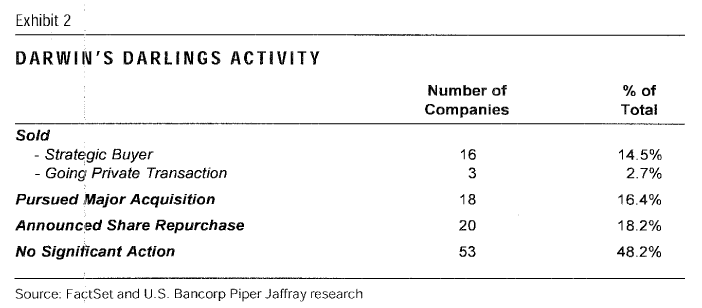
About half of the Darwin’s Darlings pursued some significant strategic alternative during the year. A significant percentage (19 of the companies) pursued a sale or going-private transaction to provide immediate value to their shareholders. Others are attempting to “grow out of” their predicament by pursuing acquisitions, and many are repurchasing shares. However, about half of the Darlings have yet to take any significant action. Presumably, these companies are ignoring their current share price and assuming that patient shareholders will eventually be rewarded through a reversal in institutional investing trends or, more likely, a liquidity event at some later date. The path chosen clearly had a significant impact on shareholder value.

Here’s the summary table:

There are several fascinating aspects to their analysis. First, they looked at the outstanding performance of the sellers:

The 19 companies that pursued a sale easily outperformed the Russell 2000 and achieved an average premium of 51.4% to their 4-week prior share price. The vast majority of transactions were sales to strategic buyers who were able to pay a handsome premium to the selling shareholders. In general, the acquirers were large cap public companies. By simply valuing the profits of a Darwin’s Darling at their own market multiple, these buyers delivered a valuation to selling shareholders that far exceeded any share price the company might have independently achieved. Note in the summary statistics below that the average deal was at an EBIT multiple greater than 10x.

Here’s the table:

Second, they considered the low proportion of sellers who went private, rather than sold out to a strategic acquirer, and likely causes:

Only three of the Darwin’s Darlings announced a going-private transaction. At first glance, this is a surprisingly small number given the group’s low trading multiples and ample debt capacity. With private equity firms expressing a very high level of interest in these transactions, one might have expected more activity.

Why isn’t the percentage higher? In our opinion, it is a mix of economic reality and an ironic impact of corporate governance requirements. The financial sponsors typically involved in taking a company private are constrained with respect to the price they can pay for a company. With limits on prudent debt levels and minimum hurdle rates for equity investments, the typical financial engineer quickly reaches a limit on the price he can pay for a company. As a result, several factors come into play:

• A Board will typically assume that if a “financial” buyer is willing to pay a certain price, a “strategic” buyer must exist that can pay more.

• Corporate governance rules are usually interpreted to mean that a Board must pursue the highest price possible if a transaction is being evaluated.

• Management is reluctant to initiate a going-private opportunity for fear of putting the Company “in play.”

• Financial buyers and management worry that an unwanted, strategic “interloper” can steal a transaction away from them when the Board fulfills its fiduciary duty.

In light of the final two considerations, which benefit only management, it’s not difficult to understand why activists considered this sector of the market ripe for picking, but I digress.

Third, they analyzed the performance of companies repurchasing shares:

To many of the Darwin’s Darlings, their undervaluation was perceived as a buying opportunity. Twenty companies announced a share repurchase, either through the open market, or through more formalized programs such as Dutch Auction tender offers (see our M&A Insights: “What About a Dutch Auction?” April 2000).

As we expected, these repurchases had little to no impact on the companies’ share prices. The signaling impact of their announcement was minimal, since few analysts or investors were listening, and the buying support to the share price was typically insignificant. Furthermore, the decrease in shares outstanding served only to exacerbate trading liquidity challenges. From announcement date to present, these 20 companies as a group have underperformed the Russell 2000 by 17.5%.

For many of the Darlings and other small cap companies the share repurchase may still have been an astute move. While share prices may not have increased, the ownership of the company was consolidated as a result of buying-in shares. ‘The remaining shareholders were, in effect, “accreted up” in their percentage ownership. When a future event occurs to unlock value, these shareholders should reap the benefit of the repurchase program. Furthermore, the Company may have accommodated sellers desiring to exit their investment, thereby eliminating potentially troublesome, dissenting shareholders.

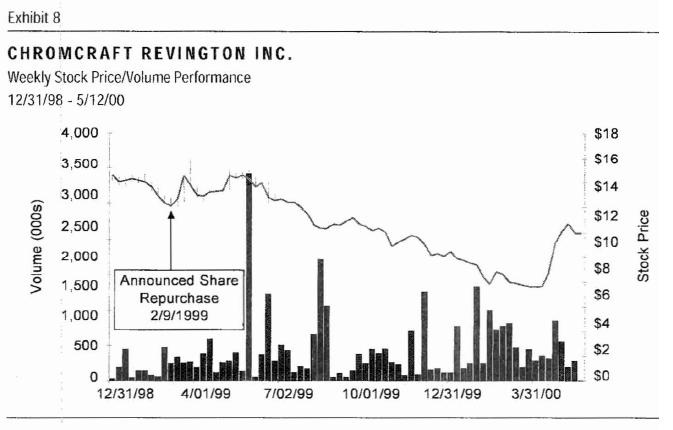
One such company repurchasing shares will be familiar to anyone who has followed Greenbackd for a while: Chromcraft Revington, Inc., (CRC:AMEX), which I entered as a sickly net net and exited right before it went up five-fold. (It’s worth noting that Jon Heller of Cheap Stocks got CRC right, buying just after I sold and making out like a bandit. I guess you can’t win ’em all.) Murphy and Buckley cite CRC as an abject lesson in why buy-backs don’t work for Darwin’s Darlings:

I’m not entirely sure that the broader conclusion is a fair one. Companies shouldn’t repurchase shares to goose share prices, but to enhance underlying intrinsic value in the hands of the remaining shareholders. That said, in CRC’s case, the fact that it went on to raise capital at a share price of ~$0.50 in 2009 probably means that their conclusion in CRC’s case was the correct one.

And what of the remainder:

About half of the Darwin’s Darlings stayed the course and did not announce any significant event over the past year. Another 18 sought and consummated an acquisition of some significant size. While surely these acquisitions had several strategic reasons, they were presumably pursued in part to help these companies grow out of their small cap valuation problems. Larger firms will, in theory, gain more recognition, additional liquidity, and higher valuations. However, for both the acquirers and the firms without any deal activity, the result was largely the same: little benefit for shareholders was provided.

Management teams and directors of many small cap companies have viewed the last few years as an aberration in the markets. “Interest in small caps will return” is a common refrain. We disagree, and our statistics prove us right thus far. Without a major change, we believe the shares of these companies will continue to meander. For the 53 Darwin’s Darlings that did not pursue any major activity in the last year, 80% are still below their 1998 high and 60% have underperformed the Russell 2000 over the last year. These are results, keep in mind, for some of the most attractive small cap firms.

This is the fabled “two-tier” market beloved by value investors. While everyone else was chasing dot coms and large caps, small cap companies with excellent fundamentals were lying around waiting to be snapped up. The authors concluded:

The public markets continue to ignore companies with a market capitalization below $250 million. Most institutional investors have large amounts of capital to invest and manage, and small caps have become problematic due to their lack of analyst coverage and minimal public float. As a result, these “orphans” of the public markets are valued at a significant discount to the remainder of the market. We do not see this trend reversing, and therefore recommend an active approach to the directors and management teams at most small cap companies. Without serious consideration of a sale to a strategic or financial buyer, we believe these companies, despite their sound operating performance, will not be able to deliver value to their shareholders.

Tomorrow, the 2001 Endangered species update.

Read Full Post »

The Wall Street Journal has an article, Activist Holders Eye Top Managers for Boards, discussing the trend for executives running public companies to switch to activist boardroom roles where they can oust executives who run other public companies:

To enhance their credibility in proxy fights, dissident investors increasingly put experienced corporate officials—including some former chief executives—on their board-seat slates, rather than simply propose relatively inexperienced managers from the activist firm. The tactic turns up the heat on the leaders of struggling businesses, and may increase dissidents’ board victories, sometimes resulting in the replacement of the CEO.

The “trend” is perhaps more in the telling than the numbers, but interesting nonetheless:

About 24% of 213 dissident nominees in 2009 contests had held top management roles at a public company, up from nearly 22% of 73 such candidates in 2004, reports data tracker FactSet SharkWatch.

The article focusses on John Mutch, the former CEO of Peregrine Systems Inc., who has “helped force out the heads of four small technology firms since 2006:”

“If I believe management is engaged in stupid, idiotic actions, I stand up and tell them so,” says Mr. Mutch. “In most cases, that means replacing the CEO.”

Most interesting for we net net folk was his involvement in the fight for Adaptec, Inc. (NASDAQ:ADPT), and the broader implications for activism in technology stocks:

Mr. Mutch says the experience convinced him that many high-tech companies “are undervalued, undermanaged and poorly governed.”

Mr. Mutch and Steel Partners launched a proxy battle for ADPT in 2007. Steel’s filings cited ADPT’s poor financial performance. Here’s the discussion in the reasons for the solicitation from the original proxy:

Given the Company’s poor track record, we believe that the Adaptec Board should not be trusted to assess acquisitions, growth investments, and product expansions while overseeing a restructuring plan.

Specifically, our concerns include the following:

· Adaptec’s operational performance has deteriorated under management and the Adaptec Board;

· Adaptec’s poor acquisition strategy and recent about-faces in strategic direction have resulted in further erosion to stockholder value;

· Adaptec’s stock performance has lagged indices and peers; and

· Adaptec has rewarded executive officers with excessive compensation packages and retention bonuses despite the Company’s poor performance.

ADPT agreed to put Mr. Mutch and Steel executives Jack Howard and John Quicke on its board ahead of the shareholder vote. The WSJ describes what happened next:

A contentious boardroom brawl occurred last August. Aristos Logic, which Adaptec acquired for $41 million in 2008, was generating less revenue growth than expected, Mr. Sundaresh informed analysts that month. Mr. Sundaresh proposed to fellow directors that they either sell the Aristos business or cut back investments severely to get costs under control, according to an attendee at the board meeting.

Mr. Mutch says he stood and attacked the CEO for switching strategy. “You sold us a bill of goods when you bought this company,” he recalls saying. “You’re not taking responsibility for this deal.” A shouting match erupted, with people “screaming at each other,” he adds.

Robert Loarie, another ally of Mr. Sundaresh, says Mr. Mutch unfairly accused the CEO of shirking his duties. Ex-director Joseph Kennedy says the dissidents also never grasped Adaptec’s strategy, and occasionally read newspapers during board discussions.

Mr. Mutch calls Mr. Kennedy’s and Mr. Loarie’s criticisms “incredulous.”

That same week, the split board replaced Mr. Howard as chairman. Steel won shareholders’ written approval to kick Messrs. Sundaresh and Loarie off the board last fall. The CEO soon resigned.

Mr. Mutch also joined activists to threaten proxy fights at Phoenix Technologies Ltd. (NASDAQ:PTEC), Aspyra, Inc (PINK:APYI) and Agilysys, Inc. (Public, NASDAQ:AGYS), and eventually got board seats at all three companies. Mr. Mutch says the CEOs in each case left during or soon after the possible contest. Perhaps a trend to watch.

Read Full Post »

The wonderful DShort.com blog has a post, Is the stock market cheap?, examining the S&P500 using Benjamin Graham’s P/E10 ratio. Doug Short describes the raison d’être of the Graham P/E10 ratio thus:

Legendary economist and value investor Benjamin Graham noticed the same bizarre P/E behavior during the Roaring Twenties and subsequent market crash. Graham collaborated with David Dodd to devise a more accurate way to calculate the market’s value, which they discussed in their 1934 classic book, Security Analysis. They attributed the illogical P/E ratios to temporary and sometimes extreme fluctuations in the business cycle. Their solution was to divide the price by the 10-year average of earnings, which we’ll call the P/E10. In recent years, Yale professor Robert Shiller, the author of Irrational Exuberance, has reintroduced the P/E10 to a wider audience of investors. …  The historic P/E10 average is 16.3.

Here’s the chart from DShort.com to April 1st:

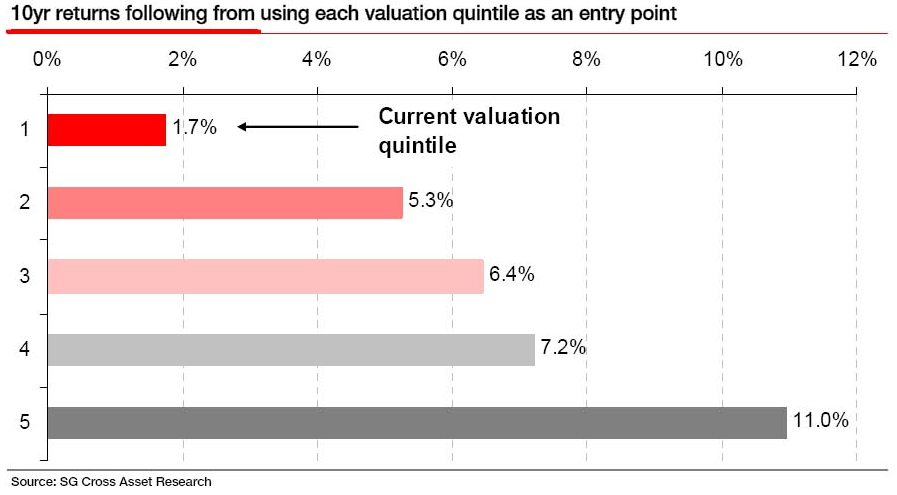
So what is the P/E10 ratio now saying about the market? In short, the market is expensive. The ratio has entered the most expensive quintile, which means it is more expensive than it has been 80% of the time. What are the implications for this? In his most recent Popular Delusions (via Zero Hedge), Dylan Grice has provided the following chart setting out the expected returns using each valuation quintile as an entry point:

Grice says:

If history is any guide, those investing today can expect a whopping 1.7% annualised return over the next ten years.

Doug Short has a more frightening conclusion:

A more cautionary observation is that every time the P/E10 has fallen from the first to the fourth quintile, it has ultimately declined to the fifth quintile and bottomed in single digits. Based on the latest 10-year earnings average, to reach a P/E10 in the high single digits would require an S&P 500 price decline below 540. Of course, a happier alternative would be for corporate earnings to make a strong and prolonged surge. When might we see the P/E10 bottom? These secular declines have ranged in length from over 19 years to as few as three. The current decline is now in its tenth year.

Or was March 2009 the beginning of a secular bull market? Perhaps, but the history of market valuations doesn’t encourage optimism.


Read Full Post »

Alfred Winslow Jones is generally regarded as the progenitor of the modern “hedge fund.” Jones’s strategy, to construct a portfolio 130% long and 30% short (known as “130/30”), seems pretty prosaic by today’s standards, but it was state-of-the-art when he established the partnership A. W. Jones & Co. in 1949. In the April 1966 Fortune article, The Jones Nobody Keeps Up With (.pdf), by Carol Loomis (the same Carol Loomis who edits Buffett’s Berkshire Hathaway shareholder letters), Loomis described Jones’s strategy thus:

[The] fund’s capital is both leveraged and “hedged.” The leverage arises from the fact that the fund margins itself to the hilt; the hedge is provided by short position – there are always some in the fund’s portfolio.

How did Jones’s “hedge” work?

In effect, the hedge concept puts Jones in a position to make money on both rising and falling stocks, and also partially shelters him if he misjudges the general trend of the market. He assumes that a prudent investor wants to protect part of his capital from such misjudgements. Most investors would build there defenses around cash reserves or bonds, but Jones protects himself by selling short.

And his strategy seemed to perform. Loomis reports that he was up 670 percent for the ten-year period to May 1965. Here’s Jones’s performance chart from the article (performance of a $100,000 investment net of fees):

Particularly interesting was Loomis’s assessment of Jones’s ability to predict the direction of the market:

Jones’s record in forecasting the direction of the market seems to have been only fair. In the early part of 1962 he had his investors in a high risk position of 140 [indicating Jones was unhedged 140% long]. As the market declined, he gradually increased his short position, but not as quickly as he should have. his losses that spring were heavy, and his investors ended up with a small loss for the fiscal year (this is the only losing year in Jones’s history). After the break, furthermore, he turned bearish and so did not at first benefit from the market’s recovery. Last year, as it happens, Jones remain quite bullish through the May-June decline, and then got bearish just about the time the big rally began. As prices rose in August, Jones actually moved to a minus 18 risk – i.e., his short positions exceeded his longs, with the unhedged short position amounting to 18 percent of partnership capital.

A perfect contrary indicator. Regardless, he seems to have generally been right when purchasing individual stocks:

Despite these miscalculations about the direction of the market, Jones’s selections of individual stocks have generally been brilliant.

Loomis credits someone else with the idea for the limited partnership structure and fee calculation adopted by Jones:

The idea is common to all the hedge funds, and the idea was not original with Jones. Benjamin Graham, for one, had once run a limited partnership along the same lines.

It’s hard to find a place in investment where Ben Graham hasn’t gone first.

Read Full Post »

I’ve exited the position in Forward Industries Inc (NASDAQ:FORD) at yesterday’s $3.23 close. I opened the position at $1.44 on July 20 last year. The stock is up 124.3% on an absolute basis and up 98% relative to the S&P500.

Post mortem

We started following FORD (see the post archive here) because it was trading at a discount to its net cash and liquidation values, although there was no obvious catalyst. Management appeared to be considering a “strategic transaction” of some kind, which might have included an “acquisition or some other combination.” At the time I said that I thought a better use of the cash on the balance sheet was a share buy-back or a dividend. Trinad Management had previously held an activist position in the stock, but had been selling at the time I opened the position and only one stockholder owned more than 5% of the stock. In late March LaGrange Capital Management filed a 13D notice for its position in Forward Industries Inc (NASDAQ:FORD) disclosing discussions with management regarding FORD’s “business and operations, financial performance, capital structure, governance, valuation, and future plans”. LaGrange is now the third largest shareholder with “just under 5% of all common shares.” At its $3.23 close yesterday, FORD has a market capitalization of $25.8M. My rough valuation pegs the Graham fire-sale liquidation value at around $20.0M or $2.50 per share. With the stock trading at a substantial 30% premium to that value and the business continuing to lose ground, I’m taking the money and running. More enterprising investors might want to hang around to see if LaGrange can squeeze some value out of a sale of the business.

The letter from LaGrange Capital Partners

LaGrange Capital Partners’ 13D notice with appended March 9 letter:

March 9, 2010

Mr. Douglas W. Sabra
Forward Industries Inc.
1801 Green Road, Suite E
Pompano Beach, FL 33064

Dear Doug,

Thank you and Jim for seeing me at the last minute. As we discussed, I am the General Partner at LaGrange Capital Partners Onshore, Offshore and Special Situations Yield Funds. LaGrange has been in business since 2000 and manages well over $100 million in assets. Our flagship fund has outperformed the S&P by approximately 7.6% per annum since inception.

LaGrange controls just under 5% of all common shares of Forward Industries, making us the third largest holder according to Bloomberg. To put it in perspective, we own approximately four times as many shares as the board (ex- Michael Schiffman), CEO and CFO combined. It is also worth noting that our shares were acquired for cash in the open market.

As a major investor, I am very concerned about the course of action presently being taken by this board and management team. To this end, I would like to discuss with you and the board of directors the company’s plans and LaGrange Capital’s desire for board representation as soon as possible.

Thank you for your time and consideration. I look forward to hearing from you, and can be reached at 212-993-7057.

Sincerely,

Grange Johnson

CC: John Chiste, Bruce Galloway, Fred Hamilton, Louis Lipschitz, Michael Schiffman

[Full Disclosure:  I do not have a holding in FORD. This is neither a recommendation to buy or sell any securities. All information provided believed to be reliable and presented for information purposes only. Do your own research before investing in any security.]

Read Full Post »

I am happy to announce that I have raised a modest amount of external seed capital for my maiden fund, which I have called Eyquem Global Value (“Eyquem” is Montaigne’s last name). The fund started trading on 1 April, but I didn’t announce it then for the obvious reason. The fund will be pursuing a deep value investment strategy with a focus on capital preservation. Often this will mean the fund is invested in special situations like liquidations, turnarounds and activist and private equity targets, but I’m not limiting the fund to that universe; I’m prepared to invest anywhere I can find overwhelming value at a good price.

Greenbackd will continue in its present format.

Update: Thank you all for the kind comments and emails.

Read Full Post »

Here are the top 10 posts for the last quarter by unique visitors:

  1. The palaeontology of Mike Burry
  2. Guest post: The short case for Berkshire
  3. Intuition and the quantitative value investor
  4. Japanese liquidation value: 1932 US redux
  5. What Montier’s Painting by Numbers can offer to value investors
  6. Seth Klarman’s Twenty Investment Lessons of 2008
  7. Quantifying qualitative factors
  8. Hunting endangered species
  9. Mean reversion in earnings
  10. The Kabuki narrative

Happy Easter. See you back here Tuesday.

Read Full Post »

« Newer Posts - Older Posts »