Feeds:
Posts
Comments

Archive for March, 2010

Dr. Michael Burry has received a great deal of well-deserved attention recently as a result of Michael Lewis’s The Big Short and the Vanity Fair article Betting on the Blind Side. Yesterday a reader provided a link to Burry’s techstocks.com “Value Investing” thread (now Silicon Investor) and today another reader has supplied a link to Burry’s Scion Capital investor letters. The site also sets out a time-line of Burry’s commentary on the financial crisis illustrating that, though it was not prevented, it was “eminently predictable and preventable”.

Burry is a superb writer. Here is a brief extract from the first quarter 2001 letter:

When I stand on my special-issue “Intelligent Investor” ladder and peer out over the frenzied crowd, I see very few others doing the same. Many stocks remain overvalued, and speculative excess – both on the upside and on the downside – is embedded in the frenzy around stocks of all stripes. And yes, I am talking about March 2001, not March 2000.

In essence, the stock market represents three separate categories of business. They are, adjusted for inflation, those with shrinking intrinsic value, those with approximately stable intrinsic value, and those with steadily growing intrinsic value. The preference, always, would be to buy a long-term franchise at a substantial discount from growing intrinsic value.

However, if one has been playing the buy-and-hold game with quality securities, one has been exposed to a substantial amount of market risk because the valuations placed on these securities have implied overly rosy scenarios prone to popular revision in times of more realistic expectation. This is one of those times, but it is my feeling that the revisions have not been severe enough, the expectations not yet realistic enough. Hence, the world’s best companies largely remain overpriced in the marketplace.

The bulk of the opportunities remain in undervalued, smaller, more illiquid situations that often represent average or slightly above-average businesses – these stocks, having largely missed out on the speculative ride up, have nevertheless frequently been pushed down to absurd levels owing to their illiquidity during a general market panic. I will not label this Fund a “small cap” fund, for this may not be where the best opportunities are next month or next year. For now, though, the Fund is biased toward smaller capitalization stocks. As for the future, I can only say the Fund will always be biased to where the value is. If recent trends continue, it would not be surprising to find the stocks of several larger capitalization stocks with significant long-term franchises meet value criteria and hence become eligible for potential addition to the Fund.


Buy my book The Acquirer’s Multiple: How the Billionaire Contrarians of Deep Value Beat the Market from on Kindlepaperback, and Audible.

Here’s your book for the fall if you’re on global Wall Street. Tobias Carlisle has hit a home run deep over left field. It’s an incredibly smart, dense, 213 pages on how to not lose money in the market. It’s your Autumn smart read. –Tom Keene, Bloomberg’s Editor-At-Large, Bloomberg Surveillance, September 9, 2014.

Click here if you’d like to read more on The Acquirer’s Multiple, or connect with me on Twitter, LinkedIn or Facebook. Check out the best deep value stocks in the largest 1000 names for free on the deep value stock screener at The Acquirer’s Multiple®.

Read Full Post »

Yesterday I ran a post on Dr. Michael Burry, the value investor who was one of the first, if not the first, to figure out how to short sub-prime mortgage bonds in his fund, Scion Capital. In The Big Short, Michael Lewis discusses Burry’s entry into value investing:

Late one night in November 1996, while on a cardiology rotation at Saint Thomas Hospital, in Nashville, Tennessee, he logged on to a hospital computer and went to a message board called techstocks.com. There he created a thread called “value investing.” Having read everything there was to read about investing, he decided to learn a bit more about “investing in the real world.” A mania for Internet stocks gripped the market. A site for the Silicon Valley investor, circa 1996, was not a natural home for a sober-minded value investor. Still, many came, all with opinions. A few people grumbled about the very idea of a doctor having anything useful to say about investments, but over time he came to dominate the discussion. Dr. Mike Burry—as he always signed himself—sensed that other people on the thread were taking his advice and making money with it.

Michael Burry’s blog, http://www.valuestocks.net, seems to be lost to the sands of time, but Burry’s techstocks.com “Value Investing” thread (now Silicon Investor) still exists. The original post in the thread hints at the content to come:

Started: 11/16/1996 11:01:00 PM

Ok, how about a value investing thread?

What we are looking for are value plays. Obscene value plays. In the Graham tradition.

This week’s Barron’s lists a tech stock named Premenos, which trades at 9 and has 5 1/2 bucks in cash. The business is valued at 3 1/2, and it has a lot of potential. Interesting.

We want to stay away from the obscenely high PE’s and look at net working capital models, etc. Schooling in the art of fundamental analysis is also appropriate here.

Good luck to all. Hope this thread survives.

Mike

Hat tip Toby.

Read Full Post »

The superb Manual of Ideas blog has an article by Ravi Nagarajan, Marty Whitman Reflects on Value Investing and Net-Nets, on legendary value investor Marty Whitman’s conversation with Columbia Professor Bruce Greenwald at the Columbia Investment Management Conference in New York. I have in the past discussed Marty Whitman’s adjustments to Graham’s net net formula, which I find endlessly useful. Whitman has some additional insights that I believe are particularly useful to net net investors:

“Cheap is Not Sufficient”

At several points in the discussion with Prof. Greenwald, Mr. Whitman came back to a central theme:  It is not sufficient for a security to be “cheap”.  It must also possess a margin of safety as demonstrated by a strong balance sheet and overall credit worthiness.   In other words, there are many securities that may appear cheap statistically based on a number of common criteria investors use to judge “cheapness”.  This might include current year earnings compared to the stock price, current year cash flow, and many others.  However, if the business does not have a durable balance sheet, adverse situations that are either of the company’s own making or due to macroeconomic factors can determine the ultimate fate of the company.  A durable balance sheet demonstrates the credit worthiness a business needs to manage through periodic adversity.

Whitman also discusses an issue near and dear to my heart: good corporate governance, and, by implication, activism:

One other point that Mr. Whitman made while discussing corporate governance also applies to many net-net situations.  The true value of a company may never come out if there is no threat of a change in control.  This obviously makes intuitive sense because the presence of a very cheap company alone will not result in realization of value unless management is willing to act in the interests of shareholders either by liquidating a business that has no future prospects but a very liquid balance sheet or taking steps to improve the business.

Read the balance of the article at The Manual of Ideas blog.

Read Full Post »

Michael Burry is a value investor notable for being one of the first, if not the first, to short sub-prime mortgage bonds in his fund, Scion Capital. He figures prominently in the Gregory Zuckerman’s book, The Greatest Trade Ever, and also in The Big Short, Michael Lewis’s contribution to the sub-prime mortgage bond market crash canon. In Betting on the Blind Side, Lewis excerpts The Big Short, which describes Burry’s short position in some detail, how he figured out that the bonds were mispriced, and how he bet against them (no small effort because the derivatives to do so didn’t exist when he started looking for them. He had to “prod the big Wall Street firms to create them.”).

Here Lewis describes Burry’s entry into value investing:

Late one night in November 1996, while on a cardiology rotation at Saint Thomas Hospital, in Nashville, Tennessee, he logged on to a hospital computer and went to a message board called techstocks.com. There he created a thread called “value investing.” Having read everything there was to read about investing, he decided to learn a bit more about “investing in the real world.” A mania for Internet stocks gripped the market. A site for the Silicon Valley investor, circa 1996, was not a natural home for a sober-minded value investor. Still, many came, all with opinions. A few people grumbled about the very idea of a doctor having anything useful to say about investments, but over time he came to dominate the discussion. Dr. Mike Burry—as he always signed himself—sensed that other people on the thread were taking his advice and making money with it.

Once he figured out he had nothing more to learn from the crowd on his thread, he quit it to create what later would be called a blog but at the time was just a weird form of communication. He was working 16-hour shifts at the hospital, confining his blogging mainly to the hours between midnight and three in the morning. On his blog he posted his stock-market trades and his arguments for making the trades. People found him. As a money manager at a big Philadelphia value fund said, “The first thing I wondered was: When is he doing this? The guy was a medical intern. I only saw the nonmedical part of his day, and it was simply awesome. He’s showing people his trades. And people are following it in real time. He’s doing value investing—in the middle of the dot-com bubble. He’s buying value stocks, which is what we’re doing. But we’re losing money. We’re losing clients. All of a sudden he goes on this tear. He’s up 50 percent. It’s uncanny. He’s uncanny. And we’re not the only ones watching it.”

Mike Burry couldn’t see exactly who was following his financial moves, but he could tell which domains they came from. In the beginning his readers came from EarthLink and AOL. Just random individuals. Pretty soon, however, they weren’t. People were coming to his site from mutual funds like Fidelity and big Wall Street investment banks like Morgan Stanley. One day he lit into Vanguard’s index funds and almost instantly received a cease-and-desist letter from Vanguard’s attorneys. Burry suspected that serious investors might even be acting on his blog posts, but he had no clear idea who they might be. “The market found him,” says the Philadelphia mutual-fund manager. “He was recognizing patterns no one else was seeing.”

Lewis discusses Burry’s perspective on value investing:

“The late 90s almost forced me to identify myself as a value investor, because I thought what everybody else was doing was insane,” he said. Formalized as an approach to financial markets during the Great Depression by Benjamin Graham, “value investing” required a tireless search for companies so unfashionable or misunderstood that they could be bought for less than their liquidation value. In its simplest form, value investing was a formula, but it had morphed into other things—one of them was whatever Warren Buffett, Benjamin Graham’s student and the most famous value investor, happened to be doing with his money.

Burry did not think investing could be reduced to a formula or learned from any one role model. The more he studied Buffett, the less he thought Buffett could be copied. Indeed, the lesson of Buffett was: To succeed in a spectacular fashion you had to be spectacularly unusual. “If you are going to be a great investor, you have to fit the style to who you are,” Burry said. “At one point I recognized that Warren Buffett, though he had every advantage in learning from Ben Graham, did not copy Ben Graham, but rather set out on his own path, and ran money his way, by his own rules.… I also immediately internalized the idea that no school could teach someone how to be a great investor. If it were true, it’d be the most popular school in the world, with an impossibly high tuition. So it must not be true.”

Investing was something you had to learn how to do on your own, in your own peculiar way. Burry had no real money to invest, but he nevertheless dragged his obsession along with him through high school, college, and medical school. He’d reached Stanford Hospital without ever taking a class in finance or accounting, let alone working for any Wall Street firm. He had maybe $40,000 in cash, against $145,000 in student loans. He had spent the previous four years working medical-student hours. Nevertheless, he had found time to make himself a financial expert of sorts. “Time is a variable continuum,” he wrote to one of his e-mail friends one Sunday morning in 1999: “An afternoon can fly by or it can take 5 hours. Like you probably do, I productively fill the gaps that most people leave as dead time. My drive to be productive probably cost me my first marriage and a few days ago almost cost me my fiancée. Before I went to college the military had this ‘we do more before 9am than most people do all day’ and I used to think I do more than the military. As you know there are some select people that just find a drive in certain activities that supersedes everything else.” Thinking himself different, he didn’t find what happened to him when he collided with Wall Street nearly as bizarre as it was.

And I love this story about his fund:

In Dr. Mike Burry’s first year in business, he grappled briefly with the social dimension of running money. “Generally you don’t raise any money unless you have a good meeting with people,” he said, “and generally I don’t want to be around people. And people who are with me generally figure that out.” When he spoke to people in the flesh, he could never tell what had put them off, his message or his person. Buffett had had trouble with people, too, in his youth. He’d used a Dale Carnegie course to learn how to interact more profitably with his fellow human beings. Mike Burry came of age in a different money culture. The Internet had displaced Dale Carnegie. He didn’t need to meet people. He could explain himself online and wait for investors to find him. He could write up his elaborate thoughts and wait for people to read them and wire him their money to handle. “Buffett was too popular for me,” said Burry. “I won’t ever be a kindly grandfather figure.”

This method of attracting funds suited Mike Burry. More to the point, it worked. He’d started Scion Capital with a bit more than a million dollars—the money from his mother and brothers and his own million, after tax. Right from the start, Scion Capital was madly, almost comically successful. In his first full year, 2001, the S&P 500 fell 11.88 percent. Scion was up 55 percent. The next year, the S&P 500 fell again, by 22.1 percent, and yet Scion was up again: 16 percent. The next year, 2003, the stock market finally turned around and rose 28.69 percent, but Mike Burry beat it again—his investments rose by 50 percent. By the end of 2004, Mike Burry was managing $600 million and turning money away. “If he’d run his fund to maximize the amount he had under management, he’d have been running many, many billions of dollars,” says a New York hedge-fund manager who watched Burry’s performance with growing incredulity. “He designed Scion so it was bad for business but good for investing.”

Thus when Mike Burry went into business he disapproved of the typical hedge-fund manager’s deal. Taking 2 percent of assets off the top, as most did, meant the hedge-fund manager got paid simply for amassing vast amounts of other people’s money. Scion Capital charged investors only its actual expenses—which typically ran well below 1 percent of the assets. To make the first nickel for himself, he had to make investors’ money grow. “Think about the genesis of Scion,” says one of his early investors. “The guy has no money and he chooses to forgo a fee that any other hedge fund takes for granted. It was unheard of.”

Hat tip Bo.

Read Full Post »
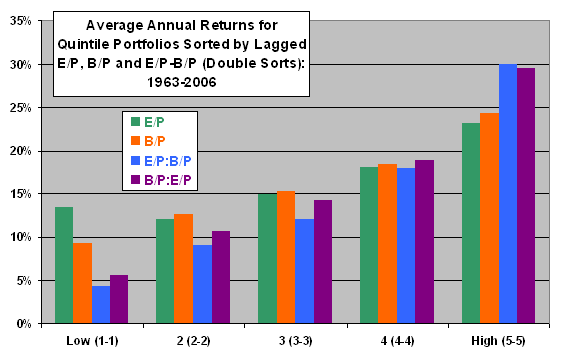
As I’ve discussed in the past, P/B and P/E are demonstratively useful as predictors of future stock returns, and more so when combined (see, for example, LSV’s Two-Dimensional Classifications). As Josef Lakonishok, Andrei Shleifer, and Robert Vishny showed in Contrarian Investment, Extrapolation, and Risk, within the set of firms whose B/M ratios are the highest (in other words, the lowest price-to-book value), further sorting on the basis of another value variable – whether it be C/P, E/P or low GS – enhances returns. In that paper, LSV concluded that value strategies based jointly on past performance and expected future performance produce higher returns than “more ad hoc strategies such as that based exclusively on the B/M ratio.” A new paper further discusses the relationship between E/P and B/P from an accounting perspective, and the degree to which E/P and B/P together predict stock returns.

The CXO Advisory Group Blog, fast becoming one of my favorite sites for new investment research, has a new post, Combining E/P and B/P, on a December 2009 paper titled “Returns to Buying Earnings and Book Value: Accounting for Growth and Risk” by Francesco Reggiani and Stephen Penman. Penman and Reggiani looked at the relationship between E/P and B/P from an accounting perspective:

This paper brings an accounting perspective to the issue: earnings and book values are accounting numbers so, if the two ratios indicate risk and return, it might have something to do with accounting principles for measuring earnings and book value.

Indeed, an accounting principle connects earnings and book value to risk: under uncertainty, accounting defers the recognition of earnings until the uncertainty has largely been resolved. The deferral of earnings to the future reduces book value, reduces short-term earnings relative to book value, and increases expected long-term earnings growth.

CXO summarize the authors’ methodology and findings as follows:

Using monthly stock return and firm financial data for a broad sample of U.S. stocks spanning 1963-2006 (153,858 firm-years over 44 years), they find that:

  • E/P predicts stock returns, consistent with the idea that it measures risk to short-term earnings.
  • B/P predicts stock returns, consistent with the idea that it measures accounting deferral of risky earnings and therefore risk to both short-term and long-term earnings. This perspective disrupts the traditional value-growth paradigm by associating expected earnings growth with high B/P.
  • For a given E/P, B/P therefore predicts incremental return associated with expected earnings growth. A joint sort on E/P and B/P discovers this incremental return and therefore generates higher returns than a sort on E/P alone, attributable to additional risk (see the chart below).
  • Results are somewhat stronger for the 1963-1984 subperiod than for the 1985-2006 subperiod.
  • Results using consensus analyst forecasts rather than lagged earnings to calculate E/P over the 1977-2006 subperiod are similar, but not as strong.

CXO set out Penman and Reggiani’s “core results” in the following table (constructed by CXO from Penman and Reggiani’s results):

The following chart, constructed from data in the paper, compares average annual returns for four sets of quintile portfolios over the entire 1963-2006 sample period, as follows:

  • “E/P” sorts on lagged earnings yield.
  • “B/P” sorts on lagged book-to-price ratio.
  • “E/P:B/P” sorts first on E/P and then sorts each E/P quintile on B/P. Reported returns are for the nth B/P quintile within the nth E/P quintile (n-n).
  • “B/P:E/P” sorts first on B/P and then sorts each B/P quintile on E/P. Reported returns are for the nth E/P quintile within the nth B/P quintile (n-n).

Start dates for return calculations are three months after fiscal year ends (when annual financial reports should be available). The holding period is 12 months. Results show that double sorts generally enhance performance discrimination among stocks. E/P measures risk to short-term earnings and therefore short-term earnings growth. B/P measures risk to short-term earnings and earnings growth and therefore incremental earnings growth. The incremental return for B/P is most striking in low E/P quintile.

The paper also discusses in some detail a phenomenon that I find deeply fascinating, mean reversion in earnings predicted by low price-to-book values:

Research (in Fama and French 1992, for example) shows that book-to-price (B/P) also predicts stock returns, so consistently so that Fama and French (1993 and 1996) have built an asset pricing model based on the observation. The same discussion of rational pricing versus market inefficiency ensues but, despite extensive modeling (and numerous conjectures), the phenomenon remains a mystery. The mystery deepens when it is said that B/P is inversely related to earnings growth while positively related to returns; low B/P stocks (referred to as “growth” stocks) yield lower returns than high B/P stocks (“value” stocks). Yet investment professionals typically think of growth as risky, requiring higher returns, consistent with the risk-return notion that one cannot buy more earnings (growth) without additional risk.

(emphasis mine)

The paper adds further weight to the predictive ability of low price-to-book value and low price-to-earnings ratios. Its conclusion that book-to-price indicates expected returns associated with expected earnings growth is particularly interesting, and accords with the same findings in Werner F.M. DeBondt and Richard H. Thaler in Further Evidence on Investor Overreaction and Stock Market Seasonality.

Read Full Post »

« Newer Posts