This site is dedicated to undervalued asset situations, but I haven’t yet spent much time on undervalued asset situations other than liquidations and Graham net current asset value stocks. Two areas worthy of further study are low price-to-book value stocks and low price-to-tangible book value stocks. I’ve found that it is difficult to impossible to find any research examining the performance of stocks selected on the basis of price-to-tangible book value. That may be because book value alone can explain most of the performance and removing goodwill and intangibles from the calculation adds very little. Tangible book value is of interest to me because I assume it more closely describes the likely value of a company in liquidation than book value does. That assumption may be wrong. Some intangibles have value in liquidation, although it’s always difficult to collect on the goodwill. If anyone knows of any study explicitly examining the performance of stocks selected on the basis of price-to-tangible book value, please shoot me an email at greenbackd at gmail or leave a comment in this post.
Book value has received plenty of attention from researchers in academia and industry, starting with Roger Ibbotson’s Decile Portfolios of the New York Stock Exchange, 1967 – 1984 (1986) and Werner F.M. DeBondt and Richard H. Thaler’s Further Evidence on Investor Overreaction and Stock Market Seasonality (1987). In Value vs Glamour: A Global Phenomenon, The Brandes Institute updated the landmark 1994 study by Josef Lakonishok, Andrei Shleifer, and Robert Vishny Contrarian Investment, Extrapolation and Risk. All of these studies looked at the performance of stocks selected on the basis of price-to-book value (among other value metrics). The findings are uniform: lower price-to-book value stocks tend to outperform higher price-to-book value stocks, and at lower risk. On the strength of the findings in these various studies I’ve decided to run a handful of real-time tests to see how a portfolio constructed of the cheapest stocks determined on a price-to-book value basis performs against the market.
Constructing a 30-stock portfolio
The Ibbotson, LSV and Brandes Institute studies created decile portfolios and Thaler and DeBont created quintile portfolios. I propose to informally test the P/B method at the extreme, taking the cheapest 30 stocks in the Google Finance screener (I use the Google Finance screener because it’s publicly available and easily replicable) and creating an equally weighted portfolio. Here is the list of stocks generated as at the November 20, 2009 close:
| Symbol | Market cap | Price to book | Last price | P/E ratio | Book value/share |
| TOPS | 33.97M | 0.11 | 1.15 | 0.92 | 9.77 |
| CEP | 76.78M | 0.15 | 3.38 | 4.76 | 23.23 |
| SVLF | 28.99M | 0.17 | 0.76 | 2.48 | 5.09 |
| BXG | 77.47M | 0.23 | 2.38 | 33.81 | 12.24 |
| SGMA | 13.46M | 0.29 | 3.52 | 14.12 | 11.88 |
| KRG | 190.16M | 0.3 | 3.02 | 28.97 | 10.3 |
| BDR | 5.88M | 0.31 | 0.95 | 9.99 | 3.14 |
| FREE | 34.30M | 0.31 | 1.62 | 1.61 | 5.71 |
| IOT | 22.51M | 0.32 | 5.4 | 3.75 | 16.98 |
| WPCS | 20.69M | 0.35 | 2.98 | 16.61 | 8.53 |
| SSY | 8.71M | 0.35 | 1.83 | 14 | 5.19 |
| CUO | 19.18M | 0.36 | 12 | 7.81 | 32.93 |
| ONAV | 73.53M | 0.37 | 3.84 | 6.83 | 10.87 |
| SBLK | 202.11M | 0.37 | 3.46 | 1.93 | 9.59 |
| CHMP | 17.68M | 0.38 | 1.77 | 6.64 | 5.19 |
| XFN | 17.64M | 0.39 | 0.96 | 5.22 | 2.34 |
| HTX | 966.12M | 0.39 | 3.01 | 29.92 | 7.68 |
| KV.A | 178.31M | 0.4 | 3.57 | 2.18 | 9.27 |
| ULTR | 144.94M | 0.4 | 4.91 | 4.75 | 12.6 |
| MDTH | 145.35M | 0.42 | 7.4 | 30.63 | 18.86 |
| HAST | 42.70M | 0.43 | 4.42 | 23.92 | 10.45 |
| TBSI | 255.08M | 0.44 | 8.53 | 4.67 | 20.01 |
| GASS | 129.40M | 0.44 | 5.8 | 6.51 | 14.25 |
| CONN | 145.52M | 0.44 | 6.48 | 6.88 | 14.89 |
| BBEP | 596.46M | 0.44 | 11.3 | 3.39 | 25.7 |
| CBR | 230.18M | 0.45 | 3.31 | 11.57 | 7.53 |
| PRGN | 222.19M | 0.48 | 5.15 | 2.29 | 11.37 |
| EROC | 352.29M | 0.48 | 4.59 | 1.25 | 9.76 |
| JTX | 119.45M | 0.5 | 4.15 | 6.55 | 8.47 |
| INOC | 23.93M | 0.5 | 1.94 | 5.68 | 3.77 |
For the sake of comparison the S&P500 closed Friday at 1,091.38.
Perhaps one of the most striking findings in the various studies discussed above was made by DeBondt and Thaler. They examined the earnings pattern of the cheapest companies (ranked on the basis of price-to-book) to the most expensive companies. They found that the earnings of the cheaper companies grew faster than the earnings of the more expensive companies over the period of the study. DeBondt and Thaler attribute the earnings outperformanceof the cheaper companies to the phenomenon of “mean reversion,” which Tweedy Browne describe as the observation that “significant declines in earnings are followed by significant earnings increases, and that significant earnings increases are followed by slower rates of increase or declines.” I’m interested to see whether this phenomenon will be observable in the 30 company portfolio listed above.
It seems counterintuitive that a portfolio constructed using a single, simple metric (in this case, price-to-book) should outperform the market. The fact that the various studies discussed above have reached uniform conclusions leads me to believe that this phenomenon is real. The companies listed above are a diverse group in terms of market capitalization, earnings, debt loads and businesses/industries. The only factor uniting the stocks in the list above is that they are the cheapest 30 stocks in the Google Finance screener on the basis of price-to-book value. I look forward to seeing how they perform against the market, represented by the S&P500 index.
Update
Here’s the Tickerspy portfolio tracker for the Greenbackd Contrarian Value Portfolio.
[Full Disclosure: No positions. This is neither a recommendation to buy or sell any securities. All information provided believed to be reliable and presented for information purposes only. Do your own research before investing in any security.]
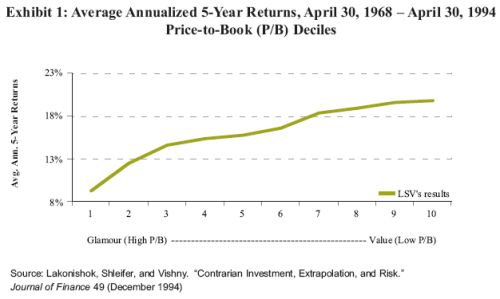
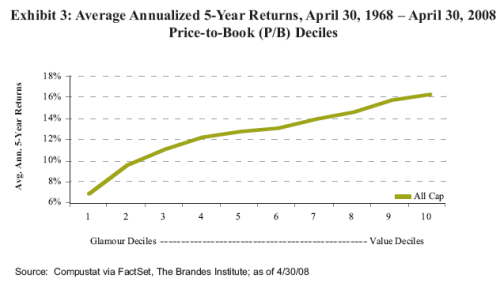
 The paper concludes that the value premium persists for the world’s developed markets in aggregate, and on an individual coutry basis. We believe it is more compelling evidence for value based investment, and, in particular, asset based value investment.

 Greenbackd