Feeds:
Posts
Comments

Posts Tagged ‘Avigen Inc (NASDAQ:AVGN)’

The Official Activist Investing Blog has published its list of activist investments for December (the investments with links are to our latest update at the time of this post):

Ticker Company Name Activist Investor
ACLS Axcelis Technologies Inc Sterling Capital
AEPI AEP Industries KSA Capital
ARS Arris Group Shamrock Activist Value fund
ATML Atmel Corp. Microchip Technology
AVGN Avigen Inc Biotechnology Value Fund
BCSB BCSB Bancorp Financial Edge Fund
BIOD Biodel Inc Moab Partners
CAMD California Micro Devices Corp Dialectic Capital Management
CKEC Carmike Cinemas Mark Cuban
CPWM Cost Plus Stephens Investment Management
CRXX CombinatoRX, Incorporated Biotechnology Value Fund
CTO Consolidated Tomoka Land Co Wintergreen Advisers
DANKY Danka Business Systems PLC DCML LLC
DDS Dillard’s Inc. Barington Capital; Clinton Group
DIN DineEquity Inc Southeastern Asset Management
DPS Dr Pepper Snapple Group Trian Fund
DUSA DUSA Pharmaceuticals SRB Management
DVD Dover Motorsports GAMCO
ESIO Electro Scientific Industries Nieremberg Investment Management
FIC Fair Isaac Corp Sandell Asset Management
FSFG First Savings Financial Group Joseph Stilwell
GGP General Growth Properties Pershing Square Capital
GLOB.OB Global Med Technologies Victory Park Capital
HIFN Hifn, Inc Adaptec, Inc
ICGN ICAgen, Inc Xmark Opportunity Partners
INFS InFocus Corp Nery Capital Partners
ITP Intertape Polymer Group KSA Capital Management
JAVA Sun Microsystems Southeastern Asset Management
JTX Jackson Hewitt Tax Service Shamrock
KANA.OB Kana Software KVO Capital Management
KFS Kingsway Financial Services Joseph Stilwell
KONA Kona Grill Mill Road Capital
LAQ The Latin America Equity Fund City of London Investment Management Co
LCAV LCA-Vision Inc. Stephen Joffe
MAG Magnetek Inc Riley Investment Management
MATH.PK Mathstar, Inc Salvatore Muoio; Zannet Opportunity Fund
MGAM Multimedia Games Dolphin Limited Partnership
MGLN Magellan Health Services Shamrock
MOVE Move Inc. Nierenberg Investment Management
MVCO Meadow Valley Corp Carpe Diem Capital
NDD Neuberger Berman Dividend Advantage Fund Western Investment
NTMD Nitromed Inc Deerfield Capital
OFIX Orthofix International Ramius Capital;
OPTV OpenTV Corp. Discovery Equity Partners
ORNG Orange 21 Costa Brava Partnership
PHMD PhotoMedex, Inc. James Sight
PIF Insured Municipal Income Fund Bulldog Investors
PPCO PenWest Pharmaceuticals Perceptive Advisors
PRXI Premier Exhibitions, Inc Sellers Capital
RDC Rowan Companies Steel Partners
RHIE RHI Entertainment Baupost Group
RIVR River Valley Bancorp Davee Thomas
SLRY Salary.com Cannell Capital
SLTC Selectica, Inc Versata
SUG Southern Union Co Sandell Asset Management
SUTM.OB Sun-Times Media Group Inc. K Capital
TIER Tier Technologies Inc Discovery Equity Partners
TLGD Tollgrade Communications Inc Bradford Capital
TMI TM Entertainment & Media Bulldog Investors
TRGL Toreador Resources Nanes Delorme Partners
TRMA Trico Marine Kistefos AS
TXCC TranSwitch Corp Brener International Group
TXI Texas Industries Southeastern Asset Management
WBSN Websense Inc Shamrock
WEDC White Electronic Designs Corp Wynnefield Capital
WOC Wilshire Enterprises Bulldog Investors
WRLS Telular Corp Simcoe Partners

Read Full Post »

Welcome back to Greenbackd and happy new year for 2009. We hope that you had a good break. There have been a number of positive developments in the companies we discussed last year. Set out below is an update on those positions we had open in the Greenbackd Portfolio at the close of 2008:

  • Trilogy has increased its stake in ABTL to 7.4%. ABTL is up 18.6% since our first post but we are maintaining our position because we think it’s still worth 50% more.
  • BVF has endorsed the MNOV offer for AVGN. AVGN is up 20% since our first post but we are holding on because we think the merger presents an opportunity for AVGN’s stockholders to receive around $1.20 per share in cash (almost 60% higher than AVGN’s $0.78 close Friday) and the possibility of “an extraordinary, uncapped return” if MNOV is successful post-merger.
  • BRN has filed its September 10Q and we believe that its liquidation value has increased from $6.52 per share to $6.91 per share. The stock is up 41% since our initial post. We still see the liquidation value some 40% higher than BRN’s Friday close of $4.95, so we will maintain our position.
  • CRC is down 6.3% from our initial post. Other than the retirement of the CFO, we have no other news to report. With CRC in a liquidity crisis, the retirement of the CFO is a worrying development. That said, we see CRC’s liquidation value at around $2.45 per share, which is more than 450% higher than its Friday close of $0.43, so we propose to maintain our position.
  • A group of “high-powered executives” plan to save INFS from “New York sharks.” The stock is up 15.9% to $0.73 since our initial post. Its liquidating value is still some 58% higher at $1.15 per share and so we are maintaining the position.
  • We’ve closed our position in KONA for an 88% gain in 18 days.
  • A new activist investor has filed a 13D for MATH and is lobbying the company to liquidate. MATH is up 17.7% since our first post but it’s still trading at half its liquidating value and a little more than half its net cash backing, so we’re maintaining our position.
  • ZLC is off 16.8% from our initial post. We’ve estimated its liquidation value at $7.63 per share, which is still 90% higher than its $4.01 close Friday, so we are maintaining our position in ZLC.

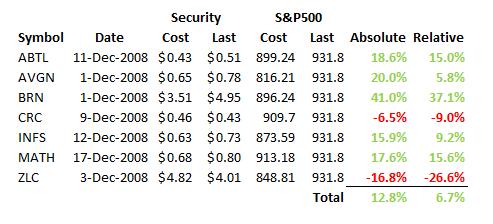
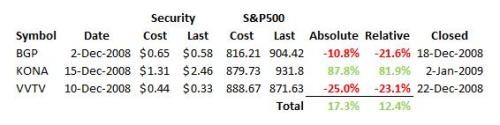
Although it is still too early to determine how Greenbackd’s strategy of investing in undervalued asset situations with a catalyst is performing, we’ve set out below a list of all the stocks we’ve included in the Greenbackd Portfolio and the absolute and relative performance of each. This is the standardized format we propose to adopt to track Greenbackd’s performance at 6-monthly intervals:

Current holdings (As at January 5, 2009)

greenbackd-portfolio-current-holdings-performance

Former holdings (As at date of our closure of the position)greenbackd-portfolio-former-holdings-performance

The absolute total return across the current and former positions as at January 5, 2009 is 14.2%, which is 8.4% higher than the S&P500’s return over the same periods. As we discussed above, the holding periods for Greenbackd’s positions has been too short to provide any meaningful information about the likely performance of the strategy over the long term (2 to 5 years), but we believe that the strategy should outperform the market by a small margin.

We look forward to bringing you the best undervalued asset situations we can dig up in 2009.

Read Full Post »

In its most recent 13D filing Biotechnology Value Fund (BVF) has provided its “full and enthusiastic support” for MediciNova, Inc.’s (NASDAQ:MNOV) offer for Avigen, Inc. (NASDAQ:AVGN).

We’ve been following AVGN (see earlier posts here, here, here, here and here) because it’s a net cash stock (i.e. it’s trading at less than the value of its cash after deducting all liabilities) and specialist biotechnology activist fund BVF has been pushing it to liquidate and return its cash to shareholders. We think that MNOV’s offer represents a clever way for AVGN’s stockholders to receive cash equivalent to that which they would receive in a liquidation (less $7M to be paid to MNOV). We estimate the cash to be paid at around $1.22 per share (BVF estimates the amount at $1.20 per share), which is more than 60% higher than AVGN’s $0.76 close Wednesday. AVGN’s shareholders also have the option to receive MNOV shares instead of the cash. MNOV values its shares at $4.00 (MNOV closed Wednesday at $1.59).

BVF’s filing sets out its rationale for endorsing the merger. The relevant text is extracted below:

On December 22, 2008 MediciNova, Inc. (“MediciNova”) described details of a Proposed Merger between MediciNova and Avigen, Inc. (“Avigen”) in a letter to Avigen’s Chairman, Zola Horovitz. The Reporting Persons hereby express their full and enthusiastic support for this Proposed Merger and believe it is the best interest of all Avigen shareholders. The Reporting Persons presently have no economic interest in MediciNova. The Reporting Persons call on Avigen’s Board of Directors to negotiate with MediciNova and work to consummate the Proposed Merger expeditiously.

The Reporting Persons support the Proposed Merger for the following reasons:

1. Downside Protection: The Proposed Merger provides for the same downside protection that the Reporting Persons encouraged Avigen to implement directly (which Avigen rejected). Subsequent to the Proposed Merger, if MediciNova is unsuccessful, Avigen shareholders will receive approximately the current liquidation value of Avigen (which the Reporting Persons estimate to be approximately $1.20/share, net of debt and expenses), as determined by an independent auditor. Incredibly, in a worst case scenario, the Proposed Merger would yield about a 60% premium to Avigen’s current stock price.

2. Extraordinary Upside Potential: If MediciNova is successful post-merger, Avigen shareholders could own a substantial percentage of MediciNova (which the Reporting Persons estimate to be approximately 45% of the combined company). Thus, in a best case scenario, Avigen shareholders could enjoy an extraordinary, uncapped return. For this reason, the Proposed Merger is superior to an immediate liquidation of Avigen.

3. Free Option: Shareholders have at least one year after the merger is consummated to choose downside protection or upside potential, as described above. This decision can be based on information obtained over the course of the free option period, including the stock performance of MediciNova. This free option period offers shareholders tremendous upside potential with virtually no risk.

4. Change of Control: The Proposed Merger would result in new stewardship of Avigen’s assets, curtailing current management’s stated plan of seeking ways to utilize (and we fear waste) Avigen’s cash in any way they wish. This is a particularly frightening prospect in light of CEO Ken Chahine’s recent statements that “it’s hard to put a finger on exactly what we would do”, that he “intends to build” and that he “thinks that there are opportunities outside of therapeutics.”

5. Unique Synergies: The Reporting Persons believe there are unique synergies between MediciNova and Avigen which likely would not exist with other potential acquirers of Avigen. These synergies give rise to the compelling nature of the Proposed Merger.

BVF wishes to see the Proposed Merger brought to a shareholder vote as soon as practical and urges other Avigen shareholders to support this offer.

We’ve noted in our earlier posts that AVGN presents an attractive investment opportunity if BVF can persuade it to quickly distribute its remaining cash to stockholders. MNOV’s offer presents a clever way for AVGN’s stockholders to receive an amount equivalent to its cash with the possibility for “an extraordinary, uncapped return” if MNOV is successful post-merger. We estimate AVGN’s cash at around $1.22 per share, which is more than 60% higher than AVGN’s $0.76 close Wednesday. With BVF’s endorsement of MNOV’s offer, we believe the investment rationale for AVGN is strong.

[Disclosure: We have a holding in AVGN. This is neither a recommendation to buy or sell any securities. All information provided believed to be reliable and presented for information purposes only.]

Read Full Post »
Avigen, Inc. (NASDAQ:AVGN) has received an offer from MediciNova, Inc. (NASDAQ:MNOV), a biopharmaceutical company that is publicly traded on both the Nasdaq Global Market and the Hercules Market of the Osaka Securities Exchange (Code Number: 4875).

We’ve been following AVGN (see earlier posts here, here, here and here) because it’s a net cash stock (i.e. it’s trading at less than the value of its cash after deducting all liabilities) and it has a specialist biotechnology activist fund Biotechnology Value Fund (BVF) pushing it to liquidate and return its cash to shareholders. We esimate AVGN’s net cash value at $43.5M or $1.46 per share.

According to this filing, MNOV proposes to offer AVGN stockholders a pro rata portion of 1.75M shares of MNOV and a convertible security representing AVGN’s Net Cash Assets,” which MNOV defines as AVGN’s cash remaining after it is wound up less $7M paid to be paid to MNOV. The convertible security issued by MNOV would allow each AVGN stockholder at their election to either (i) convert each share of the convertible security into MNOV at a conversion price of $4.00 per share or (ii) have the convertible security redeemed for cash in an amount per share that represents the Net Cash Assets per share of AVGN. The redemption would occur on the later of March 31, 2010 or 12 months from the closing of the merger transaction. The letter from MNOV to AVGN is reproduced below:

Zola Horovitz, Ph.D.

Chairman of the Board

Avigen, Inc.

Dear Dr. Horovitz:

The purpose of this letter is to provide you with more details concerning the recent expression of interest MediciNova, Inc. (“MediciNova”) made to Avigen, Inc. (“Avigen”) with respect to a potential merger of the two companies in the letter to you dated December 9, 2008.

Our present thinking, based upon the information in publicly available documents and preliminary due diligence, is that we would offer as consideration a combination of registered MediciNova common stock and shares of a MediciNova convertible security for each share of Avigen common stock outstanding. In connection with the merger, Avigen would wind up all of its business activities, including satisfying all of its obligations by way of indebtedness, severance and related liabilities, while retaining all intellectual property assets for the combined companies.

MediciNova proposes that at closing each Avigen shareholder will receive a pro rata portion of 1.75 million shares of MediciNova common stock. In consideration for this, MediciNova will receive $7 million of Avigen cash.

The remaining amount of Avigen cash after Avigen’s wind-up activities are completed and less the $7 million in cash received by MediciNova (the “Net Cash Assets”) will be sequestered and, unless converted earlier as described in the next sentence, not used until the later of March 31, 2010 or 12 months from the closing of the merger transaction (the “Final Conversion Date”). The Net Cash Assets of Avigen will be attested by an independent auditor. The convertible security issued by MediciNova as consideration would allow each Avigen stockholder at their election to either (i) convert each share of such convertible security into shares of MediciNova common stock at a conversion price of $4.00 per share at certain pre-specified accelerated conversion dates or the Final Conversion Date or (ii) have the convertible security redeemed by MediciNova on the Final Conversion Date for cash in an amount per share which represents the Net Cash Assets per share of Avigen.

Based on this proposal, we note that the proposed transaction values each Avigen share at a substantial premium to both your recent stock price and the closing average market price of Avigen’s common stock since your October 21, 2008 announcement. Additionally, the convertible security allows each Avigen stockholder the choice of receiving cash in an amount not presently available to them, other than in a liquidation scenario, or participating in what we believe will be growth in value of the combined entity.

We continue to believe that a merger between MediciNova and Avigen would be in the best interests of the stockholders of both companies for many reasons, including the likely incremental increase in value of the Companies’ combined product candidates. We note that it also addresses the recent pressures Avigen has faced from its stockholder base.

Our proposal remains subject to the completion of customary due diligence, as well as the negotiation of definitive transaction agreements and the satisfaction of necessary approvals and customary conditions to closing of a transaction to be set forth in such agreements. While this letter, and our prior letter to you dated December 9, 2008, are not intended as a binding offer, we continue to stand ready to meet with you and your advisors immediately to discuss this matter.

Please be advised that, because of the past relationships among various of our respective directors, MediciNova has constituted a Special Committee of Directors to represent MediciNova with respect to the proposed business combination. That Special Committee consists of myself as Chair, along with Alan Dunton, Arlene Morris and Hideki Nagao from the MediciNova Board. Our Committee continues to believe this proposal represents a unique opportunity for Avigen’s stockholders and we look forward to a prompt and favorable reply.

Very truly yours,

Jeff Himawan, Ph.D.

Chairman of the Board of Directors

MNOV’s offer represents a clever way for AVGN’s stockholders to receive cash in an amount almost equivalent to what they would receive in a liquidation scenario less $7M paid to MNOV. This equates to approximately $1.22 per share in cash. AVGN’s shareholders also have the option to receive MNOV shares valued at $4.00 (MNOV closed yesterday at $1.60) instead of the cash. AVGN shareholders would also receive 1.75M shares of MNOV divided between 30M AVGN shares on issue.

The offer seems broadly positive to us. Our few quibbles are as follows:

  1. the $7M payment to MNOV seems excessive
  2. the MNOV conversion price of $4.00 is too high
  3. the redemption date – on the later of March 31, 2010 or 12 months from the closing of the merger transaction – is too far away.

If these could be negotiated to a more favorable position for AVGN, the MNOV offer should be welcomed by AVGN’s stockholders.

Hat tip to commenter KC.

Read Full Post »

We posted yesterday that Avigen, Inc. (NASDAQ:AVGN) had announced the sale of its rights to an early-stage blood coagulation compound for $7M. We weren’t sure that the sale was for cash. According to this filing, the sale was for cash:

On December 17, 2008, Avigen, Inc. entered into an Asset Purchase Agreement with Baxter Healthcare Corporation, Baxter International Inc., and Baxter Healthcare S.A. (collectively “Baxter”), providing for the sale of the rights to Avigen’s early stage blood coagulation compound, AV513, to Baxter.

Avigen received a cash payment of $7.0 million from Baxter as proceeds from the sale of AV513. At September 30, 2008, Avigen reported cash, cash-equivalents, and available for sale securities and restricted investments of $56.4 million and an accumulated deficit of $244.9 million. Avigen reported no revenue for the first nine-months of 2008 and a net loss of $24.2 million. The Company is in the process of evaluating the terms of the transaction, but believe that if the transaction had been completed at the beginning of the 2008 fiscal year, the cash received would have been recorded as revenue and would have increased the amount of financial assets and decreased each of the net loss and the accumulated deficit reported at September 30, 2008 by $7.0 million. Avigen is unable to estimate the amount of any expenses that would have been avoided, if any, if the sale of AV513 had been completed at the beginning of the 2008 fiscal year. Other than these items, the transaction would not have had any other impact on Avigen’s financial statements.

We’ve been following AVGN (see earlier posts here, here and here) because it’s a net cash stock (i.e. it’s trading at less than the value of its cash after deducting all liabilities) and it has a specialist biotechnology activist fund Biotechnology Value Fund (BVF) pushing it to liquidate and return its cash to shareholders. In our initial post,we noted that AVGN’s net cash position was $36.5M. Adding the $7M or $0.24 per share to AVGN’s cash position gives it a net cash value we estimate at $43.5M or $1.46 per share against a close yesterday of $0.73.

Read Full Post »

Avigen, Inc. (NASDAQ:AVGN) announced on Thursday that it had sold its rights to an early-stage blood coagulation compound for $7M. We have not been able to confirm that the sale was for cash. Assuming that it was, we estimate that it adds $0.24 per share to AVGN’s cash position and takes its net cash value to $1.46 per share, some 122% higher than its close Friday at $0.658.

We’ve been following AVGN (see earlier posts here and here) because it’s a net cash stock (i.e. it’s trading at less than the value of its cash after deducting all liabilities) and it has a specialist biotechnology activist fund Biotechnology Value Fund (BVF) pushing it to liquidate and return its cash to shareholders. In our initial post,we noted that AVGN’s net cash position was $36.5M. Assuming that the $7M sale was for cash, adding it to AVGN’s cash position gives it a net cash value we estimate at $43.5M or $1.46 per share, 122% higher than its Friday close.

If BVF is able to cause the company to quickly distribute its remaining cash to stockholders, AVGN is an attractive investment opportunity. The risk is that BVF is unable to persuade the company to do so before AVGN dissipates its remaining cash.

AVGN closed Friday at $0.658.

The S&P 500 Index closed Friday at 887.88.

[Disclosure: We do not presently have a holding in AVGN. This is neither a recommendation to buy or sell any securities. All information provided believed to be reliable and presented for information purposes only.]

Read Full Post »
We posted about Avigen, Inc. (NASDAQ:AVGN) on December 1, 2008, noting that it was a rare opportunity because it was a net cash stock (i.e. it was trading at less than the value of its cash after deducting all liabilities). Since our initial post, AVGN has fallen from $0.65 to close yesterday at $0.54. At $0.54, AVGN has a market capitalization of $16.1M against a net cash position of $36.5M, some 127% higher.

Biotechnology Value Fund (BVF), who we noted in our earlier post had an active interest in AVGN, filed an updated 13D last week. In the new filing BVF says that it sent a letter to AVGN “expressing its displeasure with [AVGN]’s recent performance and continued destruction of shareholder value.” The letter is reproduced below:

Members of the Board:

As you know, Biotechnology Value Fund, L.P., together with its affiliates, is the largest shareholder of Avigen, Inc. (“Avigen” or the “Company”), holding an ownership stake of approximately 29% of Avigen’s outstanding common stock. We first became investors in Avigen in 2004 and have provided capital directly to the Company. We are writing to express our frustration with recent developments at Avigen, particularly with what we perceive to be this Board’s self-serving actions and disregard of shareholder interests.

Since January 1, 2004, Avigen’s stock price has fallen more than 90% and the Company has accumulated a deficit of more than $110 million. Presently, Avigen’s stock trades at less than 1/3 of its net per share cash value, indicative of the investment community’s conviction that Avigen’s Board will destroy its remaining value. We have repeatedly reached out to the Company and have offered to work collaboratively to maximize shareholder value. The Company responded to our offers by unilaterally increasing and broadening management’s “golden parachute” severance agreements and by unilaterally adopting a “poison pill.”

The Board’s increase and broadening of its “golden parachute” severance agreements with management, under the ridiculous justification that such payouts are necessary to “attract and retain key employees,” is particularly outrageous given Avigen’s current circumstances. Our analysis indicates that these payouts, which we believe would be triggered by most “change in control” scenarios, including a liquidation, total at least $3 million, an incredible 20% of the Company’s entire market value. The recipients of these golden parachute arrangements include Avigen’s CEO, Ken Chahine, who resides in Park City, Utah, while the Company is based in California. How can the Company justify such actions as necessary to “attract and retain key employees” when Avigen has no real business at this time and has abandoned the development of all its products? These hastily adopted severance arrangements need to be revoked.

In addition, we believe the Board’s implementation of the “poison pill” serves no purpose other than to keep BVF from purchasing additional stock in the Company. We are concerned that management and Board members are more concerned with retaining their jobs and compensation than with maximizing shareholder value. As evidence, Avigen’s stock price has fallen more than 20% since the adoption of the poison pill. We find the poison pill to be disrespectful and offensive, given our substantial ownership position and our long history with the Company. Nevertheless, our response was to offer a compromise proposal: modify the poison pill to allow anyone to acquire as much stock as they like, however, neutralize the voting power on all shares of Avigen stock above a specified threshold. We specifically offered to have any additional shares that we acquire to abstain from voting or to vote in proportion to all other outstanding shares. This offer was not accepted. The pill should be redeemed altogether.

The Board’s recent actions reveal its true self-interest and leave us concerned that Avigen will indeed destroy and/or take all remaining value. Consequently, our primary issue has been and remains that Avigen immediately guarantee the worst case outcome for all shareholders. This guarantee could be accomplished in several ways, including by dividending or otherwise distributing all excess cash to shareholders now, or by offering to buy back any and all shares from holders that wish to sell at a specific price at a specific future date (i.e., $1.25 per share in December, 2009). In both cases, shareholders could stand to reap potentially substantial upside derived from the monetization of Avigen’s remaining assets and could finally stop worrying about whether the Company will destroy its substantial cash value. To the extent the Board believes it can generate value in excess of its cash in the bank today, offering downside protection ultimately costs the Company nothing. However, by rejecting our proposal to provide a downside guarantee, the Board has indicated its willingness to place its remaining cash at continued risk, without shareholder consent.

As the Company’s largest shareholder, we are fighting to return value to all shareholders, not just ourselves, and we feel a responsibility to do so. To be clear, we do not seek to impose our own agenda on Avigen, we only ask that shareholders be empowered to decide the fate of the Company’s residual cash, rather than the management and Board of a company which has repeatedly tried and failed to create any shareholder value whatsoever. Shareholders have good reason to worry that Avigen’s management fully intends to put its remaining cash at risk. Yesterday, at the RBC Capital Markets Healthcare Conference, CEO Ken Chahine said, “We are going to be looking at building…How do we do that?…There are some opportunities as well that have emerged from the credit crisis. There are some commercialization, or near-commercialization, type companies that could use an infusion of cash…Those are some of the things we are looking at. Now, will that be in the therapeutic space? It could be…We’re opening it up because I think that there are opportunities outside of therapeutics…We will spend the balance of 2009 trying to look for opportunities.” Mr. Chahine, shareholders do not need or want you to invest their money.

If recent empirical evidence with respect to numerous other failed biotech companies is any guide (e.g., Corgentech, Renovis, Novacea, Nitromed, Nuvelo and others), the future does not bode well for Avigen shareholders if left to its own devices. In one similar situation, the company could have returned in excess of $10/share in cash to shareholders had it been liquidated in 2005. Instead, after opting for a value-destroying merger, that company today trades at a mere 0.09 cents per share – a 99% decline! Avigen’s golden parachutes have incentivized management to merge with any company that will take it. Management would walk away with its $3 million cash windfall; shareholders would get stuck with potentially worthless stock in a merged company. In the current fiscal environment, shareholders will no longer tolerate such self-interested behavior on the part of failed biotechnology companies.

We believe the Avigen Board is not only willing to sacrifice and squander shareholder money but, in the process, its members are making a mockery of their obligations to fulfill their fiduciary duties as directors of the Company. To that end, please be advised that we intend to hold each member of the Board and management fully accountable for any continued erosion of value from the current liquidation value of the Company.

Sincerely,

Mark Lampert

Conclusion

As we noted in our earlier post, while it’s frightening to see AVGN hemorrhaging cash, BVF is working to persuade it to salvage what remains of the company’s value. If BVF is able to cause the company to quickly distribute its remaining cash to stockholders, AVGN is an attractive investment opportunity. The risk is that BVF is unable to persuade the company to do so before AVGN dissipates its remaining cash.

AVGN closed yesterday at 0.54.

The S&P 500 Index closed yesterday at 868.57.

[Disclosure: We do not presently have a holding in AVGN. This is neither a recommendation to buy or sell any securities. All information provided believed to be reliable and presented for information purposes only.]

Read Full Post »

« Newer Posts