Feeds:
Posts
Comments

Posts Tagged ‘Avigen Inc (NASDAQ:AVGN)’

Biotechnology Value Fund (BVF) has filed the slides to its presentation to the stockholders of Avigen Inc (Nasdaq: AVGN) to remove the existing directors at the special meeting to be held March 27, 2009.

The slides can be viewed here.

We’ve been following AVGN (see archived posts here) because it’s a net cash stock (i.e. it’s trading at less than the value of its cash after deducting all liabilities) and specialist biotechnology activist fund BVF has been pushing it to liquidate and return its cash to shareholders. MediciNova Inc (NASDAQ:MNOV) has made an offer for AVGN that we think represents a clever way for AVGN’s stockholders to receive cash equivalent to that which they would receive in a liquidation (less $7M to be paid to MNOV) with the possibility for “an extraordinary, uncapped return” if MNOV is successful post-merger. The stock is up 68% from $0.65 to close at $1.09 on Friday. We are maintaining our position because we estimate AVGN’s liquidation value to be around 12% higher at $1.22 per share (BVF estimates $1.20 per share).

BVF has also issued the following press release:

BIOTECHNOLOGY VALUE FUND CONFIRMS NOMINEES’ PLANS IF ELECTED TO THE AVIGEN BOARD AT SPECIAL MEETING

Urges Stockholders to Vote to Remove Current Board and Elect its Slate of Four Stockholder-Oriented Independent Nominees

Biotechnology Value Fund, L.P. (“BVF”), today confirmed its plans for the future of Avigen, Inc. (Nasdaq: AVGN) if stockholders remove the current members of the Avigen Board and replace them with BVF’s four new, stockholder-oriented, independent director nominees at the Special Meeting of stockholders to be held on March 27, 2009. BVF, the beneficial owner of approximately 30% of the Company’s outstanding common stock, has called the Special Meeting to give stockholders the opportunity to protect what remains of Avigen’s assets, which it believes are in danger of being completely wasted by the Board. Upon the removal of the current Board and election of BVF’s nominees, subject to the nominees’ fiduciary duties, BVF pledges the following:

· First, all stockholders who desire liquidity will have the immediate ability to cash out of their investment in Avigen and receive a payment of $1.00 per share by tendering their shares into the BVF tender. Stockholders who do not wish to sell their shares will have the opportunity to participate with BVF in the future of Avigen;

· Next, the nominees will immediately announce that Avigen will only consider and proceed with strategic transactions that guarantee a quantified worst-case outcome of approximately Avigen’s liquidation value;

· Next, the nominees will then commence negotiations with MediciNova, with the goal of reaching an agreement on the best terms possible for all Avigen stockholders;

· Next, the nominees will consider any other transactions that satisfied the downside protection requirements described above; and

· Ultimately, the nominees will present any transaction that satisfies the downside protection requirements described above and that the nominees believe is in the best interests of stockholders to stockholders for their approval.

Should the nominees be unable to negotiate final terms with a third party that satisfies the requirements described above, or should such transaction not be approved by stockholders, the nominees intend to promptly return the Company’s remaining cash to stockholders.

Mark N. Lampert BVF Partner stated, “In addition to confirming our plan for the future of the Company, we also wanted to clarify a few remaining issues for stockholders. Specifically, neither BVF nor its nominees have any financial interest or other stake in MediciNova or its proposed transaction. Our only concern is for the fair valuation and prevention of lost value of Avigen. Our interest in Avigen is solely as stockholders – we have never sought, nor would we accept, any benefit solely for ourselves. In addition, in the event they are elected to the Board, our nominees will not receive any compensation for their services as directors of Avigen, other than Mr. Coppedge who stands to receive only nominal director fees. We encourage stockholders to act now to protect their investment by voting the GOLD proxy card today.”

[Full Disclosure: We have a holding in AVGN. This is neither a recommendation to buy or sell any securities. All information provided believed to be reliable and presented for information purposes only.]

Read Full Post »
Biotechnology Value Fund (BVF) yesterday filed additional material in the proxy solicitation to remove the existing directors of Avigen Inc (Nasdaq: AVGN) at the special meeting to be held March 27, 2009. BVF is urging stockholders to remove the current members of the AVGN and replace them with BVF’s four “new, stockholder-oriented, independent director nominees.” BVF has called the special meeting “to give stockholders the opportunity to protect what remains of [AVGN]’s assets, which it believes are in danger of being completely wasted by the Board.”

We’ve been following AVGN (see archived posts here) because it’s a net cash stock (i.e. it’s trading at less than the value of its cash after deducting all liabilities) and specialist biotechnology activist fund BVF has been pushing it to liquidate and return its cash to shareholders. MediciNova Inc (NASDAQ:MNOV) has made an offer for AVGN that we think represents a clever way for AVGN’s stockholders to receive cash equivalent to that which they would receive in a liquidation (less $7M to be paid to MNOV) with the possibility for “an extraordinary, uncapped return” if MNOV is successful post-merger. We estimate AVGN’s cash at around $1.22 per share (BVF estimates $1.20 per share), which is around 16% higher than AVGN’s $1.05 close yesterday.

BVF’s press release is set out below:

BIOTECHNOLOGY VALUE FUND, L.P.

March 12, 2009

VOTE THE ENCLOSED GOLD PROXY CARD TO HELP UNLOCK VALUE AT AVIGEN, INC.

ELECT DIRECTORS WHO ARE DEDICATED TO MAXIMIZING VALUE FOR ALL AVIGEN STOCKHOLDERS BY REDUCING CORPORATE WASTE AND PROTECTING STOCKHOLDERS’ DOWNSIDE RISK WHILE MAINTAINING SIGNIFICANT UPSIDE POTENTIAL

Dear Fellow Stockholders:

We, the Biotechnology Value Fund (“BVF”), are the owners of 8,819,600 shares, or approximately 30% of Avigen’s outstanding common stock. Since we took the lead in protecting value for all stockholders of Avigen in October of 2008, the stock price has increased by over 65%. We have successfully caused the Avigen management team and Board to reduce expenses and sell off programs that they do not have the necessary expertise to develop. We now need your participation to secure Avigen’s substantial remaining value by removing the members of the current self-serving Board and electing our independent nominees who are committed to protecting value for all stockholders.

Let me state from the outset that we neither seek, nor would we accept, any consideration or benefit solely for ourselves. Avigen has falsely accused us of this numerous times, even though we have been crystal clear on this fundamental issue all along. We are waging this effort because (a) we feel a sense of responsibility to do so on behalf of all stockholders given our unique position as the largest stockholder and (b) we believe it is the right thing to do, especially in the context of the current economic environment caused, in part, by similar self-serving managements and Boards.

Throughout this process we have sought only three simple things:

1. that Avigen stop recklessly wasting stockholder money;

2. that stockholders be empowered to decide the fate of Avigen’s remaining cash; and

3. that stockholders be guaranteed a quantified worst-case outcome of approximately Avigen’s liquidation value.

Thus far we have made progress with #1 and #2 above. Facing pressure from BVF, Avigen has abandoned, at least temporarily, its plan to spend money on its remaining products. In addition, the Company has now been forced to call a special meeting to finally permit stockholders the opportunity to weigh in. Prior to our intervention, Avigen’s stock traded at a mere 33% of the cash in the bank and at a steep discount to its current price. This is a remarkable reflection on how poorly Avigen was and is viewed by the investment community. Prior to our intervention, Avigen’s plan was to spend all stockholder money over two years on uncompelling products that it has subsequently conceded were not worthy of investment.

It is worth reflecting on some of Avigen’s historical “accomplishments”:

1. Avigen has consumed over $250 million of investor capital, with little value to show for it. Why should they be entrusted with the last $50 million?

2. Avigen selected a Chief Executive Officer who lives in Park City, Utah when the Company is based in California.

3. Avigen has committed to pay significant fees in the form of golden parachutes to its senior executives and multiple investment bankers, lawyers and consultants in an amount that, we believe, could exceed $5 million under certain circumstances.

4. Despite purporting to have reduced their use of cash and working to protect stockholders, we believe Avigen will spend nearly $20 million, or over $0.65 per share, between the time they announced the failure of AV650 and when they supposedly hope to complete a merger.

5. Avigen adopted a “poison pill,” which we believe is just another example of the Board acting first to protect their jobs rather than the stockholders they have a fiduciary duty to represent.

6. Avigen delayed calling the special meeting for approximately two months before setting a rushed meeting date that we believe was set to prevent stockholders from having adequate opportunity to receive and review proxy materials and vote at the special meeting.

We have grown increasingly dismayed that Avigen’s Board and management team, who collectively own little stock, have wasted money on golden parachutes, multiple investment bankers, consultants and lawyers. Had Avigen merely agreed to guarantee a worst case scenario for stockholders, this fight would not have transpired. Thus, we can only conclude that Avigen is likely to gamble stockholders’ remaining capital that, precedent warns, could result in a near total destruction of stockholder value.

We are frankly surprised that the Board has not previously addressed our concerns by affirmatively and unequivocally agreeing to proceed only with a transaction that provides for stockholders to receive no less than the Company’s approximate liquidation value. In fact, it appears to us that the Board is only now even mentioning an undefined intent to provide some merger liquidity in response to our demand for full downside protection for all stockholders. We believe that Avigen’s shares are undervalued by the market as a result of stockholders’ concern about the direction the current Board is taking the Company. New leadership is needed to prevent further erosion of each stockholder’s investment in Avigen, as well as to take advantage of opportunities that exist to maximize stockholder value.

WITHOUT ANY EVIDENT RATIONAL MOTIVE, AVIGEN HAS NOT AGGRESSIVELY PURSUED THE COMPELLING MERGER PROPOSAL BY MEDICINOVA THAT OFFERED BOTH DOWNSIDE PROTECTION AND SIGNIFICANT UPSIDE TO ALL AVIGEN STOCKHOLDERS

Unlike the current Board, we believe that a merger with MediciNova makes sense for all Avigen stockholders and we cannot understand why only lip service was paid to pursue a deal with MediciNova. Among the extraordinary potential benefits we see in a merger with MediciNova are:

Downside Protection: Based on our analysis, even if a merger with MediciNova is unsuccessful, Avigen stockholders would still receive the approximate current liquidation value of Avigen. This means that, even in the worst-case scenario, the merger would yield an approximate 65% premium to Avigen’s stock price before we submitted our request to the Company to call the special meeting.

Tremendous Upside Potential: Based on our analysis, if a merger with MediciNova is successful, Avigen stockholders could own a substantial percentage of MediciNova (approximately 45% of the combined company). We believe the Board has not had any substantive discussions with MediciNova. We do not understand why they have dismissed the offer as providing little value.

• Free Option: Under the terms of the proposed merger, stockholders would have at least one year after the merger is consummated to choose whether they want downside protection or upside potential, as described above. We believe this free option period offers stockholders tremendous upside potential with low risk.

Neither BVF nor its nominees have any financial interests in MediciNova. BVF is only interested in the superior transaction for ALL stockholders. We simply believe that in light of similar historical transactions, it is important that stockholders have downside protection. If BVF’s nominees are elected to the Board, stockholders can either tender their shares in the BVF tender, or not tender and participate with BVF in the future of Avigen, whether through a merger with MediciNova, subject to the nominees’ fiduciary obligations, or if the merger is not feasible, to consider liquidation or other similar type transactions. In any case all stockholders will get to choose and have the opportunity to get immediate cash back. The nominees intend to present any potential MediciNova transaction to stockholders for approval – ensuring that stockholders will get a true say in the future of Avigen.

We believe the Board’s failure to commit exclusively to a transaction that offers downside protection based on the Company’s liquidation value suggests that the Board is considering other options, which will put the value of Avigen at risk. As the Company’s largest stockholder, we share the interest of all stockholders in protecting and preserving our investment. Unlike the directors and management, BVF only profits if the stock price goes up and shares the interest of all stockholders to increase share value and limit share loss. We receive no other payments or compensation.

THE VAST MAJORITY OF FAILED BIOTECHNOLOGY COMPANIES THAT HAVE FOUND THEMSELVES IN AVIGEN’S CURRENT SITUATION HAVE MANAGED TO DESTROY BETWEEN 80%-99% OF STOCKHOLDER VALUE FROM THEIR THEN LIQUIDATION VALUE

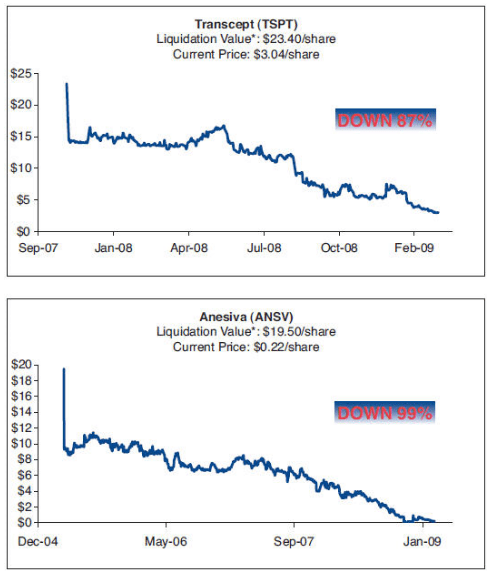
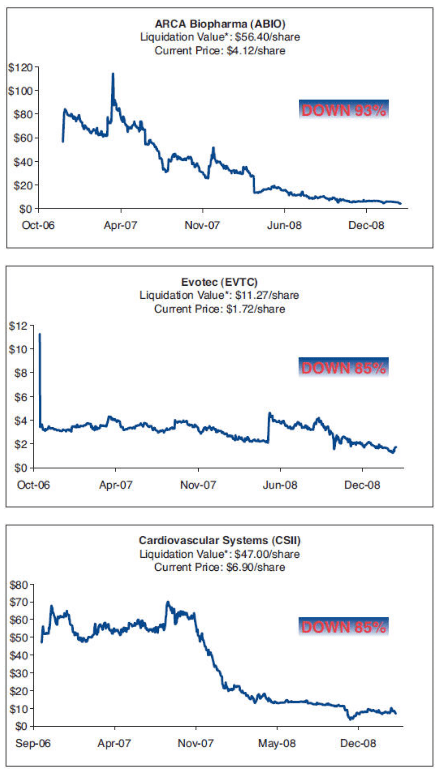
We are concerned that Avigen will enter into a transaction without downside protection that would end up destroying value. We have good reason to fear this, because most recent mergers involving companies similarly situated to Avigen (e.g., Transcept Pharmaceuticals, Inc., Anesiva, Inc., ARCA biopharma, Inc., Evotec Aktiengesellschaft, Cardiovascular Systems, Inc. and others), managed to destroy stockholder value. In each of these transactions, the stock prices declined over 80% from their liquidation value following the Board’s decision to pursue a transaction, resulting in aggregate lost value in excess of $200 million. Of course the management, directors, and bankers took their millions of dollars of fees in cash rather than stock in the companies they supposedly supported. The directors and management of companies like Avigen deserve recognition: it is quite a feat to destroy 80% of the liquidation value of a company possessing little else but cash! The charts below illustrate these astonishing failures.

bvf-charts-1-and-21bvf-charts-3-4-and-5* Approximate net cash per share liquidation value at time of negative binary event.

This repeated lost value and waste is a key reason why we believe downside protection is so important for all stockholders. We want to prevent Avigen from joining this long and infamous list of failures. This is a key reason why we believe the MediciNova transaction is so attractive.

WE BELIEVE THE AVIGEN BOARD IS ENTRENCHING ITSELF AS IT PREPARES TO ENTER INTO AN EGREGIOUS TRANSACTION THAT COULD BURN THROUGH OUR COMPANY’S REMAINING CASH

In a shameless example of protecting their own self-interest, in October 2008 Avigen increased its golden parachute payments, allegedly to attract and retain executive talent. Our first question is: which executive employees does Avigen need to retain when, in our view, Avigen does not possess a viable business? We have estimated that the golden parachute payouts total at least $2 million. Payments to consultants, bankers and lawyers are quickly adding up as well. Given the current economic conditions, we find it irresponsible for Avigen to engage in such behavior that amounts to a slap in the face of all Avigen stockholders. The recent addition of a poison pill by the Board adds further insult to stockholders who have already been insulted by a Board that ignores their pleas.

We are afraid that if the current Board remains in place, they will burn through Avigen’s remaining cash by engaging in a transaction that will further destroy stockholder value. For example, any transaction proposed by Avigen is likely to have a substantial and non-refundable breakup fee that will not be returned to stockholders even if a transaction is not approved. Everyday that the current Board remains in place, the cash per share is dwindling.

AFTER DELAYING THE SPECIAL MEETING FOR MONTHS, THE BOARD FINALLY SET AN ACCELERATED MEETING DATE TO TRY AND PREVENT STOCKHOLDERS FROM HAVING AN OPPORTUNITY TO LET THEIR VOICE BE HEARD

The Board has now set March 27, 2009 as the date for the special meeting of stockholders. We delivered our notice to the board demanding that a special meeting be called approximately two months ago. Finally, after nearly two months of delay and significant and unnecessary corporate waste, the Company announced a March 27, 2009 meeting date, which will occur in just over two weeks, barely enough time to deliver our proxy materials to you. At this critical meeting, Avigen stockholders will be given the opportunity to remove the entire Board and elect independent directors who will strive to preserve and enhance value for all Avigen stockholders. We hope that you will support us by immediately voting the enclosed GOLD proxy card. If you Share our Concern for the Future of Our Company, Do Not Delay, Vote Your Gold Proxy Card Today.

TIME IS SHORT

Act Now to Protect Your Investment By Voting The Enclosed Gold Proxy Card Today

Unfortunately, we have come to the conclusion that the current Board is not fit to run our Company and that it will continue to destroy stockholder value if it is not replaced. Please join our campaign to maximize stockholder value by voting the enclosed GOLD proxy card today.

If you have any questions or need assistance in voting your GOLD proxy card, please contact our proxy solicitors, MacKenzie Partners, Inc., Toll-Free at 1-800-322-2885 or 1-212-929-5500 (call collect) or by email at proxy@mackenziepartners.com. We look forward to speaking to many of you during the course of this campaign and hope that we can count on your support.

Sincerely,

/s/ Mark N. Lampert
Mark N. Lampert
Biotechnology Value Fund, L.P.

[Full Disclosure: We have a holding in AVGN. This is neither a recommendation to buy or sell any securities. All information provided believed to be reliable and presented for information purposes only.]

Read Full Post »
Biotechnology Value Fund (BVF) yesterday filed an amended proxy statement in its effort to remove all of the existing directors of Avigen Inc (Nasdaq: AVGN).

We’ve been following AVGN (see archived posts here) because it’s a net cash stock (i.e. it’s trading at less than the value of its cash after deducting all liabilities) and specialist biotechnology activist fund BVF has been pushing it to liquidate and return its cash to shareholders. MediciNova Inc (NASDAQ:MNOV) has made an offer for AVGN that we think represents a clever way for AVGN’s stockholders to receive cash equivalent to that which they would receive in a liquidation (less $7M to be paid to MNOV) with the possibility for “an extraordinary, uncapped return” if MNOV is successful post-merger. We estimate AVGN’s cash at around $1.22 per share (BVF estimates $1.20 per share), which is around 20% higher than AVGN’s $1.02 close yesterday.

The Background to Solicitation portion of the amended proxy statement sets out a potted history of the situation to date:

The members of the BVF Group are currently the beneficial owners of an aggregate of 8,819,600 Shares, representing approximately 29.63% of the issued and outstanding common stock. As significant stockholders of Avigen, we have one goal: to maximize the value and minimize the risk on behalf of all stockholders. A brief synopsis of Avigen corporate history as well as our recent efforts to maximize stockholder value is summarized in the following chronology of events leading up to this proxy solicitation:

We first became a shareholder of Avigen in 2005, the year Avigen sold, for $12 million, its unsuccessful gene therapy business in which the Company had invested over $150 million. The Company, led by its current CEO, Ken Chahine, spent nearly two years running a “process” with the mandate to re-invent the Company by investing in whatever the current management team deemed compelling. In January 2006, this management team chose to acquire its lead development candidate, AV650, because, in their own words, “we believe it is a low risk.” In fact the Company’s entire strategy, then and now, is supposedly “designed to mitigate the risk of bringing innovative therapies to U.S. patients.” $100 million later, on October 21, 2008, Avigen announced the outright failure of its “low risk” bet on AV650, resulting in a collapse in the Company’s stock price. This same management team and Board, which has failed previously, now wishes to bet the substantial remaining stockholder capital on whatever it deems appropriate.

We recently acquired a significant number of Shares and became the largest stockholder of Avigen. We increased our investment in October 2008 based upon our belief that Avigen’s shares were significantly undervalued. In fact, Avigen reported $56 million, or $1.88 per Share, of financial assets as of September 30, 2008, consisting of cash, cash equivalents, available-for-sale securities and restricted investments, while trading at a price well below $1.00 during the two months prior to filing this proxy statement. We believe this depressed trading price, substantially below Avigen’s cash liquidation value, is based upon the market’s concern that management and the existing Board will pursue ill-advised or other value destroying ventures, at stockholders’ expense, while compensating themselves in the process.

Since this time, we have reached out to the Board numerous times, each time raising our concern that Avigen’s existing liquid assets not be wasted or otherwise committed to value destroying ventures.

We have specifically suggested that the Board “guaranty” the worst case outcome for all stockholders. This guaranty could be accomplished in several ways, including by dividending or distributing all excess cash to stockholders at the present time, or by offering to buy back any and all Shares from stockholders that wish to sell at a specific price at a specific future date. At no time have we asked for – nor would we accept – any consideration or benefit for ourselves that would not be offered to all stockholders.

The Board has ignored our attempts to work constructively for the benefit of all stockholders. Avigen responded to our offers by unilaterally increasing and broadening management’s “golden parachute” severance agreements and unilaterally adopting a “poison pill,” raising our concerns about this Board’s and management’s true intentions.

The Board’s “golden parachute” severance agreements with management, approved under the ridiculous justification that such payouts are necessary to “attract and retain key employees,” are particularly outrageous given Avigen’s current circumstances. Our analysis indicates that these payouts, which we believe would be triggered by most “change in control” scenarios, including a liquidation, total at least $2 million, a significant amount of the Company’s entire market value at the time of adoption. The recipients of these golden parachute arrangements include Avigen’s CEO, Ken Chahine, who resides in Park City, Utah, even though the Company is based in California. We question how the Company can justify such actions as necessary to “attract and retain key employees” when Avigen has no real business at this time. These hastily adopted severance arrangements need to be challenged and, if possible, revoked.

In addition, we believe the Board’s implementation of the stockholder rights plan, or “poison pill,” serves no purpose other than to entrench the Board and keep the BVF Group from purchasing additional stock in the Company. We are concerned that management and the Board are more concerned with retaining their jobs and compensation than with maximizing stockholder value. As evidence, Avigen’s stock price fell more than 20% after the adoption of the poison pill. The pill should be redeemed. The Board’s recent actions reveal its true self-interest and leave us concerned that the Board will indeed destroy and/or take all remaining value. Please see “Proposal No. 1 – Reasons for Removing Existing Directors – We believe the unilateral action by the Board to adopt a “poison pill” is an attempt by the Board and management to ensure the retention of their jobs and their compensation” for further discussion of Avigen’s recently adopted stockholder rights plan.

On December 22, 2008, MediciNova, Inc. (“MediciNova”), a company in which we have no economic interest, proposed to merge with Avigen with an innovative and, we believe, compelling downside-protected structure. We believe the proposed merger is uncontrovertibly in the best interest of all stockholders and we had grave concerns that the Board may not negotiate in good faith with MediciNova, if at all. Avigen’s statements apparently rejecting this proposal confirmed our worst fears. We are concerned that the Board’s and management’s self-interest will prevent them from acting in what we believe to clearly be the best interests of all stockholders.

Accordingly, after much consideration we felt compelled to call the Special Meeting to remove the existing directors and to elect new, truly independent directors who, if elected, plan to take actions to benefit all stockholders, including redeeming Avigen’s stockholder rights plan, working to consummate the proposed transaction with MediciNova and/or working to complete a distribution of Avigen’s assets to all stockholders.

Additionally, on January 23, 2009, we commenced a cash tender offer to purchase any and all of the outstanding Shares that we do not own at a price of $1.00 per Share (the “Offer”). The offer price represents a 35% premium over Avigen’s closing stock price of $0.74 on January 8, 2009, the date prior to the date of our announcement that we were seeking to remove all incumbent members of the Board. The Offer was extended on February 20, 2009 and on March 5, 2009 and is currently scheduled to expire at 6:00 p.m., New York City time, on Friday, April 3, 2009, unless it is further extended.

The Offer is conditioned upon, among other things, (i) the Nominees being elected to the Board at the Special Meeting or otherwise being appointed to, and constituting a majority of, the members of the Board, (ii) the Board redeeming the “poison pill,” or our being satisfied in our reasonable discretion that the “poison pill” is otherwise inapplicable to the Offer, the BVF Group or any affiliates or associates of the BVF Group, and (iii) Avigen not having authorized, recommended, proposed, announced its intent to enter into or entered into an agreement with respect to or effected any merger, consolidation, liquidation, dissolution, business combination, acquisition of assets, disposition of assets, alternative strategy or relinquishment of any material contract or other right of Avigen or any comparable event or capital depleting transaction not in the ordinary course of business. The Offer is not subject to any financing condition.

Assuming the conditions to this Offer are satisfied, stockholders would have the choice of (i) tendering their Shares and receiving a fixed cash payment upon the closing of the Offer at a premium to the market price on the day prior to both the announcement of the Offer and the announcement we were seeking to remove the incumbent members of the Board and to elect the Nominees, or (ii) maintaining their investment in the Company and participating in the proposed merger with MediciNova, if it occurs. Regardless of whether or not a stockholder intends to tender their Shares in the Offer, we strongly recommend that all stockholders vote to elect each of the Nominees and in favor of the other proposals set forth in this Proxy Statement.

We encourage you to review the remainder of this Proxy Statement, which describes in greater detail our concerns and the proposals contained herein.

[Full Disclosure: We have a holding in AVGN. This is neither a recommendation to buy or sell any securities. All information provided believed to be reliable and presented for information purposes only.]

Read Full Post »

Avigen Inc (Nasdaq: AVGN) yesterday mailed a letter to stockholders calling on them to reject the proposal to remove AVGN’s board being presented to stockholders by Biotechnology Value Fund (BVF).

We’ve been following AVGN (see archived posts here) because it’s a net cash stock (i.e. it’s trading at less than the value of its cash after deducting all liabilities) and specialist biotechnology activist fund BVF has been pushing it to liquidate and return its cash to shareholders. MediciNova Inc (NASDAQ:MNOV) has made an offer for AVGN that we think represents a clever way for AVGN’s stockholders to receive cash equivalent to that which they would receive in a liquidation (less $7M to be paid to MNOV) with the possibility for “an extraordinary, uncapped return” if MNOV is successful post-merger. We estimate AVGN’s cash at around $1.22 per share (BVF estimates $1.20 per share), which is around 20% higher than AVGN’s $1.02 close yesterday.

The text of AVGN’s letter to stockholders is set out below:

To our stockholders:

We urge you to support your Board of Directors at the upcoming Special Meeting of Avigen Stockholders on March 27, 2009 – by rejecting the proposal to remove your Board of Directors that is being presented to stockholders by Biotechnology Value Fund (BVF).

The Avigen Board is committed to enhancing the value of your investment and has acted consistently and responsibly to protect the company’s value and represent your best interest.

In contrast, BVF, an activist investor, seeks to take direct control of the company with nominees that have conflicts of interest (all but one is a BVF manager or partner), have no insight into the value of Avigen’s assets, have not been forthcoming with other stockholders about their dealings, and have a record of acting in ways that are NOT in the best interests of other stockholders.

Your Board of Directors unanimously recommends that you vote AGAINST the proposal to remove the current Board, using the enclosed WHITE proxy card. This will enable the Board to continue working to maximize Avigen’s value.

AVIGEN’S BOARD HAS WORKED HARD TO EARN YOUR TRUST

Avigen’s Board is executing a plan to maximize the value of your investment. Your vote will allow the Board to complete these efforts:

Our Pledge To Stockholders

Avigen’s Board is committed to protecting your rights and intends to:

1) Continue efforts to capture the financial value of our AV411 pain and addiction program;

2) Present the best merger transaction, if any, for a vote of stockholders;

3) Provide stockholders who have a preference for liquidity in a transaction, the ability to redeem part, if not all, of their shares for cash;

4) Continue to update stockholders on our progress; and

5) Conclude the process in a timely manner – no later than the end of 2009.

1) We’ve preserved cash and protected Avigen stockholders’ upside.

We expect to have cash of more than $40 million at the end of 2009, in part because of the conservative actions we took last year, including cutting headcount by 70% and selling an early-stage program for $7 million in cash. Even before the disappointing clinical trial results last October, we worked hard to maintain a strong and clean balance sheet and to hold the line on expenses. Importantly, in each of the last five years, your Board has met or exceeded its year-end cash projections and we intend to do the same in 2009.

2) We’re conducting a competitive process so stockholders get the most value out of Avigen’s current assets.

Your Board is leading an orderly process to maximize value for the assets of the company and is committed to taking steps to ensure we deliver the best opportunities for stockholders.

Your current Board and management have the necessary know-how to sell or partner our pain and addiction program for its highest value to stockholders. AV411 is a promising therapy that is in government-funded human testing. We are currently in negotiations with multiple interested parties.

3) The Board’s strategic review process is paying off: we have received seven written proposals to date.

Seven companies have made written offers to Avigen. Now, we are carefully negotiating with interested parties. Because this is a competitive process, each of the companies knows they must present their best offer. We are making steady progress in our negotiations and expect to complete the process in the coming months.

4) We intend to give stockholders with a need or preference for liquidity in a transaction an option to redeem at least part, if not all, of their shares for cash

We believe BVF’s need for liquidity greatly outweighs its interest in evaluating opportunities that could lead to increased value for other stockholders. With your best interest in mind, we intend to provide an opportunity for any stockholder to opt-out and redeem at least part, if not all, of their shares for cash in any transaction. We believe this will provide BVF an opportunity to sell part or all of its position and not impose its own agenda on other stockholders.

5) We’re prepared to cash out stockholders if we can’t find a better option.

We recognize that despite our best intentions and efforts, it may not be possible to identify a favorable merger transaction. Therefore, if at any point during this process, your Board of Directors determines that a favorable transaction is unlikely, the Board will continue to consider all other strategic options, including a partial or complete distribution of Avigen’s cash. In any event, we intend to complete the process, including monetizing our pain and addiction program, no later than the end of 2009.

BVF DOES NOT REPRESENT YOUR INTEREST

BVF is trying to seize complete control of your Board and has acted in ways that are not in the best interests of other stockholders.

1) BVF’s interests are different from other stockholders’ interests

Why does BVF oppose the Board’s competitive process – a process that aims to maximize value for all stockholders? We believe it’s because BVF’s interests are different from the interests of all other stockholders.

BVF cannot easily sell its almost 9 million shares of Avigen without causing the stock price to fall. It could avoid this risk, however, if it can force Avigen into any transaction that cashes BVF out of the stock – even if that means accepting a significant discount to our book value and a significantly lower price for you.

In fact, BVF has opposed all plans that don’t fit its self-serving agenda – even when this has meant destroying value for other Avigen stockholders.

2) BVF favors immediate acceptance of the initial acquisition proposal from MediciNova – despite the low initial proposed value per share – apparently without negotiations to improve the terms

BVF immediately supported the initial acquisition proposal by MediciNova without encouraging negotiation to improve the terms. That proposal is estimated to result in potential cash for Avigen stockholders of approximately $0.91 per share1 after being sequestered and unavailable to Avigen stockholders until at least June 2010. The other components of the transaction provide little value. Your Board believes it can deliver more value for your investment through negotiations with MediciNova or through other competitive proposals.

____________________
1 This estimate is based on our good faith assumptions of Avigen’s cash at the close of the transaction and estimated transaction costs.

3) BVF has not been forthcoming with stockholders

The CEO of MediciNova told Avigen’s management that MediciNova was working with BVF in making its acquisition proposal to Avigen. BVF has not disclosed this working relationship with MediciNova to stockholders.

4) BVF activities have hurt other Avigen stockholders

In the face of BVF’s public support for the MediciNova acquisition and its attacks on Avigen’s Board, several potential bidders who have not submitted a written proposal for Avigen’s assets have been reluctant to negotiate with Avigen until BVF’s threats are resolved. One important would-be buyer said they don’t want to spend the time and money in making a proposal that BVF is going to reject out of hand.

Finally, we learned from three separate parties that a BVF manager – and one of BVF’s nominees for the Avigen Board – tried to sabotage Avigen’s confidential discussions with a potential bidder. The BVF nominee contacted Board members of a potential bidder and warned them that BVF would withhold its support for their potential deal with Avigen. These actions undermine the best interest of other stockholders.

In short, BVF’s actions have consistently harmed the interests of other Avigen stockholders. The Board believes BVF would not be an appropriate steward for all stockholders, and urges stockholders to reject the BVF proposal by voting on the WHITE proxy card AGAINST the removal of your Board.

YOUR BOARD IS COMMITTED TO CREATING WEALTH FOR ALL STOCKHOLDERS – AND IS MAKING GOOD ON THIS COMMITMENT

Your Board of Directors is committed to pursuing the strategies that are in the best interest of the majority of our stockholders and to protecting the rights of all stockholders. It is committed to finding a way to work with BVF, our largest stockholder – and has made numerous attempts to reach out to BVF and to accommodate its interests.

We believe that removing, without cause, all six of your directors – and replacing them with BVF’s nominees who lack relevant experience2 and are not independent – is not in the best interests of all of Avigen’s stockholders.

____________________
2 Based on disclosure in BVF’s proxy statement.

Your vote in this proxy contest comes down to one thing: Who can you expect to deliver, to you and all other Avigen stockholders, the full value from Avigen’s assets? We urge you to reject the BVF proposal and support your current Board of Directors, which has over the years earned your trust.

Respectfully,

Signed for the Board of Directors
Zola Horovitz, Ph.D. as Chairman of the Board
Kenneth G. Chahine, Ph.D., J.D. as Chief Executive Officer

[Full Disclosure: We have a holding in AVGN. This is neither a recommendation to buy or sell any securities. All information provided believed to be reliable and presented for information purposes only.]

Read Full Post »

The New York Times has an article by Andrew Pollack, “Drug Investors Lose Patience,” about investors pushing biotechnology companies to liquidate and return capital to investors. Pollack notes that such clashes have become much more common in recent months as the stock market crash has pushed the market capitalization of many biotechnology companies to less than the cash on hand, which creates an opportunity for investors to realize an immediate return if the company dissolves. The article covers three situations that we have been following closely for several months, Avigen Inc (Nasdaq: AVGN), Neurobiological Technologies Inc (NASDAQ:NTII) and Northstar Neuroscience Inc (NASDAQ:NSTR).

The first is the clash between Avigen Inc (Nasdaq: AVGN) and Biotechnology Value Fund (BVF). We’ve been following AVGN (see archived posts here) for exactly the reason that Pollack identifies: it’s a net cash stock (i.e. it’s trading at less than the value of its cash after deducting all liabilities) and specialist biotechnology activist fund BVF has been pushing it to liquidate and return its cash to shareholders. MediciNova Inc (NASDAQ:MNOV) has made an offer for AVGN that we think represents a clever way for AVGN’s stockholders to receive cash equivalent to that which they would receive in a liquidation (less $7M to be paid to MNOV) with the possibility for “an extraordinary, uncapped return” if MNOV is successful post-merger. We estimate AVGN’s cash at around $1.22 per share (BVF estimates $1.20 per share), which is around 20% higher than AVGN’s $1.02 close yesterday.

Pollack provides a good background to the AVGN vs BVF stoush:

The Biotechnology Value Fund, often called BVF, was a longtime shareholder in Avigen. But it sold 640,000 shares, nearly all its holdings, for about $3.95 to $4.60 a share. The sale was near the stock’s highs for the year – in the two months before Avigen was scheduled to announce, in October, the clinical trial results of its drug to treat a symptom of multiple sclerosis. After the drug failed, BVF swooped in and bought more than eight million shares, nearly a 30 percent stake, at about 58 cents a share. That was well below Avigen’s cash total of about $1.90 a share at the time.

BVF has made a $1-a-share tender offer for Avigen and is trying to replace the directors. If it gains control, it could liquidate Avigen or sell it to MediciNova, which has said it wants to buy it. Mr. Chahine, the chief of Avigen, which is based in Alameda, Calif., said its assets might be parlayed into a deal that would be worth more than BVF or MediciNova would pay and more than the liquidation value. “All we’re saying is, give us an opportunity to canvass the field, see what’s out there and bring something to the shareholders,” he said.

But Mr. Nodelman said such a process might eat up the company’s remaining cash. “Someone’s got to police the space,” he said. “We’re making sure that the last $50 million in the company don’t go to the bankers and the consultants and the golden parachutes.”

BVF, which specializes in smaller biotech companies, has become the most outspoken investor pressing for its money back. The fund, based in San Francisco, gets about half of its capital from the Ziff family, which made its fortune in magazine publishing.

Mr. Nodelman makes no apologies for BVF’s having bought Avigen stock again after the collapse.

He also neatly captures the perspective of AVGN’s CEO, Ken Chahine, who, we think, speaks for on behalf of most CEOs in the same position:

“I hear that argument” about shareholder rights, said Kenneth G. Chahine, Avigen’s chief. “But it’s really ‘I want to raid the cash.’ We’re back to 1987 and ‘Barbarians at the Gate.’ “

The second situation mentioned in the article that we have been following is Neurobiological Technologies Inc (NASDAQ:NTII):

BVF is also one of four investors, which collectively own about two-thirds of the shares, demanding money back from Neurobiological Technologies of Emeryville, Calif.

The company’s stroke drug is derived from the venom of the Malayan pit viper. Three of the investors, including BVF, were shareholders when that drug failed in a clinical trial in December. The fourth bought in after the failure. The stock now trades at 58 cents, but its liquidation value would be as high as $1 a share.

Matthew Loar, the chief financial officer, said the company was sympathetic to the requests but had not yet decided what to do. In any case, he said, it could not act as fast as the investors want.

“You can’t just turn off the lights in a company in a day,” he said. Among other things, the company must figure out what to do with 1,000 poisonous snakes, he said. “We’re going to get rid of them in the most expeditious, reasonable way possible.”

We’ve been following NTII because it’s trading at a substantial discount to our estimate of its liquidating value. At its $0.59 close yesterday, NTII has a market capitalization of just $15.9M, which is around 10% higher than our $14.5M estimate for its net cash value but around two-thirds of our estimate of its $21.9M or $0.81 per share liquidation value. There exists the possibility that its liquidation value is significantly higher again if NTII receives a portion of the net proceeds paid to Celtic Pharmaceuticals upon a sale of XERECEPT. With stockholders representing 45% (note that Samuel L. Schwerin estimates 65%) of the outstanding stock of NTII calling for its liquidation, we feel the company will be under some pressure to accede and that should lead to a reasonably quick resolution.

The third situation we have been following is Northstar Neuroscience Inc (NASDAQ:NSTR), and it is particularly interesting because the company has agreed to liquidate:

Under pressure from the hedge fund RA Capital Management, for example, Northstar Neuroscience, a medical device company in Seattle whose stroke treatment failed, is proposing to liquidate, with shareholders receiving an estimated $1.90 to $2.10 a share in cash. The company’s stock, which had been as low as 90 cents in November, closed at $1.90 on Monday.

We started following NSTR because it is a net cash stock that has announced that it plans to liquidate. NSTR closed yesterday at $1.92, giving it a market capitalization of $50.2M. We originally estimated the final pay out figure in the liquidation to be around $59M or $2.26 per share, which presents an upside of around 17%. The company estimates a slightly lower pay out figure of between $1.90 and $2.10 “assuming we are unable to sell our non-cash assets” and expects to make an initial distribution within approximately 45 days after the Effective Date (which is to be announced) of approximately $1.80 per share.

The article notes that in some cases the investors asking for their money back are “not long-suffering shareholders” but “speculators who bought in only after the stock price collapsed, hoping to make a quick killing.” Aside from their characterization as “speculators,” we find ourselves in the latter camp. Our definition of investment hell is being caught in what Pollack calls a “zombie” – a company “lurching from product to product, surviving years or even decades without ever achieving success.” Finding a stock trading below a conservative estimate of the value of its assets with a good prospect that the value can be unlocked is our definition of investment heaven. Here’s to a few more quick killings, even if an investor requires the patience of Job to get them.

Hat tip to John Allen.

[Full Disclosure:  We have a holding in AVGN. We do not have a holding in NTII or NSTR. This is neither a recommendation to buy or sell any securities. All information provided believed to be reliable and presented for information purposes only. Do your own research before investing in any security.]

Read Full Post »

Biotechnology Value Fund (BVF) has extended its offer to purchase all of the outstanding shares of Avigen Inc (Nasdaq: AVGN) for $1.00 per share to April 3, 2009.

We’ve been following AVGN (see archived posts here) because it’s a net cash stock (i.e. it’s trading at less than the value of its cash after deducting all liabilities) and specialist biotechnology activist fund BVF has been pushing it to liquidate and return its cash to shareholders. MediciNova Inc (NASDAQ:MNOV) has made an offer for AVGN that we think represents a clever way for AVGN’s stockholders to receive cash equivalent to that which they would receive in a liquidation (less $7M to be paid to MNOV) with the possibility for “an extraordinary, uncapped return” if MNOV is successful post-merger. We estimate AVGN’s cash at around $1.22 per share (BVF estimates $1.20 per share), which is around 20% higher than AVGN’s $1.02 close today.

BVF’s press release follows:

BVF ACQUISITION LLC EXTENDS AVIGEN TENDER OFFER TO APRIL 3, 2009

NEW YORK, March 6, 2009 – BVF Acquisition LLC (the “Purchaser”), an affiliate of Biotechnology Value Fund L.P. (“BVF”), which has commenced a cash tender offer to purchase all of the outstanding shares of Avigen, Inc. (Nasdaq: AVGN) (“Avigen”) for $1.00 per share, announced today that it has extended the expiration date for the tender offer to 6:00 p.m., New York City time, on Friday, April 3, 2009. The tender offer was previously set to expire at 6:00 p.m., New York City time, on Friday, March 6, 2009. As of the close of business on March 6, 2009, a total of 2,854,626 shares, including shares tendered by guaranteed delivery, had been tendered in and not withdrawn from the offer, which together with the shares owned by BVF and affiliates, represents approximately 39.2% of the total shares outstanding of Avigen.

[Full Disclosure: We have a holding in AVGN. This is neither a recommendation to buy or sell any securities. All information provided believed to be reliable and presented for information purposes only.]

Read Full Post »

Avigen Inc (Nasdaq: AVGN) has filed amended proxy material in its opposition to the proxy solicitation of Biotechnology Value Fund (BVF).

We’ve been following AVGN (see archived posts here) because it’s a net cash stock (i.e. it’s trading at less than the value of its cash after deducting all liabilities) and specialist biotechnology activist fund BVF has been pushing it to liquidate and return its cash to shareholders. MediciNova Inc (NASDAQ:MNOV) has made an offer for AVGN that we think represents a clever way for AVGN’s stockholders to receive cash equivalent to that which they would receive in a liquidation (less $7M to be paid to MNOV) with the possibility for “an extraordinary, uncapped return” if MNOV is successful post-merger. We estimate AVGN’s cash at around $1.22 per share (BVF estimates $1.20 per share), which is around 26% higher than AVGN’s $0.97 close yesterday.

AVGN’s amended proxy material sets out an interesting background to the proxy solicitation. The background is quite lengthy, so we’ll pick it up from AVGN’s February 11 conference call:

On February 11, 2009, senior management of Avigen hosted a conference call relating to its fiscal year ended December 31, 2008. Senior management also updated stockholders on Avigen’s strategic process and responded to questions and answers.

On February 13, 2009, Dr. Horovitz spoke with Mr. Lampert and attempted to reassure him that Avigen was preserving its assets and that the competitive process to identify potential strategic opportunities was proceeding well. Mr. Horovitz indicated to Mr. Lampert that once the process was complete Avigen would communicate its findings to stockholders and that the Board did not believe that it would be prudent to make public commitments until that time.

On February 20, 2009, Mr. Lampert sent a letter to the Board, again demanding “downside protection” for all stockholders.

On February 21, 2009, Dr. Chahine was informed by multiple parties that Mr. Nodelman, a BVF Nominee, had learned of confidential early negotiations Avigen had with a company, and that during the previous week, Mr. Nodelman contacted one or more of the members of the board of that company to warn that BVF would withhold its support for any potential strategic transaction between Avigen and that company.

On February 23, 2009, the Board sent BVF a letter offering to discuss their differences with a view to arriving at a mutually beneficial outcome for all stockholders. Later that day, Drs. Horovitz and Chahine met with representatives of BVF to discuss whether there was a solution to avoid a proxy contest.

On February 24, 2009, MediciNova and Avigen reached a tentative agreement that they would sign a mutual confidentiality agreement with no standstill, with the understanding that only information that the companies were comfortable disclosing without a standstill would be exchanged.

On February 27, 2009, the Board reiterated to BVF its earlier offer to compromise and conveyed its desire to come to a mutually beneficial outcome for all stockholders and cease the proxy fight. Although no agreement was reached, the Board also reiterated its offer to continue to work collaboratively and professionally with BVF.

[Full Disclosure: We have a holding in AVGN. This is neither a recommendation to buy or sell any securities. All information provided believed to be reliable and presented for information purposes only.]

Read Full Post »

Greenbackd Portfolio Q1 performance and update

March 1, 2009 marked the end of Greenbackd’s first quarter, so we thought we’d take the opportunity to update you on the performance of the Greenbackd Portfolio and the positions in the portfolio, discuss some changes in our valuation methodology since our first post and outline the future direction of Greenbackd.com.

First quarter performance of the Greenbackd Portfolio

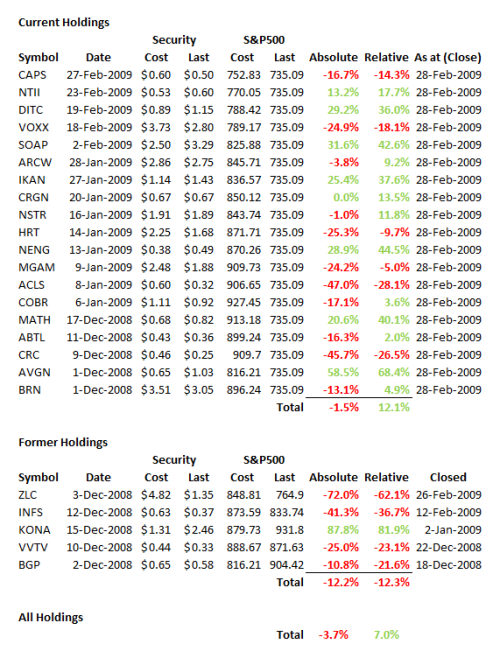
We get many questions about the content and performance of the portfolio. We had originally planned to report on a six-monthly basis, but we have now decided to report on a quarterly basis so that we can address these questions on a more frequent basis. Although it is still too early to determine how Greenbackd’s strategy of investing in undervalued asset situations with a catalyst is performing, we’ve set out below a list of all the stocks we’ve included in the Greenbackd Portfolio and the absolute and relative performance of each at the close on the last trading day in our first quarter, Friday, February 28, 2009:

greenbackd-portfolio-performance-2009-q13The absolute total return across the current and former positions as at February 28, 2009 was -3.7%, which was +7.0% higher than the S&P500’s return over the same periods. A negative return for the first period is disappointing, but we are heartened by the fact that we outperformed the market by a small margin.

You may have noticed something odd about our presentation of performance. The S&P500 index declined by 18.0% in our first quarter (from 896.24 to 735.09). Our -3.7% performance might suggest an outperformance over the S&P500 index of +14.3%. We calculate our performance on a slightly different basis, recording the level of the S&P500 index on the day each stock is added to the portfolio and then comparing the performance of each stock against the index for the same holding period. The Total Relative performance, therefore, is the average performance of each stock against the performance of the S&P500 index for the same periods. As we discussed above, the holding period for Greenbackd’s positions has been too short to provide any meaningful information about the likely performance of the strategy over the long term (2 to 5 years), but we believe that the strategy should outperform the market by a small margin.

Greenbackd’s valuation methodology

We started Greenbackd in an effort to extend our understanding of asset-based valuation described by Benjamin Graham in the 1934 Edition of Security Analysis. Through some great discussion with our readers, many of whom work in the fund management industry as experienced analysts or even managing members of hedge funds, we have had the opportunity to refine our process. We believe that what started out as a pretty unsophisticated application of Graham’s liquidation value methodology has evolved into a more realistic analysis of the balance sheet and the relationship of certain disclosures in the financial statements to asset value. We’re not yet ready to send it into space, but we believe our analyses are now qualitatively more robust than when we started and that has manifest itself quantitatively in better performance (more on this below).

The two main differences between our early analyses and our more recent ones are as follows (these are truly cringe-worthy, but that’s why we undertook the exercise):

  1. We didn’t take account of the effect of off-balance sheet arrangements and contractual obligations. This caused us to enter into several positions we should have avoided, including BGP and VVTV.
  2. We were using overly optimistic estimates for the recovery rates of assets in liquidation. For example, we started using 50% of Gross PP&E. We now use 20% of Net PP&E. We now apply Graham’s formula as the base case and deviate only when we believe that Graham’s formulation doesn’t reflect reality.

The effect of these two broad errors in analysis was to create several “false positives,” which is to say that we added stocks to the portfolio that wouldn’t have passed our current, more rigorous standards. The performance of those “false positive” stocks has been almost uniformly negative, and dragged down the performance of the portfolio. As an exercise, we went back through all the positions we have opened since we started the site and applied our current criteria, which are more stringent and dour than our earlier standards. We found that we would not have opened positions in the following eight stocks:

  • BRN (-13.1% on an absolute basis and +4.9% on a relative basis)
  • BGP (-10.8% on an absolute basis and -21.6% on a relative basis)
  • COBR (-17.1% on an absolute basis and +3.6% on a relative basis)
  • HRT (-25.3% on an absolute basis and -9.7% on a relative basis)
  • KONA (+87.8% on an absolute basis and +81.9% on a relative basis)
  • MGAM (-24.2% on an absolute basis and -5.0% on a relative basis)
  • VVTV (-25.0% on an absolute basis and -23.1% on a relative basis)
  • ZLC (-72.0% on an absolute basis and -61.1% on a relative basis)

It seems we got lucky with KONA, but the performance of the balance of the stocks was wholly negative. The performance across all stocks listed above was -12.5% on an absolute basis and -3.9% on a relative basis. Excluding these eight stocks from our portfolio (i.e. treating the portfolio as if we had not entered into these positions) would have resulted in a slightly positive absolute return of +0.7% and a relative performance over the S&P500 of +12.5%. This is a compelling reason to apply the more dour and rigorous standards.

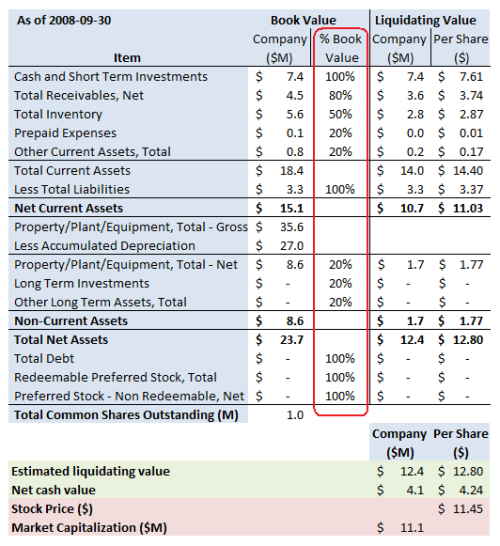
We like to think we’ve now learned out lesson and the more dour and rigorous standards are here to stay. Set out below is an example balance sheet summary (for Chicago Rivet & Machine Co. (AMEX:CVR)) showing our present base case discounts from book value (circled in red):

example-summary-2

Readers will note that these are the same base case discounts from book value suggested by Benjamin Graham in the 1934 Edition of Security Analysis, more fully described in our Valuing long-term and fixed assets post under the heading “Graham’s approach to valuing long-term and fixed assets.” Why we ever deviated from these standards in the first place is beyond us.

Update on the holdings in the Greenbackd Portfolio

Leading on from our discussion above, four of the stocks we picked using the initial, overly optimistic criteria no longer meet our more stringent standards but haven’t yet been removed from the portfolio. We’re going to take our medicine now and do just that. To make it clear, these stocks aren’t being removed because the value has deteriorated, but because we made a mistake adding them to the portfolio in the first place. As much as we’d like to treat these positions as void ab initio (“invalid from the beginning”), we’re not going to do that. We’ve made a full accounting of the impact they’ve had on the portfolio in the First quarter performance of the Greenbackd Portfolio section above, but we don’t want them affecting our future performance. The stocks to be removed from the Greenbackd Portfolio and their absolute and relative returns are as follows:

  • BRN (-13.1% on an absolute basis and +4.9% on a relative basis)
  • HRT (-25.3% on an absolute basis and -9.7% on a relative basis)
  • MGAM (-24.2% on an absolute basis and -5.0% on a relative basis)
  • COBR (-17.1% on an absolute basis and +3.6% on a relative basis)

We’ll provide a more full discussion of where we went wrong with these stocks at a later date, but suffice it to say for present purposes that all were errors from the second bullet point in the Greenbackd’s valuation methodology section above (i.e. overly optimistic estimates for the recovery rates of assets in liquidation).

There are fifteen stocks remaining in the Greenbackd Portfolio:

Eight of these positions (ABTL, ACLS, ARCW, CAPS, CRC, CRGN, NSTR, and VOXX) are trading at or below our nominal purchase price and initial valuations. The remaining seven positions (AVGN, DITC, IKAN, MATH, NENG, NTII, and SOAP) are trading above our intial purchase price but are still at varying discounts to our valuations. We’ll provide a more full update on these positions over the course of this week.

The future of Greenbackd.com

We are going to trial some small changes to the layout of the site over the next few weeks. We’ve already made the first change: the newest comments now appear at the top of the list. We’ll also be amalgamating some pages and adding some new ones, including a page dedicated to tracking the portfolio with links to the analyses. We’re also considering some options for generating income from the site. At the moment, Greenbackd is a labor of love. We try to create new content every week day, and to get the stock analyses up just after midnight Eastern Standard Time, so that they’re available before the markets open the following day. More than 80% of the stocks that are currently trading at a premium to the price at which we originally identified them (NTII, SOAP, IKAN, DITC, NENG, MATH and AVGN) traded for a period at a discount to the price at which we identified them. This means that there are plenty of opportunities to trade on our ideas (not that we suggest you do that). If you find the ideas here compelling and you get some value from them, you can support our efforts by making a donation via PayPal.

We look forward to bringing you the best undervalued asset situations we can dig up in the next quarter.

Read Full Post »

Biotechnology Value Fund (BVF) has extended its tender offer for the outstanding shares of Avigen Inc (Nasdaq: AVGN).

We’ve been following AVGN (see archived posts here) because it’s a net cash stock (i.e. it’s trading at less than the value of its cash after deducting all liabilities) and specialist biotechnology activist fund BVF has been pushing it to liquidate and return its cash to shareholders. MediciNova Inc (NASDAQ:MNOV) has made an offer for AVGN that we think represents a clever way for AVGN’s stockholders to receive cash equivalent to that which they would receive in a liquidation (less $7M to be paid to MNOV) with the possibility for “an extraordinary, uncapped return” if MNOV is successful post-merger. We estimate AVGN’s cash at around $1.22 per share (BVF estimates $1.20 per share), which is around 20% higher than AVGN’s $1.01 close yesterday.

The full text of BVF’s press release is reproduced below:

BVF Acquisition LLC (the “Purchaser”), an affiliate of Biotechnology Value Fund L.P. (“BVF”), which has commenced a cash tender offer to purchase all of the outstanding shares of Avigen, Inc. (Nasdaq: AVGN) (“Avigen”) for $1.00 per share, announced today that it has extended the expiration date for the tender offer to 6:00 p.m., New York City time, on Friday, March 6, 2009. The tender offer was previously set to expire at 12:00 midnight, New York City time, on Monday, February 23, 2009. As of the close of business on February 20, 2009, a total of 1,132,192 shares had been tendered in and not withdrawn from the offer, which together with the shares owned by BVF and affiliates, represents approximately 33% of the total shares outstanding of Avigen.

[Full Disclosure: We have a holding in AVGN. This is neither a recommendation to buy or sell any securities. All information provided believed to be reliable and presented for information purposes only.]

Read Full Post »

Avigen Inc (Nasdaq: AVGN) has filed the transcript of its earnings call held last Wednesday. In the call, AVGN’s management addresses their estimate of AVGN’s net cash value, their attitude to the MediciNova Inc (NASDAQ:MNOV) offer, and the possibility of a liquidation or a return of capital.

We’ve been following AVGN (see archived posts here) because it’s a net cash stock (i.e. it’s trading at less than the value of its cash after deducting all liabilities) and specialist biotechnology activist fund BVF has been pushing it to liquidate and return its cash to shareholders. MNOV has made an offer for AVGN that we think represents a clever way for AVGN’s stockholders to receive cash equivalent to that which they would receive in a liquidation (less $7M to be paid to MNOV) with the possibility for “an extraordinary, uncapped return” if MNOV is successful post-merger. We estimate AVGN’s cash at around $1.22 per share (BVF estimates $1.20 per share), which is a little less than 15% higher than AVGN’s $1.05 close yesterday.

Selected portions of the transcript follow:

On the possibility of liquidation

Ken Chahine [President and Chief Executive Officer]

Oh, okay. So yes, our — so was the question are we committed to liquidation at some point?

Juan Sanchez, [Ladenburg and Thalmann]

Yes. You don’t come out with a real — a proposal to the investors. And in the exercise you guys are going through, are you committing to returning the money back to investors? And is $42 million the money that is going to be available to investors by then, or is a different amount? You see?

Ken Chahine

Juan, our commitment is very, very simple. We’re going to maximize the value. If liquidation ends up being the best offer we have, then liquidation is the best offer we have. There’s no hidden agenda here. It’s simply a matter of maximizing the value.

Is MediciNova the best deal? I don’t really — at this point I honestly don’t know. Could it be? It could be. Is it? I don’t know.

And I think if — let me give you an example, Juan. If you were selling a house and you got an offer for your house and your realtor came by and said you have three more offers that are coming in today, and we have three more that we think are coming next week. I think it’s fair to say that you would probably not take that first offer unless you had at least an opportunity to look at the other three and wait for the other three to come in.

Now, even if you like that first offer, you might say, I think this one is going to be hard to beat. I think you would say that it would be negligent not to at least look at those other offers.

So I think what we’re asking here is not unreasonable. I think it’s absolutely logical, and I think it’s exactly what you and other shareholders on this call would expect — would do. And so that’s all we’re saying.

And so if at the end of the day, is it going to be MediciNova, is it going to be a liquidation, is it going to be sale to a larger company? I don’t know. But I think the commitment absolutely is that whatever it is, it’s going to maximize the value to the shareholders. And if it turns out to be, in our opinion, an M&A transaction, we will propose that transaction and the shareholders will have the right to either vote for it or not vote for it, right?

So at the end of the day, the fate of this Company is not in our hands. The fate of this Company is squarely in the hands of the shareholders. And we’ve protected the burden so that there’s no risk that we’re squandering the money in the meantime.

And again, going back to your — Andy can answer some of the specific questions on the finances, but again, the severance package may or may not be payable at all by the Avigen shareholders. If it turns out that a company comes in and buys us out and retains some of the employees, then the answer is, no, there would be none.

So I think, again, we’re not trying to avoid the question.

Juan Sanchez

So the $42 million doesn’t include the severance package?

Ken Chahine

I don’t know. I’m going to pass that on to Andy, and he can answer that specifically.

Andy Sauter [Chief Financial Officer]

All right, Juan. So the $42 million does not remove any severance payments. At the end of the year we will still have a year of obligations with regard to our lease billing. Again, that’s only one more year. We avoided any extensions that could’ve put further future monies that risk.

Obviously, the process of liquidation involves a number of things. There would most likely be significant monies put in escrow to cover potential unidentified obligations for a period of time. A custodian would have to wrap up any remaining corporate rights and obligations, and that could take a couple of years.

So how exactly liquidation would spill out is something that is very hard to project, exactly what the net payment to shareholders would be and that those delays in distribution further reduce the value. And right now we believe that the value of our current assets and the potential to enter into a successful M&A has significant value over liquidation.

On the MNOV offer

Juan Sanchez

Just one last question before I move on (inaudible). In a nutshell, what do you guys find fundamentally slow or wrong with the MediciNova offer? What’s — what don’t you like about this offer that you’re not willing to entertain it in a more active way, so that –(multiple speakers) See what I mean?

Ken Chahine

Juan, can you — yes. I’d like you to please clarify, though. What have we said that’s said it’s not attractive, and what have we done to not entertain it more aggressively? — so I can answer your question more directly.

Juan Sanchez

The — it’s more like the body language that you guys transmit seems to be that the MediciNova offer is the last option that you guys have and it’s not attractive for you at this point. So from the financial point of view, what’s not to like and what’s to like?

Ken Chahine

Well, I’m very curious at that statement because we have tried, as we stated clearly in our 14D9, to engage MediciNova. As of yesterday, I am very pleased that MediciNova and Avigen came to an agreement to initiate diligence. Up until now MediciNova has been unwilling to sign a confidentiality agreement that every other company has signed.

So we’re not — and this is not a special one for them at all. So again, I take a little bit of issue with that because I think that we have not put them in any special box or disadvantaged them in any way. They’d like to preserve their right to continue to file press releases and other documents, and that’s fine. We respect that. It’s their right, and we respect their right to do that.

However, we do have a common asset in AV411, and I think it’s important that we protect that asset for Avigen shareholders in the event that if a transaction is not consummated with MediciNova and a larger pharmaceutical company would like to come in here and purchase that asset, that we haven’t devalued the asset by sharing a bunch of confidential information with MediciNova.

So we are now just starting to assess MediciNova, and we’re going to look at it very carefully. If it is the winning bid, I guarantee that it will be up to the shareholders to decide whether they like that transaction or not.

I absolutely have no judgment on that right now because we haven’t had a chance to do diligence. So I’m pleased that we’re going to get started, and we’ll see how it stacks up to the rest of the offers.

On AVGN’s net cash value

Edgar Bordovski, [Burlingame Asset Management]

Can you guys put a bound on the time at which shareholders can decide on the state of the Company and whether all possible transactions that you consider attractive will be presented before Management decides to proceed with those transactions? I understand you can’t pinpoint when that will be, but can you put an upper bound on how long we have to wait before we have clarity on all the attractive transactions?

And then my second question is, what is the lower bound on the cash, net of liabilities including remaining liabilities like the leases that you will still have to pay and liabilities that you may not be sure you have to pay? What is the net number at the end of the year? Thank you.

Ken Chahine

Was that — I think I got it right. It’s Edgar? So, Edgar, yes. So thanks for your question.

So yes, we are moving actually pretty rapidly. And I think — I will be honest with you, I think a lot of the pressure is coming from more the capital markets than any other. There’s a lot of companies out there that are in need of cash. Some of them have very attractive assets. And I think that’s what’s really driving the process.

I firmly believe in the next month or two we’re going to have some really good clarity. This is not something that’s going to drag out at all. I just don’t think that, A, we have any desire to drag it out, and, I don’t see any need to drag it out.

So I think in the next month or two we’re going to have a lot of clarity. And again I want to reiterate, I don’t know that we will find something, but I think it’s our duty and I think it’s in all shareholders’ best interest for us to go out there and see if we can find something that’s better.

And at the end, you and other shareholders are going to vote as to whether you agree that that transaction is better.And we know that that’s a high hurdle, and we don’t intend to present anything to shareholders that we don’t think is going to meet that hurdle.

So if — okay again, in a month or two I think we’re going to have some clarity, we will present it. We’ll present what we have to shareholders, and then we’ll go from there. So — then Andy, if you can just address –?

Andy Sauter

Yes. I mean, I guess just to try to reiterate, your question about what’s the lower bound on our cash. At this point, if we go through the year with this limited burn and obligations and nothing else happens, at the end of the year we believe our cash will be between $40 million and $42 million.

At that point we will have one year left on our lease obligations. That’s probably a two-year obligation — or a two-year cost that would have to be paid no matter what. And in the meantime we have significant opportunity to bring in additional cash that exceed our expenses, both through the transaction related to AV411, both through keeping up with potential Genzyme milestone payments, and then basically giving us a free look at these M&A opportunities that could create significant value for the shareholder base and give them a chance to choose something that they might not otherwise have access to.

So that’s how we look at the cash. It’s been preserved. We’ve set our year-end estimates. We’ll have very little obligations left after that. And there’s a lot more potential upside in the meantime than that lower bound is that you’re asking about.

Edgar Bordovski

So just to clarify, when you say very little liabilities, can you put an upper bound on those liabilities at the end of the year?

Ken Chahine

So, Edgar, I guess what we’re trying to say — and I will say it since I’m not a CFO — that — maybe I will say it a different way that maybe you can relate to better.

What is the only expense that shareholders would have to incur let’s say in 2009 that you wouldn’t have to incur otherwise? The reality is that it’s about — it’s under $3 million worth of salaries going forward. So even a very modest, I would argue, almost unattractive transaction in 411 will more than make up for that expense.

Other than that, I think the public listing is something that’s worth keeping up because we think we can get the value, and I can tell you now some of the offers that we have, there’s definitely value in that public listing. I think the public listing could more than make up for all of that.

So what’s really variable here — it’s very little. It’s $2 million in the salaries. There’s some in the listing, which I would argue absolutely we should maintain. And that’s it, everything else has to be paid out whether we are here for the remainder of the year or not.

So does that help a little bit?

Edgar Bordovski

So just to conclude, number one, shareholders will be able to vote within say several months as to all the possible transactions that Avigen is considering, and Avigen will not pursue a transaction without that vote. And number two, the liability at the end of the year that remains, you’ll have $40 million in cash, but you will have some liabilities relating to leases and other things. That number is going to be $2 million, $3 million, $4 million. It’s not going to be more than that.

Ken Chahine

I think that’s right. It is very difficult to think that we can cut the expenses significantly, if at all, without starting to significantly impair the value of the assets that are here.

So I think, yes, you are absolutely right. The cash is safe. The one thing that is a little bit of a variable cost — and we hate to bring it up, but it’s the reality — is the legal costs. We’ve probably spent more on legal costs now than we have spent in any other year since I have been here. I’m an attorney. We handle our finances and our legal costs very modestly, like we do the rest of the company. That’s a variable cost that I can’t help you with because I don’t know what’s down the pipe.

But shareholders will absolutely have the opportunity to vote. There’s a special meeting that has been called. We absolutely plan to have that special meeting. By the bylaws, it’s 120 days from when it’s called. When are we going to have that meeting? We really have not set a date, but we just want to make sure that you had the opportunity to say, yes, I either like this transaction or don’t like this transaction — at the time that you make the vote. And we’re happy with the decision. Whatever it is that the shareholders want, we will abide by.

Edgar Bordovski

Okay. Can I just get an answer on the net liability at the end of the year in terms of putting an upper bound on it? You mentioned it’s going to be very little, but can I — is it possible to quantify that number?

Ken Chahine

I’ll try this — Andy, please feel free to jump in — because I think I have these memorized, right? It’s — we have the leases. Those are in the 10-K. Andy went through them. It’s $2 million on the leases. They would be more except that we’ve been very aggressive at subleasing.

There is some accrued liabilities that came in the fourth quarter. You can’t just stop a trial and decide that you’re not going to pay anything further. There has been work that has been accrued up until the time that we terminated the trial. Those have now been paid, so there’s really no further obligations or very little on the AV650 and other trials.

I’m trying to think. There’s some wind-down costs that would normally have to happen. If we were to — there’s a potential of a severance — partial payment or full payment, depending on, again, what the transaction is or isn’t.

And am I missing anything?

Andy Sauter

No. Again, the only last thing here is that to wind up a company there is some sort of cost of custodialship and execution. So if we are not able to deal with the AV411 asset during 2009, there would be some cost to dealing with it after 2009. It’s hard for us to project what that would be, but as far as you can tell — or as far as we can reassure you — the only obligations we’re committed to that are on the books that you can see is going to be the one last year of leases, which is $2 million net. So we’ve certainly tried to point that out a couple of times.

Ken Chahine

Yes. And we’re certainly not trying to avoid the question. It’s just that it’s not as simple of an answer. A judge in a dissolution proceeding, for example, is not going to just take the AV411 asset and leave it completely untouched, right? There’s going to be a duty for that dissolution judge to actually try to monetize that asset, right? Well who’s going to do it? Well, it could be the Management. It could be somebody else.

But what we’re trying to point out here is that it will be someone and there will be some cost. Okay? So exactly what that, we can’t tell you for sure.

The other thing is, the judge — dissolution judge — isn’t necessarily going to say, okay, that’s it; we’re not going to keep any reserves for liabilities.

We’ve run some clinical trials, and so there may be some liabilities on the D&O side. It could be liabilities for clinical trials. There may be a reservation there that is held out. What that’s going to be? Again, we’re not trying to avoid it. There’s just no really good way for us to do it. That’s typical in a dissolution proceeding.

So I really hope I’m — we’re answering your question as clearly as possible. And we’re not trying to complicate it any further.

On the chances for a return of capital

Joe Spiegel, [Chalet Capital]

Great. I’ve got just two other quick questions. The first is, you guys talk a lot about the value of the public listing, but you said yourself it’s costing you $1.5 million. Now, we can all go and look at the present value of negative $1.5 million going out till infinity.

It seems to me that the value of the public listing is far less than your advisers are telling you. It’s a great drain. So I don’t think you should put too much weight on that.

The number two — and then I guess that was a statement, not a question. But the question becomes, have you looked at NUCRYST and this situation there? The largest holder wanted a return of capital. NUCRYST was tremendously overcapitalized. And I believe they were going to have their special meeting, which they agreed to hold, and the vote’s tomorrow, and the chances are, I would say, 100% that NUCRYST shareholders will receive a return of capital. It will leave the company with plenty of cash to pursue their business objectives or have an acquirer acquire their programs.

What — why do you guys feel that returning capital is an either/or? Capital — a dollar in the bank is only worth a dollar. There’s no multiplier in acquisitions for money, for cash. Why not return capital to shareholders, give us $1.00 a share. BVF is happy. Your other shareholders are thrilled, and you still have more than enough money to run the business. Why is that not the top option?

Ken Chahine

It may very well be. We’re not saying that it’s not.

Joe Spiegel

If it’s the top option, do it. Just do it.

Ken Chahine

Well, but I mean (multiple speakers) I’m sorry. Did I get the — is it “Joe”?

Joe Spiegel

Yes.

Ken Chahine

Joe, I mean, I don’t know this other company’s situation.

Joe Spiegel

Take a look, NCST.

Ken Chahine

That’s fine. I don’t know how long they were operating without sort of the business model. I want to just take a step back.

We are absolutely not dragging our feet. I think you can go back — and I think you even said that in many ways we’re handling this in a professional and admirable way, because we aren’t dragging our feet, and so — but this happened — the third week of October is when we announced the data. We’ve restructured. We’ve cut costs. We’ve sold one asset, and we have just engaged the process. So — and we said it’s going to take a month or two.

I’ve seen this play out many, many times. If we in the next month or two come to some decision as to where we are, we’re going to be at the very top of quick and efficient processes. So all we’re saying is, look, that may be very well the answer. And if that’s the answer, we will absolutely pursue it.

But I think — we’ve been in this thing for two months, and I think we’ve had the strategic process for three or four weeks. So I don’t think it’s even been four weeks. I think it’s been like three weeks. So all we’re saying is that. We’ve had very honest discussions in the Board, and I can tell you unequivocally, the Board is not at a position where it says, it’s an M&A or bust. We’re definitely not that way.

But we’re saying, look, we’re in a very interesting situation where capital markets are obviously shut. Where would a company that they had just launched a product — or was just about to launch a product — where would they normally get their working capital? Well, normally they would go to the credit market. That would be the most efficient way, and that’s the least dilutive way for shareholders. And then they would launch a product and then repay that debt.

Well, that whole market is shut down, right? So (multiple speakers) I guess — would you be completely opposed to the concept — if we could have a Company that would be cash flow positive in the very near term and have revenues by the end of let’s say the year — just throwing it out — would that be something that you would absolutely not consider?

Joe Spiegel

Well guys, you have to understand. You are not a bank. You’re a biotechnology Company that unfortunately is seeing hard times. You can still run your business and still bring value to the shareholders through the AV411 program while returning capital to your investors. It doesn’t have to be either/or. But remember, you’re not a bank.

Ken Chahine

Understood. And I think we do have very strong expertise in identifying opportunities that are good. And all we’re saying is, we can present it if we find one. And if we do, great. And if not, we do not intend to be a bank. But a bank is also not — doesn’t have the expertise we have.

So all we’re saying is, hey, if we can find an opportunity that makes sense — and we may not — then that’s fine. I mean, we’ll do that.

Again I want to continue to reiterate, we really — there is absolutely no hidden agenda here. The Board is completely open. And if that is the best option, we can guarantee that we’re going to pursue it.

Joe Spiegel

Well, great. I appreciate you guys taking the time to explain all of this on the conference call. And like I said, a lot of companies wouldn’t even go that far. So I do think you are doing a good job. Do see what happens at NUCRYST. And do consider the fact that these are not either/or proposals. You can satisfy all your constituents.

[Full Disclosure: We have a holding in AVGN. This is neither a recommendation to buy or sell any securities. All information provided believed to be reliable and presented for information purposes only.]

Read Full Post »

« Newer Posts - Older Posts »