Feeds:
Posts
Comments

Robert L. Chapman, Jr.’s 13D poison pen letters are welcome relief in the generally flat, arid landscape of SEC filings, and so it’s no small disappointment to us that he has been quiet of late. When we started Greenbackd, we imagined that we’d be covering his missives on a regular basis. Unfortunately, aside from his appointment in January as Chief Executive Officer of EDCI Holdings Inc (NASDAQ:EDCI), Chapman hasn’t troubled the SEC filing clerk at 5670 Wilshire Boulevard with so much as a Form 13F this year and hasn’t filed a 13D since August last year. We think it’s a shame, and so we ask, “Where in the world is Chapman Capital?”

Chapman is widely regarded as the progenitor of the 13D poison pen letter. He’s also one of the more literate shareholder activists prepared to share his letters with the world at large. Said The New Yorker, in an August 7, 2006 article, 13D:

Bob writes letters-publicly filed with the Securities and Exchange Commission-that no recreational user of, say, the Microsoft Word thesaurus could dare parse, let alone compose. A sampling of Chapman’s correspondence from the past two months reveals the following usages: “pretermit,” “fustigation,” “macerate,” “ablated,” “accretive,” “remora,” “phlebotomizing,” “gasconade.” Only occasionally does he bother to define his terms for the benefit of the less literate. (” ‘Remora’: any of several marine fishes of the family Echeneidae, having on the head a sucking disk with which they attach themselves to sharks; see volatility injected into other activist portfolios due to the remora’s often swashbuckling behavior.”)

As with all genres, the 13D attack letter has its tropes: macho swagger about work ethic, war metaphors, regional stereotyping. Chapman’s contributions stand out, however, with a baroque style that is reminiscent of David Foster Wallace: heavy on footnotes (there are fourteen in one paragraph of a recent filing) and on wordplay (no alliteration is too much: “expeditious exercise,” “tutelary tactics,” “insidious ink”). In early June, Chapman fired off a letter (”Dear Denny”) to the C.E.O. of the Dallas-based software company Carreker, whom he called “Long Winder of the Year.” “I have nightmares involving my choking down gourmet tuna sandwiches and uninformed, ‘long-term’ business judgments, both being served in abundant quantity by you and your Texas ‘pardners,’ ” he wrote. (At one point, he referred to the C.E.O.’s brother “Jimbo,” whose “bloodline,” in a recent press release, had evidently “pressed the surface like a varicose vein.”)

Chapman’s oeuvre is “asset-rich companies with battered stock prices” (WSJ.com subscription required) and he often operates in the universe of stocks trading below liquidation value. With more stocks fitting his criteria available now than at any time in recent history, we figure that Chapman Capital should be quite, er, active. Unfortunately, that doesn’t seem to be the case, and the 13D genre is the poorer for it.

Come back, Bob, and bring your poison pen.

Spencer Capital Management LLC has announced that it intends to nominate an alternate slate of candidates for the board of Trident Microsystems Inc (NASDAQ:TRID). We’ve been following TRID since January 21 this year, arguing that it’s a good candidate for an activist campaign for the following reasons:

  1. It’s large for a net cash stock: As its $1.30 close yesterday, the company has a market capitalization of $83M. That puts it into the strike zone for funds with around $100M under management.
  2. It’s deeply undervalued: We estimate its liquidation value is around $167M or $2.66 per share, which is more than 100% higher than its close yesterday.
  3. Its value is predominantly cash: TRID is trading at half net cash value of approximately $155M or $2.48 per share.
  4. Its stock is liquid enough: According to TRID’s Google Finance page, the average volume for the stock is more than 530,000 shares per day. It traded more than 655,000 yesterday. With 63M shares on issue, an investor seeking ~5% of TRID needs a few more than 3M shares, which should be readily achievable in a reasonably short period of time.
  5. Management holds a vanishingly small number of shares and are net sellers.

Spencer Capital Management is a “New York-based fund advisor that specializes in deep value investing” headed by Kenneth H. Shubin Stein, MD, CFA. We’re not sure how much stock Spencer Capital Management holds. TRID doesn’t seem to feature in its most recent Form 13F and no 13D has been filed since December 31, 2008, the end of the period covered by the Form 13F. The investor’s press release reads as follows:

SPENCER CAPITAL MANAGEMENT, LLC SEEKS TO RESTRUCTURE THE BOARD OF DIRECTORS OF TRIDENT MICROSYSTEMS

Effort Aimed At Strengthening Corporate Governance And Repositioning Struggling Technology Company

Spencer Capital Management LLC, a New York-based investment partnership, announced today its intention to put forth a slate of candidates for election to the board of Trident Microsystems, Inc. (TRID). Trident Microsystems, based in Santa Clara, California, is a designer of integrated circuits for the digital television market.

Kenneth H. Shubin Stein, MD, CFA, and founder of Spencer Capital Management is leading the effort to restructure the board with an aim towards improving corporate governance and repositioning the company.

“This is a company whose revenue has deteriorated significantly, product line has lost ground and business model is under enormous pressure,” said Dr. Shubin Stein. “We intend to run a slate of candidates whose interests will be aligned with shareholders and who have the investing and technological expertise to effectively analyze the assets of the company and maximize their value. We encourage all shareholders to reach out to us to further discuss this proposal.”

Hat tip to JM.

Northstar Neuroscience Inc (NASDAQ:NSTR) has filed its notice of special meeting of shareholders annexing the Plan of Complete Liquidation and Dissolution (Plan).

We started following NSTR because it is a net cash stock that has announced that it plans to liquidate. NSTR closed yesterday at $1.85, giving it a market capitalization of $48.4M. We originally estimated the final pay out figure in the liquidation to be around $59M or $2.26 per share, which presents an upside of around 25%. The company estimates a slightly lower pay out figure of between $1.90 and $2.10 “assuming we are unable to sell our non-cash assets” and expects to make an initial distribution within approximately 45 days after the Effective Date (which is to be announced) of approximately $1.80 per share. The following is extracted from the Plan:

Q: What will shareholders receive in the liquidation?

A: Pursuant to the Plan of Dissolution, we intend to liquidate all of our remaining non-cash assets and, after satisfying or making reasonable provision for the satisfaction of claims, obligations and liabilities as required by law, distribute any remaining cash to our shareholders. We can only estimate the amount of cash that may be available for distribution among our shareholders. We currently estimate that the amount ultimately distributed will be between approximately $1.90 and $2.10 per share of common stock, assuming we are unable to sell our non-cash assets. Many of the factors influencing the amount of cash distributed to our shareholders as a liquidating distribution cannot be currently quantified with certainty and are subject to change. Accordingly, you will not know the exact amount of any liquidating distributions you may receive as a result of the Plan of Dissolution when you vote on the proposal to approve the Plan of Dissolution. You may receive substantially less than the amount we currently estimate. See “Proposal 1: Approval of Plan of Dissolution-Estimated Liquidating Distributions.”

Q: When will shareholders receive payment of any available liquidation proceeds?

A: Although we are not able to predict with certainty the precise nature, amount or timing of any distributions, we presently expect to make an initial distribution, within approximately 45 days after the Effective Date, to holders of record of our common stock as of the close of business on the Effective Date of approximately $1.80 per share. We do not intend to make any further distributions until after we sell, liquidate or otherwise dispose of our remaining non-cash assets, consisting primarily of our RenovaTM Cortical Stimulation System and related intellectual property, and pay or otherwise make reasonable provision for the payment of claims against and obligations of Northstar. We are not able to predict with certainty the precise nature, amount or timing of any distributions, primarily due to our inability to predict the amount of our remaining liabilities or the amount that we will expend during the course of the liquidation and the net value, if any, of our remaining non-cash assets. To the extent that the amount of our liabilities or the amounts that we expend during the liquidation are greater, or the value of our non-cash assets is less, than we anticipate, our shareholders may receive substantially less than the amount we currently estimate. Our board of directors has not established a firm timetable for any final distributions to our shareholders. Subject to contingencies inherent in winding up our business, our board of directors intends to authorize any distributions as promptly as reasonably practicable in the best interests of Northstar and its shareholders. Our board of directors, in its discretion, will determine the nature, amount and timing of all distributions.

Assuming shares can be purchased at NSTR’s $1.85 close yesterday, after receiving the initial $1.80 per share, an investor will have $0.05 per share of capital invested for an upside of between $0.10 ($1.90 minus $1.80) and $0.30 ($2.10 minus $1.80) per share plus the possibility of receiving a further amount for NSTR’s non-cash assets, which we estimate could be as much as $0.16 per share. That seems like a favorable risk:reward ratio to us. The liquidation is still subject to stockholder approval, but we think NSTR presents a reasonable prospect for a good return in a short time frame.

[Full Disclosure:  We do not have a holding in NSTR. This is neither a recommendation to buy or sell any securities. All information provided believed to be reliable and presented for information purposes only. Do your own research before investing in any security.]

March 1, 2009 marked the end of Greenbackd’s first quarter, so we thought we’d take the opportunity to update you on the performance of the Greenbackd Portfolio and the positions in the portfolio, discuss some changes in our valuation methodology since our first post and outline the future direction of Greenbackd.com.

First quarter performance of the Greenbackd Portfolio

We get many questions about the content and performance of the portfolio. We had originally planned to report on a six-monthly basis, but we have now decided to report on a quarterly basis so that we can address these questions on a more frequent basis. Although it is still too early to determine how Greenbackd’s strategy of investing in undervalued asset situations with a catalyst is performing, we’ve set out below a list of all the stocks we’ve included in the Greenbackd Portfolio and the absolute and relative performance of each at the close on the last trading day in our first quarter, Friday, February 28, 2009:
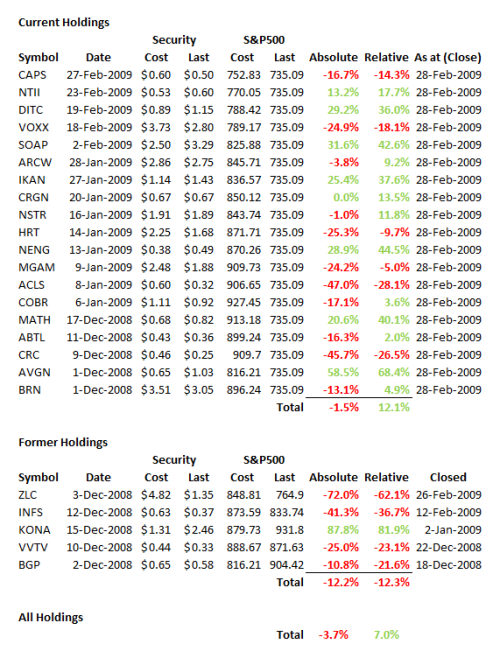
greenbackd-portfolio-performance-2009-q13The absolute total return across the current and former positions as at February 28, 2009 was -3.7%, which was +7.0% higher than the S&P500’s return over the same periods. A negative return for the first period is disappointing, but we are heartened by the fact that we outperformed the market by a small margin.

You may have noticed something odd about our presentation of performance. The S&P500 index declined by 18.0% in our first quarter (from 896.24 to 735.09). Our -3.7% performance might suggest an outperformance over the S&P500 index of +14.3%. We calculate our performance on a slightly different basis, recording the level of the S&P500 index on the day each stock is added to the portfolio and then comparing the performance of each stock against the index for the same holding period. The Total Relative performance, therefore, is the average performance of each stock against the performance of the S&P500 index for the same periods. As we discussed above, the holding period for Greenbackd’s positions has been too short to provide any meaningful information about the likely performance of the strategy over the long term (2 to 5 years), but we believe that the strategy should outperform the market by a small margin.

Greenbackd’s valuation methodology

We started Greenbackd in an effort to extend our understanding of asset-based valuation described by Benjamin Graham in the 1934 Edition of Security Analysis. Through some great discussion with our readers, many of whom work in the fund management industry as experienced analysts or even managing members of hedge funds, we have had the opportunity to refine our process. We believe that what started out as a pretty unsophisticated application of Graham’s liquidation value methodology has evolved into a more realistic analysis of the balance sheet and the relationship of certain disclosures in the financial statements to asset value. We’re not yet ready to send it into space, but we believe our analyses are now qualitatively more robust than when we started and that has manifest itself quantitatively in better performance (more on this below).

The two main differences between our early analyses and our more recent ones are as follows (these are truly cringe-worthy, but that’s why we undertook the exercise):

  1. We didn’t take account of the effect of off-balance sheet arrangements and contractual obligations. This caused us to enter into several positions we should have avoided, including BGP and VVTV.
  2. We were using overly optimistic estimates for the recovery rates of assets in liquidation. For example, we started using 50% of Gross PP&E. We now use 20% of Net PP&E. We now apply Graham’s formula as the base case and deviate only when we believe that Graham’s formulation doesn’t reflect reality.

The effect of these two broad errors in analysis was to create several “false positives,” which is to say that we added stocks to the portfolio that wouldn’t have passed our current, more rigorous standards. The performance of those “false positive” stocks has been almost uniformly negative, and dragged down the performance of the portfolio. As an exercise, we went back through all the positions we have opened since we started the site and applied our current criteria, which are more stringent and dour than our earlier standards. We found that we would not have opened positions in the following eight stocks:

  • BRN (-13.1% on an absolute basis and +4.9% on a relative basis)
  • BGP (-10.8% on an absolute basis and -21.6% on a relative basis)
  • COBR (-17.1% on an absolute basis and +3.6% on a relative basis)
  • HRT (-25.3% on an absolute basis and -9.7% on a relative basis)
  • KONA (+87.8% on an absolute basis and +81.9% on a relative basis)
  • MGAM (-24.2% on an absolute basis and -5.0% on a relative basis)
  • VVTV (-25.0% on an absolute basis and -23.1% on a relative basis)
  • ZLC (-72.0% on an absolute basis and -61.1% on a relative basis)

It seems we got lucky with KONA, but the performance of the balance of the stocks was wholly negative. The performance across all stocks listed above was -12.5% on an absolute basis and -3.9% on a relative basis. Excluding these eight stocks from our portfolio (i.e. treating the portfolio as if we had not entered into these positions) would have resulted in a slightly positive absolute return of +0.7% and a relative performance over the S&P500 of +12.5%. This is a compelling reason to apply the more dour and rigorous standards.

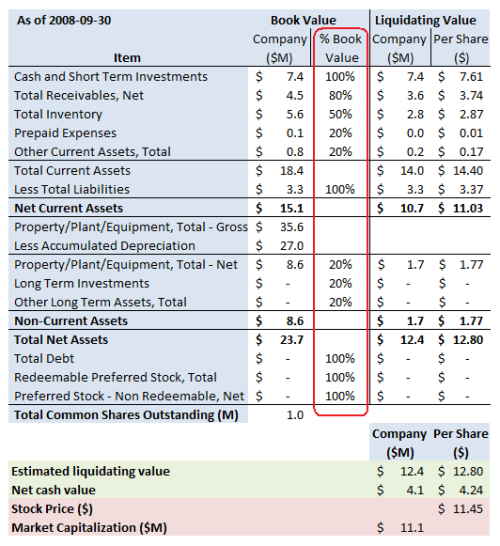
We like to think we’ve now learned out lesson and the more dour and rigorous standards are here to stay. Set out below is an example balance sheet summary (for Chicago Rivet & Machine Co. (AMEX:CVR)) showing our present base case discounts from book value (circled in red):
example-summary-2

Readers will note that these are the same base case discounts from book value suggested by Benjamin Graham in the 1934 Edition of Security Analysis, more fully described in our Valuing long-term and fixed assets post under the heading “Graham’s approach to valuing long-term and fixed assets.” Why we ever deviated from these standards in the first place is beyond us.

Update on the holdings in the Greenbackd Portfolio

Leading on from our discussion above, four of the stocks we picked using the initial, overly optimistic criteria no longer meet our more stringent standards but haven’t yet been removed from the portfolio. We’re going to take our medicine now and do just that. To make it clear, these stocks aren’t being removed because the value has deteriorated, but because we made a mistake adding them to the portfolio in the first place. As much as we’d like to treat these positions as void ab initio (“invalid from the beginning”), we’re not going to do that. We’ve made a full accounting of the impact they’ve had on the portfolio in the First quarter performance of the Greenbackd Portfolio section above, but we don’t want them affecting our future performance. The stocks to be removed from the Greenbackd Portfolio and their absolute and relative returns are as follows:

  • BRN (-13.1% on an absolute basis and +4.9% on a relative basis)
  • HRT (-25.3% on an absolute basis and -9.7% on a relative basis)
  • MGAM (-24.2% on an absolute basis and -5.0% on a relative basis)
  • COBR (-17.1% on an absolute basis and +3.6% on a relative basis)

We’ll provide a more full discussion of where we went wrong with these stocks at a later date, but suffice it to say for present purposes that all were errors from the second bullet point in the Greenbackd’s valuation methodology section above (i.e. overly optimistic estimates for the recovery rates of assets in liquidation).

There are fifteen stocks remaining in the Greenbackd Portfolio:

Eight of these positions (ABTL, ACLS, ARCW, CAPS, CRC, CRGN, NSTR, and VOXX) are trading at or below our nominal purchase price and initial valuations. The remaining seven positions (AVGN, DITC, IKAN, MATH, NENG, NTII, and SOAP) are trading above our intial purchase price but are still at varying discounts to our valuations. We’ll provide a more full update on these positions over the course of this week.

The future of Greenbackd.com

We are going to trial some small changes to the layout of the site over the next few weeks. We’ve already made the first change: the newest comments now appear at the top of the list. We’ll also be amalgamating some pages and adding some new ones, including a page dedicated to tracking the portfolio with links to the analyses. We’re also considering some options for generating income from the site. At the moment, Greenbackd is a labor of love. We try to create new content every week day, and to get the stock analyses up just after midnight Eastern Standard Time, so that they’re available before the markets open the following day. More than 80% of the stocks that are currently trading at a premium to the price at which we originally identified them (NTII, SOAP, IKAN, DITC, NENG, MATH and AVGN) traded for a period at a discount to the price at which we identified them. This means that there are plenty of opportunities to trade on our ideas (not that we suggest you do that). If you find the ideas here compelling and you get some value from them, you can support our efforts by making a donation via PayPal.

We look forward to bringing you the best undervalued asset situations we can dig up in the next quarter.
OrthoLogic Corporation (NASDAQ:CAPS) is a little unusual for us. While it trades below its net cash value and Biotechnology Value Fund (BVF) has disclosed a 13.42% holding, BVF’s holding is passive. At CAPS’s $0.60 close yesterday it has a market capitalization of $24.4M. We estimate the net cash value to be 80% higher at $1.08 per share. CAPS’s cash burn rate is quite high relative to its net cash position, so rapid steps need to be taken for this to be a profitable investment. We think that BVF is a good bet, so we’re adding CAPS to the Greenbackd Portfolio.

About CAPS

CAPS is a development stage biotechnology company focused on the development and commercialization of the synthetic peptides Chrysalin (TP508) and AZX100. Effective October 1, 2008, OrthoLogic Corp. is known and doing business as Capstone Therapeutics. The company’s investor relations website is here.

The value proposition

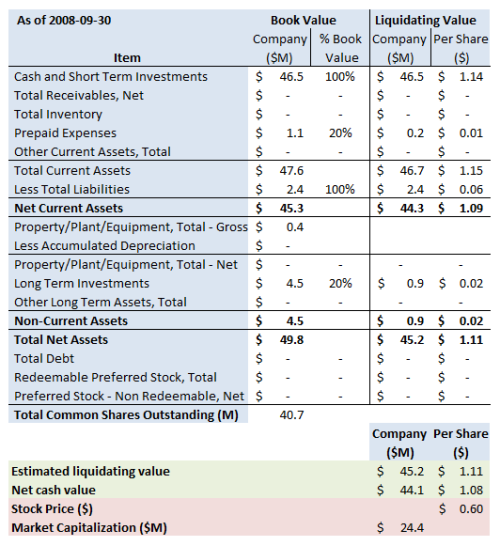
The summary of our estimate for the company’s liquidation value is set out below (the “Book Value” column shows the assets as they are carried in the financial statements, and the “Liquidating Value” column shows our estimate of the value of the assets in a liquidation):

caps-summary

Note that we have used the September 10Q. CAPS’s most recent filings indicate that cash is actually $48M (see slide 13), but we don’t know what the rest of the balance sheet looks like. The presentation also gives cash burn guidance this year of $14M to $16M.

The company also included the following in its 10Q, which seems to indicate a shift to cash preservation:

We announced that we have no immediate plans to re-enter clinical trials for Chrysalin-based product candidates and a strategic shift in our development approach to our Chrysalin Product Platform. We currently intend to pursue development partnering or licensing opportunities for our Chrysalin-based product candidates, a change from our previous development history of independently conducting human clinical trials necessary to advance our Chrysalin-based product candidates to market. We will continue to explore Chrysalin’s therapeutic value in tissues and diseases exhibiting endothelial dysfunction as well as the science behind and potential of Chrysalin. We will also continue research and development expenditures for further pre-clinical studies supporting multiple indications for AZX100 and plan to continue AZX100 dermal scarring human clinical trials.

Off-balance sheet arrangements and Contractual obligations

There is no discussion in the September 10Q about CAPS’s off-balance sheet arrangements or contractual obligations.

The catalyst

Given that BVF has filed a 13G notice, which indicates a passive investment, we’re not entirely sure what BVF has planned for CAPS. It’s possible that it is simply a passive holding. We’re reasonably comfortable following BVF into CAPS because of their efforts with Avigen Inc (NASDAQ:AVGN) and Neurobiological Technologies Inc (NASDAQ:NTII).

CAPS has been undertaking a stock repurchase program since March 5, 2008. At September 30, 2008, the company had repurchased 1.1.M shares of its common stock, at a total cost of $1.0M, and had allocated approximately a further $1.1M to fund possible future stock repurchases. We don’t know the status of the buy-back at this time.

Conclusion

At its $0.60 close yesterday, CAPS is trading at 55% of our estimate of its $1.08 per share net cash value. The risk for this investment – as it is for all of these types of investment – is that CAPS dissipates its cash before it or BVF can salvage that value. Management is taking steps to reduce its cash burn and repurchase undervalued stock, which is encouraging. Perhaps this is what BVF has seen, and the reason BVF hasn’t filed a 13D notice. We think that BVF is a good bet, so we’re adding CAPS to the Greenbackd Portfolio.

CAPS closed yesterday at $0.60.

The S&P500 Index closed yesterday at 752.83.

Hat tip to ef.

[Full Disclosure:  We do not have a holding in CAPS. This is neither a recommendation to buy or sell any securities. All information provided believed to be reliable and presented for information purposes only. Do your own research before investing in any security.]

Axcelis Technologies Inc (NASDAQ:ACLS) has announced that it has agreed to sell its 50% interest in SEN Corporation, its joint venture with Sumitomo Heavy Industries, Ltd. (SHI) to SHI for Y13 billion, or approximately $133 million, in cash. This is an outstanding achievement by ACLS management under difficult conditions. The sale will provide the liquidity necessary to meet the $85M due to the holders of the company’s 4.25% Convertible Senior Subordinated Notes, upon which ACLS defaulted in January.

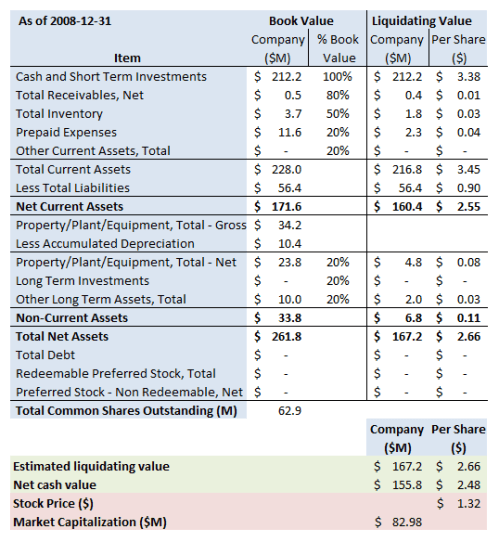
We started following ACLS on January 8 this year because it is an undervalued asset play with an activist investor, Sterling Capital Management, holding 10.7% of its outstanding stock. In our initial post we estimated ACLS’s liquidating value at $134.9M, or $1.31 per share. Assuming the sale is completed, we estimate ACLS’s liquidating value to be slightly higher at $147M or $1.43 per share, which is more than 300% higher than its close yesterday of $0.35.

The value proposition updated

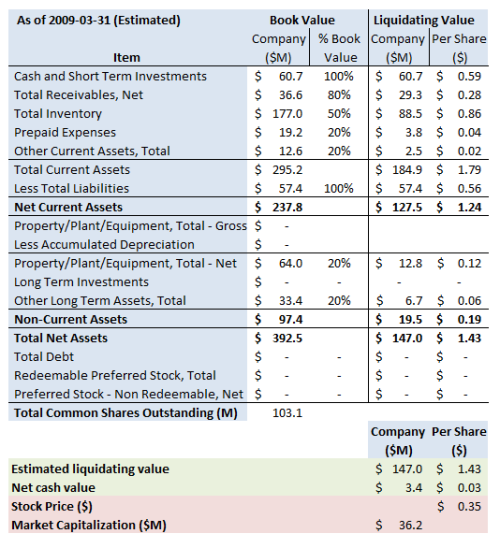
ACLS is generating substantial and increasing operating losses, reaching a $22.8M nadir for the September quarter (see the September 10Q here). We have adjusted the September 10Q balance sheet to account for the sale of the SEN JV and to back out several other payments and projected it forward to March (the “Book Value” column shows the assets as they are carried in the financial statements, and the “Liquidating Value” column shows our estimate of the value of the assets in a liquidation):

acls-summary-sen-sale1This summary balance sheet assumes that the $133M to be received in March 2009 from the sale of SEN is used to pay off the notes first (approximately $85M) with the remainder added to cash. We have backed out a further $15M in termination payments from cash. This summary balance sheet also assumes that ACLS burns an additional $22M in cash in the current quarter. The company is still making substantial operating losses that have widened over the last five quarters, so these amounts are likely to be substantial on an ongoing basis.
The press release

ACLS has not yet filed an 8K but the press release is as follows (via Tradingmarkets.com):

Axcelis Technologies, Inc. (Nasdaq:ACLS) today announced that it has entered into a Share Purchase Agreement in which Sumitomo Heavy Industries, Ltd. (“SHI”) will purchase Axcelis’ 50% interest in their joint venture, SEN Corporation, an SHI and Axcelis Company, (“SEN”), for Y13 billion, or approximately $133 million, in cash at current conversion rates. Axcelis and SHI each currently own 50% of SEN, a Japanese company that is licensed by Axcelis to manufacture and sell certain implant products in Japan.

It is anticipated that the transaction between Axcelis and SHI will be completed on March 31, 2009. Axcelis will use a portion of the proceeds from the sale of its SEN interests to meet its obligations under its 4.25% Convertible Senior Secured Subordinated Notes, which were due in January. Pending the closing, the trustee for the notes has agreed to stand down on litigation filed in connection with Axcelis’ default on the notes.

Mary Puma, Chairman and CEO of Axcelis, said: “This transaction serves the best interests of Axcelis shareholders as it enables us to fulfill our senior debt obligations and gives us greater financial flexibility during this difficult economic climate and semiconductor industry downturn. Axcelis will continue to fully focus its efforts on tight cash and cost controls and on developing and selling innovative products like our Optima implanters and Integra dry strip tools, both of which have received strong customer reviews. With these products, Axcelis believes that we can compete and gain market share once demand for semiconductor equipment returns.”

As part of the transaction, at the closing Axcelis and SEN will enter into cross licenses that will allow the two companies to continue to use certain patents and technical information owned by the other to make and sell ion implant systems on a worldwide, royalty-free, perpetual basis. Axcelis’ license to SEN would not include patents, licenses, or technical information developed by Axcelis for the Optima HD, Optima XE, or any non-implant products. The transaction will terminate all existing agreements among Axcelis, SHI and SEN relating to the SEN joint venture.

More information can be found in the Form 8-K that Axcelis will file with the Securities and Exchange Commission at http://www.sec.gov.

Hat tip to manny.

[Full Disclosure:  We have a holding in ACLS. This is neither a recommendation to buy or sell any securities. All information provided believed to be reliable and presented for information purposes only. Do your own research before investing in any security.]

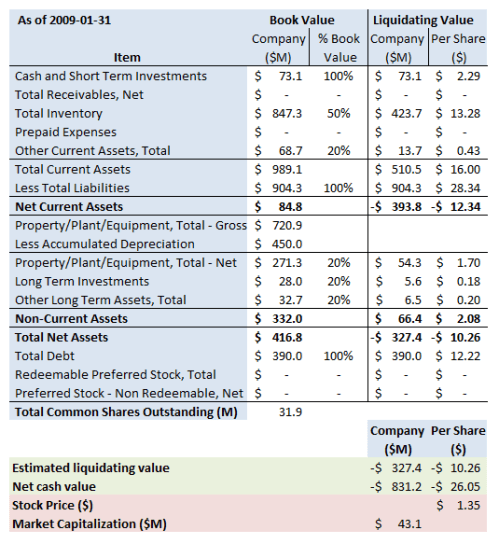
Trident Microsystems Inc (NASDAQ:TRID) has filed its results for the quarter ended December 31, 2008. While its earnings and operating cash flow have now turned negative, its liquidation value remains almost unchanged. In our original post we wrote that TRID is an undervalued net cash stock looking for a catalyst. We continue to think it’s a good candidate for an activist campaign for the following reasons:

  1. It’s large for a net cash stock: As its $1.32 close yesterday, the company has a market capitalization of $83M. That puts it into the strike zone for funds with around $100M under management.
  2. It’s deeply undervalued: We estimate its liquidation value is around $167M or $2.66 per share, which is more than 100% higher than its close yesterday.
  3. Its value is predominantly cash: TRID is trading at half net cash value of approximately $155M or $2.48 per share.
  4. Its stock is liquid enough: According to TRID’s Google Finance page, the average volume for the stock is more than 530,000 shares per day. It traded more than 427,000 yesterday. With 63M shares on issue, an investor seeking ~5% of TRID needs a few more than 3M shares, which should be readily achievable in a reasonably short period of time.
  5. Management holds a vanishingly small number of shares and are net sellers.

We confess that – aside from the litigation and regulatory investigations into TRID’s granting of stock options – we can’t see the problem with TRID. Please leave a comment if you can see what we are missing.

The value proposition updated

TRID continues to boast an embarrassment of riches on its balance sheet (the “Book Value” column shows the assets as they are carried in the financial statements, and the “Liquidating Value” column shows our estimate of the value of the assets in a liquidation):

trid-summary-2009-12-31While TRID has burned through $18M of cash since our last post, it has reduced its liabilities by around the same amount, so its liquidation value remains unchanged. The slight reduction in liquidation value is a direct result of the additional stock on issue, which is the really TRID’s whole story: management takes the value that should belong to the shareholders.
Off-balance sheet arrangements and Contractual obligations

According to the 10Q, TRID has no off-balance sheet arrangements and its contractual obligations are relatively modest $11.6M, which includes total operating lease payments of $2.5M and total purchase obligations of $9.1M. There is also a long-term income tax payable of $20.1M but TRID is “unable to make a reasonably reliable estimate of the timing of payments in individual years beyond twelve months due to uncertainties in the timing of tax audit outcomes.”

Contingencies

The only real area of concern for us is the litigation and regulatory investigations into TRID’s granting of stock options. The following is extracted from the 10Q:

Shareholder Derivative Litigation

Trident has been named as a nominal defendant in several purported shareholder derivative lawsuits concerning the granting of stock options. The federal court cases have been consolidated as In re Trident Microsystems Inc. Derivative Litigation, Master File No. C-06-3440-JF. A case also has been filed in State court, Limke v. Lin et al., No. 1:07-CV-080390. Plaintiffs in all cases allege that certain of our current or former officers and directors caused it to grant options at less than fair market value, contrary to our public statements (including our financial statements); and that as a result those officers and directors are liable to us. No particular amount of damages has been alleged, and by the nature of the lawsuit no damages will be alleged against us. The Board of Directors has appointed a Special Litigation Committee, or SLC, composed solely of independent directors, to review and manage any claims that we may have relating to the stock option grant practices investigated by the SLC. The scope of the SLC’s authority includes the claims asserted in the derivative actions. In federal court, Trident has moved to stay the case pending the assessment by the SLC that was formed to consider nominal plaintiffs’ claims. In State court, Trident moved to stay the case in deference to the federal lawsuit, and the parties have agreed, with the Court’s approval, to take that motion off of the Court’s calendar to await the assessment of the SLC. We cannot predict whether these actions are likely to result in any material recovery by or expense to, Trident. We expect to continue to incur legal fees in responding to these lawsuits, including expenses for the reimbursement of legal fees of present and former officers and directors under indemnification obligations.

Regulatory Actions

The DOJ is currently conducting an investigation of us in connection with our investigation into our stock option grant practices and related issues, and we are subject to a subpoena from the DOJ. We are also subject to a formal investigation by the SEC on the same issues. We have been cooperating with, and continue to cooperate with, inquiries from the SEC and DOJ investigations. In addition, we have received an inquiry from the Internal Revenue Service to which we have responded. We are unable to predict what consequences, if any, that an investigation by any regulatory agency may have on it. Any regulatory investigation could result in our business being adversely impacted. If a regulatory agency were to commence civil or criminal action against us, it is possible that we could be required to pay significant penalties and/or fines and could become subject to administrative or court orders, and could result in civil or criminal sanctions against certain of our former officers, directors and/or employees and might result in such sanctions against us and/or our current officers, directors and/or employees. Any regulatory action could result in the filing of additional restatements of our prior financial statements or require that we take other actions. If we are subject to an adverse finding resulting from the SEC and DOJ investigations, we could be required to pay damages or penalties or have other remedies imposed upon us. The period of time necessary to resolve the investigation by the DOJ and the investigation from the SEC is uncertain, and these matters could require significant management and financial resources which could otherwise be devoted to the operation of our business. In addition, our 401(k) plan and its administration were audited by the Department of Labor but no further action was noted.

Indemnification Obligations

We indemnify, as permitted under Delaware law and in accordance with our Bylaws, our officers, directors and members of our senior management for certain events or occurrences, subject to certain limits, while they were serving at our request in such capacity. In this regard, we have received, or expect to receive, requests for indemnification by certain current and former officers, directors and employees in connection with our investigation of our historical stock option grant practices and related issues, and the related governmental inquiries and shareholder derivative litigation. The maximum amount of potential future indemnification is unknown and potentially unlimited; therefore, it cannot be estimated. We have directors’ and officers’ liability insurance policies that may enable us to recover a portion of such future indemnification claims paid, subject to coverage limitations of the policies, and plan to make claim for reimbursement from our insurers of any potentially covered future indemnification payments.

The catalyst?

Still none. No investors have disclosed an activist position in this stock and management still seem intent on helping themselves to big portions of options and restricted stock. Rather than pay dividends to long-suffering stockholders, they’ll retain the earnings to pump up the stock price, which helps with their options. The company could comfortably pay a special dividend of around $2.75 per share and still leave $40M of cash in the bank.

Conclusion

TRID’s board and senior management should be embarrassed that TRID is a perennial net net stock and now trades consistently below its net cash value. The market is sending a clear message when it values stock at less than net cash value. That they have the effrontery to gift themselves such huge helpings of stock and options in the face of such a message is astonishing. Even though it’s deeply undervalued, without some external pressure to allign management’s interests with its stockholders, TRID will remain that way. For the reasons we outlined above, TRID seems to us to be a prime candidate for an activist campaign. We can’t figure out why no activists are interested in this stock. What are we missing? Are we underestimating the impact of the litigation and regulatory investigations into TRID’s granting of stock options?

TRID closed yesterday at $1.32.

The S&P500 Index closed yesterday at 764.90.

[Full Disclosure:  We do not have a holding in TRID. This is neither a recommendation to buy or sell any securities. All information provided believed to be reliable and presented for information purposes only. Do your own research before investing in any security.]

The Zanett Group has increased its stake in MATH to 6.58% according to its most recent Schedule 13D amendment.

We’ve been following MATH since December last year when it was trading at $0.68. We initiated the position because MATH is a net cash stock with two substantial stockholders lobbying management to liquidate. The stock is up 19% to $0.87 yesterday, giving it a market capitalization of $8.0M. We estimate MATH’s liquidation value still to be more than 80% higher at $14.4M or $1.57 per share. That value is predominantly cash and short term investments and doesn’t take into account any further value that the sale of the FPOA technology and intellectual property may yield. The two activist investors, Mr. Zachary McAdoo of The Zanett Group and Mr. Salvatore Muoio of S. Muoio & Co., have been urging MATH’s board to consider liquidation rather than a merger. MATH’s board seems to agree, twice rejecting unsolicited merger proposals, suspending the company’s operations and exploring “strategic alternatives, which could include merger, acquisition, increasing operations in another structure or liquidation.”

The Zanett Group’s most recent share purchases were undertaken between January 22 and February 19 this year at prices between $0.81 and $0.90.

[Full Disclosure: We do not have a holding in MATH. This is neither a recommendation to buy or sell any securities. All information provided believed to be reliable and presented for information purposes only.]

Zale Corporation (NYSE:ZLC) has released its results for the quarter to January 31, 2009. After reviewing the results, we have significantly reduced our original estimate for the company’s liquidating value since we initiated the position at $4.82 on December 3, 2008. Our initial analysis of ZLC’s balance sheet was overly optimistic. We’ve now applied more dour assumptions to ZLC’s results and, as a result, we’ve decided to close the position.

We started following ZLC believing it to be an undervalued asset situation. With former Chairman of the SEC turned activist investor, Richard Breeden of Breeden Capital Management LLC, holding two seats on the board, we thought it looked like a reasonable opportunity. At its $4.82 closing price on December 3, 2008 the company had a market capitalization of $154M. We estimated ZLC’s liquidation value at that time to be around $243M or $7.63 per share. After reviewing ZLC’s Q2 financial results and applying more dour assumptions for the value of the assets in liquidation, we now believe there is a risk that ZLC has no value in liquidation.

The value proposition updated

Set out below is our summary analysis of the balance sheet (the “Book Value” column shows the assets as they are carried in the financial statements, and the “Liquidating Value” column shows our estimate of the value of the assets in a liquidation):

zlc-summary-2009-q2Conclusion

At its $1.35 close yesterday, ZLC has a market capitalization of just $43M. When we started coverage in December last year, ZLC traded at $4.82 and had a market capitalization of $154M. Our ZLC position is down a punishing 72% on an absolute basis. The S&P 500 Index closed at 848.81 on December 3, 2008 and closed yesterday at 764.90. That’s a return of -9.9% for the index and means we’re off 62.1% on a relative basis, which is still very disappointing. The simple fact is that this was an unforced error. Our original analysis of ZLC was overly optimistic. We’ve been applying more dour assumptions about the recovery values of assets in liquidation to our most recent analyses. If we had been applying the more dour assumptions at the time we made our original assessment of ZLC, we would not have initiated the position.

[Full Disclosure:  We do not have a holding in ZLC. This is neither a recommendation to buy or sell any securities. All information provided believed to be reliable and presented for information purposes only. Do your own research before investing in any security.]

Biotechnology Value Fund (BVF) has extended its tender offer for the outstanding shares of Avigen Inc (Nasdaq: AVGN).

We’ve been following AVGN (see archived posts here) because it’s a net cash stock (i.e. it’s trading at less than the value of its cash after deducting all liabilities) and specialist biotechnology activist fund BVF has been pushing it to liquidate and return its cash to shareholders. MediciNova Inc (NASDAQ:MNOV) has made an offer for AVGN that we think represents a clever way for AVGN’s stockholders to receive cash equivalent to that which they would receive in a liquidation (less $7M to be paid to MNOV) with the possibility for “an extraordinary, uncapped return” if MNOV is successful post-merger. We estimate AVGN’s cash at around $1.22 per share (BVF estimates $1.20 per share), which is around 20% higher than AVGN’s $1.01 close yesterday.

The full text of BVF’s press release is reproduced below:

BVF Acquisition LLC (the “Purchaser”), an affiliate of Biotechnology Value Fund L.P. (“BVF”), which has commenced a cash tender offer to purchase all of the outstanding shares of Avigen, Inc. (Nasdaq: AVGN) (“Avigen”) for $1.00 per share, announced today that it has extended the expiration date for the tender offer to 6:00 p.m., New York City time, on Friday, March 6, 2009. The tender offer was previously set to expire at 12:00 midnight, New York City time, on Monday, February 23, 2009. As of the close of business on February 20, 2009, a total of 1,132,192 shares had been tendered in and not withdrawn from the offer, which together with the shares owned by BVF and affiliates, represents approximately 33% of the total shares outstanding of Avigen.

[Full Disclosure: We have a holding in AVGN. This is neither a recommendation to buy or sell any securities. All information provided believed to be reliable and presented for information purposes only.]