Feeds:
Posts
Comments

Business Week has an article, Fighting takeovers by playing the debt card, describing Amylin Pharmaceuticals Inc.’s (NASDAQ:AMLN) attempts to fend off Carl Icahn through the use of a “Poison Put.” A poison put is a change-of-control debt covenant the effect of which is to require the borrower to pay back an outstanding loan if investors buy a sufficiently large stake in the company or elect a slate of directors. In this case, AMLN says it would be forced to pay back a $125M loan if Icahn’s slate gets control of its board, which could in turn cause it to default on up to $900M in debt. That makes AMLN an unpalatable activist target.

Business Week says the covenant is the “choice du jour” for an increasing number of companies seeking to avoid the attention of activists and raiders:

Many companies have such change of control covenants in their bond or loan agreements, among them J.C. Penney (JCP), Kroger (KR), Ingersoll-Rand (IR), and Dell (DELL). That’s not to say they would use them to ward off an Icahn. Nor is it clear how many companies are using these covenants to do so. But shareholder activists have little doubt that they have become a takeover defense. “[These change of control provisions] are designed to deter a proxy fight,” says Chris Young, director of mergers and acquisitions research for the shareholder advisory firm RiskMetrics Group (RMG).

Change in control provisions are nothing new. In fact they are a standard condition in most loan agreements:

Change of control provisions first began appearing in 1980 when corporate raiders started taking over companies and loading them up with debt. Concerned that these companies would be unable to pay back their loans, lenders insisted on covenants requiring them to repay their original lenders. These provisions became fashionable again during the private equity boom of recent years. Now, with credit tight, they have become a potent deterrent to corporate raiders leery of being forced to repay a company’s debt and then refinance the loans at higher rates.

What is new, however, is companies actively seeking the inclusion of such a covenant as a device to fend off a suitor, as Lions Gate Entertainment Corp. (USA) (NYSE:LGF) and Exelon Corporation (NYSE:EXC) seemed to do recently:

When JPMorgan Chase (JPM) extended Lions Gate’s revolving line of credit last year, the terms included a provision that triggers instant repayment if an investor buys more than 20% of the company’s stock. Since then Icahn has acquired 14% of Lions Gate. In late March, Lions Gate “strongly urged” investors-while taking no formal position-to scrutinize an offer by Icahn to buy $316 million in debt. (He could convert it into stock and boost his ownership stake.) In the same letter, Lions Gate, without mentioning Icahn, said it could be forced to repay both its bank debt and notes.

In another case, the giant electric utility Exelon (EXC) wants to buy rival NRG Energy (NRG) for $5 billion and is waging a proxy battle to elect nine members to NRG’s board. In a letter to shareholders, NRG warned that such an outcome would trigger “an acceleration” of its $8 billion of debt. Exelon General Counsel William A. Von Hoene Jr. counters that NRG is “using the debt issue as a threat” to scare off NRG’s shareholders from considering its bid.

AMLN shareholders aren’t taking it lying down. The San Antonio Fire & Police Pension Fund, an AMLN investor, has sued the company for agreeing to the poison put about the time takeover speculation began in 2007. For its part, AMLN says it has since tried unsuccessfully to get bondholders to waive a provision blocking outsiders from taking over the board and has asked its bankers for a similar waiver. Steven M. Davidoff, The Deal Professor, has a superb analysis of the issues in his NYTimes.com DealBook column, Icahn, Amylin and the New Nuances of Activist Investing. Says Davidoff:

The pension fund’s claim is mainly that these poison put provisions are void. In support of this claim, the plaintiff appears to be arguing that the provision violates the Unocal standard in Delaware, which requires that director action in response to a threat to the corporation not be coercive vis-à-vis stockholders.

In addition, the plaintiff claims that the poison put provisions violate Section 141(a) of the Delaware General Corporation Law which requires that the business and affairs of a Delaware corporation be run by the board. Here, the plaintiff claims that the poison put provisions hinder the board’s exercise of its fiduciary duties to ensure a free and fair election, since the directors cannot approve all nominees for election.

The more problematic issue is with the language in the credit agreement for the term loan. … [If] in a two-year period the board changes control due to a proxy contest, the provision is triggered. The actions of Mr. Icahn and Eastbourne, if successful, would do the trick.

So, we are left with the issue of whether this provision violates Unocal. The answer is likely no. Delaware has broadly interpreted the doctrine, and here there is an opening for a change of control to occur – it will just take two years. This conceivably could be only two proxy contests, and therefore I suspect will likely not be found coercive. After all if Delaware tolerates staggered boards, why wouldn’t it tolerate a provision which has a similar effect?

Shareholder activist Nell Minow says companies shouldn’t use the poison put if their object is to disenfranchise stockholders:

These are shareholder rights that can’t be negotiated away by someone else.

We agree. Unfortunately, as Davidoff points out, lenders do have legitimate reasons for asking for such a provisions: they want to know who they are dealing with. This means that lenders will keep proposing poison puts and boards will “avoid resisting” them because they deter shareholder activism.
Chromcraft Revington (AMEX:CRC) has filed its 10K for the period ended December 31, 2008.

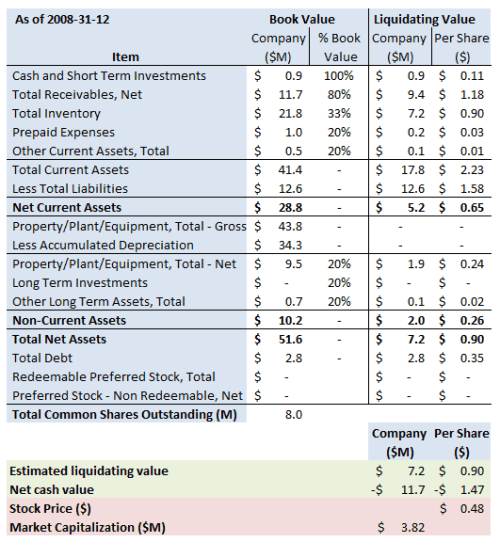
We initiated the position in CRC in December last year (see the post archive here) because it was trading at a substantial discount to its liquidation value and a substantial stockholder had called for its sale or orderly liquidation. Aldebaran Capital, LLC, a 7.7% stockholder, sent a letter to the company on October 29 last year arguing that if CRC is unable to “promptly stabilize its business and rationalize its cost structure” it should be sold or liquidated. Neither of those two events has occurred and the company now appears to be trading at a premium to its value in liquidation. We initially estimated the company’s liquidation value at around $15M. We’ve now reduced our valuation to $2.8M or $0.35 per share. The problem we identified when we opened the position persists: The company is in a liquidity crisis and risks entering bankruptcy. For these reasons, we’re exiting.

We opened the CRC position at $0.46 and it closed yesterday at $0.48, which means we’re up 4.8% on an absolute basis. The S&P500 Index was at 909.7 when we opened the position and closed yesterday at 832.39, which means we’re up 12.8% on a relative basis.

The value proposition updated

The company appears to have some value on its balance sheet, but much of that value is illusory for the reasons we’ll outline below (the “Book Value” column shows the assets as they are carried in the financial statements, and the “Liquidating Value” column shows our estimate of the value of the assets in a liquidation):

crc-summary-2008-12-31The $7.2M in liquidation value above doesn’t take into account CRC’s non-cancelable operating leases for office space, showroom facilities and transportation and other equipment. The future minimum lease payments under these leases for the years ending December 31, 2009, 2010, 2011, 2012 and 2013 are $1.9M, $1.1M, $0.8M, $0.6M, and $0, respectively, or $4.4M in total. Deducting the $4.4M from the $7.2M in balance sheet value leaves just $2.8M or $0.35 per share.
A slightly disappointing outcome, but we’re happy to take a small gain given the reduction in value.

[Full Disclosure:  We do not have a holding in CRC. This is neither a recommendation to buy or sell any securities. All information provided believed to be reliable and presented for information purposes only. Do your own research before investing in any security.]

In Icahn Takes On Kerkorian in Big Las Vegas Showdown (subscription required), The Wall Street Journal reports that Carl Icahn has built a large position in the bonds of MGM MIRAGE (NYSE:MGM) and is pushing it to restructure in bankruptcy court. MGM is struggling to service approximately $14B in debt and fund payments on its $8.6B City Center project in Las Vegas. MGM is controlled by billionaire Kirk Kerkorian, who holds about 53% of MGM valued at approximately $900M (down from ~$15B in late 2007). Kerkorian’s stake would be wiped out in a bankruptcy filing, which gives secured debtholders priority over stockholders in relation to assets.

It’s an interesting play for Icahn. The WSJ reports that he and Oaktree Capital Management hold a “little less than $500M” face value of MGM bonds out of approximately $7B of the non-bank debt. According to the WSJ, Icahn has little leverage now, but that could change as the bonds fall due:

When MGM Mirage bonds come due in July and October, the bondholders could force a filing if the company is unable to make those payments. Or, if MGM Mirage were to try to tender an offer to repurchase its bonds to lighten its debt load, they could also block that move. “Right now, it is just, sit back and wait,” said a person familiar with the matter. “The company is in a jam.”

The WSJ reports that the company has some unusual debt:

Its $7 billion in bank debt isn’t secured by the kind of assets typically used as collateral, meaning banks can’t foreclose on any of it (sic) properties. Those properties are still generating cash and stand to see strong profits if the economy improves.

MGM’s bank lenders have two reasons to help it avoid bankruptcy: 1. A bankruptcy filing would put the banks “on par with bondholders, leaving the two groups to battle over the assets,” and 2. MGM can still offer its properties as collateral to the banks and so improve their position relative to the bondholders.

The WSJ says that Icahn and Oaktree aren’t working together and their strategies aren’t yet clear:

They could be angling for equity in the company inside or outside bankruptcy. They could also be after some of MGM Mirage’s storied casino assets or simply want to ride out a bankruptcy with the bet that the bonds will recover far more than it cost to purchase them.

If MGM Mirage tried to buy up those bonds, then Mr. Icahn and Oaktree could block such steps.

But the move could blow up on Mr. Icahn and Oaktree if the company is able to avoid bankruptcy or it cuts deals with bank lenders and provides them liens on MGM Mirage’s assets, which could depress the recovery rates for MGM Mirage bonds.

It’s an interesting situation, and one we’re going to watch closely. Hunter over at Distressed Debt Investing says “MGM bondholders are licking their chops about a possible debt for equity exchange” and is looking to build a MGM bond valuation model. We’ll let you know how he goes.

In his blog, The Icahn Report, Carl Icahn argues in a new post, It’s Up to the Shareholders, Not the Government, to Demand Change at a Company, that “shareholders have been complicit in allowing management excesses and incompetence by not taking a stand.” Nell Minnow, editor and co-founder of the Corporate Library, agrees:

Shareholders have reelected these directors, have approved these pay plans and have been enablers for the addictive behavior of the corporate community.

Icahn asks, “Why should investors tolerate poor performance? Why should taxpayers?”

I have shaken up boards and managements at many companies in which I have invested, including Blockbuster, ImClone, Stratosphere, Philips Services, Federal-Mogul and many others. Generally, but not always, the net result has been very positive for the company and the shareholders. It is important to get new blood, new strategies and new ideas into underperforming companies.

Icahn laments the fact that it took a “force the size of the U.S. government” to change the board and management at General Motors Corporation (NYSE:GM):

In effect, the government has become the world’s biggest activist investor, making the same kinds of demands that any activist or creditor should rightfully make in return for its investment.

He concludes that he hopes that the “global economic meltdown” results in shareholders demanding more of their companies and not leaving it to the government.

Soapstone Networks Inc (NASDAQ:SOAP) has announced that it is reducing its headcount by approximately 40% “to reduce expenses and conserve cash in the current economic environment without diminishing the overall value of the Company.”

We been following SOAP (see our post archive here) because it is trading well below its net cash value with an activist investor, Mithras Capital, disclosing an 8.7% holding in October last year. The stock is up 40.0% from $2.50 when we initiated our position to close yesterday at $3.50, giving SOAP a market capitalization of $52.0M. We estimate the company’s net cash value to be $86.1M or $5.59 per share. We continue to believe that SOAP is a very good opportunity. The company’s ongoing business is small in comparison to its net cash position, so it shouldn’t dissipate its cash any time soon. It has no off-balance sheet arrangements, little in the way of ongoing contractual obligations and no material litigation, so the cash position seems reasonably certain. The company’s engagement of an investment bank to explore strategic alternatives is a promising step in the right direction. Of concern is the continued issuance of stock and options at a huge discount to liquidation value. The sooner Mithras Capital gets control of this situation the better.

The press release from SOAP is as follows:

Billerica, MA, April 14, 2009 – Soapstone Networks Inc. (NASDAQ: SOAP) today announced that it has undertaken an initiative to further reduce its total headcount by approximately 40%, in order to reduce expenses and conserve cash in the current economic environment without diminishing the overall value of the Company.

The Company expects to incur charges for severance and related costs of approximately $0.5 million in the second quarter of fiscal 2009 in connection with this action and anticipates overall incremental cost savings of approximately $3.0 million during 2009 as a result of these reductions, in addition to the $5.0 million in cost savings anticipated to result from the reduction in force previously announced February 12, 2009.

“We have taken these additional steps as we continue to aggressively explore strategic alternatives with the help of our financial advisor, Morgan Stanley & Co. Incorporated,” said Bill Leighton, Soapstone’s CEO. “We believe that this is a level at which we can continue with our PNC development and sales effort into the Carrier Ethernet market, while conserving a significant amount of cash.”

Hat tip to Double F.

[Full Disclosure:  We have a holding in SOAP. This is neither a recommendation to buy or sell any securities. All information provided believed to be reliable and presented for information purposes only. Do your own research before investing in any security.]

You may have noticed that the frequency with which we post new ideas on this site has slowed somewhat over the last month or so. Our earlier ideas are generally up substantially, but that’s nothing to crow about given that the market as a whole, after falling 56.8% from its peak, is up 24.4% from its trough. Anyone who thinks that the bounce means that the current bear market is over would do well to study the behavior of bear markets past (quite aside from simply looking at the plethora of data about the economy in general, the cyclical nature of long-run corporate earnings and price-earnings multiples over the same cycle). They might find it a sobering experience.

CalculatedRisk has an ongoing series of graphs from Doug Short showing how the current bear market compares to three other bear markets: the Dow Crash of 1929 (1929-1932), the Oil Crisis (1973-1974) and the Tech Wreck (2000-2002) (click for a larger version from dshort.com via CalculatedRisk):

four-bad-bears

The current bear market has been deeper and faster than either the Oil Crisis or the Tech Crash, but it really pales into insignificance beside the Dow Crash of 1929 (maybe not insignificance, but you get the picture. If this was the Dow Crash of 1929 we’d have another third to go). We’re not sure what one can deduce from the graphs, other than several big (>20-30%) rallies in the middle of a bad bear market is nothing unusual and there’s no obvious price behavior that heralds the end of a bear market. We think it’s worth keeping in mind.

In a post last week, Tracking our portfolio performance with Tickerspy, we mentioned that we were using Tickerspy to track our portfolio. We said that we like Tickerspy because it tracks the performance of each stock in the portfolio and the portfolio performance against the S&P500 and automatically updates it all on a daily basis. We wrote in the post, “It’s almost there, but Tickerspy is not entirely satisfactory. Ideally, we’d like a widget for the site that does all of this and doesn’t require our readers to open an account.” In a world of faceless bureaucracies, it’s rare to find a business that’s responsive to the needs of its customers, so we thought we’d mention the email that we’ve received from C. Max Magee at Tickerspy:

Hi,

I helped create and now run tickerspy, and I saw from a recent post at greenbackd that you are trying out tickerspy for tracking your portfolio.

You are probably aware of this, but your readers who aren’t registered with tickerspy will be able to see everything on your tickerspy portfolio page except the graph and the similar portfolios. This means that, even when not logged in, they’ll be able to see the daily, one-month, and all-time actual returns and returns relative to the S&P 500. So, at the very least, the numbers will be available to your readers even if they haven’t registered with tickerspy. (Of course, there are lots of benefits to registering for free at tickerspy. They can create their own portfolios, more easily track the greenbackd portfolio moves, etc.)

We do like the idea of an embeddable portfolio graph widget and it’s something we’ve been exploring. We’ll keep you posted on our progress there, and please let us know if there are any other tools that we might be able to offer that might be useful to you at greenbackd or just as an investor.

Best,

Max

Thanks, Max. Tickerspy has gone up immeasurably in our estimation. We look forward to seeing the “embeddable portfolio graph widget” and we’ll continue to support you as long as you continue to treat your customers this well.

The Official Activist Investing Blog has published its list of activist investments for March (links are to the relevant post archive for our open positions):

Ticker Company Investor
ACTL Actel Corp Ramius Capital
AGYS Agilysys Inc Ramius Capital
AMLN Amylin Pharmaceuticals Eastbourne Capital
ASPM Aspect Medical Systems First Manhattan Co
ASPM Aspect Medical Systems Coghill Capital
AVCA Advocat Inc. Bristol Investment Fund
AVGN Avigen Inc Biotechnology Value Fund
BARI Bancorp Rhode Island Financial Edge Fund
BASI Bioanalytical Systems Thomas Harenburg
BBI Blockbuster Inc. Mark Wattles
BBW Build-A-Bear Workshop Crescendo Capital
BNV Beverly National Corp Lawrence Seidman
CAMD California Micro Devices Corp Dialectic Capital Management
CEE Central Europe & Russia Fund City of London Investment Group
CHIC Charlotte Russe Holding Inc KarpReilly Capital Management
CITZ CFS Bancorp Inc Financial Edge Fund
CLCT Collectors Universe Shamrock Activist Value Fund
CLHI.PK CLST Holdings Red Oak Partners
CRGN Curagen Corp DellaCamera Capital
CTO Consolidated Tomoka Land Co Wintergreen Advisers
CYBI Cybex International Discovery Partners
DSCM Drugstore.com Discovery Partners
DVD Dover Motorsports, Inc. Gamco Investors
FACE Physicians Formula Holdings, Inc Mill Road Capital
FMMH.OB Fremont Michigan Insurance Corp Harry Long
FSCI Fisher Communications Gamco Investors
GET Gaylord Entertainment GAMCO
GET Gaylord Entertainment TRT Holdings
GMXR GMX Resources Centennial Energy Partners
HWK Hawk Corp Gamco Investors
IPAS iPass Inc Foxhill Opportunity Master Fund
JAX J. Alexanders Corp Mill Road Capital
KFS Kingsway Financial Services Oakmont Capital
KONA Kona Grill Mill Road Capital
LCAV LCA Vision Inc Stephen Joffe
LGF Lions Gate Entertainment Carl Icahn
LNBB LNB Bancorp Richard Osborne
LSR Life Sciences Research Andrew Baker
MCGC MCG Capital Springbok Capital
MCRL Micrel Inc Obrem Capital
MDS Midas Inc. Silverstone Capital
MHGC Morgans Hotel Group Co Edward Scheetz
MIM MI Developments Hotchkis & Wiley Capital
MXF The Mexico Fund Inc. City of London Investment Group
MYE Myers Industries GAMCO Investors
NLCI Nobel Learning Communities Blesbok Inc
NOX Neuberger Berman Income Opportunity Fund Western Investment
NTN NTN Buzztime Trinad Capital
NUF Nuveen Florida Quality Income Municipal Fund Western Investment
PHH PHH Corp Pennant Capital
PNNW Pennichuck Corp Gamco Investors
PPCO Penwest Pharmaceuticals Tang Capital; Perceptive Life Sciences
PXD Pioneer Natural Resources Southeastern Asset Management
RDC Rowan Companies Steel Partners
RHDC.PK RH Donnelley Dodsville Investments
RPT Ramco-Gershenson Properties Trust Equity One
RUBO Rubios Restaurant Alex Meruelo
SCLN SciClone Pharmaceuticals Sigma Tau Financial
SLRY Salary.com Raging Capital Management
SRLS Seracare Life Sciences Ltova Holdings
SSE Southern Connecticut Bancorp Inc Lawrence Seidman
SUAI Specialty Underwriters Alliance Hallmark Financial Services
SUG Southern Union Co Sandell Asset Management
TDS Telephone & Data Systems Inc. Gamco Investors
TGT Target Corp Pershing Square Capital
TMI TM Entertainment & Media Bulldog Investors
TRID Trident Microsystems Inc. Spencer Capital
TRMA Trico Marine Kistefos AS
VSNT Versant Corp Discovery Capital
WBSN Websense Inc Shamrock Actvivist Value fund
WOC Wilshire Enterprises Pennsylvania Avenue Funds
WOC Wilshire Enterprises Bulldog Investors

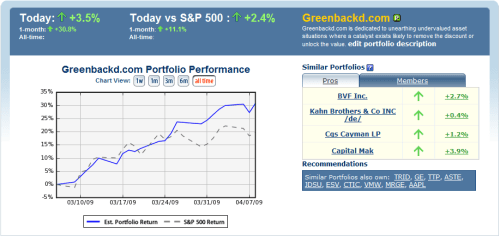
We’ve been tracking our performance using Tickerspy. You can see our up-to-date portfolio and performance here (You’ll need to set up an account with Tickerspy, which is free). We’re providing the link to the Tickerspy account so that you don’t need to wait for our quarterly report to see how the Greenbackd Portfolio is performing. For those who don’t want to set up a Tickerspy account, here’s a screen grab showing our performance since we opened our account on March 6, 2009 through April 8, 2009 (The usual caveat applies: one month is too short a period of time to determine whether Greenbackd’s strategy is working.):

tickerspy

We’re using Tickerspy because it tracks the performance of each stock in the portfolio and the portfolio performance against the S&P500 and automatically updates it all on a daily basis. It’s almost there, but Tickerspy is not entirely satisfactory. Ideally, we’d like a widget for the site that does all of this and doesn’t require our readers to open an account. We haven’t found anything like that yet. Does anyone have any suggestions for a service like this? If so, please drop us a line at greenbackd [at] gmail [dot] com or leave a comment below.

Hedge Fund Solutions, which produces The Official Activist Investing Blog, recently announced the launch of a new investment research product, Catalyst Investment Research, which is “dedicated to uncovering undervalued publicly traded companies that could have the potential to generate outsized returns due to an activist investor’s involvement.”

Catalyst Investment Research is a collaboration between Damien J. Park of Hedge Fund Solutions and The Official Activist Investing Blog, and Jonathan Heller, CFA, who writes Cheap Stocks, which was one of the inspirations for this site.

Download a complimentary copy (.pdf) of the recently published Catalyst Investment Research analysis for Consolidated-Tomoka Land Co (AMEX:CTO).